

ASTM E2254-24
(Test Method)Standard Test Method for Storage Modulus Calibration of Dynamic Mechanical Analyzers
General Information
- Abstract
SIGNIFICANCE AND USE
5.1 This test method calibrates or demonstrates conformity of a dynamic mechanical analyzer at an isothermal temperature within the range of –100 °C to 300 °C.
5.2 Dynamic mechanical analysis experiments often use temperature ramps. This method does not address the effect of that change in temperature on the storage modulus.
5.3 A calibration factor may be required to obtain corrected storage modulus values.
5.4 This method may be used in research and development, specification acceptance, and quality control or assurance.
SCOPE
1.1 This test method describes the calibration or performance confirmation for the storage modulus scale of a commercial or custom built dynamic mechanical analyzer (DMA) over the temperature range of –100 °C to 300 °C using reference materials in the range of 1 GPa to 200 GPa.
1.2 The values stated in SI units are to be regarded as standard. No other units of measurement are included in this standard.
1.3 This standard does not purport to address all of the safety concerns, if any, associated with its use. It is the responsibility of the user of this standard to establish appropriate safety, health, and environmental practices and determine the applicability of regulatory limitations prior to use.
1.4 This international standard was developed in accordance with internationally recognized principles on standardization established in the Decision on Principles for the Development of International Standards, Guides and Recommendations issued by the World Trade Organization Technical Barriers to Trade (TBT) Committee.
- Status
- Published
- Publication Date
- 14-Mar-2024
- Technical Committee
- E37 - Thermal Measurements
- Drafting Committee
- E37.10 - Fundamental, Statistical and Mechanical Properties
Buy Documents

ASTM E2254-24 - Standard Test Method for Storage Modulus Calibration of Dynamic Mechanical Analyzers
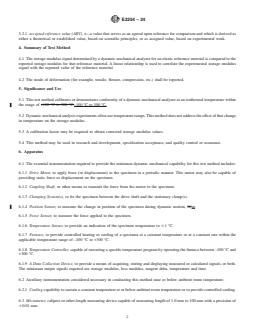
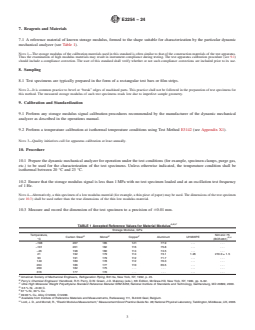
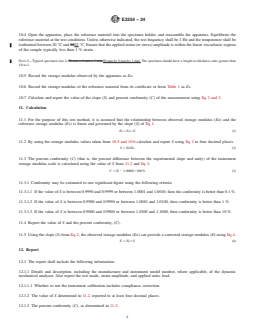
REDLINE ASTM E2254-24 - Standard Test Method for Storage Modulus Calibration of Dynamic Mechanical Analyzers
Overview
ASTM E2254-24: Standard Test Method for Storage Modulus Calibration of Dynamic Mechanical Analyzers establishes procedures for calibrating or verifying the storage modulus scale of dynamic mechanical analyzers (DMA) over a temperature range from –100 °C to 300 °C. By using certified reference materials with known storage modulus values between 1 GPa and 200 GPa, this method helps ensure the reliability and accuracy of DMA instruments, supporting research, quality control, and product development activities. Complying with international best practices, ASTM E2254-24 reinforces conformity and performance in the measurement of viscoelastic properties of polymers and other materials.
Key Topics
- Storage Modulus Calibration: Defines a standardized approach to calibrate the storage modulus (stiffness under dynamic loading) using reference materials, confirming instrument performance.
- Isothermal Testing: Focuses on calibration at static temperatures rather than during temperature ramps, eliminating variables introduced by changing temperatures.
- Precision and Conformity: Outlines statistical methods for evaluating repeatability and reproducibility within and between laboratories, as well as calculating percent conformity relative to accepted reference values.
- Reference Materials: Specifies requirements for reference materials with established storage modulus values, ensuring traceable calibration across the DMA’s applicable modulus range.
- Instrumentation Requirements: Details necessary DMA components, including drive motor, clamping systems, temperature sensors, furnaces, and data collection systems.
- Reporting: Enforces comprehensive documentation requirements, such as instrument configuration, reference materials used, calibration factor, and conformity metrics.
Applications
Dynamic mechanical analyzer calibration using ASTM E2254-24 brings practical benefits across industries and laboratory environments:
- Research & Development: Provides confidence in the accuracy of DMA results, supporting the design and investigation of new polymers, composites, and advanced materials.
- Specification Acceptance: Enables producers and suppliers to demonstrate instrument conformity to customer or regulatory requirements, facilitating material qualification and acceptance testing.
- Quality Control & Assurance: Essential for routine facility or process audits, enabling detection of drift or instrument error and supporting compliant production processes.
- Comparative Analysis: Ensures consistent measurement of viscoelastic properties, allowing reliable benchmarking of materials from different sources or batches.
- Instrument Performance Verification: Regular calibration per ASTM E2254-24 helps identify compliance issues, guide instrument maintenance, and confirm suitability for high-precision applications.
Related Standards
Organizations implementing or referencing ASTM E2254-24 may also consider these related ASTM standards for dynamic mechanical analysis calibration and terminology:
- ASTM E473: Terminology Relating to Thermal Analysis and Rheology
- ASTM E1142: Terminology Relating to Thermophysical Properties
- ASTM E698: Test Method for Kinetic Parameters for Thermally Unstable Materials Using Differential Scanning Calorimetry
- ASTM E2425: Test Method for Loss Modulus Conformance of Dynamic Mechanical Analyzers
- ASTM E3142: Test Method for Thermal Lag of Thermal Analysis Apparatus
- ASTM D638: Test Method for Tensile Properties of Plastics
By following ASTM E2254-24, laboratories and manufacturers worldwide can ensure their dynamic mechanical analyzers provide reliable, traceable, and reproducible storage modulus measurements, supporting robust material characterization and compliance with international standards.
Keywords: ASTM E2254-24, dynamic mechanical analyzer calibration, storage modulus, conformity, reference materials, DMA, viscoelastic properties, quality control, isothermal calibration, material testing standards
Relations
- Replaces
ASTM E2254-23 - Standard Test Method for Storage Modulus Calibration of Dynamic Mechanical Analyzers - Effective Date
- 15-Mar-2024
- Effective Date
- 15-Mar-2024
- Referred By
ASTM D8269-21 - Standard Guide for the Use of Geocells in Geotechnical and Roadway Projects - Effective Date
- 15-Mar-2024
- Effective Date
- 15-Mar-2024
Buy Documents
ASTM E2254-24 - Standard Test Method for Storage Modulus Calibration of Dynamic Mechanical Analyzers
REDLINE ASTM E2254-24 - Standard Test Method for Storage Modulus Calibration of Dynamic Mechanical Analyzers
Get Certified
Connect with accredited certification bodies for this standard

BSMI (Bureau of Standards, Metrology and Inspection)
Taiwan's standards and inspection authority.
Sponsored listings
Frequently Asked Questions
ASTM E2254-24 is a standard published by ASTM International. Its full title is "Standard Test Method for Storage Modulus Calibration of Dynamic Mechanical Analyzers". This standard covers: SIGNIFICANCE AND USE 5.1 This test method calibrates or demonstrates conformity of a dynamic mechanical analyzer at an isothermal temperature within the range of –100 °C to 300 °C. 5.2 Dynamic mechanical analysis experiments often use temperature ramps. This method does not address the effect of that change in temperature on the storage modulus. 5.3 A calibration factor may be required to obtain corrected storage modulus values. 5.4 This method may be used in research and development, specification acceptance, and quality control or assurance. SCOPE 1.1 This test method describes the calibration or performance confirmation for the storage modulus scale of a commercial or custom built dynamic mechanical analyzer (DMA) over the temperature range of –100 °C to 300 °C using reference materials in the range of 1 GPa to 200 GPa. 1.2 The values stated in SI units are to be regarded as standard. No other units of measurement are included in this standard. 1.3 This standard does not purport to address all of the safety concerns, if any, associated with its use. It is the responsibility of the user of this standard to establish appropriate safety, health, and environmental practices and determine the applicability of regulatory limitations prior to use. 1.4 This international standard was developed in accordance with internationally recognized principles on standardization established in the Decision on Principles for the Development of International Standards, Guides and Recommendations issued by the World Trade Organization Technical Barriers to Trade (TBT) Committee.
SIGNIFICANCE AND USE 5.1 This test method calibrates or demonstrates conformity of a dynamic mechanical analyzer at an isothermal temperature within the range of –100 °C to 300 °C. 5.2 Dynamic mechanical analysis experiments often use temperature ramps. This method does not address the effect of that change in temperature on the storage modulus. 5.3 A calibration factor may be required to obtain corrected storage modulus values. 5.4 This method may be used in research and development, specification acceptance, and quality control or assurance. SCOPE 1.1 This test method describes the calibration or performance confirmation for the storage modulus scale of a commercial or custom built dynamic mechanical analyzer (DMA) over the temperature range of –100 °C to 300 °C using reference materials in the range of 1 GPa to 200 GPa. 1.2 The values stated in SI units are to be regarded as standard. No other units of measurement are included in this standard. 1.3 This standard does not purport to address all of the safety concerns, if any, associated with its use. It is the responsibility of the user of this standard to establish appropriate safety, health, and environmental practices and determine the applicability of regulatory limitations prior to use. 1.4 This international standard was developed in accordance with internationally recognized principles on standardization established in the Decision on Principles for the Development of International Standards, Guides and Recommendations issued by the World Trade Organization Technical Barriers to Trade (TBT) Committee.
ASTM E2254-24 is classified under the following ICS (International Classification for Standards) categories: 17.020 - Metrology and measurement in general. The ICS classification helps identify the subject area and facilitates finding related standards.
ASTM E2254-24 has the following relationships with other standards: It is inter standard links to ASTM E2254-23, ASTM E1640-23, ASTM D8269-21, ASTM D4065-20. Understanding these relationships helps ensure you are using the most current and applicable version of the standard.
ASTM E2254-24 is available in PDF format for immediate download after purchase. The document can be added to your cart and obtained through the secure checkout process. Digital delivery ensures instant access to the complete standard document.
Standards Content (Sample)
This international standard was developed in accordance with internationally recognized principles on standardization established in the Decision on Principles for the
Development of International Standards, Guides and Recommendations issued by the World Trade Organization Technical Barriers to Trade (TBT) Committee.
Designation: E2254 − 24
Standard Test Method for
Storage Modulus Calibration of Dynamic Mechanical
Analyzers
This standard is issued under the fixed designation E2254; the number immediately following the designation indicates the year of
original adoption or, in the case of revision, the year of last revision. A number in parentheses indicates the year of last reapproval. A
superscript epsilon (´) indicates an editorial change since the last revision or reapproval.
1. Scope* E3142 Test Method for Thermal Lag of Thermal Analysis
Apparatus
1.1 This test method describes the calibration or perfor-
mance confirmation for the storage modulus scale of a com-
3. Terminology
mercial or custom built dynamic mechanical analyzer (DMA)
3.1 Definitions:
over the temperature range of –100 °C to 300 °C using
3.1.1 Specific technical terms used in this test method are
reference materials in the range of 1 GPa to 200 GPa.
defined in Terminologies E473 and E1142 including Celsius,
1.2 The values stated in SI units are to be regarded as
dynamic mechanical analysis, and storage modulus.
standard. No other units of measurement are included in this
3.2 Definitions of Terms Specific to This Standard:
standard.
3.2.1 accepted reference value (ARV), n—a value that serves
1.3 This standard does not purport to address all of the
as an agreed upon reference for comparison and which is
safety concerns, if any, associated with its use. It is the
derived as either a theoretical or established value, based on
responsibility of the user of this standard to establish appro-
scientific principles, or as assigned value, based on experimen-
priate safety, health, and environmental practices and deter-
tal work.
mine the applicability of regulatory limitations prior to use.
4. Summary of Test Method
1.4 This international standard was developed in accor-
dance with internationally recognized principles on standard-
4.1 The storage modulus signal determined by a dynamic
ization established in the Decision on Principles for the
mechanical analyzer for an elastic reference material is com-
Development of International Standards, Guides and Recom-
pared to the reported storage modulus for that reference
mendations issued by the World Trade Organization Technical
material. A linear relationship is used to correlate the experi-
Barriers to Trade (TBT) Committee.
mental storage modulus signal with the reported value of the
reference material.
2. Referenced Documents
4.2 The mode of deformation (for example, tensile, flexure,
2.1 ASTM Standards:
compression, etc.) shall be reported.
E473 Terminology Relating to Thermal Analysis and Rhe-
ology
5. Significance and Use
E698 Test Method for Kinetic Parameters for Thermally
5.1 This test method calibrates or demonstrates conformity
Unstable Materials Using Differential Scanning Calorim-
of a dynamic mechanical analyzer at an isothermal temperature
etry and the Flynn/Wall/Ozawa Method
within the range of –100 °C to 300 °C.
E1142 Terminology Relating to Thermophysical Properties
5.2 Dynamic mechanical analysis experiments often use
E2425 Test Method for Loss Modulus Conformance of
Dynamic Mechanical Analyzers temperature ramps. This method does not address the effect of
that change in temperature on the storage modulus.
D638 Test Method for Tensile Properties of Plastics
5.3 A calibration factor may be required to obtain corrected
storage modulus values.
This test method is under the jurisdiction of ASTM Committee E37 on Thermal
Measurements and is the direct responsibility of Subcommittee E37.10 on
5.4 This method may be used in research and development,
Fundamental, Statistical and Mechanical Properties.
specification acceptance, and quality control or assurance.
Current edition approved March 15, 2024. Published March 2024. Originally
approved in 2003. Last previous edition approved in 2023 as E2254 – 23. DOI:
6. Apparatus
10.1520/E2254-24.
For referenced ASTM standards, visit the ASTM website, www.astm.org, or
6.1 The essential instrumentation required to provide the
contact ASTM Customer Service at service@astm.org. For Annual Book of ASTM
minimum dynamic mechanical capability for this test method
Standards volume information, refer to the standard’s Document Summary page on
the ASTM website. includes:
*A Summary of Changes section appears at the end of this standard
Copyright © ASTM International, 100 Barr Harbor Drive, PO Box C700, West Conshohocken, PA 19428-2959. United States
E2254 − 24
apparatus. Thus the examination of high modulus materials may result in
6.1.1 Drive Motor, to apply force (or displacement) to the
instrument compliance during testing. The test apparatus calibration
specimen in a periodic manner. This motor may also be capable
procedure (see 9.1) should include a compliance correction. The user of
of providing static force or displacement on the specimen.
this standard shall verify whether or not such compliance corrections are
6.1.2 Coupling Shaft, or other means to transmit the force
included prior to its use.
from the motor to the specimen.
6.1.3 Clamping System(s), to fix the specimen between the
8. Sampling
drive shaft and the stationary clamp(s).
8.1 Test specimens are typically prepared in the form of a
6.1.4 Position Sensor, to measure the change in position of
rectangular test bars or film strips.
the specimen during dynamic motion, or
NOTE 2—It is common practice to bevel or “break” edges of machined
6.1.5 Force Sensor, to measure the force applied to the
parts. This practice shall not be followed in the preparation of test
specimen.
specimens for this method. The measured storage modulus of such test
6.1.6 Temperature Sensor, to provide an indication of the specimens reads low due to imperfect sample geometry.
specimen temperature to 61 °C.
9. Calibration and Standardization
6.1.7 Furnace, to provide controlled heating or cooling of a
specimen at a constant temperature or at a constant rate within
9.1 Perform any storage modulus signal calibration proce-
the applicable temperature range of –100 °C to +300 °C.
dures recommended by the manufacturer of the dynamic
6.1.8 Temperature Controller, capable of executing a spe-
mechanical analyzer as described in the operations manual.
cific temperature program by operating the furnace between
9.2 Perform a temperature calibration at isothermal tem-
–100 °C and +300 °C.
perature conditions using Test Method E3142 (see Appendix
6.1.9 A Data Collection Device, to provide a means of
X1).
acquiring, storing and displaying measured or calculated
signals, or both. The minimum output signals required are
NOTE 3—Quality initiatives call for apparatus calibration at least
storage modulus, loss modulus, tangent delta, temperature and annually.
time.
10. Procedure
6.2 Auxiliary instrumentation considered necessary in con-
ducting this method near or below ambient room temperature.
10.1 Prepare the dynamic mechanical analyzer for operation
6.2.1 Cooling capability to sustain a constant temperature at under the test conditions (for example, specimen clamps, purge
or below ambient room temperature or to provide controlled
gas, etc.) to be used for the characterization of the test
cooling. specimens. Unless otherwise indicated, the temperature condi-
tion shall be isothermal between 20 °C and 23 °C.
6.3 Micrometer, calipers or other length measuring device
capable of measuring length of 1.0 mm to 100 mm with a
10.2 Ensure that the storage modulus signal is less than
precision of 60.01 mm.
1 MPa with no test specimen loaded and at an oscillation test
frequency of 1 Hz.
7. Reagents and Materials
NOTE 4—Alternatively, a thin specimen of a low modulus material (for
example, a thin piece of paper) may be used. The dimensions of the test
7.1 A reference material of known storage modulus, formed
specimen (see 10.3) shall be used rather than the true dimensions of the
to the shape suitable for characterization by the particular
thin low modulus material.
dynamic mechanical analyzer (see Table 1).
10.3 Measure and record the dimension of the test specimen
NOTE 1—The storage modulus of the calibration materials used in this
standard is often similar to that of the construction materials of the test to a precision of 60.01 mm.
A,B,C
TABLE 1 Accepted Reference Values for Material Modulus
Storage Modulus, GPa
Temperature, Nimonic 75
D E F
Carbon Steel Monel Copper Aluminum UHMWPE
G,H
°C (BCR-661)
–198 207 185 121 77.9 . . . . . .
–101 201 182 116 75.8 . . . . . .
–46 198 180 114 74.5 . . . . . .
21 192 179 114 73.1 1.26 210.0 ± 1.5
93 191 179 112 71.7 . . . . . .
149 189 178 112 70.3 . . . . . .
204 186 177 110 65.5 . . . . . .
260 182 175 . . . . . . . . . . . .
316 177 170 . . . . . . . . . . . .
A
American Society of Mechanical Engineers, Refrigeration Piping, B31.5a,
...
This document is not an ASTM standard and is intended only to provide the user of an ASTM standard an indication of what changes have been made to the previous version. Because
it may not be technically possible to adequately depict all changes accurately, ASTM recommends that users consult prior editions as appropriate. In all cases only the current version
of the standard as published by ASTM is to be considered the official document.
Designation: E2254 − 23 E2254 − 24
Standard Test Method for
Storage Modulus Calibration of Dynamic Mechanical
Analyzers
This standard is issued under the fixed designation E2254; the number immediately following the designation indicates the year of
original adoption or, in the case of revision, the year of last revision. A number in parentheses indicates the year of last reapproval. A
superscript epsilon (´) indicates an editorial change since the last revision or reapproval.
1. Scope*
1.1 This test method describes the calibration or performance confirmation for the storage modulus scale of a commercial or
custom built dynamic mechanical analyzer (DMA) over the temperature range of –100 °C to 300 °C –100 °C to 300 °C using
reference materials in the range of 1 GPa to 200 GPa.
1.2 The values stated in SI units are to be regarded as standard. No other units of measurement are included in this standard.
1.3 This standard does not purport to address all of the safety concerns, if any, associated with its use. It is the responsibility
of the user of this standard to establish appropriate safety, health, and environmental practices and determine the applicability of
regulatory limitations prior to use.
1.4 This international standard was developed in accordance with internationally recognized principles on standardization
established in the Decision on Principles for the Development of International Standards, Guides and Recommendations issued
by the World Trade Organization Technical Barriers to Trade (TBT) Committee.
2. Referenced Documents
2.1 ASTM Standards:
E473 Terminology Relating to Thermal Analysis and Rheology
E698 Test Method for Kinetic Parameters for Thermally Unstable Materials Using Differential Scanning Calorimetry and the
Flynn/Wall/Ozawa Method
E1142 Terminology Relating to Thermophysical Properties
E2425 Test Method for Loss Modulus Conformance of Dynamic Mechanical Analyzers
D638 Test Method for Tensile Properties of Plastics
E3142 Test Method for Thermal Lag of Thermal Analysis Apparatus
3. Terminology
3.1 Definitions:
3.1.1 Specific technical terms used in this test method are defined in Terminologies E473 and E1142 including Celsius, dynamic
mechanical analysis, and storage modulus.
3.2 Definitions of Terms Specific to This Standard:
This test method is under the jurisdiction of ASTM Committee E37 on Thermal Measurements and is the direct responsibility of Subcommittee E37.10 on Fundamental,
Statistical and Mechanical Properties.
Current edition approved Aug. 1, 2023March 15, 2024. Published August 2023March 2024. Originally approved in 2003. Last previous edition approved in 20182023
as E2254 – 18.E2254 – 23. DOI: 10.1520/E2254-23.10.1520/E2254-24.
For referenced ASTM standards, visit the ASTM website, www.astm.org, or contact ASTM Customer Service at service@astm.org. For Annual Book of ASTM Standards
volume information, refer to the standard’s Document Summary page on the ASTM website.
*A Summary of Changes section appears at the end of this standard
Copyright © ASTM International, 100 Barr Harbor Drive, PO Box C700, West Conshohocken, PA 19428-2959. United States
E2254 − 24
3.2.1 accepted reference value (ARV), n—a value that serves as an agreed upon reference for comparison and which is derived as
either a theoretical or established value, based on scientific principles, or as assigned value, based on experimental work.
4. Summary of Test Method
4.1 The storage modulus signal determined by a dynamic mechanical analyzer for an elastic reference material is compared to the
reported storage modulus for that reference material. A linear relationship is used to correlate the experimental storage modulus
signal with the reported value of the reference material.
4.2 The mode of deformation (for example, tensile, flexure, compression, etc.) shall be reported.
5. Significance and Use
5.1 This test method calibrates or demonstrates conformity of a dynamic mechanical analyzer at an isothermal temperature within
the range of –100 °C to 300 °C.–100 °C to 300 °C.
5.2 Dynamic mechanical analysis experiments often use temperature ramps. This method does not address the effect of that change
in temperature on the storage modulus.
5.3 A calibration factor may be required to obtain corrected storage modulus values.
5.4 This method may be used in research and development, specification acceptance, and quality control or assurance.
6. Apparatus
6.1 The essential instrumentation required to provide the minimum dynamic mechanical capability for this test method includes:
6.1.1 Drive Motor, to apply force (or displacement) to the specimen in a periodic manner. This motor may also be capable of
providing static force or displacement on the specimen.
6.1.2 Coupling Shaft, or other means to transmit the force from the motor to the specimen.
6.1.3 Clamping System(s), to fix the specimen between the drive shaft and the stationary clamp(s).
6.1.4 Position Sensor, to measure the change in position of the specimen during dynamic motion, or,or
6.1.5 Force Sensor, to measure the force applied to the specimen.
6.1.6 Temperature Sensor, to provide an indication of the specimen temperature to 61 °C.
6.1.7 Furnace, to provide controlled heating or cooling of a specimen at a constant temperature or at a constant rate within the
applicable temperature range of –100 °C to +300 °C.
6.1.8 Temperature Controller, capable of executing a specific temperature program by operating the furnace between –100 °C and
+300 °C.
6.1.9 A Data Collection Device, to provide a means of acquiring, storing and displaying measured or calculated signals, or both.
The minimum output signals required are storage modulus, loss modulus, tangent delta, temperature and time.
6.2 Auxiliary instrumentation considered necessary in conducting this method near or below ambient room temperature.
6.2.1 Cooling capability to sustain a constant temperature at or below ambient room temperature or to provide controlled cooling.
6.3 Micrometer, calipers or other length measuring device capable of measuring length of 1.0 mm to 100 mm with a precision of
60.01 mm.
E2254 − 24
7. Reagents and Materials
7.1 A reference material of known storage modulus, formed to the shape suitable for characterization by the particular dynamic
mechanical analyzer (see Table 1).
NOTE 1—The storage modulus of the calibration materials used in this standard is often similar to that of the construction materials of the test apparatus.
Thus the examination of high modulus materials may result in instrument compliance during testing. The test apparatus calibration procedure (see 9.1)
should include a compliance correction. The user of this standard shall verify whether or not such compliance corrections are included prior to its use.
8. Sampling
8.1 Test specimens are typically prepared in the form of a rectangular test bars or film strips.
NOTE 2—It is common practice to bevel or “break” edges of machined parts. This practice shall not be followed in the preparation of test specimens for
this method. The measured storage modulus of such test specimens reads low due to imperfect sample geometry.
9. Calibration and Standardization
9.1 Perform any storage modulus signal calibration procedures recommended by the manufacturer of the dynamic mechanical
analyzer as described in the operations manual.
9.2 Perform a temperature calibration at isothermal temperature conditions using Test Method E3142 (see Appendix X1).
NOTE 3—Quality initiatives call for apparatus calibration at least annually.
10. Procedure
10.1 Prepare the dynamic mechanical analyzer for operation under the test conditions (for example, specimen clamps, purge gas,
etc.) to be used for the characterization of the test specimens. Unless otherwise indicated, the temperature condition shall be
isothermal between 20 °C and 23 °C.
10.2 Ensure that the storage modulus signal is less than 1 MPa with no test specimen loaded and at an oscillation test frequency
of 1 Hz.
NOTE 4—Alternatively, a thin specimen of a low modulus material (for example, a thin piece of paper) may be used. The dimensions of the test specimen
(see 10.3) shall be used rather than the true dimensions of the thin low modulus material.
10.3 Measure and record the dimension of the test specimen to a precision of 60.01 mm.
A,B,C
TABLE 1 Accepted Reference Values for Material Modulus
Storage Modulus, GPa
Temperature, Nimonic 75
D E F
Carbon Steel Monel Copper Aluminum UHMWPE
G,H
°C (BCR-661)
–198 207 185 121 77.9 . . . . . .
–101 201 182 116 75.8 . . . . . .
–46 198 180 114 74.5 . . . . . .
21 192 179 114 73.1 1.26 210.0 ± 1.5
93 191 179 112 71.7 . . . . . .
149 189 178 112 70.3 . . . . . .
204 186 177 110 65.5 . . . . . .
260 182 175 . . . . . . . . . . . .
316 177 170 . . . . . . . .
...