

ASTM D6914/D6914M-16(2024)
(Practice)Standard Practice for Sonic Drilling for Site Characterization and the Installation of Subsurface Monitoring Devices
General Information
- Abstract
SIGNIFICANCE AND USE
5.1 Sonic drilling is a rapid, primarily dry drilling method (see 5.2), used both in geotechnical applications to avoid hydraulic fracturing, and in environmental site exploration. Geotechnical applications include exploration for tunnels, underground excavations, and installation of instrumentation or structural elements. Sonic drilling methods are used in rocky soils with large diameter casing to obtain continuous samples in materials that are difficult to sample using other methods. It is well suited for projects of a production-orientated nature with a drilling rate faster than most all other drilling methods (Guide D6286/D6286M). Sonic drilling is used for environmental explorations because sonic drilling offers the benefit of significantly reduced drill cuttings, a major cost element, and reduced drill fluid use and production. Sonic drilling offers rapid formation penetration thereby increasing production. It can reduce fieldwork time generating overall project cost reductions. The continuous core sample recovered provides a representative lithological column for review and analysis. Sonic drilling readily lends itself to environmental instrumentation installation and to in-situ testing. The advantage of a clean cased hole without the use of drilling fluids provides for increased efficiency in instrumentation installation. The ability to cause vibration to the casing string eliminates the complication of monitoring well backfill bridging common to other drilling methods and reduces the risk of casing lockup allowing for easy casing withdrawal during grouting. The clean borehole reduces well development time. Pumping tests can be performed as needed prior to well screen placement to allow for proper screen location. The sonic method is readily utilized in multiple cased well applications which are required to prevent aquifer cross contamination. The installation of inclinometers, vibrating wire piezometers, settlement gauges, and the like can be accomplished e...
SCOPE
1.1 This practice covers procedures for using sonic drilling methods in the conducting of subsurface exploration for site characterization and in the installation of subsurface monitoring devices.
1.2 The use of the sonic drilling method for exploration and monitoring-device installation may often involve preliminary site research and safety planning, administration, and documentation.
1.3 Soil or Rock samples collected by sonic methods are classed as group A or group B in accordance with Practices D4220/D4220M. Other sampling methods (Guide D6169/D6169M) may be used in conjunction with the sonic method to collect samples classed as group C and Group D. Other drilling methods are summarized in Guide D6286/D6286M.
1.4 Units—The values stated in either inch-pound units or SI units [presented in brackets] are to be regarded separately as standard. The values stated in each system may not be exact equivalents; therefore, each system shall be used independently of the other. Combining values from the two systems may result in non-conformance with the standard. Reporting of test results in units other than in-pound shall not be regarded as nonconformance with this practice.
1.5 All observed and calculated values shall conform to the guidelines for significant digits and rounding established in Practice D6026, unless superseded by this standard.
1.6 This practice offers a set of instructions for performing one or more specific operations. It is a description of the present state-of-the-art practice of sonic drilling. It does not recommend this method as a specific course of action. This document cannot replace education or experience and should be used in conjunction with professional judgment. Not all aspects of this practice may be applicable in all circumstances. This ASTM standard is not intended to represent or replace the standard of care by which the adequacy of a given professional service must be judged,...
- Status
- Published
- Publication Date
- 14-Mar-2024
- Technical Committee
- D18 - Soil and Rock
- Drafting Committee
- D18.21 - Groundwater and Vadose Zone Investigations
Overview
ASTM D6914/D6914M-16(2024), Standard Practice for Sonic Drilling for Site Characterization and the Installation of Subsurface Monitoring Devices, is a prominent international ASTM standard detailing methodologies for utilizing sonic drilling in subsurface site exploration and monitoring device installation. Developed by ASTM Committee D18, this standard supports rapid, mostly dry drilling techniques for geotechnical and environmental applications, ensuring minimal site disturbance and effective data collection. The document provides best practices for sampling, instrumentation placement, and the use of sonic drilling across diverse formations, contributing to cost-effective and accurate site characterization.
Key Topics
- Sonic Drilling Method: Employs high-frequency vibrations primarily as a dry drilling method, facilitating rapid advancement through subsurface formations with minimal use of fluids, reducing drill cuttings and site impact.
- Site Characterization: Offers guidance for continuous core sample collection in difficult-to-sample soils and rocks, vital for projects such as tunnels, underground excavations, and subsurface instrumentation.
- Installation of Monitoring Devices: Details procedures for efficient placement of devices like groundwater monitoring wells, inclinometers, vibrating wire piezometers, and settlement gauges.
- Sample Quality and Handling: Addresses the collection of high-quality (Group A and B) soil and rock samples, with cross-references to applicable ASTM sampling and preservation standards.
- Safety and Documentation: Emphasizes preliminary site research, planning, administrative controls, and adherence to relevant safety regulations and guidelines.
- Flexibility and Professional Judgment: Encourages use by qualified professionals, noting that not every aspect applies to all sites and that professional experience should guide application.
Applications
ASTM D6914/D6914M is widely used in:
- Geotechnical Engineering: For exploration related to infrastructure development, such as tunnels, underground utilities, and foundation investigations.
- Environmental Site Assessment: Enables drilling and installation of monitoring devices with reduced drill cuttings and minimal site disturbance, addressing concerns such as aquifer cross-contamination and efficient well development.
- Construction Projects: Supports rapid site evaluation and facilitates installation of structural monitoring instruments, reducing fieldwork time and project costs.
- Mineral and Aggregate Exploration: Allows for bulk sampling and continuous core recovery to assess mineral content and define aggregate deposits.
- Well Installation: Suitable for setting up groundwater and dewatering wells, particularly when multiple casing requirements are present.
The method’s advantages, such as clean boreholes, easy casing withdrawal, and compatibility with a wide range of samplers and borehole tools, make it ideal for challenging and production-oriented projects.
Related Standards
For effective application of this standard, reference and integration with other ASTM standards are recommended, including:
- ASTM D4220/D4220M - Practices for Soil Sample Preservation and Transportation
- ASTM D6169/D6169M - Guide for Selection of Subsurface Sampling Devices
- ASTM D6286/D6286M - Guide for Selection of Drilling Methods for Site Characterization
- ASTM D1586/D1586M - Standard Penetration Test Method
- ASTM D5092/D5092M - Practice for Installation of Groundwater Monitoring Wells
- ASTM D6026 - Practice for Use of Significant Digits in Geotechnical Data
- ASTM D3740 - Requirements for Agencies Engaged in Testing and Inspection of Soil and Rock
These related standards ensure consistency in sampling, data reporting, safety practices, and the overall quality of geotechnical and environmental investigations.
ASTM D6914/D6914M provides a robust framework for efficient, accurate, and safe site investigations and monitoring device installations using sonic drilling technology, supporting industry professionals in achieving high-quality geotechnical and environmental outcomes.
Relations
- Effective Date
- 15-Mar-2024
- Effective Date
- 15-Mar-2024
- Effective Date
- 15-Mar-2024
- Effective Date
- 15-Mar-2024
- Effective Date
- 15-Mar-2024
- Effective Date
- 15-Mar-2024
- Effective Date
- 15-Mar-2024
Get Certified
Connect with accredited certification bodies for this standard

CIS Institut d.o.o.
Personal Protective Equipment (PPE) certification body. Notified Body NB-2890 for EU Regulation 2016/425 PPE.

Kiwa BDA Testing
Building and construction product certification.
Kmetijski inštitut Slovenije
Agricultural Institute of Slovenia. Soil testing, plant health, agricultural product analysis.
Sponsored listings
Frequently Asked Questions
ASTM D6914/D6914M-16(2024) is a standard published by ASTM International. Its full title is "Standard Practice for Sonic Drilling for Site Characterization and the Installation of Subsurface Monitoring Devices". This standard covers: SIGNIFICANCE AND USE 5.1 Sonic drilling is a rapid, primarily dry drilling method (see 5.2), used both in geotechnical applications to avoid hydraulic fracturing, and in environmental site exploration. Geotechnical applications include exploration for tunnels, underground excavations, and installation of instrumentation or structural elements. Sonic drilling methods are used in rocky soils with large diameter casing to obtain continuous samples in materials that are difficult to sample using other methods. It is well suited for projects of a production-orientated nature with a drilling rate faster than most all other drilling methods (Guide D6286/D6286M). Sonic drilling is used for environmental explorations because sonic drilling offers the benefit of significantly reduced drill cuttings, a major cost element, and reduced drill fluid use and production. Sonic drilling offers rapid formation penetration thereby increasing production. It can reduce fieldwork time generating overall project cost reductions. The continuous core sample recovered provides a representative lithological column for review and analysis. Sonic drilling readily lends itself to environmental instrumentation installation and to in-situ testing. The advantage of a clean cased hole without the use of drilling fluids provides for increased efficiency in instrumentation installation. The ability to cause vibration to the casing string eliminates the complication of monitoring well backfill bridging common to other drilling methods and reduces the risk of casing lockup allowing for easy casing withdrawal during grouting. The clean borehole reduces well development time. Pumping tests can be performed as needed prior to well screen placement to allow for proper screen location. The sonic method is readily utilized in multiple cased well applications which are required to prevent aquifer cross contamination. The installation of inclinometers, vibrating wire piezometers, settlement gauges, and the like can be accomplished e... SCOPE 1.1 This practice covers procedures for using sonic drilling methods in the conducting of subsurface exploration for site characterization and in the installation of subsurface monitoring devices. 1.2 The use of the sonic drilling method for exploration and monitoring-device installation may often involve preliminary site research and safety planning, administration, and documentation. 1.3 Soil or Rock samples collected by sonic methods are classed as group A or group B in accordance with Practices D4220/D4220M. Other sampling methods (Guide D6169/D6169M) may be used in conjunction with the sonic method to collect samples classed as group C and Group D. Other drilling methods are summarized in Guide D6286/D6286M. 1.4 Units—The values stated in either inch-pound units or SI units [presented in brackets] are to be regarded separately as standard. The values stated in each system may not be exact equivalents; therefore, each system shall be used independently of the other. Combining values from the two systems may result in non-conformance with the standard. Reporting of test results in units other than in-pound shall not be regarded as nonconformance with this practice. 1.5 All observed and calculated values shall conform to the guidelines for significant digits and rounding established in Practice D6026, unless superseded by this standard. 1.6 This practice offers a set of instructions for performing one or more specific operations. It is a description of the present state-of-the-art practice of sonic drilling. It does not recommend this method as a specific course of action. This document cannot replace education or experience and should be used in conjunction with professional judgment. Not all aspects of this practice may be applicable in all circumstances. This ASTM standard is not intended to represent or replace the standard of care by which the adequacy of a given professional service must be judged,...
SIGNIFICANCE AND USE 5.1 Sonic drilling is a rapid, primarily dry drilling method (see 5.2), used both in geotechnical applications to avoid hydraulic fracturing, and in environmental site exploration. Geotechnical applications include exploration for tunnels, underground excavations, and installation of instrumentation or structural elements. Sonic drilling methods are used in rocky soils with large diameter casing to obtain continuous samples in materials that are difficult to sample using other methods. It is well suited for projects of a production-orientated nature with a drilling rate faster than most all other drilling methods (Guide D6286/D6286M). Sonic drilling is used for environmental explorations because sonic drilling offers the benefit of significantly reduced drill cuttings, a major cost element, and reduced drill fluid use and production. Sonic drilling offers rapid formation penetration thereby increasing production. It can reduce fieldwork time generating overall project cost reductions. The continuous core sample recovered provides a representative lithological column for review and analysis. Sonic drilling readily lends itself to environmental instrumentation installation and to in-situ testing. The advantage of a clean cased hole without the use of drilling fluids provides for increased efficiency in instrumentation installation. The ability to cause vibration to the casing string eliminates the complication of monitoring well backfill bridging common to other drilling methods and reduces the risk of casing lockup allowing for easy casing withdrawal during grouting. The clean borehole reduces well development time. Pumping tests can be performed as needed prior to well screen placement to allow for proper screen location. The sonic method is readily utilized in multiple cased well applications which are required to prevent aquifer cross contamination. The installation of inclinometers, vibrating wire piezometers, settlement gauges, and the like can be accomplished e... SCOPE 1.1 This practice covers procedures for using sonic drilling methods in the conducting of subsurface exploration for site characterization and in the installation of subsurface monitoring devices. 1.2 The use of the sonic drilling method for exploration and monitoring-device installation may often involve preliminary site research and safety planning, administration, and documentation. 1.3 Soil or Rock samples collected by sonic methods are classed as group A or group B in accordance with Practices D4220/D4220M. Other sampling methods (Guide D6169/D6169M) may be used in conjunction with the sonic method to collect samples classed as group C and Group D. Other drilling methods are summarized in Guide D6286/D6286M. 1.4 Units—The values stated in either inch-pound units or SI units [presented in brackets] are to be regarded separately as standard. The values stated in each system may not be exact equivalents; therefore, each system shall be used independently of the other. Combining values from the two systems may result in non-conformance with the standard. Reporting of test results in units other than in-pound shall not be regarded as nonconformance with this practice. 1.5 All observed and calculated values shall conform to the guidelines for significant digits and rounding established in Practice D6026, unless superseded by this standard. 1.6 This practice offers a set of instructions for performing one or more specific operations. It is a description of the present state-of-the-art practice of sonic drilling. It does not recommend this method as a specific course of action. This document cannot replace education or experience and should be used in conjunction with professional judgment. Not all aspects of this practice may be applicable in all circumstances. This ASTM standard is not intended to represent or replace the standard of care by which the adequacy of a given professional service must be judged,...
ASTM D6914/D6914M-16(2024) is classified under the following ICS (International Classification for Standards) categories: 13.080.05 - Examination of soils in general. The ICS classification helps identify the subject area and facilitates finding related standards.
ASTM D6914/D6914M-16(2024) has the following relationships with other standards: It is inter standard links to ASTM D6914/D6914M-16, ASTM D6169/D6169M-21, ASTM E3268-21, ASTM D6286/D6286M-20, ASTM D1586/D1586M-18e1, ASTM D420-18, ASTM D6001/D6001M-20. Understanding these relationships helps ensure you are using the most current and applicable version of the standard.
ASTM D6914/D6914M-16(2024) is available in PDF format for immediate download after purchase. The document can be added to your cart and obtained through the secure checkout process. Digital delivery ensures instant access to the complete standard document.
Standards Content (Sample)
This international standard was developed in accordance with internationally recognized principles on standardization established in the Decision on Principles for the
Development of International Standards, Guides and Recommendations issued by the World Trade Organization Technical Barriers to Trade (TBT) Committee.
Designation: D6914/D6914M − 16 (Reapproved 2024)
Standard Practice for
Sonic Drilling for Site Characterization and the Installation
of Subsurface Monitoring Devices
This standard is issued under the fixed designation D6914/D6914M; the number immediately following the designation indicates the
year of original adoption or, in the case of revision, the year of last revision. A number in parentheses indicates the year of last
reapproval. A superscript epsilon (´) indicates an editorial change since the last revision or reapproval.
1. Scope aspects of this practice may be applicable in all circumstances.
This ASTM standard is not intended to represent or replace the
1.1 This practice covers procedures for using sonic drilling
standard of care by which the adequacy of a given professional
methods in the conducting of subsurface exploration for site
service must be judged, nor should this document be applied
characterization and in the installation of subsurface monitor-
without consideration of a project’s many unique aspects. The
ing devices.
word “Standard” in the title of this document means only that
1.2 The use of the sonic drilling method for exploration and
the document has been approved through the ASTM consensus
monitoring-device installation may often involve preliminary
process.
site research and safety planning, administration, and docu-
1.6.1 This practice does not purport to comprehensively
mentation.
address all the methods and the issues associated with drilling
1.3 Soil or Rock samples collected by sonic methods are practices. Users should seek qualified professionals for deci-
sions as to the proper equipment and methods that would be
classed as group A or group B in accordance with Practices
D4220/D4220M. Other sampling methods (Guide D6169/ most successful for their site investigation. Other methods may
be available for drilling and sampling of soil, and qualified
D6169M) may be used in conjunction with the sonic method to
collect samples classed as group C and Group D. Other drilling professionals should have the flexibility to exercise judgment
as to possible alternatives not covered in this practice. This
methods are summarized in Guide D6286/D6286M.
practice is current at the time of issue, but new alternative
1.4 Units—The values stated in either inch-pound units or
methods may become available prior to revisions, therefore,
SI units [presented in brackets] are to be regarded separately as
users should consult manufacturers or sonic drilling services
standard. The values stated in each system may not be exact
providers prior to specifying program requirements.
equivalents; therefore, each system shall be used independently
1.7 This practice does not purport to address all the safety
of the other. Combining values from the two systems may
concerns, if any, associated with its use and may involve use of
result in non-conformance with the standard. Reporting of test
hazardous materials, equipment, and operations. It is the
results in units other than in-pound shall not be regarded as
responsibility of the user of this standard to establish appro-
nonconformance with this practice.
priate safety, health, and environmental practices and deter-
1.5 All observed and calculated values shall conform to the
mine the applicability of regulatory requirements prior to use.
guidelines for significant digits and rounding established in
For good safety practice, consult applicable OSHA regulations
Practice D6026, unless superseded by this standard.
2,3,4
and drilling safety guides.
1.6 This practice offers a set of instructions for performing
1.8 This international standard was developed in accor-
one or more specific operations. It is a description of the
dance with internationally recognized principles on standard-
present state-of-the-art practice of sonic drilling. It does not
ization established in the Decision on Principles for the
recommend this method as a specific course of action. This
Development of International Standards, Guides and Recom-
document cannot replace education or experience and should
mendations issued by the World Trade Organization Technical
be used in conjunction with professional judgment. Not all
Barriers to Trade (TBT) Committee.
This practice is under the jurisdiction of ASTM Committee D18 on Soil and
Rock and is the direct responsibility of Subcommittee D18.21 on Groundwater and “Drilling Safety Guide,” National Drilling Association.
Vadose Zone Investigations. “Drillers Handbook,” Thomas C. Ruda and Peter Bosscher, National Drilling
Current edition approved March 15, 2024. Published March 2024. Originally Association.
approved in 2004. Last previous edition approved in 2016 as D6914–16. DOI: “Innovative Technology Summary Report,” April 1995, U.S. Department of
10.1520/D6914_D6914M-16R24. Energy.
Copyright © ASTM International, 100 Barr Harbor Drive, PO Box C700, West Conshohocken, PA 19428-2959. United States
D6914/D6914M − 16 (2024)
2. Referenced Documents 2.4 ASTM Standards—Aquifer Testing:
D4044/D4044M Test Method for (Field Procedure) for In-
2.1 ASTM Standards—Soil Classification:
stantaneous Change in Head (Slug) Tests for Determining
D653 Terminology Relating to Soil, Rock, and Contained
Hydraulic Properties of Aquifers (Withdrawn 2024)
Fluids
D4050 Test Method for (Field Procedure) for Withdrawal
D2113 Practice for Rock Core Drilling and Sampling of
6 and Injection Well Testing for Determining Hydraulic
Rock for Site Exploration (Withdrawn 2023)
Properties of Aquifer Systems
D2488 Practice for Description and Identification of Soils
D5092/D5092M Practice for Design and Installation of
(Visual-Manual Procedures)
Groundwater Monitoring Wells
D5434 Guide for Field Logging of Subsurface Explorations
2.5 ASTM Standards—Other:
of Soil and Rock (Withdrawn 2021)
D3740 Practice for Minimum Requirements for Agencies
2.2 ASTM Standards—Drilling Methods and Installation
Engaged in Testing and/or Inspection of Soil and Rock as
Methods:
Used in Engineering Design and Construction
D1452/D1452M Practice for Soil Exploration and Sampling
D6026 Practice for Using Significant Digits and Data Re-
by Auger Borings
cords in Geotechnical Data
D5088 Practice for Decontamination of Field Equipment
Used at Waste Sites
3. Terminology
D5299/D5299M Guide for Decommissioning of Groundwa-
3.1 Definitions:
ter Wells, Vadose Zone Monitoring Devices, Boreholes,
3.1.1 For common definitions of technical terms in this
and Other Devices for Environmental Activities
standard refer to Terminology D653.
D5782 Guide for Use of Direct Air-Rotary Drilling for
Geoenvironmental Exploration and the Installation of
3.2 Definitions of Terms Specific to This Standard:
Subsurface Water-Quality Monitoring Devices
3.2.1 hydraulic extraction, n—the removal of the sample
D5783 Guide for Use of Direct Rotary Drilling with Water-
specimen from the solid sampling barrel by the application of
Based Drilling Fluid for Geoenvironmental Exploration
fluid.
and the Installation of Subsurface Water-Quality Monitor-
3.2.2 natural frequency, n—the frequency or frequencies at
ing Devices
which an object tends to vibrate when disturbed.
D5784/D5784M Guide for Use of Hollow-Stem Augers for
3.2.3 resonance, n—when one object (sine generator) vi-
Geoenvironmental Exploration and the Installation of
brating at the natural frequency of a second object (drill pipe or
Subsurface Water Quality Monitoring Devices
casing) forces the second object into vibrational motion.
D5791 Guide for Using Probability Sampling Methods in
Studies of Indoor Air Quality in Buildings 3.2.4 sine wave generator, n—a drill head that imparts
D6286/D6286M Guide for Selection of Drilling and Direct forces in wave forms corresponding to single-frequency peri-
Push Methods for Geotechnical and Environmental Sub- odic oscillations to create resonance of the drill rods and
surface Site Characterization casings to advance the drill hole.
3.2.4.1 Discussion—This drill head is referred to as a sonic
2.3 ASTM Standards—Soil Sampling:
D1586/D1586M Test Method for Standard Penetration Test drill head, or resonant sonic drill head throughout this standard.
This drill head is attached to the drill rods and casings and can
(SPT) and Split-Barrel Sampling of Soils
D1587/D1587M Practice for Thin-Walled Tube Sampling of be used to lift rods for sample extrusion.
Fine-Grained Soils for Geotechnical Purposes (Withdrawn
3.2.5 sonic drilling, n—the practice of using high frequency
2024)
vibration as the primary force to advance drill tools through
D3550/D3550M Practice for Thick Wall, Ring-Lined, Split
subsurface formations.
Barrel, Drive Sampling of Soils
3.2.5.1 Discussion—While vibration is the primary force for
D4220/D4220M Practices for Preserving and Transporting
drilling, the drilling process also requires rotation of the drill
Soil Samples (Withdrawn 2023)
rods with applied downforce reaction from the drill
D4700 Guide for Soil Sampling from the Vadose Zone
(Withdrawn 2024) 4. Summary of Practice
D6169/D6169M Guide for Selection of Subsurface Soil and
4.1 Sonic drilling is the utilization of high frequency vibra-
Rock Sampling Devices for Environmental and Geotech-
tion aided by down pressure and rotation to advance drilling
nical Investigations
tools through various subsurface formations. All objects have a
D6640 Practice for Collection and Handling of Soils Ob-
natural frequency or set of frequencies at which they will
tained in Core Barrel Samplers for Environmental Inves-
vibrate when disturbed. The natural frequency is dependent
tigations
upon the properties of the material the object is made of and the
length of the object. The sonic drill head provides the distur-
bance to the drilling tools causing them to vibrate. To achieve
For referenced ASTM standards, visit the ASTM website, www.astm.org, or
contact ASTM Customer Service at service@astm.org. For Annual Book of ASTM
penetration of the formation the strata is fractured, sheared, or
Standards volume information, refer to the standard’s Document Summary page on
displaced. The high frequency vibration can cause the soil in
the ASTM website.
contact with the drill bit and drilling casing string to liquefy
The last approved version of this historical standard is referenced on
www.astm.org. and flow away allowing the casing to pass through with
D6914/D6914M − 16 (2024)
reduced friction. Rotation of the drill string is primarily for clean cased hole without the use of drilling fluids provides for
even distribution of the applied energy, to control bit wear, and increased efficiency in instrumentation installation. The ability
to help maintain borehole alignment. The use of vibratory
to cause vibration to the casing string eliminates the compli-
technology reduces the amount of drill cuttings, provides rapid cation of monitoring well backfill bridging common to other
formation penetration, and the recovery of a continuous core
drilling methods and reduces the risk of casing lockup allowing
sample of formation specimens for field analysis and labora-
for easy casing withdrawal during grouting. The clean borehole
tory testing. Boreholes generated by sonic drilling can be fitted
reduces well development time. Pumping tests can be per-
with various subsurface condition monitoring devices. Numer-
formed as needed prior to well screen placement to allow for
ous sampling techniques can also be used with this system
proper screen location. The sonic method is readily utilized in
including thin walled tubes, split barrel samplers, and in-situ
multiple cased well applications which are required to prevent
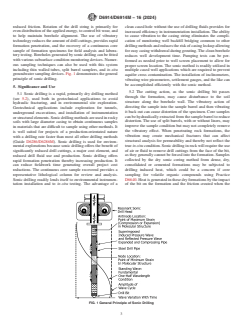
groundwater sampling devices. Fig. 1 demonstrates the general
aquifer cross contamination. The installation of inclinometers,
principle of sonic drilling.
vibrating wire piezometers, settlement gauges, and the like can
be accomplished efficiently with the sonic method.
5. Significance and Use
5.2 The cutting action, as the sonic drilling bit passes
5.1 Sonic drilling is a rapid, primarily dry drilling method
through the formation, may cause disturbance to the soil
(see 5.2), used both in geotechnical applications to avoid
structure along the borehole wall. The vibratory action of
hydraulic fracturing, and in environmental site exploration.
directing the sample into the sample barrel and then vibrating
Geotechnical applications include exploration for tunnels,
it back out can cause distortion of the specimen. Core samples
underground excavations, and installation of instrumentation
can be hydraulically extracted from the sample barrel to reduce
or structural elements. Sonic drilling methods are used in rocky
distortion. The use of split barrels, with or without liners, may
soils with large diameter casing to obtain continuous samples
improve the sample condition but may not completely remove
in materials that are difficult to sample using other methods. It
the vibratory effect. When penetrating rock formations, the
is well suited for projects of a production-orientated nature
vibration may create mechanical fractures that can affect
with a drilling rate faster than most all other drilling methods
structural analysis for permeability and thereby not reflect the
(Guide D6286/D6286M). Sonic drilling is used for environ-
true in-situ condition. Sonic drilling in rock will require the use
mental explorations because sonic drilling offers the benefit of
of air or fluid to remove drill cuttings from the face of the bit,
significantly reduced drill cuttings, a major cost element, and
as they generally cannot be forced into the formation. Samples
reduced drill fluid use and production. Sonic drilling offers
collected by the dry sonic coring method from dense, dry,
rapid formation penetration thereby increasing production. It
consolidated or cemented formations may be subjected to
can reduce fieldwork time generating overall project cost
reductions. The continuous core sample recovered provides a drilling induced heat, which could be a concern if core
sampling for volatile organic compounds using Practice
representative lithological column for review and analysis.
Sonic drilling readily lends itself to environmental instrumen- D6640. Heat is generated in these dry formations by the impact
tation installation and to in-situ testing. The advantage of a of the bit on the formation and the friction created when the
FIG. 1 General Principle of Sonic Drilling
D6914/D6914M − 16 (2024)
and rock. As such, it is not totally applicable to agencies performing this
core barrel is forced into the formation. The sampling barrel is
practice. However, user of this practice should recognize that the
advanced without drilling fluid whenever possible. Therefore,
framework of Practice D3740 is appropriate for evaluating the quality of
in very dense formations, drilling fluids may have to be used to
an agency performing this practice. Currently there is no known qualify-
remove drill cuttings from the bit face and to control drilling
ing national authority that inspects agencies that perform this practice.
generated heat. In dry, dense formations precautions to control
drilling generated heat may be necessary to avoid affecting
6. Criteria for Selection
contaminant presence. The effects of drilling generated heat
6.1 Important criteria to consider when selecting the sonic
can be mitigated by shortening sampling runs, changing
drilling method include the following:
vibration level and rotation speed, using cooled sampling
6.1.1 Diameter of borehole,
barrels, collecting larger diameter samples to reduce effect on
6.1.2 Sample quality (Class A, B) for laboratory physical
the interior of the sample, and using fluid coring methods or by
testing (Refer to Practices D4220/D4220M),
using alternate sampling methods such as the standard penetra-
6.1.3 Sample handling requirements such as containers,
tion test type samplers at specific intervals. Heat generated
preservation requirements,
while casing the borehole through dense formations after the
6.1.4 Subsurface conditions anticipated: soil type or rock
core sample has been extracted can be alleviated by potable
type/hardness,
water injection and/or by using crowd-in casing bits that shear
6.1.5 Groundwater depth anticipated,
the formation with minimal resistance. Should borehole wall
6.1.6 Boring depth,
densification be a concern it can be alleviated by potable water
6.1.7 Instrumentation requirements,
injection, by borehole wall scraping with the casing bit, by
6.1.8 Chemical composition of soil and contained pore
using a crowd-in style bit, or by injecting natural clay break-
fluids,
down compounds.
6.1.9 Available funds,
5.3 Other uses for the sonic drilling method include mineral
6.1.10 Estimated cost,
investigations. Bulk samples can be collected continuously,
6.1.11 Time constraints,
quite rapidly, in known quantities to assess mineral content.
6.1.12 History of method performance under anticipated
Aggregate deposits can be accurately defined by using large
conditions (consult experienced users and manufacturers),
diameter continuous core samplers that gather representative
6.1.13 Site accessibility,
samples. A limited amount of rock can be effectively pen-
6.1.14 Decontamination requirements,
etrated and crushability determined. In construction, projects
6.1.15 Grouting requirements, local regulations, and
include freeze tube installations for deep tunnel shafts,
6.1.16 Amount of and disposal costs for generated drill
piezometers, small diameter piles, dewatering wells, founda-
cuttings and drilling wastes.
tion anchors with grouting, and foundation movement moni-
toring instrumentation. Sonic drills can be used to set potable
7. Apparatus
water production wells. However, production may not equal
more conventional potable well drilling techniques because of
7.1 Sonic Drill Head—The sonic drill head contains a sine
the need to transport drill cuttings to the surface in short wave generator, sine generator drive mechanism, lubrication
increments. Sonic drill units presently in use are in various
system to reduce friction and control heat in the head, vibration
sizes and most are truck mounted. Sonic drills can be skid or isolation device, drill string rotating mechanism, and a connec-
all-terrain vehicle mounted to access difficult areas.
tion to the drill string. The sine wave generator must be capable
of producing sufficient energy to force movement in the drill
5.4 Sonic drills can be adapted to such other drill methods
string to accomplish the fracturing, shearing or displacement
as conventional rotary (Guide D1583, Guide D5782), down
necessary for the borehole to be advanced as shown in Fig. 1.
hole air hammer work (Guide D5782), diamond bit rock
7.1.1 Sine Wave Generator—The sine wave generator uses
coring; conventional and wireline (Practice D2113), direct
eccentric, counter rotating balance weights that are timed to
push probing (Guide D6001, Guide D6286/D6286M), thin wall
direct 100 percent of the vibration at 0 degrees and at 180
tube sampling (Practice D1587/D1587M), and standard pen-
degrees (Figs. 2 and 3). The sine wave generator is powered
etration test split barrel sampling (Practice D1586/D1586M).
hydraulically and generally operates at frequencies between 0
The sonic drilling equipment offers more adaptability than
and 185 Hz delivering a full range of energy outputs for
most existing drilling systems. However, it is important to keep
advancement of up to 12 in. [300 mm] drill casing.
in mind that the technique the machine is designed for is the
7.1.2 Lubrication System—The lubrication system is fitted
one at which it will be the most efficient. Long term use of
with oil coolers of sufficient capacity to keep the hydraulic
sonic drills for other drilling methods may not be cost effective.
fluid at an allowable operating range as recommended by the
NOTE 1—The quality of the result produced by this standard is
oil supplier.
dependent on the competence of the personnel performing it, and the
suitability of the equipment and facilities used. Agencies that meet the 7.1.3 Vibration Isolation System—In order to transmit the
criteria of Practice D3740 are generally considered capable of competent
maximum vibratory energy to the drill string and not damage
and objective testing/sampling/inspection/etc. Users of this standard are
the drilling rig the vibration applied to the drill tools must be
cautioned that compliance with Practice D3740 does not in itself assure
isolated from the drill rig as shown in Figs. 2 and 3. This can
reliable results. Reliable results depend on many factors; Practice D3740
be accomplished by using air charged springs, manual disk
provides a means of evaluating some of those factors. Practice D3740 was
developed for agencies engaged in the testing and/or inspection of soils springs, or such other methods as will meet that goal.
D6914/D6914M − 16 (2024)
FIG. 2 Typical Sonic Drill Head with Disk Spring Form of Isolation System
FIG. 3 Typical Sonic Drill Head with Air Spring Form of Isolation System
7.2 Drilling Tools—A significant variety of tooling is nec- casing bits, direct push sampling probes, borehole water
essary to accomplish the sonic drilling program. The tools sample collection systems, etc. Individual drillers and compa-
consist of drill rods, drill casing, sampler barrels, sampler bits, nies have in-house tooling designed for specific purposes and
D6914/D6914M − 16 (2024)
projects. If these specialized tools provide high quality sam- handling techniques. Liners, clear butyl or polyethylene based
pling and efficient drilling processes they are acceptable to the plastic, or stainless steel are available for use with split barrel
practice. and solid barrel samplers.
7.2.1 Drilling Rods and Casing—Drilling rods are used to 7.2.2.3 Standard formation sampling devices can be used in
propel and recover the sampling barrels. Drill rods are the most conjunction with the sonic drill rig for geotechnical applica-
handled tools. The common sizes are 2 in. [50 mm] to 4 in. tions. The standard penetration test D1586/D1586M can be
[100 mm] diameter by 2 ft [0.5 m], 5 ft [1.5 m], 10 ft [3 m], and performed if the unit is equipped with a cathead or an
20 ft [5 m] lengths. Annular space between casing and rod is automatic-hammer 140 lb [63.523 kg]. The hydraulically
not critical allowing the same sized drill rod to be used with activated, D6519, as well as manual, fixed piston, thin wall
various sized sampling barrels. Current sonic drilling technol- tube samplers D1587/D1587M can be used if the unit is
ogy can be used to set drill casing in various sizes from 4 in. equipped with a fluid pump of sufficient capacity. Sonic drills
[100 mm] up to 12 in. [300 mm] nominal outside diameter are generally equipped with winch lines for using sampling
depending on project requirements. tools in geotechnical drilling programs.
7.2.2 Sampler Barrel—Sampler barrels (a.k.a. core barrels) 7.2.3 Casing Drill Bits—Drill bits are attached to the
are used to recover formation specimens and to clean the inside leading section of drill casing. Their function is to provide a
of the drill casing. Sampler barrels are either solid tubes or split cutting edge to assist in moving the casing through the various
barrels of various diameters and lengths. The sampling barrels formations encountered and to direct the movement of forma-
are generally sized to match the inside diameter of the various tion materials during the making of the boring. The face of the
sizes of drill casing and to fulfill project requirements. The drill bit follows one of three basic directional designs: (1)
barrel is fitted with a drill bit/cutting shoe that holds the “Crowd-in” move most of the material encountered at the drill
borehole alignment as it passes through the outer casing into face into the borehole or casing as it is advanced. This style of
the formation. bit face provides the best service in dense, dry, or cohesive
7.2.2.1 Solid Barrels—Solid sampler barrels are a solid formations as it helps reduce formation compaction and
length of tubing with thread sections on each end. They are friction; (2) “Crowd-out” moves most of the material encoun-
available in various sizes and lengths. Typical sampling runs tered at the drill face into the borehole wall. This design works
are 10 to 20 ft [3 to 5 m] in length. Sampling run length can be better in softer and more granular, sands, gravels, and silt
adjusted to provide the most optimum sample recovery. Sam- formations; and (3) “Neutral” allows the bit face material to
pler barrels can be joined to increase the length of sampling choose the path of least resistance. Different bit face configu-
increment. In some formations there is a tendency to lose rations are used to effectively penetrate different formations.
recovery with longer core run lengths while in others longer The general-purpose bit face is fitted with carbide buttons
core runs may improve recovery. Samples of loose unconsoli- spaced equally across and around the bit face. Fig. 4 shows a
dated granular formations can be consolidated by the vibratory typical carbide button faced bit. The carbide buttoned bit works
action. In loose or soft formations the inability of the soil well in most formations and is considered a general-purpose
structure to support the force necessary to move the material bit. Carbide buttons are well suited for the impact action that
into the barrel can cause that material to be forced into the occurs in sonic drilling. Other configurations include welded
formation. carbide chips and blocks in a matrix, saw tooth shapes both
7.2.2.2 Split Barrel Samplers—Split barrel samplers are hard surfaced and plain, and tearing shoe designs with large
tubes that are split lengthwise with thread sections on both irregular carbides for working in construction debris and
ends. The split sections utilize a tongue & groove feature that penetrating refuse in landfills. Each of these designs has a
interlocks to prevent lateral movement between the two halves useful purpose and can be quite effective at penetrating their
of the tube. Split barrel samplers are available in various respective formations.
diameters and lengths. While split barrel samplers provide a 7.2.4 Sample Barrel Bit—The sample barrel bit is designed
better format to view the specimen and may subject it to less to both penetrate the formation and to shape the sample so it
disturbance, they do receive vibratory action during penetra- will pass through the bit into the sample barrel with the least
tion. Depending on the method of construction, split barrels amount of friction or compression. The bit may be constructed
have a tendency to spread open in hard formations. They are with serrated, carbide buttoned, or some other form of rough-
quite heavy when fully loaded and may require special ened inside diameter surface, or with a machined space for a
FIG. 4 Sonic Casing Bit
D6914/D6914M − 16 (2024)
retainer basket to assist in the retention of the sample. The should have sufficient retraction power to lift a full-length
interior of the sampler bit should have a minimum inside string of the largest rated diameter drill tools from the deepest
diameter ⁄8 in. [3 mm] less than the inside diameter of the rated depth plus an additional 50 % or more of that total
sampling barrel to allow the passage of the sample into the core weight.
barrel with the least amount of resistance so as to not impede
7.3.2 Tool Handling—Sonic drills traditionally use several
recovery or create unnecessary disturbance to the sample. The
different sizes of tooling. The units are generally equipped with
cutting face of the bit used should be the design best suited to
some form of tool handling devices. Some units are equipped
the formation being penetrated. For dense formations with
with a pivotal sonic head. This allows the head to tilt up 90
cobbles and boulders a bit face with carbide buttons may be
degrees to vertical so drill rod or casing can be aligned to the
used. For soft formations a serrated face, sharpened to force the
spindle for mechanical attachment. The length is then raised
cuttings away from the bit, works well. The choice of bit face
and rotated back to vertical for attachment to the drill string.
type and sample retention method is governed by the charac-
Other units use mechanical rod loaders, which position drill
teristics of the formation and should be optimized as the
rods or casing for hook up. Wire rope winches can be used for
borehole progresses to obtain the highest recovery percentage
drill rod tripping. Units using the winch method are generally
with the least possible sample disturbance.
fitted with a slide tray that can accommodate up to 20 ft [5 m]
7.2.5 Direct Push Water Sampling Tools—Sonic drilling is a
lengths of drill rod for reducing sample barrel retrieval time.
direct push drilling method as well. Therefore, other sampling
7.3.2.1 Tool Joint Wrench and Rod Holder Table—A key
tools similar to those used in the direct push industry are also
component of the sonic drill is the tool joint make-up,
available to the sonic drilling practice. In-situ water sampling
breakout, and rod holding table. The upper vice of the tool joint
tools are constructed using a screened inner stem attached to a
should be capable of bi-directional rotation to both close and
point that is surrounded by an outer drive pipe. The point is the
open the tool joints. The throat of the joint wrench must be
same diameter as the outer drive pipe to prevent the creation of
large enough to accommodate the largest rated O.D. tooling of
an enlarged annular space that could provide an avenue for
the drill. The throat clearance may be accomplished by jaw
cross contamination between aquifers. The inner screen assem-
retraction or by installing different sized jaws. The lower jaw
bly is sealed from the formation during installation by an outer
assembly and its supporting members should be capable of
drive pipe fitted with “o” rings. With the friction of the soil
supporting the total weight of the maximum O.D tooling at the
holding the point in place while being driven to depth, the
maximum depth rating of the machine. The upper jaw may
screen section is then exposed to the formation by pulling back
include some form of high-speed rod spinning device to
on the outer drive pipe. The inner tube can have an inside
expedite rod disconnection.
diameter of 2 to 4 in. [50 to 100 mm] or larger to allow for
7.3.3 Auxiliary Equipment—Sonic drill units require a fluid
larger capacity sampling pumps. Using higher capacity pumps
pump or pumps depending on the anticipated work program.
accelerates the purging process and allows for rapid sampling
The pumps serve many purposes; to push drilling fluids down
from deep formations. The water sampling probes can be fitted
the bore hole for lubrication and bit face cuttings removal
with disposable points to allow for pressure grouting or
while advancing the outer casing over core barrels in certain
installation of small diameter monitor wells. There are also
formations, when rock drilling to assist i
...