

ASTM F1538-24
(Specification)Standard Specification for Glass and Glass-Ceramic Biomaterials for Implantation
General Information
- Abstract
ABSTRACT
This specification covers the material requirements and characterization techniques for glass and glass-ceramic biomaterials intended for use as bulk porous or powdered surgical implants, or as coatings on surgical devices, but not including drug delivery systems. Glass and glass-ceramic biomaterials should be evaluated thoroughly for biocompatibility before human use. Tests shall be performed to determine the properties of the biomaterials, in accordance with the following test methods: bulk composition; density; flexural strength; Young's modulus; hardness; surface area; bond strength of glass or glass ceramic coating; crystallinity; thermal expansion; and particle size.
SCOPE
1.1 This specification covers the material requirements and characterization techniques for glass and glass-ceramic biomaterials intended for use as bulk porous or powdered surgical implants, or as coatings on surgical devices, but not including drug delivery systems.
1.2 The biological response to glass and glass-ceramic biomaterials in bone and soft tissue has been demonstrated in clinical use (1-12)2 and laboratory studies (13-17).
1.3 This specification excludes synthetic hydroxylapatite, hydroxylapatite coatings, aluminum oxide ceramics, alpha- and beta-tricalcium phosphate, and whitlockite.
1.4 Warning—Mercury has been designated by EPA and many state agencies as a hazardous material that can cause central nervous system, kidney, and liver damage. Mercury, or its vapor, may be hazardous to health and corrosive to materials. Caution should be taken when handling mercury and mercury-containing products. See the applicable product Material Safety Data Sheet (MSDS) for details and EPA’s website (http://www.epa.gov/mercury/faq.htm) for additional information. Users should be aware that selling mercury or mercury-containing products, or both, in your state may be prohibited by state law.
1.5 This international standard was developed in accordance with internationally recognized principles on standardization established in the Decision on Principles for the Development of International Standards, Guides and Recommendations issued by the World Trade Organization Technical Barriers to Trade (TBT) Committee.
- Status
- Published
- Publication Date
- 14-Mar-2024
- Technical Committee
- F04 - Medical and Surgical Materials and Devices
- Drafting Committee
- F04.13 - Ceramic Materials
Buy Documents
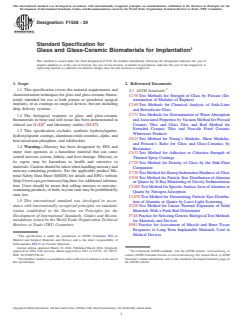
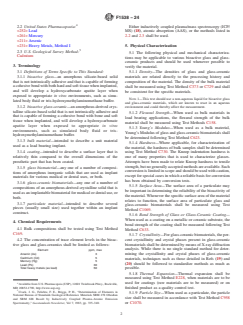
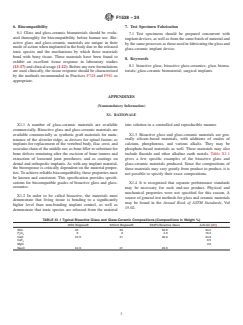

ASTM F1538-24 - Standard Specification for Glass and Glass-Ceramic Biomaterials for Implantation
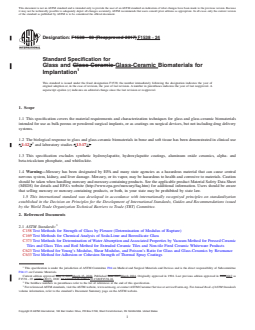
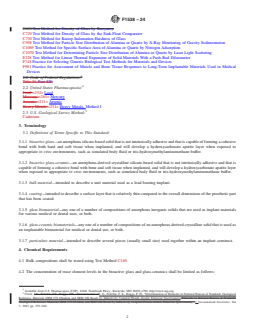
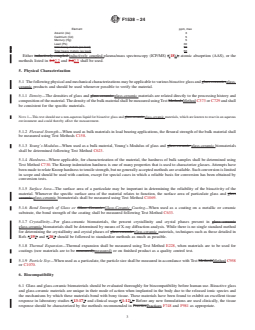
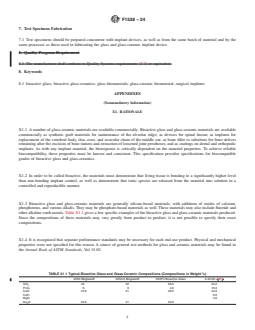
REDLINE ASTM F1538-24 - Standard Specification for Glass and Glass-Ceramic Biomaterials for Implantation
Overview
ASTM F1538-24: Standard Specification for Glass and Glass-Ceramic Biomaterials for Implantation outlines comprehensive material requirements and characterization methodologies for glass and glass-ceramic biomaterials intended for use in surgical implants and device coatings. This internationally recognized standard, developed by ASTM International, ensures the safe and consistent performance of glass and glass-ceramic materials in medical and dental implant applications, with a particular focus on their biocompatibility and physical properties. Notably, this specification does not cover drug delivery systems, synthetic hydroxylapatite, aluminum oxide ceramics, tricalcium phosphates, or whitlockite.
Key Topics
Material Characterization:
The standard mandates detailed evaluation of glass and glass-ceramic biomaterials, including measurement of:- Bulk chemical composition (via ASTM C169)
- Density (using ASTM C373, C693, or C729)
- Flexural strength (ASTM C158)
- Young's modulus (ASTM C623)
- Hardness (Knoop indentation, ASTM C730)
- Surface area (ASTM C1069)
- Bond strength for coatings (ASTM C633)
- Crystallinity (X-ray diffraction analysis)
- Thermal expansion (ASTM E228)
- Particle size (ASTM C958, C1070)
Biocompatibility Requirements:
Glass and glass-ceramic biomaterials must undergo thorough biocompatibility testing before clinical use. Practices ASTM F748 and F981 provide guidance for assessing tissue responses to ensure these materials are safe and effective when implanted in bone or soft tissue.Chemical Safety:
The specification sets strict limits on trace elements (e.g., arsenic, cadmium, mercury, and lead) to prevent potential toxicity. Analysis methods such as ICP/MS and AAS are recommended, with reference to the U.S. Pharmacopeia and relevant regulatory guidelines.Quality Assurance:
Manufacturers are required to establish a robust quality management system, such as those described in Title 21, Part 820 of the Code of Federal Regulations, to support consistent production and verification of implant materials.
Applications
ASTM F1538-24 covers a range of clinical and medical device applications for bioactive glass and glass-ceramic biomaterials, such as:
Bulk and Particulate Implants:
Glass and glass-ceramic biomaterials are used in synthetic bone grafts for alveolar ridge maintenance, bone defect repair, spinal fusion, and replacement of bone structures such as the vertebral body, iliac crest, and ossicular chain of the ear.Coatings on Surgical Devices:
These biomaterials are commonly applied as coatings to orthopedic and dental implants, enhancing osseointegration and device longevity by promoting bone bonding and reducing adverse tissue reactions.Bone Fillers:
Utilized as bioactive fillers following tumor excision or as substitutes for loosened prostheses, these materials offer controlled release of ionic species and reliable bonding to living tissue.
Clinicians, manufacturers, and regulatory bodies rely on ASTM F1538-24 to ensure that glass and glass-ceramic implant materials meet critical biocompatibility and quality benchmarks, ultimately improving patient outcomes.
Related Standards
For a comprehensive approach to biomaterial evaluation and device performance, ASTM F1538-24 references and aligns with several important standards:
- ASTM C158 – Strength of Glass by Flexure
- ASTM C169 – Chemical Analysis of Glass
- ASTM C623 – Young’s Modulus of Glass and Glass-Ceramics
- ASTM C733/C729 – Density Measurement Methods
- ASTM C730 – Knoop Indentation Hardness
- ASTM C633 – Bond Strength of Coatings
- ASTM F748 – Selecting Generic Biological Test Methods
- ASTM F981 – Assessment of Muscle and Bone Tissue Responses
- ASTM E228 – Linear Thermal Expansion
- US Pharmacopeia – Heavy Metals Testing
- 21 CFR 820 – Quality System Regulation for Medical Devices
By adhering to ASTM F1538-24 and its referenced standards, stakeholders can ensure the safe, effective, and reliable use of glass and glass-ceramic biomaterials in surgical implant technology.
Relations
- Effective Date
- 15-Mar-2024
- Effective Date
- 15-Mar-2024
Buy Documents
ASTM F1538-24 - Standard Specification for Glass and Glass-Ceramic Biomaterials for Implantation
REDLINE ASTM F1538-24 - Standard Specification for Glass and Glass-Ceramic Biomaterials for Implantation
Get Certified
Connect with accredited certification bodies for this standard

BSI Group
BSI (British Standards Institution) is the business standards company that helps organizations make excellence a habit.

TÜV Rheinland
TÜV Rheinland is a leading international provider of technical services.

TÜV SÜD
TÜV SÜD is a trusted partner of choice for safety, security and sustainability solutions.
Sponsored listings
Frequently Asked Questions
ASTM F1538-24 is a technical specification published by ASTM International. Its full title is "Standard Specification for Glass and Glass-Ceramic Biomaterials for Implantation". This standard covers: ABSTRACT This specification covers the material requirements and characterization techniques for glass and glass-ceramic biomaterials intended for use as bulk porous or powdered surgical implants, or as coatings on surgical devices, but not including drug delivery systems. Glass and glass-ceramic biomaterials should be evaluated thoroughly for biocompatibility before human use. Tests shall be performed to determine the properties of the biomaterials, in accordance with the following test methods: bulk composition; density; flexural strength; Young's modulus; hardness; surface area; bond strength of glass or glass ceramic coating; crystallinity; thermal expansion; and particle size. SCOPE 1.1 This specification covers the material requirements and characterization techniques for glass and glass-ceramic biomaterials intended for use as bulk porous or powdered surgical implants, or as coatings on surgical devices, but not including drug delivery systems. 1.2 The biological response to glass and glass-ceramic biomaterials in bone and soft tissue has been demonstrated in clinical use (1-12)2 and laboratory studies (13-17). 1.3 This specification excludes synthetic hydroxylapatite, hydroxylapatite coatings, aluminum oxide ceramics, alpha- and beta-tricalcium phosphate, and whitlockite. 1.4 Warning—Mercury has been designated by EPA and many state agencies as a hazardous material that can cause central nervous system, kidney, and liver damage. Mercury, or its vapor, may be hazardous to health and corrosive to materials. Caution should be taken when handling mercury and mercury-containing products. See the applicable product Material Safety Data Sheet (MSDS) for details and EPA’s website (http://www.epa.gov/mercury/faq.htm) for additional information. Users should be aware that selling mercury or mercury-containing products, or both, in your state may be prohibited by state law. 1.5 This international standard was developed in accordance with internationally recognized principles on standardization established in the Decision on Principles for the Development of International Standards, Guides and Recommendations issued by the World Trade Organization Technical Barriers to Trade (TBT) Committee.
ABSTRACT This specification covers the material requirements and characterization techniques for glass and glass-ceramic biomaterials intended for use as bulk porous or powdered surgical implants, or as coatings on surgical devices, but not including drug delivery systems. Glass and glass-ceramic biomaterials should be evaluated thoroughly for biocompatibility before human use. Tests shall be performed to determine the properties of the biomaterials, in accordance with the following test methods: bulk composition; density; flexural strength; Young's modulus; hardness; surface area; bond strength of glass or glass ceramic coating; crystallinity; thermal expansion; and particle size. SCOPE 1.1 This specification covers the material requirements and characterization techniques for glass and glass-ceramic biomaterials intended for use as bulk porous or powdered surgical implants, or as coatings on surgical devices, but not including drug delivery systems. 1.2 The biological response to glass and glass-ceramic biomaterials in bone and soft tissue has been demonstrated in clinical use (1-12)2 and laboratory studies (13-17). 1.3 This specification excludes synthetic hydroxylapatite, hydroxylapatite coatings, aluminum oxide ceramics, alpha- and beta-tricalcium phosphate, and whitlockite. 1.4 Warning—Mercury has been designated by EPA and many state agencies as a hazardous material that can cause central nervous system, kidney, and liver damage. Mercury, or its vapor, may be hazardous to health and corrosive to materials. Caution should be taken when handling mercury and mercury-containing products. See the applicable product Material Safety Data Sheet (MSDS) for details and EPA’s website (http://www.epa.gov/mercury/faq.htm) for additional information. Users should be aware that selling mercury or mercury-containing products, or both, in your state may be prohibited by state law. 1.5 This international standard was developed in accordance with internationally recognized principles on standardization established in the Decision on Principles for the Development of International Standards, Guides and Recommendations issued by the World Trade Organization Technical Barriers to Trade (TBT) Committee.
ASTM F1538-24 is classified under the following ICS (International Classification for Standards) categories: 11.040.40 - Implants for surgery, prosthetics and orthotics. The ICS classification helps identify the subject area and facilitates finding related standards.
ASTM F1538-24 has the following relationships with other standards: It is inter standard links to ASTM F1538-03(2017), ASTM F2027-16. Understanding these relationships helps ensure you are using the most current and applicable version of the standard.
ASTM F1538-24 is available in PDF format for immediate download after purchase. The document can be added to your cart and obtained through the secure checkout process. Digital delivery ensures instant access to the complete standard document.
Standards Content (Sample)
This international standard was developed in accordance with internationally recognized principles on standardization established in the Decision on Principles for the
Development of International Standards, Guides and Recommendations issued by the World Trade Organization Technical Barriers to Trade (TBT) Committee.
Designation: F1538 − 24
Standard Specification for
Glass and Glass-Ceramic Biomaterials for Implantation
This standard is issued under the fixed designation F1538; the number immediately following the designation indicates the year of
original adoption or, in the case of revision, the year of last revision. A number in parentheses indicates the year of last reapproval. A
superscript epsilon (´) indicates an editorial change since the last revision or reapproval.
1. Scope 2. Referenced Documents
1.1 This specification covers the material requirements and
2.1 ASTM Standards:
characterization techniques for glass and glass-ceramic bioma-
C158 Test Methods for Strength of Glass by Flexure (De-
terials intended for use as bulk porous or powdered surgical
termination of Modulus of Rupture)
implants, or as coatings on surgical devices, but not including
C169 Test Methods for Chemical Analysis of Soda-Lime
drug delivery systems.
and Borosilicate Glass
C373 Test Methods for Determination of Water Absorption
1.2 The biological response to glass and glass-ceramic
and Associated Properties by Vacuum Method for Pressed
biomaterials in bone and soft tissue has been demonstrated in
Ceramic Tiles and Glass Tiles and Boil Method for
clinical use (1-12) and laboratory studies (13-17).
Extruded Ceramic Tiles and Non-tile Fired Ceramic
1.3 This specification excludes synthetic hydroxylapatite,
Whiteware Products
hydroxylapatite coatings, aluminum oxide ceramics, alpha- and
C623 Test Method for Young’s Modulus, Shear Modulus,
beta-tricalcium phosphate, and whitlockite.
and Poisson’s Ratio for Glass and Glass-Ceramics by
1.4 Warning—Mercury has been designated by EPA and
Resonance
many state agencies as a hazardous material that can cause
C633 Test Method for Adhesion or Cohesion Strength of
central nervous system, kidney, and liver damage. Mercury, or
Thermal Spray Coatings
its vapor, may be hazardous to health and corrosive to
C729 Test Method for Density of Glass by the Sink-Float
materials. Caution should be taken when handling mercury and
Comparator
mercury-containing products. See the applicable product Ma-
C730 Test Method for Knoop Indentation Hardness of Glass
terial Safety Data Sheet (MSDS) for details and EPA’s website
C958 Test Method for Particle Size Distribution of Alumina
(http://www.epa.gov/mercury/faq.htm) for additional informa-
or Quartz by X-Ray Monitoring of Gravity Sedimentation
tion. Users should be aware that selling mercury or mercury-
C1069 Test Method for Specific Surface Area of Alumina or
containing products, or both, in your state may be prohibited by
Quartz by Nitrogen Adsorption
state law.
C1070 Test Method for Determining Particle Size Distribu-
1.5 This international standard was developed in accor-
tion of Alumina or Quartz by Laser Light Scattering
dance with internationally recognized principles on standard-
E228 Test Method for Linear Thermal Expansion of Solid
ization established in the Decision on Principles for the
Materials With a Push-Rod Dilatometer
Development of International Standards, Guides and Recom-
F748 Practice for Selecting Generic Biological Test Methods
mendations issued by the World Trade Organization Technical
for Materials and Devices
Barriers to Trade (TBT) Committee.
F981 Practice for Assessment of Muscle and Bone Tissue
Responses to Long-Term Implantable Materials Used in
1 Medical Devices
This specification is under the jurisdiction of ASTM Committee F04 on
Medical and Surgical Materials and Devices and is the direct responsibility of
Subcommittee F04.13 on Ceramic Materials.
Current edition approved March 15, 2024. Published March 2024. Originally
approved in 1994. Last previous edition approved in 2017 as F1538 – 03 (2017). For referenced ASTM standards, visit the ASTM website, www.astm.org, or
DOI: 10.1520/F1538-24. contact ASTM Customer Service at service@astm.org. For Annual Book of ASTM
The boldface numbers in parentheses refer to the list of references at the end of Standards volume information, refer to the standard’s Document Summary page on
this specification. the ASTM website.
Copyright © ASTM International, 100 Barr Harbor Drive, PO Box C700, West Conshohocken, PA 19428-2959. United States
F1538 − 24
2.2 United States Pharmacopoeia: Either inductively coupled plasma/mass spectroscopy (ICP/
<252> Lead MS) (18), atomic absoprtion (AAS), or the methods listed in
<261> Mercury 2.2 and 2.3 shall be used.
<211> Arsenic
<231> Heavy Metals, Method I
5. Physical Characterization
2.3 U.S. Geological Survey Method:
5.1 The following physical and mechanical characteriza-
Cadmium
tions may be applicable to various bioactive glass and glass-
ceramic products and should be used whenever possible to
3. Terminology
verify the material.
3.1 Definitions of Terms Specific to This Standard:
5.1.1 Density—The densities of glass and glass-ceramic
3.1.1 bioactive glass—an amorphous silicate-based solid
materials are related directly to the processing history and
that is not intrinsically adhesive and that is capable of forming
composition of the material. The density of the bulk material
a cohesive bond with both hard and soft tissue when implanted,
shall be measured using Test Method C373 or C729 and shall
and will develop a hydroxycarbonate apatite layer when
be consistent for the specific materials.
exposed to appropriate in vitro environments, such as simu-
NOTE 1—This test should use a non-aqueous liquid for bioactive glass
lated body fluid or tris-hydroxymethylaminomethane buffer.
and glass-ceramic materials, which are known to react in an aqueous
3.1.2 bioactive glass-ceramic—an amorphous-derived crys- environment and could thereby affect the measurement.
talline silicate-based solid that is not intrinsically adhesive and
5.1.2 Flexural Strength—When used as bulk materials in
that is capable of forming a cohesive bond with bone and soft
load bearing applications, the flexural strength of the bulk
tissue when implanted, and will develop a hydroxycarbonate
material shall be measured using Test Methods C158.
apatite layer when exposed to appropriate in vitro
5.1.3 Young’s Modulus—When used as a bulk material,
environments, such as simulated body fluid or tris-
Young’s Modulus of glass and glass-ceramic biomaterials shall
hydroxymethylaminomethane buffer.
be determined following Test Method C623.
3.1.3 bulk material—intended to describe a unit material
5.1.4 Hardness—Where applicable, for characterization of
used as a load bearing implant.
the material, the hardness of bulk samples shall be determined
3.1.4 coating—intended to describe a surface layer that is using Test Method C730. The Knoop indentation hardness is
relatively thin compared to the overall dimensions of the one of many properties that is used to characterize glasses.
prosthetic part that has been coated. Attempts have been made to relate Knoop hardness to tensile
strength, but no generally accepted methods are available. Such
3.1.5 glass biomaterial—any one of a number of composi-
conversion is limited in scope and should be used with caution,
tions of amorphous inorganic solids that are used as implant
except for special cases in which a reliable basis for conversion
materials for various medical or dental uses, or both.
has been obtained by conversion tests.
3.1.6 glass-ceramic biomaterials—any one of a number of
5.1.5 Surface Area—The surface area of a particulate may
compositions of an amorphous-derived crystalline solid that is
be important in determining the reliability of the bioactivity of
used as an implantable biomaterial for medical or dental use, or
the material. Whenever the specific surface area of the material
both.
relates to function, the surface area of particulate glass and
3.1.7 particulate material—intended to describe several
glass-ceramic biomaterials shall be measured using Test
pieces (usually small size) used together within an implant
Method C1069.
construct.
5.1.6 Bond Strength of Glass or Glass-Ceramic Coating—
When used as a coating on a metallic or ceramic substrate, the
4. Chemical Requirements
bond strength of the coating shall be measured following Test
4.1 Bulk compositions shall be tested using Test Method
Method C633.
C169.
5.1.7 Crystallinity—For glass-ceramic biomaterials, the per-
4.2 The concentration of trace element levels in the bioac- cent crystallinity and crystal phases present in glass-ceramic
biomaterials shall be determined by means of X-ray diffraction
tive glass and glass-ceramics shall be limited as follows:
analysis. While there is no single standard method for deter-
Element ppm, max
Arsenic (As) 3 mining the crystallinity and crystal phases of glass-ceramic
Cadmium (Cd) 5
materials, techniques such as those detailed in Refs (19) and
Mercury (Hg) 5
(20) should be followed to standardize methods as much as
Lead (Pb) 30
Total heavy metals (as lead) 50 possible.
5.1.8 Thermal Expansion—Thermal expansion shall be
measured using Test Method E228, when materials are to be
used for coatings (raw materials are to be measured) or on
Available from U.S. Pharmacopeia (USP), 12601 Twinbrook Pkwy., Rockville,
MD 20852-1790, http://www.usp.org. finished p
...
This document is not an ASTM standard and is intended only to provide the user of an ASTM standard an indication of what changes have been made to the previous version. Because
it may not be technically possible to adequately depict all changes accurately, ASTM recommends that users consult prior editions as appropriate. In all cases only the current version
of the standard as published by ASTM is to be considered the official document.
Designation: F1538 − 03 (Reapproved 2017) F1538 − 24
Standard Specification for
Glass and Glass Ceramic Glass-Ceramic Biomaterials for
Implantation
This standard is issued under the fixed designation F1538; the number immediately following the designation indicates the year of
original adoption or, in the case of revision, the year of last revision. A number in parentheses indicates the year of last reapproval. A
superscript epsilon (´) indicates an editorial change since the last revision or reapproval.
1. Scope
1.1 This specification covers the material requirements and characterization techniques for glass and glass-ceramic biomaterials
intended for use as bulk porous or powdered surgical implants, or as coatings on surgical devices, but not including drug delivery
systems.
1.2 The biological response to glass and glass-ceramic biomaterials in bone and soft tissue has been demonstrated in clinical use
((1-12)) and laboratory studies ((13-17).).
1.3 This specification excludes synthetic hydroxylapatite, hydroxylapatite coatings, aluminum oxide ceramics, alpha- and
beta-tricalcium phosphate, and whitlockite.
1.4 Warning—Mercury has been designated by EPA and many state agencies as a hazardous material that can cause central
nervous system, kidney, and liver damage. Mercury, or its vapor, may be hazardous to health and corrosive to materials. Caution
should be taken when handling mercury and mercury-containing products. See the applicable product Material Safety Data Sheet
(MSDS) for details and EPA’s website (http://www.epa.gov/mercury/faq.htm) for additional information. Users should be aware
that selling mercury or mercury-containing products, or both, in your state may be prohibited by state law.
1.5 This international standard was developed in accordance with internationally recognized principles on standardization
established in the Decision on Principles for the Development of International Standards, Guides and Recommendations issued
by the World Trade Organization Technical Barriers to Trade (TBT) Committee.
2. Referenced Documents
2.1 ASTM Standards:
C158 Test Methods for Strength of Glass by Flexure (Determination of Modulus of Rupture)
C169 Test Methods for Chemical Analysis of Soda-Lime and Borosilicate Glass
C373 Test Methods for Determination of Water Absorption and Associated Properties by Vacuum Method for Pressed Ceramic
Tiles and Glass Tiles and Boil Method for Extruded Ceramic Tiles and Non-tile Fired Ceramic Whiteware Products
C623 Test Method for Young’s Modulus, Shear Modulus, and Poisson’s Ratio for Glass and Glass-Ceramics by Resonance
C633 Test Method for Adhesion or Cohesion Strength of Thermal Spray Coatings
This specification is under the jurisdiction of ASTM Committee F04 on Medical and Surgical Materials and Devices and is the direct responsibility of Subcommittee
F04.13 on Ceramic Materials.
Current edition approved May 1, 2017March 15, 2024. Published June 2017March 2024. Originally approved in 1994. Last previous edition approved in 20092017 as
F1538 – 03 (2009).(2017). DOI: 10.1520/F1538-03R17.10.1520/F1538-24.
The boldface numbers in parentheses refer to the list of references at the end of this specification.
For referenced ASTM standards, visit the ASTM website, www.astm.org, or contact ASTM Customer Service at service@astm.org. For Annual Book of ASTM Standards
volume information, refer to the standard’s Document Summary page on the ASTM website.
Copyright © ASTM International, 100 Barr Harbor Drive, PO Box C700, West Conshohocken, PA 19428-2959. United States
F1538 − 24
C693 Test Method for Density of Glass by Buoyancy
C729 Test Method for Density of Glass by the Sink-Float Comparator
C730 Test Method for Knoop Indentation Hardness of Glass
C958 Test Method for Particle Size Distribution of Alumina or Quartz by X-Ray Monitoring of Gravity Sedimentation
C1069 Test Method for Specific Surface Area of Alumina or Quartz by Nitrogen Adsorption
C1070 Test Method for Determining Particle Size Distribution of Alumina or Quartz by Laser Light Scattering
E228 Test Method for Linear Thermal Expansion of Solid Materials With a Push-Rod Dilatometer
F748 Practice for Selecting Generic Biological Test Methods for Materials and Devices
F981 Practice for Assessment of Muscle and Bone Tissue Responses to Long-Term Implantable Materials Used in Medical
Devices
2.2 Code of Federal Regulations:
Title 21, Part 820
2.2 United States Pharmacopoeia:
Lead <252> Lead
Mercury <261> Mercury
Arsenic <211> Arsenic
Heavy Metals <231> Heavy Metals, Method I
2.3 U.S. Geological Survey Method:
Cadmium
3. Terminology
3.1 Definitions of Terms Specific to This Standard:
3.1.1 bioactive glass—an amorphous silicate-based solid that is not intrinsically adhesive and that is capable of forming a cohesive
bond with both hard and soft tissue when implanted, and will develop a hydroxycarbonate apatite layer when exposed to
appropriate in vitro environments, such as simulated body fluid or tris-hydroxymethylaminomethane buffer.
3.1.2 bioactive glass-ceramic—an amorphous-derived crystalline silicate-based solid that is not intrinsically adhesive and that is
capable of forming a cohesive bond with bone and soft tissue when implanted, and will develop a hydroxycarbonate apatite layer
when exposed to appropriate in vitro environments, such as simulated body fluid or tris-hydroxymethylaminomethane buffer.
3.1.3 bulk material—intended to describe a unit material used as a load bearing implant.
3.1.4 coating—intended to describe a surface layer that is relatively thin compared to the overall dimensions of the prosthetic part
that has been coated.
3.1.5 glass biomaterial—any one of a number of compositions of amorphous inorganic solids that are used as implant materials
for various medical or dental uses, or both.
3.1.6 glass-ceramic biomaterials—any one of a number of compositions of an amorphous-derived crystalline solid that is used as
an implantable biomaterial for medical or dental use, or both.
3.1.7 particulate material—intended to describe several pieces (usually small size) used together within an implant construct.
4. Chemical Requirements
4.1 Bulk compositions shall be tested using Test Method C169.
4.2 The concentration of trace element levels in the bioactive glass and glass-ceramics shall be limited as follows:
Available from U.S. Pharmacopeia (USP), 12601 Twinbrook Pkwy., Rockville, MD 20852-1790, http://www.usp.org.
Crock, J.G., Felichte, F.E., Briggs, P.H., “Determination ofJ. G., Felichte, F. E., Briggs, P. H., “Determination of Elements in National Bureau of Standards Geological
Reference Materials SRM 278 Obsidian and SRM 688 Basalt by Inductively Coupled Plasma-Atomic Emission Spectrometry Elements in National Bureau of Standards
Geological Reference Materials SRM 278 Obsidian and SRM 688 Basalt by Inductively Coupled Plasma-Atomic Emission Spectrometry,” ,” Geostandards Newsletter, Vol
7, 1983, pp. 335–340.
F1538 − 24
Element ppm, max
Arsenic (As) 3
Cadmium (Cd) 5
Mercury (Hg) 5
Lead (Pb) 30
total heavy metals (as lead) 50
Total heavy metals (as lead) 50
Either inductively-coupled inductively coupled plasma/mass spectroscopy (ICP/MS) ((18),), atomic absoprtion (AAS), or the
methods listed in 2.32.2 and 2.42.3 shall be used.
5. Physical Characterization
5.1 The following physical and mechanical characterizations may be applicable to various bioactive glass and glass-ceramicsglass-
ceramic products and should be used whenever possible to verify the material.
5.1.1 Density—The densities of glass and glass ceramic glass-ceramic materials are related directly to the processing history and
composition of the material. The density of the bulk material shall be measured using Test MethodsMethod C373 or C729 and shall
be consistent for the specific materials.
NOTE 1—This test should use a non-aqueous liquid for bioactive glass and glass ceramic glass-ceramic materials, which are known to react in an aqueous
environment and could thereby affect the measurement.
5.1.2 Flexural Strength—When used as bulk materials in load bearing applications, the flexural strength of the bulk material shall
be measured using Test Methods C158.
5.1.3 Young’s Modulus—When used as a bulk material, Young’s Modulus of glass and glass ceramic glass-ceramic biomaterials
shall be determined following Test Method C623.
5.1.4 Hardness—Where applicable, for characterization of the material, the hardness of bulk samples shall be determined using
Test Method C730. The Knoop indentation hardness is one of many properties that is used to characterize glasses. Attempts have
been made to relate Knoop hardness to tensile strength, but no generally accepted methods are available. Such conversion is limited
in scope and should be used with caution, except for special cases in which a reliable basis for conversion has been obtained by
conversion tests.
5.1.5 Surface Area—The surface area of a particulate may be important in determining the reliability of the bioactivity of the
material. Whenever the specific surface area of the material relates to function, the surface area of particulate glass and glass
ceramic glass-ceramic biomaterials shall be measured using Test Method C1069.
5.1.6 Bond Strength of Glass or Glass Ceramic Glass-Ceramic Coating—When used as a coating on a metallic or ceramic
substrate, the bond strength of the coating shall be measured following Test Method C633.
5.1.7 Crystallinity—For glass-ceramic biomaterials, the percent crystallinity and crystal phases present in glass ceramic
glass-ceramic biomaterials shall be determined by means of X-ray diffraction analysis. While there is no single standard method
for determining the crystallinity and crystal phases of glass ceramic glass-ceramic materials, techniques such as those detailed in
Refs ((19)) and ((20)) should be followed to standardize methods as much as possible.
5.1.8 Thermal Expansion—Thermal expansion shall be measured using Test Method E228, when materials are to be used for
coatings (raw materials are to be measured),measured) or on finished product as a quality control test.
5.1.9 Particle Size—When used as a particulate, the particle size shall be measured in accordance with Test MethodsMethod C958
or C1070.
6. Biocompatibility
6.1 Glass and glass-ceramic biomaterials should be evaluated thoroughly for biocompatibility before human use. Bioactive glass
and glass-ceramic materials are unique in their mode of action when implanted in the
...