


ASTM E360-96(2001)
(Test Method)Standard Test Methods for Chemical Analysis of Silicon and Ferrosilicon (Withdrawn 2006)
Standard Test Methods for Chemical Analysis of Silicon and Ferrosilicon (Withdrawn 2006)
SCOPE
DESIG: E360 96 (Reapproved 2001) ^TITLE: Standard Test Methods for Chemical Analysis of Silicon and Ferrosilicon ^SCOPE:
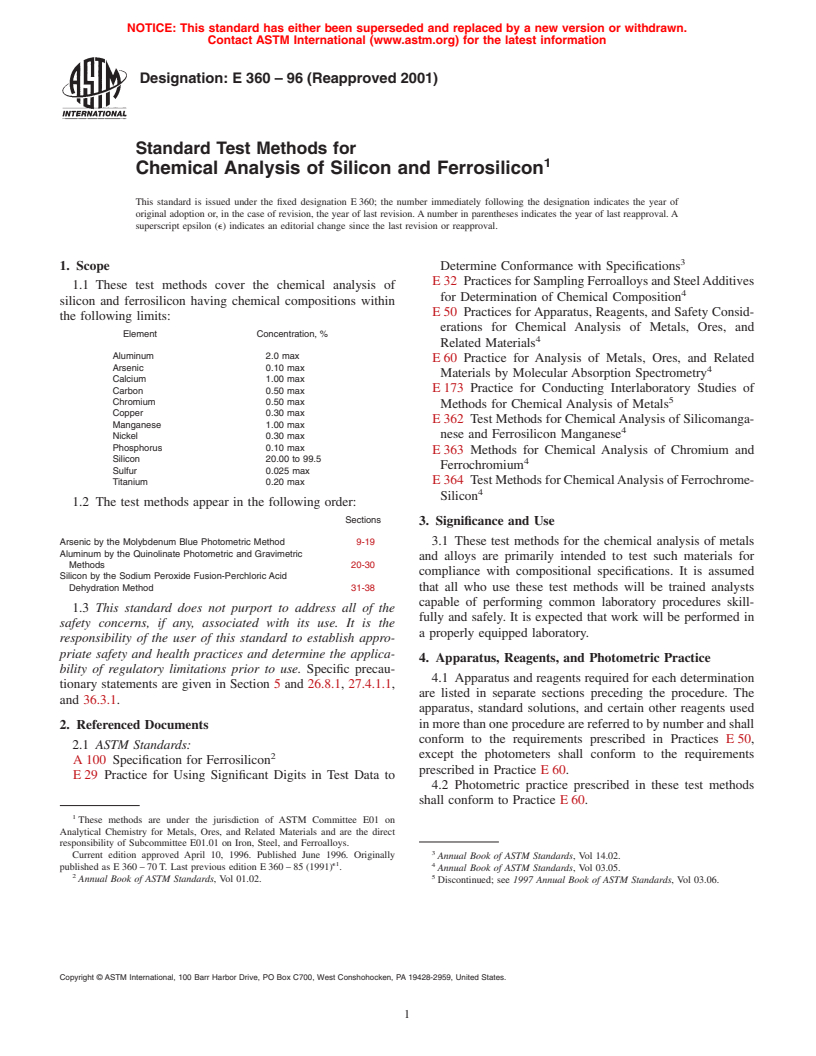
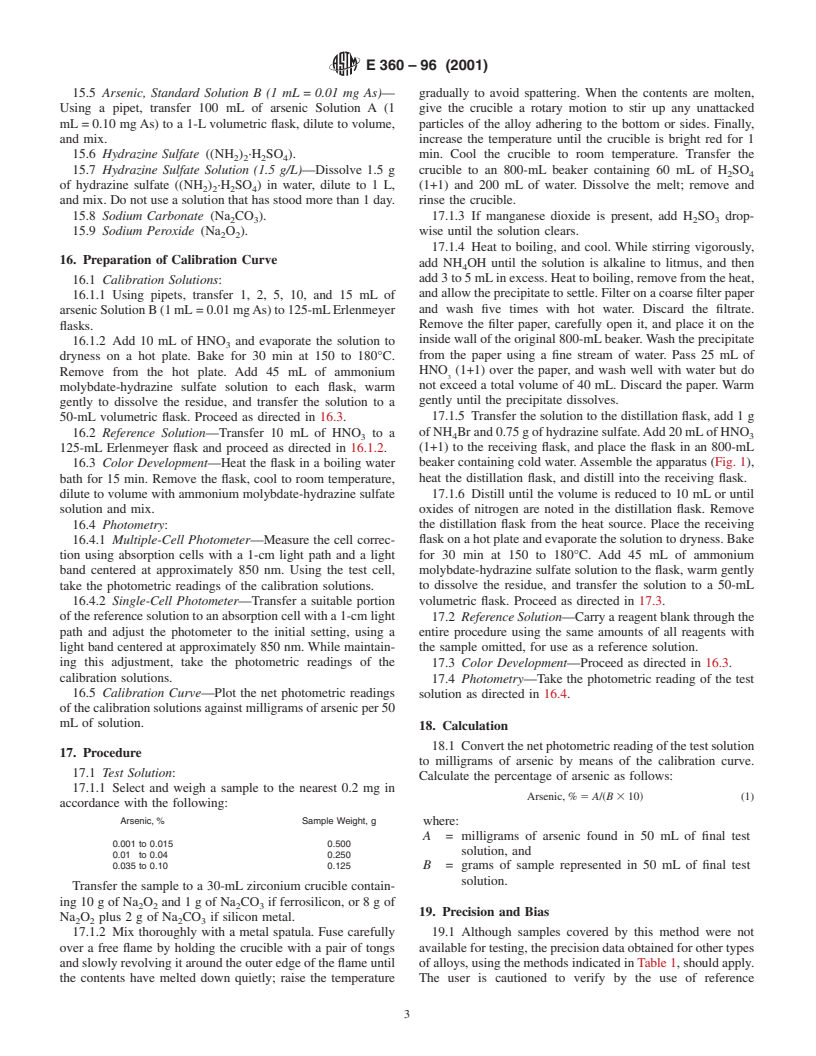
1.1 These test methods cover the chemical analysis of silicon and ferrosilicon having chemical compositions within the following limits:ElementConcentration, %Aluminum2.0 maxArsenic0.10 maxCalcium1.00 maxCarbon0.50 maxChromium0.50 maxCopper0.30 maxManganese1.00 maxNickel0.30 maxPhosphorus0.10 maxSilicon20.00 to 99.5Sulfur0.025 maxTitanium0.20 max
1.2 The test methods appear in the following order: SectionsArsenic by the Molybdenum Blue Photometric MethodAluminum by the Quinolinate Photometric and GravimetricMethodsSilicon by the Sodium Peroxide Fusion-Perchloric Acid Dehydration Method
1.3 This standard does not purport to address all of the safety concerns, if any, associated with its use. It is the responsibility of the user of this standard to establish appropriate safety and health practices and determine the applicability of regulatory limitations prior to use. Specific precautionary statements are given in Section 5 and 26.8.1, 27.4.1.1, and 36.3.1.
WITHDRAWN RATIONALE
These test methods cover the chemical analysis of silicon and ferrosilicon having chemical compositions within established limits.
Formerly under the jurisdiction of Committee E01 on Analytical Chemistry for Metals, Ores, and Related Materials, these test methods were withdrawn in September 2006.
General Information
Relations
Standards Content (Sample)
NOTICE: This standard has either been superseded and replaced by a new version or withdrawn.
Contact ASTM International (www.astm.org) for the latest information
Designation:E360–96(Reapproved2001)
Standard Test Methods for
1
Chemical Analysis of Silicon and Ferrosilicon
This standard is issued under the fixed designation E 360; the number immediately following the designation indicates the year of
original adoption or, in the case of revision, the year of last revision. A number in parentheses indicates the year of last reapproval. A
superscript epsilon (e) indicates an editorial change since the last revision or reapproval.
3
1. Scope Determine Conformance with Specifications
E32 Practices for Sampling Ferroalloys and SteelAdditives
1.1 These test methods cover the chemical analysis of
4
for Determination of Chemical Composition
silicon and ferrosilicon having chemical compositions within
E50 Practices forApparatus, Reagents, and Safety Consid-
the following limits:
erations for Chemical Analysis of Metals, Ores, and
Element Concentration, %
4
Related Materials
Aluminum 2.0 max
E60 Practice for Analysis of Metals, Ores, and Related
Arsenic 0.10 max
4
Materials by Molecular Absorption Spectrometry
Calcium 1.00 max
E 173 Practice for Conducting Interlaboratory Studies of
Carbon 0.50 max
5
Chromium 0.50 max
Methods for Chemical Analysis of Metals
Copper 0.30 max
E 362 Test Methods for ChemicalAnalysis of Silicomanga-
Manganese 1.00 max
4
nese and Ferrosilicon Manganese
Nickel 0.30 max
Phosphorus 0.10 max
E 363 Methods for Chemical Analysis of Chromium and
Silicon 20.00 to 99.5
4
Ferrochromium
Sulfur 0.025 max
Titanium 0.20 max E 364 Test Methods for ChemicalAnalysis of Ferrochrome-
4
Silicon
1.2 The test methods appear in the following order:
Sections
3. Significance and Use
3.1 These test methods for the chemical analysis of metals
Arsenic by the Molybdenum Blue Photometric Method 9-19
Aluminum by the Quinolinate Photometric and Gravimetric
and alloys are primarily intended to test such materials for
Methods 20-30
compliance with compositional specifications. It is assumed
Silicon by the Sodium Peroxide Fusion-Perchloric Acid
that all who use these test methods will be trained analysts
Dehydration Method 31-38
capable of performing common laboratory procedures skill-
1.3 This standard does not purport to address all of the
fully and safely. It is expected that work will be performed in
safety concerns, if any, associated with its use. It is the
a properly equipped laboratory.
responsibility of the user of this standard to establish appro-
priate safety and health practices and determine the applica-
4. Apparatus, Reagents, and Photometric Practice
bility of regulatory limitations prior to use. Specific precau-
4.1 Apparatus and reagents required for each determination
tionary statements are given in Section 5 and 26.8.1, 27.4.1.1,
are listed in separate sections preceding the procedure. The
and 36.3.1.
apparatus, standard solutions, and certain other reagents used
in more than one procedure are referred to by number and shall
2. Referenced Documents
conform to the requirements prescribed in Practices E50,
2.1 ASTM Standards:
except the photometers shall conform to the requirements
2
A 100 Specification for Ferrosilicon
prescribed in PracticeE60.
E29 Practice for Using Significant Digits in Test Data to
4.2 Photometric practice prescribed in these test methods
shall conform to PracticeE60.
1
These methods are under the jurisdiction of ASTM Committee E01 on
Analytical Chemistry for Metals, Ores, and Related Materials and are the direct
responsibility of Subcommittee E01.01 on Iron, Steel, and Ferroalloys.
3
Current edition approved April 10, 1996. Published June 1996. Originally
Annual Book of ASTM Standards, Vol 14.02.
e1
4
published as E 360 – 70 T. Last previous edition E 360 – 85 (1991) .
Annual Book of ASTM Standards, Vol 03.05.
2
5
Annual Book of ASTM Standards, Vol 01.02.
Discontinued; see 1997 Annual Book of ASTM Standards, Vol 03.06.
Copyright © ASTM International, 100 Barr Harbor Drive, PO Box C700, West Conshohocken, PA 19428-2959, United States.
1
---------------------- Page: 1 ----------------------
E360–96 (2001)
5. Safety Hazards 11. Concentration Range
5.1 For precautions to be observed in the use of certain 11.1 The recommended concentration range is 0.01 to 0.15
reagents in these test methods, refer to PracticesE50. mg of arsenic per 50 mL of solution using a 1-cm cell.
NOTE 1—This method has been written for cells having a 1-cm light
6. Sampling
path. Cells having other dimensions may be used, provided suitable
adjustments can be made in the amount of sample and reagents used.
6.1 For procedures for sampling the material, and for
particle size of the sample for chemical analysis, refer to
12. Stability of Color
PracticesE32.
12.1 The color is stable for at least 2 h.
7. Rounding Off Calculated Values
13. Interferences
7.1 Calculated values shall be rounded off to the desired
13.1 The elements
...
Questions, Comments and Discussion
Ask us and Technical Secretary will try to provide an answer. You can facilitate discussion about the standard in here.