

ASTM A36/A36M-19
(Specification)Standard Specification for Carbon Structural Steel
General Information
- Abstract
ABSTRACT
This specification covers carbon structural steel shapes, plates, and bars of structural quality for use in riveted, bolted, or welded construction of bridges and buildings, and for general structural purposes. Heat analysis shall be used to determine the required chemical composition for carbon, manganese, phosphorus, sulfur, silicon, and copper. Tensile strength, yield strength, and elongation shall be evaluated using tension test and must conform to the required tensile properties.
SCOPE
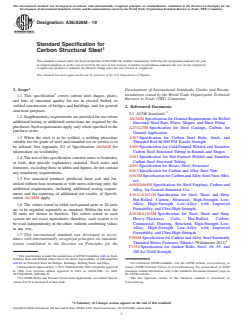
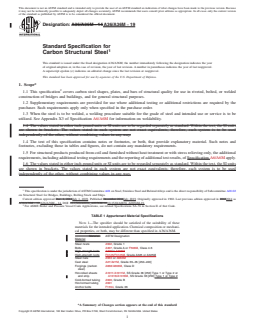
1.1 This specification2 covers carbon steel shapes, plates, and bars of structural quality for use in riveted, bolted, or welded construction of bridges and buildings, and for general structural purposes.
1.2 Supplementary requirements are provided for use where additional testing or additional restrictions are required by the purchaser. Such requirements apply only when specified in the purchase order.
1.3 When the steel is to be welded, a welding procedure suitable for the grade of steel and intended use or service is to be utilized. See Appendix X3 of Specification A6/A6M for information on weldability.
1.4 The text of this specification contains notes or footnotes, or both, that provide explanatory material. Such notes and footnotes, excluding those in tables and figures, do not contain any mandatory requirements.
1.5 For structural products produced from coil and furnished without heat treatment or with stress relieving only, the additional requirements, including additional testing requirements and the reporting of additional test results, of Specification A6/A6M apply.
1.6 The values stated in either inch-pound units or SI units are to be regarded separately as standard. Within the text, the SI units are shown in brackets. The values stated in each system are not exact equivalents; therefore, each system is to be used independently of the other, without combining values in any way.
1.7 This international standard was developed in accordance with internationally recognized principles on standardization established in the Decision on Principles for the Development of International Standards, Guides and Recommendations issued by the World Trade Organization Technical Barriers to Trade (TBT) Committee.
- Status
- Published
- Publication Date
- 30-Jun-2019
- Technical Committee
- A01 - Steel, Stainless Steel and Related Alloys


Overview
ASTM A36/A36M-19: Standard Specification for Carbon Structural Steel defines the requirements for shapes, plates, and bars made of carbon steel, particularly for use in structural applications such as bridges and buildings. Published by ASTM International, this widely recognized standard outlines critical characteristics for steel materials intended for riveted, bolted, or welded construction. Its specifications address essential aspects like chemical composition, mechanical properties, manufacturing practices, and supplementary requirements requested by purchasers.
Key Topics
Scope of Application
ASTM A36/A36M-19 covers carbon structural steel for general structural purposes, particularly where steel will be part of load-bearing frames in bridges, buildings, and other structures.Material Forms
The standard applies to a variety of product forms including:- Plates
- Shapes (such as beams, angles, channels)
- Bars
Mandatory Properties
- Chemical Composition: Specifies maximum content for elements including carbon, manganese, phosphorus, sulfur, silicon, and, optionally, copper.
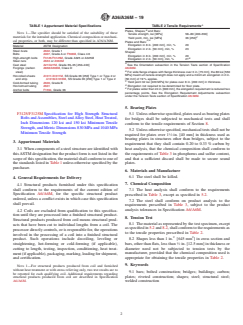
- Mechanical Properties: Requires tensile strength, yield strength, and elongation to be verified by tension testing.
- Manufacturing Processes: Dictates requirements for heat analysis and product analysis to ensure quality and consistency.
Qualified Construction Methods
- Riveting
- Bolting
- Welding (with guidelines for suitable welding procedures depending on intended use)
Optional Supplementary Requirements
- Purchasers may request additional or stricter testing and restrictions by indicating them in purchase orders, allowing for customization based on project needs.
Units of Measure
- Both inch-pound and SI (metric) units are accepted, though each system must be used independently without intermixing values.
Applications
ASTM A36/A36M-19 is integral to the international supply chain for structural steel, ensuring consistency and reliability in key sectors, including:
Building Construction:
Utilized in structural frames, columns, beams, and reinforcement elements for commercial, residential, and industrial buildings.Bridge Construction:
Applied in bridge girders, deck plates, and other load-bearing elements, supporting both vehicular and pedestrian traffic.General Structural Purposes:
Suitable for use in framing, supports, bracing, machinery bases, and other critical infrastructure where strength and weldability are essential.Welded, Bolted, or Riveted Assemblies:
The standard provides guidelines ensuring the material’s compatibility with various attachment and joining methods common in modern construction.
Related Standards
ASTM A36/A36M-19 references a suite of related documents and material specifications that support different aspects of steel structures and fastener systems. Key related standards include:
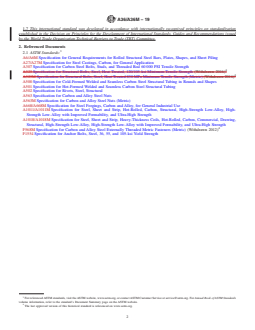
- ASTM A6/A6M: General requirements for rolled structural steel bars, plates, shapes, and sheet piling
- ASTM A27/A27M: Specification for steel castings, carbon, for general application
- ASTM A307: Specification for carbon steel bolts, studs, and threaded rods
- ASTM A500 & A501: Specifications for welded and seamless carbon steel structural tubing
- ASTM F3125/F3125M: High-strength structural bolts (replacing A325/A325M)
- ASTM A563/A563M: Specification for carbon and alloy steel nuts
- ASTM A1011/A1011M & A1018/A1018M: Specifications for hot-rolled carbon steel, sheet, and strip
- ASTM F1554: Specification for anchor bolts
Practical Value
The adoption of ASTM A36/A36M-19 in engineering and construction projects:
- Promotes reliable quality and predictable performance in carbon structural steel products.
- Facilitates international procurement by harmonizing material standards.
- Supports building and bridge safety through minimum requirements for strength, ductility, and chemical composition.
- Enhances design flexibility with recognized weldability and compatibility with standard fastener systems.
- Enables better communication and specification in construction contracts and supply agreements.
Keywords: ASTM A36, Carbon Structural Steel, Steel Plates, Structural Shapes, Steel Bars, Building Construction, Bridge Construction, Steel Standard, Welded Construction, Bolted Construction, Mechanical Properties, Chemical Composition.
For further information or to purchase the full standard, visit the ASTM International website.
Relations
- Effective Date
- 01-Mar-2024
- Effective Date
- 01-Feb-2024
- Effective Date
- 01-Nov-2023
- Effective Date
- 01-Nov-2023
- Effective Date
- 01-Nov-2023
- Effective Date
- 01-May-2020
- Effective Date
- 01-Mar-2020
- Effective Date
- 01-Dec-2019
- Effective Date
- 01-Sep-2019
- Effective Date
- 01-Sep-2019
- Effective Date
- 01-May-2019
- Effective Date
- 01-Dec-2018
- Effective Date
- 01-Jun-2018
- Refers
ASTM F1554-17 - Standard Specification for Anchor Bolts, Steel, 36, 55, and 105-ksi Yield Strength - Effective Date
- 01-Dec-2017
- Refers
ASTM F1554-17e1 - Standard Specification for Anchor Bolts, Steel, 36, 55, and 105-ksi Yield Strength - Effective Date
- 01-Dec-2017
Get Certified
Connect with accredited certification bodies for this standard

Element Materials Technology
Materials testing and product certification.

Inštitut za kovinske materiale in tehnologije
Institute of Metals and Technology. Materials testing, metallurgical analysis, NDT.
Sponsored listings
Frequently Asked Questions
ASTM A36/A36M-19 is a technical specification published by ASTM International. Its full title is "Standard Specification for Carbon Structural Steel". This standard covers: ABSTRACT This specification covers carbon structural steel shapes, plates, and bars of structural quality for use in riveted, bolted, or welded construction of bridges and buildings, and for general structural purposes. Heat analysis shall be used to determine the required chemical composition for carbon, manganese, phosphorus, sulfur, silicon, and copper. Tensile strength, yield strength, and elongation shall be evaluated using tension test and must conform to the required tensile properties. SCOPE 1.1 This specification2 covers carbon steel shapes, plates, and bars of structural quality for use in riveted, bolted, or welded construction of bridges and buildings, and for general structural purposes. 1.2 Supplementary requirements are provided for use where additional testing or additional restrictions are required by the purchaser. Such requirements apply only when specified in the purchase order. 1.3 When the steel is to be welded, a welding procedure suitable for the grade of steel and intended use or service is to be utilized. See Appendix X3 of Specification A6/A6M for information on weldability. 1.4 The text of this specification contains notes or footnotes, or both, that provide explanatory material. Such notes and footnotes, excluding those in tables and figures, do not contain any mandatory requirements. 1.5 For structural products produced from coil and furnished without heat treatment or with stress relieving only, the additional requirements, including additional testing requirements and the reporting of additional test results, of Specification A6/A6M apply. 1.6 The values stated in either inch-pound units or SI units are to be regarded separately as standard. Within the text, the SI units are shown in brackets. The values stated in each system are not exact equivalents; therefore, each system is to be used independently of the other, without combining values in any way. 1.7 This international standard was developed in accordance with internationally recognized principles on standardization established in the Decision on Principles for the Development of International Standards, Guides and Recommendations issued by the World Trade Organization Technical Barriers to Trade (TBT) Committee.
ABSTRACT This specification covers carbon structural steel shapes, plates, and bars of structural quality for use in riveted, bolted, or welded construction of bridges and buildings, and for general structural purposes. Heat analysis shall be used to determine the required chemical composition for carbon, manganese, phosphorus, sulfur, silicon, and copper. Tensile strength, yield strength, and elongation shall be evaluated using tension test and must conform to the required tensile properties. SCOPE 1.1 This specification2 covers carbon steel shapes, plates, and bars of structural quality for use in riveted, bolted, or welded construction of bridges and buildings, and for general structural purposes. 1.2 Supplementary requirements are provided for use where additional testing or additional restrictions are required by the purchaser. Such requirements apply only when specified in the purchase order. 1.3 When the steel is to be welded, a welding procedure suitable for the grade of steel and intended use or service is to be utilized. See Appendix X3 of Specification A6/A6M for information on weldability. 1.4 The text of this specification contains notes or footnotes, or both, that provide explanatory material. Such notes and footnotes, excluding those in tables and figures, do not contain any mandatory requirements. 1.5 For structural products produced from coil and furnished without heat treatment or with stress relieving only, the additional requirements, including additional testing requirements and the reporting of additional test results, of Specification A6/A6M apply. 1.6 The values stated in either inch-pound units or SI units are to be regarded separately as standard. Within the text, the SI units are shown in brackets. The values stated in each system are not exact equivalents; therefore, each system is to be used independently of the other, without combining values in any way. 1.7 This international standard was developed in accordance with internationally recognized principles on standardization established in the Decision on Principles for the Development of International Standards, Guides and Recommendations issued by the World Trade Organization Technical Barriers to Trade (TBT) Committee.
ASTM A36/A36M-19 is classified under the following ICS (International Classification for Standards) categories: 77.140.10 - Heat-treatable steels. The ICS classification helps identify the subject area and facilitates finding related standards.
ASTM A36/A36M-19 has the following relationships with other standards: It is inter standard links to ASTM A6/A6M-24, ASTM A502-24, ASTM F3125/F3125M-23, ASTM A1018/A1018M-23a, ASTM A6/A6M-23, ASTM A27/A27M-20, ASTM A668/A668M-20, ASTM F3125/F3125M-19, ASTM A27/A27M-19, ASTM A668/A668M-19a, ASTM A668/A668M-19, ASTM F3125/F3125M-18, ASTM A1011/A1011M-18, ASTM F1554-17, ASTM F1554-17e1. Understanding these relationships helps ensure you are using the most current and applicable version of the standard.
ASTM A36/A36M-19 is available in PDF format for immediate download after purchase. The document can be added to your cart and obtained through the secure checkout process. Digital delivery ensures instant access to the complete standard document.
Standards Content (Sample)
This international standard was developed in accordance with internationally recognized principles on standardization established in the Decision on Principles for the
Development of International Standards, Guides and Recommendations issued by the World Trade Organization Technical Barriers to Trade (TBT) Committee.
Designation:A36/A36M −19
Standard Specification for
Carbon Structural Steel
This standard is issued under the fixed designation A36/A36M; the number immediately following the designation indicates the year
of original adoption or, in the case of revision, the year of last revision. A number in parentheses indicates the year of last reapproval.
A superscript epsilon (´) indicates an editorial change since the last revision or reapproval.
This standard has been approved for use by agencies of the U.S. Department of Defense.
1. Scope* Development of International Standards, Guides and Recom-
2 mendations issued by the World Trade Organization Technical
1.1 This specification covers carbon steel shapes, plates,
Barriers to Trade (TBT) Committee.
and bars of structural quality for use in riveted, bolted, or
welded construction of bridges and buildings, and for general
2. Referenced Documents
structural purposes.
2.1 ASTM Standards:
1.2 Supplementary requirements are provided for use where
A6/A6M Specification for General Requirements for Rolled
additional testing or additional restrictions are required by the
Structural Steel Bars, Plates, Shapes, and Sheet Piling
purchaser. Such requirements apply only when specified in the
A27/A27M Specification for Steel Castings, Carbon, for
purchase order.
General Application
1.3 When the steel is to be welded, a welding procedure A307 Specification for Carbon Steel Bolts, Studs, and
Threaded Rod 60 000 PSI Tensile Strength
suitable for the grade of steel and intended use or service is to
be utilized. See Appendix X3 of Specification A6/A6M for A500 Specification for Cold-Formed Welded and Seamless
Carbon Steel Structural Tubing in Rounds and Shapes
information on weldability.
A501 Specification for Hot-Formed Welded and Seamless
1.4 Thetextofthisspecificationcontainsnotesorfootnotes,
Carbon Steel Structural Tubing
or both, that provide explanatory material. Such notes and
A502 Specification for Rivets, Steel, Structural
footnotes, excluding those in tables and figures, do not contain
A563 Specification for Carbon and Alloy Steel Nuts
any mandatory requirements.
A563M Specification for Carbon andAlloy Steel Nuts (Met-
1.5 For structural products produced from coil and fur-
ric)
nished without heat treatment or with stress relieving only, the
A668/A668M Specification for Steel Forgings, Carbon and
additional requirements, including additional testing require-
Alloy, for General Industrial Use
ments and the reporting of additional test results, of Specifi-
A1011/A1011M Specification for Steel, Sheet and Strip,
cation A6/A6M apply.
Hot-Rolled, Carbon, Structural, High-Strength Low-
1.6 The values stated in either inch-pound units or SI units Alloy, High-Strength Low-Alloy with Improved
Formability, and Ultra-High Strength
are to be regarded separately as standard. Within the text, the
SI units are shown in brackets. The values stated in each A1018/A1018M Specification for Steel, Sheet and Strip,
Heavy-Thickness Coils, Hot-Rolled, Carbon,
system are not exact equivalents; therefore, each system is to
be used independently of the other, without combining values Commercial, Drawing, Structural, High-Strength Low-
Alloy, High-Strength Low-Alloy with Improved
in any way.
Formability, and Ultra-High Strength
1.7 This international standard was developed in accor-
F568M Specification for Carbon and Alloy Steel Externally
dance with internationally recognized principles on standard-
Threaded Metric Fasteners (Metric) (Withdrawn 2012)
ization established in the Decision on Principles for the
F1554 Specification for Anchor Bolts, Steel, 36, 55, and
105-ksi Yield Strength
This specification is under the jurisdiction of ASTM Committee A01 on Steel,
Stainless Steel and Related Alloys and is the direct responsibility of Subcommittee
A01.02 on Structural Steel for Bridges, Buildings, Rolling Stock and Ships. For referenced ASTM standards, visit the ASTM website, www.astm.org, or
Current edition approved July 1, 2019. Published July 2019. Originally approved contact ASTM Customer Service at service@astm.org. For Annual Book of ASTM
in 1960. Last previous edition approved in 2014 as A36/A36M – 14. DOI: Standards volume information, refer to the standard’s Document Summary page on
10.1520/A0036_A0036M-19. the ASTM website.
2 4
For ASME Boiler and Pressure Vessel Code Applications, see related Specifi- The last approved version of this historical standard is referenced on
cations SA-36 in Section II of that Code. www.astm.org.
*A Summary of Changes section appears at the end of this standard
Copyright © ASTM International, 100 Barr Harbor Drive, PO Box C700, West Conshohocken, PA 19428-2959. United States
A36/A36M−19
A
TABLE 1 Appurtenant Material Specifications TABLE 2 Tensile Requirements
B
Plates, Shapes, and Bars:
NOTE 1—The specifier should be satisfied of the suitability of these
Tensile strength, ksi [MPa] 58–80 [400–550]
materials for the intended application. Chemical composition or mechani-
C
Yield point, min, ksi [MPa] 36 [250]
D,E
cal properties, or both, may be different than specified in A36/A36M.
Plates and Bars:
Elongation in 8 in. [200 mm], min, % 20
Material ASTM Designation
Elongation in 2 in. [50 mm], min, % 23
Steel rivets A502, Grade 1
Shapes:
Bolts A307, GradeAor F568M, Class 4.6
Elongation in 8 in. [200 mm], min, % 20
High-strength bolts F3125/F3125M, Grade A325 or A325M
B
Elongation in 2 in. [50 mm], min, % 21
Steel nuts A563 or A563M
A
Cast steel A27/A27M, Grade 65–35 [450–240] See the Orientation subsection in the Tension Tests section of Specification
A6/A6M.
Forgings (carbon A668/A668M, Class D
B
For wide flange shapes with flange thickness over 3 in. [75 mm], the 80 ksi [550
steel)
MPa] maximum tensile strength does not apply and a minimum elongation in 2 in.
Hot-rolled sheets A1011/A1011M, SS Grade 36 [250] Type 1 or Type 2 or
[50 mm] of 19 % applies.
and strip A1018/A1018M, SS Grade 36 [250] Type 1 or Type 2
C
Yield point 32 ksi [220 MPa] for plates over 8 in. [200 mm] in thickness.
Cold-formed tubing A500, Grade B
D
Elongation not required to be determined for floor plate.
Hot-formed tubing A501
E
For plates wider than 24 in. [600 mm], the elongation requirement is reduced two
Anchor bolts F1554, Grade 36
percentage points. See the Elongation Requirement Adjustments subsection
under the Tension Tests section of Specification A6/A6M.
5. Bearing Plates
F3125/F3125M Specification for High Strength Structural
5.1 Unless otherwise specified, plates used as bearing plates
BoltsandAssemblies,SteelandAlloySteel,HeatTreated,
for bridges shall be subjected to mechanical tests and shall
Inch Dimensions 120 ksi and 150 ksi Minimum Tensile
conform to the t
...
This document is not an ASTM standard and is intended only to provide the user of an ASTM standard an indication of what changes have been made to the previous version. Because
it may not be technically possible to adequately depict all changes accurately, ASTM recommends that users consult prior editions as appropriate. In all cases only the current version
of the standard as published by ASTM is to be considered the official document.
Designation: A36/A36M − 14 A36/A36M − 19
Standard Specification for
Carbon Structural Steel
This standard is issued under the fixed designation A36/A36M; the number immediately following the designation indicates the year
of original adoption or, in the case of revision, the year of last revision. A number in parentheses indicates the year of last reapproval.
A superscript epsilon (´) indicates an editorial change since the last revision or reapproval.
This standard has been approved for use by agencies of the U.S. Department of Defense.
1. Scope*
1.1 This specification covers carbon steel shapes, plates, and bars of structural quality for use in riveted, bolted, or welded
construction of bridges and buildings, and for general structural purposes.
1.2 Supplementary requirements are provided for use where additional testing or additional restrictions are required by the
purchaser. Such requirements apply only when specified in the purchase order.
1.3 When the steel is to be welded, a welding procedure suitable for the grade of steel and intended use or service is to be
utilized. See Appendix X3 of Specification A6/A6M for information on weldability.
1.4 The values stated in either inch-pound units or SI units are to be regarded separately as standard. Within the text, the SI units
are shown in brackets. The values stated in each system are not exact equivalents; therefore, each system is to be used
independently of the other, without combining values in any way.
1.4 The text of this specification contains notes or footnotes, or both, that provide explanatory material. Such notes and
footnotes, excluding those in tables and figures, do not contain any mandatory requirements.
1.5 For structural products produced from coil and furnished without heat treatment or with stress relieving only, the additional
requirements, including additional testing requirements and the reporting of additional test results, of Specification A6/A6M apply.
1.6 The values stated in either inch-pound units or SI units are to be regarded separately as standard. Within the text, the SI units
are shown in brackets. The values stated in each system are not exact equivalents; therefore, each system is to be used
independently of the other, without combining values in any way.
This specification is under the jurisdiction of ASTM Committee A01 on Steel, Stainless Steel and Related Alloys and is the direct responsibility of Subcommittee A01.02
on Structural Steel for Bridges, Buildings, Rolling Stock and Ships.
Current edition approved Dec. 1, 2014July 1, 2019. Published December 2014July 2019. Originally approved in 1960. Last previous edition approved in 20122014 as
A36/A36M – 12.A36/A36M – 14. DOI: 10.1520/A0036_A0036M-14.10.1520/A0036_A0036M-19.
For ASME Boiler and Pressure Vessel Code Applications, see related Specifications SA-36 in Section II of that Code.
TABLE 1 Appurtenant Material Specifications
NOTE 1—The specifier should be satisfied of the suitability of these
materials for the intended application. Chemical composition or mechani-
cal properties, or both, may be different than specified in A36/A36M.
Material- ASTM Designation
Material
Steel rivets A502, Grade 1
Bolts A307, Grade A or F568M, Class 4.6
High-strength bolts A325or A325M
High-strength bolts F3125/F3125M, Grade A325 or A325M
Steel nuts A563 or A563M
Cast steel A27/A27M, Grade 65–35 [450–240]
Forgings (carbon A668/A668M, Class D
steel)
Hot-rolled sheets A1011/A1011M, SS Grade 36 [250] Type 1 or Type 2 or
and strip A1018/A1018M, SS Grade 36 [250] Type 1 or Type 2
Cold-formed tubing A500, Grade B
Hot-formed tubing A501
Anchor bolts F1554, Grade 36
*A Summary of Changes section appears at the end of this standard
Copyright © ASTM International, 100 Barr Harbor Drive, PO Box C700, West Conshohocken, PA 19428-2959. United States
A36/A36M − 19
1.7 This international standard was developed in accordance with internationally recognized principles on standardization
established in the Decision on Principles for the Development of International Standards, Guides and Recommendations issued
by the World Trade Organization Technical Barriers to Trade (TBT) Committee.
2. Referenced Documents
2.1 ASTM Standards:
A6/A6M Specification for General Requirements for Rolled Structural Steel Bars, Plates, Shapes, and Sheet Piling
A27/A27M Specification for Steel Castings, Carbon, for General Application
A307 Specification for Carbon Steel Bolts, Studs, and Threaded Rod 60 000 PSI Tensile Strength
A325 Specification for Structural Bolts, Steel, Heat Treated, 120/105 ksi Minimum Tensile Strength (Withdrawn 2016)
A325M Specification for Structural Bolts, Steel, Heat Treated 830 MPa Minimum Tensile Strength (Metric) (Withdrawn 2016)
A500 Specification for Cold-Formed Welded and Seamless Carbon Steel Structural Tubing in Rounds and Shapes
A501 Specification for Hot-Formed Welded and Seamless Carbon Steel Structural Tubing
A502 Specification for Rivets, Steel, Structural
A563 Specification for Carbon and Alloy Steel Nuts
A563M Specification for Carbon and Alloy Steel Nuts (Metric)
A668/A668M Specification for Steel Forgings, Carbon and Alloy, for General Industrial Use
A1011/A1011M Specification for Steel, Sheet and Strip, Hot-Rolled, Carbon, Structural, High-Strength Low-Alloy, High-
Strength Low-Alloy with Improved Formability, and Ultra-High Strength
A1018/A1018M Specification for Steel, Sheet and Strip, Heavy-Thickness Coils, Hot-Rolled, Carbon, Commercial, Drawing,
Structural, High-Strength Low-Alloy, High-Strength Low-Alloy with Improved Formability, and Ultra-High Strength
F568M Specification for Carbon and Alloy Steel Externally Threaded Metric Fasteners (Metric) (Withdrawn 2012)
F1554 Specification for Anchor Bolts, Steel, 36, 55, and 105-ksi Yield Strength
For referenced ASTM standards, visit the ASTM website, www.astm.org, or contact ASTM Customer Service at service@astm.org. For Annual Book of ASTM Standards
volume information, refer to the standard’s Document Summary page on the ASTM website.
The last approved version of this historical standard is referenced on www.astm.org.
A36/A36M − 19
A
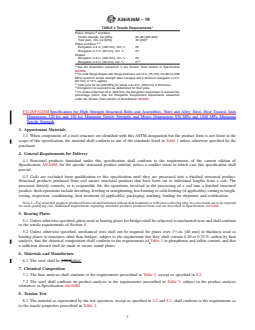
TABLE 2 Tensile Requirements
B
Plates, Shapes, and Bars:
Tensile strength, ksi [MPa] 58–80 [400–550]
C
Yield point, min, ksi [MPa] 36 [250]
D,E
Plates and Bars:
Elongation in 8 in. [200 mm], min, % 20
Elongation in 2 in. [50 mm], min, % 23
Shapes:
Elongation in 8 in. [200 mm], min, % 20
B
Elongation in 2 in. [50 mm], min, % 21
A
See the Orientation subsection in the Tension Tests section of Specification
A6/A6M.
B
For wide flange shapes with flange thickness over 3 in. [75 mm], the 80 ksi [550
MPa] maximum tensile strength does not apply and a minimum elongation in 2 in.
[50 mm] of 19 % applies.
C
Yield point 32 ksi [220 MPa] for plates over 8 in. [200 mm] in thickness.
D
Elongation not required to be determined for floor plate.
E
For plates wider than 24 in. [600 mm], the elongation requirement is reduced two
percentage points. See the Elongation Requirement Adjustments subsection
under the Tension Tests section of Specification A6/A6M.
F3125/F3125M Specification for High Strength Structural Bolts and Assemblies, Steel and Alloy Steel, Heat Treated, Inch
Dimensions 120 ksi and 150 ksi Minimum Tensile Strength, and Metric Dimensions 830 MPa and 1040 MPa Minimum
Tensile Strength
3. Appurtenant Materials
3.1 Wh
...