

ASTM A884/A884M-19e1
(Specification)Standard Specification for Epoxy-Coated Steel Wire and Welded Wire Reinforcement
General Information
- Abstract
ABSTRACT
This specification covers plain and deformed steel wire and plain and deformed steel welded wire reinforcement with protective epoxy coating for use in concrete, masonry and mechanically stabilized earth applications. The materials under this specification shall be in accordance with other ASTM documents enlisted herein. Tests for coating thickness and continuity shall be made on each size of wire or style of welded wire reinforcement. Bend tests for coating flexibility shall be conducted on at least one wire of each size or style or welded wire reinforcement. If the specimen fails to meet the specified requirements for coating thickness, continuity, or bend test (if applicable), two retests on random specimens shall be conducted for each failed test. If both retests meet the specified requirements, the coated material represented by the specimens shall be accepted.
SCOPE
1.1 This specification covers plain and deformed steel wire and plain and deformed steel welded wire reinforcement with protective epoxy coating. A Class A minimum coating thickness is required for wire and welded wire reinforcement intended for use in concrete and masonry. A Class B minimum coating thickness is required for wire and welded wire reinforcement intended for use in mechanically stabilized earth applications. A Type 1 coating is a fusion-bonded epoxy coating that has been formulated to be sufficiently flexible to allow bending of the coated wire or welded wire reinforcement. A Type 2 coating is a fusion-bonded epoxy coating that has not been designed to be sufficiently flexible to allow bending of the coated wire or welded wire reinforcement.
Note 1: The coating applicator is identified throughout this specification as the manufacturer.
1.2 This specification is applicable for orders in either inch-pound units (as Specification A884) or SI units [as Specification A884M].
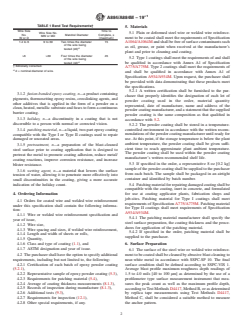
1.3 The values stated in either inch-pound or SI units are to be regarded separately as standard. Within the text, the SI units are shown in brackets. The values stated in each system may not be exact equivalents; therefore, each system shall be used independently of the other except as specifically noted in Table 1. Combining values from the two systems may result in non-conformance with this specification.
1.4 This standard does not purport to address all of the safety concerns, if any, associated with its use. It is the responsibility of the user of this standard to establish appropriate safety, health, and environmental practices and determine the applicability of regulatory limitations prior to use.
1.5 This international standard was developed in accordance with internationally recognized principles on standardization established in the Decision on Principles for the Development of International Standards, Guides and Recommendations issued by the World Trade Organization Technical Barriers to Trade (TBT) Committee.
- Status
- Published
- Publication Date
- 28-Feb-2019
- Technical Committee
- A01 - Steel, Stainless Steel and Related Alloys
- Drafting Committee
- A01.05 - Steel Reinforcement
Overview
ASTM A884/A884M-19e1 is the standard specification developed by ASTM International for epoxy-coated steel wire and welded wire reinforcement. These materials are specifically designed for use in concrete, masonry, and mechanically stabilized earth (MSE) applications. By providing protective epoxy coatings on both plain and deformed steel wire, as well as welded wire reinforcement, this standard helps enhance the durability, corrosion resistance, and lifespan of reinforcing materials in civil engineering and construction projects.
The standard outlines requirements for epoxy coating thickness, flexibility, and continuity, as well as key testing and inspection procedures. Compliance with ASTM A884/A884M-19e1 ensures that steel reinforcement products have consistent quality and are suitable for use in demanding environments.
Key Topics
Types and Classes of Epoxy Coating
- Class A: Minimum coating thickness for concrete and masonry reinforcement
- Class B: Minimum coating thickness for MSE applications
- Type 1: Fusion-bonded epoxy coating designed for flexibility and bending
- Type 2: Fusion-bonded epoxy coating not intended for bending
Material Requirements
- Covers plain and deformed steel wire and welded wire reinforcement
- Coated materials must comply with referenced ASTM specifications for steel quality
Coating Application and Testing
- Surface preparation by abrasive blast cleaning
- Application of fusion-bonded epoxy powder coating via electrostatic spray or suitable methods
- Mandatory testing for coating thickness, continuity (holiday detection), and flexibility (bend test for Type 1)
Inspection, Handling, and Repair
- Guidelines for handling, storing, and transporting coated reinforcement to prevent damage
- Procedures for patching damaged coatings with compatible materials
Acceptance Criteria
- Criteria for test acceptance and procedures for retesting if initial results fail to meet specifications
- Certification requirements for each lot shipped
Applications
Epoxy-coated steel wire and welded wire reinforcement as specified in ASTM A884/A884M-19e1 are used in a variety of construction scenarios where corrosion protection and high durability are essential, including:
- Reinforced concrete structures such as bridges, parking garages, and buildings exposed to harsh environments
- Masonry walls and panels where long-term durability is required
- Mechanically stabilized earth (MSE) structures, such as retaining walls and embankments, where reinforcement may be exposed to soil chemicals and moisture
- Infrastructure projects in coastal environments or locations subject to deicing salts
By specifying ASTM A884/A884M-19e1, engineers and contractors ensure the reinforcement used in their projects meets rigorous requirements for coating thickness, adhesion, and durability, improving the lifespan and reliability of concrete and masonry structures.
Related Standards
The following standards are directly referenced or complement ASTM A884/A884M-19e1, supporting the implementation and quality control of epoxy-coated reinforcements:
- ASTM A775/A775M - Standard Specification for Epoxy-Coated Steel Reinforcing Bars
- ASTM A934/A934M - Standard Specification for Epoxy-Coated Prefabricated Steel Reinforcing Bars
- ASTM A1064/A1064M - Standard Specification for Carbon-Steel Wire and Welded Wire Reinforcement, Plain and Deformed, for Concrete
- SSPC-PA2 - Measurement of Dry Coating Thickness with Magnetic Gauges
- SSPC-SP 10 - Near-White Blast Cleaning
- ACI 301 - Specifications for Structural Concrete (American Concrete Institute)
Adhering to these related standards further ensures the quality, performance, and consistency of materials and processes associated with epoxy-coated steel wire and welded wire reinforcement.
Keywords: ASTM A884, epoxy-coated steel wire, welded wire reinforcement, concrete reinforcement, corrosion resistance, mechanically stabilized earth, construction standards, coating requirements, ASTM standards.
Relations
- Effective Date
- 15-Apr-2024
- Effective Date
- 01-Dec-2019
- Effective Date
- 01-Nov-2018
- Effective Date
- 15-Mar-2017
- Effective Date
- 01-Sep-2016
- Effective Date
- 01-May-2016
- Refers
ASTM A934/A934M-16 - Standard Specification for Epoxy-Coated Prefabricated Steel Reinforcing Bars - Effective Date
- 01-Mar-2016
- Effective Date
- 01-Mar-2016
- Effective Date
- 01-Nov-2015
- Effective Date
- 01-Mar-2015
- Effective Date
- 01-Nov-2014
- Effective Date
- 01-Mar-2014
- Effective Date
- 01-Oct-2013
- Refers
ASTM A934/A934M-13 - Standard Specification for Epoxy-Coated Prefabricated Steel Reinforcing Bars - Effective Date
- 01-Jun-2013
- Effective Date
- 15-Nov-2012
Get Certified
Connect with accredited certification bodies for this standard

Element Materials Technology
Materials testing and product certification.

Inštitut za kovinske materiale in tehnologije
Institute of Metals and Technology. Materials testing, metallurgical analysis, NDT.
Sponsored listings
Frequently Asked Questions
ASTM A884/A884M-19e1 is a technical specification published by ASTM International. Its full title is "Standard Specification for Epoxy-Coated Steel Wire and Welded Wire Reinforcement". This standard covers: ABSTRACT This specification covers plain and deformed steel wire and plain and deformed steel welded wire reinforcement with protective epoxy coating for use in concrete, masonry and mechanically stabilized earth applications. The materials under this specification shall be in accordance with other ASTM documents enlisted herein. Tests for coating thickness and continuity shall be made on each size of wire or style of welded wire reinforcement. Bend tests for coating flexibility shall be conducted on at least one wire of each size or style or welded wire reinforcement. If the specimen fails to meet the specified requirements for coating thickness, continuity, or bend test (if applicable), two retests on random specimens shall be conducted for each failed test. If both retests meet the specified requirements, the coated material represented by the specimens shall be accepted. SCOPE 1.1 This specification covers plain and deformed steel wire and plain and deformed steel welded wire reinforcement with protective epoxy coating. A Class A minimum coating thickness is required for wire and welded wire reinforcement intended for use in concrete and masonry. A Class B minimum coating thickness is required for wire and welded wire reinforcement intended for use in mechanically stabilized earth applications. A Type 1 coating is a fusion-bonded epoxy coating that has been formulated to be sufficiently flexible to allow bending of the coated wire or welded wire reinforcement. A Type 2 coating is a fusion-bonded epoxy coating that has not been designed to be sufficiently flexible to allow bending of the coated wire or welded wire reinforcement. Note 1: The coating applicator is identified throughout this specification as the manufacturer. 1.2 This specification is applicable for orders in either inch-pound units (as Specification A884) or SI units [as Specification A884M]. 1.3 The values stated in either inch-pound or SI units are to be regarded separately as standard. Within the text, the SI units are shown in brackets. The values stated in each system may not be exact equivalents; therefore, each system shall be used independently of the other except as specifically noted in Table 1. Combining values from the two systems may result in non-conformance with this specification. 1.4 This standard does not purport to address all of the safety concerns, if any, associated with its use. It is the responsibility of the user of this standard to establish appropriate safety, health, and environmental practices and determine the applicability of regulatory limitations prior to use. 1.5 This international standard was developed in accordance with internationally recognized principles on standardization established in the Decision on Principles for the Development of International Standards, Guides and Recommendations issued by the World Trade Organization Technical Barriers to Trade (TBT) Committee.
ABSTRACT This specification covers plain and deformed steel wire and plain and deformed steel welded wire reinforcement with protective epoxy coating for use in concrete, masonry and mechanically stabilized earth applications. The materials under this specification shall be in accordance with other ASTM documents enlisted herein. Tests for coating thickness and continuity shall be made on each size of wire or style of welded wire reinforcement. Bend tests for coating flexibility shall be conducted on at least one wire of each size or style or welded wire reinforcement. If the specimen fails to meet the specified requirements for coating thickness, continuity, or bend test (if applicable), two retests on random specimens shall be conducted for each failed test. If both retests meet the specified requirements, the coated material represented by the specimens shall be accepted. SCOPE 1.1 This specification covers plain and deformed steel wire and plain and deformed steel welded wire reinforcement with protective epoxy coating. A Class A minimum coating thickness is required for wire and welded wire reinforcement intended for use in concrete and masonry. A Class B minimum coating thickness is required for wire and welded wire reinforcement intended for use in mechanically stabilized earth applications. A Type 1 coating is a fusion-bonded epoxy coating that has been formulated to be sufficiently flexible to allow bending of the coated wire or welded wire reinforcement. A Type 2 coating is a fusion-bonded epoxy coating that has not been designed to be sufficiently flexible to allow bending of the coated wire or welded wire reinforcement. Note 1: The coating applicator is identified throughout this specification as the manufacturer. 1.2 This specification is applicable for orders in either inch-pound units (as Specification A884) or SI units [as Specification A884M]. 1.3 The values stated in either inch-pound or SI units are to be regarded separately as standard. Within the text, the SI units are shown in brackets. The values stated in each system may not be exact equivalents; therefore, each system shall be used independently of the other except as specifically noted in Table 1. Combining values from the two systems may result in non-conformance with this specification. 1.4 This standard does not purport to address all of the safety concerns, if any, associated with its use. It is the responsibility of the user of this standard to establish appropriate safety, health, and environmental practices and determine the applicability of regulatory limitations prior to use. 1.5 This international standard was developed in accordance with internationally recognized principles on standardization established in the Decision on Principles for the Development of International Standards, Guides and Recommendations issued by the World Trade Organization Technical Barriers to Trade (TBT) Committee.
ASTM A884/A884M-19e1 is classified under the following ICS (International Classification for Standards) categories: 77.140.65 - Steel wire, wire ropes and link chains. The ICS classification helps identify the subject area and facilitates finding related standards.
ASTM A884/A884M-19e1 has the following relationships with other standards: It is inter standard links to ASTM A1064/A1064M-24, ASTM D4417-19, ASTM A1064/A1064M-18, ASTM A1064/A1064M-17, ASTM A1064/A1064M-16b, ASTM A1064/A1064M-16a, ASTM A934/A934M-16, ASTM A1064/A1064M-16, ASTM A1064/A1064M-15a, ASTM A1064/A1064M-15, ASTM A1064/A1064M-14, ASTM A775/A775M-07b(2014), ASTM A1064/A1064M-13, ASTM A934/A934M-13, ASTM A1064/A1064M-12. Understanding these relationships helps ensure you are using the most current and applicable version of the standard.
ASTM A884/A884M-19e1 is available in PDF format for immediate download after purchase. The document can be added to your cart and obtained through the secure checkout process. Digital delivery ensures instant access to the complete standard document.
Standards Content (Sample)
This international standard was developed in accordance with internationally recognized principles on standardization established in the Decision on Principles for the
Development of International Standards, Guides and Recommendations issued by the World Trade Organization Technical Barriers to Trade (TBT) Committee.
´1
Designation:A884/A884M −19
Standard Specification for
Epoxy-Coated Steel Wire and Welded Wire Reinforcement
This standard is issued under the fixed designationA884/A884M; the number immediately following the designation indicates the year
of original adoption or, in the case of revision, the year of last revision. A number in parentheses indicates the year of last reapproval.
A superscript epsilon (´) indicates an editorial change since the last revision or reapproval.
ε NOTE—Editorial corrections were made throughout in September 2020.
1. Scope* Development of International Standards, Guides and Recom-
mendations issued by the World Trade Organization Technical
1.1 This specification covers plain and deformed steel wire
Barriers to Trade (TBT) Committee.
and plain and deformed steel welded wire reinforcement with
protective epoxy coating. A Class A minimum coating thick-
2. Referenced Documents
ness is required for wire and welded wire reinforcement
intended for use in concrete and masonry.AClass B minimum 2.1 ASTM Standards:
A775/A775M Specification for Epoxy-Coated Steel Rein-
coating thickness is required for wire and welded wire rein-
forcement intended for use in mechanically stabilized earth forcing Bars
A934/A934M Specification for Epoxy-Coated Prefabricated
applications. A Type 1 coating is a fusion-bonded epoxy
coating that has been formulated to be sufficiently flexible to Steel Reinforcing Bars
A1064/A1064M Specification for Carbon-Steel Wire and
allow bending of the coated wire or welded wire reinforce-
ment. A Type 2 coating is a fusion-bonded epoxy coating that Welded Wire Reinforcement, Plain and Deformed, for
Concrete
has not been designed to be sufficiently flexible to allow
bending of the coated wire or welded wire reinforcement. D4417 Test Methods for Field Measurement of Surface
Profile of Blast Cleaned Steel
NOTE 1—The coating applicator is identified throughout this specifica-
tion as the manufacturer. 2.2 Society for Protective Coatings Specifications:
SSPC-PA2 Measurement of Dry Coating Thickness with
1.2 This specification is applicable for orders in either
Magnetic Gauges
inch-pound units (as Specification A884) or SI units [as
SSPC-SP 10 Near-White Blast Cleaning
Specification A884M].
SSPC-VIS 1 Pictorial Surface Preparation Standards for
1.3 The values stated in either inch-pound or SI units are to
Painting Steel Surfaces
be regarded separately as standard.Within the text, the SI units
2.3 American Concrete Institute Specification:
are shown in brackets. The values stated in each system may
ACI 301 Specifications for Structural Concrete
not be exact equivalents; therefore, each system shall be used
2.4 Concrete Reinforcing Steel Institute:
independently of the other except as specifically noted in Table
CRSI “Voluntary Certification Program for Fusion Bonded
1. Combining values from the two systems may result in
Epoxy Coating Applicator Plants”
non-conformance with this specification.
1.4 This standard does not purport to address all of the
3. Terminology
safety concerns, if any, associated with its use. It is the
3.1 Definitions:
responsibility of the user of this standard to establish appro-
3.1.1 disbonding, n—loss of adhesion between the fusion-
priate safety, health, and environmental practices and deter-
bonded epoxy coating and the steel reinforcement.
mine the applicability of regulatory limitations prior to use.
1.5 This international standard was developed in accor-
dance with internationally recognized principles on standard-
ization established in the Decision on Principles for the For referenced ASTM standards, visit the ASTM website, www.astm.org, or
contact ASTM Customer Service at service@astm.org. For Annual Book of ASTM
Standards volume information, refer to the standard’s Document Summary page on
the ASTM website.
1 3
This specification is under the jurisdiction ofASTM Committee A01 on Steel, Available from Society for Protective Coatings (SSPC), 800 Trumbull Dr.,
Stainless Steel and Related Alloys and is the direct responsibility of Subcommittee Pittsburgh, PA 15205, http://www.sspc.org.
A01.05 on Steel Reinforcement. Available from American Concrete Institute (ACI), 38800 Country Club Dr.,
Current edition approved March 1, 2019. Published March 2019. Originally Farmington Hills, MI 48331-3439, http://www.concrete.org.
approved in 1988. Last previous edition approved in 2014 as A884/A884M – 14. Available from Concrete Reinforcing Steel Institute (CRSI), 933 N. Plum
DOI: 10.1520/A0884_A0884M-19E01. Grove Rd., Schaumburg, IL 60173-4758, http://www.crsi.org.
*A Summary of Changes section appears at the end of this standard
Copyright © ASTM International, 100 Barr Harbor Drive, PO Box C700, West Conshohocken, PA 19428-2959. United States
´1
A884/A884M−19
TABLE 1 Bend Test Requirements†
5. Materials
Wire Size Time to
Wire Size No. 5.1 Plain or deformed steel wire or welded wire reinforce-
No. Mandrel Diameter Complete, s
MW or MD
ment to be coated shall meet the requirements of Specification
WorD [maximum]
1.4 to 6 9 to 39 Two times the diameter 15
A1064/A1064Mandshallbefreeofsurfacecontaminantssuch
of the wire being
as oil, grease, or paint when received at the manufacturer’s
A
tested (2d)
plant and prior to cleaning and coating.
>6 >39 Four times the diameter 45
5.2 Type 1 coatings shall meet the requirements of and shall
of the wire being
A
tested (4d) be qualified in accordance with Annex A1 of Specification
† Editorially corrected.
A775/A775M. Type 2 coatings shall meet the requirements of
A
d = nominal diameter of wire.
and shall be qualified in accordance with Annex A1 of
Specification A934/A934M. Upon request, the purchaser shall
be provided with data demonstrating that these products meet
the specifications.
5.2.1 A written certification shall be furnished to the pur-
3.1.2 fusion-bonded epoxy coating, n—a product containing
chaser that properly identifies the designation of each lot of
pigments, thermosetting epoxy resins, crosslinking agents, and
powder coating used in the order, material quantity
other additives that is applied in the form of a powder on a
represented, date of manufacture, name and address of the
clean, heated, metallic substrate and fuses to form a continuous
powdercoatingmanufacturer,andastatementthatthesupplied
barrier coating.
powder coating is the same composition as that qualified in
3.1.3 holiday, n—a discontinuity in a coating that is not
accordance with 5.2.
discernible to a person with normal or corrected vision.
5.2.2 The powder coating shall be stored in a temperature-
3.1.4 patching material, n—aliquid,two-partepoxycoating controlled environment in accordance with the written recom-
mendations of the powder coating manufacturer until ready for
compatible with the Type I or Type II coatings used to repair
use.At this point, if the storage temperature is below the plant
damaged or uncoated areas.
ambient temperature, the powder coating shall be given suffi-
3.1.5 pretreatment, n—a preparation of the blast-cleaned
cient time to reach approximate plant ambient temperature.
steel surface prior to coating application that is designed to
The powder coating shall be used within the powder coating
pretreat the metal to promote coating adhesion, reduce metal/
manufacturer’s written recommended shelf life.
coating reactions, improve corrosion resistance, and increase
5.3 If specified in the order, a representative 8 oz [0.2 kg]
blister resistance.
sampleofthepowdercoatingshallbesuppliedtothepurchaser
3.1.6 wetting agent, n—a material that lowers the surface
from each batch. The sample shall be packaged in an airtight
tension of water, allowing it to penetrate more effectively into
container and identified by batch number.
small discontinuities in the coating, giving a more accurate
5.4 Patchingmaterialforrepairingdamagedcoatingshallbe
indication of the holiday count.
compatible with the coating, inert in concrete, and formulated
for use at coating applicator plants, fabrication shops and
4. Ordering Information
job-sites. Patching material for Type I coatings shall meet
4.1 Orders for coated wire and welded wire reinforcement
requirements of Specification A775/A775M. Patching material
under this specification shall contain the following informa-
for Type II coatings shall meet requirements of Specification
tion:
A934/A934M.
4.1.1 Wire or welded wire reinforcement specification and
5.4.1 The patching material manufacturer shall specify the
year of issue,
steel surface preparation, the coating thickness and the proce-
4.1.2 Wire size,
dures for application of the patching material.
4.1.3 Wire spacing and sizes, if welded wire reinforcement,
5.4.2 If specified in the order, patching material shall be
4.1.4 Length and width of sheets or rolls,
supplied to the purchaser.
4.1.5 Quantity,
4.1.6 Class and type of coating (1.1), and
6. Surface Preparation
4.1.7 ASTM designation and year of issue.
6.1 The surface of the steel wire or welded wire reinforce-
4.2 Thepurchasershallhavetheoptiontospecifyadditional menttobecoatedshallbecleanedbyabrasiveblastcleaningto
requirements, including but not limited to, the following: near-white metal in accordance with SSPC-SP 10. The final
4.2.1 Certification of each batch of epoxy powder coating surface condition shall be defined according to SSPC-VIS 1.
(5.2.1), Average blast profile maximum roughness depth readings of
4.2.2 Representative sample of epoxy powder coating (5.3), 1.5 to 4.0 mils [40 to 100 µm] as determined by the use of a
4.2.3 Requirements for patching material (5.4), profilometer type surface measurement instrument that mea-
4.2.4 Average of coating thickness measurements (8.1.3), sures the peak count as well as the maximum profile depth,
4.2.5 Records of inspection during manufacture (8.1.3), according toTest Methods D4417, Method B, or as determined
4.2.6 Additional tests (9.3), by replica tape measurements using Test Methods D4417,
4.2.7 Requirements for inspection (12.1), Method C, shall be considered a suitable method to measure
4.2.8 Other special requirements, if any. the anchor pattern.
´1
A884/A884M−19
NOTE 2—Abrasive blast cleaning of wire and welded wire reinforce-
of10recordedmeasurementspertestspecimen).Noindividual
mentwithahighdegree(>90 %)ofgritinthecleaningmediaprovidesthe
gauge reading shall be taken closer than 0.5 in. [13 mm] from
most suitable anchor profile for coating adhesion. After grit has been
an intersection.
recycled, a small portion of it will take on the appearance of shot.
8.1.4 For acceptance purposes, the average of all coating
6.2 Multidirectional, high-pressure, dry air knives shall be
thickness measurements shall not be less than the specified
used after blast cleaning to remove dust, grit, and other foreign
minimum thickness. No single coating thickness measurement
matter from the steel surface. The air knives shall not deposit
shall be less than 80 % of the specified minimum thickness.
oil on the steel reinforcement.
Any individual gauge reading may be under-run by a greater
amount.
NOTE 3—It is recommended that incoming wire and welded wire
8.1.5 Measurements shall be made in accordance with
reinforcement and blast media should be checked for salt contamination
prior to use. Blast media found to be salt contaminated should be rejected. SSPC-PA2 following the instructions for calibration and use
Wire and welded wire reinforcement found to be salt contaminated from
recommended by the thickness gauge manufacturer. Pull-off or
exposure to deicing salts or salt spray should be cleaned by acid washing
fixed-probe gauges shall be used. Pencil-type pull-off gauges
or other suitable methods to remove salt contaminants from the surface
that require the operator to observe the reading at the instant
prior to blast cleaning.
the magnet is pulled from the surface shall not be used.
6.3 Pretreatment of the blast-cleaned steel reinforcement
8.2 Coating Continuity:
surface by the manufacturer is required when specified by the
8.2.1 Thereshallnotbemorethananaverageofoneholiday
purchaser. This pretreatment shall be applied after abrasive
per foot [three holidays per metre] on the coated wire (spool
cleaning and before coating, in accordance with the written
and individual lengths).
application instructions specified by the pretreatment manufac-
8.2.2 In welded wire reinforcement, there shall not be more
turer.
than an average of one holiday per foot [three holidays per
metre] in each wire direction. Voids (uncoated areas due to the
7. Coating Application
Faraday Cage Effect and weld spurs) at welded intersections
7.1 The powder coating shall be applied to the cleaned and
shall not be counted. Damage at cut ends shall not be counted.
pretreated (if used) surface within 3 hours after surface
8.2.3 Holiday checks to determine acceptability of the wire
treatments have been completed, and before visible oxidation
or welded wire reinforcement shall be made at the manufac-
of the surface occurs discernible to a person with normal or
turer’s plant with a 67 ⁄2-V, 80 000 ohm, wet-sponge-type
corrected vision.
direct current holiday detector.
7.2 The fusion-bonded epoxy powder coating shall be
NOTE 5—Holiday detection is not intended for use at the job-site.
applied in accordance with the written recommendations of the
8.3 Bend Test—Type 1 Coating Requirement Only:
manufacturer of the powder coating for initial steel surface
8.3.1 The flexibility of the coating shall be evaluated by
temperature range and post-
...