

ASTM F1941/F1941M-16
(Specification)Standard Specification for Electrodeposited Coatings on Mechanical Fasteners, Inch and Metric
General Information
- Abstract
ABSTRACT
This specification covers application, performance and dimensional requirements for electrodeposited coatings on threaded fasteners with metric screw threads. It specifies coating thickness, supplementary hexavalent chromate or trivalent chromite finishes, corrosion resistance, precautions for managing the risk of hydrogen embrittlement and hydrogen embrittlement relief for high-strength and surface-hardened fasteners. It also highlights the differences between barrel and rack plating and makes recommendations as to the applicability of each process. The coating material, coating thickness, chromate finish, and trivalent chromite finish shall be selected and designated. The electrodeposited coating shall cover all surfaces and shall meet the following requirements: the coating metal deposit shall be bright or semibright, smooth, fine grained, adherent and uniform in appearance; the coating shall be free of blisters, pits, nodules, roughness, cracks, unplated areas, and other defects that will affect the function of the coating; and the coating shall not be stained, discolored or exhibit any evidence of white or red corrosion products. Slight discoloration that results from baking, drying, or electrode contact during rack-plating, or all of these, as well as slight staining that results from rinsing shall not be cause for rejection. Corrosion resistance and embrittlement of coatings shall be determined by performing mechanical tests.
SCOPE
1.1 This specification covers application, performance and dimensional requirements for electrodeposited coatings on threaded fasteners with unified inch and metric screw threads, but it may also be applied to other threaded parts and non-threaded parts such as washers and pins. It specifies coating thickness, supplementary hexavalent chromate or non-hexavalent conversion coatings, corrosion resistance, precautions for managing the risk of hydrogen embrittlement and hydrogen embrittlement relief for high-strength and surface-hardened fasteners. It also highlights the differences between barrel and rack plating and makes recommendations as to the applicability of each process.
1.2 The values stated in either SI units or inch-pound units are to be regarded separately as standard. The values stated in each system may not be exact equivalents; therefore, each system shall be used independently of the other. Combining values from the two systems may result in non-conformance with the standard.
1.3 Terms used in this specification are defined in Terminology F1789.
1.4 The following precautionary statement pertains to the test method portion only, Section 9, of this specification: This standard does not purport to address all of the safety concerns, if any, associated with its use. It is the responsibility of the user of this standard to establish appropriate safety and health practices and determine the applicability of regulatory limitations prior to use.
- Status
- Published
- Publication Date
- 30-Nov-2016
- Technical Committee
- F16 - Fasteners
- Drafting Committee
- F16.03 - Coatings on Fasteners
Buy Documents
ASTM F1941/F1941M-16 - Standard Specification for Electrodeposited Coatings on Mechanical Fasteners, Inch and Metric
REDLINE ASTM F1941/F1941M-16 - Standard Specification for Electrodeposited Coatings on Mechanical Fasteners, Inch and Metric
Overview
ASTM F1941/F1941M-16 is the internationally recognized standard that specifies the application, performance, and dimensional requirements for electrodeposited coatings on mechanical fasteners. This standard covers both unified inch and metric screw threads, and it also applies to non-threaded parts like washers and pins. Key focus areas include coating thickness, conversion coatings (such as supplementary hexavalent chromate or non-hexavalent finishes), corrosion resistance, and recommendations for barrel vs rack plating processes. The standard is designed to ensure that coated fasteners maintain integrity, durability, and adequate protection against environmental factors, while managing risks such as hydrogen embrittlement.
Key Topics
Scope and Applicability
- Covers all threaded fasteners with unified inch and metric threads.
- Applicable to other threaded and non-threaded mechanical parts.
- Addresses both dimensional and functional coating requirements.
Coating Specifications
- Outlines minimum coating thicknesses based on fastener application.
- Specifies compatible electrodeposited coating materials, including zinc, cadmium, zinc-cobalt, zinc-nickel, and zinc-iron alloys.
- Provides clear designations for conversion coatings, such as hexavalent and non-hexavalent chromate finishes.
Performance Requirements
- Defines acceptable coating characteristics: bright to semi-bright, smooth, fine-grained, adherent, and uniform appearance.
- Coatings must be free of defects like blisters, pits, nodules, roughness, and unplated areas that impact function.
- Mandates corrosion resistance, including specific neutral salt spray test durations.
- Outlines hydrogen embrittlement risk management and relief processes, especially for high-strength and surface-hardened fasteners.
Dimensional and Process Guidance
- Ensures thread dimensions are not compromised by coating applications.
- Details the suitability of barrel vs rack plating processes, considering fastener size and thread integrity.
- Explains differences in coating distribution on surfaces based on chosen electroplating method.
Applications
Industrial and Manufacturing Sectors
- Widely used in automotive, aerospace, construction, and machinery applications where mechanical fasteners require enhanced corrosion protection and durability.
- Frequently specified for fasteners used in harsh or outdoor environments to ensure extended service life.
Quality Assurance and Compliance
- Serves as a reference for coating applicators, fastener manufacturers, and purchasers seeking reliable criteria for coated fastener performance.
- Supports achieving consistent, high-quality results in mass production environments where repeatable coating performance is vital.
Procurement and Contracting
- Provides clear ordering information for specifying desired coating type, thickness, conversion finish, and supplementary topcoats or lubricants.
- Assists in selecting the most cost-effective and functionally appropriate electroplating process for each application.
Related Standards
- ASTM B633: Specification for Electrodeposited Coatings of Zinc on Iron and Steel (previously used for mechanical fasteners, now superseded by ASTM F1941/F1941M for these applications).
- ISO 4042: International standard covering electroplated coatings on threaded fasteners.
- ASME B1.1 & ISO 965 series: For thread dimensional requirements and tolerances in inch and metric systems.
- ASTM B117: Salt spray (fog) testing for evaluating corrosion resistance.
- ASTM F519: Hydrogen embrittlement evaluation for coatings and service environments.
- ASTM F1940: Verification to prevent hydrogen embrittlement in plated fasteners.
- ASTM F1470: Guide for fastener sampling and inspection processes.
ASTM F1941/F1941M-16 is an essential standard for ensuring that electrodeposited coatings on mechanical fasteners meet stringent quality, performance, and durability criteria. By following its guidelines, manufacturers and end-users can achieve reliable corrosion protection, maintain dimensional integrity, and reduce failures due to coating defects or hydrogen embrittlement. This leads to improved performance, safety, and long-term value in industrial applications.
Relations
- Effective Date
- 01-Dec-2016
- Effective Date
- 19-Oct-2015
- Effective Date
- 01-Jan-2024
- Effective Date
- 01-Dec-2023
- Effective Date
- 01-Nov-2023
- Effective Date
- 01-Aug-2019
- Effective Date
- 01-May-2019
- Effective Date
- 01-Nov-2018
- Effective Date
- 01-Nov-2018
- Effective Date
- 01-Sep-2018
- Effective Date
- 01-Feb-2018
- Effective Date
- 01-Dec-2017
- Effective Date
- 01-Nov-2017
- Effective Date
- 01-Jun-2017
- Effective Date
- 01-Mar-2017
Buy Documents
ASTM F1941/F1941M-16 - Standard Specification for Electrodeposited Coatings on Mechanical Fasteners, Inch and Metric
REDLINE ASTM F1941/F1941M-16 - Standard Specification for Electrodeposited Coatings on Mechanical Fasteners, Inch and Metric
Get Certified
Connect with accredited certification bodies for this standard

DVS-ZERT GmbH
German welding certification society.
CARES (UK Certification Authority for Reinforcing Steels)
UK certification for reinforcing steels and construction.
EWF/IIW (European/International Welding Federation)
International welding personnel certification.
Sponsored listings
Frequently Asked Questions
ASTM F1941/F1941M-16 is a technical specification published by ASTM International. Its full title is "Standard Specification for Electrodeposited Coatings on Mechanical Fasteners, Inch and Metric". This standard covers: ABSTRACT This specification covers application, performance and dimensional requirements for electrodeposited coatings on threaded fasteners with metric screw threads. It specifies coating thickness, supplementary hexavalent chromate or trivalent chromite finishes, corrosion resistance, precautions for managing the risk of hydrogen embrittlement and hydrogen embrittlement relief for high-strength and surface-hardened fasteners. It also highlights the differences between barrel and rack plating and makes recommendations as to the applicability of each process. The coating material, coating thickness, chromate finish, and trivalent chromite finish shall be selected and designated. The electrodeposited coating shall cover all surfaces and shall meet the following requirements: the coating metal deposit shall be bright or semibright, smooth, fine grained, adherent and uniform in appearance; the coating shall be free of blisters, pits, nodules, roughness, cracks, unplated areas, and other defects that will affect the function of the coating; and the coating shall not be stained, discolored or exhibit any evidence of white or red corrosion products. Slight discoloration that results from baking, drying, or electrode contact during rack-plating, or all of these, as well as slight staining that results from rinsing shall not be cause for rejection. Corrosion resistance and embrittlement of coatings shall be determined by performing mechanical tests. SCOPE 1.1 This specification covers application, performance and dimensional requirements for electrodeposited coatings on threaded fasteners with unified inch and metric screw threads, but it may also be applied to other threaded parts and non-threaded parts such as washers and pins. It specifies coating thickness, supplementary hexavalent chromate or non-hexavalent conversion coatings, corrosion resistance, precautions for managing the risk of hydrogen embrittlement and hydrogen embrittlement relief for high-strength and surface-hardened fasteners. It also highlights the differences between barrel and rack plating and makes recommendations as to the applicability of each process. 1.2 The values stated in either SI units or inch-pound units are to be regarded separately as standard. The values stated in each system may not be exact equivalents; therefore, each system shall be used independently of the other. Combining values from the two systems may result in non-conformance with the standard. 1.3 Terms used in this specification are defined in Terminology F1789. 1.4 The following precautionary statement pertains to the test method portion only, Section 9, of this specification: This standard does not purport to address all of the safety concerns, if any, associated with its use. It is the responsibility of the user of this standard to establish appropriate safety and health practices and determine the applicability of regulatory limitations prior to use.
ABSTRACT This specification covers application, performance and dimensional requirements for electrodeposited coatings on threaded fasteners with metric screw threads. It specifies coating thickness, supplementary hexavalent chromate or trivalent chromite finishes, corrosion resistance, precautions for managing the risk of hydrogen embrittlement and hydrogen embrittlement relief for high-strength and surface-hardened fasteners. It also highlights the differences between barrel and rack plating and makes recommendations as to the applicability of each process. The coating material, coating thickness, chromate finish, and trivalent chromite finish shall be selected and designated. The electrodeposited coating shall cover all surfaces and shall meet the following requirements: the coating metal deposit shall be bright or semibright, smooth, fine grained, adherent and uniform in appearance; the coating shall be free of blisters, pits, nodules, roughness, cracks, unplated areas, and other defects that will affect the function of the coating; and the coating shall not be stained, discolored or exhibit any evidence of white or red corrosion products. Slight discoloration that results from baking, drying, or electrode contact during rack-plating, or all of these, as well as slight staining that results from rinsing shall not be cause for rejection. Corrosion resistance and embrittlement of coatings shall be determined by performing mechanical tests. SCOPE 1.1 This specification covers application, performance and dimensional requirements for electrodeposited coatings on threaded fasteners with unified inch and metric screw threads, but it may also be applied to other threaded parts and non-threaded parts such as washers and pins. It specifies coating thickness, supplementary hexavalent chromate or non-hexavalent conversion coatings, corrosion resistance, precautions for managing the risk of hydrogen embrittlement and hydrogen embrittlement relief for high-strength and surface-hardened fasteners. It also highlights the differences between barrel and rack plating and makes recommendations as to the applicability of each process. 1.2 The values stated in either SI units or inch-pound units are to be regarded separately as standard. The values stated in each system may not be exact equivalents; therefore, each system shall be used independently of the other. Combining values from the two systems may result in non-conformance with the standard. 1.3 Terms used in this specification are defined in Terminology F1789. 1.4 The following precautionary statement pertains to the test method portion only, Section 9, of this specification: This standard does not purport to address all of the safety concerns, if any, associated with its use. It is the responsibility of the user of this standard to establish appropriate safety and health practices and determine the applicability of regulatory limitations prior to use.
ASTM F1941/F1941M-16 is classified under the following ICS (International Classification for Standards) categories: 21.060.01 - Fasteners in general; 25.220.40 - Metallic coatings. The ICS classification helps identify the subject area and facilitates finding related standards.
ASTM F1941/F1941M-16 has the following relationships with other standards: It is inter standard links to ASTM F1941/F1941M-15, ASTM F1941M-07, ASTM F1470-24, ASTM F519-23, ASTM F1789-23, ASTM F1940-07a(2019), ASTM E376-19, ASTM F519-18, ASTM F1624-12(2018), ASTM F788-13(2018), ASTM F1470-18, ASTM F519-17a, ASTM E376-17, ASTM F1789-17, ASTM F519-17. Understanding these relationships helps ensure you are using the most current and applicable version of the standard.
ASTM F1941/F1941M-16 is available in PDF format for immediate download after purchase. The document can be added to your cart and obtained through the secure checkout process. Digital delivery ensures instant access to the complete standard document.
Standards Content (Sample)
This international standard was developed in accordance with internationally recognized principles on standardization established in the Decision on Principles for the
Development of International Standards, Guides and Recommendations issued by the World Trade Organization Technical Barriers to Trade (TBT) Committee.
Designation:F1941/F1941M −16
Standard Specification for
Electrodeposited Coatings on Mechanical Fasteners, Inch
and Metric
ThisstandardisissuedunderthefixeddesignationF1941/F1941M;thenumberimmediatelyfollowingthedesignationindicatestheyear
of original adoption or, in the case of revision, the year of last revision.Anumber in parentheses indicates the year of last reapproval.
A superscript epsilon (´) indicates an editorial change since the last revision or reapproval.
INTRODUCTION
This specification covers the coating of steel unified inch and metric mechanical fasteners by
electrodeposition. The properties of the coatings shall conform to the ASTM standards for the
individual finishes. This standard shall be used in place of ASTM B633 for mechanical fasteners.
Coating thickness values are based on standard tolerances for inch and metric external threads.The
coating must not cause the basic thread size to be transgressed by either the internal or external
threads.ThemethodofdesignatinginchcoatedthreadsshallcomplywithASMEB1.1andISO965-1,
ISO 965-2, and ISO 965-3 for ISO metric coated threads.
With normal methods for depositing metallic coatings from aqueous solutions, there is a risk of
delayed failure due to hydrogen embrittlement for case hardened fasteners and fasteners having a
hardnessabove39HRC.Althoughthisriskcanbemanagedbyselectingrawmaterialssuitableforthe
application of electrodeposited coatings and by using modern methods of surface treatment and post
heat-treatment (baking), the risk of hydrogen embrittlement cannot be completely eliminated.
Therefore, the application of a metallic coating by electrodeposition is not recommended for such
fasteners.
1. Scope* 1.3 Terms used in this specification are defined in Termi-
nology F1789.
1.1 This specification covers application, performance and
1.4 The following precautionary statement pertains to the
dimensional requirements for electrodeposited coatings on
test method portion only, Section 9, of this specification: This
threaded fasteners with unified inch and metric screw threads,
standard does not purport to address all of the safety concerns,
but it may also be applied to other threaded parts and
if any, associated with its use. It is the responsibility of the user
non-threaded parts such as washers and pins. It specifies
of this standard to establish appropriate safety and health
coating thickness, supplementary hexavalent chromate or non-
practices and determine the applicability of regulatory limita-
hexavalent conversion coatings, corrosion resistance, precau-
tions prior to use.
tions for managing the risk of hydrogen embrittlement and
hydrogen embrittlement relief for high-strength and surface-
2. Referenced Documents
hardened fasteners. It also highlights the differences between
2.1 ASTM Standards:
barrel and rack plating and makes recommendations as to the
applicability of each process. B117Practice for Operating Salt Spray (Fog) Apparatus
B487Test Method for Measurement of Metal and Oxide
1.2 The values stated in either SI units or inch-pound units
Coating Thickness by Microscopical Examination of
are to be regarded separately as standard. The values stated in
Cross Section
each system may not be exact equivalents; therefore, each
B499Test Method for Measurement of CoatingThicknesses
system shall be used independently of the other. Combining
by the Magnetic Method: Nonmagnetic Coatings on
values from the two systems may result in non-conformance
Magnetic Basis Metals
with the standard.
B504Test Method for Measurement of Thickness of Metal-
lic Coatings by the Coulometric Method
This specification is under the jurisdiction of ASTM Committee F16 on
Fasteners and is the direct responsibility of Subcommittee F16.03 on Coatings on
Fasteners. For referenced ASTM standards, visit the ASTM website, www.astm.org, or
Current edition approved Dec. 1, 2016. Published January 2017. Originally contact ASTM Customer Service at service@astm.org. For Annual Book of ASTM
approved in 1998. Last previous edition approved in 2015 as F1941/F1941M–15. Standards volume information, refer to the standard’s Document Summary page on
DOI: 10.1520/F1941_F1941M-16 the ASTM website.
*A Summary of Changes section appears at the end of this standard
Copyright © ASTM International, 100 Barr Harbor Drive, PO Box C700, West Conshohocken, PA 19428-2959. United States
F1941/F1941M−16
NOTE 1—Black dot (•) indicates test surface.
FIG. 1Significant Surfaces on Externally Threaded Fasteners
B567Test Method for Measurement of Coating Thickness 2.5 ISO Standards:
by the Beta Backscatter Method ISO 965-1ISO General Purpose Metric Screw Threads –
B568Test Method for Measurement of Coating Thickness Tolerances – Part 1: Principles and Basic Data
by X-Ray Spectrometry ISO 965-2ISO General Purpose Metric Screw Threads –
B633SpecificationforElectrodepositedCoatingsofZincon Tolerances – Part 2: Limits of Sizes for General Purpose
Iron and Steel External and Internal Screw Threads
B659Guide for Measuring Thickness of Metallic and Inor- ISO 965-3ISO General Purpose Metric Screw Threads –
ganic Coatings Tolerances – Part 3: Deviations for Construction Screw
D6492Practice for Detection of Hexavalent Chromium On Threads
Zinc and Zinc/Aluminum Alloy Coated Steel ISO 4042Electroplated Coatings
E376 Practice for Measuring Coating Thickness by
3. Terminology
Magnetic-Field or Eddy-Current (Electromagnetic) Test-
ing Methods
3.1 Definitions:
F519Test Method for Mechanical Hydrogen Embrittlement
3.1.1 reference area—the area within which a specified
Evaluation of Plating/Coating Processes and Service En-
number of single measurements are required to be made.
vironments
3.1.2 sealant—chemical with or without integral lubricant
F606/F606MTest Methods for Determining the Mechanical
applied on the substrate which forms a composite layer with a
Properties of Externally and Internally Threaded
conversion coating in order to improve chemical resistance,
Fasteners, Washers, Direct Tension Indicators, and Rivets
corrosion protection, UV resistance, etc.
F788Specification for Surface Discontinuities of Bolts,
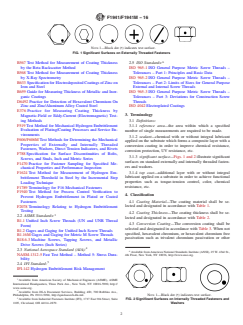
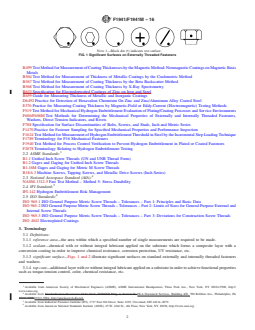
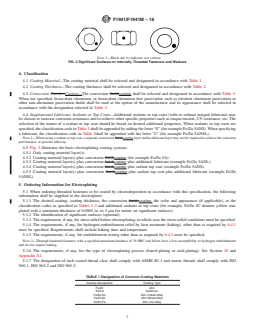
3.1.3 significant surface—Figs. 1 and 2 illustrate significant
Screws, and Studs, Inch and Metric Series
surfaces on standard externally and internally threaded fasten-
F1470Practice for Fastener Sampling for Specified Me-
ers and washers.
chanical Properties and Performance Inspection
3.1.4 top coat—additional layer with or without integral
F1624Test Method for Measurement of Hydrogen Em-
lubricant applied on a substrate in order to achieve functional
brittlement Threshold in Steel by the Incremental Step
properties such as torque-tension control, color, chemical
Loading Technique
resistance, etc.
F1789Terminology for F16 Mechanical Fasteners
F1940Test Method for Process Control Verification to
4. Classification
Prevent Hydrogen Embrittlement in Plated or Coated
Fasteners 4.1 Coating Material—The coating material shall be se-
lected and designated in accordance with Table 1.
F2078Terminology Relating to Hydrogen Embrittlement
Testing
4.2 Coating Thickness—The coating thickness shall be se-
2.2 ASME Standards:
lected and designated in accordance with Table 2.
B1.1Unified Inch Screw Threads (UN and UNR Thread
4.3 Conversion Coating—The conversion coating shall be
Form)
selected and designated in accordance with Table 3. When not
B1.2Gages and Gaging for Unified Inch Screw Threads
specified, hexavalent chromium, or hexavalent chromium free
B1.16MGages and Gaging for Metric M Screw Threads
passivation such as trivalent chromium passivation or other
B18.6.3Machine Screws, Tapping Screws, and Metallic
Drive Screws (Inch Series)
2.3 National Aerospace Standard (AIA):
Available fromAmerican National Standards Institute (ANSI), 25 W. 43rd St.,
NASM-1312-5Fast Test Method – Method 5: Stress Dura-
4th Floor, New York, NY 10036, http://www.ansi.org.
bility
2.4 IFI Standard:
IFI-142Hydrogen Embrittlement Risk Management
Available from American Society of Mechanical Engineers (ASME), ASME
International Headquarters, Three Park Ave., New York, NY 10016-5990, http://
www.asme.org.
Available from DLA Document Services, Building 4/D, 700 Robbins Ave.,
NOTE 1—Black dot (•) indicates test surface.
Philadelphia, PA 19111-5094, http://quicksearch.dla.mil.
Available from Industrial Fasteners Institute (IFI), 1717 East 9th Street, Suite FIG. 2Significant Surfaces on Internally Threaded Fasteners and
1105, Cleveland, OH 44114–2879. Washers
F1941/F1941M−16
TABLE 1 Designation of Common Coating Materials
4.5.2 Coating material layer(s) plus conversion coating (for
Coating Designation Coating Type example Fe/Zn 5A).
Fe/Zn Zinc
4.5.3 Coating material layer(s) plus conversion coating plus
Fe/Cd Cadmium
additional lubricant (example Fe/Zn 5ANL).
Fe/Zn-Co Zinc Cobalt Alloy
4.5.4 Coating material layer(s) plus conversion coating plus
Fe/Zn-Ni Zinc Nickel Alloy
Fe/Zn-Fe Zinc Iron Alloy
sealant top coat (example Fe/Zn 5ANS).
4.5.5 Coating material layer(s) plus conversion coating plus
sealant top coat plus additional lubricant (example Fe/Zn
TABLE 2 Designation of Coating Thickness – Inch and Metric
5ANSL).
NOTE 1—The conversion factor from inch to microns is 2.54 × 10 (for
example, 0.0001 in. = 2.54 µm).
5. Ordering Information for Electroplating
Minimum Thickness
Thickness
5.1 When ordering threaded fasteners to be coated by
Designation
in. µm
electrodeposition in accordance with this specification, the
3 0.0001 3
following information shall be supplied to the electroplater:
5 0.0002 5
8 0.0003 8 5.1.1 The desired coating, coating thickness, the conversion
12 0.0005 12
coating, the color and appearance (if applicable), or the
classification codes as specified in Tables 1-3 and additional
sealants or top coats (for example, Fe/Zn 5C denotes yellow
TABLE 3 Designation of Conversion Coating
zincplatedwithaminimumthicknessof0.0002in.or5µmfor
Conversion Designation
metric on significant surfaces).
Hexavalent
Type Typical Appearance
Hexavalent 5.1.2 The identification of significant surfaces (optional).
Chromium
Chromium
5.1.3 The requirement, if any, for stress relief before
Free
electroplating, in which case the stress-relief conditions must
Clear Transparent colorless with slight AAN
be specified.
iridescence
5.1.4 The requirements, if any, for hydrogen embrittlement
Blue-bright Transparent with a bluish tinge BBN
and slight iridescence
relief by heat treatment (baking), other than as required by
Yellow Yellow iridescent C CN
6.4.1 must be specified. Requirements shall include baking
Opaque Olive green, shading to brown or DDN
time and temperature.
bronze
Black Black with slight iridescence E EN
5.1.5 The requirements, if any, for embrittlement testing
other than as required by 6.4.3 must be specified.
NOTE 2—Through hardened fasteners with a specified maximum
non-chromium passivation finish shall be used at the option of
hardness of 39 HRC and below have a low susceptibility to hydrogen
the manufacturer and its appearance shall be selected in
embrittlement and do not require baking.
accordance with the designation selected in Table 3.
5.1.6 Therequirements,ifany,forthetypeofelectroplating
4.4 Supplemental Lubricant, Sealants or Top Coats—
process (barrel-plating or rack-plating). See Section 10 and
Additional sealants or top coats (with or without integral
Appendix X1.
lubricant) may be chosen to increase corrosion resistance and
5.1.7 The designation of inch coated thread class shall
to achieve other specific properties such as torque-tension, UV
complywithASMEB1.1andmetricthreadsshallcomplywith
resistance, etc. The selection of the nature of a sealant or top
ISO 965-1, ISO 965-2 and ISO 965-3.
coat should be based on desired additional properties. When
sealants or top coats are specified, the classification code in
6. Requirements
Table3shallbeappendedbyaddingtheletter“S”(forexample
6.1 Coating Requirements—The electrodeposited coating as
Fe/Zn 5ANS). When specifying a lubricant, the classification
ordered shall cover all surfaces and shall meet the following
code in Table 3shall be appended with the letter “L” (for
requirements:
example Fe/Zn 5ANSL).
6.1.1 The coating metal deposit shall be bright or semi-
NOTE 1—When using a sealant or top coat, a separate conversion
coating layer and/or lubricant layer may not be required to achieve the
brightunlessotherwisespecifiedbythepurchaser,smooth,fine
corrosion performance or provide lubricity.
grained, adherent and uniform in appearance.
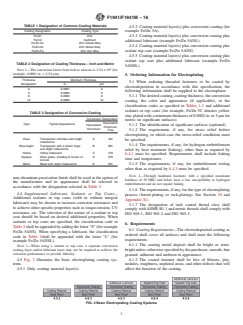
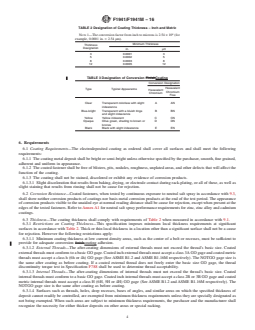
4.5 Fig. 3 illustrates the basic electroplating coating sys- 6.1.2 The coated fastener shall be free of blisters, pits,
tems. nodules, roughness, unplated areas, and other defects that will
4.5.1 Only coating material layer(s). affect the function of the coating.
FIG. 3Basic Electroplating Coating Systems
F1941/F1941M−16
6.1.3 The coating shall not be stained, discolored or exhibit diameter, allowance and tolerance positions. Refer to Appen-
any evidence of corrosion products. dix X3 as a guideline for the tolerances of the various thread
6.1.3.1 Slightdiscolorationthatresultsfrombaking,drying, sizes and classes and the coating thickness they will accom-
or electrode contact during rack-plating, or all of these, as well modate.
asslightstainingthatresultsfromrinsingshallnotbecausefor 6.3.2.2 Because of the inherent variability in coating thick-
rejection. ness by the barrel-plating process, the application of a mini-
mum coating thickness of 0.0005 in. or 12 µm for metric is not
6.2 CorrosionResistance—Coatedfasteners,whentestedby
recommended for a standard screw thread by this method due
continuous exposure to neutral salt spray in accordance with
to the fact that dimensional allowance of most threaded
9.3,shallshowneithercorrosionproductsofcoatingsnorbasis
fasteners normally does not permit it. If the size of the fastener
metal corrosion products at the end of the test period. The
is large enough to economically use the rack-plating process,
appearance of corrosion products visible to the unaided eye at
then the latter shall be used to obtain this thickness require-
normal reading distance shall be cause for rejection, except
ment. If heavier coatings are required, allowance for the
when present at the edges of the tested fasteners. Refer to
deposit buildup must be made during the manufacture of
AnnexA1 for neutral salt spray performance requirements for
fasteners by adjusting pre-plating thread size.
zinc, zinc alloy and cadmium coatings.
6.3.3 Applicability to Wood Screws and Thread Forming
6.3 Thickness—The coating thickness shall comply with
Screws—Any classification code in Tables 1-3 may be applied
requirements of Table 2 when measured in accordance with
to screws that cut or form their own threads.
9.1.
6.4 Hydrogen Embrittlement Relief:
6.3.1 Restrictions on Coating Thickness—This specification
6.4.1 Requirement for Baking for Through Hardened
imposes minimum local thickness requirements at significant
Fasteners—Unless otherwise specified by the purchaser, bak-
surfaces in accordance with Table 2. Thick or thin local
ing is not mandatory for fasteners with specified maximum
thickness in a location other than a significant surface shall not
hardness 39 HRC and below (see Note 3). Coated fasteners
be a cause for rejection. However the following restrictions
made from steel heat treated to a specified hardness above 39
apply:
HRC, and fasteners with captive washers made from hardened
6.3.1.1 Minimum coating thickness at low current density
steelshallbebakedtominimizetheriskofhydrogenembrittle-
areas,suchasthecenterofaboltorrecesses,mustbesufficient
ment.
to provide for adequate conversion coating adhesion.
6.3.1.2 External Threads—The after-coating dimensions of
NOTE 3—With proper care many steel fasteners can be plated without
baking by correlating process conditions, and coating material to the
externalthreadsmustnotexceedthethread’sbasicsize.Coated
susceptibility of the fastener material to hydrogen embrittlement, and by
externalthreadsmustconformtoabasicGOgage.Coatedinch
applying adequate process control procedures, such as those outlined in
external threads must accept a class 3A GO gage and coated
Appendix X4.2. Test Method F1940 is a recognized verification method
metric threads must accept a class h (6h or 4h) GO gage (See
for process control to minimize the risk of hydrogen embrittlement. Upon
ASME B1.2 and ASME B1.16M respectively). The NOTGO
agreementbetweenthesupplierandthepurchaser,thistestmethodcanbe
used as a basis for determining if baking should be mandated in a
gagesizeisthesameaftercoatingasbeforecoating.Ifacoated
controlled process environment.
external thread does not freely enter the basic size GO gage,
the thread discontinuity torque test in Specification F788 shall 6.4.2 Baking Conditions—Unless otherwise specified, mini-
be used to determine thread acceptability. mum baking times shall be in accordance with Table 4.
6.3.1.3 Internal Threads—The after-coating dimensions of 6.4.2.1 Bake temperatures shall always be kept below the
internalthreadsmustnotexceedthethread’sbasicsize.Coated temperingtemperatureofquenchedandtemperedsteelpartsto
internalthreadsmustconformtoabasicGOgage.Coatedinch avoid alteration of mechanical properties by re-tempering.
internal threads must accept a class 2B or 3B GO gage and 6.4.2.2 Baketemperaturesshallnotexceedthevaluesspeci-
coatedmetricinternalthreadsmustacceptaclassH(6H,5Hor fied in Table 4 to avoid the risk of solid or liquid metal
4H) GO gage (See ASME B1.2 and ASME B1.16M respec- embrittlement.
tively). The NOTGO gage size is the same after coating as
NOTE4—Baketimesandtemperaturesareloweredtominimizetherisk
before coating.
of solid or liquid metal embrittlement resulting from alloy compositions
6.3.1.4 Surfaces such as threads, holes, deep recesses, bases
such as those containing lead or from lowering melting point of the
ofangles,andsimilarareasonwhichthespecifiedthicknessof coating material. For example, cadmium has a melting point of 610°F or
310°Cincomparisontozincwhichhasameltingpointof786°For419°C.
deposit cannot readily be controlled, are exempted from
minimum thickness requirements unless they are specially
6.4.2.3 Baking to relieve hydrogen embrittlement should be
designatedasnotbeingexempted.Whensuchareasaresubject performed after electroplating, prior to the application of the
to minimum thickness requirements, the purchaser and the
conversion coating and prior to the application of sealant
manufacturer shall recognize the necessity for either thicker and/or top coat, if any where baking temperatures can damage
deposits on other areas or special racking.
the conversion film thereby negating its performance. After
6.3.2 Applicability to Unified Inch Screw and M Series experimentation,coatersmayfindothersequencesaresuitable.
Metric Threads:
The time between coating and baking should be as short as
6.3.2.1 The applicability of the required coating to unified possible. The requirement, if any, for a specific maximum
inch and M series metric screw threads is limited by the basic allowable time (in hours) between electroplating and baking
deviation of the threads, and hence limited by the pitch shall be explicitly specified by the purchaser at the time of
F1941/F1941M−16
B
TABLE 4 Hydrogen Embrittlement Relief Requirements
ASTM Hydrogen Tapping Screw Hydrogen
Specified Core Hardness Min – Max Baking ASTM Process Control
Min Baking Time Embrittlement Test Embrittlement Test
C,D E
(HRC) Temperature Test Requirement
E
Requirement Requirement
A
Over 39 and up to 44 Min 14 h 375 to 425°F or F606/F606M or F1624 ASME B18.6.3 or F1624 F1940 or F519
190 to 220°C
A
Over 44 Min 24 h 375 to 425°F or F606/F606M or F1624 ASME B18.6.3 or F1624 F1940 or F519
190° to 220C
A
IfTestMethodF1940processcontroltestingisnotperformed,bakingandproducttestingaremandatoryinaccordancewithTable4.IfTestMethodF1940processcontrol
testingisperformedandisshowntoconsistentlypassataminimumofamonthlybasis,thenproducttestingandbakingarenotmandatory.IfTestMethodF1940process
control testing is performed and does not pass, then baking and product testing are mandatory.
B
Variablessuchascoatingtype,coatingthickness,bakingtemperaturesandplatingprocess(barrelorrackplating)caneffectbakingrequirements.ASTMF1940process
control testing can be used to isolate the effect of baking, and shall be the basis to increase or decrease baking times or to eliminate baking altogether. In the absence
of Test Method F1940 process control testing, baking and testing requirements specified in Table 4 shall be used as the default for all conditions.
C
Cadmium baking temperatures should be between 375 to 400°F or 190 to 205°C.
D
Part temperature.
E
When agreed upon between supplier and purchaser, alternative hydrogen embrittlement test methods such as NASM 1312-5 and alternative process control test
methods may be used.
order. A reasonable tolerance of +2h resulting from normal ended stud. An indication that high residual stresses may be
operational constraints shall be assumed. (See Appendix X4.3 present in a portion of the fastener is when localized hardness
for additional information.) below the surface exceeds 30 HRC.
6.4.3 Hydrogen Embrittlement Testing—Unless otherwise
6.5.1 Fasteners with configurations or conditions described
specified by the purchaser, hydrogen embrittlement testing in
above shall be stress relieved at a minimum temperature of
accordance with Table 4 is mandatory for through hardened
875°For470°Cpriortoelectroplatingtoavoidbrittlefractures.
fasteners with a specified core hardness above 39 HRC unless
Increasedhardnessresultingfromthreadrollingbefore,afteror
the electroplating process has been qualified in accordance
without thermal hardening are due to the creation of non-
with a test method in Table 4 (that is, the process has been
detrimental compressive stresses and do not require stress
shown not to cause embrittlement for a given product or class
relief before electroplating.
of product).
NOTE 5—Stress relieving is not intended in cases where residual
6.4.4 Baking and Testing Requirements for Case Hardened
stresses are intentionally introduced, such as screws which are thread
Screws—Surfacehardeningofcasehardenedscrewsintroduces
rolled after heat treatment.
variables additional to the hardness of the core, notably case
hardness and case depth. Case hardened screws that are 6.6 Non-Hexavalent Conversion Coating—When the use of
electroplated shall adhere to the following baking require-
hexavalent chromium is prohibited, coated fasteners shall be
ments. free of hexavalent chromium when tested in accordance with
6.4.4.1 All lots of case hardened screws shall be baked for
the test method defined in 9.4.
a minimum of4hat375to 400°F or 190 to 205°C part
temperature.
7. Dimensional Requirements
6.4.4.2 All case hardened screws shall be tested for hydro-
7.1 Threaded components, except those with spaced and
gen embrittlement in accordance with ASME B18.6.3 for all
forming threads, supplied for electrodeposited coating inch
self-tapping screws. For case hardened machine screws, the
threadsshallcomplywithASMEB1.1andmetricthreadsshall
ASME B18.6.3 method shall be applied except use a hardened
complywithISO965-1,ISO965-2,andISO965-3(see6.3.1.2
threadedtestplatehavingaminimumthicknessofonenominal
and 6.3.1.3). Screw threads that are specifically manufactured
diameter.Thetappedholesshallbe2Bforinchfastenersor6H
to allow the application of 0.0005 in. or 12 µm for metric
for metric fasteners.
threads or greater coating thickness by the barrel-plating
6.4.5 Any lot that fails hydrogen embrittlement testing shall
process, must adhere to a special allowance specified by the
be baked for 24 h at 375 to 400°F or 190 to 205°C part
manufacturer or inASME B1.1 or ISO 965-1, ISO 965-2, and
temperature and retest shall be made using twice the original
ISO 965-3. The other dimensional characteristics shall be as
sample size.
specified in the applicable standard or drawing. It should be
6.5 Stress Relieving Requirements for Work Hardened Fas-
notedthatmodificationstothethreadsofafastenercouldaffect
teners Without Thermal Hardening—Somecoldformedfasten-
its properties or performance, or both. Refer to Appendix X3
ers that are not thermally hardened can fracture due to buildup
for further information on effects of coating on pitch diameter,
of high residual stresses at stress concentration points. The
allowances and tolerances for external and internal threads.
types of fastener shapes that make this a particular concern are
carriagebolts,thinheadpartswheretheminimumthicknessof
8. Sampling
theheadislessthan50%ofthenominaldiameterofthescrew,
shoulder type fasteners where the thread major diameter is 8.1 Samplingforcoatingthickness,saltsprayandembrittle-
menttestingshallbeconductedbasedonlotsizeinaccordance
more than 20% smaller than the shoulder diameter, or where a
larger diameter, thin washer or collar is formed on a double with Guide F1470.
F1941/F1941M−16
9. Test Methods secure uniformity of results, samples shall be aged at room
temperature for 24 h before being subjected to the salt spray
9.1 Coating Thickness—Unless otherwise specified, the re-
test. The salt spray test shall commence within 72 h of
quirement to measure coating thickness is applicable to sig-
completion of the aging period and prior to sorting, packaging
nificant surfaces only. The test methods for determining the
and/or assembling.
coating thickness are defined in Test Methods B487, B499,
9.4 Non-Hexavalent Conversion Coating—The presence of
B504, B567, B568, Guide B659, or Practice E376 as appli-
hexavalent chromium shall be determined in accordance with
cable.
Practice D6492.
9.2 Embrittlement Test Method—Unless otherwise
specified,the
...
This document is not an ASTM standard and is intended only to provide the user of an ASTM standard an indication of what changes have been made to the previous version. Because
it may not be technically possible to adequately depict all changes accurately, ASTM recommends that users consult prior editions as appropriate. In all cases only the current version
of the standard as published by ASTM is to be considered the official document.
Designation: F1941/F1941M − 15 F1941/F1941M − 16
Standard Specification for
Electrodeposited Coatings on Mechanical Fasteners, Inch
and Metric
This standard is issued under the fixed designation F1941/F1941M; the number immediately following the designation indicates the year
of original adoption or, in the case of revision, the year of last revision. A number in parentheses indicates the year of last reapproval.
A superscript epsilon (´) indicates an editorial change since the last revision or reapproval.
INTRODUCTION
This specification covers the coating of steel unified inch and metric mechanical fasteners by
electrodeposition. The properties of the coatings shall conform to the ASTM standards for the
individual finishes. This standard shall be used in place of ASTM B633B633 for mechanical fasteners.
Coating thickness values are based on standard tolerances for inch and metric external threads. The
coating must not cause the basic thread size to be transgressed by either the internal or external
threads. The method of designating inch coated threads shall comply with ASME B1.1 and ISO 965-1,
ISO 965-2, and ISO 965-3 for ISO metric coated threads.
With normal methods for depositing metallic coatings from aqueous solutions, there is a risk of
delayed failure due to hydrogen embrittlement for case hardened fasteners and fasteners having a
hardness above 39 HRC. Although this risk can be managed by selecting raw materials suitable for the
application of electrodeposited coatings and by using modern methods of surface treatment and post
heat-treatment (baking), the risk of hydrogen embrittlement cannot be completely eliminated.
Therefore, the application of a metallic coating by electrodeposition is not recommended for such
fasteners.
1. Scope*
1.1 This specification covers application, performance and dimensional requirements for electrodeposited coatings on threaded
fasteners with unified inch and metric screw threads, but it may also be applied to other threaded parts and non-threaded parts such
as washers and pins. It specifies coating thickness, supplementary hexavalent chromate or non-hexavalent conversion
finishes,coatings, corrosion resistance, precautions for managing the risk of hydrogen embrittlement and hydrogen embrittlement
relief for high-strength and surface-hardened fasteners. It also highlights the differences between barrel and rack plating and makes
recommendations as to the applicability of each process.
1.2 The values stated in inch-pound units and SI metric units. either SI units or inch-pound units are to be regarded separately
as standard. The values stated in each system may not be exact equivalents; therefore, each system shall be used independently
of the other. Combining values from the two systems may result in non-conformance towith the standard.
1.3 Terms used in this specification are defined in Terminology F1789.
1.4 The following precautionary statement pertains to the test method portion only, Section 9, of this specification: This
standard does not purport to address all of the safety concerns, if any, associated with its use. It is the responsibility of the user
of this standard to establish appropriate safety and health practices and determine the applicability of regulatory limitations prior
to use.
2. Referenced Documents
2.1 ASTM Standards:
B117 Practice for Operating Salt Spray (Fog) Apparatus
B487 Test Method for Measurement of Metal and Oxide Coating Thickness by Microscopical Examination of Cross Section
This specification is under the jurisdiction of ASTM Committee F16 on Fasteners and is the direct responsibility of Subcommittee F16.03 on Coatings on Fasteners.
Current edition approved Sept. 1, 2015Dec. 1, 2016. Published October 2015January 2017. Originally approved in 1998. Last previous edition approved in 20102015 as
F1941 – 10.F1941/F1941M – 15. DOI: 10.1520/F1941_F1941M-1510.1520/F1941_F1941M-16
For referenced ASTM standards, visit the ASTM website, www.astm.org, or contact ASTM Customer Service at service@astm.org. For Annual Book of ASTM Standards
volume information, refer to the standard’s Document Summary page on the ASTM website.
*A Summary of Changes section appears at the end of this standard
Copyright © ASTM International, 100 Barr Harbor Drive, PO Box C700, West Conshohocken, PA 19428-2959. United States
F1941/F1941M − 16
NOTE 1—Black dot (•) indicates test surface.
FIG. 1 Significant Surfaces on Externally Threaded Fasteners
B499 Test Method for Measurement of Coating Thicknesses by the Magnetic Method: Nonmagnetic Coatings on Magnetic Basis
Metals
B504 Test Method for Measurement of Thickness of Metallic Coatings by the Coulometric Method
B567 Test Method for Measurement of Coating Thickness by the Beta Backscatter Method
B568 Test Method for Measurement of Coating Thickness by X-Ray Spectrometry
B633 Specification for Electrodeposited Coatings of Zinc on Iron and Steel
B659 Guide for Measuring Thickness of Metallic and Inorganic Coatings
D6492 Practice for Detection of Hexavalent Chromium On Zinc and Zinc/Aluminum Alloy Coated Steel
E376 Practice for Measuring Coating Thickness by Magnetic-Field or Eddy-Current (Electromagnetic) Testing Methods
F519 Test Method for Mechanical Hydrogen Embrittlement Evaluation of Plating/Coating Processes and Service Environments
F606/F606M Test Methods for Determining the Mechanical Properties of Externally and Internally Threaded Fasteners,
Washers, Direct Tension Indicators, and Rivets
F788 Specification for Surface Discontinuities of Bolts, Screws, and Studs, Inch and Metric Series
F1470 Practice for Fastener Sampling for Specified Mechanical Properties and Performance Inspection
F1624 Test Method for Measurement of Hydrogen Embrittlement Threshold in Steel by the Incremental Step Loading Technique
F1789 Terminology for F16 Mechanical Fasteners
F1940 Test Method for Process Control Verification to Prevent Hydrogen Embrittlement in Plated or Coated Fasteners
F2078 Terminology Relating to Hydrogen Embrittlement Testing
2.2 ASME Standards:
B1.1 Unified Inch Screw Threads (UN and UNR Thread Form)
B1.2 Gages and Gaging for Unified Inch Screw Threads
B1.16M Gages and Gaging for Metric M Screw Threads
B18.6.3 Machine Screws, Tapping Screws, and Metallic Drive Screws (Inch Series)
2.3 National Aerospace Standard (AIA):
NASM-1312-5 Fast Test Method – Method 5: Stress Durability
2.4 IFI Standard:
IFI-142 Hydrogen Embrittlement Risk Management
2.5 ISO Standards:
ISO 965-1 ISO General Purpose Metric Screw Threads – Tolerances – Part 1: Principles and Basic Data
ISO 965-2 ISO General Purpose Metric Screw Threads – Tolerances – Part 2: Limits of Sizes for General Purpose External and
Internal Screw Threads
ISO 965-3 ISO General Purpose Metric Screw Threads – Tolerances – Part 3: Deviations for Construction Screw Threads
ISO 4042 Electroplated Coatings
3. Terminology
3.1 Definitions:
3.1.1 reference area—the area within which a specified number of single measurements are required to be made.
3.1.2 sealant—chemical with or without integral lubricant applied on the substrate which forms a composite layer with a
conversion coating in order to improve chemical resistance, corrosion protection, UV resistance, etc.
3.1.3 significant surface—Figs. 1 and 2 illustrate significant surfaces on standard externally and internally threaded fasteners
and washers.
3.1.4 top coat—additional layer with or without integral lubricant applied on a substrate in order to achieve functional properties
such as torque-tension control, color, chemical resistance, etc.
Available from American Society of Mechanical Engineers (ASME), ASME International Headquarters, Three Park Ave., New York, NY 10016-5990, http://
www.asme.org.
Available from Standardization Documents Order Desk, DODSSP, Bldg. 4, Section D, DLA Document Services, Building 4/D, 700 Robbins Ave., Philadelphia, PA
19111-5098.19111-5094, http://quicksearch.dla.mil.
Available from Industrial Fasteners Institute (IFI), 1717 East 9th Street, Suite 1105, Cleveland, OH 44114–2879.
Available from American National Standards Institute (ANSI), 25 W. 43rd St., 4th Floor, New York, NY 10036, http://www.ansi.org.
F1941/F1941M − 16
NOTE 1—Black dot (•) indicates test surface.
FIG. 2 Significant Surfaces on Internally Threaded Fasteners and Washers
4. Classification
4.1 Coating Material—The coating material shall be selected and designated in accordance with Table 1.
4.2 Coating Thickness—The coating thickness shall be selected and designated in accordance with Table 2.
4.3 Conversion Finish—Coating—The conversion finishcoating shall be selected and designated in accordance with Table 3.
When not specified, hexavalent chromium, or hexavalent chromium free passivation such as trivalent chromium passivation or
other non-chromium passivation finish shall be used at the option of the manufacturer and its appearance shall be selected in
accordance with the designation selected in Table 3.
4.4 Supplemental Lubricant, Sealants or Top Coats—Additional sealants or top coats (with or without integral lubricant) may
be chosen to increase corrosion resistance and to achieve other specific properties such as torque-tension, UV resistance, etc. The
selection of the nature of a sealant or top coat should be based on desired additional properties. When sealants or top coats are
specified, the classification code in Table 3 shall be appended by adding the letter “S” (for example Fe/Zn 5ANS). When specifying
a lubricant, the classification code in Table 3shall be appended with the letter “L” (for example Fe/Zn 5ANSL).
NOTE 1—When using a sealant or top coat, a separate conversion finishcoating layer and/or lubricant layer may not be required to achieve the corrosion
performance or provide lubricity.
4.5 Fig. 3 illustrates the basic electroplating coating systems.
4.5.1 Only coating material layer(s).
4.5.2 Coating material layer(s) plus conversion finishcoating (for example Fe/Zn 5A).
4.5.3 Coating material layer(s) plus conversion finishcoating plus additional lubricant (example Fe/Zn 5ANL).
4.5.4 Coating material layer(s) plus conversion finishcoating plus sealant top coat (example Fe/Zn 5ANS).
4.5.5 Coating material layer(s) plus conversion finishcoating plus sealant top coat plus additional lubricant (example Fe/Zn
5ANSL).
5. Ordering Information for Electroplating
5.1 When ordering threaded fasteners to be coated by electrodeposition in accordance with this specification, the following
information shall be supplied to the electroplater:
5.1.1 The desired coating, coating thickness, the conversion finish,coating, the color and appearance (if applicable), or the
classification codes as specified in Tables 1-3 and additional sealants or top coats (for example, Fe/Zn 5C denotes yellow zinc
plated with a minimum thickness of 0.0002 in. or 5 μm for metric on significant surfaces).
5.1.2 The identification of significant surfaces (optional).
5.1.3 The requirement, if any, for stress relief before electroplating, in which case the stress-relief conditions must be specified.
5.1.4 The requirements, if any, for hydrogen embrittlement relief by heat treatment (baking), other than as required by 6.4.1
must be specified. Requirements shall include baking time and temperature.
5.1.5 The requirements, if any, for embrittlement testing other than as required by 6.4.3 must be specified.
NOTE 2—Through hardened fasteners with a specified maximum hardness of 39 HRC and below have a low susceptibility to hydrogen embrittlement
and do not require baking.
5.1.6 The requirements, if any, for the type of electroplating process (barrel-plating or rack-plating). See Section 10 and
Appendix X1.
5.1.7 The designation of inch coated thread class shall comply with ASME B1.1 and metric threads shall comply with ISO
965-1, ISO 965-2 and ISO 965-3.
TABLE 1 Designation of Common Coating Materials
Coating Designation Coating Type
Fe/Zn Zinc
Fe/Cd Cadmium
Fe/Zn-Co Zinc Cobalt Alloy
Fe/Zn-Ni Zinc Nickel Alloy
Fe/Zn-Fe Zinc Iron Alloy
F1941/F1941M − 16
TABLE 2 Designation of Coating Thickness – Inch and Metric
NOTE 1—The conversion factor from inch to microns is 2.54 × 10 (for
example, 0.0001 in. = 2.54 μm).
Minimum Thickness
Thickness
Designation
in. μm
3 0.0001 3
5 0.0002 5
8 0.0003 8
12 0.0005 12
TABLE 3 Designation of Conversion FinishCoating
Conversion Designation
Hexavalent
Type Typical Appearance
Hexavalent
Chromium
Chromium
Free
Clear Transparent colorless with slight A AN
iridescence
Blue-bright Transparent with a bluish tinge B BN
and slight iridescence
Yellow Yellow iridescent C CN
Opaque Olive green, shading to brown or D DN
bronze
Black Black with slight iridescence E EN
6. Requirements
6.1 Coating Requirements—The electrodeposited coating as ordered shall cover all surfaces and shall meet the following
requirements:
6.1.1 The coating metal deposit shall be bright or semi-bright unless otherwise specified by the purchaser, smooth, fine grained,
adherent and uniform in appearance.
6.1.2 The coated fastener shall be free of blisters, pits, nodules, roughness, unplated areas, and other defects that will affect the
function of the coating.
6.1.3 The coating shall not be stained, discolored or exhibit any evidence of corrosion products.
6.1.3.1 Slight discoloration that results from baking, drying, or electrode contact during rack-plating, or all of these, as well as
slight staining that results from rinsing shall not be cause for rejection.
6.2 Corrosion Resistance—Coated fasteners, when tested by continuous exposure to neutral salt spray in accordance with 9.3,
shall show neither corrosion products of coatings nor basis metal corrosion products at the end of the test period. The appearance
of corrosion products visible to the unaided eye at normal reading distance shall be cause for rejection, except when present at the
edges of the tested fasteners. Refer to Annex A1 for neutral salt spray performance requirements for zinc, zinc alloy and cadmium
coatings.
6.3 Thickness—The coating thickness shall comply with requirements of Table 2 when measured in accordance with 9.1.
6.3.1 Restrictions on Coating Thickness—This specification imposes minimum local thickness requirements at significant
surfaces in accordance with Table 2. Thick or thin local thickness in a location other than a significant surface shall not be a cause
for rejection. However the following restrictions apply:
6.3.1.1 Minimum coating thickness at low current density areas, such as the center of a bolt or recesses, must be sufficient to
provide for adequate conversion finishcoating adhesion.
6.3.1.2 External Threads—The after-coating dimensions of external threads must not exceed the thread’s basic size. Coated
external threads must conform to a basic GO gage. Coated inch external threads must accept a class 3A GO gage and coated metric
threads must accept a class h (6h or 4h) GO gage (See ASME B1.2 and ASME B1.16M respectively). The NOTGO gage size is
the same after coating as before coating. If a coated external thread does not freely enter the basic size GO gage, the thread
discontinuity torque test in Specification F788 shall be used to determine thread acceptability.
6.3.1.3 Internal Threads—The after-coating dimensions of internal threads must not exceed the thread’s basic size. Coated
internal threads must conform to a basic GO gage. Coated inch internal threads must accept a class 2B or 3B GO gage and coated
metric internal threads must accept a class H (6H, 5H or 4H) GO gage (See ASME B1.2 and ASME B1.16M respectively). The
NOTGO gage size is the same after coating as before coating.
6.3.1.4 Surfaces such as threads, holes, deep recesses, bases of angles, and similar areas on which the specified thickness of
deposit cannot readily be controlled, are exempted from minimum thickness requirements unless they are specially designated as
not being exempted. When such areas are subject to minimum thickness requirements, the purchaser and the manufacturer shall
recognize the necessity for either thicker deposits on other areas or special racking.
F1941/F1941M − 16
FIG. 3 Basic Electroplating Coating Systems
6.3.2 Applicability to Unified Inch Screw and M Series Metric Threads:
6.3.2.1 The applicability of the required coating to unified inch and M series metric screw threads is limited by the basic
deviation of the threads, and hence limited by the pitch diameter, allowance and tolerance positions. Refer to Appendix X3 as a
guideline for the tolerances of the various thread sizes and classes and the coating thickness they will accommodate.
6.3.2.2 Because of the inherent variability in coating thickness by the barrel-plating process, the application of a minimum
coating thickness of 0.0005 in. or 12 μm for metric is not recommended for a standard screw thread by this method due to the fact
that dimensional allowance of most threaded fasteners normally does not permit it. If the size of the fastener is large enough to
economically use the rack-plating process, then the latter shall be used to obtain this thickness requirement. If heavier coatings are
required, allowance for the deposit buildup must be made during the manufacture of fasteners by adjusting pre-plating thread size.
6.3.3 Applicability to Wood Screws and Thread Forming Screws—Any classification code in Tables 1-3 may be applied to
screws that cut or form their own threads.
6.4 Hydrogen Embrittlement Relief:
6.4.1 Requirement for Baking for Through Hardened Fasteners—Unless otherwise specified by the purchaser, baking is not
mandatory for fasteners with specified maximum hardness 39 HRC and below (see Note 3). Coated fasteners made from steel heat
treated to a specified hardness above 39 HRC, and fasteners with captive washers made from hardened steel shall be baked to
minimize the risk of hydrogen embrittlement.
NOTE 3—With proper care many steel fasteners can be plated without baking by correlating process conditions, and coating material to the susceptibility
of the fastener material to hydrogen embrittlement, and by applying adequate process control procedures, such as those outlined in Appendix X4.2. Test
Method F1940 is a recognized verification method for process control to minimize the risk of hydrogen embrittlement. Upon agreement between the
supplier and the purchaser, this test method can be used as a basis for determining if baking should be mandated in a controlled process environment.
6.4.2 Baking Conditions—Unless otherwise specified, minimum baking times shall be in accordance with Table 4.
6.4.2.1 Bake temperatures shall always be kept below the tempering temperature of quenched and tempered steel parts to avoid
alteration of mechanical properties by re-tempering.
6.4.2.2 Bake temperatures shall not exceed the values specified in Table 4 to avoid the risk of solid or liquid metal
embrittlement.
NOTE 4—Bake times and temperatures are lowered to minimize the risk of solid or liquid metal embrittlement resulting from alloy compositions such
as those containing lead or from lowering melting point of the coating material. For example, cadmium has a melting point of 610°F or 310°C in
comparison to zinc which has a melting point of 786°F or 419°C.
6.4.2.3 Baking to relieve hydrogen embrittlement should be performed after electroplating, prior to the application of the
conversion finishcoating and prior to the application of sealant and/or top coat, if any where baking temperatures can damage the
conversion film thereby negating its performance. After experimentation, coaters may find other sequences are suitable. The time
between coating and baking should be as short as possible. The requirement, if any, for a specific maximum allowable time (in
B
TABLE 4 Hydrogen Embrittlement Relief Requirements
ASTM Hydrogen Tapping Screw Hydrogen
Specified Core Hardness Min – Max Baking ASTM Process Control
Min Baking Time Embrittlement Test Embrittlement Test
C,D E
(HRC) Temperature Test Requirement
E
Requirement Requirement
A
Over 39 and up to 44 Min 14 h 375 to 425°F or F606/F606M or F1624 ASME B18.6.3 or F1624 F1940 or F519
190 to 220°C
A
Over 44 Min 24 h 375 to 425°F or F606/F606M or F1624 ASME B18.6.3 or F1624 F1940 or F519
190° to 220C
A
If Test Method F1940 process control testing is not performed, baking and product testing are mandatory in accordance with Table 4. If Test Method F1940 process control
testing is performed and is shown to consistently pass at a minimum of a monthly basis, then product testing and baking are not mandatory. If Test Method F1940 process
control testing is performed and does not pass, then baking and product testing are mandatory.
B
Variables such as coating type, coating thickness, baking temperatures and plating process (barrel or rack plating) can effect baking requirements. ASTM F1940 process
control testing can be used to isolate the effect of baking, and shall be the basis to increase or decrease baking times or to eliminate baking altogether. In the absence
of Test Method F1940 process control testing, baking and testing requirements specified in Table 4 shall be used as the default for all conditions.
C
Cadmium baking temperatures should be between 375 to 400°F or 190 to 205°C.
D
Part temperature.
E
When agreed upon between supplier and purchaser, alternative hydrogen embrittlement test methods such as NASM 1312-5 and alternative process control test
methods may be used.
F1941/F1941M − 16
hours) between electroplating and baking shall be explicitly specified by the purchaser at the time of order. A reasonable tolerance
of +2h resulting from normal operational constraints shall be assumed. (See Appendix X4.3 for additional information.)
6.4.3 Hydrogen Embrittlement Testing—Unless otherwise specified by the purchaser, hydrogen embrittlement testing in
accordance with Table 4 is mandatory for through hardened fasteners with a specified core hardness above 39 HRC unless the
electroplating process has been qualified in accordance with a test method in Table 4 (that is, the process has been shown not to
cause embrittlement for a given product or class of product).
6.4.4 Baking and Testing Requirements for Case Hardened Screws—Surface hardening of case hardened screws introduces
variables additional to the hardness of the core, notably case hardness and case depth. Case hardened screws that are electroplated
shall adhere to the following baking requirements.
6.4.4.1 All lots of case hardened screws shall be baked for a minimum of 4 h at 375 to 400°F or 190 to 205°C part temperature.
6.4.4.2 All case hardened screws shall be tested for hydrogen embrittlement in accordance with ASME B18.6.3 for all
self-tapping screws. For case hardened machine screws, the ASME B18.6.3 method shall be applied except use a hardened
threaded test plate having a minimum thickness of one nominal diameter. The tapped holes shall be 2B for inch fasteners or 6H
for metric fasteners.
6.4.5 Any lot that fails hydrogen embrittlement testing shall be baked for 24 h at 375 to 400°F or 190 to 205°C part temperature
and retest shall be made using twice the original sample size.
6.5 Stress Relieving Requirements for Work Hardened Fasteners Without Thermal Hardening—Some cold formed fasteners that
are not thermally hardened can fracture due to buildup of high residual stresses at stress concentration points. The types of fastener
shapes that make this a particular concern are carriage bolts, thin head parts where the minimum thickness of the head is less than
50% of the nominal diameter of the screw, shoulder type fasteners where the thread major diameter is more than 20% smaller than
the shoulder diameter, or where a larger diameter, thin washer or collar is formed on a double ended stud. An indication that high
residual stresses may be present in a portion of the fastener is when localized hardness below the surface exceeds 30 HRC.
6.5.1 Fasteners with configurations or conditions described above shall be stress relieved at a minimum temperature of 875°F
or 470°C prior to electroplating to avoid brittle fractures. Increased hardness resulting from thread rolling before, after or without
thermal hardening are due to the creation of non-detrimental compressive stresses and do not require stress relief before
electroplating.
NOTE 5—Stress relieving is not intended in cases where residual stresses are intentionally introduced, such as screws which are thread rolled after heat
treatment.
6.6 Non-Hexavalent Conversion Finishes—Coating—When the use of hexavalent chromium is prohibited, coated fasteners shall
be free of hexavalent chromium when tested in accordance with the test method defined in 9.4.
7. Dimensional Requirements
7.1 Threaded components, except those with spaced and forming threads, supplied for electrodeposited coating inch threads
shall comply with ASME B1.1 and metric threads shall comply with ISO 965-1, ISO 965-2, and ISO 965-3 (see 6.3.1.2 and
6.3.1.3). Screw threads that are specifically manufactured to allow the application of 0.0005 in. or 12 μm for metric threads or
greater coating thickness by the barrel-plating process, must adhere to a special allowance specified by the manufacturer or in
ASME B1.1 or ISO 965-1, ISO 965-2, and ISO 965-3. The other dimensional characteristics shall be as specified in the applicable
standard or drawing. It should be noted that modifications to the threads of a fastener could affect its properties or performance,
or both. Refer to Appendix X3 for further information on effects of coating on pitch diameter, allowances and tolerances for
external and internal threads.
8. Sampling
8.1 Sampling for coating thickness, salt spray and embrittlement testing shall be conducted based on lot size in accordance with
Guide F1470.
9. Test Methods
9.1 Coating Thickness—Unless otherwise specified, the requirement to measure coating thickness is applicable to significant
surfaces only. The test methods for determining the coating thickness are defined in Test Methods B487, B499, B504, B567, B568,
Guide B659, or Practice E376 as applicable.
9.2 Embrittlement Test Method—Unless otherwise specified, the embrittlement test method shall conform to those specified in
Test Methods F1940 or F519 for process verification, or F606/F606M, or F1624 for product testing. If agreed upon by the
purchaser and supplier, alternative
...