

ASTM D6804-24
(Guide)Standard Guide for Hand Hole Design in Corrugated Boxes
General Information
- Abstract
SIGNIFICANCE AND USE
4.1 It may be desirable at times to provide hand holes in corrugated boxes. Package designers use hand holes to solve ergonomic and handling problems associated with large or awkward containers. This guide provides an aid for proper hand hole design and use.
4.1.1 Boxes for handling by a single person.
4.1.2 Boxes that are too large or awkward to be handled well by a single person (4.4.1).
4.2 Ergonomics:
4.2.1 In studying and applying ergonomic principles, of primary concern is the need to provide a safe work environment for material handlers who may be required to lift or transport packages. A safe work environment is difficult to define and varies with the package in question. Several ergonomic safety issues involve repetitive motions and spine loading in the lifting process. Other issues involve finger and foot protection.
4.2.2 In distribution centers or warehouses, low back disorders have been identified as areas of elevated risk. Low back problems continue to represent the most common and costly musculoskeletal disorders in the work place.4
4.2.3 One method used to reduce the concern of distance of lift (spinal loading) is to bring the reach of the material handler's hands closer to the body. With large or awkward boxes, placing hand holes in a more advantageous position can solve this problem.
4.2.4 Maximum weight for lifting is not generally specified by safety organizations. However, when considerations of repetition, movement, and other ergonomics are taken into account, a typical maximum load per single person is often limited to 40 to 50 lb per package.
4.3 NIOSH:
4.3.1 The National Institute for Occupational Safety and Health (NIOSH) has published Work Practices Guide for Manual Lifting.5 This document may be of assistance in developing proper hand holes and their placement for a specific package.
4.3.2 Hand holes for single person box handling are generally intended for vertical symmetric lifting with some rotation and ...
SCOPE
1.1 This standard provides guidelines for designing pre-cut apertures intended for use as hand holes in corrugated boxes during manual handling of boxed cargo.
1.2 Limitations—This standard offers guidance for package development and for subsequent testing of boxes to measure performance. It is not intended to provide specific information on the design of hand holes.
1.3 The values stated in inch-pound units are to be regarded as the standard. The SI units are for information only.
1.4 This standard does not purport to address all of the safety concerns, if any, associated with its use. It is the responsibility of the user of this standard to establish appropriate safety, health, and environmental practices and determine the applicability of regulatory limitations prior to use..
1.5 This international standard was developed in accordance with internationally recognized principles on standardization established in the Decision on Principles for the Development of International Standards, Guides and Recommendations issued by the World Trade Organization Technical Barriers to Trade (TBT) Committee.
- Status
- Published
- Publication Date
- 29-Feb-2024
- Technical Committee
- D10 - Packaging
Overview
ASTM D6804-24: Standard Guide for Hand Hole Design in Corrugated Boxes provides guidance on the design and placement of hand holes (pre-cut apertures) in corrugated boxes used for manual handling of packaged goods. Developed by ASTM International, this guide assists packaging professionals in solving ergonomic and handling challenges, particularly for large or awkward containers that require safe and efficient manual handling. While the standard offers comprehensive principles for package development and performance testing, it does not specify detailed hand hole designs, allowing for versatility in application.
Key Topics
- Purpose of Hand Holes: Hand holes are incorporated into corrugated boxes to facilitate manual handling, improve grip, and address ergonomic considerations, especially for containers that are difficult to maneuver.
- Ergonomic Considerations: Key safety concerns focus on safe lifting practices to reduce risk of musculoskeletal disorders, particularly low back injuries in distribution environments. Bringing hand holes closer to the handler’s body can reduce spinal load and repetitive strain.
- Design Flexibility: The standard allows for various hand hole designs:
- Simple holes
- Molded or reinforced handles
- Rope handles or reinforced tape enhancements
- Limitations: Not every box aperture is a hand hole; some may be designed for ventilation or inspection. The guide cautions against using such apertures for handling.
- Guidance on Weight: While maximum allowable weight is not specified universally, ergonomic principles generally limit a single-person lift to between 40–50 pounds per package.
- Placement and Reinforcement: Proper hand hole placement is critical for safe handling and box stability. For example, hand holes should be positioned below structural score lines and can be reinforced with materials like tape or additional board layers. Curved hand holes are less prone to tearing compared to straight designs.
Applications
- Packaging Design: Package designers and manufacturers use this guide to integrate efficient hand holes into corrugated boxes used in logistics, warehousing, and shipping environments.
- Manual Handling in Warehousing: The standard is referenced in environments where goods are handled manually, emphasizing employee safety and ease of transportation.
- Box Performance Testing: Organizations use ASTM D6804-24 to develop and test boxes for performance under real-world manual handling conditions, considering both static and dynamic lifting forces.
- Ergonomic Risk Mitigation: By following the ergonomic recommendations, companies can help reduce workplace injuries and improve manual material handling operations.
Related Standards
- ASTM D996 – Terminology of Packaging and Distribution Environments
- ASTM D1974 – Practice for Methods of Closing, Sealing, and Reinforcing Fiberboard Boxes
- ASTM D4332 – Practice for Conditioning Containers for Testing
- ASTM D5276 – Test Method for Drop Test of Loaded Containers
- ASTM D5445 – Practice for Pictorial Markings for Handling Goods
- ASTM E4 – Practices for Force Calibration and Verification of Testing Machines
- ASTM E122 – Practice for Calculating Sample Size
- TAPPI T400 – Sampling for Paper and Related Products
Practical Value
The ASTM D6804-24 guide is a valuable resource for:
- Enhancing the ergonomics and safety of manual handling in packaging operations
- Informing package design decisions that impact box strength, durability, and usability
- Providing clear, practical guidelines for testing and evaluating the performance of hand holes in corrugated boxes
- Supporting compliance with workplace safety regulations and international best practices
By leveraging this standard, packaging professionals can ensure their box designs not only support product protection but also contribute to efficient, safe manual handling practices across the supply chain.
Relations
- Effective Date
- 01-Mar-2024
- Effective Date
- 01-Mar-2024
Get Certified
Connect with accredited certification bodies for this standard

BRCGS (Brand Reputation Compliance Global Standards)
Global food safety and quality standards owner.
Sponsored listings
Frequently Asked Questions
ASTM D6804-24 is a guide published by ASTM International. Its full title is "Standard Guide for Hand Hole Design in Corrugated Boxes". This standard covers: SIGNIFICANCE AND USE 4.1 It may be desirable at times to provide hand holes in corrugated boxes. Package designers use hand holes to solve ergonomic and handling problems associated with large or awkward containers. This guide provides an aid for proper hand hole design and use. 4.1.1 Boxes for handling by a single person. 4.1.2 Boxes that are too large or awkward to be handled well by a single person (4.4.1). 4.2 Ergonomics: 4.2.1 In studying and applying ergonomic principles, of primary concern is the need to provide a safe work environment for material handlers who may be required to lift or transport packages. A safe work environment is difficult to define and varies with the package in question. Several ergonomic safety issues involve repetitive motions and spine loading in the lifting process. Other issues involve finger and foot protection. 4.2.2 In distribution centers or warehouses, low back disorders have been identified as areas of elevated risk. Low back problems continue to represent the most common and costly musculoskeletal disorders in the work place.4 4.2.3 One method used to reduce the concern of distance of lift (spinal loading) is to bring the reach of the material handler's hands closer to the body. With large or awkward boxes, placing hand holes in a more advantageous position can solve this problem. 4.2.4 Maximum weight for lifting is not generally specified by safety organizations. However, when considerations of repetition, movement, and other ergonomics are taken into account, a typical maximum load per single person is often limited to 40 to 50 lb per package. 4.3 NIOSH: 4.3.1 The National Institute for Occupational Safety and Health (NIOSH) has published Work Practices Guide for Manual Lifting.5 This document may be of assistance in developing proper hand holes and their placement for a specific package. 4.3.2 Hand holes for single person box handling are generally intended for vertical symmetric lifting with some rotation and ... SCOPE 1.1 This standard provides guidelines for designing pre-cut apertures intended for use as hand holes in corrugated boxes during manual handling of boxed cargo. 1.2 Limitations—This standard offers guidance for package development and for subsequent testing of boxes to measure performance. It is not intended to provide specific information on the design of hand holes. 1.3 The values stated in inch-pound units are to be regarded as the standard. The SI units are for information only. 1.4 This standard does not purport to address all of the safety concerns, if any, associated with its use. It is the responsibility of the user of this standard to establish appropriate safety, health, and environmental practices and determine the applicability of regulatory limitations prior to use.. 1.5 This international standard was developed in accordance with internationally recognized principles on standardization established in the Decision on Principles for the Development of International Standards, Guides and Recommendations issued by the World Trade Organization Technical Barriers to Trade (TBT) Committee.
SIGNIFICANCE AND USE 4.1 It may be desirable at times to provide hand holes in corrugated boxes. Package designers use hand holes to solve ergonomic and handling problems associated with large or awkward containers. This guide provides an aid for proper hand hole design and use. 4.1.1 Boxes for handling by a single person. 4.1.2 Boxes that are too large or awkward to be handled well by a single person (4.4.1). 4.2 Ergonomics: 4.2.1 In studying and applying ergonomic principles, of primary concern is the need to provide a safe work environment for material handlers who may be required to lift or transport packages. A safe work environment is difficult to define and varies with the package in question. Several ergonomic safety issues involve repetitive motions and spine loading in the lifting process. Other issues involve finger and foot protection. 4.2.2 In distribution centers or warehouses, low back disorders have been identified as areas of elevated risk. Low back problems continue to represent the most common and costly musculoskeletal disorders in the work place.4 4.2.3 One method used to reduce the concern of distance of lift (spinal loading) is to bring the reach of the material handler's hands closer to the body. With large or awkward boxes, placing hand holes in a more advantageous position can solve this problem. 4.2.4 Maximum weight for lifting is not generally specified by safety organizations. However, when considerations of repetition, movement, and other ergonomics are taken into account, a typical maximum load per single person is often limited to 40 to 50 lb per package. 4.3 NIOSH: 4.3.1 The National Institute for Occupational Safety and Health (NIOSH) has published Work Practices Guide for Manual Lifting.5 This document may be of assistance in developing proper hand holes and their placement for a specific package. 4.3.2 Hand holes for single person box handling are generally intended for vertical symmetric lifting with some rotation and ... SCOPE 1.1 This standard provides guidelines for designing pre-cut apertures intended for use as hand holes in corrugated boxes during manual handling of boxed cargo. 1.2 Limitations—This standard offers guidance for package development and for subsequent testing of boxes to measure performance. It is not intended to provide specific information on the design of hand holes. 1.3 The values stated in inch-pound units are to be regarded as the standard. The SI units are for information only. 1.4 This standard does not purport to address all of the safety concerns, if any, associated with its use. It is the responsibility of the user of this standard to establish appropriate safety, health, and environmental practices and determine the applicability of regulatory limitations prior to use.. 1.5 This international standard was developed in accordance with internationally recognized principles on standardization established in the Decision on Principles for the Development of International Standards, Guides and Recommendations issued by the World Trade Organization Technical Barriers to Trade (TBT) Committee.
ASTM D6804-24 is classified under the following ICS (International Classification for Standards) categories: 55.160 - Cases. Boxes. Crates. The ICS classification helps identify the subject area and facilitates finding related standards.
ASTM D6804-24 has the following relationships with other standards: It is inter standard links to ASTM D6804-19, ASTM D6198-18. Understanding these relationships helps ensure you are using the most current and applicable version of the standard.
ASTM D6804-24 is available in PDF format for immediate download after purchase. The document can be added to your cart and obtained through the secure checkout process. Digital delivery ensures instant access to the complete standard document.
Standards Content (Sample)
This international standard was developed in accordance with internationally recognized principles on standardization established in the Decision on Principles for the
Development of International Standards, Guides and Recommendations issued by the World Trade Organization Technical Barriers to Trade (TBT) Committee.
Designation: D6804 − 24
Standard Guide for
Hand Hole Design in Corrugated Boxes
This standard is issued under the fixed designation D6804; the number immediately following the designation indicates the year of
original adoption or, in the case of revision, the year of last revision. A number in parentheses indicates the year of last reapproval. A
superscript epsilon (´) indicates an editorial change since the last revision or reapproval.
1. Scope* E4 Practices for Force Calibration and Verification of Test-
ing Machines
1.1 This standard provides guidelines for designing pre-cut
E122 Practice for Calculating Sample Size to Estimate, With
apertures intended for use as hand holes in corrugated boxes
Specified Precision, the Average for a Characteristic of a
during manual handling of boxed cargo.
Lot or Process
1.2 Limitations—This standard offers guidance for package
2.2 TAPPI Standards:
development and for subsequent testing of boxes to measure
T400 Sampling and Accepting a Single lot of Paper,
performance. It is not intended to provide specific information
Paperboard, Containerboard, or Related Product
on the design of hand holes.
1.3 The values stated in inch-pound units are to be regarded
3. Terminology
as the standard. The SI units are for information only.
3.1 Definitions—General definitions for packaging and dis-
1.4 This standard does not purport to address all of the
tribution environments are found in Terminology D996.
safety concerns, if any, associated with its use. It is the
3.2 Definitions of Terms Specific to This Standard:
responsibility of the user of this standard to establish appro-
3.2.1 hand holes—apertures, pre-cut in corrugated boxes by
priate safety, health, and environmental practices and deter-
box manufacturers, as requested by box purchasers. These
mine the applicability of regulatory limitations prior to use.
apertures facilitate manual handling during distribution and
1.5 This international standard was developed in accor-
improve grip during handling.
dance with internationally recognized principles on standard-
ization established in the Decision on Principles for the
4. Significance and Use
Development of International Standards, Guides and Recom-
4.1 It may be desirable at times to provide hand holes in
mendations issued by the World Trade Organization Technical
corrugated boxes. Package designers use hand holes to solve
Barriers to Trade (TBT) Committee.
ergonomic and handling problems associated with large or
2. Referenced Documents
awkward containers. This guide provides an aid for proper
2.1 ASTM Standards: hand hole design and use.
D996 Terminology of Packaging and Distribution Environ-
4.1.1 Boxes for handling by a single person.
ments 4.1.2 Boxes that are too large or awkward to be handled
D1974 Practice for Methods of Closing, Sealing, and Rein-
well by a single person (4.4.1).
forcing Fiberboard Boxes
4.2 Ergonomics:
D4332 Practice for Conditioning Containers, Packages, or
4.2.1 In studying and applying ergonomic principles, of
Packaging Components for Testing
primary concern is the need to provide a safe work environ-
D5276 Test Method for Drop Test of Loaded Containers by
ment for material handlers who may be required to lift or
Free Fall
transport packages. A safe work environment is difficult to
D5445 Practice for Pictorial Markings for Handling of
define and varies with the package in question. Several
Goods
ergonomic safety issues involve repetitive motions and spine
loading in the lifting process. Other issues involve finger and
This guide is under the jurisdiction of ASTM Committee D10 on Packaging and
foot protection.
is the direct responsibility of Subcommittee D10.27 on Fiberboard Shipping
4.2.2 In distribution centers or warehouses, low back disor-
Containers, Containerboard and Related Structures and Materials.
Current edition approved March 1, 2024. Published March 2024. Originally ders have been identified as areas of elevated risk. Low back
approved in 2002. Last previous edition approved in 2019 as D6804– 19. DOI:
10.1520/D6804-24.
For referenced ASTM standards, visit the ASTM website, www.astm.org, or
contact ASTM Customer Service at service@astm.org. For Annual Book of ASTM Available from Technological Association of the Pulp and Paper Industry
Standards volume information, refer to the standard’s Document Summary page on (TAPPI), 15 Technology Parkway South, Suite 115, Peachtree Corners, GA 30092,
the ASTM website. http://www.tappi.org.
*A Summary of Changes section appears at the end of this standard
Copyright © ASTM International, 100 Barr Harbor Drive, PO Box C700, West Conshohocken, PA 19428-2959. United States
D6804 − 24
problems continue to represent the most common and costly 5. General Design Considerations
musculoskeletal disorders in the work place.
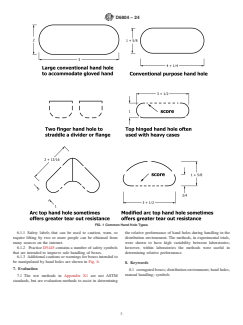
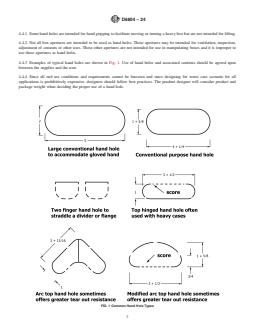
5.1 Hand holes can take many forms (see Fig. 1). They can:
4.2.3 One method used to reduce the concern of distance of
5.1.1 Be a simple hole in a box,
lift (spinal loading) is to bring the reach of the material
5.1.2 Be a complex molded handle with a reinforcement
handler’s hands closer to the body. With large or awkward
mounted at the attaching point,
boxes, placing hand holes in a more advantageous position can
5.1.3 Incorporate rope handles, and
solve this problem.
4.2.4 Maximum weight for lifting is not generally specified
5.1.4 Be reinforced by the box maker with reinforcing tape
by safety organizations. However, when considerations of
applied above them.
repetition, movement, and other ergonomics are taken into
5.2 If possible, position hand holes so that product and
account, a typical maximum load per single person is often
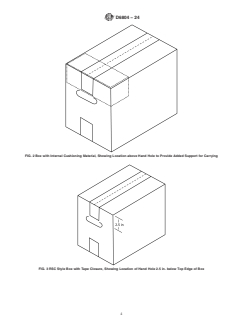
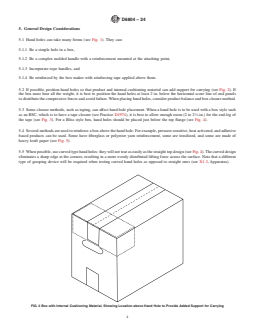
internal cushioning material can add support for carrying (see
limited to 40 to 50 lb per package.
Fig. 2). If the box must bear all the weight, it is best to position
4.3 NIOSH:
the hand holes at least 2 in. below the horizontal score line of
4.3.1 The National Institute for Occupational Safety and
end panels to distribute the compressive forces and avoid
Health (NIOSH) has published Work Practices Guide for
failure. When placing hand holes, consider product balance and
Manual Lifting. This document may be of assistance in
box closure method.
developing proper hand holes and their placement for a specific
5.3 Some closure methods, such as taping, can affect hand
package.
hole placement. When a hand hole is to be used with a box
4.3.2 Hand holes for single person box handling are gener-
style such as an RSC, which is to have a tape closure (see
ally intended for vertical symmetric lifting with some rotation
Practice D1974), it is best to allow enough room (2 to 2 ⁄2-in.)
and is limited to a few steps. Use of hand holes to lift with one
for the end-leg of the tape (see Fig. 3). For a Bliss style box,
hand, push a box, or pull a box are not recommended practices.
hand holes should be placed just below the top flange (see Fig.
4.3.2.1 Pushing or pulling by hand holes can weaken the
4).
box sidewall and thus reduce compression resistance at the
time of damage and reduce the expected time a box can survive
5.4 Several methods are used to reinforce a box above the
constant load before failure (lifetime).
hand hole. For example, pressure sensitive, heat activated, and
4.3.2.2 Pulling by hand holes may lead to tearing and loss of
adhesive based products can be used. Some have fiberglass or
control of box as it exits its supporting structure (Appendix polyester yarn reinforcement, some are tensilized, and some
X1).
are made of heavy kraft paper (see Fig. 5).
4.3.3 Actual maximum acceptable load for a single person
5.5 When possible, use curved type hand holes: they will
lift depends on box weight, size, lift frequency and distance of
not tear as easily as the straight top design (see Fig. 4). The
movement. Maximum weight and size limits can be estimated
curved design eliminates a sharp edge at the corners, resulting
using the NIOSH equations.
in a more evenly distributed lifting force across the surface.
4.4 Other Box Apertures – Improper Use as Hand Holes:
Note that a different type of grasping device will be required
4.4.1 Some hand holes are intended for hand gripping to
when testing curved hand holes as opposed to straight ones (see
facilitate moving or turning a heavy box but are not intended
X1.3, Apparatus).
for lifting.
5.6 Singlewall boxes with hand holes may require hole
4.4.2 Not all box apertures are intended to be used as hand
reinforcement or double scoring as the board alone may not
holes. These apertures may be intended for ventilation,
have sufficient strength to prevent tearing. Moderate to heavy
inspection, adjustment of contents or other uses. These other
weight boxes (4.2.4) with hand holes are often made with
apertures are not intended for use in manipulating boxes and it
double wall board. Very heavy boxes may require the use of
is improper to use these apertures as hand holes.
triple wall board which often utilizes mechanical handling.
4.4.3 Examples of typical hand holes are shown in Fig. 1.
Hand holes in triple wall board are commonly for purposes
Use of hand holes and associated cautions should be agreed
other than vertical lifting.
upon between the supplier and the user.
5.7 ECT board is designed for stacking strength. Mullen
4.4.4 Since all end use conditions and requirements cannot
be foreseen and since designing for worst case scenario for all board is designed for rough handling. Use of hand holes in
ECT board will reduce compression strength. Use of hand
applications is prohibitively expensive, designers should fol-
low best practices. The prudent designer will consider product holes in Mullen board will reduce durability. These strength
reductions should be considered when designing boxes with
and package weight when deciding the proper use of a hand
hole. hand holes. Mullen board compared to ECT board for similar
uses has generally better tear resistance which could affect
hand hole strength.
“Effects of Box Features on Spine Loading during Warehouse Order Selecting,”
6. Labels , Symbols, and Cautions
Marras, Granata, Davis, Allread, and Jorgensen, The Institute for Ergonomics, Ohio
State University.
6.1 Labels, printed symbols, or cautions can be used to
NIOSH Technical Report No. 81-122 from the US Department of Health and
Human Sevices. clarify appropriate and inappropriate use of hand holes.
D6804 − 24
FIG. 1 Common Hand Hole Types
6.1.1 Safety labels that can be used to caution, warn, or the relative performance of hand holes during handling in the
require lifting by two or more people can be obtained from distribution environment. The methods, in experimental trials,
many sources on the internet.
were shown to have high variability between laboratories;
6.1.2 Practice D5445 contains a number of safety symbols
however, within laboratories the methods were useful in
that are intended to improve safe handling of boxes.
determining relative performance.
6.1.3 Additional cautions or warnings for boxes intended to
be manipulated by hand holes are shown in Fig. 6.
8. Keywords
7. Evaluation
8.1 corrugated boxes; distribution environment; hand holes;
manual handling; symbols
7.1 The test methods in Appendix X1 are not ASTM
standards, but are evaluation methods to assist in determining
D6804 − 24
FIG. 2 Box with Internal Cushioning Material, Showing Location above Hand Hole to Provide Added Support for Carrying
FIG. 3 RSC Style Box with Tape Closure, Showing Location of Hand Hole 2.5 in. below Top Edge of Box
D6804 − 24
FIG. 4 Bliss Style Box Showing Curved Hand Hole Located just below the Top Flange
FIG. 5 RSC Style Box Showing Placement of Reinforcement Material around Perimeter of Box, just above Hand Hole
FIG. 6 Additional Cautions or Warnings for Boxes Intended to be Manipulated by Hand Holes
--------
...
This document is not an ASTM standard and is intended only to provide the user of an ASTM standard an indication of what changes have been made to the previous version. Because
it may not be technically possible to adequately depict all changes accurately, ASTM recommends that users consult prior editions as appropriate. In all cases only the current version
of the standard as published by ASTM is to be considered the official document.
Designation: D6804 − 19 D6804 − 24
Standard Guide for
Hand Hole Design in Corrugated Boxes
This standard is issued under the fixed designation D6804; the number immediately following the designation indicates the year of
original adoption or, in the case of revision, the year of last revision. A number in parentheses indicates the year of last reapproval. A
superscript epsilon (´) indicates an editorial change since the last revision or reapproval.
1. Scope Scope*
1.1 This standard provides guidelines for designing pre-cut apertures intended for use as hand holes in corrugated boxes during
manual handling of boxed cargo.
1.2 Limitations—This standard offers guidance for package development and for subsequent testing of boxes to measure
performance. It is not intended to provide specific information on the design of hand holes.
1.3 The values stated in inch-pound units are to be regarded as the standard. The SI units are for information only.
1.4 This standard does not purport to address all of the safety concerns, if any, associated with its use. It is the responsibility
of the user of this standard to establish appropriate safety, health, and environmental practices and determine the applicability of
regulatory limitations prior to use.
1.5 This international standard was developed in accordance with internationally recognized principles on standardization
established in the Decision on Principles for the Development of International Standards, Guides and Recommendations issued
by the World Trade Organization Technical Barriers to Trade (TBT) Committee.
2. Referenced Documents
2.1 ASTM Standards:
D996 Terminology of Packaging and Distribution Environments
D1974 Practice for Methods of Closing, Sealing, and Reinforcing Fiberboard Boxes
D4332 Practice for Conditioning Containers, Packages, or Packaging Components for Testing
D5276 Test Method for Drop Test of Loaded Containers by Free Fall
D5445 Practice for Pictorial Markings for Handling of Goods
E4 Practices for Force Calibration and Verification of Testing Machines
E122 Practice for Calculating Sample Size to Estimate, With Specified Precision, the Average for a Characteristic of a Lot or
Process
2.2 TAPPI Standards:
T400 Sampling and Accepting a Single lot of Paper, Paperboard, Containerboard, or Related Product
This guide is under the jurisdiction of ASTM Committee D10 on Packaging and is the direct responsibility of Subcommittee D10.27 on Fiberboard Shipping Containers,
Containerboard and Related Structures and Materials.
Current edition approved Oct. 1, 2019March 1, 2024. Published November 2019March 2024. Originally approved in 2002. Last previous edition approved in 20152019
as D6804– 02(2015). DOI: 10.1520/D6804-19.– 19. DOI: 10.1520/D6804-24.
For referenced ASTM standards, visit the ASTM website, www.astm.org, or contact ASTM Customer Service at service@astm.org. For Annual Book of ASTM Standards
volume information, refer to the standard’s Document Summary page on the ASTM website.
Available from Technological Association of the Pulp and Paper Industry (TAPPI), 15 Technology Parkway South, Suite 115, Peachtree Corners, GA 30092,
http://www.tappi.org.
*A Summary of Changes section appears at the end of this standard
Copyright © ASTM International, 100 Barr Harbor Drive, PO Box C700, West Conshohocken, PA 19428-2959. United States
D6804 − 24
3. Terminology
3.1 Definitions—General definitions for packaging and distribution environments are found in Terminology D996.
3.2 Definitions of Terms Specific to This Standard:
3.2.1 hand holes—apertures, pre-cut in corrugated boxes by box manufacturers, as requested by box purchasers. These apertures
facilitate manual handling during distribution and improve grip during handling.
4. Significance and Use
4.1 It may be desirable at times to provide hand holes in corrugated boxes. Package designers use hand holes to solve ergonomic
and handling problems associated with large or awkward containers. This guide provides an aid for proper hand hole design and
use.
4.1.1 Boxes for handling by a single person.
4.1.2 Boxes that are too large or awkward to be handled well by a single person (4.4.1).
4.2 Ergonomics:
4.2.1 In studying and applying ergonomic principles, of primary concern is the need to provide a safe work environment for
material handlers who may be required to lift or transport packages. A safe work environment is difficult to define and varies with
the package in question. Several ergonomic safety issues involve repetitive motions and spine loading in the lifting process. Other
issues involve finger and foot protection.
4.2.2 In distribution centers or warehouses, low back disorders have been identified as areas of elevated risk. Low back problems
continue to represent the most common and costly musculoskeletal disorders in the work place.
4.2.3 One method used to reduce the concern of distance of lift (spinal loading) is to bring the reach of the material handler’s hands
closer to the body. With large or awkward boxes, placing hand holes in a more advantageous position can solve this problem.
4.2.4 Maximum weight for lifting is not generally specified by safety organizations. However, when considerations of repetition,
movement, and other ergonomics are taken into account, a typical maximum load per single person is often limited to 40 to 50
lb per package.
4.3 NIOSH:
4.3.1 The National Institute for Occupational Safety and Health (NIOSH) has published Work Practices Guide for Manual
Lifting. This document may be of assistance in developing proper hand holes and their placement for a specific package.
4.3.2 Hand holes for single person box handling are generally intended for vertical symmetric lifting with some rotation and is
limited to a few steps. Use of hand holes to lift with one hand, push a box, or pull a box are not recommended practices.
4.3.2.1 Pushing or pulling by hand holes can weaken the box sidewall and thus reduce compression resistance at the time of
damage and reduce the expected time a box can survive constant load before failure (lifetime).
4.3.2.2 Pulling by hand holes may lead to tearing and loss of control of box as it exits its supporting structure (Appendix X1).
4.3.3 Actual maximum acceptable load for a single person lift depends on box weight, size, lift frequency and distance of
movement. Maximum weight and size limits can be estimated using the NIOSH equations.
4.4 Other Box Apertures – Improper Use as Hand Holes:
“Effects of Box Features on Spine Loading during Warehouse Order Selecting,” Marras, Granata, Davis, Allread, and Jorgensen, The Institute for Ergonomics, Ohio State
University.
NIOSH Technical Report No. 81-122 from the US Department of Health and Human Sevices.
D6804 − 24
4.4.1 Some hand holes are intended for hand gripping to facilitate moving or turning a heavy box but are not intended for lifting.
4.4.2 Not all box apertures are intended to be used as hand holes. These apertures may be intended for ventilation, inspection,
adjustment of contents or other uses. These other apertures are not intended for use in manipulating boxes and it is improper to
use these apertures as hand holes.
4.4.3 Examples of typical hand holes are shown in Fig. 1. Use of hand holes and associated cautions should be agreed upon
between the supplier and the user.
4.4.4 Since all end use conditions and requirements cannot be foreseen and since designing for worst case scenario for all
applications is prohibitively expensive, designers should follow best practices. The prudent designer will consider product and
package weight when deciding the proper use of a hand hole.
FIG. 1 Common Hand Hole Types
D6804 − 24
5. General Design Considerations
5.1 Hand holes can take many forms (see Fig. 1). They can:
5.1.1 Be a simple hole in a box,
5.1.2 Be a complex molded handle with a reinforcement mounted at the attaching point,
5.1.3 Incorporate rope handles, and
5.1.4 Be reinforced by the box maker with reinforcing tape applied above them.
5.2 If possible, position hand holes so that product and internal cushioning material can add support for carrying (see Fig. 2). If
the box must bear all the weight, it is best to position the hand holes at least 2 in. below the horizontal score line of end panels
to distribute the compressive forces and avoid failure. When placing hand holes, consider product balance and box closure method.
5.3 Some closure methods, such as taping, can affect hand hole placement. When a hand hole is to be used with a box style such
as an RSC, which is to have a tape closure (see Practice D1974), it is best to allow enough room (2 to 2 ⁄2-in.) for the end-leg of
the tape (see Fig. 3). For a Bliss style box, hand holes should be placed just below the top flange (see Fig. 4).
5.4 Several methods are used to reinforce a box above the hand hole. For example, pressure sensitive, heat activated, and adhesive
based products can be used. Some have fiberglass or polyester yarn reinforcement, some are tensilized, and some are made of
heavy kraft paper (see Fig. 5).
5.5 When possible, use curved type hand holes: they will not tear as easily as the straight top design (see Fig. 4). The curved design
eliminates a sharp edge at the corners, resulting in a more evenly distributed lifting force across the surface. Note that a different
type of grasping device will be required when testing curved hand holes as opposed to straight ones (see X1.3, Apparatus).
FIG. 2 Box with Internal Cushioning Material, Showing Location above Hand Hole to Provide Added Support for Carrying
D6804 − 24
FIG. 3 RSC Style Box with Tape Closure, Showing Location of Hand Hole 2.5 in. below Top Edge of Box
FIG. 4 Bliss Style Box Showing Curved Hand Hole Located just below the Top Flange
5.6 Singlewall boxes with hand holes may require hole reinforcement or double scoring as the board alone may not have sufficient
strength to prevent tearing. Moderate to heavy weight boxes (4.2.4) with hand holes are often made with double wall board. Very
heavy boxes may require the use of triple wall board which often utilizes mechanical handling. Hand holes in triple wall board
are commonly for purposes other than vertical lifting.
5.7 ECT board is designed for stacking strength. Mullen board is designed for rough handling. Use of hand holes in ECT board
will reduce compression strength. Use of hand holes in Mullen board will reduce durability. These strength reductions should be
considered when designing boxes with hand holes. Mullen board compared to ECT board for similar uses has generally better tear
resistance which could affect hand hole strength.
6. Labels , Symbols, and Cautions
6.1 Labels, printed symbols, or cautions can be used to clarify appropriate and inappropriate use of hand holes.
6.1.1 Safety labels that can be used to caution, warn, or require lifting by two or more people can be obtained from many sources
on the internet.
D6804 − 24
FIG. 5 RSC Style Box Showing Placement of Reinforcement Material around Perimeter of Box, just above Hand Hole
6.1.2 Practice D5445 contains a number of safety symbols that are intended to improve safe handling of boxes.
6.1.3 Additional cautions or warnings for boxes intended to be manipulated by hand holes are shown in Fig. 6.
7. Evaluation
7.1 The test methods in Appendix X1 are not ASTM standards, but are evaluation methods to assist in determining the relative
performance of hand holes during handling in the distribution environment. The methods, in experimental trials, were shown to
have high variability between laboratories; however, within laboratories the methods were useful in determining relative
performance.
8. Keywords
8.1 corrugated boxes; distribution environment; hand holes; manual handling; symbols
FIG. 6 Additional Cautions or Warnings for B
...