

ASTM D451/D451M-17(2022)
(Test Method)Standard Test Method for Sieve Analysis of Granular Mineral Surfacing for Asphalt Roofing Products
General Information
- Abstract
SIGNIFICANCE AND USE
4.1 This test method is used to determine the grading of materials used as granular mineral surfacing. The results are used to determine compliance of the particle size distribution with applicable specification requirements.
SCOPE
1.1 This test method covers the determination of the particle size distribution of granular mineral surfacing material such as crushed slate, stone, coated granules, and so forth, used on the weather surface of prepared asphalt roofing and shingles.
1.2 The values stated in either SI units or inch-pound units are to be regarded separately as standard. The values stated in each system may not be exact equivalents; therefore, each system shall be used independently of the other. Combining values from the two systems may result in nonconformance with the standard.
1.3 This standard does not purport to address all of the safety concerns, if any, associated with its use. It is the responsibility of the user of this standard to establish appropriate safety, health, and environmental practices and determine the applicability of regulatory limitations prior to use.
1.4 This international standard was developed in accordance with internationally recognized principles on standardization established in the Decision on Principles for the Development of International Standards, Guides and Recommendations issued by the World Trade Organization Technical Barriers to Trade (TBT) Committee.
- Status
- Published
- Publication Date
- 31-Oct-2022
- Technical Committee
- D08 - Roofing and Waterproofing
- Drafting Committee
- D08.02 - Steep Roofing Products and Assemblies


Overview
ASTM D451/D451M-17(2022): Standard Test Method for Sieve Analysis of Granular Mineral Surfacing for Asphalt Roofing Products provides a standardized procedure for determining the particle size distribution of materials such as crushed slate, stone, and coated granules. These mineral granules are commonly used as surfacing materials on the weather-exposed side of asphalt roofing and shingles. By establishing a reliable method for sieve analysis, this ASTM standard ensures consistent grading and quality control, which is crucial for the longevity and performance of roofing products.
This international standard aligns with the principles established by the World Trade Organization Technical Barriers to Trade (TBT) Committee, underscoring its role in global commerce and manufacturing consistency.
Key Topics
- Sieve Analysis: The test method defines steps for separating and quantifying mineral granule sizes using a specified set of sieves.
- Particle Size Distribution: Emphasis is placed on accurately determining grading to meet specification requirements for asphalt roofing materials.
- Sampling Procedures: Proper sampling techniques are outlined, whether the granules are shipped in bulk or bags, ensuring representative results for each shipment.
- Equipment Requirements: The standard details the necessary apparatus, including standardized sieves (as per ASTM E11), mechanical sieve shakers, sample splitters, and precision balances.
- Reporting and Precision: Procedures for recording and calculating results are specified, ensuring repeatable and accurate outcomes for quality assurance.
Applications
The practical uses of ASTM D451/D451M-17(2022) extend across the following areas:
- Quality Control in Asphalt Roofing Manufacturing: Roofing material manufacturers use this method to verify that mineral surfacing granules conform to required grading specifications, directly impacting the durability and weather resistance of shingles and prepared roofing.
- Material Acceptance and Compliance: The sieve analysis outlined in this standard is critical for suppliers and purchasers to demonstrate compliance with contractual and regulatory standards.
- Research and Development: R&D labs utilize this analysis to evaluate new mineral sources or develop innovative roofing products with improved performance and longevity.
- Routine Production Monitoring: Regular sieve analysis checks help maintain consistent production quality by detecting variations in granule sizing before materials are applied to roofing products.
- Regulatory Documentation: The standard provides verifiable test data that supports regulatory submissions and product certifications in both domestic and international markets.
Related Standards
For a comprehensive approach to mineral material analysis for asphalt roofing, consider referencing the following related ASTM standards:
- ASTM E11 - Specification for Woven Wire Test Sieve Cloth and Test Sieves: Sets the requirements for the sieves used in the analysis, ensuring consistent performance and accuracy.
- Other ASTM D08 Standards - Covering a range of roofing and waterproofing test methods and material specifications.
- International Standards Based on WTO Principles - Ensures harmonization and acceptance across global markets, facilitating trade and product acceptance.
Practical Value
Implementing the procedures outlined in ASTM D451/D451M-17(2022) enables manufacturers, testing laboratories, and quality assurance professionals to:
- Achieve accurate and reproducible measurements of particle size distribution in mineral surfacing materials
- Validate compliance with industry specifications for asphalt roofing products
- Enhance product performance through better control of granular material grading
- Meet international trade and regulatory requirements by adhering to an established, recognized standard
Keywords: ASTM D451, sieve analysis, granular mineral surfacing, asphalt roofing, particle size distribution, quality control, roofing granules, testing standard, ASTM standards, mineral granules analysis
Relations
- Effective Date
- 01-Oct-2013
- Effective Date
- 01-May-2009
- Effective Date
- 01-May-2004
- Effective Date
- 10-May-2001
- Effective Date
- 10-May-2001
Get Certified
Connect with accredited certification bodies for this standard

DIBt (Deutsches Institut für Bautechnik)
German Institute for Building Technology.
DIN CERTCO
DIN Group product certification.

Aboma Certification B.V.
Specialized in construction, metal, and transport sectors.
Sponsored listings
Frequently Asked Questions
ASTM D451/D451M-17(2022) is a standard published by ASTM International. Its full title is "Standard Test Method for Sieve Analysis of Granular Mineral Surfacing for Asphalt Roofing Products". This standard covers: SIGNIFICANCE AND USE 4.1 This test method is used to determine the grading of materials used as granular mineral surfacing. The results are used to determine compliance of the particle size distribution with applicable specification requirements. SCOPE 1.1 This test method covers the determination of the particle size distribution of granular mineral surfacing material such as crushed slate, stone, coated granules, and so forth, used on the weather surface of prepared asphalt roofing and shingles. 1.2 The values stated in either SI units or inch-pound units are to be regarded separately as standard. The values stated in each system may not be exact equivalents; therefore, each system shall be used independently of the other. Combining values from the two systems may result in nonconformance with the standard. 1.3 This standard does not purport to address all of the safety concerns, if any, associated with its use. It is the responsibility of the user of this standard to establish appropriate safety, health, and environmental practices and determine the applicability of regulatory limitations prior to use. 1.4 This international standard was developed in accordance with internationally recognized principles on standardization established in the Decision on Principles for the Development of International Standards, Guides and Recommendations issued by the World Trade Organization Technical Barriers to Trade (TBT) Committee.
SIGNIFICANCE AND USE 4.1 This test method is used to determine the grading of materials used as granular mineral surfacing. The results are used to determine compliance of the particle size distribution with applicable specification requirements. SCOPE 1.1 This test method covers the determination of the particle size distribution of granular mineral surfacing material such as crushed slate, stone, coated granules, and so forth, used on the weather surface of prepared asphalt roofing and shingles. 1.2 The values stated in either SI units or inch-pound units are to be regarded separately as standard. The values stated in each system may not be exact equivalents; therefore, each system shall be used independently of the other. Combining values from the two systems may result in nonconformance with the standard. 1.3 This standard does not purport to address all of the safety concerns, if any, associated with its use. It is the responsibility of the user of this standard to establish appropriate safety, health, and environmental practices and determine the applicability of regulatory limitations prior to use. 1.4 This international standard was developed in accordance with internationally recognized principles on standardization established in the Decision on Principles for the Development of International Standards, Guides and Recommendations issued by the World Trade Organization Technical Barriers to Trade (TBT) Committee.
ASTM D451/D451M-17(2022) is classified under the following ICS (International Classification for Standards) categories: 91.100.15 - Mineral materials and products. The ICS classification helps identify the subject area and facilitates finding related standards.
ASTM D451/D451M-17(2022) has the following relationships with other standards: It is inter standard links to ASTM E11-13, ASTM E11-09e1, ASTM E11-04, ASTM E11-01, ASTM E11-95. Understanding these relationships helps ensure you are using the most current and applicable version of the standard.
ASTM D451/D451M-17(2022) is available in PDF format for immediate download after purchase. The document can be added to your cart and obtained through the secure checkout process. Digital delivery ensures instant access to the complete standard document.
Standards Content (Sample)
This international standard was developed in accordance with internationally recognized principles on standardization established in the Decision on Principles for the
Development of International Standards, Guides and Recommendations issued by the World Trade Organization Technical Barriers to Trade (TBT) Committee.
Designation:D451/D451M −17 (Reapproved 2022)
Standard Test Method for
Sieve Analysis of Granular Mineral Surfacing for Asphalt
Roofing Products
This standard is issued under the fixed designation D451/D451M; the number immediately following the designation indicates the year
of original adoption or, in the case of revision, the year of last revision. A number in parentheses indicates the year of last reapproval.
A superscript epsilon (´) indicates an editorial change since the last revision or reapproval.
1. Scope 4. Significance and Use
1.1 This test method covers the determination of the particle 4.1 This test method is used to determine the grading of
size distribution of granular mineral surfacing material such as materials used as granular mineral surfacing. The results are
crushed slate, stone, coated granules, and so forth, used on the used to determine compliance of the particle size distribution
weather surface of prepared asphalt roofing and shingles. with applicable specification requirements.
1.2 The values stated in either SI units or inch-pound units
5. Apparatus
are to be regarded separately as standard. The values stated in
5.1 Sieves—Aset of the sieves listed in Table 1, conforming
each system may not be exact equivalents; therefore, each
to Specification E11. For routine testing, the group of sieves
system shall be used independently of the other. Combining
actually used shall include only those appropriate for the
values from the two systems may result in nonconformance
granular material being graded. Coarser or finer sieves, on
with the standard.
which less than 0.05 mass % of the specimen would be found
1.3 This standard does not purport to address all of the
after sieving, need not be included in the group.
safety concerns, if any, associated with its use. It is the
5.2 Sieve Shaker—A mechanically operated sieve shaker,
responsibility of the user of this standard to establish appro-
which produces a uniform rotary motion and tapping action
priate safety, health, and environmental practices and deter-
with140to160tapsperminute.Thesieveshakershallbefitted
mine the applicability of regulatory limitations prior to use.
with a plug to receive the impact of the tapping device. The
1.4 This international standard was developed in accor-
plug shall be one of the following: a hard maple plug; a #9
dance with internationally recognized principles on standard-
black rubber plug; or a #22 cork plug as chosen by the user.
ization established in the Decision on Principles for the
Plug dimensions are: top diameter 44 6 1 mm, bottom
Development of International Standards, Guides and Recom-
mendations issued by the World Trade Organization Technical diameter 37 6 1 mm, and length of 38 6 6 mm. See Note 1.
The entire apparatus shall be rigidly mounted by bolting to a
Barriers to Trade (TBT) Committee.
solid foundation, preferably concrete.
2. Referenced Documents
NOTE 1—Supporting data on the equivalency of the plug materials is on
2.1 ASTM Standards:
file at ASTM Headquarters.
E11 Specification for Woven Wire Test Sieve Cloth and Test
5.3 Sample Splitter—The riffle sample splitter is an open
Sieves
V-shaped box in which a series of chutes is mounted at right
angles to the long axis to give a series of rectangular slots of
3. Summary of Test Method
equal area alternatively feeding two trays placed on either side
3.1 A weighed sample of granular mineral surfacing mate-
of the trough.The sample is poured into the chute and split into
rial is separated through a series of sieves of progressively
equal portions by the slots, until, after repeated cycles, a
smaller openings for the determination of particle size distri-
sample of the desired size is obtained.Ariffle sampler with 9.5
bution.
3 1
or 12.7 mm [ ⁄8 or ⁄2 in.] divisions shall be used for reducing
the sample to the specimen required for sieve analysis.
This test method is under the jurisdiction ofASTM Committee D08 on Roofing
andWaterproofingandisthedirectresponsibilityofSubcommitteeD08.02onSteep
5.4 Balance—A laboratory balance sensitive to 0.1 g.
Roofing Products and Assemblies.
Current edition approved Nov. 1, 2022. Published November 2022. Originally
6. Sampling
approved in 1973. Last previous edition approved in 2017 as D451/D451M – 17.
DOI: 10.1520/D0451_D0451M-17R22.
6.1 Each shipment of mineral granules of a single type shall
For referenced ASTM standards, visit the ASTM website, www.astm.org, or
be considered a unit for sampling. If a shipment contains more
contact ASTM Customer Service at service@astm.org. For Annual Book of ASTM
than one type of granule, the entire quantity of each type in the
Standards volume information, refer to the standard’s Document Summary page on
the ASTM website. vehicle shall be considered a unit for sampling.
Copyright © ASTM International, 100 Barr Harbor Drive, PO Box C700, West Conshohocken, PA 19428-2959. United States
D451/D451M−17 (2022)
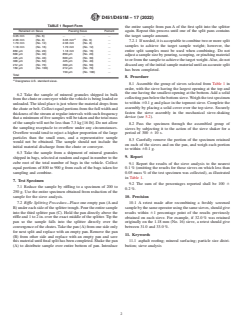
TABLE 1 Report Form
the entire sample from pan A of the first split into the splitter
Retained on Sieve Passing Sieve Percent again. Repeat this process until one of the split pans contains
3.35 mm (No. 6) . . . the target sample amount.
A
2.36 mm (No. 8) 3.35 mm
...