

ASTM A368-95a(2019)
(Specification)Standard Specification for Stainless Steel Wire Strand
General Information
- Abstract
ABSTRACT
This specification covers the standard for stainless steel wire strand composed of a multiplicity of round wires and suitable for use as guy wires, overhead ground wires, and similar purposes. Stranding shall be sufficiently close to ensure no appreciable reduction in diameter when stressed to the specified strength. Several types of steel are covered like Type 302, 304, 305, 316, 316Cb, or 316Ti and shall conform to the required chemical composition values in carbon, manganese, phosphorus, sulfur, silicon, chromium, nickel, molybdenum, and nitrogen. The tensile strength, based upon the nominal strand diameter and the number of wires in each strand, shall conform to the minimum values in breaking strength. The individual wires of the completed strand shall not fracture when wrapped in a close helix of at least two turns upon itself as a mandrel.
SCOPE
1.1 This specification covers stainless steel wire strand composed of a multiplicity of round wires and suitable for use as guy wires, overhead ground wires, and similar purposes.
1.2 The values stated in inch-pound units are to be regarded as standard. The values given in parentheses are mathematical conversions to SI units that are provided for information only and are not considered standard.
1.3 This international standard was developed in accordance with internationally recognized principles on standardization established in the Decision on Principles for the Development of International Standards, Guides and Recommendations issued by the World Trade Organization Technical Barriers to Trade (TBT) Committee.
- Status
- Published
- Publication Date
- 28-Feb-2019
- Technical Committee
- A01 - Steel, Stainless Steel and Related Alloys
- Drafting Committee
- A01.17 - Flat-Rolled and Wrought Stainless Steel


Overview
The ASTM A368-95a(2019) - Standard Specification for Stainless Steel Wire Strand - is an international standard developed by ASTM International. This specification applies to stainless steel wire strand consisting of multiple round wires, intended for use in guy wires, overhead ground wires, and similar applications. The standard outlines material requirements, mechanical properties, and test methods for wire strands made from various stainless steel types, ensuring superior performance and durability in demanding environments.
By adhering to ASTM A368, manufacturers, suppliers, and end users benefit from consistent quality, predictable performance, and global relevance for stainless steel wire strand products.
Key Topics
ASTM A368 covers several critical aspects for stainless steel wire strand, including:
- Material Types: Includes Type 302, 304, 305, 316, 316Cb, and 316Ti stainless steels, each with specified chemical composition requirements for elements such as carbon, manganese, phosphorus, sulfur, silicon, chromium, nickel, molybdenum, and nitrogen.
- Mechanical Properties:
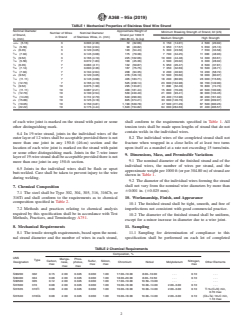
- Minimum breaking strength requirements based on strand diameter and wire count
- Tensile strength classifications as medium or high strength
- Stranding Requirements:
- Specifications for the number of wires per strand (commonly 3, 7, or 19)
- Pitch, lay direction, and strand uniformity to ensure structural integrity
- Workmanship and Finish: Strands must be smooth, tight, and free from imperfections consistent with good commercial practice.
- Dimensional Tolerances: Controls for nominal strand diameters, weight per 1000 ft (304.8 m), and permissible variations.
- Testing and Inspection:
- Tension and wrapping tests to verify strand performance
- Sampling guidelines for quality assurance
Applications
Stainless steel wire strand manufactured in accordance with ASTM A368 finds widespread use in applications that demand high strength and superior corrosion resistance, such as:
- Guy Wires: For utility poles, towers, and support structures
- Overhead Ground Wires: Used in transmission lines to provide lightning protection and grounding
- Stay Wires: For stabilizing masts, marine rigging, and communications infrastructure
- Architectural and Industrial Uses: Safety barriers, fencing, suspension bridges, and tensioned support systems
Thanks to its durability and resistance to environmental degradation, ASTM A368-compliant stainless steel wire strand is a reliable choice for both outdoor and industrial environments.
Related Standards
Adherence to ASTM A368 is complemented by several referenced and related standards, including:
- ASTM A555/A555M: General Requirements for Stainless Steel Wire and Wire Rods, covering general delivery requirements applicable to stainless steel strand products.
- ASTM A751: Test Methods, Practices, and Terminology for Chemical Analysis of Steel Products, detailing analytical procedures for verifying material composition.
These standards collectively address comprehensive requirements from material selection and manufacture, through quality verification and delivery, serving stakeholders in the construction, energy, and infrastructure sectors.
By implementing ASTM A368-95a(2019), organizations ensure that stainless steel wire strand products meet accepted benchmarks for strength, consistency, and reliability, supporting safer and more durable installations in a wide range of applications. ASTM standards improve international compatibility and facilitate acceptance in global supply chains.
Relations
- Effective Date
- 01-Mar-2019
- Effective Date
- 01-Jan-2016
- Effective Date
- 01-Mar-2014
- Effective Date
- 01-Mar-2014
- Effective Date
- 01-May-2009
- Effective Date
- 01-Oct-2008
- Effective Date
- 01-Jun-2007
- Effective Date
- 01-Apr-2007
- Effective Date
- 01-May-2006
- Effective Date
- 01-Sep-2005
- Effective Date
- 10-Sep-2001
- Effective Date
- 10-Sep-2001
- Effective Date
- 10-Mar-1997
- Effective Date
- 10-Mar-1997
- Effective Date
- 01-Mar-2019
Get Certified
Connect with accredited certification bodies for this standard

Element Materials Technology
Materials testing and product certification.

Inštitut za kovinske materiale in tehnologije
Institute of Metals and Technology. Materials testing, metallurgical analysis, NDT.
Sponsored listings
Frequently Asked Questions
ASTM A368-95a(2019) is a technical specification published by ASTM International. Its full title is "Standard Specification for Stainless Steel Wire Strand". This standard covers: ABSTRACT This specification covers the standard for stainless steel wire strand composed of a multiplicity of round wires and suitable for use as guy wires, overhead ground wires, and similar purposes. Stranding shall be sufficiently close to ensure no appreciable reduction in diameter when stressed to the specified strength. Several types of steel are covered like Type 302, 304, 305, 316, 316Cb, or 316Ti and shall conform to the required chemical composition values in carbon, manganese, phosphorus, sulfur, silicon, chromium, nickel, molybdenum, and nitrogen. The tensile strength, based upon the nominal strand diameter and the number of wires in each strand, shall conform to the minimum values in breaking strength. The individual wires of the completed strand shall not fracture when wrapped in a close helix of at least two turns upon itself as a mandrel. SCOPE 1.1 This specification covers stainless steel wire strand composed of a multiplicity of round wires and suitable for use as guy wires, overhead ground wires, and similar purposes. 1.2 The values stated in inch-pound units are to be regarded as standard. The values given in parentheses are mathematical conversions to SI units that are provided for information only and are not considered standard. 1.3 This international standard was developed in accordance with internationally recognized principles on standardization established in the Decision on Principles for the Development of International Standards, Guides and Recommendations issued by the World Trade Organization Technical Barriers to Trade (TBT) Committee.
ABSTRACT This specification covers the standard for stainless steel wire strand composed of a multiplicity of round wires and suitable for use as guy wires, overhead ground wires, and similar purposes. Stranding shall be sufficiently close to ensure no appreciable reduction in diameter when stressed to the specified strength. Several types of steel are covered like Type 302, 304, 305, 316, 316Cb, or 316Ti and shall conform to the required chemical composition values in carbon, manganese, phosphorus, sulfur, silicon, chromium, nickel, molybdenum, and nitrogen. The tensile strength, based upon the nominal strand diameter and the number of wires in each strand, shall conform to the minimum values in breaking strength. The individual wires of the completed strand shall not fracture when wrapped in a close helix of at least two turns upon itself as a mandrel. SCOPE 1.1 This specification covers stainless steel wire strand composed of a multiplicity of round wires and suitable for use as guy wires, overhead ground wires, and similar purposes. 1.2 The values stated in inch-pound units are to be regarded as standard. The values given in parentheses are mathematical conversions to SI units that are provided for information only and are not considered standard. 1.3 This international standard was developed in accordance with internationally recognized principles on standardization established in the Decision on Principles for the Development of International Standards, Guides and Recommendations issued by the World Trade Organization Technical Barriers to Trade (TBT) Committee.
ASTM A368-95a(2019) is classified under the following ICS (International Classification for Standards) categories: 77.140.65 - Steel wire, wire ropes and link chains. The ICS classification helps identify the subject area and facilitates finding related standards.
ASTM A368-95a(2019) has the following relationships with other standards: It is inter standard links to ASTM A368-95a(2013), ASTM A555/A555M-16, ASTM A751-14, ASTM A555/A555M-05(2014), ASTM A555/A555M-05(2009), ASTM A751-08, ASTM A751-07a, ASTM A751-07, ASTM A751-01(2006), ASTM A555/A555M-05, ASTM A751-96, ASTM A751-01, ASTM A555/A555M-97(2002), ASTM A555/A555M-97, ASTM A555/A555M-23. Understanding these relationships helps ensure you are using the most current and applicable version of the standard.
ASTM A368-95a(2019) is available in PDF format for immediate download after purchase. The document can be added to your cart and obtained through the secure checkout process. Digital delivery ensures instant access to the complete standard document.
Standards Content (Sample)
This international standard was developed in accordance with internationally recognized principles on standardization established in the Decision on Principles for the
Development of International Standards, Guides and Recommendations issued by the World Trade Organization Technical Barriers to Trade (TBT) Committee.
Designation:A368 −95a (Reapproved 2019)
Standard Specification for
Stainless Steel Wire Strand
This standard is issued under the fixed designation A368; the number immediately following the designation indicates the year of
original adoption or, in the case of revision, the year of last revision. A number in parentheses indicates the year of last reapproval. A
superscript epsilon (´) indicates an editorial change since the last revision or reapproval.
1. Scope 3.1.5 Number of wires per strand (Table 1),
3.1.6 Minimum breaking strength (medium or high
1.1 This specification covers stainless steel wire strand
strength),
composed of a multiplicity of round wires and suitable for use
3.1.7 Type designation (see Section 7),
as guy wires, overhead ground wires, and similar purposes.
3.1.8 ASTM designation, and date of issue, and
1.2 The values stated in inch-pound units are to be regarded
3.1.9 Special requirements, if any.
as standard. The values given in parentheses are mathematical
NOTE 1—Atypical ordering description is as follows: 1000 ft, stainless
conversions to SI units that are provided for information only
steel 7-wire strand, ⁄16-in. diameter, medium strength, on reel, Type 302,
and are not considered standard.
ASTM A368 dated _____.
1.3 This international standard was developed in accor-
4. General Requirements for Delivery
dance with internationally recognized principles on standard-
ization established in the Decision on Principles for the
4.1 In addition to the requirements of this specification, all
Development of International Standards, Guides and Recom-
requirements of the current edition of Specification A555/
mendations issued by the World Trade Organization Technical
A555M shall apply. Failure to comply with the general
Barriers to Trade (TBT) Committee.
requirements of Specification A555/A555M constitutes non-
conformance with this specification.
2. Referenced Documents
2 5. Stranding
2.1 ASTM Standards:
A555/A555M Specification for General Requirements for 5.1 Three-wire strand shall have a left lay with a uniform
Stainless Steel Wire and Wire Rods pitch of not less than 10 nor more than 16 times the nominal
A751 Test Methods, Practices, and Terminology for Chemi- diameter of the strand. Seven-wire strand and the outer layer of
cal Analysis of Steel Products 19-wire strand, shall have a left lay with a uniform pitch of not
lessthan12normorethan16timesthenominaldiameterofthe
3. Ordering Information
strand. A left lay is defined as a counter-clockwise twist away
from the observer. All wires shall be stranded with uniform
3.1 It is the responsibility of the purchaser to specify all
tension. Stranding shall be sufficiently close to ensure no
requirements that are necessary for material ordered under this
appreciable reduction in diameter when stressed to 10 % of the
specification. Such requirements may include, but are not
specified strength.
limited to, the following:
3.1.1 Quantity (length of strand or weight of quantity
5.2 All wires in the strand shall lie naturally in their true
ordered, or both; see 13.1 and Table 1),
positions in the completed strand, and when the strand is cut,
3.1.2 Name of material (stainless steel),
the ends shall remain in position or be readily replaced by hand
3.1.3 Form (wire strand in coils or on reels),
and then remain in position. This may be accomplished by any
3.1.4 Applicable dimensions (for nominal strand diameter,
means or process, such as preforming, post forming, or form
see Table 1),
setting.
6. Joints
This specification is under the jurisdiction of ASTM Committee A01 on Steel,
6.1 There shall be no strand joints or strand splices in any
Stainless Steel and Related Alloys and is the direct responsibility of Subcommittee
length of the completed strand.
A01.17 on Flat-Rolled and Wrought Stainless Steel.
Current edition approved March 1, 2019. Published March 2019. Originally
6.2 In3-wirestrand,thereshallbenojointsintheindividual
approved in 1953. Last previous edition approved in 2013 as A368 – 95a (2013).
wires.
DOI: 10.1520/A0368-95AR19.
For referenced ASTM standards, visit the ASTM website, www.astm.org, or
6.3 In 7-wire strand, joints in individual wires shall be
contact ASTM Customer Service at service@astm.org. For Annual Book of ASTM
acceptable provided there is not more than one joint in any
Standards volume information, refer to the standard’s Document Summary page on
the ASTM website. 150-ft (46-m) section of the completed strand and the location
Copyright © ASTM International, 100 Barr Harbor Drive, PO Box C700, West Conshohocken, PA 19428-2959. United States
A368−95a (2019)
TABLE 1 Mechanical Properties of Stainless Steel Wire Strand
Nominal Diameter Approximate Weight of
Minimum Breaking Strength of Strand, lbf (kN)
Number of Wires Nominal Diameter
of Strand, Strand per 1000 ft
in Strand of Stainless Wires, in. (mm)
Medium Strength High Strength
in. (mm) (304.80 m), lb (kg)
⁄64 (5.16) 3 0.093 (2.36) 72 (32.66) 3 150 (14.01) 4 500 (20.02)
⁄32 (5.56) 3 0.104 (2.64) 90 (40.82) 3 950 (17.57) 5 650 (25.13)
⁄4 (6.35) 3 0.120 (3.05) 120 (54.43) 5 300 (23.58) 7 550 (33.58)
⁄16 (7.94) 3 0.145 (3.68) 175 (79.38) 7 700 (34.25) 11 000 (48.93)
⁄8 (9.52) 3 0.165 (4.19) 225 (102.06) 10 000 (44.48) 14 300 (63.61)
⁄32 (5.56) 7 0.072 (1.83) 100 (45.36) 4 500 (20.02) 6 300 (28.02)
⁄4 (6.35) 7 0.083 (2.11) 132 (59.87) 5 950 (26.47) 8 500 (37.81)
⁄32 (7.14) 7 0.093 (2.36) 167 (75.75) 7 350 (32.69) 10 500 (46.71)
⁄16 (7.94) 7 0.104 (2.64) 208 (94.35) 9 200 (40.92) 13 200 (58.72)
⁄8 (9.52) 7 0.120 (3.05) 278 (126.10) 12 500 (55.60) 18 000 (80.07)
⁄16 (11.11) 7 0.145 (3.68) 405 (183.71) 18 200 (80.96) 26 000 (115.65)
⁄2 (12.70) 7 0.165 (4.19) 525 (238.14) 23 600 (104.98) 33 700 (149.90)
⁄8 (9.52) 19 0.075 (1.90) 295 (133.81) 11 800 (52.49) 16 800 (74.73)
⁄16 (11.11) 19 0.087 (2.21) 400 (181.44) 15 800 (70.28) 22 500 (100.08)
⁄2 (12.70) 19 0.100 (2.54) 530 (240.40) 21 000 (93.41) 30 000 (133.45)
⁄16 (14.29) 19 0.110 (2.79) 640 (290.30) 25 400 (112.98) 36 200 (161.02)
⁄8 (15.88) 19 0.125 (3.18) 825 (374.21) 33 000 (146.79) 47 000 (209.07)
⁄4 (19.05) 19 0.150 (3.81) 1,190 (539.78) 47 500 (211.29) 67 500 (300.25)
⁄8 (22.22) 19 0.175 (4.44) 1,620 (734.82) 64 000 (284.69) 91 400 (406.57)
of each wire joint is marked on the strand with paint or some shall conform to the requirements specified in Table 1. All
other distinguishing mark. tension tests shall be made upon lengths of strand that do not
contain welds in the indi
...