


ASTM D4206-96(2018)
(Test Method)Standard Test Method for Sustained Burning of Liquid Mixtures Using the Small Scale Open-Cup Apparatus
Standard Test Method for Sustained Burning of Liquid Mixtures Using the Small Scale Open-Cup Apparatus
SIGNIFICANCE AND USE
4.1 Mixtures of flammable liquids and nonflammable liquids, such as an alcohol and water mixture, are classified by the U. S. Government by the definition of flammable liquid based on a closed-cup flash point method. Thus, mixtures may be classed as flammable even though they do not sustain burning. This test method determines the ability of a liquid mixture to sustain burning and, when used with a closed-cup flash point method, indicates the flammability characteristics of the mixture.
SCOPE
1.1 This test method2 describes a procedure for determining the sustained burning characteristics of mixtures of flammable and nonflammable liquids and to mixtures containing liquids with widely different flash points.
1.2 The values stated in inch-pound units are to be regarded as standard. The values given in parentheses are mathematical conversions to SI units that are provided for information only and are not considered standard.
1.3 This standard should be used to measure and describe the response of materials, products, or assemblies to heat and flame under controlled conditions and should not be used to describe or appraise the fire-hazard or fire-risk of materials, products, or assemblies under actual fire conditions. However, results of the test may be used as elements of a fire-hazard assessment or a fire-risk assessment which takes into account all of the factors which are pertinent to an assessment of the fire hazard or fire risk of a particular end use.
1.4 This standard does not purport to address all of the safety concerns, if any, associated with its use. It is the responsibility of the user of this standard to establish appropriate safety, health, and environmental practices and determine the applicability of regulatory limitations prior to use.
1.5 This international standard was developed in accordance with internationally recognized principles on standardization established in the Decision on Principles for the Development of International Standards, Guides and Recommendations issued by the World Trade Organization Technical Barriers to Trade (TBT) Committee.
General Information
- Status
- Published
- Publication Date
- 31-May-2018
- Technical Committee
- D01 - Paint and Related Coatings, Materials, and Applications
- Drafting Committee
- D01.21 - Chemical Analysis of Paints and Paint Materials
Relations
- Effective Date
- 01-Jun-2018
- Effective Date
- 01-Jun-2018
- Referred By
ASTM D92-18 - Standard Test Method for Flash and Fire Points by Cleveland Open Cup Tester - Effective Date
- 01-Jun-2018
Overview
ASTM D4206-96(2018), titled Standard Test Method for Sustained Burning of Liquid Mixtures Using the Small Scale Open-Cup Apparatus, provides a standardized procedure for determining the sustained burning characteristics of mixtures containing flammable and nonflammable liquids, as well as mixtures with liquids of widely different flash points. Developed by ASTM International, this test method serves an important role in evaluating the capacity of liquid mixtures to sustain burning, which extends beyond traditional closed-cup flash point determination.
In the context of regulatory classification, this method is valuable because certain liquid mixtures might be considered flammable by closed-cup flash point tests yet may not sustain burning under actual conditions. This standard offers an additional assessment to inform fire hazard or fire risk analysis, making it especially relevant to industries dealing with coatings, paints, chemicals, and other mixed liquid products.
Key Topics
Sustained Burning Test:
This method directly measures whether a liquid mixture maintains combustion when exposed to a standard ignition source in a small scale open-cup apparatus.Apparatus and Sample Handling:
The test uses a nonrusting metal block (often stainless steel or aluminum alloy) with a concave well, a gas jet, thermometer, and a temperature-controlling hot plate. Proper handling and preparation of samples are essential to maintain reliability and prevent the loss of volatile constituents.Test Procedure Highlights:
- Heating the sample in the apparatus well to a prescribed temperature (adjusted for barometric pressure, if necessary)
- Introducing 2 mL of the liquid mixture into the well
- Exposing the sample to a standard test flame and observing burning duration
Classification of Results:
The sample is considered to exhibit sustained burning if combustion continues for more than 15 seconds after flame exposure is removed.Significance in Safety Assessment:
While not a direct appraisal of fire hazard in actual conditions, results contribute to broader fire risk and hazard evaluations, especially when used in conjunction with flash point data.
Applications
Regulatory Compliance:
Assists manufacturers in demonstrating compliance with local and international fire safety regulations by providing a more comprehensive understanding of flammability hazards.Product Development & Safety Testing:
Used in the formulation and quality control of paints, coatings, solvents, and chemical mixtures to determine if a product poses a sustained burning risk.Risk Assessments:
Provides critical data for fire risk assessments in occupational safety planning, especially in storage, transportation, and handling of liquid mixtures where sustained burning could escalate fire hazards.Comparison with Other Flammability Tests:
When paired with closed-cup flash point determination, this test provides a fuller picture of a liquid's burning behavior, helping distinguish between mixtures that ignite but do not sustain combustion versus those that pose a lasting fire risk.
Related Standards
- ASTM D56 - Standard Test Method for Flash Point by Tag Closed Cup Tester
- ASTM D93 - Standard Test Methods for Flash Point by Pensky-Martens Closed Cup Tester
- British Standard BS 3900 Part A-11 - Small Scale Test for Combustibility
- Other international flammability assessment methods referenced for regulatory purposes.
Keywords: sustained burning test, flammable liquid mixtures, open-cup apparatus, fire risk assessment, ASTM D4206, combustibility test method, paint and coatings safety, regulatory compliance, flammability standards, flash point testing.
By providing an additional dimension to fire safety testing, ASTM D4206-96(2018) is an essential tool for industries managing or producing liquid mixtures with potential fire hazards, ensuring safer practices and compliance with safety standards worldwide.

Frequently Asked Questions
ASTM D4206-96(2018) is a standard published by ASTM International. Its full title is "Standard Test Method for Sustained Burning of Liquid Mixtures Using the Small Scale Open-Cup Apparatus". This standard covers: SIGNIFICANCE AND USE 4.1 Mixtures of flammable liquids and nonflammable liquids, such as an alcohol and water mixture, are classified by the U. S. Government by the definition of flammable liquid based on a closed-cup flash point method. Thus, mixtures may be classed as flammable even though they do not sustain burning. This test method determines the ability of a liquid mixture to sustain burning and, when used with a closed-cup flash point method, indicates the flammability characteristics of the mixture. SCOPE 1.1 This test method2 describes a procedure for determining the sustained burning characteristics of mixtures of flammable and nonflammable liquids and to mixtures containing liquids with widely different flash points. 1.2 The values stated in inch-pound units are to be regarded as standard. The values given in parentheses are mathematical conversions to SI units that are provided for information only and are not considered standard. 1.3 This standard should be used to measure and describe the response of materials, products, or assemblies to heat and flame under controlled conditions and should not be used to describe or appraise the fire-hazard or fire-risk of materials, products, or assemblies under actual fire conditions. However, results of the test may be used as elements of a fire-hazard assessment or a fire-risk assessment which takes into account all of the factors which are pertinent to an assessment of the fire hazard or fire risk of a particular end use. 1.4 This standard does not purport to address all of the safety concerns, if any, associated with its use. It is the responsibility of the user of this standard to establish appropriate safety, health, and environmental practices and determine the applicability of regulatory limitations prior to use. 1.5 This international standard was developed in accordance with internationally recognized principles on standardization established in the Decision on Principles for the Development of International Standards, Guides and Recommendations issued by the World Trade Organization Technical Barriers to Trade (TBT) Committee.
SIGNIFICANCE AND USE 4.1 Mixtures of flammable liquids and nonflammable liquids, such as an alcohol and water mixture, are classified by the U. S. Government by the definition of flammable liquid based on a closed-cup flash point method. Thus, mixtures may be classed as flammable even though they do not sustain burning. This test method determines the ability of a liquid mixture to sustain burning and, when used with a closed-cup flash point method, indicates the flammability characteristics of the mixture. SCOPE 1.1 This test method2 describes a procedure for determining the sustained burning characteristics of mixtures of flammable and nonflammable liquids and to mixtures containing liquids with widely different flash points. 1.2 The values stated in inch-pound units are to be regarded as standard. The values given in parentheses are mathematical conversions to SI units that are provided for information only and are not considered standard. 1.3 This standard should be used to measure and describe the response of materials, products, or assemblies to heat and flame under controlled conditions and should not be used to describe or appraise the fire-hazard or fire-risk of materials, products, or assemblies under actual fire conditions. However, results of the test may be used as elements of a fire-hazard assessment or a fire-risk assessment which takes into account all of the factors which are pertinent to an assessment of the fire hazard or fire risk of a particular end use. 1.4 This standard does not purport to address all of the safety concerns, if any, associated with its use. It is the responsibility of the user of this standard to establish appropriate safety, health, and environmental practices and determine the applicability of regulatory limitations prior to use. 1.5 This international standard was developed in accordance with internationally recognized principles on standardization established in the Decision on Principles for the Development of International Standards, Guides and Recommendations issued by the World Trade Organization Technical Barriers to Trade (TBT) Committee.
ASTM D4206-96(2018) is classified under the following ICS (International Classification for Standards) categories: 87.060.30 - Solvents. The ICS classification helps identify the subject area and facilitates finding related standards.
ASTM D4206-96(2018) has the following relationships with other standards: It is inter standard links to ASTM D4206-96(2013), ASTM D8254-19, ASTM D92-18. Understanding these relationships helps ensure you are using the most current and applicable version of the standard.
ASTM D4206-96(2018) is available in PDF format for immediate download after purchase. The document can be added to your cart and obtained through the secure checkout process. Digital delivery ensures instant access to the complete standard document.
Standards Content (Sample)
This international standard was developed in accordance with internationally recognized principles on standardization established in the Decision on Principles for the
Development of International Standards, Guides and Recommendations issued by the World Trade Organization Technical Barriers to Trade (TBT) Committee.
Designation: D4206 − 96 (Reapproved 2018)
Standard Test Method for
Sustained Burning of Liquid Mixtures Using the Small Scale
Open-Cup Apparatus
This standard is issued under the fixed designation D4206; the number immediately following the designation indicates the year of
original adoption or, in the case of revision, the year of last revision.Anumber in parentheses indicates the year of last reapproval.A
superscript epsilon (´) indicates an editorial change since the last revision or reapproval.
INTRODUCTION
This test method may be used in conjunction with a flash point determination. If the flash point of
a mixture of flammable and nonflammable liquids or liquids of widely different flash points is below
the upper limit of a flammability classification (for example, 100°F specified by the U.S. Department
ofTransportation),thistestmaybeconductedtodeterminethesustainedburningcharacteristicsofthe
mixture.
This test method is a modification of the test for combustibility now incorporated as Schedule 2 of
the “Highly Flammable Liquids and Liquefied Petroleum Gases Regulation, 1972” of the United
KingdomunderTheFactoriesAct,1961,whichisalsoissuedasBritishStandardBS-3900,PartA-11,
Small Scale Test for Combustibility. This sustained burning test was studied and proposed by the
ASTMCoordinatingCommitteeforFlashPointandRelatedProperties.Themajorpurposeofthistest
is similar to that of the British test—to provide a method for determining the sustained burning
characteristics by directly observing this property rather than by deducing them from the flash point.
1. Scope 1.4 This standard does not purport to address all of the
2 safety concerns, if any, associated with its use. It is the
1.1 Thistestmethod describesaprocedurefordetermining
responsibility of the user of this standard to establish appro-
the sustained burning characteristics of mixtures of flammable
priate safety, health, and environmental practices and deter-
and nonflammable liquids and to mixtures containing liquids
mine the applicability of regulatory limitations prior to use.
with widely different flash points.
1.5 This international standard was developed in accor-
1.2 The values stated in inch-pound units are to be regarded
dance with internationally recognized principles on standard-
as standard. The values given in parentheses are mathematical
ization established in the Decision on Principles for the
conversions to SI units that are provided for information only
Development of International Standards, Guides and Recom-
and are not considered standard.
mendations issued by the World Trade Organization Technical
1.3 This standard should be used to measure and describe Barriers to Trade (TBT) Committee.
the response of materials, products, or assemblies to heat and
2. Referenced Documents
flame under controlled conditions and should not be used to
describe or appraise the fire-hazard or fire-risk of materials,
2.1 British Standards:
products, or assemblies under actual fire conditions. However,
BS-3900Part A-11, Small Scale Test for Combustibility
results of the test may be used as elements of a fire-hazard
3. Summary of Test Method
assessment or a fire-risk assessment which takes into account
all of the factors which are pertinent to an assessment of the
3.1 Ablockofaluminumalloy,orothernonrustingmetalof
fire hazard or fire risk of a particular end use.
suitable heat conductivity, with a concave depression (called
thewell)isheatedtotherequiredtemperatureof120°F(49°C).
A standard source of flame, capable of being swung over the
This test method is under the jurisdiction of ASTM Committee D01 on Paint
centerofthewellandatagivendistancefromit,isattachedto
and Related Coatings, Materials, andApplications and is the direct responsibility of
the metal block.
Subcommittee D01.21 on Chemical Analysis of Paints and Paint Materials.
Current edition approved June 1, 2018. Published June 2018. Originally
approved in 1982. Last previous edition approved in 2013 as D4206–96(2013).
DOI: 10.1520/D4206-96R18. Available from British Standards Institute (BSI), 389 Chiswick High Rd.,
McKelvie, A. N., “A Test for Ability to Support Combustion for Liquids LondonW44AL,U.K.,http://www.bsi-global.comorAmericanNationalStandards
Including Paints and Allied Products,” Journal of Oil Co. Chemical Assoc., 1972, Institute (ANSI), 25 W. 43rd St., 4th Floor, New York, NY 10036, http://
Vol 55, pp. 1086–1095. www.ansi.org.
Copyright © ASTM International, 100 Barr Harbor Drive, PO Box C700, West Conshohocken, PA 19428-2959. United States
D4206 − 96 (2018)
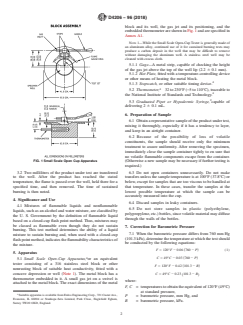
block and its well, the gas jet and its positioning, and the
embeddedthermometerareshowninFig.1andarespecifiedin
Annex A1.
NOTE 1—While the Small Scale Open-Cup Tester is generally made of
an aluminum alloy, continued use of it for sustained burning tests may
produce a carbon deposit in the well that may be difficult to remove
without damaging the aluminum well. A stainless steel well may be
cleaned with crocus cloth.
5.1.1 Gage—A metal strip, capable of checking the height
of the gas jet above the top of the well lip (2.2 6 0.1 mm).
5.1.2 Hot Plate,fittedwithatemperature-controllingdevice
or other means of heating the metal block.
5.1.3 Stopwatch, or other suitable timing device.
5.2 Thermometer, 32to230°F(−5to110°C),traceableto
the National Institute of Standards and Technology.
5.3 Graduated Pipet or Hypodermic Syringe, capable of
delivering 2 6 0.1 mL.
6. Preparation of Sample
6.1 Obtainarepresentativesampleoftheproductundertest,
mixing it thoroughly, especially if it has a tendency to layer,
and keep in an airtight container.
6.2 Because of the possibility of loss of volatile
constituents, the sample should receive only the minimum
treatment to assure uniformity. After removing the specimen,
immediately close the sample container tightly to en sure that
no volatile flammable components escape from the container.
FIG. 1 Small Scale Open Cup Apparatus
(Otherwise a new sample may be necessary if further testing is
required.)
3.2 Two millilitres of the product under test are transferred 6.3 Do not open containers unnecessarily. Do not make
transfersunlessthesampletemperatureisat100°F(37.8°C)or
to the well. After the product has reached the stated
temperature, the flame is passed over the well, held there for a
...
Questions, Comments and Discussion
Ask us and Technical Secretary will try to provide an answer. You can facilitate discussion about the standard in here.
Loading comments...