

ASTM D7511-12(2017)e1
(Test Method)Standard Test Method for Total Cyanide by Segmented Flow Injection Analysis, In-Line Ultraviolet Digestion and Amperometric Detection
General Information
- Abstract
SIGNIFICANCE AND USE
5.1 Cyanide and hydrogen cyanide are highly toxic. Regulations have been established to require the monitoring of cyanide in industrial and domestic wastewaters and surface waters.4
5.2 This test method is applicable for natural water, saline waters, and wastewater effluent.
5.3 This test method may be used for process control in wastewater treatment facilities.
5.4 The spot test outlined in Test Methods D2036, Annex A1, can be used to detect cyanide and thiocyanate in water or wastewater, and to approximate its concentration.
SCOPE
1.1 This test method is used for determining total cyanide in drinking and surface waters, as well as domestic and industrial wastes. Cyanide ion (CN–), hydrogen cyanide in water (HCN(aq)), and the cyano-complexes of zinc, copper, cadmium, mercury, nickel, silver, and iron may be determined by this test method. Cyanide ions from Au(I), Co(III), Pd(II), and Ru(II) complexes are only partially determined.
1.2 The method detection limit (MDL) is 1.0 μg/L cyanide and the minimum level (ML) is 3 μg/L. The applicable range of the method is 3 to 500 μg/L cyanide using a 200-μL sample loop. Extend the range to analyze higher concentrations by sample dilution or changing the sample loop volume.
1.3 This test method can be used by analysts experienced with equipment using segmented flow analysis (SFA) and flow injection analysis (FIA) or working under the close supervision of such qualified persons.
1.4 The values stated in SI units are to be regarded as standard. No other units of measurement are included in this standard.
1.5 This standard does not purport to address all of the safety concerns, if any, associated with its use. It is the responsibility of the user of this standard to establish appropriate safety and health practices and determine the applicability of regulatory limitations prior to use. Specific hazard statements are given in 8.5 and Section 9.
1.6 This international standard was developed in accordance with internationally recognized principles on standardization established in the Decision on Principles for the Development of International Standards, Guides and Recommendations issued by the World Trade Organization Technical Barriers to Trade (TBT) Committee.
- Status
- Published
- Publication Date
- 30-Jun-2017
- Technical Committee
- D19 - Water
- Drafting Committee
- D19.06 - Methods for Analysis for Organic Substances in Water
Overview
ASTM D7511-12(2017)e1 is a standardized test method developed by ASTM International for determining total cyanide concentrations in various water matrices, including drinking water, surface water, saline water, and domestic and industrial wastewater. This method utilizes segmented flow injection analysis, in-line ultraviolet (UV) digestion, and amperometric detection, providing a sensitive and reliable approach for cyanide monitoring. Cyanide and hydrogen cyanide are highly toxic substances, and their measurement is critical for regulatory compliance and environmental safety.
Key Topics
- Total Cyanide Determination: The method measures total cyanide, encompassing free cyanide, hydrogen cyanide, and cyano-complexes with metals such as zinc, copper, cadmium, mercury, nickel, silver, and iron.
- Detection Limits: Method detection limit (MDL) is 1.0 μg/L; the minimum reporting level (ML) is 3 μg/L. The typical analysis range is 3 to 500 μg/L, extendable by diluting samples or adjusting sample volume.
- Applicable Matrices: Suitable for natural waters, saline waters, and wastewater effluent-covers a broad range of regulatory and industrial scenarios.
- Technical Approach: The test involves:
- UV Digestion: Releases cyanide from metal complexes.
- Amperometric Detection: Uses a silver electrode for quantitative detection.
- Segmented Flow and Membrane Diffusion: Ensures selective measurement and minimizes interferences.
- Qualified Personnel: The method is intended for use by trained analysts experienced with segmented flow analysis (SFA) and flow injection analysis (FIA).
- Safety Considerations: Due to cyanide toxicity, the standard requires rigorous laboratory safety and waste management protocols.
Applications
Regulatory Compliance
- Wastewater Monitoring: Essential for facilities discharging industrial or domestic wastewater, ensuring adherence to legal cyanide discharge limits set by environmental agencies.
- Surface Water Assessment: Protects public health and ecosystem integrity by monitoring surface water bodies for cyanide contamination.
- Drinking Water Testing: Supports the safety of potable water supplies by enabling sensitive cyanide detection.
Process Control
- Industrial Process Optimization: Used in wastewater treatment plants for process control, helping operators monitor cyanide removal efficiency and optimize treatment processes.
Environmental Protection
- Pollution Incident Response: Allows rapid, accurate quantification of cyanide in environmental spill events.
- Screening and Surveillance: Can be used for ongoing surveillance of water bodies where cyanide contamination risk exists.
Laboratory Quality Assurance
- Comparison & Validation: Provides a benchmark method for validating other cyanide test procedures.
Related Standards
Several ASTM and regulatory documents are referenced for sampling, quality control, and terminology:
- ASTM D2036: Test Methods for Cyanides in Water
- ASTM D1129: Terminology Relating to Water
- ASTM D1193: Specification for Reagent Water
- ASTM D2777: Precision and Bias in Water Test Methods
- ASTM D3370: Practices for Sampling Water from Closed Conduits
- ASTM D3856: Guide for Management Systems in Laboratories Engaged in Water Analysis
- ASTM D4210: Quality Control for Water Test Methods
- ASTM D5847: Writing QC Specifications for Water Analysis
- ASTM D6696: Understanding Cyanide Species
- ASTM D7365: Sampling and Preservation for Cyanide Analysis
Practical Value
Implementing ASTM D7511 helps laboratories, industries, and regulators ensure accurate, reproducible, and safe cyanide analyses in water. Routine use supports risk management, legal compliance, and environmental stewardship. By standardizing methodology and incorporating robust quality control, this test method remains a key reference for water quality assessment involving total cyanide.
Keywords: ASTM D7511, total cyanide, segmented flow injection analysis, amperometric detection, cyanide monitoring, wastewater, surface water, UV digestion, water quality, cyanide test method.
Relations
- Effective Date
- 01-Jul-2017
- Effective Date
- 15-Nov-2023
- Effective Date
- 01-May-2020
- Effective Date
- 01-Apr-2016
- Effective Date
- 01-Jan-2014
- Effective Date
- 15-Jun-2012
- Refers
ASTM D3856-11 - Standard Guide for Management Systems in Laboratories Engaged in Analysis of Water - Effective Date
- 15-Nov-2011
- Effective Date
- 01-Dec-2010
- Effective Date
- 01-Jun-2010
- Effective Date
- 01-Mar-2010
- Effective Date
- 01-Oct-2009
- Effective Date
- 01-Oct-2009
- Effective Date
- 15-Feb-2009
- Effective Date
- 01-Oct-2008
- Effective Date
- 15-Jan-2008
Get Certified
Connect with accredited certification bodies for this standard

CIS Institut d.o.o.
Personal Protective Equipment (PPE) certification body. Notified Body NB-2890 for EU Regulation 2016/425 PPE.

Kiwa BDA Testing
Building and construction product certification.
Kmetijski inštitut Slovenije
Agricultural Institute of Slovenia. Soil testing, plant health, agricultural product analysis.
Sponsored listings
Frequently Asked Questions
ASTM D7511-12(2017)e1 is a standard published by ASTM International. Its full title is "Standard Test Method for Total Cyanide by Segmented Flow Injection Analysis, In-Line Ultraviolet Digestion and Amperometric Detection". This standard covers: SIGNIFICANCE AND USE 5.1 Cyanide and hydrogen cyanide are highly toxic. Regulations have been established to require the monitoring of cyanide in industrial and domestic wastewaters and surface waters.4 5.2 This test method is applicable for natural water, saline waters, and wastewater effluent. 5.3 This test method may be used for process control in wastewater treatment facilities. 5.4 The spot test outlined in Test Methods D2036, Annex A1, can be used to detect cyanide and thiocyanate in water or wastewater, and to approximate its concentration. SCOPE 1.1 This test method is used for determining total cyanide in drinking and surface waters, as well as domestic and industrial wastes. Cyanide ion (CN–), hydrogen cyanide in water (HCN(aq)), and the cyano-complexes of zinc, copper, cadmium, mercury, nickel, silver, and iron may be determined by this test method. Cyanide ions from Au(I), Co(III), Pd(II), and Ru(II) complexes are only partially determined. 1.2 The method detection limit (MDL) is 1.0 μg/L cyanide and the minimum level (ML) is 3 μg/L. The applicable range of the method is 3 to 500 μg/L cyanide using a 200-μL sample loop. Extend the range to analyze higher concentrations by sample dilution or changing the sample loop volume. 1.3 This test method can be used by analysts experienced with equipment using segmented flow analysis (SFA) and flow injection analysis (FIA) or working under the close supervision of such qualified persons. 1.4 The values stated in SI units are to be regarded as standard. No other units of measurement are included in this standard. 1.5 This standard does not purport to address all of the safety concerns, if any, associated with its use. It is the responsibility of the user of this standard to establish appropriate safety and health practices and determine the applicability of regulatory limitations prior to use. Specific hazard statements are given in 8.5 and Section 9. 1.6 This international standard was developed in accordance with internationally recognized principles on standardization established in the Decision on Principles for the Development of International Standards, Guides and Recommendations issued by the World Trade Organization Technical Barriers to Trade (TBT) Committee.
SIGNIFICANCE AND USE 5.1 Cyanide and hydrogen cyanide are highly toxic. Regulations have been established to require the monitoring of cyanide in industrial and domestic wastewaters and surface waters.4 5.2 This test method is applicable for natural water, saline waters, and wastewater effluent. 5.3 This test method may be used for process control in wastewater treatment facilities. 5.4 The spot test outlined in Test Methods D2036, Annex A1, can be used to detect cyanide and thiocyanate in water or wastewater, and to approximate its concentration. SCOPE 1.1 This test method is used for determining total cyanide in drinking and surface waters, as well as domestic and industrial wastes. Cyanide ion (CN–), hydrogen cyanide in water (HCN(aq)), and the cyano-complexes of zinc, copper, cadmium, mercury, nickel, silver, and iron may be determined by this test method. Cyanide ions from Au(I), Co(III), Pd(II), and Ru(II) complexes are only partially determined. 1.2 The method detection limit (MDL) is 1.0 μg/L cyanide and the minimum level (ML) is 3 μg/L. The applicable range of the method is 3 to 500 μg/L cyanide using a 200-μL sample loop. Extend the range to analyze higher concentrations by sample dilution or changing the sample loop volume. 1.3 This test method can be used by analysts experienced with equipment using segmented flow analysis (SFA) and flow injection analysis (FIA) or working under the close supervision of such qualified persons. 1.4 The values stated in SI units are to be regarded as standard. No other units of measurement are included in this standard. 1.5 This standard does not purport to address all of the safety concerns, if any, associated with its use. It is the responsibility of the user of this standard to establish appropriate safety and health practices and determine the applicability of regulatory limitations prior to use. Specific hazard statements are given in 8.5 and Section 9. 1.6 This international standard was developed in accordance with internationally recognized principles on standardization established in the Decision on Principles for the Development of International Standards, Guides and Recommendations issued by the World Trade Organization Technical Barriers to Trade (TBT) Committee.
ASTM D7511-12(2017)e1 is classified under the following ICS (International Classification for Standards) categories: 13.060.50 - Examination of water for chemical substances. The ICS classification helps identify the subject area and facilitates finding related standards.
ASTM D7511-12(2017)e1 has the following relationships with other standards: It is inter standard links to ASTM D7511-12, ASTM D6696-16(2023), ASTM D1129-13(2020)e2, ASTM D6696-16, ASTM D6696-14, ASTM D2777-12, ASTM D3856-11, ASTM D3370-10, ASTM D6696-10, ASTM D1129-10, ASTM D2036-09, ASTM D7365-09a, ASTM D7365-09, ASTM D3370-08, ASTM D2777-08. Understanding these relationships helps ensure you are using the most current and applicable version of the standard.
ASTM D7511-12(2017)e1 is available in PDF format for immediate download after purchase. The document can be added to your cart and obtained through the secure checkout process. Digital delivery ensures instant access to the complete standard document.
Standards Content (Sample)
This international standard was developed in accordance with internationally recognized principles on standardization established in the Decision on Principles for the
Development of International Standards, Guides and Recommendations issued by the World Trade Organization Technical Barriers to Trade (TBT) Committee.
´1
Designation: D7511 − 12 (Reapproved 2017)
Standard Test Method for
Total Cyanide by Segmented Flow Injection Analysis, In-Line
Ultraviolet Digestion and Amperometric Detection
This standard is issued under the fixed designation D7511; the number immediately following the designation indicates the year of
original adoption or, in the case of revision, the year of last revision. A number in parentheses indicates the year of last reapproval. A
superscript epsilon (´) indicates an editorial change since the last revision or reapproval.
ε NOTE—Warning notes were editorially updated throughout in July 2017.
1. Scope 2. Referenced Documents
2.1 ASTM Standards:
1.1 This test method is used for determining total cyanide in
drinking and surface waters, as well as domestic and industrial D1129 Terminology Relating to Water
–
D1193 Specification for Reagent Water
wastes. Cyanide ion (CN ), hydrogen cyanide in water
(HCN(aq)), and the cyano-complexes of zinc, copper, D2036 Test Methods for Cyanides in Water
D2777 Practice for Determination of Precision and Bias of
cadmium, mercury, nickel, silver, and iron may be determined
by this test method. Cyanide ions from Au(I), Co(III), Pd(II), Applicable Test Methods of Committee D19 on Water
D3370 Practices for Sampling Water from Closed Conduits
and Ru(II) complexes are only partially determined.
D3856 Guide for Management Systems in Laboratories
1.2 The method detection limit (MDL) is 1.0 µg/L cyanide
Engaged in Analysis of Water
andtheminimumlevel(ML)is3µg/L.Theapplicablerangeof
D4210 Practice for Intralaboratory Quality Control Proce-
the method is 3 to 500 µg/L cyanide using a 200-µL sample
dures and a Discussion on Reporting Low-Level Data
loop. Extend the range to analyze higher concentrations by
(Withdrawn 2002)
sample dilution or changing the sample loop volume.
D5847 Practice for Writing Quality Control Specifications
1.3 This test method can be used by analysts experienced
for Standard Test Methods for Water Analysis
with equipment using segmented flow analysis (SFA) and flow
D6696 Guide for Understanding Cyanide Species
injectionanalysis(FIA)orworkingundertheclosesupervision
D7365 Practice for Sampling, Preservation and Mitigating
of such qualified persons.
Interferences in Water Samples for Analysis of Cyanide
1.4 The values stated in SI units are to be regarded as
3. Terminology
standard. No other units of measurement are included in this
3.1 Definitions:
standard.
3.1.1 For definitions of terms used in this standard, refer to
1.5 This standard does not purport to address all of the
Terminology D1129 and Guide D6696.
safety concerns, if any, associated with its use. It is the
3.2 Definitions of Terms Specific to This Standard:
responsibility of the user of this standard to establish appro-
3.2.1 total cyanide, n—referstoallcyanide-containingcom-
priate safety and health practices and determine the applica-
pounds in a sample, including free cyanide, WAD cyanide
bility of regulatory limitations prior to use. Specific hazard
compounds, and strong metal cyanide complexes.
statements are given in 8.5 and Section 9.
1.6 This international standard was developed in accor-
4. Summary of Test Method
dance with internationally recognized principles on standard-
4.1 Prior to analysis, treat the sample to remove potential
ization established in the Decision on Principles for the
Development of International Standards, Guides and Recom- interferences (Sections 4 and 8). Ultraviolet (UV) digestion
releases cyanide from cyanide complexes. Acid addition con-
mendations issued by the World Trade Organization Technical
Barriers to Trade (TBT) Committee. verts cyanide ion to hydrogen cyanide gas (HCN), which
passes under a gas diffusion membrane. The hydrogen cyanide
1 2
This test method is under the jurisdiction of ASTM Committee D19 on Water For referenced ASTM standards, visit the ASTM website, www.astm.org, or
andisthedirectresponsibilityofSubcommitteeD19.06onMethodsforAnalysisfor contact ASTM Customer Service at service@astm.org. For Annual Book of ASTM
Organic Substances in Water. Standards volume information, refer to the standard’s Document Summary page on
Current edition approved July 1, 2017. Published July 2017. Originally approved the ASTM website.
in 2009. Last previous edition approved in 2012 as D7511 – 12. DOI: 10.1520/ The last approved version of this historical standard is referenced on
D7511-12R17E01. www.astm.org.
Copyright © ASTM International, 100 Barr Harbor Drive, PO Box C700, West Conshohocken, PA 19428-2959. United States
´1
D7511 − 12 (2017)
gas diffuses through the membrane into an alkaline receiving from high carbonate containing wastes, such as coal gasifica-
solution, where it converts back to cyanide ion. A silver tion waste and atmospheric emission scrub water, with hy-
working electrode, silver/silver chloride reference electrode, drated lime to stabilize the sample.
and platinum/stainless steel counter electrode at an applied
6.7 High concentrations of surfactants interfere by changing
potential of zero volt amperometrically monitor the cyanide
the characteristics of the gas diffusion membrane, allowing
ion. The current generated is proportional to the cyanide
acid solution to pass through the membrane and enter the
concentration present in the original sample.
detector.
4.2 Calibrations and data are processed with the instru-
6.8 Nitrate and nitrite if treated with sulfamic acid do not
ment’s data acquisition software.
interfere in this test method.
5. Significance and Use
6.9 Sodiumsulfite,sulfurdioxide,orsodiumbisulfitedonot
–
5.1 Cyanide and hydrogen cyanide are highly toxic. Regu- interfere at up to 2000 ppm SO .
lations have been established to require the monitoring of
6.10 Sodium Thiosulfate exhibits a slight positive bias at
cyanide in industrial and domestic wastewaters and surface
concentrations above 200 ppm. This positive bias may be
waters.
removed by increasing the amount of Bismuth Nitrate in the
5.2 This test method is applicable for natural water, saline
TA2 reagent.
waters, and wastewater effluent.
6.11 Samplescontainingparticulatesshouldbefilteredprior
5.3 This test method may be used for process control in
to analysis. Extract and combine filtered extract with original
wastewater treatment facilities.
sample prior to analysis, or measure the filtered extract and the
5.4 The spot test outlined in Test Methods D2036, Annex
aqueous sample separately and combine results mathemati-
A1, can be used to detect cyanide and thiocyanate in water or cally.
wastewater, and to approximate its concentration.
7. Apparatus
6. Interferences
7.1 The instrument should be equipped with a precise
6.1 Test method interferences can be caused by contami-
sampleintroductionsystem,aUVdigesterwitha312-nmlamp
nantsinthereagents,reagentwater,glassware,etc.,whichmay
and UV transparent digestion coil, a gas diffusion manifold
bias the results. Take care to keep all such items free of
with hydrophobic membrane, and an amperometric detection
contaminants.
system to include a silver working electrode, an Ag/AgCl
6.2 Sulfide and sulfide-containing compounds are positive
reference electrode, and a Pt or stainless steel counter elec-
interferents in this test method. When acidified, sulfide forms
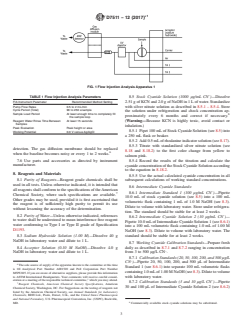
trode. Examples of the apparatus schematics are shown in Fig.
hydrogen sulfide, which passes through the gas diffusion
1. Example instrument settings are shown in Table 1.
membrane and produces a signal at the silver electrode. In
NOTE 1—The instrument settings in Table 1 are only examples. The
addition, sulfide ion reacts with cyanide ion in solution to analyst may modify the settings as long as performance of the test method
has not been degraded. Contact the instrument manufacturer for recom-
reduce its concentration over time. Treat samples containing
mended instrument parameters.
sulfide according to 11.4. During UV digestion, some sulfur
compounds may produce sulfide. TA2 reagent contains a
7.2 An autosampler is recommended but not required to
2–
sulfide scrubber that can remove up to 50 mg/L S from the
automate sample injections and increase throughput. Auto
system prior to amperometric detection.
samplers are usually available as an option from the instru-
ment’s manufacturer.
6.3 Treat sample containing water-soluble aldehydes, such
as formaldehyde or acetaldehyde, by adding ethylenediamine
7.3 Data Acquisition System—Use the computer hardware
solution.
and software recommended by the instrument manufacturer to
control the apparatus and to collect data from the detector.
6.4 Remove oxidizing agents that decompose cyanides by
adding ascorbic acid, or sodium arsenite.
7.4 Pump Tubing—Use tubing recommended by instrument
6.5 Thiocyanate can produce positive interference when
manufacturer. Replace pump tubing when worn, or when
they decompose to cyanide by UV irradiation or oxidation.
precision is no longer acceptable.
This test method uses 312 nm as the irradiation wavelength,
7.5 Gas Diffusion Membranes—A hydrophobic membrane
which keeps thiocyanate interference from UV irradiation
which allows gaseous hydrogen cyanide to diffuse from the
minimal. Use of Total Acid Reagent–Modified, TA1M (see
donor to the acceptor stream at a sufficient rate to allow
8.21) minimizes interference from thiocyanate.
6.6 High concentrations of carbonate can result in a nega-
tive response in the amperometric detector when carbon
The sole source of supply of the apparatus known to the committee at this time
dioxide diffuses across the gas diffusion membrane into the
is the trademarked CNSolution equipped with an amperometric flow cell, gas
alkaline receiving solution, reducing its pH. Treat effluents
diffusion, and UV digestion module, available from OIAnalytical. If you are aware
of alternative suppliers, please provide this information to ASTM International
Headquarters.Your comments will receive careful consideration at a meeting of the
4 1
40 CFR Part 136. responsible technical committee, which you may attend.
´1
D7511 − 12 (2017)
FIG. 1 Flow Injection Analysis Apparatus 1
–
TABLE 1 Flow Injection Analysis Parameters
8.5 Stock Cyanide Solution (1000 µg/mL CN )—Dissolve
FIA Instrument Parameter Recommended Method Setting 2.51 g of KCN and 2.0 g of NaOH in 1 Lof water. Standardize
Pump Flow Rates 0.5 to 2 mL/min with silver nitrate solution as described in 8.5.1 – 8.5.4. Store
Cycle Period (Total) 90 to 250 s/sample
the solution under refrigeration and check concentration ap-
Sample Load Period At least enough time to completely fill
proximately every 6 months and correct if necessary.
the sample loop
Reagent Water Rinse Time Between At least 15 seconds (Warning—Because KCN is highly toxic, avoid contact or
Samples
inhalation.)
Peak Evaluation Peak height or area
8.5.1 Pipet 100 mLof Stock Cyanide Solution (see 8.5) into
Working Potential 0.0 V versus Ag/AgCl
a 250 mL flask or beaker.
8.5.2 Add0.5mLofrhodanineindicatorsolution(see8.17).
8.5.3 Titrate with standardized silver nitrate solution (see
detection. The gas diffusion membrane should be replaced
8.18 and 8.18.2) to the first color change from yellow to
when the baseline becomes noisy or every 1 to 2 weeks.
salmon pink.
7.6 Use parts and accessories as directed by instrument
8.5.4 Record the results of the titration and calculate the
manufacturer. cyanideconcentrationoftheStockCyanideSolutionaccording
to the equation in 8.18.2.
8. Reagents and Materials
8.5.5 Use the actual calculated cyanide concentration in all
8.1 Purity of Reagents—Reagent grade chemicals shall be subsequent calculations of working standard concentrations.
used in all tests. Unless otherwise indicated, it is intended that
8.6 Intermediate Cyanide Standards:
all reagents shall conform to the specifications of theAmerican
–
8.6.1 Intermediate Standard 1 (100 µg/mL CN )—Pipette
Chemical Society, where such specifications are available.
10.0 mL of stock cyanide solution (see 8.5) into a 100 mL
Other grades may be used, provided it is first ascertained that
volumetric flask containing 1 mL of 1.0 M NaOH (see 8.3).
the reagent is of sufficiently high purity to permit its use
Dilute to volume with laboratory water. Store under refrigera-
without lessening the accuracy of the determination.
tion. The standard should be stable for at least 2 weeks.
–
8.2 Purity of Water—Unless otherwise indicated, references
8.6.2 Intermediate Cyanide Solution 2 (10 µg/mL CN )—
to water shall be understood to mean interference free reagent
Pipette 10.0 mLof Intermediate Cyanide Solution 1 (see 8.6.1)
water conforming to Type I or Type II grade of Specification
into a 100 mL volumetric flask containing 1.0 mL of 1.00 M
D1193.
NaOH (see 8.3). Dilute to volume with laboratory water. The
standard should be stable for at least 2 weeks.
8.3 Sodium Hydroxide Solution (1.00 M)—Dissolve 40 g
NaOH in laboratory water and dilute to 1 L.
8.7 Working Cyanide Calibration Standards—Prepare fresh
8.4 Acceptor Solution (0.10 M NaOH)—Dissolve 4.0 g daily as described in 8.7.1 and 8.7.2 ranging in concentration
–
NaOH in laboratory water and dilute to 1 L. from 3 to 500 µg/L CN .
8.7.1 Calibration Standards (20, 50, 100, 200, and 500 µg/L
–
CN )—Pipette 20, 50, 100, 200, and 500 µL of Intermediate
The sole source of supply of the apparatus known to the committee at this time
Standard 1 (see 8.6.1) into separate 100 mL volumetric flasks
is OI Analytical Part Number A001520 and Pall Corporation Part Number
containing1.0mLof1.00MNaOH(see8.3).Dilutetovolume
M5PU025. If you are aware of alternative suppliers, please provide this information
to ASTM International Headquarters. Your comments will receive careful consid- with laboratory water.
eration at a meeting of the responsible technical committee, which you may attend. –
8.7.2 Calibration Standards (3 and 10 µg/L CN )—Pipette
Reagent Chemicals, American Chemical Society Specifications, American
30 and 100 µL of Intermediate Cyanide Solution 2 (see 8.6.2)
Chemical Society, Washington, DC. For Suggestions on the testing of reagents not
listed by the American Chemical Society, see Annual Standards for Laboratory
Chemicals, BDH Ltd., Poole, Dorset, U.K., and the United States Pharmacopeia
and National Formulary, U.S. Pharmacopeial Convention, Inc. (USPC), Rockville,
MD. Commercially available stock cyanide solutions may be substituted.
´1
D7511 − 12 (2017)
into separate 100 mL volumetric flasks containing 1.0 mL of 8.18.1 Potassium Chloride (KCl)—Primary Standard—
1.00 M NaOH (see 8.3). Dilute to volume with laboratory Purity 99.98 % minimum. Ignite KCl for4hat 500ºC in a
water. platinum or high silica vessel. Borosilicate vessels are unsat-
isfactory for this purpose. Store in a dessicator prior to use.
8.8 Cyanide Electrode Stabilization Solution (Approxi-
– 8.18.2 Standardization—Dissolve 1.000 g of primary stan-
mately 5 ppm as CN )—Pipette 500 µL of Stock Cyanide (see
dard KCl (see 8.18.1) in 150 mL water containing 1 mL of
8.5) into a 100 mL volumetric flask containing 1.0 mL of 1.00
HNO (1+1) in a 1-L volumetric flask, dilute to volume and
M NaOH (see 8.3). Dilute to volume with laboratory water.
mix.Transfer 15 mLof the 1g/Lpotassium chloride solution to
The solution should be stored under refrigeration.
a 250-mL beaker by using a 15 ml volumetric pipet, dilute to
8.9 Acetate Buffer—Dissolve 410 g of sodium acetate trihy-
about 100-mL with deionized water and titrate with 0.01 M
drate (NaC H O ·3H O) in 500 mL of laboratory water. Add
2 3 2 2 Silver Nitrate titrant (see 8.18) using a silver indicator elec-
glacialaceticacid(approximately500mL)toyieldapHof4.5.
trode or the Rhodanine Indicator Solution (see 8.17) for
endpoint detection. Calculate the molarity of the titrant as
8.10 Iron (II) Cyanide Stock Solution—Weigh 0.2706 g
follows:
K [Fe(CN) ]·3H O into a 100 mL volumetric flask. Place 1.0
4 6 2
mLof 1.00 M NaOH (see 8.3) in the flask and dilute to volume
A 5 0.01341 B/C (1)
with laboratory water. The solution must be stored in an amber
where:
glass bottle under refrigeration at 4°C.
A = molarity of titrant, moles/L,
8.11 Iron (II) Cyanide Intermediate Solution—Pipet 10.0
0.01341 = molarity of 1 g/L potassium chloride primary
mLof the iron (II) cyanide stock solution (see 8.10) into a 100
standard solution,
mL volumetric flask containing 1.0 mL of 1.00 M NaOH (see
B = mL of 1g/L potassium chloride solution titrated,
8.3). Dilute to volume with laboratory grade water. The
and
solution must be stored in an amber glass bottle under
C = volume of silver nitrate consumed, mL.
refrigeration at 4°C.
8.19 Total Acid Reagent 2 (TA2)—Weigh 1.00 g bismuth
8.12 Iron (II) Cyanide Recovery Solution—Pipet 100 µL of
nitrate pentahydrate, Bi(NO ) ·5HO,intoa1L volumetric
3 3 2
iron(II)cyanideintermediatesolution(see8.11)intoa100mL
flask. Add 55 mL of water then carefully add 55 mL of
volumetric flask containing 1.0 mLof 1.00 M NaOH (see 8.3).
concentrated sulfuric acid to the flask. Gently swirl the flask
Dilute to volume with laboratory water. Prepare fresh daily.
until the bismuth nitrate pentahydrate has dissolved in the acid
solution. Carefully add about 800 mL of ASTM Type II water
8.13 Iron (III) Cyanide Stock Solution—Weigh 0.2109 g of
to the volumetric flask. Cool to room temperature and add 20
K Fe(CN) in a 100 mLvolumetric flask. Place 1.0 mLof 1.00
3 6
mL of hypophosphorous acid. Dilute to volume and mix.
M NaOH (see 8.3) in the flask and dilute to volume with
(Warning—This is an exothermic reaction and the solution
laboratorywater.Thesolutionmustbestoredinanamberglass
willbecomehotwhenpreparingthissolution.Usethissolution
bottle under refrigeration at 4°C.
within 48 hours of preparation.)
8.14 Iron (III) Cyanide Intermediate Solution—Pipet 10.0
8.20 Total Acid Reagent 1 (TA1)—Carefully add 55 mL of
mLof the iron (III) cyanide stock solution (see8.13) into a 100
concentrated sulfuric acid to about 800 mL of ASTM Type II
mL volumetric flask containing 1.0 mL of 1.00 M NaOH (see
waterina1000mLvolumetricflask.Cooltoroomtemperature
8.3). Dilute to volume with laboratory grade water. The
andadd20mLofhypophosphorousacid.Dilutetovolumeand
solution must be stored in an amber glass bottle under
mix. (Warning—This is an exothermic reaction and the
refrigeration at 4°C.
solutionwillbecomehotwhenpreparingthissolution.Usethis
8.15 Iron (III) Cyanide Recovery Solution—Pipet 100 µLof
solution within 48 hours of preparation.)
iron (III) cyanide intermediate solution (see 8.14) into a 100
8.21 TotalAcidReagent1–Modified(TA1M)—Carefullyadd
mL volumetric flask containing 1.0 mL of 1.00 M NaOH (see
55 mLof concentrated sulfuric acid to about 800 mLofASTM
8.3). Dilute to volume with laboratory water. Prepare fresh
Type II water in a 1000 mL volumetric flask and mix. Cool to
daily.
room temperature and add 19 grams of Ascorbic acid and stir
8.16 Ag/AgCl Reference Electrode Filling Solution—Fillthe
till dissolved. Add 19 grams citric acid stir till dissolved and
reference electrode as recommended by the instrument manu-
dilute to 1000 mL with ASTM Type II water and mix.
facturer.
8.21.1 The modified TotalAcid Reagent 1 has been demon-
8.17 Rhodanine Indicator Solution (0.2 g/L)—Dissolve 0.02 strated to have less positive bias from thiocyanate (<0.1 %)
grams of (p-dimethylaminobenzylidene) in 100 mL acetone. than Total Acid Reagent 1 (~0.8 %), however, recoveries of
Iron (III) Cyanide complexes may be slightly lower than
8.18 Silver Nitrate Standard Solution (0.01 M)—Dissolve
recoveries using the Total Acid Reagent 1.
1.6987 g of silver nitrate (AgNO ) in water and dilute to 1 L.
Mix thoroughly. Commercial solutions that are certified at the 8.22 Challenge Matrix Solution Stock—Prepare a stock
designated normality are suitable if used within the manufac- solution by transferring 0.954 g ammonium chloride NH Cl,
turer’s recommended storage date, otherwise standardize as 1.8 g potassium nitrate KNO , 7.03 g sodium sulfate Na SO ,
3 2 4
designated in sections 8.18.1 and 8.18.2. Store in a dark 0.483 g potassium cyanate KOCN, and 0.251 g potassium
container. thiocyanate KSCN into a 1L volumetric flask containing 100
´1
D7511 − 12 (2017)
mL reagent water, then dilute to volume with reagent water. 11.4 Sulfide—Test for the presence of sulfide by placing a
Stable for 6 months when protected from light drop of sample on a lead acetate test strip that has been
previously moistened with acetate buffer. If the test strip turns
8.23 Practice D7365 Challenge Matrix Solution—Dilute 10
2-
black, sulfide is present (above 50 mg/L S ) and treatment is
milliliters of stock solution to 100 milliliters with reagent
necessary as described in 11.4.1. If the test is negative and
water.The challenge matrix solution contains 25 mg/LNH -N,
there are no further interferences suspected, adjust the pH to
25 mg/L NO -N, 475 mg/L SO , 25 mg/L OCN, and 15 mg/L
3 4
12–13, refrigerate, and ship or transport to the laboratory.
SCN.
11.4.1 If the sample contains sulfide as indicated with a lead
8.24 Ethylenediamine Solution—Dilute 3.5 mL of ethylene-
acetate test strip or is known to contain sulfides that will
diamine to 100 mLwith reagent water in a 100-mLvolumetric
interfere with the test method, dilute the sample with reagent
flask and mix well.
water until the lead acetate test strip no longer indicates the
2-
presence of sulfide (<50 mg/L S ). For example, add 200-mL
9. Hazards
of freshly collected sample into a bottle containing 800-mL of
9.1 Warning—Because of the toxicity of cyanide, great
reagent water, then test for sulfide again as indicated in 11.4.If
care must be exercised in its handling.Acid
...