

ASTM B804-02(2024)
(Specification)Standard Specification for UNS N08367 and UNS N08926 Welded Pipe
General Information
- Abstract
ABSTRACT
This guide covers UNS N08367 and UNS N08926 welded pipe for general corrosion applications. The joints of the specimens shall be double or single welded and full penetration welded made. The welds shall be made either manually or automatically by an electric process involving the deposition of filler metal according to the class specified. The weld surface on either side of the weld shall be flush with the base plate. The contour of the reinforcement shall be reasonably smooth and free of irregularities. The deposited metal shall be fused uniformly into the plate surface. Transverse tension tests shall be made across the welded joint to assure that it must have the same minimum ultimate tensile strength as the specified minimum ultimate tensile strength of the plate. Transverse guided weld bend test shall be used to check cracks or other imperfections. The pipe shall be furnished with smooth ends, free of burrs and injurious defects and shall have a workmanlike finish.
SCOPE
1.1 This specification covers UNS N08367 and UNS N08926 welded pipe for general corrosion applications. (Although no restrictions are placed on the sizes of pipe that may be furnished under this specification, commercial practice is commonly limited to sizes not less than 8 in. nominal diameter.)
1.2 Six classes of pipe are covered as follows:
1.2.1 Class 1 pipe shall be double welded by processes employing filler metal in all passes and shall be completely radiographed.
1.2.2 Class 2 pipe shall be double welded by processes employing filler metal in all passes. No radiography is required.
1.2.3 Class 3 pipe shall be double welded by processes employing filler metal in all passes except the inside root weld may be made without the addition of filler metal. Welds are to be completely radiographed.
1.2.4 Class 4 pipe shall be double welded by processes employing filler metal in all passes except the inside root weld may be made without the addition of filler metal. No radiography is required.
1.2.5 Class 5 pipe shall be single welded by processes employing filler metal in all passes except that the pass exposed to the inside pipe surface may be made without the addition of filler metal. Welds are to be completely radiographed.
1.2.6 Class 6 pipe shall be single welded by processes employing filler metal in all passes except that the pass exposed to the inside pipe surface may be made without the addition of filler metal. No radiography is required.
1.3 The values stated in inch-pound units are to be regarded as standard. The values given in parentheses are mathematical conversions to SI units that are provided for information only and are not considered standard.
1.4 The following safety hazards caveat pertains only to the test methods portion, Section 13, of this standard: This standard does not purport to address all of the safety concerns, if any, associated with its use. It is the responsibility of the user of this standard to become familiar with all hazards including those identified in the appropriate Safety Data Sheet (SDS) for this product/material as provided by the manufacturer, to establish appropriate safety, health, and environmental practices, and determine the applicability of regulatory limitations prior to use.
1.5 This international standard was developed in accordance with internationally recognized principles on standardization established in the Decision on Principles for the Development of International Standards, Guides and Recommendations issued by the World Trade Organization Technical Barriers to Trade (TBT) Committee.
- Status
- Published
- Publication Date
- 31-Mar-2024
- Technical Committee
- B02 - Nonferrous Metals and Alloys
- Drafting Committee
- B02.07 - Refined Nickel and Cobalt and Their Alloys
Overview
ASTM B804-02(2024) is the internationally recognized standard specification for welded pipe made from UNS N08367 and UNS N08926. These pipes are primarily designed for general corrosion applications, ensuring both durability and performance in demanding environments. Issued by ASTM International, this document establishes requirements concerning manufacturing, chemical composition, mechanical properties, and testing to guarantee product consistency and safety.
The specification applies to welded pipes usually not less than 8 inches in nominal diameter and covers six distinct classes of pipe, each defined by specific welding and inspection criteria. This standard is widely used across industries where corrosion resistance, structural reliability, and verifiable quality are essential.
Key Topics
- Material Grades: Covers UNS N08367 and UNS N08926, both known for their superior corrosion resistance in harsh environments.
- Welded Pipe Classes: Six classes (1-6) define the type of welding, use of filler metal, and requirements for radiographic examination:
- Double-welded or single-welded
- Use of filler metals during welding
- Requirement (or exemption) from radiographic inspection
- Manufacturing Requirements:
- Pipes must have double or single full penetration welds
- Manual or automatic welding by electric process
- Welds should be flush, smooth, and free of surface irregularities
- Mechanical & Chemical Testing:
- Mandatory transverse tension tests across welded joints
- Transverse guided weld bend tests for defects and cracks
- Adherence to specified chemical composition per referenced ASTM standards
- Dimensional Tolerances and Quality:
- Strict requirements for pipe dimensions, wall thickness, and out-of-roundness
- Smooth ends, absence of burrs or harmful defects, and a workmanlike finish
Applications
ASTM B804-02(2024) welded pipes are essential in industries and environments demanding high resistance to general corrosion. Typical applications include:
- Chemical Processing: Used in piping systems exposed to aggressive chemicals and temperature variations.
- Petrochemical Industry: Suitable for transporting liquids and gases that may cause corrosion or stress cracking.
- Offshore and Marine Structures: Ideal for seawater and brine environments due to the high corrosion resistance of UNS N08367 and UNS N08926.
- Power Generation: Utilized in boilers, heat exchangers, and condensers where reliability and maintenance of mechanical integrity are critical.
- Pharmaceutical and Food Processing: Chosen for environments requiring corrosion-resistant and contaminant-free piping solutions.
Pipes manufactured under this standard are also specified for pressure-containing systems, with optional supplementary requirements such as intergranular corrosion testing available when requested by the purchaser.
Related Standards
The following ASTM and related standards are referenced or relevant when considering welded pipe manufacturing and testing to ASTM B804-02(2024):
- ASTM B688: Specification for Chromium-Nickel-Molybdenum-Iron Alloy Plate, Sheet, and Strip (UNS N08367)
- ASTM B625: Specification for Ni-Fe-Cr-Mo-Cu-N Low-Carbon Alloy Plate, Sheet, and Strip (UNS N08926)
- ASTM A262: Detecting Susceptibility to Intergranular Attack in Austenitic Stainless Steels
- ASTM A370: Mechanical Testing of Steel Products
- ASTM E8/E8M: Tension Testing of Metallic Materials
- ASME Boiler and Pressure Vessel Code, Section VIII and IX: Rules for construction and welding procedure qualifications
- AWS A5.11 and A5.14: Nickel and Nickel Alloy Welding Electrodes
These standards collectively ensure the welded pipe manufactured under ASTM B804-02(2024) meets stringent chemical, mechanical, and quality requirements vital to high-performance, corrosion-resistant piping installations.
Keywords: ASTM B804-02, UNS N08367, UNS N08926, welded pipe, corrosion resistance, ASTM pipe standard, welded pipe specification, industrial piping, chemical processing pipe, marine pipe, mechanical testing, pressure pipe standards
Get Certified
Connect with accredited certification bodies for this standard

Element Materials Technology
Materials testing and product certification.

Inštitut za kovinske materiale in tehnologije
Institute of Metals and Technology. Materials testing, metallurgical analysis, NDT.
Sponsored listings
Frequently Asked Questions
ASTM B804-02(2024) is a technical specification published by ASTM International. Its full title is "Standard Specification for UNS N08367 and UNS N08926 Welded Pipe". This standard covers: ABSTRACT This guide covers UNS N08367 and UNS N08926 welded pipe for general corrosion applications. The joints of the specimens shall be double or single welded and full penetration welded made. The welds shall be made either manually or automatically by an electric process involving the deposition of filler metal according to the class specified. The weld surface on either side of the weld shall be flush with the base plate. The contour of the reinforcement shall be reasonably smooth and free of irregularities. The deposited metal shall be fused uniformly into the plate surface. Transverse tension tests shall be made across the welded joint to assure that it must have the same minimum ultimate tensile strength as the specified minimum ultimate tensile strength of the plate. Transverse guided weld bend test shall be used to check cracks or other imperfections. The pipe shall be furnished with smooth ends, free of burrs and injurious defects and shall have a workmanlike finish. SCOPE 1.1 This specification covers UNS N08367 and UNS N08926 welded pipe for general corrosion applications. (Although no restrictions are placed on the sizes of pipe that may be furnished under this specification, commercial practice is commonly limited to sizes not less than 8 in. nominal diameter.) 1.2 Six classes of pipe are covered as follows: 1.2.1 Class 1 pipe shall be double welded by processes employing filler metal in all passes and shall be completely radiographed. 1.2.2 Class 2 pipe shall be double welded by processes employing filler metal in all passes. No radiography is required. 1.2.3 Class 3 pipe shall be double welded by processes employing filler metal in all passes except the inside root weld may be made without the addition of filler metal. Welds are to be completely radiographed. 1.2.4 Class 4 pipe shall be double welded by processes employing filler metal in all passes except the inside root weld may be made without the addition of filler metal. No radiography is required. 1.2.5 Class 5 pipe shall be single welded by processes employing filler metal in all passes except that the pass exposed to the inside pipe surface may be made without the addition of filler metal. Welds are to be completely radiographed. 1.2.6 Class 6 pipe shall be single welded by processes employing filler metal in all passes except that the pass exposed to the inside pipe surface may be made without the addition of filler metal. No radiography is required. 1.3 The values stated in inch-pound units are to be regarded as standard. The values given in parentheses are mathematical conversions to SI units that are provided for information only and are not considered standard. 1.4 The following safety hazards caveat pertains only to the test methods portion, Section 13, of this standard: This standard does not purport to address all of the safety concerns, if any, associated with its use. It is the responsibility of the user of this standard to become familiar with all hazards including those identified in the appropriate Safety Data Sheet (SDS) for this product/material as provided by the manufacturer, to establish appropriate safety, health, and environmental practices, and determine the applicability of regulatory limitations prior to use. 1.5 This international standard was developed in accordance with internationally recognized principles on standardization established in the Decision on Principles for the Development of International Standards, Guides and Recommendations issued by the World Trade Organization Technical Barriers to Trade (TBT) Committee.
ABSTRACT This guide covers UNS N08367 and UNS N08926 welded pipe for general corrosion applications. The joints of the specimens shall be double or single welded and full penetration welded made. The welds shall be made either manually or automatically by an electric process involving the deposition of filler metal according to the class specified. The weld surface on either side of the weld shall be flush with the base plate. The contour of the reinforcement shall be reasonably smooth and free of irregularities. The deposited metal shall be fused uniformly into the plate surface. Transverse tension tests shall be made across the welded joint to assure that it must have the same minimum ultimate tensile strength as the specified minimum ultimate tensile strength of the plate. Transverse guided weld bend test shall be used to check cracks or other imperfections. The pipe shall be furnished with smooth ends, free of burrs and injurious defects and shall have a workmanlike finish. SCOPE 1.1 This specification covers UNS N08367 and UNS N08926 welded pipe for general corrosion applications. (Although no restrictions are placed on the sizes of pipe that may be furnished under this specification, commercial practice is commonly limited to sizes not less than 8 in. nominal diameter.) 1.2 Six classes of pipe are covered as follows: 1.2.1 Class 1 pipe shall be double welded by processes employing filler metal in all passes and shall be completely radiographed. 1.2.2 Class 2 pipe shall be double welded by processes employing filler metal in all passes. No radiography is required. 1.2.3 Class 3 pipe shall be double welded by processes employing filler metal in all passes except the inside root weld may be made without the addition of filler metal. Welds are to be completely radiographed. 1.2.4 Class 4 pipe shall be double welded by processes employing filler metal in all passes except the inside root weld may be made without the addition of filler metal. No radiography is required. 1.2.5 Class 5 pipe shall be single welded by processes employing filler metal in all passes except that the pass exposed to the inside pipe surface may be made without the addition of filler metal. Welds are to be completely radiographed. 1.2.6 Class 6 pipe shall be single welded by processes employing filler metal in all passes except that the pass exposed to the inside pipe surface may be made without the addition of filler metal. No radiography is required. 1.3 The values stated in inch-pound units are to be regarded as standard. The values given in parentheses are mathematical conversions to SI units that are provided for information only and are not considered standard. 1.4 The following safety hazards caveat pertains only to the test methods portion, Section 13, of this standard: This standard does not purport to address all of the safety concerns, if any, associated with its use. It is the responsibility of the user of this standard to become familiar with all hazards including those identified in the appropriate Safety Data Sheet (SDS) for this product/material as provided by the manufacturer, to establish appropriate safety, health, and environmental practices, and determine the applicability of regulatory limitations prior to use. 1.5 This international standard was developed in accordance with internationally recognized principles on standardization established in the Decision on Principles for the Development of International Standards, Guides and Recommendations issued by the World Trade Organization Technical Barriers to Trade (TBT) Committee.
ASTM B804-02(2024) is classified under the following ICS (International Classification for Standards) categories: 77.150.40 - Nickel and chromium products. The ICS classification helps identify the subject area and facilitates finding related standards.
ASTM B804-02(2024) is available in PDF format for immediate download after purchase. The document can be added to your cart and obtained through the secure checkout process. Digital delivery ensures instant access to the complete standard document.
Standards Content (Sample)
This international standard was developed in accordance with internationally recognized principles on standardization established in the Decision on Principles for the
Development of International Standards, Guides and Recommendations issued by the World Trade Organization Technical Barriers to Trade (TBT) Committee.
Designation: B804 − 02 (Reapproved 2024)
Standard Specification for
UNS N08367 and UNS N08926 Welded Pipe
This standard is issued under the fixed designation B804; the number immediately following the designation indicates the year of
original adoption or, in the case of revision, the year of last revision. A number in parentheses indicates the year of last reapproval. A
superscript epsilon (´) indicates an editorial change since the last revision or reapproval.
1. Scope dard does not purport to address all of the safety concerns, if
any, associated with its use. It is the responsibility of the user
1.1 This specification covers UNS N08367 and UNS
of this standard to become familiar with all hazards including
N08926 welded pipe for general corrosion applications. (Al-
those identified in the appropriate Safety Data Sheet (SDS) for
though no restrictions are placed on the sizes of pipe that may
this product/material as provided by the manufacturer, to
be furnished under this specification, commercial practice is
establish appropriate safety, health, and environmental
commonly limited to sizes not less than 8 in. nominal diam-
practices, and determine the applicability of regulatory limi-
eter.)
tations prior to use.
1.2 Six classes of pipe are covered as follows:
1.5 This international standard was developed in accor-
1.2.1 Class 1 pipe shall be double welded by processes
dance with internationally recognized principles on standard-
employing filler metal in all passes and shall be completely
ization established in the Decision on Principles for the
radiographed.
Development of International Standards, Guides and Recom-
1.2.2 Class 2 pipe shall be double welded by processes
mendations issued by the World Trade Organization Technical
employing filler metal in all passes. No radiography is re-
Barriers to Trade (TBT) Committee.
quired.
1.2.3 Class 3 pipe shall be double welded by processes 2. Referenced Documents
employing filler metal in all passes except the inside root weld 2
2.1 ASTM Standards:
may be made without the addition of filler metal. Welds are to
A262 Practices for Detecting Susceptibility to Intergranular
be completely radiographed.
Attack in Austenitic Stainless Steels
1.2.4 Class 4 pipe shall be double welded by processes
A370 Test Methods and Definitions for Mechanical Testing
employing filler metal in all passes except the inside root weld
of Steel Products
may be made without the addition of filler metal. No radiog-
B625 Specification for Ni-Fe-Cr-Mo-Cu-N Low-Carbon
raphy is required.
Alloy, Ni-Fe-Cr-Si Alloy, Cr-Ni-Fe-N Low-Carbon Alloy,
1.2.5 Class 5 pipe shall be single welded by processes
Fe-Ni-Cr-Mo-Cu-N Alloy, and Ni-Fe-Cr-Mo-N Alloy
employing filler metal in all passes except that the pass
Plate, Sheet, and Strip
exposed to the inside pipe surface may be made without the
B688 Specification for Chromium-Nickel-Molybdenum-
addition of filler metal. Welds are to be completely radio-
Iron Plate, Sheet, and Strip
graphed.
B880 Specification for General Requirements for Chemical
1.2.6 Class 6 pipe shall be single welded by processes
Check Analysis Limits for Nickel, Nickel Alloys and
employing filler metal in all passes except that the pass
Cobalt Alloys
exposed to the inside pipe surface may be made without the
B899 Terminology Relating to Non-ferrous Metals and Al-
addition of filler metal. No radiography is required.
loys
1.3 The values stated in inch-pound units are to be regarded E8/E8M Test Methods for Tension Testing of Metallic Ma-
as standard. The values given in parentheses are mathematical terials
conversions to SI units that are provided for information only E29 Practice for Using Significant Digits in Test Data to
and are not considered standard. Determine Conformance with Specifications
E38 Methods for Chemical Analysis of Nickel-Chromium
1.4 The following safety hazards caveat pertains only to the
and Nickel-Chromium-Iron Alloys (Withdrawn 1989)
test methods portion, Section 13, of this standard: This stan-
1 2
This specification is under the jurisdiction of ASTM Committee B02 on For referenced ASTM standards, visit the ASTM website, www.astm.org, or
Nonferrous Metals and Alloys and is the direct responsibility of Subcommittee contact ASTM Customer Service at service@astm.org. For Annual Book of ASTM
B02.07 on Refined Nickel and Cobalt and Their Alloys. Standards volume information, refer to the standard s Document Summary page on
Current edition approved April 1, 2024. Published May 2024. Originally the ASTM website.
approved in 1989. Last previous edition approved in 2018 as B804 – 02 (2018). The last approved version of this historical standard is referenced on
DOI: 10.1520/B0804-02R24. www.astm.org.
Copyright © ASTM International, 100 Barr Harbor Drive, PO Box C700, West Conshohocken, PA 19428-2959. United States
B804 − 02 (2024)
E354 Test Methods for Chemical Analysis of High- 5.2.3 The weld surface on either side of the weld shall be
Temperature, Electrical, Magnetic, and Other Similar Iron, flush with the base plate or shall have a reasonably uniform
Nickel, and Cobalt Alloys crown, not to exceed ⁄8 in. (3.2 mm). Any weld reinforcement
E1019 Test Methods for Determination of Carbon, Sulfur, may be removed at the manufacturer’s option or by agreement
Nitrogen, and Oxygen in Steel, Iron, Nickel, and Cobalt between the manufacturer and purchaser. The contour of the
Alloys by Various Combustion and Inert Gas Fusion reinforcement shall be reasonably smooth and free of irregu-
Techniques larities. The deposited metal shall be fused uniformly into the
E1473 Test Methods for Chemical Analysis of Nickel, plate surface. No concavity of contour is permitted unless the
Cobalt, and High-Temperature Alloys resulting thickness of weld metal is equal to or greater than the
minimum thickness of the adjacent base metal.
2.2 ASME Boiler and Pressure Vessel Code:
5.2.4 Weld defects shall be repaired by removal to sound
Section VIII, Division 1 Rules for Construction of Pressure
metal and rewelding. Subsequent heat treatment and inspection
Vessels
shall be as required on the original welds.
Section IX Qualification Standard for Welding and Brazing
Procedures, Welders, Brazers, and Welding and Brazing
5.3 Heat Treatment—The recommended heat treatment shall
Operators
consist of heating to a minimum temperature of 2025 °F for
UNS N08367 and 2012 °F for UNS N08926 followed by
2.3 American Welding Society Standards:
quenching in water or rapidly cooling by other means.
AWS A5.11 Nickel and Nickel Alloy Covered Welded Elec-
trodes
6. Chemical Composition
AWS A5.14 Nickel and Nickel Alloy Bare Welding Rods
and Electrodes
6.1 The chemical composition of the pipe shall conform to
the requirements in Table 1 of Specification B688 for UNS
3. Terminology
N08367 and Table 1 of Specification B625 for UNS N08926.
3.1 Terms defined in Terminology B899 shall apply unless
6.2 The alloy content of the deposited weld metal shall
otherwise defined in this standard.
conform to that required for the plate or the welding electrodes
as shown in Specification AWS A5.11 for ENiCrMo-3,
4. Ordering Information
ENiCrMo-4, and ENiCrMo-10 or AWS A5.14 for ERNiCrMo-
4.1 It is the responsibility of the purchaser to specify all
10, ERNiCrMo-3, and ERNiCrMo-4.
requirements that are necessary for material ordered under this
6.3 If product analysis is made of the plate or weld metal by
specification. Examples of such requirements include, but are
the purchaser, the chemical composition thus determined shall
not limited to, the following:
conform to the requirements specified in 6.1 and 6.2 subject to
4.1.1 Quantity (feet or number of lengths),
the permissible tolerances in Specification B880.
4.1.2 Class (see 1.2),
4.1.3 Size (outside diameter and minimum wall thickness),
7. Mechanical Properties and Other Requirements
4.1.4 Length (specific or random),
7.1 Mechanical Properties:
4.1.5 ASTM specification number,
7.1.1 The mechanical properties of the plate shall be in
4.1.6 Authorization for repair of plate defects by welding
accordance with Table 1. Tension tests made by the plate
without prior approval if such is intended (see 9.4),
manufacturer shall qualify the plate material.
4.1.7 Circumferential weld permissibility (see 8.3.2), and
7.1.2 Transverse tension tests taken across the welded joint
4.1.8 Supplementary requirements.
shall have the same minimum ultimate tensile strength as the
specified minimum ultimate tensile strength of the plate.
5. Materials and Manufacture
7.2 Transverse Guided Weld Bend Test Requirements—
5.1 Materials—The starting material shall conform to the
Bends made in accordance with Fig. 1 shall be acceptable if no
requirements of Specification B688 for UNS N08367 and
cracks or other imperfections exceeding ⁄8 in. (3.2 mm) in any
Specification B625 for UNS N08926.
direction are present in the weld metal or between the weld and
5.2 Manufacture:
the pipe metal after bending. Cracks that originate along the
5.2.1 The joints shall be double or single welded, full
penetration welds made in accordance with ASME Boiler and
Pressure Vessel Code, Section IX.
5.2.2 The welds shall be made either manually or automati-
TABLE 1 Mechanical Property Requirements
cally by an electric process involving the deposition of filler
Elongation
Tensile Strength, min Yield Strength, min
metal according to the class specified.
in 2 in. or
Gage
50.8 mm,
ksi MPa ksi MPa
min, %
UNS # ⁄16 100 690 45 310 30
Available from American Society of Mechanical Engineers (ASME), ASME
N08367
International Headquarters, Three Park Ave., New York, NY 10016-5990, http://
> ⁄16 95 655 45 310 30
www.asme.org.
UNS 94 650 43 295 35
Available from American Welding Society (AWS), 550 NW LeJeune Rd., N08926
Miami, FL 33126, http://www.aws.org.
B804 − 02 (2024)
NOTE 1—1 in. = 25.4 mm.
Test Specimen Thickness, in. A B C D
3 1 3 3 3
⁄8 1 ⁄2 ⁄4 2 ⁄8 1 ⁄16
1 1
t 4t 2t 6t + ⁄8 3t + ⁄16
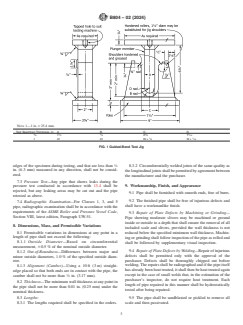
FIG. 1 Guided-Bend Test Jig
edges of the specimen during testing, and that are less than ⁄4 8.3.2 Circumferentially welded joints of the same quality as
in. (
...