

ASTM D7007-24
(Practice)Standard Practices for Electrical Methods for Locating Leaks in Geomembranes Covered with Water or Earthen Materials
General Information
- Abstract
SIGNIFICANCE AND USE
4.1 Geomembranes are used as impermeable barriers to prevent liquids from leaking from landfills, ponds, and other containments. The liquids may contain contaminants that, if released, can cause damage to the environment. Leaking liquids can erode the subgrade, causing further damage. Leakage can result in product loss or otherwise prevent the installation from performing its intended containment purpose. For these reasons, it is desirable that the geomembrane have as little leakage as practical.
4.2 Geomembrane leaks can be caused by poor quality of the subgrade, poor quality of the material placed on the geomembrane, accidents, poor workmanship, manufacturing defects, and carelessness.
4.3 The most significant causes of leaks in geomembranes that are covered with only water are related to construction activities, including pumps and equipment placed on the geomembrane, accidental punctures, and punctures caused by traffic over rocks or debris on the geomembrane or in the subgrade.
4.4 The most significant cause of leaks in geomembranes covered with earthen materials is construction damage caused by machinery that occurs while placing the earthen material on the geomembrane. Such damage also can breach additional layers of the lining system such as geosynthetic clay liners.
4.5 Electrical leak location methods are an effective final quality assurance measure to detect and locate leaks. If any of the requirements for survey area preparation is not adhered to, then leak sensitivity could be diminished. Optimal survey area conditions are described in Section 6.
SCOPE
1.1 These practices cover standard procedures for using electrical methods to locate leaks in geomembranes covered with water or earthen materials. For clarity, this practice uses the term “leak” to mean holes, punctures, tears, knife cuts, seam defects, cracks, and similar breaches in an installed geomembrane (as defined in 3.2.9).
1.2 These practices are intended to ensure that leak location surveys are performed with a standardized level of leak detection capability. To allow further innovations, and because various leak location practitioners use a wide variety of procedures and equipment to perform these surveys, performance-based protocol are also used that specify minimum leak detection criteria.
1.3 The survey shall then be conducted using the demonstrated equipment, procedures, and survey parameters. In the absence of the minimum signal strength during leak detection distance testing, a minimum measurement density specification is provided. Alternatively, the minimum measurement density may simply be used.
1.4 Separate procedures are given for leak location surveys for geomembranes covered with water and for geomembranes covered with earthen materials. Separate procedures are given for leak detection distance tests using actual and artificial leaks.
1.5 Examples of methods of data analysis for soil-covered surveys are provided as guidance in Appendix X1.
1.6 Leak location surveys can be used on geomembranes installed in basins, ponds, tanks, ore and waste pads, landfill cells, landfill caps, and other containment facilities. The procedures are applicable for geomembranes made of materials such as polyethylene, polypropylene, polyvinyl chloride, chlorosulfonated polyethylene, bituminous material, and other electrically insulating materials.
1.7 The values stated in SI units are to be regarded as standard. No other units of measurement are included in this standard.
1.8 (Warning—The electrical methods used for geomembrane leak location could use high voltages, resulting in the potential for electrical shock or electrocution. This hazard might be increased because operations might be conducted in or near water. In particular, a high voltage could exist between the water or earthen material and earth ground, or any grounded conductor. These procedures are potentially VERY DANGEROUS, and can re...
- Status
- Published
- Publication Date
- 29-Feb-2024
- Technical Committee
- D35 - Geosynthetics
- Drafting Committee
- D35.10 - Geomembranes
Buy Documents
ASTM D7007-24 - Standard Practices for Electrical Methods for Locating Leaks in Geomembranes Covered with Water or Earthen Materials
REDLINE ASTM D7007-24 - Standard Practices for Electrical Methods for Locating Leaks in Geomembranes Covered with Water or Earthen Materials
Overview
ASTM D7007-24 is a globally recognized standard developed by ASTM International that prescribes practices for using electrical methods to locate leaks in geomembranes that are covered with either water or earthen materials. Geomembranes play a critical role as impermeable barriers in environmental containment systems such as landfills, ponds, tanks, and waste pads. Detecting and locating leaks in these barriers is vital for maintaining containment integrity, protecting the environment, and ensuring compliance with regulatory requirements.
This standard aims to provide a consistent level of leak detection capability using performance-based protocols, enabling practitioners to adapt to varying project conditions and the continuous advancement of survey technologies.
Key Topics
- Significance of Leak Detection: Geomembrane leaks can result from subgrade issues, construction damage, poor workmanship, or accidental punctures during installation and use. Leaks can allow contaminants to escape, leading to environmental harm, product loss, and compromised containment performance.
- Electrical Leak Location Methods: The standard covers standardized procedures for using electrical techniques to identify leaks, including holes, punctures, tears, seam defects, and similar breaches in geomembranes.
- Survey Preparation and Execution: Emphasizes optimal survey area conditions and preparation, including the need for conductive layers, proper isolation of conductive paths, and adequate moisture for surveys involving earthen materials.
- Separate Procedures for Water and Earthen Cover: Distinct protocols for performing surveys where geomembranes are covered by water versus those covered by soil or other earthen materials.
- Standardized Test Methods: Includes procedures for leak detection distance testing using both artificial and actual leaks to determine the sensitivity and coverage of the survey equipment.
- Safety Considerations: Electrical methods for leak detection can involve high voltages and present significant safety hazards, especially around water; therefore, only trained and qualified personnel should perform these surveys with appropriate precautions.
Applications
ASTM D7007-24 is essential for professionals involved in the design, installation, quality assurance, and routine integrity assessment of geomembrane-lined facilities, including:
- Landfills (cells and caps)
- Evaporation ponds and reservoirs
- Mining leach pads, ore, and waste storage facilities
- Water and wastewater treatment basins
- Containment tanks and secondary containment systems
Typical geomembrane materials suitable for testing under this standard include polyethylene (PE), polypropylene (PP), polyvinyl chloride (PVC), chlorosulfonated polyethylene (CSPE), bituminous materials, and other electrically insulating membranes.
The adoption of ASTM D7007-24 in containment projects supports construction quality assurance (CQA) by offering a reliable means to identify and repair leaks before system commissioning, thereby reducing environmental risks and operational costs.
Related Standards
Professionals implementing ASTM D7007-24 may also refer to these relevant ASTM standards and guides:
- ASTM D4439: Terminology for Geosynthetics - Provides definitions for terminology used throughout geosynthetic standards.
- ASTM D6747: Guide for Selection of Techniques for Electrical Leak Location of Leaks in Geomembranes - Offers guidance on choosing appropriate electrical leak location methods.
- Other Geomembrane Testing Standards: Such as those covering geomembrane manufacture, installation, and mechanical property evaluation.
Practical Value
- Quality Assurance: Enables systematic, repeatable surveys to detect defects in new and existing installations.
- Environmental Protection: Early detection and prompt repair of leaks reduce the risk of contaminant release.
- Operational Efficiency: Minimizes loss of stored liquids and supports compliance with environmental regulations.
- Versatility: Applicable to a variety of geomembrane materials and facility types, with flexibility for innovation in survey techniques.
ASTM D7007-24 sets a benchmark for electrical leak detection in geomembrane-covered systems, empowering engineers, contractors, and regulators to maintain high containment integrity and environmental stewardship.
Relations
- Effective Date
- 01-Mar-2024
- Effective Date
- 01-Mar-2024
- Effective Date
- 01-Mar-2024
- Effective Date
- 01-Mar-2024
- Effective Date
- 01-Mar-2024
Buy Documents
ASTM D7007-24 - Standard Practices for Electrical Methods for Locating Leaks in Geomembranes Covered with Water or Earthen Materials
REDLINE ASTM D7007-24 - Standard Practices for Electrical Methods for Locating Leaks in Geomembranes Covered with Water or Earthen Materials
Get Certified
Connect with accredited certification bodies for this standard

Control Union Certifications
Global certification for agriculture and sustainability.

Hohenstein Institut
Textile testing and certification.

Bureau Veritas Bangladesh
Bureau Veritas certification services in Bangladesh.
Sponsored listings
Frequently Asked Questions
ASTM D7007-24 is a standard published by ASTM International. Its full title is "Standard Practices for Electrical Methods for Locating Leaks in Geomembranes Covered with Water or Earthen Materials". This standard covers: SIGNIFICANCE AND USE 4.1 Geomembranes are used as impermeable barriers to prevent liquids from leaking from landfills, ponds, and other containments. The liquids may contain contaminants that, if released, can cause damage to the environment. Leaking liquids can erode the subgrade, causing further damage. Leakage can result in product loss or otherwise prevent the installation from performing its intended containment purpose. For these reasons, it is desirable that the geomembrane have as little leakage as practical. 4.2 Geomembrane leaks can be caused by poor quality of the subgrade, poor quality of the material placed on the geomembrane, accidents, poor workmanship, manufacturing defects, and carelessness. 4.3 The most significant causes of leaks in geomembranes that are covered with only water are related to construction activities, including pumps and equipment placed on the geomembrane, accidental punctures, and punctures caused by traffic over rocks or debris on the geomembrane or in the subgrade. 4.4 The most significant cause of leaks in geomembranes covered with earthen materials is construction damage caused by machinery that occurs while placing the earthen material on the geomembrane. Such damage also can breach additional layers of the lining system such as geosynthetic clay liners. 4.5 Electrical leak location methods are an effective final quality assurance measure to detect and locate leaks. If any of the requirements for survey area preparation is not adhered to, then leak sensitivity could be diminished. Optimal survey area conditions are described in Section 6. SCOPE 1.1 These practices cover standard procedures for using electrical methods to locate leaks in geomembranes covered with water or earthen materials. For clarity, this practice uses the term “leak” to mean holes, punctures, tears, knife cuts, seam defects, cracks, and similar breaches in an installed geomembrane (as defined in 3.2.9). 1.2 These practices are intended to ensure that leak location surveys are performed with a standardized level of leak detection capability. To allow further innovations, and because various leak location practitioners use a wide variety of procedures and equipment to perform these surveys, performance-based protocol are also used that specify minimum leak detection criteria. 1.3 The survey shall then be conducted using the demonstrated equipment, procedures, and survey parameters. In the absence of the minimum signal strength during leak detection distance testing, a minimum measurement density specification is provided. Alternatively, the minimum measurement density may simply be used. 1.4 Separate procedures are given for leak location surveys for geomembranes covered with water and for geomembranes covered with earthen materials. Separate procedures are given for leak detection distance tests using actual and artificial leaks. 1.5 Examples of methods of data analysis for soil-covered surveys are provided as guidance in Appendix X1. 1.6 Leak location surveys can be used on geomembranes installed in basins, ponds, tanks, ore and waste pads, landfill cells, landfill caps, and other containment facilities. The procedures are applicable for geomembranes made of materials such as polyethylene, polypropylene, polyvinyl chloride, chlorosulfonated polyethylene, bituminous material, and other electrically insulating materials. 1.7 The values stated in SI units are to be regarded as standard. No other units of measurement are included in this standard. 1.8 (Warning—The electrical methods used for geomembrane leak location could use high voltages, resulting in the potential for electrical shock or electrocution. This hazard might be increased because operations might be conducted in or near water. In particular, a high voltage could exist between the water or earthen material and earth ground, or any grounded conductor. These procedures are potentially VERY DANGEROUS, and can re...
SIGNIFICANCE AND USE 4.1 Geomembranes are used as impermeable barriers to prevent liquids from leaking from landfills, ponds, and other containments. The liquids may contain contaminants that, if released, can cause damage to the environment. Leaking liquids can erode the subgrade, causing further damage. Leakage can result in product loss or otherwise prevent the installation from performing its intended containment purpose. For these reasons, it is desirable that the geomembrane have as little leakage as practical. 4.2 Geomembrane leaks can be caused by poor quality of the subgrade, poor quality of the material placed on the geomembrane, accidents, poor workmanship, manufacturing defects, and carelessness. 4.3 The most significant causes of leaks in geomembranes that are covered with only water are related to construction activities, including pumps and equipment placed on the geomembrane, accidental punctures, and punctures caused by traffic over rocks or debris on the geomembrane or in the subgrade. 4.4 The most significant cause of leaks in geomembranes covered with earthen materials is construction damage caused by machinery that occurs while placing the earthen material on the geomembrane. Such damage also can breach additional layers of the lining system such as geosynthetic clay liners. 4.5 Electrical leak location methods are an effective final quality assurance measure to detect and locate leaks. If any of the requirements for survey area preparation is not adhered to, then leak sensitivity could be diminished. Optimal survey area conditions are described in Section 6. SCOPE 1.1 These practices cover standard procedures for using electrical methods to locate leaks in geomembranes covered with water or earthen materials. For clarity, this practice uses the term “leak” to mean holes, punctures, tears, knife cuts, seam defects, cracks, and similar breaches in an installed geomembrane (as defined in 3.2.9). 1.2 These practices are intended to ensure that leak location surveys are performed with a standardized level of leak detection capability. To allow further innovations, and because various leak location practitioners use a wide variety of procedures and equipment to perform these surveys, performance-based protocol are also used that specify minimum leak detection criteria. 1.3 The survey shall then be conducted using the demonstrated equipment, procedures, and survey parameters. In the absence of the minimum signal strength during leak detection distance testing, a minimum measurement density specification is provided. Alternatively, the minimum measurement density may simply be used. 1.4 Separate procedures are given for leak location surveys for geomembranes covered with water and for geomembranes covered with earthen materials. Separate procedures are given for leak detection distance tests using actual and artificial leaks. 1.5 Examples of methods of data analysis for soil-covered surveys are provided as guidance in Appendix X1. 1.6 Leak location surveys can be used on geomembranes installed in basins, ponds, tanks, ore and waste pads, landfill cells, landfill caps, and other containment facilities. The procedures are applicable for geomembranes made of materials such as polyethylene, polypropylene, polyvinyl chloride, chlorosulfonated polyethylene, bituminous material, and other electrically insulating materials. 1.7 The values stated in SI units are to be regarded as standard. No other units of measurement are included in this standard. 1.8 (Warning—The electrical methods used for geomembrane leak location could use high voltages, resulting in the potential for electrical shock or electrocution. This hazard might be increased because operations might be conducted in or near water. In particular, a high voltage could exist between the water or earthen material and earth ground, or any grounded conductor. These procedures are potentially VERY DANGEROUS, and can re...
ASTM D7007-24 is classified under the following ICS (International Classification for Standards) categories: 59.080.70 - Geotextiles. The ICS classification helps identify the subject area and facilitates finding related standards.
ASTM D7007-24 has the following relationships with other standards: It is inter standard links to ASTM D7007-16, ASTM D7909-21a, ASTM D8551-24, ASTM D6747-21, ASTM D7700-22. Understanding these relationships helps ensure you are using the most current and applicable version of the standard.
ASTM D7007-24 is available in PDF format for immediate download after purchase. The document can be added to your cart and obtained through the secure checkout process. Digital delivery ensures instant access to the complete standard document.
Standards Content (Sample)
This international standard was developed in accordance with internationally recognized principles on standardization established in the Decision on Principles for the
Development of International Standards, Guides and Recommendations issued by the World Trade Organization Technical Barriers to Trade (TBT) Committee.
Designation: D7007 − 24
Standard Practices for
Electrical Methods for Locating Leaks in Geomembranes
Covered with Water or Earthen Materials
This standard is issued under the fixed designation D7007; the number immediately following the designation indicates the year of
original adoption or, in the case of revision, the year of last revision. A number in parentheses indicates the year of last reapproval. A
superscript epsilon (´) indicates an editorial change since the last revision or reapproval.
1. Scope 1.7 The values stated in SI units are to be regarded as
standard. No other units of measurement are included in this
1.1 These practices cover standard procedures for using
standard.
electrical methods to locate leaks in geomembranes covered
1.8 (Warning—The electrical methods used for geomem-
with water or earthen materials. For clarity, this practice uses
brane leak location could use high voltages, resulting in the
the term “leak” to mean holes, punctures, tears, knife cuts,
potential for electrical shock or electrocution. This hazard
seam defects, cracks, and similar breaches in an installed
might be increased because operations might be conducted in
geomembrane (as defined in 3.2.9).
or near water. In particular, a high voltage could exist between
1.2 These practices are intended to ensure that leak location
the water or earthen material and earth ground, or any
surveys are performed with a standardized level of leak
grounded conductor. These procedures are potentially VERY
detection capability. To allow further innovations, and because
DANGEROUS, and can result in personal injury or death. The
various leak location practitioners use a wide variety of
electrical methods used for geomembrane leak location should
procedures and equipment to perform these surveys,
be attempted only by qualified and experienced personnel.
performance-based protocol are also used that specify mini-
Appropriate safety measures must be taken to protect the leak
mum leak detection criteria.
location operators as well as other people at the site.)
1.3 The survey shall then be conducted using the demon-
1.9 This standard does not purport to address all of the
strated equipment, procedures, and survey parameters. In the
safety concerns, if any, associated with its use. It is the
absence of the minimum signal strength during leak detection
responsibility of the user of this standard to establish appro-
distance testing, a minimum measurement density specification
priate safety, health, and environmental practices and deter-
is provided. Alternatively, the minimum measurement density
mine the applicability of regulatory limitations prior to use.
may simply be used.
1.10 This international standard was developed in accor-
dance with internationally recognized principles on standard-
1.4 Separate procedures are given for leak location surveys
ization established in the Decision on Principles for the
for geomembranes covered with water and for geomembranes
Development of International Standards, Guides and Recom-
covered with earthen materials. Separate procedures are given
mendations issued by the World Trade Organization Technical
for leak detection distance tests using actual and artificial leaks.
Barriers to Trade (TBT) Committee.
1.5 Examples of methods of data analysis for soil-covered
surveys are provided as guidance in Appendix X1.
2. Referenced Documents
1.6 Leak location surveys can be used on geomembranes 2.1 ASTM Standards:
installed in basins, ponds, tanks, ore and waste pads, landfill
D4439 Terminology for Geosynthetics
cells, landfill caps, and other containment facilities. The D6747 Guide for Selection of Techniques for Electrical Leak
procedures are applicable for geomembranes made of materials
Location of Leaks in Geomembranes
such as polyethylene, polypropylene, polyvinyl chloride, chlo-
3. Terminology
rosulfonated polyethylene, bituminous material, and other
electrically insulating materials.
3.1 For general definitions related to geosynthetics, see
Terminology D4439.
3.2 Definitions of Terms Specific to This Standard:
These practices are under the jurisdiction of ASTM Committee D35 on
Geosynthetics and are the direct responsibility of Subcommittee D35.10 on
Geomembranes. For referenced ASTM standards, visit the ASTM website, www.astm.org, or
Current edition approved March 1, 2024. Published March 2024. Originally contact ASTM Customer Service at service@astm.org. For Annual Book of ASTM
approved in 2003. Last previous edition approved in 2016 as D7007 – 16. DOI: Standards volume information, refer to the standard’s Document Summary page on
10.1520/D7007-24. the ASTM website.
Copyright © ASTM International, 100 Barr Harbor Drive, PO Box C700, West Conshohocken, PA 19428-2959. United States
D7007 − 24
3.2.1 artificial leak, n—an electrical simulation of a leak in For these reasons, it is desirable that the geomembrane have as
a geomembrane. little leakage as practical.
3.2.2 conductive-backed geomembrane, n—a geomembrane
4.2 Geomembrane leaks can be caused by poor quality of
that is manufactured with one surface that is conductive.
the subgrade, poor quality of the material placed on the
3.2.3 conductive drainage geocomposite, n—a drainage geomembrane, accidents, poor workmanship, manufacturing
geocomposite manufactured with one or several conductive defects, and carelessness.
geotextiles.
4.3 The most significant causes of leaks in geomembranes
3.2.4 conductive geotextile, n—a geotextile manufactured
that are covered with only water are related to construction
with an electrically conductive element or fiber or external
activities, including pumps and equipment placed on the
treatment to make it electrically conductive.
geomembrane, accidental punctures, and punctures caused by
3.2.5 current source electrode, n—the electrode that is traffic over rocks or debris on the geomembrane or in the
placed in the water or earthen material above the geomem- subgrade.
brane.
4.4 The most significant cause of leaks in geomembranes
3.2.6 dipole measurement, n—an electrical measurement
covered with earthen materials is construction damage caused
made on or in a partially conductive material using two closely
by machinery that occurs while placing the earthen material on
spaced electrodes.
the geomembrane. Such damage also can breach additional
3.2.7 earthen material, n—sand, gravel, clay, silt, combina-
layers of the lining system such as geosynthetic clay liners.
tions of these materials, and similar materials with at least
4.5 Electrical leak location methods are an effective final
minimal moisture for electrical current conduction.
quality assurance measure to detect and locate leaks. If any of
3.2.8 functionality testing, n—for the purposes of these
the requirements for survey area preparation is not adhered to,
practices, functionality testing is a demonstration that a testing
then leak sensitivity could be diminished. Optimal survey area
circuit is installed in order to detect an artificial or actual leak
conditions are described in Section 6.
using the proposed equipment settings and survey procedures.
Functionality testing may be used to determine the measure-
5. Summary of the Electrical Leak Location Methods for
ment density through the use of leak detection distance testing.
Covered Geomembranes
3.2.9 leak, n—for the purposes of these practices, a leak is
5.1 The principle of the electrical leak location method is to
any unintended opening, perforation, breach, slit, tear,
place a voltage across a geomembrane and then locate the
puncture, crack, or seam breach. Significant amounts of liquids
points of anomalous potential distribution where electrical
or solids may or may not flow through a leak. Scratches,
current flows through leaks in the geomembrane. Additional
gouges, dents, or other aberrations that do not completely
information can be found in Guide D6747.
penetrate the geomembrane are not considered to be leaks.
Types of leaks detected during surveys include, but are not
5.2 General Principles:
limited to: burns, circular holes, linear cuts, seam defects, tears,
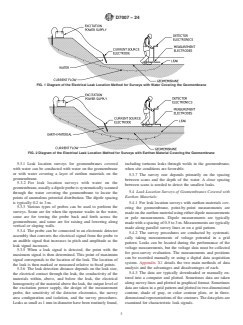
5.2.1 Figs. 1 and 2 show diagrams of the electrical leak
punctures, and material defects.
location method for a geomembrane covered with water and
3.2.10 noise, n—the unwanted part of a measured signal
for a geomembrane covered with earthen materials, respec-
contributed by phenomena other than the desired signal.
tively. One output of an electrical excitation power supply is
connected to a current source electrode placed in the material
3.2.11 pole measurement, n—an electrical measurement
covering the geomembrane. The other output of the power
made on or in a partially conductive material using one
supply is connected to an electrode in contact with electrically
measurement electrode and a remote reference electrode.
conductive material under the geomembrane.
3.2.12 potential, n—electrical voltage measured relative to a
5.2.2 When there are leaks, electrical current flows through
reference point.
the leaks, which produces high current density and a localized
3.2.13 site response current, n—the value of current, typi-
anomaly in the voltage potential distribution in the material
cally expressed in milliamps, resulting from applying a voltage
above the geomembrane. Electrical measurements are made to
to a current source electrode inserted into the material covering
locate those areas of anomalous signal at the leaks.
the geomembrane in the survey area with the current return
5.2.3 Measurements are made using a dipole or pole mea-
electrode connected to the underlying conductive layer.
surement configuration. Various types of data acquisition are
used, including audio indications of the signal level, manual
4. Significance and Use
measurements with manual recording of data, and automated
4.1 Geomembranes are used as impermeable barriers to
digital data acquisition.
prevent liquids from leaking from landfills, ponds, and other
5.2.4 Direct current and alternating current excitation power
containments. The liquids may contain contaminants that, if
supplies and potential measurement systems have been used
released, can cause damage to the environment. Leaking
for leak location surveys.
liquids can erode the subgrade, causing further damage.
Leakage can result in product loss or otherwise prevent the 5.3 Leak Location Surveys of Geomembranes Covered with
installation from performing its intended containment purpose. Water:
D7007 − 24
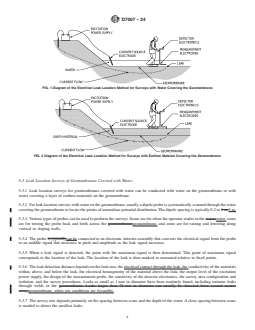
FIG. 1 Diagram of the Electrical Leak Location Method for Surveys with Water Covering the Geomembrane
FIG. 2 Diagram of the Electrical Leak Location Method for Surveys with Earthen Material Covering the Geomembrane
5.3.1 Leak location surveys for geomembranes covered including tortuous leaks through welds in the geomembrane,
with water can be conducted with water on the geomembrane when site conditions are favorable.
or with water covering a layer of earthen materials on the
5.3.7 The survey rate depends primarily on the spacing
geomembrane.
between scans and the depth of the water. A close spacing
5.3.2 For leak location surveys with water on the
between scans is needed to detect the smallest leaks.
geomembrane, usually a dipole probe is systematically scanned
5.4 Leak Location Surveys of Geomembranes Covered with
through the water covering the geomembrane to locate the
Earthen Materials:
points of anomalous potential distribution. The dipole spacing
is typically 0.2 to 3 m.
5.4.1 For leak location surveys with earthen materials cov-
5.3.3 Various types of probes can be used to perform the
ering the geomembrane, point-by-point measurements are
surveys. Some are for when the operator wades in the water,
made on the earthen material using either dipole measurements
some are for towing the probe back and forth across the
or pole measurements. Dipole measurements are typically
geomembrane, and some are for raising and lowering along
made with a spacing of 0.5 to 3 m. Measurements are typically
vertical or sloping walls.
made along parallel survey lines or on a grid pattern.
5.3.4 The probe can be connected to an electronic detector
5.4.2 The survey procedures are conducted by systemati-
assembly that converts the electrical signal from the probe to
cally taking measurements of voltage potential in a grid
an audible signal that increases in pitch and amplitude as the
pattern. Leaks can be located during the performance of the
leak signal increases.
voltage measurements, but the voltage data must be collected
5.3.5 When a leak signal is detected, the point with the
for post-survey evaluation. The measurements and positions
maximum signal is then determined. This point of maximum
can be recorded manually or using a digital data acquisition
signal corresponds to the location of the leak. The location of
system. Appendix X1 details the two main methods of data
the leak is then marked or measured relative to fixed points.
analysis and the advantages and disadvantages of each.
5.3.6 The leak detection distance depends on the leak size,
5.4.3 The data are typically downloaded or manually en-
the electrical contact through the leak, the conductivity of the
tered into a computer and plotted. Sometimes data are taken
materials within, above, and below the leak, the electrical
along survey lines and plotted in graphical format. Sometimes
homogeneity of the material above the leak, the output level of
data are taken in a grid pattern and plotted in two-dimensional
the excitation power supply, the design of the measurement
contour, shade of gray, or color contour plots, or in three-
probe, the sensitivity of the detector electronics, the survey
dimensional representations of the contours. The data plots are
area configuration and isolation, and the survey procedures.
Leaks as small as 1 mm in diameter have been routinely found, examined for characteristic leak signals.
D7007 − 24
5.4.4 The approximate location of the leak signal is deter- geocomposite is electrically insulative. Drainage geocompos-
mined from the data plots, and additional measurements are ites without an electrically insulative core may not be subject
made on the earthen material in the vicinity of the detected leak to this limitation.
signal to more accurately determine the position of the leak. 6.1.5 For lining systems comprised of two geomembranes
with only a geonet or only a drainage geocomposite between
5.4.5 The leak detection distance depends on the leak size,
the electrical contact through the leak, the conductivity of the them, it is recommended to use either a conductive-backed
geomembrane or conductive geosynthetic between the
materials within, above, and below the leak, the electrical
homogeneity of the material above the leak, the design of the geomembranes. If the drainage geocomposite or geomembrane
is not electrically conductive, the volume between the
measurement electrodes, the output level of the excitation
power supply, the sensitivity of the detector electronics, the geomembranes shall be filled with a liquid to provide the
conductive material. The liquid level in the area between the
survey procedures, the survey area configuration and isolation,
and the data interpretation methods and expertise. Usually geomembranes should be limited so that it exerts a pressure
less than the pressure exerted by the liquid and any earthen
leaks as small as 5 mm in diameter can be located under
600 mm of earthen material. Leaks as small as 1 mm in materials on the primary geomembrane. When the head pres-
sure of the liquid under the geomembrane exceeds the down-
diameter can be found, including tortuous leaks through welds
in the geomembrane, when site conditions are favorable. ward pressure exerted by the weight of the liquid and any
earthen materials on the geomembrane, the primary geomem-
5.4.6 The survey rate depends primarily on the spacing
brane will begin to float. For surveys with only a liquid on the
between the measurement points, the type of data acquisition,
geomembrane, the survey area will be limited to the area of the
and whether data interpretation is accomplished in the field.
geomembrane that is covered with liquid. For surveys with
Optimal survey area conditions are described in Section 6.
earthen materials on the geomembrane, the survey area can be
calculated from the relative density of the earthen materials,
6. General Leak Location Survey Procedures
the thickness of the earthen materials, and the slope of the
6.1 The following measures shall be taken to optimize the
geomembrane. Additional area can be surveyed by placing a
leak location survey:
liquid on the earthen material on the primary geomembrane.
6.1.1 Conductive paths such as metal pipe penetrations,
6.1.6 For surveys with earthen materials on the
pump grounds, and batten strips on concrete should be isolated
geomembrane, the earthen materials shall have adequate mois-
or insulated from the water or earthen material on the geomem-
ture to provide a continuous path for electrical current to flow
brane whenever practical. These conductive paths conduct
through the leak. Earthen materials usually have sufficient
electricity and mask nearby leaks from detection, as well as
moisture at depth, but sometimes the surface of the earthen
compromising the overall survey quality.
materials becomes too dry. This dry material shall be scraped
6.1.2 In applications where a single geomembrane is cov-
away at the measurement points, or the surface shall be wetted
ered with earthen materials that overlap the edges of the
with water. The earthen materials do not have to be saturated
geomembrane, measures should be taken to isolate the edges.
with water. The amount of moisture required depends on the
If earthen materials overlap the edges of the survey area to
earthen material, the equipment, and procedures.
earth ground, electrical current will flow from the earthen
6.1.7 If it is suspected that existing numerous or large leaks
material to earth ground, compromising survey sensitivity.
in the geomembrane may be causing poor leak detection
Isolation can be accomplished by either performing the leak
sensitivity, it is recommended that more than one survey be
location survey before the edges of the geomembrane are
performed, the first to locate and uncover the large leak(s) and
covered, removing the earthen materials from a narrow path
the subsequent survey(s) to perform the method at the desired
around the perimeter of the geomembrane, or allowing the
sensitivity.
edge of the geomembrane to protrude above the earthen
6.2 After the survey circuit is installed, a functionality test is
materials.
performed using an actual or artificial leak, which may include
6.1.3 There must be a conductive component on the bottom
leak detection distance testing as described in the annexes. The
surface of the geomembrane or material directly below the
measurements obtained over the actual or artificial leak are
electrically insulative geomembrane being tested. Typically,
used in tandem with the site response current to assess the site’s
leak location surveys on a properly prepared subgrade will
conduciveness to testing and verify functionality of the testing
have sufficient conductivity. Under proper conditions and
circuit.
preparations, geosynthetic clay liners (GCLs) can be adequate
as conductive material. There are some conductive geotextiles
7. Leak Location Survey Procedures for Surveys with
or other conductive materials with successful field experience
Water Covering the Geomembrane
which can be installed as part of or beneath the geomembrane
to facilitate electrical leak location survey (that is, on dry
7.1 The leak location survey shall be performed by scanning
subgrades or as part of a planar drainage geocomposite).
the leak location probe along the submerged geomembrane.
6.1.4 For lining systems where an electrically insulative The maximum distance between adjacent scans shall be
geomembrane is overlain by a drainage geonet geocomposite, determined by a leak detection distance test using an artificial
if the drainage geocomposite is not saturated or is not manu- or actual leak. The advantages and disadvantages of using the
factured to be conductive, only leaks that penetrate both artificial or actual leak are listed in Table 1. A leak detection
geosynthetics can be detected, as a dry drainage geonet distance test shall be conducted on each geomembrane being
D7007 − 24
TABLE 1 Comparison of Artificial Leaks versus Actual Leaks for Leak Detection Distance Test with Water on the Geomembrane
Factor Actual Leak Artificial Leak
Repairs Geomembrane must be repaired after test No geomembrane repair
Mobility Moving location requires another actual leak to be made and Can be easily moved without needing geomembrane repair
repaired.
Test adequacy of the conductivity Yes, could be important for double geomembranes Yes for single geomembranes, yes for double geomembranes
of the material under the if the artificial leak current return path corresponds to actual
geomembrane site survey conditions
Convenience Must drill hole, sometimes under water, position is difficult to Artificial leak is just placed in the water, can usually see the
determine position
tested for each set of equipment used before the set is used on 7.6 The locations of all leaks found shall be marked or
that geomembrane. Periodic leak detection distance tests are measured relative to fixed points.
specified in 7.7.
7.7 Periodic Leak Detection Distance Test—The leak detec-
7.2 Artificial Leak Procedures—Annex A1 contains the
tion distance test using the artificial or actual leak shall be
procedures for using an artificial leak to conduct a leak
conducted for each set of equipment, as a minimum, at the
detection distance test and determine the detection distance for
beginning and end of each day of survey. For this test, the
surveys with water on the geomembrane.
current source electrode shall be no closer to the artificial or
actual leak than the maximum distance used during the survey.
7.3 Actual Leak Procedures—Annex A2 contains the proce-
The periodic leak detection distance tests shall produce a leak
dures for using an actual leak to conduct a leak detection
detection distance larger than the leak detection distance used
distance test and determine the detection distance for surveys
for the leak location survey. If any leak detection distance is
with water on the geomembrane.
smaller, then the area surveyed with that set of equipment in
7.4 Leak Location Survey—The leak location survey shall
the period since the previous leak detection distance test shall
be conducted using procedures whereby the leak location probe
be repeated.
passes within the detection distance of all locations on the
geomembrane being surveyed for leaks. Because the probe
8. Leak Location Survey Procedures for Surveys with
detects leaks within the detection distance on both sides of the
Earthen Material Covering the Geomembrane
probe, the distance between leak detection sweeps can be no
8.1 The distance between adjacent survey lines or grid
more than twice the detection distance. In addition to these
points shall be determined by a leak detection distance test
procedures, any seams that can be visually located, or located
using an artificial or actual leak. The advantages and disadvan-
by feel as the probe is scanned on the geomembrane, shall be
tages of using the artificial leak and actual leak are listed in
surveyed for leaks by passing the probe directly along the seam
Table 2. A leak detection distance test shall be conducted on
or seam flap.
each geomembrane being tested for each set of equipment used
7.5 The criteria used to define the system leak detection
before the set is used on that geomembrane. Periodic leak
distance as required in 7.3 and 7.4 and described in Annex A1
detection distance tests are also specified in 8.12.
and Annex A2 shall not to be used as the leak detection criteria.
Any definite, repeatable leak signal indication shall be consid- 8.2 Artificial Leak Procedures—Annex A3 contains the
ered to be a leak. procedures for using an artificial leak to conduct a leak
TABLE 2 Comparison of Artificial Leaks versus Actual Leaks for Leak Detection Distance Test with Earthen Material on the
Geomembrane
Factor Actual Leak Artificial Leak
Repairs Geomembrane must be repaired after test. If a geotextile No geomembrane or geotextile cushion repair.
cushion is on the geomembrane, it also must be removed
and repaired.
Mobility Moving location requires another actual leak to be made and Can be easily moved without needing geomembrane repair
repaired.
Test adequacy of the conductivity Yes Yes for single geomembranes, yes for double
of the material under the geomembrane geomembranes if the artificial leak current return path
corresponds to actual site survey conditions
Effect on survey sensitivity Affects sensitivity of immediate vicinity of leak; leak must
...
This document is not an ASTM standard and is intended only to provide the user of an ASTM standard an indication of what changes have been made to the previous version. Because
it may not be technically possible to adequately depict all changes accurately, ASTM recommends that users consult prior editions as appropriate. In all cases only the current version
of the standard as published by ASTM is to be considered the official document.
Designation: D7007 − 16 D7007 − 24
Standard Practices for
Electrical Methods for Locating Leaks in Geomembranes
Covered with Water or Earthen Materials
This standard is issued under the fixed designation D7007; the number immediately following the designation indicates the year of
original adoption or, in the case of revision, the year of last revision. A number in parentheses indicates the year of last reapproval. A
superscript epsilon (´) indicates an editorial change since the last revision or reapproval.
1. Scope
1.1 These practices cover standard procedures for using electrical methods to locate leaks in geomembranes covered with water
or earthen materials. For clarity, this practice uses the term “leak” to mean holes, punctures, tears, knife cuts, seam defects, cracks,
and similar breaches in an installed geomembrane (as defined in 3.2.53.2.9).
1.2 These practices are intended to ensure that leak location surveys are performed with demonstrated a standardized level of leak
detection capability. To allow further innovations, and because various leak location practitioners use a wide variety of procedures
and equipment to perform these surveys, performance-based operationsprotocol are also used that specify the minimum leak
detection performance for the equipment and procedures.criteria.
1.3 These practices require that the leak location The survey shall then be conducted using the demonstrated equipment,
procedures, and survey parameters used are demonstrated to result in an established minimum leak detection distance. The survey
shall then be conducted using the demonstrated equipment, procedures, and survey parameters.parameters. In the absence of the
minimum signal strength during leak detection distance testing, a minimum measurement density specification is provided.
Alternatively, the minimum measurement density may simply be used.
1.4 Separate procedures are given for leak location surveys for geomembranes covered with water and for geomembranes covered
with earthen materials. Separate procedures are given for leak detection distance tests using actual and artificial leaks.
1.5 Examples of methods of data analysis for soil-covered surveys are provided as guidance in Appendix X1.
1.6 Leak location surveys can be used on geomembranes installed in basins, ponds, tanks, ore and waste pads, landfill cells, landfill
caps, and other containment facilities. The procedures are applicable for geomembranes made of materials such as polyethylene,
polypropylene, polyvinyl chloride, chlorosulfonated polyethylene, bituminous material, and other electrically-insulating electri-
cally insulating materials.
1.7 The values stated in SI units are to be regarded as standard. No other units of measurement are included in this standard.
1.8 (Warning—The electrical methods used for geomembrane leak location could use high voltages, resulting in the potential for
electrical shock or electrocution. This hazard might be increased because operations might be conducted in or near water. In
particular, a high voltage could exist between the water or earthen material and earth ground, or any grounded conductor. These
These practices are under the jurisdiction of ASTM Committee D35 on Geosynthetics and isare the direct responsibility of Subcommittee D35.10 on Geomembranes.
Current edition approved Jan. 1, 2016March 1, 2024. Published January 2016March 2024. Originally approved in 2003. Last previous edition approved in 20152016 as
D7007D7007 – 16.-15. DOI: 10.1520/D7007-16.10.1520/D7007-24.
Copyright © ASTM International, 100 Barr Harbor Drive, PO Box C700, West Conshohocken, PA 19428-2959. United States
D7007 − 24
procedures are potentially VERY DANGEROUS, and can result in personal injury or death. The electrical methods used for
geomembrane leak location should be attempted only by qualified and experienced personnel. Appropriate safety measures must
be taken to protect the leak location operators as well as other people at the site.)
1.9 This standard does not purport to address all of the safety concerns, if any, associated with its use. It is the responsibility
of the user of this standard to establish appropriate safety and healthsafety, health, and environmental practices and determine
the applicability of regulatory limitations prior to use.
1.10 This international standard was developed in accordance with internationally recognized principles on standardization
established in the Decision on Principles for the Development of International Standards, Guides and Recommendations issued
by the World Trade Organization Technical Barriers to Trade (TBT) Committee.
2. Referenced Documents
2.1 ASTM Standards:
D4439 Terminology for Geosynthetics
D6747 Guide for Selection of Techniques for Electrical Leak Location of Leaks in Geomembranes
3. Terminology
3.1 For general definitions related to geosynthetics, see Terminology D4439.
3.2 Definitions of Terms Specific to This Standard:
3.2.1 artificial leak, n—an electrical simulation of a leak in a geomembrane.
3.2.2 conductive-backed geomembrane, n—a geomembrane that is manufactured with one surface that is conductive.
3.2.3 conductive drainage geocomposite, n—a drainage geocomposite manufactured with one or several conductive geotextiles.
3.2.4 conductive geotextile, n—a geotextile manufactured with an electrically conductive element or fiber or external treatment to
make it electrically conductive.
3.2.5 current source electrode, n—the electrode that is placed in the water or earthen material above the geomembrane.
3.2.6 dipole measurement, n—an electrical measurement made on or in a partially conductive material using two closely-spaced
closely spaced electrodes.
3.2.7 earthen material, n—sand, gravel, clay, silt, combinations of these materials, and similar materials with at least minimal
moisture for electrical current conduction.
3.2.8 functionality testing, n—for the purposes of these practices, functionality testing is a demonstration that a testing circuit is
installed in order to detect an artificial or actual leak using the proposed equipment settings and survey procedures. Functionality
testing may be used to determine the measurement density through the use of leak detection distance testing.
3.2.9 leak, n—for the purposes of these practices, a leak is any unintended opening, perforation, breach, slit, tear, puncture, crack,
or seam breach. Significant amounts of liquids or solids may or may not flow through a leak. Scratches, gouges, dents, or other
aberrations that do not completely penetrate the geomembrane are not considered to be leaks. Types of leaks detected during
surveys include, but are not limited to: burns, circular holes, linear cuts, seam defects, tears, punctures, and material defects.
3.2.6 leak detection distance, n—The distance that a leak location equipment and survey methodology are capable of detecting a
specified leak. The leak is usually specified as a circular leak with a specified diameter. For surveys with earthen materials on the
geomembrane, the leak detection distance is usually measured from the surface projection of the leak.
3.2.10 noise, n—the unwanted part of a measured signal contributed by phenomena other than the desired signal.
For referenced ASTM standards, visit the ASTM website, www.astm.org, or contact ASTM Customer Service at service@astm.org. For Annual Book of ASTM Standards
volume information, refer to the standard’s Document Summary page on the ASTM website.
D7007 − 24
3.2.11 pole measurement, n—an electrical measurement made on or in a partially conductive material using one measurement
electrode and a remote reference electrode.
3.2.12 potential, n—electrical voltage measured relative to a reference point.
3.2.13 site response current, n—the value of current, typically expressed in milliamps, resulting from applying a voltage to a
current source electrode inserted into the material covering the geomembrane in the survey area with the current return electrode
connected to the underlying conductive layer.
4. Significance and Use
4.1 Geomembranes are used as impermeable barriers to prevent liquids from leaking from landfills, ponds, and other
containments. The liquids may contain contaminants that, if released, can cause damage to the environment. Leaking liquids can
erode the subgrade, causing further damage. Leakage can result in product loss or otherwise prevent the installation from
performing its intended containment purpose. For these reasons, it is desirable that the geomembrane have as little leakage as
practical.
4.2 Geomembrane leaks can be caused by poor quality of the subgrade, poor quality of the material placed on the geomembrane,
accidents, poor workmanship, manufacturing defects, and carelessness.
4.3 The most significant causes of leaks in geomembranes that are covered with only water are related to construction activities,
including pumps and equipment placed on the geomembrane, accidental punctures, and punctures caused by traffic over rocks or
debris on the geomembrane or in the subgrade.
4.4 The most significant cause of leaks in geomembranes covered with earthen materials is construction damage caused by
machinery that occurs while placing the earthen material on the geomembrane. Such damage also can breach additional layers of
the lining system such as geosynthetic clay liners.
4.5 Electrical leak location methods are an effective final quality assurance measure to detect and locate leaks. If any of the
requirements for survey area preparation is not adhered to, then leak sensitivity could be diminished. Optimal survey area
conditions are described in Section 6.
5. Summary of the Electrical Leak Location Methods for Covered Geomembranes
5.1 The principle of the electrical leak location method is to place a voltage across a geomembrane and then locate the points of
anomalous potential distribution where electrical current flows through leaks in the geomembrane. Additional information can be
found in Guide D6747.
5.2 General Principles:
5.2.1 Figs. 1 and 2 show diagrams of the electrical leak location method for a geomembrane covered with water and for a
geomembrane covered with earthen materials, respectively. One output of an electrical excitation power supply is connected to a
current source electrode placed in the material covering the geomembrane. The other output of the power supply is connected to
an electrode in contact with electrically conductive material under the geomembrane.
5.2.2 When there are leaks, electrical current flows through the leaks, which produces high current density and a localized anomaly
in the voltage potential distribution in the material above the geomembrane. Electrical measurements are made to locate those areas
of anomalous signal at the leaks.
5.2.3 Measurements are made using a dipole or pole measurement configuration. Various types of data acquisition are used,
including audio indications of the signal level, manual measurements with manual recording of data, and automated digital data
acquisition.
5.2.4 Direct current and alternating current excitation power supplies and potential measurement systems have been used for leak
location surveys.
D7007 − 24
FIG. 1 Diagram of the Electrical Leak Location Method for Surveys with Water Covering the Geomembrane
FIG. 2 Diagram of the Electrical Leak Location Method for Surveys with Earthen Material Covering the Geomembrane
5.3 Leak Location Surveys of Geomembranes Covered with Water:
5.3.1 Leak location surveys for geomembranes covered with water can be conducted with water on the geomembrane or with
water covering a layer of earthen materials on the geomembrane.
5.3.2 For leak location surveys with water on the geomembrane, usually a dipole probe is systematically scanned through the water
covering the geomembrane to locate the points of anomalous potential distribution. The dipole spacing is typically 0.2 to 1 m.3 m.
5.3.3 Various types of probes can be used to perform the surveys. Some are for when the operator wades in the water;water, some
are for towing the probe back and forth across the geomembrane;geomembrane, and some are for raising and lowering along
vertical or sloping walls.
5.3.4 The probe is typicallycan be connected to an electronic detector assembly that converts the electrical signal from the probe
to an audible signal that increases in pitch and amplitude as the leak signal increases.
5.3.5 When a leak signal is detected, the point with the maximum signal is then determined. This point of maximum signal
corresponds to the location of the leak. The location of the leak is then marked or measured relative to fixed points.
5.3.6 The leak detection distance depends on the leak size, the electrical contact through the leak, the conductivity of the materials
within, above, and below the leak, the electrical homogeneity of the material above the leak, the output level of the excitation
power supply, the design of the measurement probe, the sensitivity of the detector electronics, the survey area configuration and
isolation, and the survey procedures. Leaks as small as 1 mm in diameter have been routinely found, including tortuous leaks
through welds in the geomembrane. Leaks larger than 25 mm in diameter can usually be detected from several metres
away.geomembrane, when site conditions are favorable.
5.3.7 The survey rate depends primarily on the spacing between scans and the depth of the water. A close spacing between scans
is needed to detect the smallest leaks.
D7007 − 24
5.4 Leak Location Surveys of Geomembranes Covered with Earthen Materials:
5.4.1 For leak location surveys with earthen materials covering the geomembrane, point-by-point measurements are made on the
earthen material using either dipole measurements or pole measurements. Dipole measurements are typically made with a spacing
of 0.5 to 3 m. Measurements are typically made along parallel survey lines or on a grid pattern.
5.4.2 The survey procedures are conducted by systematically taking measurements of voltage potential in a grid pattern. Leaks
can be located during the performance of the voltage measurements, but the voltage data must be collected for post-survey
evaluation. The measurements and positions can be recorded manually or using a digital data acquisition system. Appendix X1
details the two main methods of data analysis and the advantages and disadvantages of each.
5.4.3 The data isare typically downloaded or manually entered into a computer and plotted. Sometimes data isare taken along
survey lines and plotted in graphical format. Sometimes data isare taken in a grid pattern and plotted in two-dimensional contour,
shade of gray, or color contour plots, or in three-dimensional representations of the contours. The data plots are examined for
characteristic leak signals.
5.4.4 The approximate location of the leak signal is determined from the data plots, and additional measurements are made on the
earthen material in the vicinity of the detected leak signal to more accurately determine the position of the leak.
5.4.5 The leak detection distance depends on the leak size, the electrical contact through the leak, the conductivity of the materials
within, above, and below the leak, the electrical homogeneity of the material above the leak, the design of the measurement
electrodes, the output level of the excitation power supply, the sensitivity of the detector electronics, the survey procedures, the
survey area configuration and isolation, and the data interpretation methods and expertise. Usually leaks as small as 5 mm in
diameter can be located under 600 mm 600 mm of earthen material. Leaks larger than 25 mm as small as 1 mm in diameter can
usually be detected from several metres away.be found, including tortuous leaks through welds in the geomembrane, when site
conditions are favorable.
5.4.6 The survey rate depends primarily on the spacing between the measurement points, the type of data acquisition, and whether
data interpretation is accomplished in the field. A close spacing between measurement points is neededOptimal survey area
conditions are described in Section 6to adequately replicate the leak signals and to detect smaller leaks.
6. General Leak Location Survey Procedures
6.1 The following measures shall be taken to optimize the leak location survey:
6.1.1 Conductive paths such as metal pipe penetrations, pump grounds, and batten strips on concrete should be isolated or
insulated from the water or earthen material on the geomembrane whenever practical. These conductive paths conduct electricity
and mask nearby leaks from detection, as well as compromising the overall survey quality.
6.1.2 In applications where a single geomembrane is covered with earthen materials that overlap the edges of the geomembrane,
measures should be taken to isolate the edges. If earthen materials overlap the edges of the survey area to earth ground, electrical
current will flow from the earthen material to earth ground, compromising survey sensitivity. Isolation can be accomplished by
either:either performing the leak location survey before the edges of the geomembrane are covered;covered, removing the earthen
materials from a narrow path around the perimeter of the geomembrane;geomembrane, or allowing the edge of the geomembrane
to protrude above the earthen materials.
6.1.3 There must be a conductive component on the bottom surface of the geomembrane or material directly below the
electrically-insulative electrically insulative geomembrane being tested. Typically, leak location surveys on a properly-prepared
properly prepared subgrade will have sufficient conductivity. Under proper conditions and preparations, geosynthetic clay liners
(GCLs) can be adequate as conductive material. There are some conductive geotextiles or other conductive materials with
successful field experience which can be installed as part of or beneath the geomembrane to facilitate electrical leak location survey
(that is, on dry subgrades,subgrades or as part of a planar drainage geocomposite).
6.1.4 For lining systems where an electrically-insulative electrically insulative geomembrane is overlain by a drainage geonet
geocomposite, if the drainage geocomposite is not saturated or is not manufactured to be conductive, only leaks that penetrate both
geosynthetics can be detected;detected, as a dry drainage geonet geocomposite is electrically-insulative.electrically insulative.
Drainage geocomposites without an electrically insulative core may not be subject to this limitation.
D7007 − 24
6.1.5 For lining systems comprised of two geomembranes with only a geonet or only a drainage geocomposite between them, the
it is recommended to use either a conductive-backed geomembrane or conductive geosynthetic between the geomembranes. If the
drainage geocomposite or geomembrane is not electrically conductive, the volume between the geomembranes shall be filled with
water a liquid to provide the conductive material. The waterliquid level in the area between the geomembranes should be limited
so that it exerts a pressure less than the pressure exerted by the waterliquid and any earthen materials on the primary geomembrane.
When the head pressure of the waterliquid under the geomembrane exceeds the downward pressure exerted by the weight of the
waterliquid and any earthen materials on the geomembrane, the primary geomembrane will begin to float. For surveys with only
water a liquid on the geomembrane, the survey area will be limited to the area of the geomembrane that is covered with
water.liquid. For surveys with earthen materials on the geomembrane, the survey area can be calculated from the relative density
of the earthen materials, the thickness of the earthen materials, and the slope of the geomembrane. Additional area can be surveyed
by placing water a liquid on the earthen material on the primary geomembrane.
6.1.6 For surveys with earthen materials on the geomembrane, the earthen materials shall have adequate moisture to provide a
continuous path for electrical current to flow through the leak. Earthen materials usually have sufficient moisture at depth, but
sometimes the surface of the earthen materials becomes too dry. This dry material shall be scraped away at the measurement points,
or the surface shall be wetwetted with water. The earthen materials do not have to be saturated with water. The amount of moisture
required depends on the earthen material, the equipment, and procedures.
6.1.7 If it is suspected that existing numerous or large leaks in the geomembrane may be causing poor leak detection sensitivity,
it is recommended that more than one survey be performed, the first to locate and uncover the large leak(s) and the subsequent
survey(s) to perform the method at the desired sensitivity.
6.2 After the survey circuit is installed, a functionality test is performed using an actual or artificial leak, which may include leak
detection distance testing as described in the annexes. The measurements obtained over the actual or artificial leak are used in
tandem with the site response current to assess the site’s conduciveness to testing and verify functionality of the testing circuit.
7. Leak Location Survey Procedures for Surveys with Water Covering the Geomembrane
7.1 The leak location survey shall be performed by scanning the leak location probe along the submerged geomembrane. The
maximum distance between adjacent scans shall be determined by a leak detection distance test using an artificial or actual leak.
The advantages and disadvantages of using the artificial or actual leak are listed in Table 1. A leak detection distance test shall be
conducted on each geomembrane being tested for each set of equipment used before the set is used on that geomembrane. Periodic
leak detection distance tests are specified in 7.87.7.
7.2 Artificial Leak Procedures—Annex A1 contains the procedures for using an artificial leak to conduct a leak detection distance
test and determine the detection distance for surveys with water on the geomembrane.
7.3 Actual Leak Procedures—Annex A2 contains the procedures for using an actual leak to conduct a leak detection distance test
and determine the detection distance for surveys with water on the geomembrane.
7.4 Leak Location Survey—The leak location survey shall be conducted using procedures whereby the leak location probe passes
within the detection distance of all locations on the geomembrane being surveyed for leaks. Because the probe detects leaks within
the detection distance on both sides of the probe, the distance between leak detection sweeps can be no more than twice the
TABLE 1 Comparison of Artificial Leaks versus Actual Leaks for Leak Detection Distance Test with Water on the Geomembrane
Factor Actual Leak Artificial Leak
Repairs Geomembrane must be repaired after test No geomembrane repair
Mobility Moving location requires another actual leak to be made and Can be easily moved without needing geomembrane repair
repaired.
Test adequacy of the conductivity Yes, could be important for double geomembranes Yes for single geomembranes, yes for double geomembranes
of the material under the if the artificial leak current return path corresponds to actual
geomembrane site survey conditions
Convenience Must drill hole, sometimes under water, position is difficult to Artificial leak is just placed in the water, can usually see the
determine position
D7007 − 24
detection distance. In addition to these procedures, any seams that can be visually located, or located by feel as the probe is scanned
on the geomembrane, shall be surveyed for leaks by passing the probe directly along the seam or seam flap.
7.5 The leak detection distance test shall be conducted at the farthest distance where the leak location survey will be performed
from where the current source electrode is located.
7.5 The criteria used to define the system leak detection distance as required in 7.3 and 7.4 and described in Annex A1 and Annex
A2Annex A1 and Annex A2 shall not to be used as the leak detection criteria. Any definite, repeatable leak signal indication shall
be considered to be a leak.
7.6 The locations of all leaks found shall be marked or measured relative to fixed points.
7.7 Periodic Leak Detection Distance Test—The leak detection distance test using the artificial or actual leak shall be conducted
for each set of equipment, as a minimum, at the beginning and end of each day of survey. For this test, the current source electrode
shall be no closer to the artificial or actual leak than the maximum distance used during the survey. The periodic leak detection
distance tests shall produce a leak detection distance larger than the leak detection distance used for the leak location survey. If
any leak detection distance is smaller, then the area surveyed with that set of equipment in the period since the previous leak
detection distance test shall be repeated.
8. Leak Location Survey Procedures for Surveys with Earthen Material Covering the Geomembrane
8.1 The distance between adjacent survey lines or grid points shall be determined by a leak detection distance test using an
artificial or actual leak. The advantages and disadvantages of using the artificial leak and actual leak are listed in Table 2. A leak
detection distance test shall be conducted on each geomembrane being tested for each set of equipment used before the set is used
on that geomembrane. Periodic leak detection distance tests are also specified in 8.12.
8.2 Artificial Leak Procedures—Annex A3 contains the procedures for using an artificial leak to conduct a leak detection distance
test and determine the detection distance for surveys with earthen materials on the geomembrane.
8.3 Actual Leak Procedures—Annex A4 contains the procedures for using an actual leak to conduct a leak detection distance test
and determine the detection distance for surveys with earthen materials on the geomembrane.
8.4 Leak Location Survey—The results of the leak detection distance test shall determine the measurement spacings f
...