

ASTM D6906-12a(2021)
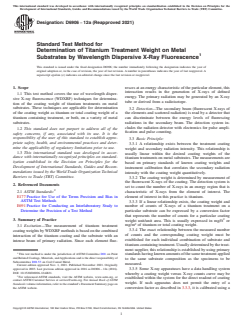
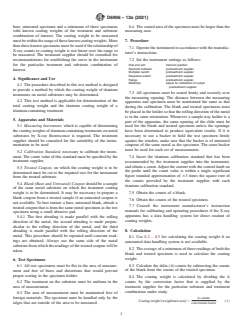
(Test Method)Standard Test Method for Determination of Titanium Treatment Weight on Metal Substrates by Wavelength Dispersive X-Ray Fluorescence
General Information
- Abstract
SIGNIFICANCE AND USE
4.1 The procedure described in this test method is designed to provide a method by which the coating weight of titanium treatments on metal substrates may be determined.
4.2 This test method is applicable for determination of the total coating weight and the titanium coating weight of a titanium-containing treatment.
SCOPE
1.1 This test method covers the use of wavelength dispersive X-ray fluorescence (WDXRF) techniques for determination of the coating weight of titanium treatments on metal substrates. These techniques are applicable for determination of the coating weight as titanium or total coating weight of a titanium containing treatment, or both, on a variety of metal substrates.
1.2 This standard does not purport to address all of the safety concerns, if any, associated with its use. It is the responsibility of the user of this standard to establish appropriate safety, health, and environmental practices and determine the applicability of regulatory limitations prior to use.
1.3 This international standard was developed in accordance with internationally recognized principles on standardization established in the Decision on Principles for the Development of International Standards, Guides and Recommendations issued by the World Trade Organization Technical Barriers to Trade (TBT) Committee.
- Status
- Published
- Publication Date
- 31-Oct-2021
- Technical Committee
- D01 - Paint and Related Coatings, Materials, and Applications
- Drafting Committee
- D01.53 - Coil Coated Metal

Overview
ASTM D6906-12a(2021) is the internationally recognized standard test method for the determination of titanium treatment weight on metal substrates using wavelength dispersive X-ray fluorescence (WDXRF). Developed by ASTM International, this standard provides a precise, quantitative approach to measure both the total coating weight and titanium-specific coating weight in titanium-containing treatments applied to various metal surfaces. The method ensures repeatable and reproducible results, supporting quality control and compliance in metal finishing and coil coating industries.
Key Topics
- Scope of Application: The method is suitable for determining titanium and total coating weights for a wide range of titanium-based treatments on metal substrates. Results can be directly used in both product development and routine quality assurance.
- WDXRF Technique: Utilizes the principles of wavelength dispersive X-ray fluorescence to excite elements in the sample, generating secondary X-rays. The titanium in the coating produces characteristic radiation, which is detected and correlated to coating weight via instrument calibration.
- Instrumentation and Calibration: Requires specialized X-ray fluorescence detectors, calibration standards, and treated/untreated coupons representative of the specific substrate and treatment combination.
- Measurement Procedure: Involves preparing flat, clean specimens, accurately placing them in the XRF instrument, and following detailed measurement protocols to ensure valid, reliable results.
- Data Analysis: The difference in detected X-ray counts between untreated (blank) and treated specimens is converted to coating weight using specific conversion factors supplied by the treatment provider.
- Precision and Reliability: The standard details requirements and recommendations for repeatability within a laboratory and reproducibility across different labs, ensuring robust results that support certification and regulatory needs.
- Health and Safety: Users are responsible for implementing appropriate safety and environmental protection measures when handling equipment and specimens.
Applications
ASTM D6906-12a(2021) is widely applied in industries where titanium-based surface treatments are used for corrosion resistance, adhesion promotion, or enhanced coating performance. Typical applications include:
- Coil Coated Metals: Ensures coil coatings meet specified titanium treatment weights for product durability and process control.
- Metal Fabrication: Quality assurance of titanium pretreatments in steel, aluminum, and coated metals prior to further processing or painting.
- Surface Engineering Research: Supports R&D by quantifying treatment weights in the development of advanced titanium-based surface systems.
- Compliance and Certification: Provides standardized data for regulatory documentation and supplier certification in international trade and manufacturing.
Using this standard helps manufacturers, laboratories, and suppliers maintain consistent product quality, document compliance with industry and customer requirements, and optimize process performance.
Related Standards
In addition to ASTM D6906-12a(2021), several related standards support metal coating measurements and X-ray fluorescence methods, including:
- ASTM E177 - Practice for Use of the Terms Precision and Bias in ASTM Test Methods
- ASTM E691 - Practice for Conducting an Interlaboratory Study to Determine the Precision of a Test Method
- Other relevant standards related to X-ray fluorescence analysis, coil coating characterization, and metal pretreatment evaluation.
When used together, these standards provide a comprehensive framework for reliable and accurate determination of coating weights in industrial and research settings.
Keywords: ASTM D6906-12a, titanium treatment weight, metal substrates, wavelength dispersive X-ray fluorescence, WDXRF, coating weight, metal coatings, surface treatment testing, quality assurance, coil coating standards, ASTM International.
Relations
- Effective Date
- 01-May-2014
- Effective Date
- 01-May-2013
- Effective Date
- 01-May-2013
- Effective Date
- 01-Nov-2011
- Effective Date
- 01-Oct-2010
- Effective Date
- 01-Oct-2008
- Effective Date
- 01-Oct-2008
- Refers
ASTM E177-06b - Standard Practice for Use of the Terms Precision and Bias in ASTM Test Methods - Effective Date
- 15-Nov-2006
- Refers
ASTM E177-06a - Standard Practice for Use of the Terms Precision and Bias in ASTM Test Methods - Effective Date
- 01-Nov-2006
- Effective Date
- 01-Nov-2005
- Refers
ASTM E177-04e1 - Standard Practice for Use of the Terms Precision and Bias in ASTM Test Methods - Effective Date
- 01-Nov-2004
- Effective Date
- 01-Nov-2004
- Effective Date
- 01-Nov-2004
- Refers
ASTM E177-90a(2002) - Standard Practice for Use of the Terms Precision and Bias in ASTM Test Methods - Effective Date
- 10-Jan-2002
- Effective Date
- 10-May-1999
Get Certified
Connect with accredited certification bodies for this standard

Element Materials Technology
Materials testing and product certification.

Inštitut za kovinske materiale in tehnologije
Institute of Metals and Technology. Materials testing, metallurgical analysis, NDT.
Sponsored listings
Frequently Asked Questions
ASTM D6906-12a(2021) is a standard published by ASTM International. Its full title is "Standard Test Method for Determination of Titanium Treatment Weight on Metal Substrates by Wavelength Dispersive X-Ray Fluorescence". This standard covers: SIGNIFICANCE AND USE 4.1 The procedure described in this test method is designed to provide a method by which the coating weight of titanium treatments on metal substrates may be determined. 4.2 This test method is applicable for determination of the total coating weight and the titanium coating weight of a titanium-containing treatment. SCOPE 1.1 This test method covers the use of wavelength dispersive X-ray fluorescence (WDXRF) techniques for determination of the coating weight of titanium treatments on metal substrates. These techniques are applicable for determination of the coating weight as titanium or total coating weight of a titanium containing treatment, or both, on a variety of metal substrates. 1.2 This standard does not purport to address all of the safety concerns, if any, associated with its use. It is the responsibility of the user of this standard to establish appropriate safety, health, and environmental practices and determine the applicability of regulatory limitations prior to use. 1.3 This international standard was developed in accordance with internationally recognized principles on standardization established in the Decision on Principles for the Development of International Standards, Guides and Recommendations issued by the World Trade Organization Technical Barriers to Trade (TBT) Committee.
SIGNIFICANCE AND USE 4.1 The procedure described in this test method is designed to provide a method by which the coating weight of titanium treatments on metal substrates may be determined. 4.2 This test method is applicable for determination of the total coating weight and the titanium coating weight of a titanium-containing treatment. SCOPE 1.1 This test method covers the use of wavelength dispersive X-ray fluorescence (WDXRF) techniques for determination of the coating weight of titanium treatments on metal substrates. These techniques are applicable for determination of the coating weight as titanium or total coating weight of a titanium containing treatment, or both, on a variety of metal substrates. 1.2 This standard does not purport to address all of the safety concerns, if any, associated with its use. It is the responsibility of the user of this standard to establish appropriate safety, health, and environmental practices and determine the applicability of regulatory limitations prior to use. 1.3 This international standard was developed in accordance with internationally recognized principles on standardization established in the Decision on Principles for the Development of International Standards, Guides and Recommendations issued by the World Trade Organization Technical Barriers to Trade (TBT) Committee.
ASTM D6906-12a(2021) is classified under the following ICS (International Classification for Standards) categories: 77.120.50 - Titanium and titanium alloys. The ICS classification helps identify the subject area and facilitates finding related standards.
ASTM D6906-12a(2021) has the following relationships with other standards: It is inter standard links to ASTM E177-14, ASTM E691-13, ASTM E177-13, ASTM E691-11, ASTM E177-10, ASTM E691-08, ASTM E177-08, ASTM E177-06b, ASTM E177-06a, ASTM E691-05, ASTM E177-04e1, ASTM E177-04, ASTM E177-06, ASTM E177-90a(2002), ASTM E691-99. Understanding these relationships helps ensure you are using the most current and applicable version of the standard.
ASTM D6906-12a(2021) is available in PDF format for immediate download after purchase. The document can be added to your cart and obtained through the secure checkout process. Digital delivery ensures instant access to the complete standard document.
Standards Content (Sample)
This international standard was developed in accordance with internationally recognized principles on standardization established in the Decision on Principles for the
Development of International Standards, Guides and Recommendations issued by the World Trade Organization Technical Barriers to Trade (TBT) Committee.
Designation: D6906 − 12a (Reapproved 2021)
Standard Test Method for
Determination of Titanium Treatment Weight on Metal
Substrates by Wavelength Dispersive X-Ray Fluorescence
This standard is issued under the fixed designation D6906; the number immediately following the designation indicates the year of
original adoption or, in the case of revision, the year of last revision. A number in parentheses indicates the year of last reapproval. A
superscript epsilon (´) indicates an editorial change since the last revision or reapproval.
1. Scope resces at an energy characteristic of the particular element, this
interaction results in the generation of X-rays of defined
1.1 This test method covers the use of wavelength disper-
energy. The primary radiation may be generated by an X-ray
sive X-ray fluorescence (WDXRF) techniques for determina-
tube or derived from a radioisotope.
tion of the coating weight of titanium treatments on metal
substrates. These techniques are applicable for determination 3.2 Detection—The secondary beam (fluorescent X-rays of
of the coating weight as titanium or total coating weight of a
the elements and scattered radiation) is read by a detector that
titanium containing treatment, or both, on a variety of metal can discriminate between the energy levels of fluorescing
substrates.
radiations in the secondary beam. The detection system in-
cludes the radiation detector with electronics for pulse ampli-
1.2 This standard does not purport to address all of the
fication and pulse counting.
safety concerns, if any, associated with its use. It is the
responsibility of the user of this standard to establish appro-
3.3 Basic Principle:
priate safety, health, and environmental practices and deter-
3.3.1 A relationship exists between the treatment coating
mine the applicability of regulatory limitations prior to use.
weight and secondary radiation intensity. This relationship is
1.3 This international standard was developed in accor-
usually linear within the desired coating weights of the
dance with internationally recognized principles on standard-
titanium treatments on metal substrates. The measurements are
ization established in the Decision on Principles for the
based on primary standards of known coating weights and
Development of International Standards, Guides and Recom-
instrument calibration that correlates the secondary radiation
mendations issued by the World Trade Organization Technical
intensity with the coating weight quantitatively.
Barriers to Trade (TBT) Committee.
3.3.2 The coating weight is determined by measurement of
the fluorescent X-rays of the coating. The detection system is
2. Referenced Documents
set to count the number of X-rays in an energy region that is
2.1 ASTM Standards: characteristic of X-rays from the element of interest. The
E177 Practice for Use of the Terms Precision and Bias in element of interest in this practice is titanium.
ASTM Test Methods
3.3.3 If a linear relationship exists, the coating weight and
E691 Practice for Conducting an Interlaboratory Study to number of counts of X-rays of a titanium treatment on a
Determine the Precision of a Test Method
particular substrate can be expressed by a conversion factor
that represents the number of counts for a particular coating
3. Summary of Practice
weight unit/unit area. This is usually expressed in mg/ft or
mg/m of titanium or total coating weight.
3.1 Excitation—The measurement of titanium treatment
3.3.4 The exact relationship between the measured number
coatingweightsbyWDXRFmethodsisbasedonthecombined
of counts and the corresponding coating weight must be
interaction of the titanium coating and the substrate with an
established for each individual combination of substrate and
intense beam of primary radiation. Since each element fluo-
titanium-containingtreatment.Usuallydeterminedbythetreat-
ment supplier, this relationship is established by using primary
This test method is under the jurisdiction of ASTM Committee D01 on Paint standardshavingknownamountsofthesametreatmentapplied
and Related Coatings, Materials, andApplications and is the direct responsibility of
to the same substrate composition as the specimens to be
Subcommittee D01.53 on Coil Coated Metal.
measured.
Current edition approved Nov. 1, 2021. Published November 2021. Originally
3.3.5 Some X-ray apparatuses have a data handling system
approved in 2003. Last previous edition approved in 2016 as D6906 – 12a (2016).
DOI: 10.1520/D6906-12AR21.
whereby a coating weight versus X-ray counts curve may be
For referenced ASTM standards, visit the ASTM website, www.astm.org, or
established within the system for the direct readout of coating
contact ASTM Customer Service at service@astm.org. For Annual Book of ASTM
weight. If such apparatus does not permit the entry of a
Standards volume information, refer to the standard’s Document Summary page on
the ASTM website. conversion factor as described in 3.3.3, it is calibrated using a
Copyright © ASTM International, 100 Barr Harbor Drive, PO Box C700, West Conshohocken, PA 19428-2959. United States
D6906 − 12a (2021)
bare, untreated specimen and a minimum of three specimens 6.4 The coated area of the specimen must be larger than the
with known coating weights of the treatment and substrate measuring area.
combination of interest. The coating weight to be measured
mustbewithintherangeoftheseknowncoatingweights.More 7. Procedure
than three known specimens must be used if the relationship of
7.1 Operate the instrument in accordance with the manufac-
X-ray counts to coating weight is not linear over the range to
turer’s instructions.
be measured. The treatment supplier should be consulted for
7.2 Set the instrument settings as follows:
recommendations for establishing the curve in the instrument
for the particular treatment and substrate combination of
Dial and arm titanium position
Seconds indicator pretreatment supplier
interest.
Multiplier switch pretreatment supplier
Response switch pretreatment supplier
4. Significance and Use
Range pretreatment supplier
Milliamps adjust for calibration of output
4.1 The procedure described in this test method is designed
pretreatment supplier
to provide a method by which the coating weight of titanium
7.3 All specimens must be seated firmly and securely over
treatments on metal substrates may be determined.
the measuring opening. The distance between the measuring
4.2 This test method is applicable for determination of the
apparatus and specimen must be maintained the same as that
total coating weight and the titanium coating weight of a
during the calibration. The blank and treated specimens must
titanium-containing treatment.
be placed in the holder so that the rolling direction of the metal
is in the same orientation. Whenever a sample tray holder is a
5. Apparatus and Materials
part of the apparatus, the same opening of the slide must be
5.1 Measuring Instrument, which is capable of determining used for the blank and treated specimen unless the openings
the coating weights of titanium-containing treatments on metal have been determined to produce equivalent results. If it is
substrates by X-ray fluorescence is required. The treatment necessary to use a backer to hold the test specimen firmly
supplier should be consulted for the suitability of the instru- against the window, make sure that the backer is of untreated
mentation to be used
coupons of the same metal as the specimen. The same backer
must be used for each set of measurements.
5.2 Calibration Standard, necessary to calibrate the instru-
ment.The count value of this standard must be specified by the
7.4 Insert the titanium calibration standard that has been
treatment supplier.
recommended by the treatment supplier into the instrument,
and obtain a count.Adjust the current with the control knob on
5.3 Treate
...