

ASTM G96-90(2018)
(Guide)Standard Guide for Online Monitoring of Corrosion in Plant Equipment (Electrical and Electrochemical Methods)
General Information
- Abstract
SIGNIFICANCE AND USE
5.1 General corrosion is characterized by areas of greater or lesser attack, throughout the plant, at a particular location, or even on a particular probe. Therefore, the estimation of corrosion rate as with mass loss coupons involves an averaging across the surface of the probe. Allowance must be made for the fact that areas of greater or lesser penetration usually exist on the surface. Visual inspection of the probe element, coupon, or electrode is required to determine the degree of interference in the measurement caused by such variability. This variability is less critical where relative changes in corrosion rate are to be detected.
5.2 Both electrical test methods described in this guide provide a technique for determining corrosion rates without the need to physically enter the system to withdraw coupons as required by the methods described in Guide G4.
5.3 Test Method B has the additional advantage of providing corrosion rate measurement within minutes.
5.4 These techniques are useful in systems where process upsets or other problems can create corrosive conditions. An early warning of corrosive attack can permit remedial action before significant damage occurs to process equipment.
5.5 These techniques are also useful where inhibitor additions are used to control the corrosion of equipment. The indication of an increasing corrosion rate can be used to signal the need for additional inhibitor.
5.6 Control of corrosion in process equipment requires a knowledge of the rate of attack on an ongoing basis. These test methods can be used to provide such information in digital format easily transferred to computers for analysis.
SCOPE
1.1 This guide covers the procedure for conducting online corrosion monitoring of metals in plant equipment under operating conditions by the use of electrical or electrochemical methods. Within the limitations described, these test methods can be used to determine cumulative metal loss or instantaneous corrosion rate, intermittently or on a continuous basis, without removal of the monitoring probes from the plant.
1.2 The following test methods are included: Test Method A for electrical resistance, and Test Method B for polarization resistance.
1.2.1 Test Method A provides information on cumulative metal loss, and corrosion rate is inferred. This test method responds to the remaining metal thickness except as described in Section 5.
1.2.2 Test Method B is based on electrochemical measurements for determination of instantaneous corrosion rate but may require calibration with other techniques to obtain true corrosion rates. Its primary value is the rapid detection of changes in the corrosion rate that may be indicative of undesirable changes in the process environment.
1.3 The values stated in SI units are to be considered standard. The values in parentheses are for information only.
1.4 This standard does not purport to address all of the safety concerns, if any, associated with its use. It is the responsibility of the user of this standard to establish appropriate safety, health, and environmental practices and determine the applicability of regulatory limitations prior to use. Specific precautionary statements are given in 5.6.
1.5 This international standard was developed in accordance with internationally recognized principles on standardization established in the Decision on Principles for the Development of International Standards, Guides and Recommendations issued by the World Trade Organization Technical Barriers to Trade (TBT) Committee.
- Status
- Published
- Publication Date
- 30-Apr-2018
- Technical Committee
- G01 - Corrosion of Metals
- Drafting Committee
- G01.11 - Electrochemical Measurements in Corrosion Testing
Overview
ASTM G96-90(2018), titled Standard Guide for Online Monitoring of Corrosion in Plant Equipment (Electrical and Electrochemical Methods), provides a comprehensive framework for conducting online corrosion monitoring of metals within plant equipment. Developed by ASTM International, this guide establishes practical procedures for utilizing both electrical and electrochemical methods to measure corrosion rates in operational systems. Its main objective is to facilitate ongoing assessment of metal loss or instantaneous corrosion rate, thereby improving maintenance, safety, and process optimization in industrial environments. This standard supports digital data acquisition, making it highly compatible with modern plant monitoring and process control systems.
Key Topics
Electrical Resistance (ER) Method
The electrical resistance technique monitors cumulative metal loss by measuring the change in resistance of a metal probe as corrosion reduces its cross-sectional area. This method enables corrosion rate calculation based on the slope of metal loss over time, allowing for both manual and automated data collection without intrusive system access.Polarization Resistance (PR) Method
The polarization resistance technique assesses the instantaneous corrosion rate using electrochemical measurements. This method provides rapid feedback, often within minutes, which is critical for detecting process upsets and dynamic changes in the environment. However, calibration with other measurements may be necessary for absolute corrosion rate determination.Non-Intrusive Monitoring
Both ER and PR methods allow continuous or intermittent corrosion monitoring without the need for removing probes, offering significant operational advantages compared to traditional coupon withdrawal approaches.Digital Data Acquisition
The standard outlines procedures for acquiring corrosion data in digital formats, facilitating integration with plant computers and process management systems for improved trend analysis and predictive maintenance.System Variability and Visual Inspection
Variability in corrosion attack across surfaces is acknowledged, and the standard stresses the importance of visual inspection of probes and electrodes to assure data accuracy and to differentiate between corrosion types, such as localized pitting versus uniform attack.
Applications
Industrial Plant Equipment Monitoring
ASTM G96-90(2018) is highly valuable for oil and gas processing, chemical manufacturing, power generation, and water treatment facilities seeking real-time corrosion rate data to extend asset life and prevent failures.Early Warning Systems
The guide supports implementation of corrosion monitoring as an early warning system. Real-time detection of increasing corrosion rates enables timely remedial action, such as process adjustments or inhibitor dosing, to prevent significant equipment damage.Corrosion Inhibitor Optimization
The ability to observe immediate effects of chemical inhibitors on corrosion rates is critical for optimizing dosage and reducing chemical costs, while ensuring adequate protection of plant assets.Process Upset Detection
Continuous monitoring enables rapid response to process upsets or environmental changes that could accelerate corrosion, reducing unplanned downtime.Data-Driven Maintenance Planning
With corrosion data available in digital formats, maintenance schedules can be optimized based on actual deterioration rates rather than fixed intervals, leading to cost savings and improved asset reliability.
Related Standards
This ASTM standard references several key related documents for enhanced corrosion monitoring practice:
- ASTM G1 – Practice for Preparing, Cleaning, and Evaluating Corrosion Test Specimens
- ASTM G3 – Practice for Conventions Applicable to Electrochemical Measurements in Corrosion Testing
- ASTM G4 – Guide for Conducting Corrosion Tests in Field Applications
- ASTM G59 – Test Method for Conducting Potentiodynamic Polarization Resistance Measurements
- ASTM G102 – Practice for Calculation of Corrosion Rates from Electrochemical Measurements
- ASTM D1125 – Test Methods for Electrical Conductivity and Resistivity of Water
Practical Value
By adhering to ASTM G96-90(2018), organizations can deploy robust online corrosion monitoring systems using electrical and electrochemical techniques tailored for continuous plant operations. This standard enables better-informed asset management, enhances safety by reducing manual interventions, and supports compliance with internationally recognized best practices. It is an essential reference for engineers, maintenance managers, and corrosion specialists involved in plant integrity and risk management.
Keywords: online corrosion monitoring, plant equipment, electrical resistance method, polarization resistance method, ASTM G96-90, corrosion measurement, industrial asset management, digital corrosion data, process equipment maintenance, corrosion inhibitors.
Relations
- Effective Date
- 01-May-2018
- Effective Date
- 01-May-2019
- Effective Date
- 15-Dec-2014
- Effective Date
- 01-Dec-2013
- Effective Date
- 01-Dec-2011
- Effective Date
- 01-May-2010
- Effective Date
- 01-May-2010
- Effective Date
- 01-May-2008
- Effective Date
- 01-Apr-2007
- Effective Date
- 01-Jul-2006
- Effective Date
- 15-Jun-2005
- Refers
ASTM D1125-95(2005) - Standard Test Methods for Electrical Conductivity and Resistivity of Water - Effective Date
- 01-Apr-2005
- Effective Date
- 01-Nov-2004
- Effective Date
- 01-Nov-2004
- Effective Date
- 01-Jan-2004
Get Certified
Connect with accredited certification bodies for this standard

Element Materials Technology
Materials testing and product certification.

Inštitut za kovinske materiale in tehnologije
Institute of Metals and Technology. Materials testing, metallurgical analysis, NDT.
Sponsored listings
Frequently Asked Questions
ASTM G96-90(2018) is a guide published by ASTM International. Its full title is "Standard Guide for Online Monitoring of Corrosion in Plant Equipment (Electrical and Electrochemical Methods)". This standard covers: SIGNIFICANCE AND USE 5.1 General corrosion is characterized by areas of greater or lesser attack, throughout the plant, at a particular location, or even on a particular probe. Therefore, the estimation of corrosion rate as with mass loss coupons involves an averaging across the surface of the probe. Allowance must be made for the fact that areas of greater or lesser penetration usually exist on the surface. Visual inspection of the probe element, coupon, or electrode is required to determine the degree of interference in the measurement caused by such variability. This variability is less critical where relative changes in corrosion rate are to be detected. 5.2 Both electrical test methods described in this guide provide a technique for determining corrosion rates without the need to physically enter the system to withdraw coupons as required by the methods described in Guide G4. 5.3 Test Method B has the additional advantage of providing corrosion rate measurement within minutes. 5.4 These techniques are useful in systems where process upsets or other problems can create corrosive conditions. An early warning of corrosive attack can permit remedial action before significant damage occurs to process equipment. 5.5 These techniques are also useful where inhibitor additions are used to control the corrosion of equipment. The indication of an increasing corrosion rate can be used to signal the need for additional inhibitor. 5.6 Control of corrosion in process equipment requires a knowledge of the rate of attack on an ongoing basis. These test methods can be used to provide such information in digital format easily transferred to computers for analysis. SCOPE 1.1 This guide covers the procedure for conducting online corrosion monitoring of metals in plant equipment under operating conditions by the use of electrical or electrochemical methods. Within the limitations described, these test methods can be used to determine cumulative metal loss or instantaneous corrosion rate, intermittently or on a continuous basis, without removal of the monitoring probes from the plant. 1.2 The following test methods are included: Test Method A for electrical resistance, and Test Method B for polarization resistance. 1.2.1 Test Method A provides information on cumulative metal loss, and corrosion rate is inferred. This test method responds to the remaining metal thickness except as described in Section 5. 1.2.2 Test Method B is based on electrochemical measurements for determination of instantaneous corrosion rate but may require calibration with other techniques to obtain true corrosion rates. Its primary value is the rapid detection of changes in the corrosion rate that may be indicative of undesirable changes in the process environment. 1.3 The values stated in SI units are to be considered standard. The values in parentheses are for information only. 1.4 This standard does not purport to address all of the safety concerns, if any, associated with its use. It is the responsibility of the user of this standard to establish appropriate safety, health, and environmental practices and determine the applicability of regulatory limitations prior to use. Specific precautionary statements are given in 5.6. 1.5 This international standard was developed in accordance with internationally recognized principles on standardization established in the Decision on Principles for the Development of International Standards, Guides and Recommendations issued by the World Trade Organization Technical Barriers to Trade (TBT) Committee.
SIGNIFICANCE AND USE 5.1 General corrosion is characterized by areas of greater or lesser attack, throughout the plant, at a particular location, or even on a particular probe. Therefore, the estimation of corrosion rate as with mass loss coupons involves an averaging across the surface of the probe. Allowance must be made for the fact that areas of greater or lesser penetration usually exist on the surface. Visual inspection of the probe element, coupon, or electrode is required to determine the degree of interference in the measurement caused by such variability. This variability is less critical where relative changes in corrosion rate are to be detected. 5.2 Both electrical test methods described in this guide provide a technique for determining corrosion rates without the need to physically enter the system to withdraw coupons as required by the methods described in Guide G4. 5.3 Test Method B has the additional advantage of providing corrosion rate measurement within minutes. 5.4 These techniques are useful in systems where process upsets or other problems can create corrosive conditions. An early warning of corrosive attack can permit remedial action before significant damage occurs to process equipment. 5.5 These techniques are also useful where inhibitor additions are used to control the corrosion of equipment. The indication of an increasing corrosion rate can be used to signal the need for additional inhibitor. 5.6 Control of corrosion in process equipment requires a knowledge of the rate of attack on an ongoing basis. These test methods can be used to provide such information in digital format easily transferred to computers for analysis. SCOPE 1.1 This guide covers the procedure for conducting online corrosion monitoring of metals in plant equipment under operating conditions by the use of electrical or electrochemical methods. Within the limitations described, these test methods can be used to determine cumulative metal loss or instantaneous corrosion rate, intermittently or on a continuous basis, without removal of the monitoring probes from the plant. 1.2 The following test methods are included: Test Method A for electrical resistance, and Test Method B for polarization resistance. 1.2.1 Test Method A provides information on cumulative metal loss, and corrosion rate is inferred. This test method responds to the remaining metal thickness except as described in Section 5. 1.2.2 Test Method B is based on electrochemical measurements for determination of instantaneous corrosion rate but may require calibration with other techniques to obtain true corrosion rates. Its primary value is the rapid detection of changes in the corrosion rate that may be indicative of undesirable changes in the process environment. 1.3 The values stated in SI units are to be considered standard. The values in parentheses are for information only. 1.4 This standard does not purport to address all of the safety concerns, if any, associated with its use. It is the responsibility of the user of this standard to establish appropriate safety, health, and environmental practices and determine the applicability of regulatory limitations prior to use. Specific precautionary statements are given in 5.6. 1.5 This international standard was developed in accordance with internationally recognized principles on standardization established in the Decision on Principles for the Development of International Standards, Guides and Recommendations issued by the World Trade Organization Technical Barriers to Trade (TBT) Committee.
ASTM G96-90(2018) is classified under the following ICS (International Classification for Standards) categories: 77.060 - Corrosion of metals. The ICS classification helps identify the subject area and facilitates finding related standards.
ASTM G96-90(2018) has the following relationships with other standards: It is inter standard links to ASTM G96-90(2013), ASTM G3-14(2019), ASTM G3-14, ASTM G3-13, ASTM G1-03(2011), ASTM G102-89(2010), ASTM G3-89(2010), ASTM G4-01(2008), ASTM G15-07, ASTM G15-06, ASTM G15-05, ASTM D1125-95(2005), ASTM G102-89(2004)e1, ASTM G3-89(2004), ASTM G15-04. Understanding these relationships helps ensure you are using the most current and applicable version of the standard.
ASTM G96-90(2018) is available in PDF format for immediate download after purchase. The document can be added to your cart and obtained through the secure checkout process. Digital delivery ensures instant access to the complete standard document.
Standards Content (Sample)
This international standard was developed in accordance with internationally recognized principles on standardization established in the Decision on Principles for the
Development of International Standards, Guides and Recommendations issued by the World Trade Organization Technical Barriers to Trade (TBT) Committee.
Designation: G96 − 90 (Reapproved 2018)
Standard Guide for
Online Monitoring of Corrosion in Plant Equipment
(Electrical and Electrochemical Methods)
ThisstandardisissuedunderthefixeddesignationG96;thenumberimmediatelyfollowingthedesignationindicatestheyearoforiginal
adoptionor,inthecaseofrevision,theyearoflastrevision.Anumberinparenthesesindicatestheyearoflastreapproval.Asuperscript
epsilon (´) indicates an editorial change since the last revision or reapproval.
1. Scope 2. Referenced Documents
1.1 This guide covers the procedure for conducting online 2.1 ASTM Standards:
corrosion monitoring of metals in plant equipment under D1125Test Methods for Electrical Conductivity and Resis-
operatingconditionsbytheuseofelectricalorelectrochemical tivity of Water
methods. Within the limitations described, these test methods G1Practice for Preparing, Cleaning, and Evaluating Corro-
can be used to determine cumulative metal loss or instanta- sion Test Specimens
neous corrosion rate, intermittently or on a continuous basis, G3Practice for Conventions Applicable to Electrochemical
without removal of the monitoring probes from the plant. Measurements in Corrosion Testing
G4Guide for Conducting Corrosion Tests in FieldApplica-
1.2 Thefollowingtestmethodsareincluded:TestMethodA
tions
for electrical resistance, and Test Method B for polarization
G15TerminologyRelatingtoCorrosionandCorrosionTest-
resistance.
ing (Withdrawn 2010)
1.2.1 Test Method A provides information on cumulative
G59TestMethodforConductingPotentiodynamicPolariza-
metal loss, and corrosion rate is inferred. This test method
tion Resistance Measurements
responds to the remaining metal thickness except as described
G102Practice for Calculation of Corrosion Rates and Re-
in Section 5.
lated Information from Electrochemical Measurements
1.2.2 Test Method B is based on electrochemical measure-
ments for determination of instantaneous corrosion rate but
3. Terminology
may require calibration with other techniques to obtain true
3.1 Definitions—See Terminology G15 for definitions of
corrosion rates. Its primary value is the rapid detection of
terms used in this guide.
changes in the corrosion rate that may be indicative of
undesirable changes in the process environment.
4. Summary of Guide
1.3 The values stated in SI units are to be considered
4.1 Test Method A–Electrical Resistance—The electrical
standard. The values in parentheses are for information only.
resistance test method operates on the principle that the
1.4 This standard does not purport to address all of the
electricalresistanceofameasuringelement(wire,strip,ortube
safety concerns, if any, associated with its use. It is the
of metal) increases as its cross-sectional area decreases:
responsibility of the user of this standard to establish appro-
l
priate safety, health, and environmental practices and deter-
R 5 σ (1)
A
mine the applicability of regulatory limitations prior to use.
Specific precautionary statements are given in 5.6. where:
1.5 This international standard was developed in accor-
R = resistance,
dance with internationally recognized principles on standard-
σ = resistivity of metal (temperature dependent),
ization established in the Decision on Principles for the l = length, and
Development of International Standards, Guides and Recom- A = cross-section area.
mendations issued by the World Trade Organization Technical
In practice, the resistance ratio between the measuring
Barriers to Trade (TBT) Committee.
element exposed to corrosion and the resistance of a similar
1 2
This guide is under the jurisdiction ofASTM Committee G01 on Corrosion of For referenced ASTM standards, visit the ASTM website, www.astm.org, or
Metals and is the direct responsibility of ASTM Subcommittee G01.11 on contact ASTM Customer Service at service@astm.org. For Annual Book of ASTM
Electrochemical Measurements in Corrosion Testing. Standards volume information, refer to the standard’s Document Summary page on
Current edition approved May 1, 2018. Published June 2018. Originally the ASTM website.
approvedin1990.Lastpreviouseditionapprovedin2013asG96–90(2013).DOI: The last approved version of this historical standard is referenced on
10.1520/G0096-90R18. www.astm.org.
Copyright © ASTM International, 100 Barr Harbor Drive, PO Box C700, West Conshohocken, PA 19428-2959. United States
G96 − 90 (2018)
reference element protected from corrosion is measured, to 4.2.3 The corrosion current density, i , can be converted
corr
compensate for resistivity changes due to temperature. Based to corrosion rate of the electrode by Faraday’s law if the
on the initial cross-sectional area of the measurement element, equivalent weight (EW) and density, ρ, of the corroding metal
the cumulative metal loss at the time of reading is determined. are known (see Practice G102):
Metal loss measurements are taken periodically and manually
i
corr
corrosionrate 5 K EW (4)
or automatically recorded against a time base.The slope of the
ρ
curve of metal loss against time at any point is the correction
where:
rateatthatpoint.Themorefrequentlymeasurementsaretaken,
the better is the resolution of the curve from which the K = a constant.
corrosion rate is derived.
4.2.4 Equivalent weight of an element is the molecular
4.1.1 The electrical resistance of the metal elements being
weight divided by the valency of the reaction (that is, the
measured is very low (typically 2 to 10 mΩ). Consequently,
number of electrons involved in the electrochemical reaction).
special measurement techniques and cables are required to
4.2.5 In order to obtain an alloy equivalent weight that is in
minimize the effect of cable resistance and electrical noise.
proportion with the mass fraction of the elements present and
4.1.2 Various probe element cross-sectional areas are nec-
their valence, it must be assumed that the oxidation process is
essarysothatawiderangeofcorrosionratescanbemonitored
uniformanddoesnotoccurselectively;thatis,eachelementof
with acceptable resolution.
the alloy corrodes as it would if it were the only element
4.2 Test Method B–Polarization Resistance:
present. In some situations these assumptions are not valid.
4.2.1 Thepolarizationresistancetestmethodinvolvesinter-
4.2.6 Effective equivalent weight of an alloy is as follows:
actionwiththeelectrochemicalcorrosionmechanismofmetals
(5)
in electrolytes in order to measure the instantaneous corrosion
m
n f
i i
rate. Its particular advantage is its speed of response to
(
W
l
i
corrosion rate upsets. On a corroding electrode subject to
certain qualifications (see 12.1), it has been shown that the where:
current density associated with a small polarization of the
f = mass fraction of i element in the alloy,
i th
electrode is directly proportional to the corrosion rate of the
W = atomic weight of the i element in the alloy,
i th
electrode. n = exhibited valence of the i element under the condi-
i th
4.2.2 The polarization resistance equation is derived inTest tions of the corrosion process, and
m = number of component elements in the alloy (normally
Method G59. See Practice G3 for applicable conventions. For
only elements above 1 mass% in the alloy are
smallpolarizationoftheelectrode(typically ∆Eupto20mV),
considered).
the corrosion current density is defined as:
Alloy equivalent weights have been calculated for many
B
i 5 (2)
corr
engineering metals and alloys and are tabulated in Practice
R
p
G102.
where:
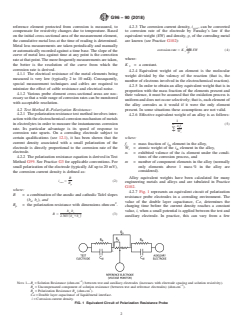
4.2.7 Fig. 1 represents an equivalent circuit of polarization
B = a combination of the anodic and cathodic Tafel slopes
resistance probe electrodes in a corroding environment. The
(b,b ), and
a c
value of the double layer capacitance, C , determines the
dl
R = the polarization resistance with dimensions ohm·cm .
p
charging time before the current density reaches a constant
b b
value, i, when a small potential is applied between the test and
a c
B 5 (3)
2.303 b 1b auxiliary electrode. In practice, this can vary from a few
~ !
a c
−2
NOTE 1—R =Solution Resistance (ohm·cm ) between test and auxiliary electrodes (increases with electrode spacing and solution resistivity).
s
−2
R =Uncompensated component of solution resistance (between test and reference electrodes) (ohm·cm ).
u
R =Polarization Resistance R (ohm·cm ).
p p
C =Double layer capacitance of liquid/metal interface.
dl
i=Corrosion current density.
FIG. 1 Equivalent Circuit of Polarization Resistance Probe
G96 − 90 (2018)
seconds up to hours. When determining the polarization reduced up to approximately ten fold. This extends the oper-
resistance, R , correction or compensation for solution ating range over which adequate determination of the polar-
p
resistance, R , is important when R becomes significant ization resistance can be made (see Fig. 2).
s s
compared to R . Test Methods D1125 describes test methods 4.2.10 A two-electrode probe with electrochemical imped-
p
for electrical conductivity and resistivity of water. ance measurement technique at high frequency short circuits
4.2.8 Two-electrodeprobes,andthree-electrodeprobeswith the double layer capacitance, C , so that a measurement of
dl
the reference electrode equidistant from the test and auxiliary solution resistance, R , can be made for application as a
s
electrode, do not correct for effects of solution resistance, correction. This also extends the operating range over which
without special electronic solution resistance compensation. adequate determination of polarization resistance can be made
Withhightomoderateconductivityenvironments,thiseffectof (see Fig. 2).
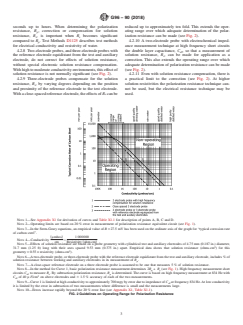
solution resistance is not normally significant (see Fig. 2). 4.2.11 Even with solution resistance compensation, there is
4.2.9 Three-electrode probes compensate for the solution a practical limit to the correction (see Fig. 2). At higher
resistance, R , by varying degrees depending on the position solution resistivities the polarization resistance technique can-
s
and proximity of the reference electrode to the test electrode. not be used, but the electrical resistance technique may be
Withaclose-spacedreferenceelectrode,theeffectsofR canbe used.
s
NOTE 1—See Appendix X1 for derivation of curves and Table X1.1 for description of points A, B, C and D.
NOTE 2—Operating limits are based on 20% error in measurement of polarization resistance equivalent circuit (see Fig. 1).
NOTE 3—In the Stern-Geary equations, an empirical value of B=27.5 mV has been used on the ordinate axis of the graph for “typical corrosion rate
of carbon steel”.
~µmhos! 1000000
NOTE 4—Conductivity 5
cm Resistivity ohm·cm
~ !
NOTE 5—Effects of solution resistance are based on a probe geometry with cylindrical test and auxiliary electrodes of 4.75 mm (0.187 in.) diameter,
31.7 mm (1.25 ft) long with their axes spaced 9.53 mm (0.375 in.) apart. Empirical data shows that solution resistance (ohms·cm ) for this
geometry=0.55×resistivity (ohms·cm ).
NOTE 6—Atwo-electrode probe, or three-electrode probe with the reference electrode equidistant from the test and auxiliary electrode, includes% of
solution resistance between working and auxiliary electrodes in its measurement of R .
p
NOTE 7—A close-space reference electrode on a three electrode probe is assumed to be one that measures 5% of solution resistance.
NOTE 8—In the method for Curve 1, basic polarization resistance measurement determines 2R + R (see Fig. 1). High frequency measurement short
p s
circuits C to measure R . By subtraction polarization resistance, R is determined. The curve is based on high frequency measurement at 834 Hz with
dl s p
C of 40 µ F/cm on above electrodes and 6 1.5% accuracy of each of the two measurements.
dl
NOTE9—Curve1islimitedathighconductivitytoapproximately700mpybyerrorduetoimpedanceof C atfrequency834Hz.Atlowconductivity
dl
it is limited by the error in subtraction of two measurements where difference is small and the measurements large.
NOTE 10—Errors increase rapidly beyond the 20% error line (see Appendix X1, Table X1.1).
FIG. 2 Guidelines on Operating Range for Polarization Resistance
G96 − 90 (2018)
4.2.12 Other methods of compensating for the effects of equipment and cable runs (where applicable) to avoid electri-
solution resistance, such as current interruption, electrochemi- cally noisy sources such as power cables, heavy duty motors,
calimpedanceandpositivefeedbackhavesofargenerallybeen switchgear, and radio transmitters.
confined to controlled laboratory tests. 6.2.1 The electrical resistivity of metals increases with
increased temperature.Although basic temperature compensa-
5. Significance and Use
tionisobtainedbymeasuringtheresistanceratioofanexposed
test element and protected reference element, the exposed
5.1 Generalcorrosionischaracterizedbyareasofgreateror
element will respond more rapidly to a change in temperature
lesser attack, throughout the plant, at a particular location, or
than does the protected reference element. This is a form of
even on a particular probe. Therefore, the estimation of
thermal noise. Various probes have different sensitivities to
corrosionrateaswithmasslosscouponsinvolvesanaveraging
such thermal noise. Where temperature fluctuations may be
across the surface of the probe. Allowance must be made for
significant, preference should be given to probes with the
the fact that areas of greater or lesser penetration usually exist
lowest thermal noise sensitivity.
onthesurface.Visualinspectionoftheprobeelement,coupon,
6.2.2 If probe elements are flexed due to excessive flow
or electrode is required to determine the degree of interference
conditions, a strain gage effect can be produced introducing
in the measurement caused by such variability.This variability
stress noise onto the probe measurement. Suitable probe
islesscriticalwhererelativechangesincorrosionratearetobe
element shielding can remove such effects.
detected.
6.3 Process fluids, except liquid metals and certain molten
5.2 Both electrical test methods described in this guide
salts, do not normally have sufficient electrical conductivity to
provideatechniquefordeterminingcorrosionrateswithoutthe
produceasignificantshortingeffectontheelectricalresistance
need to physically enter the system to withdraw coupons as
of the exposed probe element. Conductive deposits (such as
required by the methods described in Guide G4.
iron sulfide) can cause some short–circuiting effect on the
5.3 Test Method B has the additional advantage of provid-
element, reducing the measured metal loss, or showing some
ing corrosion rate measurement within minutes.
apparent metal gain. Certain probe configurations are less
5.4 These techniques are useful in systems where process
sensitive to this than others, depending on the path length
upsets or other problems can create corrosive conditions. An
between one end of the exposed probe element and the other.
early warning of corrosive attack can permit remedial action
6.4 When first introduced into a system, initial transient
before significant damage occurs to process equipment.
corrosion rates on a probe element may be different from the
5.5 These techniques are also useful where inhibitor addi-
longer term corrosion rates.
tions are used to control the corrosion of equipment. The
6.4.1 Establishment of a probe element surface typical of
indication of an increasing corrosion rate can be used to signal
the plant by passivation, oxidation, deposits, or inhibitor film
the need for additional inhibitor.
build up may vary from hours to several days.
5.6 Control of corrosion in process equipment requires a
6.5 Since the corrosion rate is usually temperature
knowledgeoftherateofattackonanongoingbasis.Thesetest
dependent, results will be comparable only for the alloy at the
methods can be used to provide such information in digital
process temperature to which the probes are exposed. In heat
format easily transferred to computers for analysis.
transfer environments actual plant metal temperatures may be
significantly different from that of the test probe.
TEST METHOD A—ELECTRICAL RESISTANCE
6.6 Electrical resistance probe elements are by their nature
(1-6)
consumable. Hazardous situations may occur if probes are left
inserviceforextendedperiodsbeyondtheirprobelife.Crevice
6. Limitations and Interferences
corrosion can cause damage or leaks at the element in some
6.1 Results are representative for average metal loss on the
specimen configurations, that can cause false readings and
probe element. On wire-form measuring elements, pitting may
early failure of probe elements. Normally the probe life is
beindicatedbyrapidincreasesinmetallossreadingafter50%
limited to approximately 50% of the probe element thickness
of probe life is passed. The larger cylindrical measuring
for safety reasons. Additionally, beyond this point measure-
elements are much less sensitive to the effect of pitting attack.
mentsbecomeincreasinglyerraticduetotheirregularcorroded
Where pitting is the only form of attack, probes may yield
surface of the probe element, and the particularly non-linear
unreliable results.
characteristics of wire probe elements.
6.2 It should be recognized that the thermal noise and
6.6.1 Electrical resistance probes should be selected to
stress-inducednoiseonprobeelements,andelectricalnoiseon
provide a suitable backup seal, that is compatible with the
these systems, occur in varying degrees due to the process and
process environment, in order to contain the process if the
local environment. Care should be exercised in the choice of
element seal fails.
the system to minimize these effects. Electrical noise can be
minimized by use of correct cabling, and careful location of
7. Apparatus
7.1 Electrical Resistance Corrosion Probes:
7.1.1 A probe is composed of two elements of identical
The boldface numbers in parentheses refer to a list of references at the end of
this standard. material. One is a measuring element and the other is a
G96 − 90 (2018)
protected reference element. In addition, a further check provides guidance on proper methods of cleaning various
element is fully incorporated beyond the reference element to materials. Some people do not recommend reusing the probes.
assist in monitoring of any process leakage into the probe.
8.4 Mechanical or chemical cleaning will remove metal
7.1.2 Process monitoring probes are available in both re-
from the probe measurement element, increasing its reading.
tractable and non-retractable configurations. The former en-
This new reading should be taken immediately after installa-
ablesremovaloftheprobeforinspectionorprobereplacement
tion in the new location.
under operating conditions, except where operational safety
precludes this.
9. Probe Installation
7.1.3 There is a trade off between probe sensitivity and
9.1 Install the probe in a position as representative of the
probe life. Care should be taken in selecting a probe suffi-
corrosive environment as possible without causing deleterious
cientlysensitiveforthecorrosionconditions,particularlywhen
effects to the probe or the system. Do not mount probe
monitoring for process upsets.
transverselyinahigh-flowpipelinewithoutshielding(see6.3).
7.1.4 Systems typically have a resolution of 0.1% of probe
9.2 Do not install the probe in a dead-end section where
life. However, for reasons of noise given in 6.2, it is generally
temperature or flow conditions, or both, are not representative
recommended that only changes of greater than 1% of probe
of the system under examination.
life are used for calculation of a corrosion rate or detection of
an upset. When monitoring steady metal loss rather than
10. Procedure
process upsets, probe life is generally more critical than
response time. For example, a typical probe span suitable for a
10.1 Portable Intermittent Instrument:
six month probe life would have on average a 1% change
10.1.1 Check correct operation of the instrument with the
approximately every two days.
test probe provided according to the manufacturer’s instruc-
7.1.5 Forprocessupsetdetection,responsetimetotheupset
tions.
ismuchmorecriticalthanprobelife.Aprobesensitivityshould 10.1.2 Connect the instrument to the probe and log both the
bechosensuchthat1%oftheprobelife,attheupsetcorrosion
measure and check readings. Ensure that the check reading is
rate, corresponds to the desired or maximum permissible
within specified limits. Follow the manufacturer’s instructions
response time to the upset condition. This generally will
to convert the measured reading to cumulative metal loss.
demand a more sensitive probe. However, since the upset
Checkthatthereadingsaresteadyandrecordthemidpointand
condition will generally not exist for an extended period, the
extent of any variation of the reading.
probe life will not be severely reduced.
10.2 Automatic Continuous Monitoring Instruments:
7.1.6 Check compatibility of process fluid with probe ma-
10.2.1 These instruments are available in various single or
terials and seals.
multi-channelconfigurations.Theymaybestandalonesystems
or interfaced with process computers, or both. These units
7.2 Electrical Resistance Probe Monitoring Instruments:
provide continuous information on metal loss or corrosion
7.2.1 Portable, intermittent instruments, and continuous
rates, or both.
single and multi-channel instruments are available. Since the
10.2.2 The system should be installed and tested according
electrical resistance probe measures cumulative metal loss, the
to the manufacturer’s instructions. Test probes are normally
intermittent measurement permits the determination of the
provided to assist the set-up of all channels and cabling of the
average corrosion rate only between the measurement points.
system.
With continuous monitoring, corrosion in real time can be
10.2.3 Connect the operational probes into the system.
determined.
10.2.4 Various output forms of information are available,
7.2.2 Automatic continuous monitoring systems may be
together with alarms. Computerized systems will often allow
standalonesystemsorinterfacedtootherprocesscomputers,or
alarms to be set for excessive corrosion rates to draw attention
both.
to problem areas that may then be analyzed in detail from the
metallossversustimegraph.Generallythemostusefulformof
8. Probe Preparation
data is the graph of metal loss versus time for each monitored
8.1 Commercial probes are generally received in sealed
point.
plastic bags to protect prepared surfaces. Care should be taken
during installation to avoid handling the probe measurement
11. Interpretation of Results
element, that can cause additional corrosion.
11.1 Plot the graph of metal loss versus time. Upsets and
8.2 Probe measurement element sur
...