


ASTM D5108-90(2007)
(Test Method)Standard Test Method for Organotin Release Rates of Antifouling Coating Systems in Sea Water (Withdrawn 2016)
Standard Test Method for Organotin Release Rates of Antifouling Coating Systems in Sea Water (Withdrawn 2016)
SIGNIFICANCE AND USE
This test method is designed to provide a laboratory procedure to measure changes in the release rates of solvent soluble tin (tributyl- and triphenyltin) that occur during a period of immersion under specified conditions of constant temperature, pH, salinity, and low heavy-metal concentrations in the surrounding sea water. Quantitative measurement of the release rate is necessary to help in selection of materials, in providing quality assurance, and in understanding the performance mechanism.
This test method serves only as a guide for organotin release rates in service. Organotin release rates of antifouling (AF) paint systems in service can vary over the life of the coating system depending on the formulation and the environment. Differences in berthing locations, operating schedules, length of service, condition of paint-film surface, temperature, pH, and salinity can affect results, Results obtained may not necessarily reflect actual tributyltin release rates that will occur in service, but provide reliable comparisons of the release rate characteristics of different antifouling formulations.
This test method will serve to characterize the early release rate pattern, as well as estimate the steady state release, of tributyltin from both self-polishing copolymer and free-association antifouling paints.
SCOPE
1.1 This test method covers the laboratory determination of the rate at which organotin expressed as tributyltin (TBT) is released from an antifouling (AF) coating in synthetic sea water using graphite furnace atomic absorption spectrophotometry (GF-AAS). This does not exclude the use of other analytical methodology for measurement of organotin in sea water such as gas chromatography.
1.2 The values stated in SI units are to be regarded as standard. The inch-pound units given in parentheses are for information only.
This standard does not purport to address all of the safety concerns, if any, associated with its use. It is the responsibility of the user of this standard to establish appropriate safety and health practices and determine the applicability of regulatory limitations prior to use. For specific hazard statements, see Section 7.
WITHDRAWN RATIONALE
This test method covers the laboratory determination of the rate at which organotin expressed as tributyltin (TBT) is released from an antifouling (AF) coating in synthetic sea water using graphite furnace atomic absorption spectrophotometry (GF-AAS). This does not exclude the use of other analytical methodology for measurement of organotin in sea water such as gas chromatography.
Formerly under the jurisdiction of Committee D01 on Paint and Related Coatings, Materials, and Applications, this test method was withdrawn in January 2016 in accordance with section 10.6.3 of the Regulations Governing ASTM Technical Committees, which requires that standards shall be updated by the end of the eighth year since the last approval date.
General Information
Relations
Standards Content (Sample)
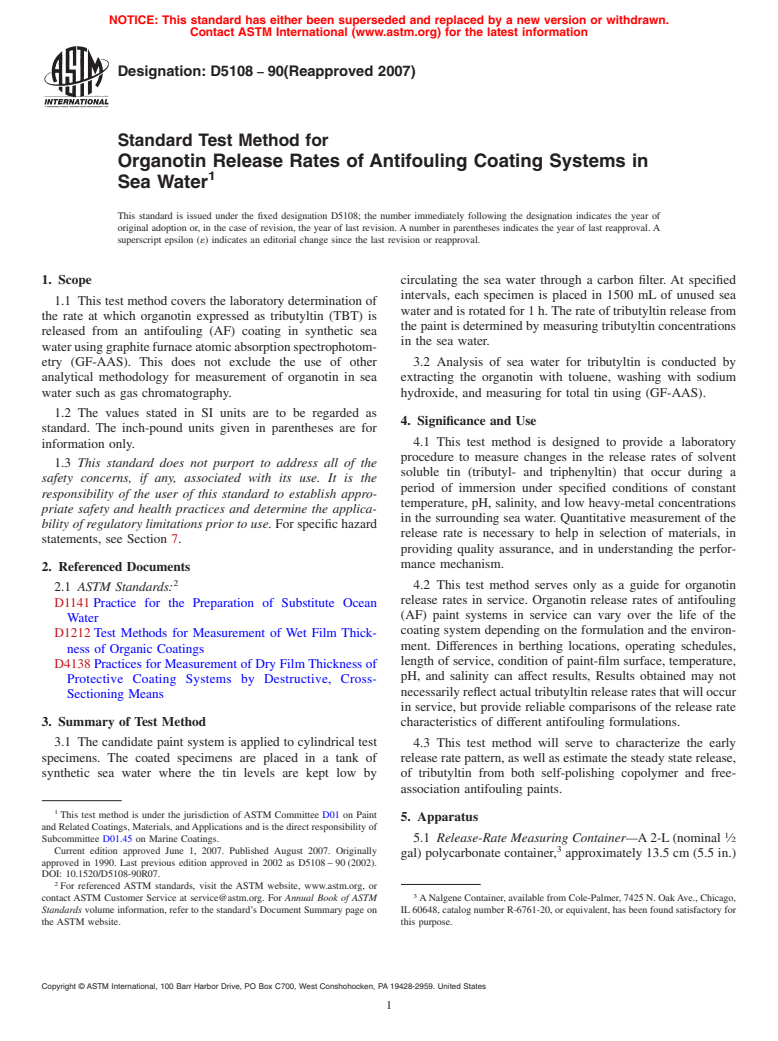
NOTICE: This standard has either been superseded and replaced by a new version or withdrawn.
Contact ASTM International (www.astm.org) for the latest information
Designation: D5108 − 90(Reapproved 2007)
Standard Test Method for
Organotin Release Rates of Antifouling Coating Systems in
Sea Water
This standard is issued under the fixed designation D5108; the number immediately following the designation indicates the year of
original adoption or, in the case of revision, the year of last revision. A number in parentheses indicates the year of last reapproval. A
superscript epsilon (´) indicates an editorial change since the last revision or reapproval.
1. Scope circulating the sea water through a carbon filter. At specified
intervals, each specimen is placed in 1500 mL of unused sea
1.1 This test method covers the laboratory determination of
water and is rotated for 1 h. The rate of tributyltin release from
the rate at which organotin expressed as tributyltin (TBT) is
the paint is determined by measuring tributyltin concentrations
released from an antifouling (AF) coating in synthetic sea
in the sea water.
waterusinggraphitefurnaceatomicabsorptionspectrophotom-
etry (GF-AAS). This does not exclude the use of other 3.2 Analysis of sea water for tributyltin is conducted by
analytical methodology for measurement of organotin in sea extracting the organotin with toluene, washing with sodium
water such as gas chromatography. hydroxide, and measuring for total tin using (GF-AAS).
1.2 The values stated in SI units are to be regarded as
4. Significance and Use
standard. The inch-pound units given in parentheses are for
4.1 This test method is designed to provide a laboratory
information only.
procedure to measure changes in the release rates of solvent
1.3 This standard does not purport to address all of the
soluble tin (tributyl- and triphenyltin) that occur during a
safety concerns, if any, associated with its use. It is the
period of immersion under specified conditions of constant
responsibility of the user of this standard to establish appro-
temperature, pH, salinity, and low heavy-metal concentrations
priate safety and health practices and determine the applica-
in the surrounding sea water. Quantitative measurement of the
bility of regulatory limitations prior to use. For specific hazard
release rate is necessary to help in selection of materials, in
statements, see Section 7.
providing quality assurance, and in understanding the perfor-
mance mechanism.
2. Referenced Documents
4.2 This test method serves only as a guide for organotin
2.1 ASTM Standards:
release rates in service. Organotin release rates of antifouling
D1141 Practice for the Preparation of Substitute Ocean
(AF) paint systems in service can vary over the life of the
Water
coating system depending on the formulation and the environ-
D1212 Test Methods for Measurement of Wet Film Thick-
ment. Differences in berthing locations, operating schedules,
ness of Organic Coatings
length of service, condition of paint-film surface, temperature,
D4138 Practices for Measurement of Dry Film Thickness of
pH, and salinity can affect results, Results obtained may not
Protective Coating Systems by Destructive, Cross-
necessarily reflect actual tributyltin release rates that will occur
Sectioning Means
in service, but provide reliable comparisons of the release rate
3. Summary of Test Method
characteristics of different antifouling formulations.
3.1 The candidate paint system is applied to cylindrical test 4.3 This test method will serve to characterize the early
specimens. The coated specimens are placed in a tank of
release rate pattern, as well as estimate the steady state release,
synthetic sea water where the tin levels are kept low by of tributyltin from both self-polishing copolymer and free-
association antifouling paints.
This test method is under the jurisdiction of ASTM Committee D01 on Paint
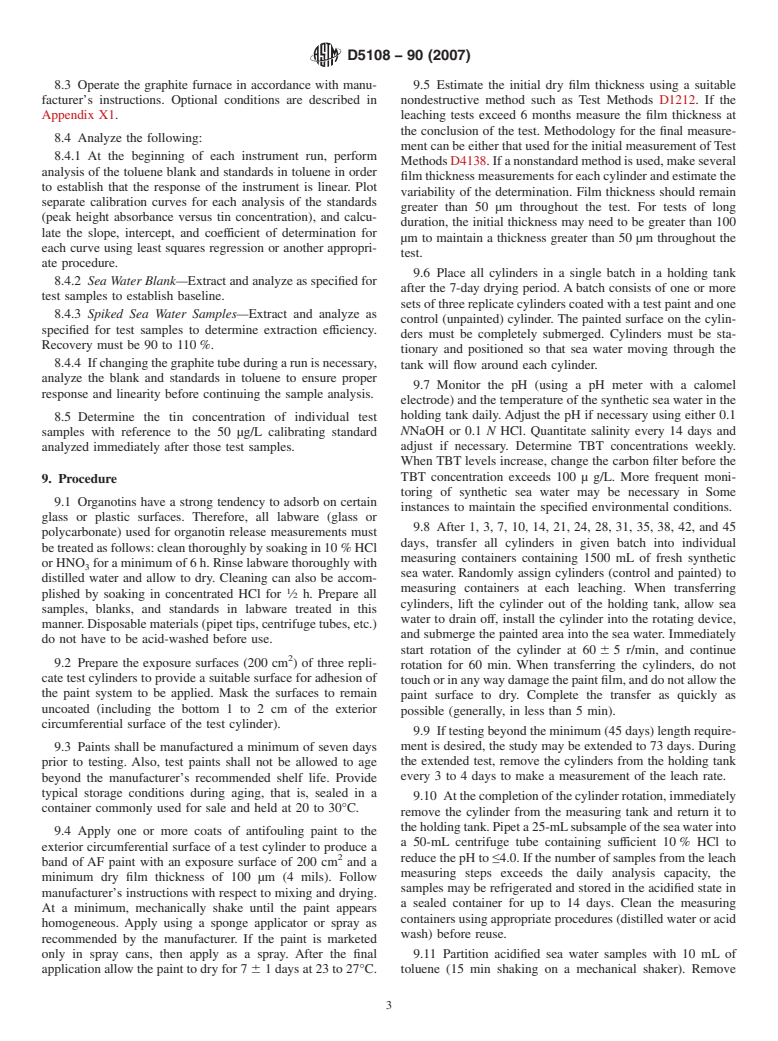
5. Apparatus
and Related Coatings, Materials, andApplications and is the direct responsibility of
Subcommittee D01.45 on Marine Coatings.
5.1 Release-Rate Measuring Container—A2-L (nominal ⁄2
Current edition approved June 1, 2007. Published August 2007. Originally
gal) polycarbonate container, approximately 13.5 cm (5.5 in.)
approved in 1990. Last previous edition approved in 2002 as D5108 – 90 (2002).
DOI: 10.1520/D5108-90R07.
For referenced ASTM standards, visit the ASTM website, www.astm.org, or
contact ASTM Customer Service at service@astm.org. For Annual Book of ASTM ANalgene Container, available from Cole-Palmer, 7425 N. OakAve., Chicago,
Standards volume information, refer to the standard’s Document Summary page on IL60648, catalog number R-6761-20, or equivalent, has been found satisfactory for
the ASTM website. this purpose.
Copyright © ASTM International, 100 Barr Harbor Drive, PO Box C700, West Conshohocken, PA 19428-2959. United States
D5108 − 90 (2007)
in diameter and 19 cm (7.5 in.) high, fitted with three 5.8 Dispensers, automatic or repeating, for reagents.
polycarbonate rods approximately 6 mm (nominal ⁄4 in.) in
5.9 Pipets, with disposable polypropylene tips.
diameter to serve as baffles. Rods shall be evenly spaced on the
5.10 Graphite Furnace, atomic absorption spectrophotom-
inside circumference of the container to prevent swirling of
eter (GF-AAS) with automatic sampler.
water with the test cylinder during rotation. The rods will be
secured to the container walls using acetone or methylene 5.11 pH Meter, with a mercury/mercurous chloride (Hg/
chloride.
Hg Cl ) electrode.
2 2
5.2 Constant Temperature Bath—A temperature controlled 5.12 Appropriate Volumetric Flasks.
water bath capable of maintaining a temperature of 25 6 2°C
6. Reagents and Materials
into which one or more release rate measuring test containers
can be placed.
6.1 Synthetic Sea Water—Substitute ocean water in accor-
dance with the Preparation of Substitute Ocean Water section
5.3 Holding Tank—Acontainer of such dimensions so as to
of Practice D1141 or a proprietary equivalent with a salinity of
permit immersion of four or more test cylinders; must be
30 to 35 ppt.
equipped with a system to continuously circulate synthetic sea
water in the tank through a carbon filter.The rate of water flow 6.2 Extraction Solvent—Toluene, spectrograde or equiva-
and the size of the carbon filter should be selected to maintain
lent.
tributyltin concentrations below 100 µg/L. Flow rates should
6.3 Tributyltin Standards—Prepare standards using a stock
generally be set to obtain 2 to 8 turnovers per h. The size and
solution of tributyltin chloride (reagent grade, minimum 96 %
geometry of the tanks as well as the positioning of the inflow
pure) in methanol (suggested concentration of approximately
and outflow ports for the water circulation system should be
10 mg/L). The standards are acidified with acetic acid (less
selected to obtain a slow, relatively uniform flow of synthetic
than pH 4) to obtain a stable solution.
sea water past all test cylinders in the tank. Maintain the pH of
6.4 Hydrochloric Acid (HCl) (10 % aqueous solution).
the synthetic sea water between 7.8 and 8.2, and the salinity
between 30 and 35 parts per thousand (ppt). The tank shall be
6.5 Hydrochloric Acid (HCl) (0.1N).
provided with heaters to maintain the temperature between 21
6.6 Nitric Acid (HNO ) (10 % aqueous solution) can be
and 27°C (70 and 81°F).
used in place of HCl to clean labware.
5.4 Test Cylinders—Approximately 6.4 cm (nominal 2 ⁄2
6.7 Sodium Hydroxide (NaOH) (3 % aqueous solution).
in.) outside diameter polycarbonate pipe coated with a 10-cm
6.8 Sodium Hydroxide (NaOH) (0.1N).
band of AF paint around the exterior circumference of the test
cylinder to provide 200 cm of paint film that can be immersed
6.9 All reagents and cleaning agents used must be tin-free.
and freely rotated in the release rate measuring container. Seal
7. Hazards
the bottom of the test cylinder with a polycarbonate disc using
acetone, methylene chloride, or a polycarbonate cement so as
7.1 Warning—Antifouling paints contain toxic materials
to form a watertight joint. Do not coat the bottom 1 to 2 cm of
that could cause skin and eye irritation on contact and adverse
the test cylinder. The test cylinder shall be of such height so
physiological effects if ingested or inhaled. In the preparation
that a rotating device can be attached to rotate the cylinder and
oftestspecimensandtheapplicationofvarioustypesofpaints,
the upper open end of the cylinder is above the level of the test
the use of appropriate protective clothing and equipment is
container immersion liquid to prevent entry of the immersion
required consistent with local, state, and federal government
liquid into the test cylinder.
regulations, and recognized industrial and technical standards.
Do not flush spills, overspray, and unused material down the
5.5 Test Cylinder Rotating Device—The device shall be
drain, but should be dispose of as hazardous waste.
capable of rotating the test cylinder in the release rate measur-
ing container at 60 6 5 r/min. No part of the device shall be
7.2 See antifouling paint supplier’s Material Safety Data
immersed in sea water.
Sheet.
5.6 Centrifuge Tubes, 50-mL capacity, with screw closures
8. Calibration and Standardization
(or disposable bottles, culture tubes, separatory funnels, etc.)
8.1 Prepare three standards throughout the range of the
made of polycarbonate, TFE flourocarbon, or borosilicate
quantification limit to 100 µg of tin per litre by dilution in
glass.
tolueneofastocksolutionoftributyltinchloride(96 %pure)in
5.7 Mechanical Shaker, with appropriate holders.
methanol. Include one standard with a concentration of ap-
proximately 50 µg of tin per litre. An alternate range of
concentrations may be used when appropriate.
Boekel Water Baths, Models 148003 and 148004 available from Boekel
8.2 Prepare synthetic sea water spiked with three concen-
Industries Inc., 509-T Vine St., Philadelphia, PA 19106, or equivalent, have been
trations of TBT in the range of 10 to 50 µg of tin per litre by
found satisfactory for this purpose.
Asix-paddle stirrer, Model 300, manufactured by Whitaker Medical Mfg. Co.,
spiking with stock solution of tributyltin chloride in methanol.
Phipps and Bird Div., 8741 Landmark Rd., Richmond,VA23228, or equivalent, has
When the concentration of tin extracted in toluene exceeds 100
been found satisfactory for this purpose.
µg/Lappropriate dilution should be employed to keep it within
Oak Ridge Tubes, available from Cole-Parmer, or equivalent, have been found
satisfactory for this purpose. the limits of the calibration curve (0 to 100 µ g/L).
D5108 − 90 (2007)
8.3 Operate the graphite furnace in accordance with manu- 9.5 Estimate the initial dry film thickness using a suitable
facturer’s instructions. Optional conditions are described in nondestructive method such as Test Methods D1212.Ifthe
Appendix X1. leaching tests exceed 6 months measure the film thickness at
the conclusion of the test. Methodology for the final measure-
8.4 Analyze the following:
ment can be either that used for the initial measurement ofTest
8.4.1 At the beginning of each instrument run, perform
MethodsD4138.Ifanonstandardmethodisused,makeseveral
analysis of the toluene blank and standards in toluene in order
filmthicknessmeasurementsforeachcylinderandestimatethe
to establish that the response of the instrument is linear. Plot
variability of the determination. Film thickness should remain
separate calibration curves for each analysis of the standards
greater than 50 µm throughout the test. For tests of long
(peak height absorbance versus tin concentration), and calcu-
duration, the initial thickness may need to be greater than 100
late the slope, intercept, and coefficient of determination for
µm to maintain a thickness greater than 50 µm throughout the
each curve using least squares regression or another appropri-
test.
ate procedure.
9.6 Place all cylinders in a single batch in a holding tank
8.4.2 SeaWaterBlank—Extract and analyze as specified for
after the 7-day drying period. A batch consists of one or more
test samples to establish baseline.
sets of three replicate cylinders coated with a test paint and one
8.4.3 Spiked Sea Water Samples—Extract and analyze as
control (unpainted) cylinder. The painted surface on the cylin-
specified for test samples to determine extraction efficiency.
ders must be completely submerged. Cylinders must be sta-
Recovery must be 90 to 110 %.
tionary and positioned so that sea water moving through the
8.4.4 Ifchangingthegraphitetubeduringarunisnecessary,
tank will flow around each cylinder.
analyze the blank and standards in toluene to ensure proper
9.7 Monitor the pH (using a pH meter with a calomel
response and linearity before continuing the sample analysis.
electrode) and the temperature of the synthetic sea water in the
holding tank daily. Adjust the pH if necessary using either 0.1
8.5 Determine the tin concentration of individual test
NNaOH or 0.1 N HCl. Quantitate salinity every 14 days and
samples with reference to the 50 µg/L calibrating standard
adjust if necessary. Determine TBT concentrations weekly.
analyzed immediately after those test samples.
When TBT levels increase, change the carbon filter before the
TBT concentration exceeds 100 µ g/L. More frequent moni-
9. Procedure
toring of synthetic sea water may be necessary in Some
9.1 Organotins have a strong tendency to adsorb on certain
instances to maintain the specified environmental conditions.
glass or plastic surfaces. Therefore, all labware (glass or
9.8 After 1, 3, 7, 10, 14, 21, 24, 28, 31, 35, 38, 42, and 45
polycarbonate) used for organotin release measurements must
days, transfer all cylinders in given batch into individual
betreatedasfollows:cleanthoroughlybysoakingin10 %HCl
measuring containers containing 1500 mL of fresh synthetic
or HNO for a minimum of 6 h. Rinse labware thoroughly with
sea water. Randomly assign cylinders (control and painted) to
distilled water and allow to dry. Cleaning can also be accom-
measuring containers at each leaching. When transferring
plished by soaking in concentrated HCl for ⁄2 h. Prepare all
cylinders, lift the cylinder out of the holding tank, allow sea
samples, blanks, and standards in labware treated in this
water to drain off, install the cylinder into the rotating device,
manner. Disposable materials (pipet tips, centrifuge tubes, etc.)
and submerge the painted area into the sea water. Immediately
do not have to be acid-washed before use.
start rotation of the cylinder at 60 6 5 r/min, and continue
9.2 Prepare the exposure surfaces (200 cm ) of three repli-
rotation for 60 min. When transferring the cylinders, do not
cate test cylinders to provide a suitable surface for adhesion of
touchorinanywaydamagethepaintfilm,anddonotallowthe
the paint system to be applied. Mask the surfac
...
Questions, Comments and Discussion
Ask us and Technical Secretary will try to provide an answer. You can facilitate discussion about the standard in here.