

ASTM D6535/D6535M-18
(Practice)Standard Practice for Determining the Dip Tube Length of a Mechanical Pump Dispenser
General Information
- Abstract
SIGNIFICANCE AND USE
2.1 This practice is to be used to determine the length of a dip tube of a mechanical pump dispenser that extends to the bottom-corner of a container.
2.2 This practice is to be used to determine the length of a dip tube of a mechanical pump dispenser that extends to the bottom-center of a container.
SCOPE
1.1 This practice covers the determination technique for a dip tube of a mechanical pump dispenser.
1.2 The values stated in either SI units or inch-pound units are to be regarded separately as standard. The values stated in each system may not be exact equivalents; therefore, each system shall be used independently of the other. Combining values from the two systems may result in non-conformance with the standard.
1.3 This standard does not purport to address all of the safety concerns, if any, associated with its use. It is the responsibility of the user of this standard to establish appropriate safety, health, and environmental practices and determine the applicability of regulatory limitations prior to use.
1.4 This international standard was developed in accordance with internationally recognized principles on standardization established in the Decision on Principles for the Development of International Standards, Guides and Recommendations issued by the World Trade Organization Technical Barriers to Trade (TBT) Committee.
- Status
- Published
- Publication Date
- 30-Apr-2018
- Technical Committee
- F02 - Primary Barrier Packaging
- Drafting Committee
- F02.30 - Mechanical Dispensers
Buy Documents


ASTM D6535/D6535M-18 - Standard Practice for Determining the Dip Tube Length of a Mechanical Pump Dispenser

REDLINE ASTM D6535/D6535M-18 - Standard Practice for Determining the Dip Tube Length of a Mechanical Pump Dispenser
Overview
ASTM D6535/D6535M-18 is the international standard practice for determining the dip tube length of a mechanical pump dispenser. Published by ASTM International and overseen by ASTM Committee F02 on Flexible Primary Barrier Packaging, this standard specifies procedures to measure the dip tube length extending either to the bottom-corner or the bottom-center of a container. The practice ensures pump dispensers can efficiently access and dispense the maximum amount of fluid stored in a container, enhancing both product performance and end-user satisfaction.
Key Topics
- Dip Tube Length Determination: Provides a clear method for measuring the required dip tube extension, whether to the bottom-corner or bottom-center of the container, based on functional requirements.
- Measurement Units: Recognizes both SI (metric) and inch-pound (imperial) measurement systems, but emphasizes they must not be combined within a single procedure to maintain accuracy and conformance.
- Apparatus Guidance: Specifies use of a thin metal ruler, with fine gradients, and calipers for precise measurement.
- Detailed Procedures: Outlines step-by-step instructions for both measurement scenarios:
- Measurement to the bottom-corner of the container (Practice “A”)
- Measurement to the bottom-center of the container (Practice “B”)
- Calculation Adjustments: Explains mandatory deductions from the measured length to ensure precise dip tube fitting.
- Verification: Stipulates verification steps to ensure the dip tube is not obstructed by the container and that the correct specification is achieved.
- Reporting Requirements: Identifies what data should be documented, including dispenser type, calculated dip tube length, measurement method, and bottle type.
- Precision and Bias: Highlights that the accuracy of dip tube determination depends on container size and that no reference bias exists due to lack of standard referee values.
- Safety and Compliance: Reminds users to address any safety, health, or regulatory concerns independently.
Applications
- Mechanical Pump Dispenser Manufacturing: Essential for manufacturers of consumer product dispensers, such as those for soaps, lotions, sanitizers, and cleaning agents, ensuring consistent and robust product performance.
- Quality Assurance: Facilitates uniform quality control across production batches by providing a repeatable, standardized methodology for dip tube length measurement.
- Packaging Design: Provides guidance for package engineers and designers in specifying dip tube lengths that maximize product dispensing and minimize waste, regardless of container geometry.
- Regulatory Compliance: Supports compliance with international trade and safety requirements, as defined by the World Trade Organization’s Technical Barriers to Trade Committee, making products more suitable for a global market.
Related Standards
- ASTM F815 - Test Methods for Mechanical Pump Dispensers
- ASTM D4169 - Performance Testing of Shipping Containers and Systems
- ISO 16187 - Packaging - Machinery and Dispensing Devices Terminology
- ASTM D999 - Methods for Vibration Testing of Shipping Containers
Implementing the ASTM D6535/D6535M-18 standard ensures that manufacturers, quality assurance professionals, and packaging engineers can reliably and accurately determine the correct dip tube lengths for mechanical pump dispensers. Adherence to this practice helps achieve optimal product performance, waste reduction, and international regulatory compliance, strengthening both product quality and marketability.
Relations
- Effective Date
- 01-May-2018
Buy Documents
ASTM D6535/D6535M-18 - Standard Practice for Determining the Dip Tube Length of a Mechanical Pump Dispenser
REDLINE ASTM D6535/D6535M-18 - Standard Practice for Determining the Dip Tube Length of a Mechanical Pump Dispenser
Get Certified
Connect with accredited certification bodies for this standard

BRCGS (Brand Reputation Compliance Global Standards)
Global food safety and quality standards owner.
Sponsored listings
Frequently Asked Questions
ASTM D6535/D6535M-18 is a standard published by ASTM International. Its full title is "Standard Practice for Determining the Dip Tube Length of a Mechanical Pump Dispenser". This standard covers: SIGNIFICANCE AND USE 2.1 This practice is to be used to determine the length of a dip tube of a mechanical pump dispenser that extends to the bottom-corner of a container. 2.2 This practice is to be used to determine the length of a dip tube of a mechanical pump dispenser that extends to the bottom-center of a container. SCOPE 1.1 This practice covers the determination technique for a dip tube of a mechanical pump dispenser. 1.2 The values stated in either SI units or inch-pound units are to be regarded separately as standard. The values stated in each system may not be exact equivalents; therefore, each system shall be used independently of the other. Combining values from the two systems may result in non-conformance with the standard. 1.3 This standard does not purport to address all of the safety concerns, if any, associated with its use. It is the responsibility of the user of this standard to establish appropriate safety, health, and environmental practices and determine the applicability of regulatory limitations prior to use. 1.4 This international standard was developed in accordance with internationally recognized principles on standardization established in the Decision on Principles for the Development of International Standards, Guides and Recommendations issued by the World Trade Organization Technical Barriers to Trade (TBT) Committee.
SIGNIFICANCE AND USE 2.1 This practice is to be used to determine the length of a dip tube of a mechanical pump dispenser that extends to the bottom-corner of a container. 2.2 This practice is to be used to determine the length of a dip tube of a mechanical pump dispenser that extends to the bottom-center of a container. SCOPE 1.1 This practice covers the determination technique for a dip tube of a mechanical pump dispenser. 1.2 The values stated in either SI units or inch-pound units are to be regarded separately as standard. The values stated in each system may not be exact equivalents; therefore, each system shall be used independently of the other. Combining values from the two systems may result in non-conformance with the standard. 1.3 This standard does not purport to address all of the safety concerns, if any, associated with its use. It is the responsibility of the user of this standard to establish appropriate safety, health, and environmental practices and determine the applicability of regulatory limitations prior to use. 1.4 This international standard was developed in accordance with internationally recognized principles on standardization established in the Decision on Principles for the Development of International Standards, Guides and Recommendations issued by the World Trade Organization Technical Barriers to Trade (TBT) Committee.
ASTM D6535/D6535M-18 is classified under the following ICS (International Classification for Standards) categories: 55.130 - Aerosol containers. The ICS classification helps identify the subject area and facilitates finding related standards.
ASTM D6535/D6535M-18 has the following relationships with other standards: It is inter standard links to ASTM D6535/D6535M-05(2010)e1. Understanding these relationships helps ensure you are using the most current and applicable version of the standard.
ASTM D6535/D6535M-18 is available in PDF format for immediate download after purchase. The document can be added to your cart and obtained through the secure checkout process. Digital delivery ensures instant access to the complete standard document.
Standards Content (Sample)
This international standard was developed in accordance with internationally recognized principles on standardization established in the Decision on Principles for the
Development of International Standards, Guides and Recommendations issued by the World Trade Organization Technical Barriers to Trade (TBT) Committee.
Designation: D6535/D6535M − 18
Standard Practice for
Determining the Dip Tube Length of a Mechanical Pump
Dispenser
This standard is issued under the fixed designation D6535/D6535M; the number immediately following the designation indicates the
year of original adoption or, in the case of revision, the year of last revision. A number in parentheses indicates the year of last
reapproval. A superscript epsilon (´) indicates an editorial change since the last revision or reapproval.
1. Scope 4. Procedure
1.1 This practice covers the determination technique for a
PRACTICE “A”—DIP TUBE LENGTH
dip tube of a mechanical pump dispenser.
DETERMINATION TO THE BOTTOM-CORNER OF
1.2 The values stated in either SI units or inch-pound units
THE CONTAINER
are to be regarded separately as standard. The values stated in
NOTE 1—This practice is used when the dip tube of a mechanical pump
each system may not be exact equivalents; therefore, each dispenser must extend to the bottom-corner of a container.
system shall be used independently of the other. Combining
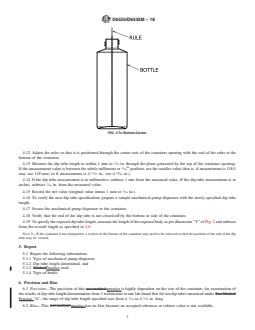
4.1 Place the zero-index end of the ruler into the container
values from the two systems may result in non-conformance
as shown in Fig. 1.
with the standard.
4.2 Turn the ruler so that the side of the ruler reaches as far
1.3 This standard does not purport to address all of the
into the bottom-corner of the container as possible.
safety concerns, if any, associated with its use. It is the
responsibility of the user of this standard to establish appro-
NOTE 2—If the cross-sectional area of the container is not round,
priate safety, health, and environmental practices and deter-
position the ruler into the farthest bottom-corner of the container.
mine the applicability of regulatory limitations prior to use.
4.3 Adjust the ruler so that it is positioned through the
1.4 This international standard was developed in accor-
center axis of the container opening.
dance with internationally recognized principles on standard-
ization established in the Decision on Principles for the 1
4.4 Measure the dip tube length to within 1 mm or ⁄16 in. If
Development of International Standards, Guides and Recom- 1
the measurement value is between the whole millimetre or ⁄16
th
mendations issued by the World Trade Organization Technical
gradient, use the larger value (that is, if measurement is 118.5
Barriers to Trade (TBT) Committee.
21 11
mm, use 119 mm; or if measurement is 4- ⁄32 in., use 4- ⁄16
in).
2. Significance and Use
4.5 If the dip tube measurement is in millimetres, subtract 1
2.1 This practice is to be used to determine the length of a
mm from the measured value. If the dip tube measurement is in
dip tube of a mechanical pump dispenser that extends to the
inches, subtract ⁄16 in. from the measured value.
bottom-corner of a container.
4.6 Record the net value (original value minus 1 mm or ⁄16
2.2 This practice is to be used to determine the length of a
in.).
dip tube of a mechanical pump dispenser that extends to the
bottom-center of a container.
4.7 To verify the new dip tube specification, prepare a
sample mechanical pump dispenser with the newly-specified
3. Apparatus
dip tube length.
3.1 Thin Metal Ruler, with minimum gradients of one
1 4.8 Secure the mechanical pump dispenser to the container.
millimeter and/or ⁄16 in. along with a zero index at the end of
the ruler.
4.9 Verify that the end of the dip tube is not closed-off by
the bottom or side of the container.
3.2 Calipers.
4.10 To specify the exposed dip tube length, measure the
length of the exposed body as per dimension “Y” of Fig. 2 and
This practice is under the jurisdiction of ASTM Committee F02 on Primary
subtract from the overall length as specified in 4.6.
Barrier Packaging and is the direct responsibility of Subcommittee F02.30 on
Mechanical Dispensers.
NOTE 3—If the container is not transparent, a section of the bottom of
Current edition approved May 1, 2018. Published June 2018. Originally
approved in 2000. Last previous edition approved in 2010 as D6535/ the container may need to be removed so that the
...
This document is not an ASTM standard and is intended only to provide the user of an ASTM standard an indication of what changes have been made to the previous version. Because
it may not be technically possible to adequately depict all changes accurately, ASTM recommends that users consult prior editions as appropriate. In all cases only the current version
of the standard as published by ASTM is to be considered the official document.
´1
Designation: D6535/D6535M − 05 (Reapproved 2010) D6535/D6535M − 18
Standard Test Method Practice for
Determining the Dip Tube Length of a Mechanical Pump
Dispenser
This standard is issued under the fixed designation D6535/D6535M; the number immediately following the designation indicates the
year of original adoption or, in the case of revision, the year of last revision. A number in parentheses indicates the year of last
reapproval. A superscript epsilon (´) indicates an editorial change since the last revision or reapproval.
ε NOTE—Units information was editorially revised in December 2010.
1. Scope
1.1 This test method practice covers the determination technique for a dip tube of a mechanical pump dispenser.
1.2 The values stated in either SI units or inch-pound units are to be regarded separately as standard. The values stated in each
system may not be exact equivalents; therefore, each system shall be used independently of the other. Combining values from the
two systems may result in non-conformance with the standard.
1.3 This standard does not purport to address all of the safety concerns, if any, associated with its use. It is the responsibility
of the user of this standard to establish appropriate safety safety, health, and healthenvironmental practices and determine the
applicability of regulatory limitations prior to use.
1.4 This international standard was developed in accordance with internationally recognized principles on standardization
established in the Decision on Principles for the Development of International Standards, Guides and Recommendations issued
by the World Trade Organization Technical Barriers to Trade (TBT) Committee.
2. Significance and Use
2.1 This test method practice is to be used to determine the length of a dip tube of a mechanical pump dispenser that extends
to the bottom-corner of a container.
2.2 This test method practice is to be used to determine the length of a dip tube of a mechanical pump dispenser that extends
to the bottom-center of a container.
3. Apparatus
3.1 Thin Metal Ruler, with minimum gradients of one millimeter and/or ⁄16 in. along with a zero index at the end of the ruler.
3.2 Calipers.
4. Procedure
TEST METHOD PRACTICE “A”—DIP TUBE LENGTH DETERMINATION TO THE BOTTOM-CORNER OF THE
CONTAINER
NOTE 1—This test method practice is used when the dip tube of a mechanical pump dispenser must extend to the bottom-corner of a container.
4.1 Place the zero-index end of the ruler into the container as shown in Fig. 1.
4.2 Turn the ruler so that the side of the ruler reaches as far into the bottom-corner of the container as possible.
NOTE 2—If the cross-sectional area of the container is not round, position the ruler into the farthest bottom-corner of the container.
4.3 Adjust the ruler so that it is positioned through the center axis of the container opening.
th
1 1
4.4 Measure the dip tube length to within 1 mm or ⁄16 in. If the measurement value is between the whole millimetre or ⁄16
21 11
gradient, use the larger value (that is, if measurement is 118.5 mm, use 119 mm; or if measurement is 4- ⁄32 in., use 4- ⁄16 in).
This test method practice is under the jurisdiction of ASTM Committee F02 on FlexiblePrimary Barrier Packaging and is the direct responsibility of Subcommittee F02.30
on Mechanical Pump Dispensers.
Current edition approved Oct. 1, 2010May 1, 2018. Published December 2010June 2018. Originally approved in 2000. Last previous edition approved in 20052010 as
ɛ1
D6535 – 05.D6535/D6535M – 05(2010) . DOI: 10.1520/D6535_D6535M-05R10E01.10.1520/D6535_D6535M-18.
Copyright © ASTM International, 100 Barr Harbor Drive, PO Box C700, West Conshohocken, PA 19428-2959. United States
D6535/D6535M − 18
FIG. 1 To Bottom-Corner
4.5 If the dip tube measurement is in millimetres, subtract 1 mm from the measured value. If the dip tube measurement is in
inches, subtract ⁄16 in. from the measured value.
4.6 Record the net value (original value minus 1 mm or ⁄16 in.).
4.7 To verify the new dip tube specification, prepare a sample mechanical pump dispenser with the newly-specified dip tube
length.
4.8 Secure the mechanical pump dispenser to the container.
...