

ASTM D5556-19
(Test Method)Standard Test Method for Determination of the Moisture and Other Volatile Matter Contained in Fats and Oils Used in Fatliquors and Softening Compounds
General Information
- Abstract
SIGNIFICANCE AND USE
3.1 This test method is intended for use in the determination of the moisture and other volatile matter contained in fats, oils, and fatliquors used in the softening and stuffing of leather, as well as those used in the manufacture of products for such purpose.
SCOPE
1.1 This test method covers the determination of moisture and other volatile material under conditions of the test. It is applicable to all fats, oils, and fatliquors used in the softening and stuffing of leather.
1.2 The values stated in SI units are to be regarded as standard. No other units of measurement are included in this standard.
1.3 This standard does not purport to address all of the safety concerns, if any, associated with its use. It is the responsibility of the user of this standard to establish appropriate safety, health, and environmental practices and determine the applicability of regulatory limitations prior to use.
1.4 This international standard was developed in accordance with internationally recognized principles on standardization established in the Decision on Principles for the Development of International Standards, Guides and Recommendations issued by the World Trade Organization Technical Barriers to Trade (TBT) Committee.
- Status
- Published
- Publication Date
- 31-Oct-2019
- Technical Committee
- D31 - Leather
- Drafting Committee
- D31.08 - Fats and Oils
Buy Documents


ASTM D5556-19 - Standard Test Method for Determination of the Moisture and Other Volatile Matter Contained in Fats and Oils Used in Fatliquors and Softening Compounds
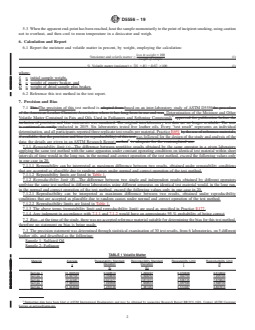


REDLINE ASTM D5556-19 - Standard Test Method for Determination of the Moisture and Other Volatile Matter Contained in Fats and Oils Used in Fatliquors and Softening Compounds
Overview
ASTM D5556-19 is the standard test method for the determination of moisture and other volatile matter contained in fats and oils used in fatliquors and softening compounds. Developed by ASTM International, this method is widely applied in the leather industry to evaluate the quality and suitability of fats, oils, and fatliquors utilized in the processing and finishing of leather. Accurate measurement of moisture and volatile content is critical in ensuring the performance, consistency, and shelf life of these materials throughout the manufacturing and application processes.
Key Topics
Purpose and Scope:
This standard covers procedures for determining moisture and other volatile materials in fats, oils, and fatliquors used specifically for softening and stuffing leather. It applies to all fats and oils, including emulsions, that are intended for leather processing.Methodology Highlights:
- Heating a weighed sample on a hot plate while rotating the container to prevent spattering
- Monitoring the removal of moisture through the cessation of rising bubbles or by detecting steam condensation
- Ensuring the sample's temperature does not exceed specified limits (notably 130°C except at the end)
- Reporting results as the percentage of volatile matter by weight
Precision and Repeatability:
The standard includes guidelines for achieving repeatable and reproducible results across different laboratories, emphasizing the method’s reliability and robust statistical backing.Safety Considerations:
Users must adhere to proper safety, health, and environmental practices, identifying and managing any risks associated with the use of chemicals and heating procedures as specified by their regulatory requirements.
Applications
Leather Manufacturing:
Primary usage is in the quality control of fats, oils, and fatliquors added during the softening and stuffing phases of leather processing. Determining moisture and volatile content is vital to avoid inconsistent product performance and to maintain material stability.Supplier and Product Verification:
Used by suppliers and manufacturers to verify that raw materials meet specified moisture and volatile matter criteria, supporting formulation and performance consistency for leather fatliquors and softening compounds.Product Development:
Supports research and development in formulating new fatliquors, ensuring new blends have acceptable moisture levels for optimal leather softness and performance.Regulatory and Trade Compliance:
Assists in meeting industry standards and international trade requirements, contributing to product traceability and overall process control in the supply chain for leather chemicals.
Related Standards
- ASTM E177: Practice for Use of the Terms Precision and Bias in ASTM Test Methods – provides foundational principles for precision analysis in test methods like D5556-19.
- ASTM E691: Practice for Conducting an Interlaboratory Study to Determine the Precision of a Test Method – establishes approaches for validating repeatability and reproducibility.
- Other Leather Testing Standards:
Manufacturers and laboratories may also reference other ASTM standards for evaluating fats, oils, and chemicals used in leather processing to ensure comprehensive quality assurance.
Practical Value
Utilizing ASTM D5556-19 ensures reliable determination of moisture and volatile content in fats, oils, and fatliquors. This not only improves leather product quality but also prevents issues related to excess moisture, such as microbial growth, instability, and reduced shelf life. The standard supports consistent manufacturing, enhances product safety, and underpins best practices within the global leather industry.
Keywords: ASTM D5556-19, moisture determination, volatile matter, fats and oils, fatliquors, softening compounds, leather, test method, quality control, leather processing, standardization.
Relations
- Effective Date
- 01-Nov-2019
- Effective Date
- 01-May-2014
- Effective Date
- 01-May-2013
- Effective Date
- 01-May-2013
- Effective Date
- 01-Nov-2011
- Effective Date
- 01-Oct-2010
- Effective Date
- 01-Oct-2008
- Effective Date
- 01-Oct-2008
- Refers
ASTM E177-06b - Standard Practice for Use of the Terms Precision and Bias in ASTM Test Methods - Effective Date
- 15-Nov-2006
- Refers
ASTM E177-06a - Standard Practice for Use of the Terms Precision and Bias in ASTM Test Methods - Effective Date
- 01-Nov-2006
- Effective Date
- 01-Nov-2005
- Refers
ASTM E177-04e1 - Standard Practice for Use of the Terms Precision and Bias in ASTM Test Methods - Effective Date
- 01-Nov-2004
- Effective Date
- 01-Nov-2004
- Effective Date
- 01-Nov-2004
- Refers
ASTM E177-90a(2002) - Standard Practice for Use of the Terms Precision and Bias in ASTM Test Methods - Effective Date
- 10-Jan-2002
Buy Documents
ASTM D5556-19 - Standard Test Method for Determination of the Moisture and Other Volatile Matter Contained in Fats and Oils Used in Fatliquors and Softening Compounds
REDLINE ASTM D5556-19 - Standard Test Method for Determination of the Moisture and Other Volatile Matter Contained in Fats and Oils Used in Fatliquors and Softening Compounds
Get Certified
Connect with accredited certification bodies for this standard

Control Union Certifications
Global certification for agriculture and sustainability.

Hohenstein Institut
Textile testing and certification.

Bureau Veritas Bangladesh
Bureau Veritas certification services in Bangladesh.
Sponsored listings
Frequently Asked Questions
ASTM D5556-19 is a standard published by ASTM International. Its full title is "Standard Test Method for Determination of the Moisture and Other Volatile Matter Contained in Fats and Oils Used in Fatliquors and Softening Compounds". This standard covers: SIGNIFICANCE AND USE 3.1 This test method is intended for use in the determination of the moisture and other volatile matter contained in fats, oils, and fatliquors used in the softening and stuffing of leather, as well as those used in the manufacture of products for such purpose. SCOPE 1.1 This test method covers the determination of moisture and other volatile material under conditions of the test. It is applicable to all fats, oils, and fatliquors used in the softening and stuffing of leather. 1.2 The values stated in SI units are to be regarded as standard. No other units of measurement are included in this standard. 1.3 This standard does not purport to address all of the safety concerns, if any, associated with its use. It is the responsibility of the user of this standard to establish appropriate safety, health, and environmental practices and determine the applicability of regulatory limitations prior to use. 1.4 This international standard was developed in accordance with internationally recognized principles on standardization established in the Decision on Principles for the Development of International Standards, Guides and Recommendations issued by the World Trade Organization Technical Barriers to Trade (TBT) Committee.
SIGNIFICANCE AND USE 3.1 This test method is intended for use in the determination of the moisture and other volatile matter contained in fats, oils, and fatliquors used in the softening and stuffing of leather, as well as those used in the manufacture of products for such purpose. SCOPE 1.1 This test method covers the determination of moisture and other volatile material under conditions of the test. It is applicable to all fats, oils, and fatliquors used in the softening and stuffing of leather. 1.2 The values stated in SI units are to be regarded as standard. No other units of measurement are included in this standard. 1.3 This standard does not purport to address all of the safety concerns, if any, associated with its use. It is the responsibility of the user of this standard to establish appropriate safety, health, and environmental practices and determine the applicability of regulatory limitations prior to use. 1.4 This international standard was developed in accordance with internationally recognized principles on standardization established in the Decision on Principles for the Development of International Standards, Guides and Recommendations issued by the World Trade Organization Technical Barriers to Trade (TBT) Committee.
ASTM D5556-19 is classified under the following ICS (International Classification for Standards) categories: 59.040 - Textile auxiliary materials. The ICS classification helps identify the subject area and facilitates finding related standards.
ASTM D5556-19 has the following relationships with other standards: It is inter standard links to ASTM D5556-95(2011), ASTM E177-14, ASTM E691-13, ASTM E177-13, ASTM E691-11, ASTM E177-10, ASTM E177-08, ASTM E691-08, ASTM E177-06b, ASTM E177-06a, ASTM E691-05, ASTM E177-04e1, ASTM E177-04, ASTM E177-06, ASTM E177-90a(2002). Understanding these relationships helps ensure you are using the most current and applicable version of the standard.
ASTM D5556-19 is available in PDF format for immediate download after purchase. The document can be added to your cart and obtained through the secure checkout process. Digital delivery ensures instant access to the complete standard document.
Standards Content (Sample)
This international standard was developed in accordance with internationally recognized principles on standardization established in the Decision on Principles for the
Development of International Standards, Guides and Recommendations issued by the World Trade Organization Technical Barriers to Trade (TBT) Committee.
Designation: D5556 − 19
Standard Test Method for
Determination of the Moisture and Other Volatile Matter
Contained in Fats and Oils Used in Fatliquors and Softening
Compounds
This standard is issued under the fixed designation D5556; the number immediately following the designation indicates the year of
original adoption or, in the case of revision, the year of last revision. A number in parentheses indicates the year of last reapproval. A
superscript epsilon (´) indicates an editorial change since the last revision or reapproval.
1. Scope 4. Apparatus
1.1 This test method covers the determination of moisture
4.1 Electric Hot Plate, with uniform heat transfer across the
and other volatile material under conditions of the test. It is
surface, chemical and scratch resistant.
applicable to all fats, oils, and fatliquors used in the softening
4.2 Glass Beakers, 100 to 150 mL.
and stuffing of leather.
1.2 The values stated in SI units are to be regarded as 4.3 Desiccator, containing an efficient desiccant.
standard. No other units of measurement are included in this
standard. 5. Procedure
1.3 This standard does not purport to address all of the
5.1 Accurately weigh 5 to 10 g of a well-mixed sample into
safety concerns, if any, associated with its use. It is the
a tared beaker that has been previously dried and cooled in a
responsibility of the user of this standard to establish appro-
desiccator. Then heat the sample on the hot plate, slowly
priate safety, health, and environmental practices and deter-
increasing to medium temperature-settings, rotating the beaker
mine the applicability of regulatory limitations prior to use.
gently, by hand, to avoid spattering that may result from too
1.4 This international standard was developed in accor-
rapid ebullition of moisture. If an excess of spattering occurs,
dance with internationally recognized principles on standard-
the experiments should be stopped and another technique
ization established in the Decision on Principles for the
should be used.
Development of International Standards, Guides and Recom-
5.2 Judge the approach of the end-point by the cessation of
mendations issued by the World Trade Organization Technical
the rising bubbles of steam as well as by the absence of foam.
Barriers to Trade (TBT) Committee.
Another good method of judging the end-point is to place a
2. Referenced Documents
clean, dry watch glass on top of the beaker. The evolution of
steam is indicated by condensation on the watch glass. The
2.1 ASTM Standards:
temperatureofthesampleshallatnotimebeallowedtoexceed
E177 Practice for Use of the Terms Precision and Bias in
130°C, except at the end of test.
ASTM Test Methods
E691 Practice for Conducting an Interlaboratory Study to
5.3 When the apparent end-point has been reached, heat the
Determine the Precision of a Test Method
sample momentarily to the point of incipient smoking, using
caution not to overheat, and then cool to room temperature in
3. Significance and Use
a desiccator and weigh.
3.1 This test method is intended for use in the determination
of the moisture and other volatile matter contained in fats, oils,
6. Calculation and Report
and fatliquors used in the softening and stuffing of leather, as
6.1 Report the moisture and volatile matter in percent, by
well as those used in the manufacture of products for such
weight, employing the calculation:
purpose.
% Volatile matter ~moisture! = S 1 B 2 D⁄S 3100 (1)
@~ ! #
This test method is under the jurisdiction ofASTM Committee D31 on Leather
where:
and is the direct responsibility of Subcommittee D31.08 on Fats and Oils. This test
S = initial sample weight,
method was developed in cooperation with the American Leather Chemists Assn.
B = weight of empty beaker, and
(Method H 20–1957).
Current edition approved Nov. 1, 2019. Published December 2019. Originally D = weight of dried sample plus beaker.
approved in 1994. Last previous edition approved in 2011 as D5556 – 95(2011).
DOI: 10.1520/D5556-19. 6.2 Reference this test method in the test report.
Copyright © ASTM International, 100 Barr Harbor Drive, PO Box C700, West Conshohocken, PA 19428-2959. United States
D5556 − 19
TABLE 1 Volatile Matter
Material Average Repeatability Standard Reproducibility Standard Repeatability Limit Reproducibility Limit
Deviation Deviation r R
x¯
S S
r R
Sample 1 31.636539 0.328513 1.290297 0.919838 3.
...
This document is not an ASTM standard and is intended only to provide the user of an ASTM standard an indication of what changes have been made to the previous version. Because
it may not be technically possible to adequately depict all changes accurately, ASTM recommends that users consult prior editions as appropriate. In all cases only the current version
of the standard as published by ASTM is to be considered the official document.
Designation: D5556 − 95 (Reapproved 2011) D5556 − 19
Standard Test Method for
Determination of the Moisture and Other Volatile Matter
Contained in Fats and Oils Used in Fat Liquors Fatliquors
and Softening Compounds
This standard is issued under the fixed designation D5556; the number immediately following the designation indicates the year of
original adoption or, in the case of revision, the year of last revision. A number in parentheses indicates the year of last reapproval. A
superscript epsilon (´) indicates an editorial change since the last revision or reapproval.
1. Scope
1.1 This test method covers the determination of moisture and other volatile material under conditions of the test. It is applicable
to all fats and oils, including emulsions.fats, oils, and fatliquors used in the softening and stuffing of leather.
1.2 The values stated in SI units are to be regarded as standard. No other units of measurement are included in this standard.
1.3 This standard does not purport to address all of the safety concerns, if any, associated with its use. It is the responsibility
of the user of this standard to establish appropriate safety safety, health, and healthenvironmental practices and determine the
applicability of regulatory limitations prior to use.
1.4 This international standard was developed in accordance with internationally recognized principles on standardization
established in the Decision on Principles for the Development of International Standards, Guides and Recommendations issued
by the World Trade Organization Technical Barriers to Trade (TBT) Committee.
2. Referenced Documents
2.1 ASTM Standards:
E177 Practice for Use of the Terms Precision and Bias in ASTM Test Methods
E691 Practice for Conducting an Interlaboratory Study to Determine the Precision of a Test Method
3. Significance and Use
3.1 This test method is intended for use in the determination of the moisture and other volatile matter contained in fats fats, oils,
and oilsfatliquors used in the softening and stuffing of leather, as well as those used in the manufacture of products for such
purpose.
4. Apparatus
4.1 Electric Hot Plate, with ceramic top and uniform heat transfer across the surface, chemical and scratch resistant.
4.2 Glass Beakers, 100 to 150 mL,mL.
4.3 Desiccator, containing an efficient desiccant.
5. Procedure
5.1 Accurately weigh 5 to 2010 g of a well mixed well-mixed sample into a tared beaker that has been previously dried and
cooled in a desiccator. Then heat the sample on the hot plate, slowly increasing to medium temperature-settings, rotating the beaker
gently, by hand, to avoid spattering that may result from too rapid ebullition of moisture. If an excess of spattering occurs, the
experiments should be stopped and another technique should be used.
5.2 Judge the approach of the end-point by the cessation of the rising bubbles of steam as well as by the absence of foam.
Another good method of judging the end-point is to place a clean, dry watch glass on top of the beaker. The evolution of steam
is indicated by condensation on the watch glass. The temperature of the sample shall at no time be allowed to exceed 130°C, except
at the end of test.
This test method is under the jurisdiction of ASTM Committee D31 on Leather and is the direct responsibility of Subcommittee D31.08 on Fats and Oils. This test method
was developed in cooperation with the American Leather Chemists Assn. (Method H 20–1957).
Current edition approved Jan. 1, 2011Nov. 1, 2019. Published March 2011December 2019. Originally approved in 1994. Last previous edition approved in 20062011 as
D5556 – 95(2006).(2011). DOI: 10.1520/D5556-95R11.10.1520/D5556-19.
Copyright © ASTM International, 100 Barr Harbor Drive, PO Box C700, West Conshohocken, PA 19428-2959. United States
D5556 − 19
5.3 When the apparent end-point has been reached, heat the sample momentarily to the point of incipient smoking, using caution
not to overheat, and then cool to room temperature in a desiccator and weigh.
6. Calculation and Report
6.1 Report the moisture and volatile matter in percent, by weight, employing the calculation:
loss in weight 3100
%moisture and volatile matter 5 (1)
weight of sample
% Volatile matter ~moisture! = S 1 B 2 D⁄S 3100 (1)
@~ ! #
where:
S = initial sample weight,
B = weight of empty beaker, and
D = weight of dried sample plus beaker.
6.2 Reference this test method in the test report.
7. Precision and Bias
7.1 This The precision of this test method is adopted from based on an inter-laboratory study of ASTM D5556the procedure
of the American Leather Chemists Association where it has long been in use and was, Determination of the Moisture and Other
Volatile Matter Contained in Fats and O
...