


ASTM B496-16(2021)
(Specification)Standard Specification for Compact Round Concentric-Lay-Stranded Copper Conductors
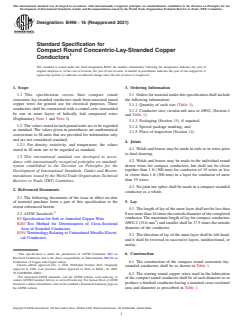
Standard Specification for Compact Round Concentric-Lay-Stranded Copper Conductors
ABSTRACT
This specification covers bare compact round concentric-lay-stranded conductors made from uncoated round copper wires for general use for electrical purposes. Welds and brazes shall be made in rods and wires prior to final drawing. The conductors shall conform to the required construction values of nominal cross-sectional area, diameter, mass per unit length and dc electrical resistance. Tests for the physical and electrical properties of wires composing the conductors shall be made before stranding.
SCOPE
1.1 This specification covers bare compact round concentric-lay-stranded conductors made from uncoated round copper wires for general use for electrical purposes. These conductors shall be constructed with a central core surrounded by one or more layers of helically laid compacted wires (Explanatory Note 1 and Note 2).
1.2 The values stated in inch-pound units are to be regarded as standard. The values given in parentheses are mathematical conversions to SI units that are provided for information only and are not considered standard.
1.2.1 For density, resistivity, and temperature, the values stated in SI units are to be regarded as standard.
1.3 This international standard was developed in accordance with internationally recognized principles on standardization established in the Decision on Principles for the Development of International Standards, Guides and Recommendations issued by the World Trade Organization Technical Barriers to Trade (TBT) Committee.
General Information
- Status
- Published
- Publication Date
- 30-Sep-2021
- Technical Committee
- B01 - Electrical Conductors
- Drafting Committee
- B01.04 - Conductors of Copper and Copper Alloys
Relations
- Effective Date
- 01-Apr-2024
- Effective Date
- 01-Oct-2018
- Effective Date
- 01-Sep-2016
- Effective Date
- 01-Oct-2013
- Effective Date
- 01-Dec-2012
- Effective Date
- 15-Nov-2012
- Effective Date
- 01-Oct-2010
- Effective Date
- 15-Mar-2007
- Effective Date
- 01-Mar-2005
- Refers
ASTM B263-04 - Standard Test Method for Determination of Cross-Sectional Area of Stranded Conductors - Effective Date
- 01-Apr-2004
- Effective Date
- 10-Mar-2001
- Refers
ASTM B263-99 - Standard Test Method for Determination of Cross-Sectional Area of Stranded Conductors - Effective Date
- 10-Oct-1999
- Effective Date
- 10-Sep-1998
Overview
ASTM B496-16(2021) is the internationally recognized standard specification for Compact Round Concentric-Lay-Stranded Copper Conductors. Developed by ASTM International, this standard outlines the requirements for bare, compact, round, concentric-lay-stranded conductors fabricated from uncoated copper wires. These conductors are engineered for general electrical applications where reliability, conductivity, and mechanical integrity are essential.
The standard applies to conductors built with a central core wire surrounded by one or more layers of helically laid, compacted copper wires. ASTM B496-16(2021) covers important construction and performance parameters such as cross-sectional area, diameter, mass per unit length, and direct current (DC) electrical resistance.
Key Topics
- Product Specifications: Addresses the construction using uncoated copper wires, details the requirements for the number of wires, core design, and compacting process.
- Dimensional and Physical Properties: Specifies nominal cross-sectional areas, diameters, and tolerance limits for diameter and area, ensuring consistency and compatibility across manufacturers.
- Electrical Resistance: Defines the allowable maximum DC resistance values at 20 °C, essential for electrical system designers focused on efficient power transmission.
- Quality and Testing: Requires testing of wires before stranding, adhering to tensile and elongation requirements referenced in ASTM B3. The finished conductor must conform to standardized physical and electrical properties.
- Jointing and Lay Direction: Explains where welds and brazes may occur within rods or wires prior to final drawing and sets parameters for the direction and length of lay of the outer conductor layer.
- Packaging and Marking: Outlines package sizes, labeling requirements, and protection measures for shipping and handling.
Applications
Compact round concentric-lay-stranded copper conductors are widely used across various industries due to their superior electrical conductivity and mechanical robustness. Practical applications include:
- Power transmission and distribution: Utilized in overhead lines and substation wiring where high current capacity and reliability are critical.
- Construction and building wiring: Employed in risers, feeders, and bus wiring in commercial and industrial installations.
- Electrical machinery and equipment: Suitable for connections inside transformers, motors, and switchgear.
- Cable manufacturing: Acts as the foundational element in armored, covered, or insulated medium and high-voltage cables.
- Rail and transportation infrastructure: Used in electrified railway lines and signaling circuitry.
- Renewable energy installations: Suitable for solar and wind energy projects that require dependable copper conductors.
By adhering to ASTM B496-16(2021), users ensure they are implementing conductors that meet established quality, safety, and performance benchmarks, facilitating project success and regulatory compliance.
Related Standards
For comprehensive electrical conductor projects, the following related ASTM standards are frequently referenced alongside ASTM B496-16(2021):
- ASTM B3: Standard Specification for Soft or Annealed Copper Wire - addresses requirements for the initial copper wire material.
- ASTM B263: Test Method for Determination of Cross-Sectional Area of Stranded Conductors - provides methods for accurately measuring strand areas.
- ASTM B354: Terminology Relating to Uninsulated Metallic Electrical Conductors - ensures common understanding of terms and definitions within the electrical conductor industry.
Adoption of ASTM B496-16(2021) and its related standards enables manufacturers, engineers, and specifiers to consistently achieve high-performance results in electrical conductor projects. This standard supports manufacturers, utilities, and contractors in meeting both technical requirements and international trade regulations for copper conductors.

Get Certified
Connect with accredited certification bodies for this standard

IMQ S.p.A. (Certification)
Italian electrical product certification.

SLG Prüf- und Zertifizierungs GmbH
German testing and certification body.

UL Solutions
Global safety science company with testing, inspection and certification.
Sponsored listings
Frequently Asked Questions
ASTM B496-16(2021) is a technical specification published by ASTM International. Its full title is "Standard Specification for Compact Round Concentric-Lay-Stranded Copper Conductors". This standard covers: ABSTRACT This specification covers bare compact round concentric-lay-stranded conductors made from uncoated round copper wires for general use for electrical purposes. Welds and brazes shall be made in rods and wires prior to final drawing. The conductors shall conform to the required construction values of nominal cross-sectional area, diameter, mass per unit length and dc electrical resistance. Tests for the physical and electrical properties of wires composing the conductors shall be made before stranding. SCOPE 1.1 This specification covers bare compact round concentric-lay-stranded conductors made from uncoated round copper wires for general use for electrical purposes. These conductors shall be constructed with a central core surrounded by one or more layers of helically laid compacted wires (Explanatory Note 1 and Note 2). 1.2 The values stated in inch-pound units are to be regarded as standard. The values given in parentheses are mathematical conversions to SI units that are provided for information only and are not considered standard. 1.2.1 For density, resistivity, and temperature, the values stated in SI units are to be regarded as standard. 1.3 This international standard was developed in accordance with internationally recognized principles on standardization established in the Decision on Principles for the Development of International Standards, Guides and Recommendations issued by the World Trade Organization Technical Barriers to Trade (TBT) Committee.
ABSTRACT This specification covers bare compact round concentric-lay-stranded conductors made from uncoated round copper wires for general use for electrical purposes. Welds and brazes shall be made in rods and wires prior to final drawing. The conductors shall conform to the required construction values of nominal cross-sectional area, diameter, mass per unit length and dc electrical resistance. Tests for the physical and electrical properties of wires composing the conductors shall be made before stranding. SCOPE 1.1 This specification covers bare compact round concentric-lay-stranded conductors made from uncoated round copper wires for general use for electrical purposes. These conductors shall be constructed with a central core surrounded by one or more layers of helically laid compacted wires (Explanatory Note 1 and Note 2). 1.2 The values stated in inch-pound units are to be regarded as standard. The values given in parentheses are mathematical conversions to SI units that are provided for information only and are not considered standard. 1.2.1 For density, resistivity, and temperature, the values stated in SI units are to be regarded as standard. 1.3 This international standard was developed in accordance with internationally recognized principles on standardization established in the Decision on Principles for the Development of International Standards, Guides and Recommendations issued by the World Trade Organization Technical Barriers to Trade (TBT) Committee.
ASTM B496-16(2021) is classified under the following ICS (International Classification for Standards) categories: 29.240.20 - Power transmission and distribution lines. The ICS classification helps identify the subject area and facilitates finding related standards.
ASTM B496-16(2021) has the following relationships with other standards: It is inter standard links to ASTM B3-13(2024), ASTM B3-13(2018), ASTM B354-16, ASTM B3-13, ASTM B354-12, ASTM B3-12, ASTM B263-04(2010), ASTM B3-01(2007), ASTM B354-05, ASTM B263-04, ASTM B3-01, ASTM B263-99, ASTM B354-98. Understanding these relationships helps ensure you are using the most current and applicable version of the standard.
ASTM B496-16(2021) is available in PDF format for immediate download after purchase. The document can be added to your cart and obtained through the secure checkout process. Digital delivery ensures instant access to the complete standard document.
Standards Content (Sample)
This international standard was developed in accordance with internationally recognized principles on standardization established in the Decision on Principles for the
Development of International Standards, Guides and Recommendations issued by the World Trade Organization Technical Barriers to Trade (TBT) Committee.
Designation: B496 −16 (Reapproved 2021)
Standard Specification for
Compact Round Concentric-Lay-Stranded Copper
Conductors
This standard is issued under the fixed designation B496; the number immediately following the designation indicates the year of
original adoption or, in the case of revision, the year of last revision. A number in parentheses indicates the year of last reapproval. A
superscript epsilon (´) indicates an editorial change since the last revision or reapproval.
1. Scope 3. Ordering Information
1.1 This specification covers bare compact round 3.1 Orders for material under this specification shall include
concentric-lay-stranded conductors made from uncoated round
the following information:
copper wires for general use for electrical purposes. These
3.1.1 Quantity of each size (Table 1),
conductors shall be constructed with a central core surrounded
3.1.2 Conductor size; circular-mil area or AWG, (Section 6
by one or more layers of helically laid compacted wires
and Table 1),
(Explanatory Note 1 and Note 2).
3.1.3 Packaging (Section 15), if required,
1.2 The values stated in inch-pound units are to be regarded
3.1.4 Special package marking, and
as standard. The values given in parentheses are mathematical
3.1.5 Place of inspection (Section 14).
conversions to SI units that are provided for information only
and are not considered standard.
4. Joints
1.2.1 For density, resistivity, and temperature, the values
4.1 Welds and brazes may be made in rods or in wires prior
stated in SI units are to be regarded as standard.
to final drawing.
1.3 This international standard was developed in accor-
4.2 Welds and brazes may be made in the individual round
dance with internationally recognized principles on standard-
drawn wires for compact conductors, but shall not be closer
ization established in the Decision on Principles for the
together than 1 ft (300 mm) for conductor of 19 wires or less
Development of International Standards, Guides and Recom-
or closer than 1 ft (300 mm) in a layer for conductor of more
mendations issued by the World Trade Organization Technical
than 19 wires.
Barriers to Trade (TBT) Committee.
4.3 No joint nor splice shall be made in a compact-stranded
2. Referenced Documents
conductor as a whole.
2.1 The following documents of the issue in effect on date
5. Lay
of material purchase form a part of this specification to the
extent referenced herein:
5.1 The length of lay of the outer layer shall not be less than
8normorethan16timestheoutsidediameterofthecompleted
2.2 ASTM Standards:
conductor.The maximum length of lay for compact conductors
B3 Specification for Soft or Annealed Copper Wire
AWG 2 (33.6 mm ) and smaller shall be 17.5 times the outside
B263 Test Method for Determination of Cross-Sectional
diameter of the conductor.
Area of Stranded Conductors
B354 Terminology Relating to Uninsulated Metallic Electri-
5.2 The direction of lay of the outer layer shall be left-hand,
cal Conductors
and it shall be reversed in successive layers, unidirectional, or
unilay.
This specification is under the jurisdiction of ASTM Committee B01 on
6. Construction
Electrical Conductors and is the direct responsibility of Subcommittee B01.04 on
Conductors of Copper and Copper Alloys. 6.1 The construction of the compact round concentric-lay-
Current edition approved Oct. 1, 2021. Published October 2021. Originally
stranded conductors shall be as shown in Table 1.
approved in 1969. Last previous edition approved in 2016 as B496 – 16. DOI:
10.1520/B0496-16R21.
6.2 The starting round copper wires used in the fabrication
For referenced ASTM standards, visit the ASTM website, www.astm.org, or
of the compact round conductor shall be of such diameter as to
contact ASTM Customer Service at service@astm.org. For Annual Book of ASTM
produce a finished conductor having a nominal cross-sectional
Standards volume information, refer to the standard’s Document Summary page on
the ASTM website. area and diameter as prescribed in Table 1.
Copyright © ASTM International, 100 Barr Harbor Drive, PO Box C700, West Conshohocken, PA 19428-2959. United States
B496 − 16 (2021)
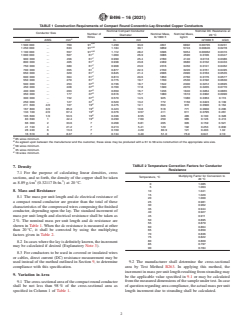
TABLE 1 Construction Requirements of Compact Round Concentric-Lay-Stranded Copper Conductors
Nominal Compact Conductor Nominal DC Resistance at
Conductor Size
Number of Nominal Mass, Nominal Mass,
Diameter 20 °C
Wires lb/1000 ft kg/km
cmil AWG mm in. mm Ω/1000 ft Ω/km
A,B
1 500 000 . 760 91 1.299 33.0 4631 6892 0.00705 0.0231
A,B
1 250 000 . 633 91 1.184 30.1 3859 5743 0.00846 0.0278
A,B
1 100 000 . 557 91 1.112 28.2 3396 5054 0.00962 0.0316
C
1 000 000 . 507 61 1.060 26.9 3086 4590 0.0106 0.0347
C
900 000 . 456 61 0.999 25.4 2780 4140 0.0118 0.0386
C
800 000 . 405 61 0.938 23.8 2469 3680 0.0132 0.0433
C
750 000 . 380 61 0.908 23.0 2316 3450 0.0141 0.0462
C
700 000 . 355 61 0.877 22.3 2160 3220 0.0151 0.0495
C
650 000 . 329 61 0.845 21.4 2006 2990 0.0163 0.0535
C
600 000 . 304 61 0.813 20.6 1850 2760 0.0176 0.0577
C
550 000 . 279 61 0.775 19.7 1700 2530 0.0192 0.0630
D
500 000 . 253 37 0.736 18.7 1542 2300 0.0212 0.0695
D
450 000 . 228 37 0.700 17.8 1390 2070 0.0235 0.0770
D
400 000 . 203 37 0.659 16.7 1236 1840 0.0264 0.0865
D
350 000 . 177 37 0.616 15.7 1080 1610 0.0302 0.0990
D
300 000 . 152 37 0.570 14.5 925 1380 0.0353 0.116
D
250 000 . 127 37 0.520 13.2 772 1150 0.0423 0.139
E
211 600 4/0 107 19 0.475 12.1 653 972 0.0500 0.164
E
167 800 3/0 85.0 19 0.423 10.8 518 771 0.0630 0.206
E
133 100 2/0 67.4 19 0.376 9.57 411 611 0.0795 0.261
E
105 600 1/0 53.5 19 0.336 8.55 326 485 0.100 0.328
E
83 690 1 42.4 19 0.299 7.60 259 385 0.126 0.413
66 360 2 33.6 7 0.268 6.81 205 305 0.159 0.521
41 740 4 21.2 7 0.213 5.41 129 192 0.253 0.830
26 240 6 13.3 7 0.169 4.29 80.9 121 0.403 1.32
16 510 8 8.37 7 0.134 3.40 51.0 75.9 0.641 2.10
A
85 wires minimum.
B
As agreed upon between the manufacturer and the customer, these sizes may be produced with a 61 to 58 wire construction of the appropriate wire size.
C
58 wires minimum.
D
35 wires minimum.
E
18 wires minimum.
TABLE 2 Temperature Correction Factors for Conductor
7. Density
Resistance
7.1 For the purpose of calculating linear densities, cross
Multiplying Factor for Conversion to
Temperature, °C
sections, and so forth, the density of the copper shall be taken
20 °C
3 3
as 8.89 g⁄cm (0.32117 lb⁄in.)at20°C.
0 1.085
5 1.063
8. Mass and Resistance
10 1.041
15 1.020
8.1 The mass per unit length and dc electrical resistance of
20 1.000
a compact round conductor are greater than the total of these 25 0.981
30 0.962
characteristics of the compressed wires composing the finished
35 0.944
conductor, depending upon the lay. The standard increment of
40 0.927
45 0.911
mass per unit length and electrical resistance shall be taken as
50 0.895
2 %. The nominal mass per unit length and dc resistance are
55 0.879
s
...
Questions, Comments and Discussion
Ask us and Technical Secretary will try to provide an answer. You can facilitate discussion about the standard in here.
Loading comments...