

ASTM D2876-00(2020)
(Test Method)Standard Test Method for Water-Soluble Matter of Vegetable-Tanned Leather
General Information
- Abstract
SIGNIFICANCE AND USE
4.1 The test method is useful for determining the water-soluble materials in vegetable-tanned leathers.
4.2 The water-soluble matter includes the soluble nontanning components of the tanning materials used, sugars and materials of a similar nature, and inorganic compounds such as Epsom salts, Glauber's salts, borax, and other soluble salts added during curing and tannery processing.
SCOPE
1.1 This test method covers the determination of the water-soluble materials in all types of vegetable-tanned leathers. This test method does not apply to wet blue.
1.2 The values stated in SI units are to be regarded as standard. No other units of measurement are included in this standard.
1.3 This standard does not purport to address all of the safety concerns, if any, associated with its use. It is the responsibility of the user of this standard to establish appropriate safety and health practices and determine the applicability of regulatory limitations prior to use.
This standard does not purport to address all of the safety concerns, if any, associated with its use. It is the responsibility of the user of this standard to establish appropriate safety, health, and environmental practices and determine the applicability of regulatory limitations prior to use.
1.4 This international standard was developed in accordance with internationally recognized principles on standardization established in the Decision on Principles for the Development of International Standards, Guides and Recommendations issued by the World Trade Organization Technical Barriers to Trade (TBT) Committee.
- Status
- Published
- Publication Date
- 30-Nov-2020
- Technical Committee
- D31 - Leather
- Drafting Committee
- D31.01 - Vegetable Leather


Overview
ASTM D2876-00(2020): Standard Test Method for Water-Soluble Matter of Vegetable-Tanned Leather is an internationally recognized standard published by ASTM International. This test method defines procedures for determining water-soluble materials in all types of vegetable-tanned leather. It ensures leather quality and consistency by quantifying the content of substances that dissolve in water, such as soluble nontanning components, sugars, and various inorganic salts introduced during processing.
Understanding water-soluble matter is crucial for manufacturers, quality control laboratories, and organizations involved in leather production and evaluation. This method does not apply to leather types such as wet blue and requires compliance with safety and health guidelines before use.
Key Topics
- Scope and Applicability:
- Covers all types of vegetable-tanned leather, except wet blue.
- Applicable for research, quality assurance, and regulatory compliance.
- Significance of Water-Soluble Matter:
- Includes sugars, similar organic materials, and inorganic compounds (such as Epsom salts, Glauber's salts, and borax).
- Indicates the presence of processing additives and residues in the finished leather product.
- Analytical Process:
- Leather samples are subjected to hexane extraction, followed by water extraction at controlled temperatures.
- The resulting solution is evaporated, and the residue is measured to determine water-soluble content.
- Equipment:
- Uses specialized apparatus, such as the Reed-Churchill type extractor, crystallizing dishes, circulating air oven, and water bath.
- Precision and Bias:
- Provides reproducible results within defined limits when performed under controlled conditions and by trained operators.
Applications
ASTM D2876-00(2020) plays a significant role in multiple aspects of the leather industry and related sectors:
- Quality Control in Leather Manufacturing:
- Ensures consistent product quality by monitoring residual processing materials that may affect durability, appearance, or chemical stability.
- Regulatory and Trade Compliance:
- Helps organizations demonstrate adherence to international standards in commercial transactions and regulatory audits.
- Research and Development:
- Assists in the evaluation and comparison of tanning processes, formulations, and their impact on water-soluble residue levels.
- Material Assessment:
- Used by buyers and suppliers to assess raw material suitability and finished product performance.
- Environmental and Health Safety:
- Identifies potentially objectionable residues, supporting eco-friendly and safety-centered production practices.
Related Standards
Several standards complement or support the implementation of ASTM D2876-00(2020):
- ASTM D3495 - Test Method for Hexane Extraction of Leather, referenced as a preliminary step in D2876.
- ISO and other ASTM Leather Standards - Address additional chemical, mechanical, and physical characteristics of leather.
- Environmental and Safety Standards - Guide appropriate safety, health, and environmental practices during laboratory testing.
Summary
The ASTM D2876-00(2020) standard test method is essential for evaluating water-soluble matter in vegetable-tanned leather. By providing a rigorous, internationally recognized procedure, this standard enables stakeholders to ensure product quality, regulatory compliance, and safety throughout the leather supply chain. Employing ASTM D2876 enhances confidence in both raw materials and finished products, supporting integrity and sustainability in the global leather industry.
Keywords: vegetable-tanned leather, water-soluble matter, leather testing, ASTM D2876, leather quality control, international standards, leather manufacturing, leather chemistry, leather additives, leather processing residues
Relations
- Effective Date
- 01-Nov-2010
- Effective Date
- 10-Sep-2000
Get Certified
Connect with accredited certification bodies for this standard

Control Union Certifications
Global certification for agriculture and sustainability.

Hohenstein Institut
Textile testing and certification.

Bureau Veritas Bangladesh
Bureau Veritas certification services in Bangladesh.
Sponsored listings
Frequently Asked Questions
ASTM D2876-00(2020) is a standard published by ASTM International. Its full title is "Standard Test Method for Water-Soluble Matter of Vegetable-Tanned Leather". This standard covers: SIGNIFICANCE AND USE 4.1 The test method is useful for determining the water-soluble materials in vegetable-tanned leathers. 4.2 The water-soluble matter includes the soluble nontanning components of the tanning materials used, sugars and materials of a similar nature, and inorganic compounds such as Epsom salts, Glauber's salts, borax, and other soluble salts added during curing and tannery processing. SCOPE 1.1 This test method covers the determination of the water-soluble materials in all types of vegetable-tanned leathers. This test method does not apply to wet blue. 1.2 The values stated in SI units are to be regarded as standard. No other units of measurement are included in this standard. 1.3 This standard does not purport to address all of the safety concerns, if any, associated with its use. It is the responsibility of the user of this standard to establish appropriate safety and health practices and determine the applicability of regulatory limitations prior to use. This standard does not purport to address all of the safety concerns, if any, associated with its use. It is the responsibility of the user of this standard to establish appropriate safety, health, and environmental practices and determine the applicability of regulatory limitations prior to use. 1.4 This international standard was developed in accordance with internationally recognized principles on standardization established in the Decision on Principles for the Development of International Standards, Guides and Recommendations issued by the World Trade Organization Technical Barriers to Trade (TBT) Committee.
SIGNIFICANCE AND USE 4.1 The test method is useful for determining the water-soluble materials in vegetable-tanned leathers. 4.2 The water-soluble matter includes the soluble nontanning components of the tanning materials used, sugars and materials of a similar nature, and inorganic compounds such as Epsom salts, Glauber's salts, borax, and other soluble salts added during curing and tannery processing. SCOPE 1.1 This test method covers the determination of the water-soluble materials in all types of vegetable-tanned leathers. This test method does not apply to wet blue. 1.2 The values stated in SI units are to be regarded as standard. No other units of measurement are included in this standard. 1.3 This standard does not purport to address all of the safety concerns, if any, associated with its use. It is the responsibility of the user of this standard to establish appropriate safety and health practices and determine the applicability of regulatory limitations prior to use. This standard does not purport to address all of the safety concerns, if any, associated with its use. It is the responsibility of the user of this standard to establish appropriate safety, health, and environmental practices and determine the applicability of regulatory limitations prior to use. 1.4 This international standard was developed in accordance with internationally recognized principles on standardization established in the Decision on Principles for the Development of International Standards, Guides and Recommendations issued by the World Trade Organization Technical Barriers to Trade (TBT) Committee.
ASTM D2876-00(2020) is classified under the following ICS (International Classification for Standards) categories: 59.140.30 - Leather and furs. The ICS classification helps identify the subject area and facilitates finding related standards.
ASTM D2876-00(2020) has the following relationships with other standards: It is inter standard links to ASTM D3495-10, ASTM D3495-00. Understanding these relationships helps ensure you are using the most current and applicable version of the standard.
ASTM D2876-00(2020) is available in PDF format for immediate download after purchase. The document can be added to your cart and obtained through the secure checkout process. Digital delivery ensures instant access to the complete standard document.
Standards Content (Sample)
This international standard was developed in accordance with internationally recognized principles on standardization established in the Decision on Principles for the
Development of International Standards, Guides and Recommendations issued by the World Trade Organization Technical Barriers to Trade (TBT) Committee.
Designation: D2876 − 00 (Reapproved 2020)
Standard Test Method for
Water-Soluble Matter of Vegetable-Tanned Leather
This standard is issued under the fixed designation D2876; the number immediately following the designation indicates the year of
original adoption or, in the case of revision, the year of last revision. A number in parentheses indicates the year of last reapproval. A
superscript epsilon (´) indicates an editorial change since the last revision or reapproval.
1. Scope extraction with hexane and leaving at ambient temperature in
an exhaust hood to remove the hexane.
1.1 This test method covers the determination of the water-
soluble materials in all types of vegetable-tanned leathers.This
4. Significance and Use
test method does not apply to wet blue.
4.1 The test method is useful for determining the water-
1.2 The values stated in SI units are to be regarded as
soluble materials in vegetable-tanned leathers.
standard. No other units of measurement are included in this
4.2 The water-soluble matter includes the soluble nontan-
standard.
ning components of the tanning materials used, sugars and
1.3 This standard does not purport to address all of the
materials of a similar nature, and inorganic compounds such as
safety concerns, if any, associated with its use. It is the
Epsom salts, Glauber’s salts, borax, and other soluble salts
responsibility of the user of this standard to establish appro-
added during curing and tannery processing.
priate safety and health practices and determine the applica-
bility of regulatory limitations prior to use.This standard does 5. Apparatus
not purport to address all of the safety concerns, if any,
5.1 Crystallizing Dish, borosilicate glass, 50 mm tall, 70
associatedwithitsuse.Itistheresponsibilityoftheuserofthis
mm in outside diameter, and weighing between 30 and 39 g.
standard to establish appropriate safety, health, and environ-
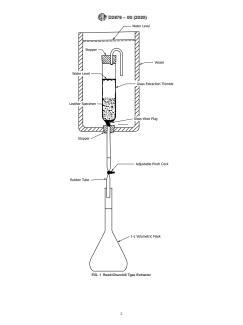
5.2 Extractor, Reed-Churchill Type —The extraction tube
mental practices and determine the applicability of regulatory
shall have an internal diameter of 45 6 2 mm and a length of
limitations prior to use.
233 6 10 mm. See Fig. 1.
1.4 This international standard was developed in accor-
dance with internationally recognized principles on standard- 5.3 WaterBath, equipped to control the temperature at 35 6
ization established in the Decision on Principles for the 0.5°C.
Development of International Standards, Guides and Recom-
5.4 CirculatingAirOven,capableofmaintainingatempera-
mendations issued by the World Trade Organization Technical
ture of 99 6 1°C.
Barriers to Trade (TBT) Committee.
6. Test Specimen
2. Referenced Documents
6.1 Thespecimenshallconsistofthe5-gleathersamplethat
2.1 ASTM Standards:
has been extracted with hexane as directed in Test Method
D3495 Test Method for Hexane Extraction of Leather
D3495.Anydeviationfromthissamplesizeshouldbeincluded
with the analytical results.
3. Summary of Test Method
7. Procedure
3.1 The test method gives the amount of water-soluble
7.1 Insert a plug of cotton or glass wool in the extraction
matter extracted from the leather at 35°C by 1 L of water in 3
tube before the specimen is added. Place the specimen in the
h. The leather is first freed of hexane-extractable material by
extraction tube, slurry, and extract at 35°C by adjusting the
flow to such a rate as to give 1 L of extract in 3 h. Cool the
extract to 23°C, adjust to volume, and thoroughly mix.
This test method is under the jurisdiction ofASTM Committee D31 on Leather
and is the direct responsibility of Subcommittee D31.01 on Vegetable Leather. This
7.2 If the extract is clear, pipet 100 mL into a tared
test method was developed in cooperation with the American Leather Chemists
crystallizing dish, evaporate and dry in a circulating air oven at
Assn. (Standard Method B8–1954).
Current edition approved Dec. 1, 2020. Published December 2020. Originally 99 6 1°C for 16 to 18 h, transfer to a desiccator, cool, and
approved in 1970. Last previous edition approved in 2016 as D2876– 00 (2016).
weigh.
DOI: 10.1520/D2876-00R20.
For referenced ASTM standards, visit the ASTM website, www.astm.org, or
contact ASTM Customer Service at service@astm.org. For Annual Book of ASTM Reed, H. C. and Churchill, J. B., “An Extractor for Water Soluble in Leather,”
Standards volume information, refer to the standard’s Document Summary page on Journal of the American Leather Chemists Association, JALCA, Vol 14, 1919, p.
the ASTM website. 137.
Copyright © ASTM International, 100 Barr Harbor Drive, PO Box C700, West Conshohocken, PA 19428-2959. United States
D2876 − 00 (2020)
FIG. 1 Reed-Churchill Type Extractor
D2876 − 00 (2020)
suspended in 100 mL of distilled water for 5 min, the suspension s
...