


ASTM C1847-21
(Specification)Standard Specification for Direct Buried Pre-Insulated and Jacketed Polyurethane Bonded Low Temperature Hot Water Piping Systems
Standard Specification for Direct Buried Pre-Insulated and Jacketed Polyurethane Bonded Low Temperature Hot Water Piping Systems
SCOPE
1.1 This specification covers direct buried underground pre-insulated, hot water piping systems with an upper temperature limit of 250 °F (121 °C) used to convey pressurized fluids for district heating. In the pre-insulated pipe industry and in this standard, this temperature range is called “low temperature hot water”.
1.2 This specification shall not be used for low-pressure steam systems, steam trap discharge or pressurized condensate systems, since there is a high risk of exceeding the upper temperature limits. Pumped condensate return lines that are vented to atmosphere are considered to be low temperature hot water and are acceptable for this application.
1.3 This specification covers only piping systems insulated and jacketed with bonded polyurethane (PUR) rigid foam. A piping system consists of both straight sections of pre-insulated piping as well as pre-insulated fittings and field closures of the insulation system, and all materials required to ensure a water tight insulation system which will preclude water from entering the insulation from the surrounding soil. This specification does not encompass insulating or jacketing materials, or insulation methods, which do not produce factory, pre-fabricated, insulated and jacketed units for assembly at the field site.
1.4 The insulated piping systems covered by this specification do not possess an air gap between the carrier pipe and the insulation nor between the insulation and jacket. For straight pipe sections of the piping systems covered by this specification, these three components are bonded together.
1.5 The carrier piping that is part of the insulated piping system covered by this specification shall be designed, fabricated, and tested to the requirements of ANSI/ASME B31.1 (Power Piping).
1.6 The values stated in inch-pound units are to be regarded as the standard. The values given in parentheses are mathematical conversions to SI units that are provided for information only and are not considered to be the standard.
1.7 This standard does not purport to address all of the safety concerns, if any, associated with its use. It is the responsibility of the user of this standard to establish appropriate safety, health, and environmental practices and determine the applicability of regulatory limitations prior to use.
1.8 This international standard was developed in accordance with internationally recognized principles on standardization established in the Decision on Principles for the Development of International Standards, Guides and Recommendations issued by the World Trade Organization Technical Barriers to Trade (TBT) Committee.
General Information
- Status
- Published
- Publication Date
- 30-Apr-2021
- Technical Committee
- C16 - Thermal Insulation
- Drafting Committee
- C16.40 - Insulation Systems
Relations
- Effective Date
- 15-Apr-2024
- Effective Date
- 15-Apr-2024
- Effective Date
- 01-Mar-2024
- Effective Date
- 01-Mar-2024
- Effective Date
- 01-Feb-2024
- Effective Date
- 01-Nov-2023
- Effective Date
- 01-Oct-2023
- Effective Date
- 15-Jul-2020
- Effective Date
- 01-Jan-2020
- Refers
ASTM A403/A403M-19a - Standard Specification for Wrought Austenitic Stainless Steel Piping Fittings - Effective Date
- 01-Nov-2019
- Effective Date
- 01-Nov-2019
- Effective Date
- 01-Aug-2019
- Effective Date
- 15-Apr-2019
- Refers
ASTM A403/A403M-19 - Standard Specification for Wrought Austenitic Stainless Steel Piping Fittings - Effective Date
- 01-Mar-2019
- Effective Date
- 01-Feb-2019
Overview
ASTM C1847-21: Standard Specification for Direct Buried Pre-Insulated and Jacketed Polyurethane Bonded Low Temperature Hot Water Piping Systems defines the requirements for underground, factory-fabricated, pre-insulated piping systems. These systems are specifically designed for conveying pressurized low temperature hot water (up to 250°F / 121°C) typically used in district heating applications. The standard encompasses systems where the carrier pipe, rigid polyurethane (PUR) foam insulation, and an outer protective jacket (typically HDPE or FRP) are factory-bonded into a single composite unit.
ASTM C1847-21 ensures optimal thermal efficiency, structural integrity, and long-term service life for buried piping in demanding environments. It does not apply to low-pressure steam or high-temperature condensate systems but does include pumped, vented condensate return lines.
Key Topics
Temperature Range and Application
Systems are rated for an upper temperature limit of 250°F (121°C), suitable for conveying low temperature hot water in district heating.Pipe System Construction
Covered piping systems must consist of:- Factory-applied, bonded rigid polyurethane foam insulation
- Protective jackets (HDPE or filament-wound fiberglass-reinforced polymer/FRP)
- Fully bonded assemblies without air gaps between pipe, insulation, and jacket
- Pre-insulated fittings and field closures
Carrier Pipe Requirements
Carrier pipes must comply with ANSI/ASME B31.1 (Power Piping) for design, fabrication, and testing. Materials compatible with service conditions, such as carbon steel or stainless steel, are permitted.Quality Control & Performance
Specifications include minimum insulation density, compressive strength, closed cell content, and aged thermal conductivity. Additionally, monthly process quality control is required for insulation thermal properties.Installation and Joint Integrity
Detailed instructions are provided for field closures to maintain water-tightness and system continuity. Only welded (steel/stainless) or brazed (copper) pressure-tested joints are accepted; mechanical or flexible joints with any leakage potential are prohibited.Inspection and Handling
The standard mandates inspection criteria for shipment, storage, and field repair of units to avoid system integrity compromise.
Applications
District Heating Systems
The primary use is for underground networks distributing pressurized low temperature hot water between central energy plants and buildings in campuses, municipalities, or industrial complexes.Underground Thermal Distribution
Applicable to any application requiring reliable, long-lasting, and energy-efficient underground thermal piping – such as hospital and university campuses, or residential developments.Pipe-in-Pipe Solutions
The system supports both straight lengths and complex networks using pre-insulated elbows, tees, and other fittings, providing custom-engineered routing for diverse project needs.Corrosion Protection
With its bonded PUR insulation and robust outer jackets, the system provides enhanced protection of carrier pipes against moisture ingress and soil contaminants.
Related Standards
- ASTM C168 – Terminology Relating to Thermal Insulation
- ASTM C335 / ISO 8497 – Test Methods for Heat Transfer Properties of Pipe Insulation
- ASTM D1621, D1622, D6226 – Rigid Cellular Plastics Test Methods
- ASTM D3350 – Polyethylene Plastics Pipe and Fittings Materials
- ANSI/ASME B31.1 – Power Piping Code
- NACE-RP-0394, SSPC-SP10 – Pipe Coating and Surface Preparation
These related ASTM and international standards support the technical framework for materials, testing, and system performance required by ASTM C1847-21, ensuring compatibility and compliance for pre-insulated, direct buried hot water piping systems.
Keywords: ASTM C1847-21, pre-insulated piping, polyurethane bonded insulation, underground hot water piping, district heating piping systems, thermal insulation standards, HDPE jacket, FRP jacket, direct buried piping, ANSI/ASME B31.1 compliant systems.
Get Certified
Connect with accredited certification bodies for this standard

Institut za varilstvo d.o.o. (Welding Institute)
Slovenia's leading welding institute since 1952. ISO 3834, EN 1090, pressure equipment certification, NDT personnel, welder qualification. Only IIW Au
Sponsored listings
Frequently Asked Questions
ASTM C1847-21 is a technical specification published by ASTM International. Its full title is "Standard Specification for Direct Buried Pre-Insulated and Jacketed Polyurethane Bonded Low Temperature Hot Water Piping Systems". This standard covers: SCOPE 1.1 This specification covers direct buried underground pre-insulated, hot water piping systems with an upper temperature limit of 250 °F (121 °C) used to convey pressurized fluids for district heating. In the pre-insulated pipe industry and in this standard, this temperature range is called “low temperature hot water”. 1.2 This specification shall not be used for low-pressure steam systems, steam trap discharge or pressurized condensate systems, since there is a high risk of exceeding the upper temperature limits. Pumped condensate return lines that are vented to atmosphere are considered to be low temperature hot water and are acceptable for this application. 1.3 This specification covers only piping systems insulated and jacketed with bonded polyurethane (PUR) rigid foam. A piping system consists of both straight sections of pre-insulated piping as well as pre-insulated fittings and field closures of the insulation system, and all materials required to ensure a water tight insulation system which will preclude water from entering the insulation from the surrounding soil. This specification does not encompass insulating or jacketing materials, or insulation methods, which do not produce factory, pre-fabricated, insulated and jacketed units for assembly at the field site. 1.4 The insulated piping systems covered by this specification do not possess an air gap between the carrier pipe and the insulation nor between the insulation and jacket. For straight pipe sections of the piping systems covered by this specification, these three components are bonded together. 1.5 The carrier piping that is part of the insulated piping system covered by this specification shall be designed, fabricated, and tested to the requirements of ANSI/ASME B31.1 (Power Piping). 1.6 The values stated in inch-pound units are to be regarded as the standard. The values given in parentheses are mathematical conversions to SI units that are provided for information only and are not considered to be the standard. 1.7 This standard does not purport to address all of the safety concerns, if any, associated with its use. It is the responsibility of the user of this standard to establish appropriate safety, health, and environmental practices and determine the applicability of regulatory limitations prior to use. 1.8 This international standard was developed in accordance with internationally recognized principles on standardization established in the Decision on Principles for the Development of International Standards, Guides and Recommendations issued by the World Trade Organization Technical Barriers to Trade (TBT) Committee.
SCOPE 1.1 This specification covers direct buried underground pre-insulated, hot water piping systems with an upper temperature limit of 250 °F (121 °C) used to convey pressurized fluids for district heating. In the pre-insulated pipe industry and in this standard, this temperature range is called “low temperature hot water”. 1.2 This specification shall not be used for low-pressure steam systems, steam trap discharge or pressurized condensate systems, since there is a high risk of exceeding the upper temperature limits. Pumped condensate return lines that are vented to atmosphere are considered to be low temperature hot water and are acceptable for this application. 1.3 This specification covers only piping systems insulated and jacketed with bonded polyurethane (PUR) rigid foam. A piping system consists of both straight sections of pre-insulated piping as well as pre-insulated fittings and field closures of the insulation system, and all materials required to ensure a water tight insulation system which will preclude water from entering the insulation from the surrounding soil. This specification does not encompass insulating or jacketing materials, or insulation methods, which do not produce factory, pre-fabricated, insulated and jacketed units for assembly at the field site. 1.4 The insulated piping systems covered by this specification do not possess an air gap between the carrier pipe and the insulation nor between the insulation and jacket. For straight pipe sections of the piping systems covered by this specification, these three components are bonded together. 1.5 The carrier piping that is part of the insulated piping system covered by this specification shall be designed, fabricated, and tested to the requirements of ANSI/ASME B31.1 (Power Piping). 1.6 The values stated in inch-pound units are to be regarded as the standard. The values given in parentheses are mathematical conversions to SI units that are provided for information only and are not considered to be the standard. 1.7 This standard does not purport to address all of the safety concerns, if any, associated with its use. It is the responsibility of the user of this standard to establish appropriate safety, health, and environmental practices and determine the applicability of regulatory limitations prior to use. 1.8 This international standard was developed in accordance with internationally recognized principles on standardization established in the Decision on Principles for the Development of International Standards, Guides and Recommendations issued by the World Trade Organization Technical Barriers to Trade (TBT) Committee.
ASTM C1847-21 is classified under the following ICS (International Classification for Standards) categories: 23.040.07 - Pipeline and its parts for district heat. The ICS classification helps identify the subject area and facilitates finding related standards.
ASTM C1847-21 has the following relationships with other standards: It is inter standard links to ASTM A105/A105M-24, ASTM C168-24, ASTM A53/A53M-24, ASTM A312/A312M-24, ASTM D883-24, ASTM D883-23, ASTM D2996-23, ASTM D1622-20, ASTM D883-20, ASTM A403/A403M-19a, ASTM A106/A106M-19a, ASTM D883-19c, ASTM D883-19a, ASTM A403/A403M-19, ASTM D883-19. Understanding these relationships helps ensure you are using the most current and applicable version of the standard.
ASTM C1847-21 is available in PDF format for immediate download after purchase. The document can be added to your cart and obtained through the secure checkout process. Digital delivery ensures instant access to the complete standard document.
Standards Content (Sample)
This international standard was developed in accordance with internationally recognized principles on standardization established in the Decision on Principles for the
Development of International Standards, Guides and Recommendations issued by the World Trade Organization Technical Barriers to Trade (TBT) Committee.
Designation:C1847 −21
Standard Specification for
Direct Buried Pre-Insulated and Jacketed Polyurethane
Bonded Low Temperature Hot Water Piping Systems
This standard is issued under the fixed designation C1847; the number immediately following the designation indicates the year of
original adoption or, in the case of revision, the year of last revision. A number in parentheses indicates the year of last reapproval. A
superscript epsilon (´) indicates an editorial change since the last revision or reapproval.
1. Scope cal conversions to SI units that are provided for information
only and are not considered to be the standard.
1.1 This specification covers direct buried underground
1.7 This standard does not purport to address all of the
pre-insulated, hot water piping systems with an upper tempera-
safety concerns, if any, associated with its use. It is the
ture limit of 250 °F (121 °C) used to convey pressurized fluids
responsibility of the user of this standard to establish appro-
for district heating. In the pre-insulated pipe industry and in
priate safety, health, and environmental practices and deter-
thisstandard,thistemperaturerangeiscalled“lowtemperature
mine the applicability of regulatory limitations prior to use.
hot water”.
1.8 This international standard was developed in accor-
1.2 This specification shall not be used for low-pressure
dance with internationally recognized principles on standard-
steam systems, steam trap discharge or pressurized condensate
ization established in the Decision on Principles for the
systems, since there is a high risk of exceeding the upper
Development of International Standards, Guides and Recom-
temperature limits. Pumped condensate return lines that are
mendations issued by the World Trade Organization Technical
vented to atmosphere are considered to be low temperature hot
Barriers to Trade (TBT) Committee.
water and are acceptable for this application.
1.3 This specification covers only piping systems insulated
2. Referenced Documents
and jacketed with bonded polyurethane (PUR) rigid foam. A
2.1 ASTM Standards:
pipingsystemconsistsofbothstraightsectionsofpre-insulated
A53/A53M Specification for Pipe, Steel, Black and Hot-
piping as well as pre-insulated fittings and field closures of the
Dipped, Zinc-Coated, Welded and Seamless
insulation system, and all materials required to ensure a water
A105/A105M Specification for Carbon Steel Forgings for
tightinsulationsystemwhichwillprecludewaterfromentering
Piping Applications
the insulation from the surrounding soil. This specification
A106/A106M Specification for Seamless Carbon Steel Pipe
does not encompass insulating or jacketing materials, or
for High-Temperature Service
insulation methods, which do not produce factory, pre-
A234/A234M Specification for Piping Fittings of Wrought
fabricated,insulatedandjacketedunitsforassemblyatthefield
Carbon Steel and Alloy Steel for Moderate and High
site.
Temperature Service
1.4 The insulated piping systems covered by this specifica-
A312/A312M Specification for Seamless, Welded, and
tion do not possess an air gap between the carrier pipe and the
Heavily Cold Worked Austenitic Stainless Steel Pipes
insulation nor between the insulation and jacket. For straight
A403/A403M SpecificationforWroughtAusteniticStainless
pipe sections of the piping systems covered by this
Steel Piping Fittings
specification, these three components are bonded together.
B88 Specification for Seamless Copper Water Tube
C168 Terminology Relating to Thermal Insulation
1.5 The carrier piping that is part of the insulated piping
C335 Test Method for Steady-State Heat Transfer Properties
system covered by this specification shall be designed,
of Pipe Insulation
fabricated, and tested to the requirements of ANSI/ASME
C518 Test Method for Steady-State Thermal Transmission
B31.1 (Power Piping).
Properties by Means of the Heat Flow Meter Apparatus
1.6 The values stated in inch-pound units are to be regarded
C1409 Guide for Measuring and Estimating Quantities of
asthestandard.Thevaluesgiveninparenthesesaremathemati-
Insulated Piping and Components
This specification is under the jurisdiction of ASTM Committee C16 on
Thermal Insulation and is the direct responsibility of Subcommittee C16.40 on For referenced ASTM standards, visit the ASTM website, www.astm.org, or
Insulation Systems. contact ASTM Customer Service at service@astm.org. For Annual Book of ASTM
Current edition approved May 1, 2021. Published June 2021. DOI: 10.1520/ Standards volume information, refer to the standard’s Document Summary page on
C1847-21. the ASTM website.
Copyright © ASTM International, 100 Barr Harbor Drive, PO Box C700, West Conshohocken, PA 19428-2959. United States
C1847−21
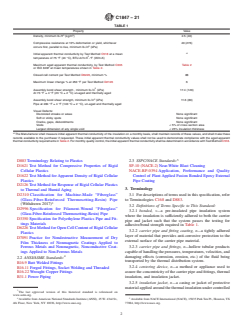
TABLE 1
Property Value
3 3
Density, minimum lb./ft (kg/m ) 2.5 (40)
Compressive resistance at 10% deformation or yield, whichever 40 (276)
occurs first, parallel to rise, minimum lb./in (kPa)
A
Initial apparent thermal conductivity by Test Method C518 at a mean
temperature of 75 °F (24 °C), BTU-in/hr-ft -°F (W/m-K)
Maximum aged apparent thermal conductivity, by Test Method C335 Table 2
or ISO 8497 at mean temperatures shown in Table 2.
Closed cell content per Test Method D6226, minimum % 88
Maximum linear change % at 250 °F per Test Method D2126 6
Assembly bond shear strength , minimum lb./in (kPa) 17.4 (120)
At73°F±4°F(23°C±2°C)un-aged and thermally aged
Assembly bond shear strength, minimum lb./in (kPa) 11.6 (80)
Pipeat284°F±4°F(140°C±2°C),un-aged and thermally aged
Visual Defects:
Discolored streaks or areas None significant
Soft or sticky spots None significant
Cracks, gaps, disbondments None significant
Voids < 5% of cross section area
Largest dimension of any single void < 25% insulation thickness
A
The Manufacturer shall measure initial apparent thermal conductivity of the insulation on a monthly basis, shall maintain records of these values, and shall make these
records available to the purchaser if requested. These initial apparent thermal conductivity values shall not be used to demonstrate compliance with the aged apparent
thermalconductivityrequirementsinTable2.Formonthlyqualitycontrol,theinitialapparentthermalconductivityshallbedeterminedinaccordancewithTestMethodC518.
D883 Terminology Relating to Plastics 2.3 SSPC/NACE Standards:
D1621 Test Method for Compressive Properties of Rigid SP-10 (NACE-2) Near-White Blast Cleaning
Cellular Plastics NACE-RP-0394 Application, Performance and Quality
D1622 Test Method for Apparent Density of Rigid Cellular Control of Plant Applied Fusion Bonded Epoxy External
Plastics Pipe Coating
D2126 Test Method for Response of Rigid Cellular Plastics
3. Terminology
to Thermal and Humid Aging
D2310 Classification for Machine-Made “Fiberglass” 3.1 For descriptions of terms used in this specification, refer
(Glass-Fiber-Reinforced Thermosetting-Resin) Pipe
to Terminologies C168 and D883.
(Withdrawn 2017)
3.2 Definitions of Terms Specific to This Standard:
D2996 Specification for Filament-Wound “Fiberglass”
3.2.1 bonded, v—a pre-insulated pipe insulation system
(Glass-Fiber-Reinforced Thermosetting-Resin) Pipe
where the insulation is sufficiently adhered to both the carrier
D3350 Specification for Polyethylene Plastics Pipe and Fit-
pipe and jacket such that the system passes the testing for
tings Materials
adhesive/bond strength required in Table 1.
D6226 Test Method for Open Cell Content of Rigid Cellular
3.2.2 carrier pipe and fitting coating, n—a tightly adhered
Plastics
layer of material that provides anti-corrosive protection to the
D7091 Practice for Nondestructive Measurement of Dry
external surface of the carrier pipe material.
Film Thickness of Nonmagnetic Coatings Applied to
3.2.3 carrier pipe and fittings, n—hollow tubular products
Ferrous Metals and Nonmagnetic, Nonconductive Coat-
capable of handling the pressures, temperatures, velocities, and
ings Applied to Non-Ferrous Metals
damaging effects (corrosion, erosion, etc.) of the fluid being
2.2 ANSI/ASME Standards:
transported by the thermal distribution system.
B16.9 Butt Welded Fittings
B16.11 Forged Fittings, Socket Welding and Threaded 3.2.4 centering device, n—a method or appliance used to
assure the concentricity of the carrier pipe and fittings, thermal
B16.22 Wrought Copper Fittings
B31.1 Power Piping insulation, and insulation jacket.
3.2.5 insulation jacket, n—a casing or jacket of protective
materialappliedaroundthethermalinsulationundercontrolled
The last approved version of this historical standard is referenced on
www.astm.org.
4 5
Available fromAmerican National Standards Institute (ANSI), 25 W. 43rd St., Available from NACE International (NACE), 15835 ParkTen Pl., Houston,TX
4th Floor, New York, NY 10036, http://www.ansi.org. 77084, http://www.nace.org.
C1847−21
conditionsatthetimeandlocationofapplicationofthethermal 4.1.12 Shipping method if other than specified (see Section
system component thermal insulation. 18).
3.2.6 jacket outside diameter, n—the sum of the carrier pipe
4.2 Order quantities for thermal distribution systems pur-
outside diameter and twice the sum of the optional carrier pipe
chased under this specification shall be specified by providing
dry film coating thickness, insulation thickness, and jacket
all necessary point to point layout dimensional information,
thickness.
including slopes, termination points, direction changes, expan-
sion loops, and all unique components and features. Thermal
3.2.7 joining, v—a method of connecting together two units
distribution systems purchased by this method are then pro-
of the thermal distribution system that maintains the strength
vided as a fully engineered and pre-fabricated system com-
and fluid tightness of the carrier pipe and fittings and the
prised of units and joining materials that minimize installation
continuity and integrity of the insulation and jacket.
time and the number of field joints required to complete the
3.2.8 leakage-free joint, n—a group of methods for joining
system.
carrier piping sections and components using welding for steel
4.3 Order quantities for thermal distribution systems pur-
and stainless steel, and brazing for copper that create rigid,
chased under this specification are in some cases specified by
pressure testable joints with zero leakage.
unit count. System orders under this method must be agreed
3.2.8.1 Discussion—All other joint types, including me-
between purchaser and supplier as to definitions and dimen-
chanical joints such as bell and spigot joints, sliding joints, and
sionsofsystemunits,components,andmaterials.GuideC1409
deformable gasket type joints are specifically not considered to
is a useful guide for reaching agreement on layout measure-
be leakage-free and do not meet the requirement of this
ment methods, unit and component definitions, and terminol-
standard.
ogy. Thermal distribution systems purchased by this method
3.2.9 pre-insulated, adj—thermal insulation applied to the
require cutting standard unit lengths to size at least once in
carrier pipe and fittings at the system supplier’s manufacturing
each run length and in most situations will result in a higher
facilities.
number of field joints, lower quality of the installation, and
3.2.9.1 Discussion—Thermal insulation applied at or near
longer installation times.
the system installation site by an installer or other organization
not engaged in manufacturing pre-insulated system compo-
5. Materials and Manufacture
nents does not conform to this definition.
5.1 Carrier Pipe and Pipe Fitting Materials—Carrier pipe
3.2.10 vapor(water)stop,n—adeviceormethodusedatthe
and carrier pipe fitting material shall be selected from those
terminations of a thermal distribution system (such as building
materials listed in Annex A1 and shall meet the statutory and
and manhole entries) that prevent the ingress of water into the
code requirements for design and service appropriate for the
thermal insulation; alternatively a device or method that seals
fluid temperature, pressure, longevity, chemical compatibility,
the ends of individual thermal distribution system units.
and resistance to the damaging effects of corrosion.
5.2 Optional Coating of Carbon Steel Carrier Pipe and
4. Ordering Information
Fittings—When carbon steel carrier pipe and fitting materials
4.1 Orders for thermal distribution systems purchased under
have been specified, they are in some cases coated, as an
this specification shall include the following information:
option, to enhance corrosion resistance and service life. When
4.1.1 Thermal system service pressure, temperature and
this option has been ordered by the purchaser, the steel pipe
transported fluids.
and fitting outside surfaces shall be prepared by abrasive
4.1.2 Insulation thickness or heat transfer losses (or gains)
blasting to near white condition in accordance with SSPC-
per unit length of carrier pipe required, and the system
SP10 and primed or coated without delay to prevent the
environmental conditions that apply such as burial depth, soil
formationofrustbloom.Thecoatingmaterialslistedbeloware
conditions, and soil temperatures, etc.
effective when applied by suitable spray techniques to the
4.1.3 Statutory or code requirements applicable to the car-
minimum thicknesses indicated.The dry film coating thickness
rier piping system design, fabrication, testing, inspection, and
shall be determined in accordance with Practice D7091.
installation (see Annex A1).
5.2.1 Epoxy Coating, shall typically be a two part system
4.1.4 Carrier pipe and fitting material specification and
consisting of a base material and curing agent (hardener).
grade, size, pressure rating or wall thickness, configuration and
Factory applied fusion bonded epoxy to the requirements of
end preparations (see Annex A1).
NACE-RP-0394 is also acceptable. Dry film coating thickness
4.1.5 Optional carrier pipe and fitting coatings (see 5.2).
shall be a minimum of 0.008 in. (200 µm).
4.1.6 Thermal insulation material (see 5.3).
5.2.2 Zinc Rich Coating, shall be a high solids, inorganic
4.1.7 Thermal insulation jacket material (see 5.4).
material consisting of a liquid vehicle and dry powdered zinc
4.1.8 Physical sizes and dimensions (see Section 7).
flake. Dry film coating thickness shall be a minimum of 0.003
4.1.9 Field closure joint preferences (see Section 8).
in. (76 µm).
4.1.10 Certification, inspection and testing requirements in
5.2.3 Polymer Coating, shall be an elastomeric polymer
addition to those specified (see Section 15).
(plastic) usually consisting of polyurethane, polyurea, or a
4.1.11 Unit marking in addition to those specified (see blend of both. Dry film coating thickness shall be a minimum
Sections 16 and 17). of 0.020 in. (500 µm).
C1847−21
5.2.4 The coating selected and applied shall have been system installers, the purchaser shall specify alternate end
shown to be capable of withstanding the service temperature conditions and tolerance.
over the system life which is to be taken as 20 years unless
5.5.2 Units shall be free of bulges that exceed the nominal
otherwise specified. The coating selected shall be applied in
outside diameter by 5% or 1.0 in. (25 mm), whichever is less.
compliance with the coating manufacturer’s directions.
Flatspotsorareasofoutsidediameterreduction(necking)shall
not deviate from the nominal outside diameter by more than
5.3 Thermal Insulation Materials—The thermal insulation
5% or 0.5 in. (13 mm), whichever is less.
shall be of closed cell, rigid, polyurethane (PUR) foam applied
bysprayorbyinjection.ThePURshallbefreeofcolorstreaks,
5.6 Pipe Fitting Units—Pipe fitting units manufactured to
voids, cracks or gaps, soft spots, or other visual defects. The
this specification shall meet the following requirements:
PUR insulation shall be bonded to the carrier pipe or optional
5.6.1 Both ends of the units shall be free of insulation and
coating to which it has been applied, and to the outer jacket.
insulationjacketmaterialforadistanceof6.0 61.0in.(150 6
Open cell or un-bonded insulations do not meet the require-
25 mm) to facilitate welding of the carrier pipe field joints
ments of this specification.
without damage to the insulation system. When special weld-
ing equipment is to be used by the purchaser or by purchaser’s
5.4 Thermal Insulation Jacket Materials—The thermal in-
system installers, the purchaser shall specify alternate end
sulation jacket shall be either high density polyethylene
conditions and tolerance.
(HDPE) in accordance with 5.4.1 or filament wound, fiberglass
5.6.2 Due to the complex shapes characteristic of pipe
reinforced polymer (FRP) in accordance with 5.4.2.
5.4.1 HDPE insulation jacket material shall meet the re- fittings such as “tees”, reducers, and elbows, the insulation is
optionally applied by building up sections of rigid foam or by
quirements of Specification D3350, with a minimum cell
classification per Table 1 of Specification D3350 of PE injection conforming to the requirements of section 5.3.
Regardless of method, all interstitial spaces and gaps created
345444C. The HDPE jacket shall be applied by continuous
extrusion or by fitting a tube of HDPE over the carrier pipe during build-up or injection shall be filled with foam. No voids
or gaps are permitted.
with centering devices prior to injecting the annular space with
foam insulation. Both jacketing methods must provide perma-
5.6.3 The thermal insulation jackets of pipe fitting units
nent concentricity, within 15% of the insulation thickness, of shall be either high density polyethylene (HDPE) in accor-
carrierpipe,insulationandHDPEjacketandbefullybondedto dance with 5.4.1 or fiberglass reinforced polymer (FRP) in
the insulation without gaps or voids. accordance with 5.4.2, and shall match the jacket material of
5.4.2 FRP insulation-jacket material shall be applied di- the straight units. HDPE insulation jackets are in some cases
rectly to the thermal insulation by machine filament winding, formed using built up sections, or by integral jackets produced
bychoppedfilamentspray-uptechniques,orbyfittingatubeof by rotational molding or other methods that produce a single
FRP pipe over the carrier pipe with centering devices prior to unitinsulationjacketthatconformsto5.4.1.Whenthebuild-up
injecting the annular space with foam insulation. method is used, the sections of HDPE jacket shall be joined by
5.4.3 Both jacketing methods must provide permanent reinforced extrusion welds. Tapes, hot air welds, or shrink
concentricity, within 15% of the insulation thickness, of carrier products are not permitted.
pipe, insulation and FRP jacket and be fully bonded to the
insulationwithoutgapsorvoids.FRPpipe,whenused,shallbe
6. Performance Requirements
in accordance with Specification D2996 and Classification
6.1 The units of the thermal distribution system shall be
D2310. All fittings shall be either a hand lay-up or chopped
pre-insulated and supplied as a complete and compatible
filamentspray-upandhavethesamethicknessandstandardsas
system to assure all components will be joined in accordance
the FRP jacket.
with the manufacturer’s procedures.
5.4.4 PVC jacket materials are not allowed. Tape type
6.2 The PUR shall meet the physical and thermal require-
products constructed from any material are not permitted.
ments of Table 1 and Table 2.
5.5 Straight Pipe Units—Straight pipe units manufactured
to this specification shall meet the following requirements: 6.3 Insulation testing for process quality control shall be
5.5.1 Both ends of the units shall be free of insulation and carried out on a monthly basis to ensure properties are in
insulationjacketmaterialforadistanceof6.0 61.0in.(150 6 accordance with this specification. Specimens shall be taken
25 mm) to facilitate welding of the carrier pipe field joints from production units. Laboratory or specially prepared speci-
without damage to the insulation system. When special weld- mens do not comply with this specification except as noted in
ing equipment is to be used by the purchaser or by purchaser’s 6.3.3.
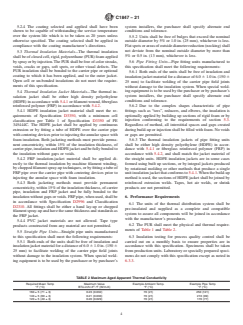
TABLE 2 Maximum Aged Apparent Thermal Conductivity
Required Mean Temp Maximum Value Example Ambient Temp. Example Pipe Temp
°F (°C) BTU-in/hr-ft -°F (W/m-K) °F (°C) °F (°C)
160±5(71±3) 0.23(0.032) 70 (21) 250 (121)
140±5(60±3) 0.21(0.030) 70 (21) 210 (99)
120±5(49±3) 0.20(0.029) 70 (21) 170 (77)
C1847−21
TABLE 3
6.3.1 Density shall be determined in accordance with Test
Method D1622. Nominal Carrier Minimum Insulation Target Insulation
Pipe Size Thickness Thickness
6.3.2 Compressive strength shall be determined in accor-
inches (mm) inches (mm) inches (mm)
dance with Test Method D1621.
1–6(25– 168) 1.35 (34) 1.5 (38)
6.3.3 Initial apparent thermal conductivity shall be deter-
8 – 14 (219 – 355) 1.8 (46) 2.0 (50)
16 – 36 (406 – 915) 2.25 (57) 2.5 (63)
mined at a mean temperature of 75 °F (24 °C) in accordance
with Test Method C518. For this test it is acceptable to make
the required flat samples by spraying or injecting the PUR onto
a flat surface. The resulting values are for manufacturing
thermal analysis and references to sources of methods. The
quality control purposes only per the footnote to Table 1.
additionalinsulationthicknessfordirectburiedsystems,ifany,
6.3.4 Closed cell content shall be determined in accordance
will depend on the thermal properties of the soil as determined
with Test Method D6226, and shall be the volume occupied by
by type classification, density and moisture content. Climato-
the closed cells and cell walls. It is not necessary to make the
logical factors at the installation site, system burial depth,
correction for surface cells opened by cutting that is described
operating temperature and other factors will in some cases also
in Appendix XI of Test Method D6226.
impact the appropriate insulation thickness. Heat transfer
6.3.5 Other physical or thermal properties are in some cases
calculations for the buried system shall follow the procedure
required, as agreed upon between purchaser and manufacturer.
outlined in the District Heating and Cooling Chapter of the
6.4 Qualification testing shall be carried out initially and
ASHRAE HVAC Systems and Equipment Handbook.
then every three (3) years thereafter and when a change in the
7.2 HDPE jacket thicknesses shall be as in Table 4.
manufacturing process, methods, or a material supplier has
occurred. All testing shall be carried out by an independent
7.3 FRP jacket thicknesses shall be as in Table 5.
laboratory accredited by a national or international accredita-
8. Other Requirements
tion agency. A report from the independent laboratory with its
certification of the results must be provided complete and in
8.1 Joining—The most critical parts of thermal distribution
unedited form. The report from the independent laboratory
system installations are the joints, whether they are factory
shall be made available to the Purchaser upon request. The
made or field installed, where carrier pipe, insulation, and
reportoftheindependentlaboratorywillcontainallrawdataas
jacket continuity and moisture tightness must be maintained.
well as calculated quantities along with photographic evidence
All joining material and methods shall be supplied by the
of test set up and test results. The following qualification
thermal distribution system manufacturer or if purchased
testing is to be conducted:
separately from other sources, the field joint materials must
6.4.1 Axialshearstrengthofthebondedpipeassemblyshall
conform to the requirements and installation instructions rec-
be tested in accordance with the test method of Annex A2 in
ommended by the thermal distribution system manufacturer.
both the thermally aged and un-aged conditions.
8.1.1 Carrier pipe joints, for the carrier pipe and fitting
6.4.2 Thermal conductivity shall be tested after aging. The
materials of A1.2 and A1.3 shall be made in strict accordance
aging process shall be accomplished by placing the entire pipe
totherequirementsofthepressurepipecodesofASMEB31.1.
assembly in a heated chamber held at 195 °F 6 2 °F (91 °C 6
Nojointsshallbeallowedwithinpre-insulatedstraightsections
2 °C) for 150 days. Before the aging begins the exposed ends
of pipe.
of the insulation shall be sealed to prevent diffusion of the cell
8.1.2 Only welded or brazed joints of the carrier piping are
gases. The pipe samples shall be 3 in. diameter pipe with
allowed. Bell and spigot joints, sliding joints, flexible gasket
minimum insulation thickness of 1.5 in.The pipe samples shall
joints, or other types of mechanical joints that have allowable
be tested in accordance with Test Method C335 or ISO 8497
leakage rates greater than zero are not permitted.
using the guarded end method. The test shall be run to obtain
8.1.3 Copper joints shall be made by silver brazing with an
apparent thermal conductivities at a minimum of three mean
alloy with a melt temperature of at least 1100 °F (593 °C).
temperatures. Table 2 shows required values for mean tem-
Tin-lead solders do not meet the requirements of this specifi-
perature and apparent thermal conductivity, and examples of
cation.
ambient and pipe temperatures for achieving these values.
8.1.4 All carrier pipe joint strength and tightness testing,
6.4.3 Dimensional stability shall be conducted in accor-
both factory and field performed, shall be in accordance with
dancewithTestMethodD2126at250°F(121°C).Acceptance
ASME B31.1 and shall be conducted and passed prior to the
criteria are in Table 1.
7. Physical Sizes and Dimensions TABLE 4
Minimum HDPE Target HDPE
7.1 For low temperature hot water service, the PUR insula-
Jacket OD
Jacket Thickness Jacket Thickness
inches (mm)
tion shall be applied to the minimum thicknesses in Table 3.
inches (mm) inches (mm)
Thethicknesstoleranceontheminimumsideshallnotbemore
OD# 10 (254) 0.143 (3.6) 0.150 (3.8)
than 10%. Higher than normal energy costs or special services 10 (254)< OD# 18 (457) 0.166 (4.2) 0.175 (4.4)
18 (457)< OD# 24 (610) 0.190 (4.8) 0.200 (5.1)
requireananalysisofsystemheattransferbythepurchaser’sor
24(610)< OD# 30 (762) 0.238 (6.0) 0.250 (6.4)
manufacturer’sengineerstodeterminetheadditionalinsulation
O
...
Questions, Comments and Discussion
Ask us and Technical Secretary will try to provide an answer. You can facilitate discussion about the standard in here.
Loading comments...