

ASTM A772/A772M-00(2022)
(Test Method)Standard Test Method for AC Magnetic Permeability of Materials Using Sinusoidal Current
General Information
- Abstract
SIGNIFICANCE AND USE
4.1 The permeability determined by this method is the impedance permeability. Impedance permeability is the ratio of the peak value of flux density (Bmax) to the assumed peak magnetic field strength (Hz) without regard to phase. As compared to testing under sinusoidal flux (sinusoidal B) conditions, the permeabilities determined by this method are numerically lower since, for a given test signal frequency, the rate of flux change (dB/dt) is higher.
4.2 This test method is suitable for impedance permeability measurements at very low magnetic inductions at power frequencies (50 Hz to 60 Hz) to moderate inductions below the point of maximum permeability of the material (the knee of the magnetization curve) or until there is visible distortion of the current waveform. The lower limit is a function of sample area, secondary turns, and the sensitivity of the flux-reading voltmeter used. At higher inductions, measurements of flux-generated voltages that are appreciably distorted mean that the flux has appreciable harmonic frequency components. The upper limit is given by the availability of pure sinusoidal current, which is a function of the power source. In addition, a large ratio (≥10) of the total series resistance of the primary circuit to the primary coil impedance is required. With proper test apparatus, this test method is suitable for use at frequencies up to 1 MHz.
4.3 This test method is suitable for design, specification acceptance, service evaluation, quality control, and research use.
SCOPE
1.1 This test method provides a means for determination of the impedance permeability (μz) of ferromagnetic materials under the condition of sinusoidal current (sinusoidal H) excitation. Test specimens in the form of laminated toroidal cores, tape-wound toroidal cores, and link-type laminated cores having uniform cross sections and closed flux paths (no air gaps) are used. The method is intended as a means for determining the magnetic performance of ferromagnetic strip having a thickness less than or equal to 0.025 in. [0.635 mm].
1.2 This test method shall be used in conjunction with those applicable paragraphs in Practice A34/A34M.
1.3 The values and equations stated in customary (cgs-emu and inch-pound) or SI units are to be regarded separately as standard. Within this standard, SI units are shown in brackets except for the sections concerning calculations where there are separate sections for the respective unit systems. The values stated in each system may not be exact equivalents; therefore, each system shall be used independently of the other. Combining values from the two systems may result in nonconformance with this standard.
1.4 This standard does not purport to address all of the safety concerns, if any, associated with its use. It is the responsibility of the user of this standard to establish appropriate safety, health, and environmental practices and determine the applicability of regulatory limitations prior to use.
1.5 This international standard was developed in accordance with internationally recognized principles on standardization established in the Decision on Principles for the Development of International Standards, Guides and Recommendations issued by the World Trade Organization Technical Barriers to Trade (TBT) Committee.
- Status
- Published
- Publication Date
- 30-Sep-2022
- Technical Committee
- A06 - Magnetic Properties
- Drafting Committee
- A06.01 - Test Methods

Overview
ASTM A772/A772M-00(2022), "Standard Test Method for AC Magnetic Permeability of Materials Using Sinusoidal Current," establishes procedures for measuring the impedance permeability of ferromagnetic materials. Released by ASTM International, this standard is specifically designed to evaluate materials subjected to sinusoidal current using test specimens such as laminated toroidal cores, tape-wound toroidal cores, and link-type laminated cores. The method is applicable for ferromagnetic strips with thicknesses less than or equal to 0.025 in. [0.635 mm] and is intended as a means to determine key magnetic properties for quality control, research, performance evaluation, and specification compliance.
Key Topics
- Impedance Permeability Measurement: The standard focuses on determining impedance permeability (μz), defined as the ratio of the peak value of magnetic flux density (Bmax) to the assumed peak magnetic field strength (Hz) under sinusoidal current excitation.
- Test Frequency Range: Suitable for measurements at power frequencies (50 Hz to 60 Hz), with applicability extending up to 1 MHz using appropriate test equipment and procedures.
- Specimen Types: Utilizes laminated toroidal, tape-wound toroidal, and link-type laminated cores, specifically those with uniform cross sections and closed flux paths.
- Test Preparation: Encompasses procedures for specimen preparation, demagnetization, and connecting primary and secondary windings to minimize measurement inaccuracies.
- Calculation Methods: Provides equations and procedures for computing mean magnetic path length, cross-sectional area, magnetic field strength, and permeability in both customary and SI units.
- Measurement Limitations: Emphasizes the requirement for a high total series resistance to primary coil impedance ratio (≥10) and the importance of maintaining pure sinusoidal current for accurate results.
- Safety and Compliance: Stresses the user’s responsibility to institute proper safety, health, and environmental practices, and addresses compliance with international standardization principles.
Applications
- Material Design and Research: Used to characterize the magnetic properties of ferromagnetic material strips during new material development and applied research.
- Specification Acceptance: Serves as a basis for acceptance testing of magnetic materials against industry or customer specifications.
- Quality Control: Facilitates routine verification of material batches to ensure compliance with required magnetic performance thresholds.
- Service Evaluation: Assesses the suitability of materials for applications such as electrical transformers, inductors, and other components where magnetic permeability is critical.
- Standardized Reporting: Ensures comparability and reproducibility of results through standardized test setups and calculation protocols.
Related Standards
- ASTM A34/A34M: Practice for Sampling and Procurement Testing of Magnetic Materials, which guides sample preparation and procurement for magnetic testing activities.
- ASTM A340: Terminology of Symbols and Definitions Relating to Magnetic Testing, a reference for terminology and symbol usage across related standards.
- International Principles: This standard is developed in alignment with principles established by the World Trade Organization Technical Barriers to Trade (TBT) Committee, supporting harmonization and international acceptance.
Keywords: ASTM A772, AC magnetic permeability, sinusoidal current test, impedance permeability, ferromagnetic materials, laminated toroidal cores, magnetic properties testing, quality control, SI and inch-pound units, standard test method.
For more information or to obtain the full standard, visit the ASTM website.
Relations
- Effective Date
- 01-Dec-2023
- Effective Date
- 15-Oct-2019
- Effective Date
- 15-Jun-2019
- Effective Date
- 15-Feb-2019
- Effective Date
- 01-Jun-2018
- Effective Date
- 15-Oct-2017
- Effective Date
- 01-Jul-2017
- Effective Date
- 01-May-2016
- Effective Date
- 01-May-2016
- Effective Date
- 01-Oct-2015
- Effective Date
- 01-Oct-2014
- Effective Date
- 01-Nov-2012
- Refers
ASTM A340-03a(2011) - Standard Terminology of Symbols and Definitions Relating to Magnetic Testing - Effective Date
- 01-May-2011
- Refers
ASTM A34/A34M-06 - Standard Practice for Sampling and Procurement Testing of Magnetic Materials - Effective Date
- 01-Nov-2006
- Effective Date
- 10-Jun-2003
Get Certified
Connect with accredited certification bodies for this standard

IMQ S.p.A. (Certification)
Italian electrical product certification.

SLG Prüf- und Zertifizierungs GmbH
German testing and certification body.

UL Solutions
Global safety science company with testing, inspection and certification.
Sponsored listings
Frequently Asked Questions
ASTM A772/A772M-00(2022) is a standard published by ASTM International. Its full title is "Standard Test Method for AC Magnetic Permeability of Materials Using Sinusoidal Current". This standard covers: SIGNIFICANCE AND USE 4.1 The permeability determined by this method is the impedance permeability. Impedance permeability is the ratio of the peak value of flux density (Bmax) to the assumed peak magnetic field strength (Hz) without regard to phase. As compared to testing under sinusoidal flux (sinusoidal B) conditions, the permeabilities determined by this method are numerically lower since, for a given test signal frequency, the rate of flux change (dB/dt) is higher. 4.2 This test method is suitable for impedance permeability measurements at very low magnetic inductions at power frequencies (50 Hz to 60 Hz) to moderate inductions below the point of maximum permeability of the material (the knee of the magnetization curve) or until there is visible distortion of the current waveform. The lower limit is a function of sample area, secondary turns, and the sensitivity of the flux-reading voltmeter used. At higher inductions, measurements of flux-generated voltages that are appreciably distorted mean that the flux has appreciable harmonic frequency components. The upper limit is given by the availability of pure sinusoidal current, which is a function of the power source. In addition, a large ratio (≥10) of the total series resistance of the primary circuit to the primary coil impedance is required. With proper test apparatus, this test method is suitable for use at frequencies up to 1 MHz. 4.3 This test method is suitable for design, specification acceptance, service evaluation, quality control, and research use. SCOPE 1.1 This test method provides a means for determination of the impedance permeability (μz) of ferromagnetic materials under the condition of sinusoidal current (sinusoidal H) excitation. Test specimens in the form of laminated toroidal cores, tape-wound toroidal cores, and link-type laminated cores having uniform cross sections and closed flux paths (no air gaps) are used. The method is intended as a means for determining the magnetic performance of ferromagnetic strip having a thickness less than or equal to 0.025 in. [0.635 mm]. 1.2 This test method shall be used in conjunction with those applicable paragraphs in Practice A34/A34M. 1.3 The values and equations stated in customary (cgs-emu and inch-pound) or SI units are to be regarded separately as standard. Within this standard, SI units are shown in brackets except for the sections concerning calculations where there are separate sections for the respective unit systems. The values stated in each system may not be exact equivalents; therefore, each system shall be used independently of the other. Combining values from the two systems may result in nonconformance with this standard. 1.4 This standard does not purport to address all of the safety concerns, if any, associated with its use. It is the responsibility of the user of this standard to establish appropriate safety, health, and environmental practices and determine the applicability of regulatory limitations prior to use. 1.5 This international standard was developed in accordance with internationally recognized principles on standardization established in the Decision on Principles for the Development of International Standards, Guides and Recommendations issued by the World Trade Organization Technical Barriers to Trade (TBT) Committee.
SIGNIFICANCE AND USE 4.1 The permeability determined by this method is the impedance permeability. Impedance permeability is the ratio of the peak value of flux density (Bmax) to the assumed peak magnetic field strength (Hz) without regard to phase. As compared to testing under sinusoidal flux (sinusoidal B) conditions, the permeabilities determined by this method are numerically lower since, for a given test signal frequency, the rate of flux change (dB/dt) is higher. 4.2 This test method is suitable for impedance permeability measurements at very low magnetic inductions at power frequencies (50 Hz to 60 Hz) to moderate inductions below the point of maximum permeability of the material (the knee of the magnetization curve) or until there is visible distortion of the current waveform. The lower limit is a function of sample area, secondary turns, and the sensitivity of the flux-reading voltmeter used. At higher inductions, measurements of flux-generated voltages that are appreciably distorted mean that the flux has appreciable harmonic frequency components. The upper limit is given by the availability of pure sinusoidal current, which is a function of the power source. In addition, a large ratio (≥10) of the total series resistance of the primary circuit to the primary coil impedance is required. With proper test apparatus, this test method is suitable for use at frequencies up to 1 MHz. 4.3 This test method is suitable for design, specification acceptance, service evaluation, quality control, and research use. SCOPE 1.1 This test method provides a means for determination of the impedance permeability (μz) of ferromagnetic materials under the condition of sinusoidal current (sinusoidal H) excitation. Test specimens in the form of laminated toroidal cores, tape-wound toroidal cores, and link-type laminated cores having uniform cross sections and closed flux paths (no air gaps) are used. The method is intended as a means for determining the magnetic performance of ferromagnetic strip having a thickness less than or equal to 0.025 in. [0.635 mm]. 1.2 This test method shall be used in conjunction with those applicable paragraphs in Practice A34/A34M. 1.3 The values and equations stated in customary (cgs-emu and inch-pound) or SI units are to be regarded separately as standard. Within this standard, SI units are shown in brackets except for the sections concerning calculations where there are separate sections for the respective unit systems. The values stated in each system may not be exact equivalents; therefore, each system shall be used independently of the other. Combining values from the two systems may result in nonconformance with this standard. 1.4 This standard does not purport to address all of the safety concerns, if any, associated with its use. It is the responsibility of the user of this standard to establish appropriate safety, health, and environmental practices and determine the applicability of regulatory limitations prior to use. 1.5 This international standard was developed in accordance with internationally recognized principles on standardization established in the Decision on Principles for the Development of International Standards, Guides and Recommendations issued by the World Trade Organization Technical Barriers to Trade (TBT) Committee.
ASTM A772/A772M-00(2022) is classified under the following ICS (International Classification for Standards) categories: 29.030 - Magnetic materials. The ICS classification helps identify the subject area and facilitates finding related standards.
ASTM A772/A772M-00(2022) has the following relationships with other standards: It is inter standard links to ASTM A340-23a, ASTM A340-19b, ASTM A340-19a, ASTM A340-19, ASTM A340-18, ASTM A340-17a, ASTM A340-17, ASTM A340-16, ASTM A340-16e1, ASTM A340-15, ASTM A340-14, ASTM A34/A34M-06(2012), ASTM A340-03a(2011), ASTM A34/A34M-06, ASTM A340-03a. Understanding these relationships helps ensure you are using the most current and applicable version of the standard.
ASTM A772/A772M-00(2022) is available in PDF format for immediate download after purchase. The document can be added to your cart and obtained through the secure checkout process. Digital delivery ensures instant access to the complete standard document.
Standards Content (Sample)
This international standard was developed in accordance with internationally recognized principles on standardization established in the Decision on Principles for the
Development of International Standards, Guides and Recommendations issued by the World Trade Organization Technical Barriers to Trade (TBT) Committee.
Designation: A772/A772M − 00 (Reapproved 2022)
Standard Test Method for
AC Magnetic Permeability of Materials Using Sinusoidal
Current
This standard is issued under the fixed designationA772/A772M; the number immediately following the designation indicates the year
of original adoption or, in the case of revision, the year of last revision.Anumber in parentheses indicates the year of last reapproval.
A superscript epsilon (´) indicates an editorial change since the last revision or reapproval.
1. Scope 2. Referenced Documents
2.1 ASTM Standards:
1.1 This test method provides a means for determination of
A34/A34MPractice for Sampling and Procurement Testing
the impedance permeability (µ ) of ferromagnetic materials
z
of Magnetic Materials
under the condition of sinusoidal current (sinusoidal H) exci-
A340Terminology of Symbols and Definitions Relating to
tation. Test specimens in the form of laminated toroidal cores,
Magnetic Testing
tape-wound toroidal cores, and link-type laminated cores
having uniform cross sections and closed flux paths (no air 3. Terminology
gaps) are used. The method is intended as a means for
3.1 Definitions—The terms and symbols used in this test
determining the magnetic performance of ferromagnetic strip
method are defined in Terminology A340.
having a thickness less than or equal to 0.025 in. [0.635 mm].
4. Significance and Use
1.2 This test method shall be used in conjunction with those
4.1 The permeability determined by this method is the
applicable paragraphs in Practice A34/A34M.
impedancepermeability.Impedancepermeabilityistheratioof
the peak value of flux density (B ) to the assumed peak
1.3 The values and equations stated in customary (cgs-emu max
magnetic field strength (H ) without regard to phase. As
z
and inch-pound) or SI units are to be regarded separately as
compared to testing under sinusoidal flux (sinusoidal B)
standard. Within this standard, SI units are shown in brackets
conditions, the permeabilities determined by this method are
except for the sections concerning calculations where there are
numerically lower since, for a given test signal frequency, the
separate sections for the respective unit systems. The values
rate of flux change (dB/dt) is higher.
stated in each system may not be exact equivalents; therefore,
4.2 This test method is suitable for impedance permeability
each system shall be used independently of the other. Combin-
measurements at very low magnetic inductions at power
ingvaluesfromthetwosystemsmayresultinnonconformance
frequencies(50Hzto60Hz)tomoderateinductionsbelowthe
with this standard.
pointofmaximumpermeabilityofthematerial(thekneeofthe
1.4 This standard does not purport to address all of the
magnetization curve) or until there is visible distortion of the
safety concerns, if any, associated with its use. It is the
currentwaveform.Thelowerlimitisafunctionofsamplearea,
responsibility of the user of this standard to establish appro-
secondary turns, and the sensitivity of the flux-reading voltme-
priate safety, health, and environmental practices and deter-
ter used.At higher inductions, measurements of flux-generated
mine the applicability of regulatory limitations prior to use.
voltages that are appreciably distorted mean that the flux has
appreciable harmonic frequency components. The upper limit
1.5 This international standard was developed in accor-
is given by the availability of pure sinusoidal current, which is
dance with internationally recognized principles on standard-
a function of the power source. In addition, a large ratio (≥10)
ization established in the Decision on Principles for the
of the total series resistance of the primary circuit to the
Development of International Standards, Guides and Recom-
primarycoilimpedanceisrequired.Withpropertestapparatus,
mendations issued by the World Trade Organization Technical
this test method is suitable for use at frequencies up to 1 MHz.
Barriers to Trade (TBT) Committee.
4.3 This test method is suitable for design, specification
acceptance, service evaluation, quality control, and research
use.
This test method is under the jurisdiction of ASTM Committee A06 on
MagneticPropertiesandisthedirectresponsibilityofSubcommitteeA06.01onTest
Methods. For referenced ASTM standards, visit the ASTM website, www.astm.org, or
Current edition approved Oct. 1, 2022. Published October 2022. Originally contact ASTM Customer Service at service@astm.org. For Annual Book of ASTM
approved in 1980. Last previous edition approved in 2016 as A772/A772M–00 Standards volume information, refer to the standard’s Document Summary page on
(2016). DOI:10.1520/A0772_A0772M-00R22. the ASTM website.
Copyright © ASTM International, 100 Barr Harbor Drive, PO Box C700, West Conshohocken, PA 19428-2959. United States
A772/A772M − 00 (2022)
5. Apparatus and the primary and secondary windings. This will also
minimizethestressintroducedbywinding.Thecaseshapeand
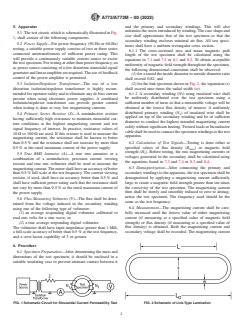
5.1 Thetestcircuit,whichisschematicallyillustratedinFig.
size shall approximate that of the test specimen so that the
1, shall consist of the following components.
secondary winding encloses minimal air flux. All test speci-
5.2 Power Supply—For power frequency (50-Hz or 60-Hz)
mens shall have a uniform rectangular cross section.
testing, a suitable power supply consists of two or three series
6.1.1 The cross-sectional area and mean magnetic path
connected autotransformers of sufficient power rating. This
length of the test specimen shall be calculated using the
will provide a continuously variable current source to excite
equations in 7.1 and 7.2 or 8.1 and 8.2. To obtain acceptable
thetestspecimen.Fortestingatotherthanpowerfrequency,an
uniformity of magnetic field strength throughout the specimen,
acpowersourceconsistingofalowdistortionsinusoidalsignal
the following dimensional constraints shall be observed:
generatorandlinearamplifierarerequired.Theuseoffeedback
(1)foratoroidtheinsidediametertooutsidediameterratio
control of the power amplifier is permitted.
shall exceed 0.82, and
(2)forthelinkspecimenshowninFig.2,theseparation(s)
5.3 Isolation/Stepdown Transformer—The use of a low
distortion isolation/stepdown transformer is highly recom- shall exceed nine times the radial width (w).
mendedforoperatorsafetyandtoeliminateanydcbiascurrent 6.1.2 A secondary winding (N ) using insulated wire shall
be uniformly distributed over the test specimen using a
present when using electronic power supplies. A combined
isolation/stepdown transformer can provide greater control sufficient number of turns so that a measurable voltage will be
obtained at the lowest flux density of interest. A uniformly
when testing is done at very low magnetizing currents.
distributed primary winding (N ) of insulated wire shall be
5.4 Primary Series Resistor (Z)—A noninductive resistor
applied on top of the secondary winding and be of sufficient
having sufficiently high resistance to maintain sinusoidal cur-
diameter to conduct the highest intended magnetizing current
rent conditions at the highest magnetizing current and test
safelywithoutsignificantheating.Twistedleadsorbiconductor
signal frequency of interest. In practice, resistance values of
cableshallbeusedtoconnectthespecimenwindingstothetest
10Ω to 100Ω are used. If this resistor is used to measure the
apparatus.
magnetizing current, the resistance shall be known to better
than 0.5% and the resistance shall not increase by more than 6.2 Calculation of Test Signals—Testing is done either at
specified values of flux density (B ) or magnetic field
0.5% at the rated maximum current of the power supply.
max
strength (H ). Before testing, the rms magnetizing currents or
z
5.5 True RMS Ammeter (A)—A true rms ammeter or a
voltages generated in the secondary shall be calculated using
combination of a noninductive, precision current viewing
the equations found in 7.3 and 7.4 or 8.3 and 8.4.
resistor and true rms voltmeter shall be used to measure the
6.3 Demagnetization—After connecting the primary and
magnetizingcurrent.Themetershallhaveanaccuracyofbetter
than 0.5% full scale at the test frequency.The current viewing secondarywindingstotheapparatus,thetestspecimenshallbe
demagnetized by applying a magnetizing c
...