

EN 12802:2011
(Main)Road marking materials - Laboratory methods for identification
- Abstract
This document specifies laboratory methods for the identification of road marking materials used in horizontal signalization. It is not necessary, unless required, to perform all of the tests described.
- Status
- Published
- Publication Date
- 07-Jun-2011
- Withdrawal Date
- 30-Dec-2011
- Technical Committee
- CEN/TC 226 - Road equipment
- Drafting Committee
- CEN/TC 226/WG 2 - Horizontal road signs
- Current Stage
- 6060 - Definitive text made available (DAV) - Publishing
- Start Date
- 08-Jun-2011
- Due Date
- 01-Jun-2012
- Completion Date
- 08-Jun-2011



Overview
EN 12802:2011 - "Road marking materials - Laboratory methods for identification" (CEN) specifies standardized laboratory methods for the identification of road marking materials used in horizontal signalisation. The standard defines sampling practices, a set of analytical test methods for paints, thermoplastics and cold plastics, and rules for reporting and tolerance assessment. Annexes A–H are normative and provide the detailed test procedures.
Keywords: EN 12802, road marking materials, laboratory methods, identification, CEN.
Key topics
- Scope and sampling
- Representative sampling is required (see EN 13459). Typical sample quantities: about 1 L for paint and cold-plastic components; thermoplastic powders are melted, homogenized and sampled as solid blocks (~1 kg).
- Material classes covered
- Paints, thermoplastics, cold plastics, preformed road markings, drop-on materials (glass beads and antiskid aggregates).
- Analytical methods (Annexes A–H)
- Annex A: solids content (paint)
- Annex B: organic constituents - identification and quantification
- Annex C: inorganic constituents - identification and quantification
- Annex D: titanium (IV) dioxide (TiO2) content
- Annex E: glass bead content
- Annex F: solvents - identification and VOC content
- Annex G: paint viscosity (Krebs–Stormer method)
- Annex H: ash content
- Performance and tolerance rules
- Specifies tolerances for verification testing (examples: solids content ±2; density tolerances for paint/cold plastics/thermoplastics; TiO2 and glass bead tolerances). Alternative quantitative methods may be used if demonstrably comparable and repeatable per ISO 5725-2.
- Test reporting
- Test reports must document methods, results, manufacturer-declared values and conformity decisions.
Practical applications and users
- Who uses EN 12802
- Road authorities, highway agencies and transport departments
- Third‑party testing laboratories and quality control (QC) labs
- Manufacturers and suppliers of road marking paints, thermoplastics, cold plastics and glass beads
- Procurement teams and conformity assessors for specification verification and dispute resolution
- Why it’s used
- Verifies identity and composition of marking materials prior to application
- Supports factory production control, quality assurance and compliance with contractual specifications
- Enables forensic analysis in case of field failures or non-conformities
Related standards
- EN 1790 (preformed road markings)
- EN 1871 (specifications for paint, thermoplastic and cold plastic materials)
- EN 13459 (sampling and testing)
- EN 1423 / EN 1424 (glass beads and drop-on materials)
- EN ISO 11890-2, EN ISO 15528, ISO 5725-2
EN 12802 is essential for consistent, reproducible laboratory identification of road marking materials and for ensuring materials meet agreed quality and safety criteria.
Relations
- Effective Date
- 19-Jun-2010
- Effective Date
- 25-Aug-2026
- Effective Date
- 28-Jan-2026
- Effective Date
- 28-Jan-2026
- Effective Date
- 28-Jan-2026
- Effective Date
- 28-Jan-2026
- Effective Date
- 28-Jan-2026
- Effective Date
- 28-Jan-2026
- Effective Date
- 28-Jan-2026
- Effective Date
- 28-Jan-2026
- Effective Date
- 28-Jan-2026
Get Certified
Connect with accredited certification bodies for this standard

Zavod za gradbeništvo Slovenije (ZAG) - Inšpekcija
ZAG inspection body for construction products, structures, and materials.
Sponsored listings
Frequently Asked Questions
EN 12802:2011 is a standard published by the European Committee for Standardization (CEN). Its full title is "Road marking materials - Laboratory methods for identification". This standard covers: This document specifies laboratory methods for the identification of road marking materials used in horizontal signalization. It is not necessary, unless required, to perform all of the tests described.
This document specifies laboratory methods for the identification of road marking materials used in horizontal signalization. It is not necessary, unless required, to perform all of the tests described.
EN 12802:2011 is classified under the following ICS (International Classification for Standards) categories: 93.080.20 - Road construction materials. The ICS classification helps identify the subject area and facilitates finding related standards.
EN 12802:2011 has the following relationships with other standards: It is inter standard links to EN 12802:2000, ISO 5725-2:1994, EN 1790:2013, EN 1423:2012, ENV 14237:2002, EN ISO 15528:2020, EN 1424:1997, EN ISO 11890-2:2020, EN 13459:2011, EN 1871:2020, EN 13212:2011. Understanding these relationships helps ensure you are using the most current and applicable version of the standard.
EN 12802:2011 is associated with the following European legislation: EU Directives/Regulations: 305/2011, 89/106/EEC. When a standard is cited in the Official Journal of the European Union, products manufactured in conformity with it benefit from a presumption of conformity with the essential requirements of the corresponding EU directive or regulation.
EN 12802:2011 is available in PDF format for immediate download after purchase. The document can be added to your cart and obtained through the secure checkout process. Digital delivery ensures instant access to the complete standard document.
Standards Content (Sample)
2003-01.Slovenski inštitut za standardizacijo. Razmnoževanje celote ali delov tega standarda ni dovoljeno.LILNDFLMRStraßenmarkierungsmaterialien - Laborverfahren für die IdentifikationProduits de marquage routier - Méthodes de laboratoire pour identificationRoad marking materials - Laboratory methods and identification93.080.20Materiali za gradnjo cestRoad construction materialsICS:Ta slovenski standard je istoveten z:EN 12802:2011SIST EN 12802:2011en,de01-oktober-2011SIST EN 12802:2011SLOVENSKI
STANDARDSIST EN 12802:20021DGRPHãþD
EUROPEAN STANDARD NORME EUROPÉENNE EUROPÄISCHE NORM
EN 12802
June 2011 ICS 93.080.20 Supersedes EN 12802:2000English Version
Road marking materials - Laboratory methods for identification Produits de marquage routier - Méthodes de laboratoire pour identification
Straßenmarkierungsmaterialien - Laborverfahren für die Identifikation This European Standard was approved by CEN on 22 April 2011.
CEN members are bound to comply with the CEN/CENELEC Internal Regulations which stipulate the conditions for giving this European Standard the status of a national standard without any alteration. Up-to-date lists and bibliographical references concerning such national standards may be obtained on application to the CEN-CENELEC Management Centre or to any CEN member.
This European Standard exists in three official versions (English, French, German). A version in any other language made by translation under the responsibility of a CEN member into its own language and notified to the CEN-CENELEC Management Centre has the same status as the official versions.
CEN members are the national standards bodies of Austria, Belgium, Bulgaria, Croatia, Cyprus, Czech Republic, Denmark, Estonia, Finland, France, Germany, Greece, Hungary, Iceland, Ireland, Italy, Latvia, Lithuania, Luxembourg, Malta, Netherlands, Norway, Poland, Portugal, Romania, Slovakia, Slovenia, Spain, Sweden, Switzerland and United Kingdom.
EUROPEAN COMMITTEE FOR STANDARDIZATION
COMITÉ EUROPÉEN DE NORMALISATION EUROPÄISCHES KOMITEE FÜR NORMUNG
Management Centre:
Avenue Marnix 17,
B-1000 Brussels © 2011 CEN All rights of exploitation in any form and by any means reserved worldwide for CEN national Members. Ref. No. EN 12802:2011: ESIST EN 12802:2011
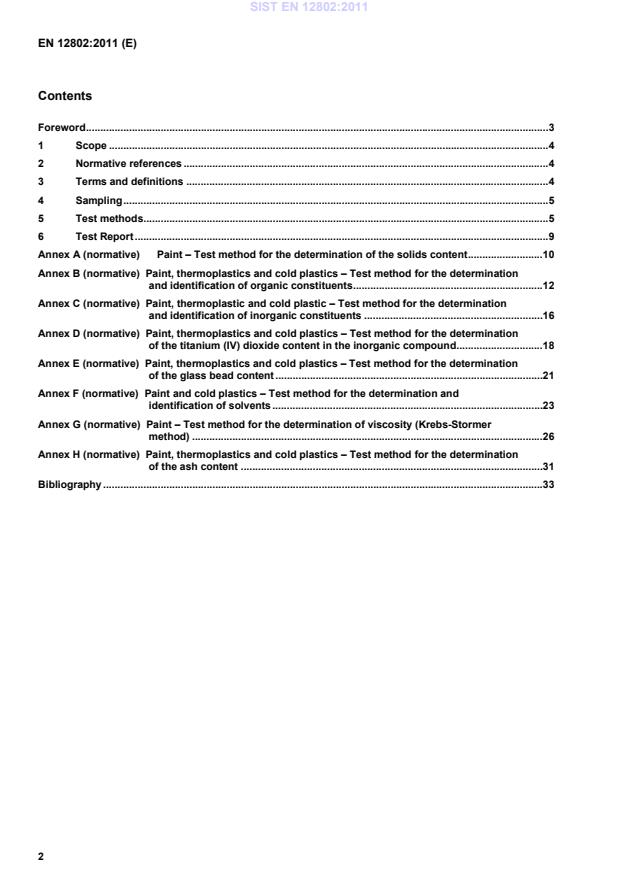
Paint – Test method for the determination of the solids content . 10Annex B (normative)
Paint, thermoplastics and cold plastics – Test method for the determination and identification of organic constituents . 12Annex C (normative)
Paint, thermoplastic and cold plastic – Test method for the determination and identification of inorganic constituents . 16Annex D (normative)
Paint, thermoplastics and cold plastics – Test method for the determination of the titanium (IV) dioxide content in the inorganic compound . 18Annex E (normative)
Paint, thermoplastics and cold plastics – Test method for the determination of the glass bead content . 21Annex F (normative)
Paint and cold plastics – Test method for the determination and identification of solvents . 23Annex G (normative)
Paint – Test method for the determination of viscosity (Krebs-Stormer method) . 26Annex H (normative)
Paint, thermoplastics and cold plastics – Test method for the determination of the ash content . 31Bibliography . 33 SIST EN 12802:2011
the co-existence period): EN 1790, Road marking materials
Preformed road markings, EN 1824, Road marking materials
Road trials, EN 1871, Road marking materials
Paint, thermoplastic and cold plastic materials Specifications, EN 12802, Road marking materials
Laboratory methods for identification, EN 13197, Road marking materials
Wear simulator Turntable, EN 13212, Road marking materials
Requirements for factory production control, EN 13459, Road marking materials
Sampling and testing. SIST EN 12802:2011
This document specifies laboratory methods for the identification of road marking materials used in horizontal signalization. It is not necessary, unless required, to perform all of the tests described. 2 Normative references The following referenced documents are indispensable for the application of this document. For dated references, only the edition cited applies. For undated references, the latest edition of the referenced document (including any amendments) applies. EN 1423, Road marking materials
Drop on materials
Glass beads, antiskid aggregates and mixtures of the two EN 1424, Road marking materials
Premix glass beads EN 1790, Road marking materials
Preformed road markings EN 13459, Road marking materials
Sampling and testing EN ISO 11890-2, Paints and varnishes
Determination of volatile organic compound (VOC) content
Part 2: Gas-chromatographic method (ISO 11890-2:2006) EN ISO 15528, Paints, varnishes and raw materials for paints and varnishes
Sampling (ISO 15528:2000) ISO 5725-2, Accuracy (trueness and precision) of measurement methods and results
Part 2: Basic method for the determination of repeatability and reproducibility of a standard measurement method 3 Terms and definitions For the purposes of this document, the following terms and definitions apply. 3.1 paints liquid product containing binders, pigments, extenders, solvents and additives
NOTE It can be supplied in single or multi-component systems. When applied it produces a cohesive film by the process of solvent evaporation, or solvent evaporation and a chemical reaction. 3.2 cold plastics viscous products supplied in two or multi-component forms (at least one main component and a hardener system) and free from solvents NOTE The cohesive film is formed after mixing of all components only by a chemical reaction. Following the reaction, the liquid becomes a solid. 3.3
thermoplastics solvent-free marking substance supplied in block, granular or powder forms NOTE It is heated to a molten state and then applied. It forms a cohesive film by cooling. SIST EN 12802:2011
The ash content of the paint shall be determined using, either the method described in Annex H, or an alternative method complying with 5.1. 5.3 Thermoplastics 5.3.1 Density The density of the thermoplastics shall be determined using, either the method laid down in EN ISO 2811-2, or an alternative method complying with 5.1. 5.3.2 Organic content and identification The type of organic materials, and the content expressed as a percentage, of the thermoplastics shall be determined using, either the method described in Annex B, or an alternative method complying with 5.1. 5.3.3 Inorganic content and identification The type of inorganic materials, and the content expressed as a percentage, of the thermoplastics shall be determined using, either the method described in Annex C, or an alternative method complying with 5.1. 5.3.4 Titanium dioxide content The titanium dioxide content of the inorganic compound of the thermoplastics, expressed as a percentage, shall be determined, either by the method described in Annex D, or an alternative method complying with 5.1. 5.3.5 Glass bead content The glass bead content of the thermoplastics, expressed as a percentage, shall be determined, either as described in Annex E, or an alternative method complying with 5.1.
5.3.6 Ash content
The ash content of the thermoplastics shall be determined using, either the method described in Annex H, or an alternative method complying with 5.1. 5.4 Cold plastics 5.4.1 Density The density of the cold plastics shall be determined using, either the method laid down in EN ISO 2811-2, or an alternative method complying with 5.1. SIST EN 12802:2011
5.4.6 Solvent content and identification The type of solvent, and the content expressed as a percentage, of the cold plastics shall be determined using, either the method described in Annex F, or an alternative method complying with 5.1. 5.4.7 Viscosity The viscosity of the cold plastics shall be determined using, either the method laid down in EN ISO 2555 with a Type A viscosimeter, or an alternative method complying with 5.1. 5.4.8 Ash content
The ash content of the cold plastics shall be determined using, either the method described in Annex H, or an alternative method complying with 5.1. 5.5 Preformed road markings The identification methods for preformed road markings are laid down in EN 1790. 5.6 Premix glass beads 5.6.1 Granulometry The granulometry of the glass beads shall be determined using the method laid down in EN 1424. 5.6.2 Refractive index The refractive index class of the glass beads shall be determined using the method laid down in EN 1424. 5.6.3 Resistance to water, hydrochloric acid, calcium chloride and sodium sulphide The glass beads shall not develop any surface haze or dulling when in contact with any of the following: water, hydrochloric acid, calcium chloride and sodium sulphide, using the method laid down in EN 1423. SIST EN 12802:2011
ParameterMaximum relative deviation Maximum absolute deviation Solids content - ± 2 Density - - - Paint: ± 0,04 g/cm³ Cold plastic: ± 0,06 g/cm³ Thermoplastic: ± 0,1 g/cm³ Organic constituents 10 % ± 2 Calcium Carbonate
± 3 Inorganic constituents - ± 3 Titanium dioxide
For TiO2 concentrations ≥ 10 % Tolerance = 10 % For TiO2 concentrations ≤ 10 % Tolerance = ± 1 Glass beads* 20 % ± 5 Solvent content
± 3 Viscosity Cold plastic: 20 %
Paint: ± 10 units Ash Content - ± 3 * Experimental values which are only applicable if the glass bead content is ≥ 10%. It is not possible to set tolerances if the percentage of glass beads is less than 10 %.NOTE When assessing the identity of two infrared spectra it has to be checked if all absorptions-/transmission peaks are present or there are additional occurrences which are significantly different from the baseline to stand out. The relative height levels between the peaks must not change significantly. 6 Test Report At the end of the tests, the test report shall be made available. The test report shall include at least: a reference to this standard and to the test method (Annex A to Annex H); the critical testing conditions; and the expression of the results (as specified in the corresponding test method) and the related uncertainty (if applicable). SIST EN 12802:2011
Paint – Test method for the determination of the solids content A.1 Principle The volatile constituents of the paint are evaporated at 105 °C. The residual solids are weighed and the solids content calculated.
A.2 Apparatus a) Cooling equipment, refrigerator or water bath with thermostat at approximately + 10 °C; b) porcelain dishes with a diameter of approximately 40 mm an a high of 20 mm to 30 mm; c) analytical balance, with an accuracy of 0,001 g, with zero point correction; d) warming cupboard, with forced fresh air ventilation and flame-proof interior capable of being heated to
105 °C ± 2 °C; e) desiccator, with drying agent, e.g. silica gel. A.3 Reagents Thinner consisting of a suitable solvent / thinner as recommended by the manufacturer. A.4 Procedure A.4.1 Carry out two determinations. A.4.2 Mark porcelain plates with numbers. Record the mass of the empty plates (L) to the nearest 0,001 g. Place approximately 2 g of the paint, pre-cooled to 10 °C and homogenized, in the plate with a spoon. Weigh to the nearest 0,001 g (mass M1).
A.4.3 Place the plates containing the sample in a warming cupboard at a temperature of 105 °C ± 2 °C and store there for at least 3 h or until constant mass is reached. Constant mass is reached when, after the sample has been in the warming cupboard for a further 1,5 h, the mass loss is less than 0,2 % of the initial mass. Cool the plate to room temperature in the desiccator, and weigh to the nearest 0,001 g. SIST EN 12802:2011
Paint, thermoplastics and cold plastics –
Test method for the determination and identification of organic constituents B.1 Principle Separation of the binder, insoluble organic and inorganic constituents from the specimen by solvent extraction, centrifuging and combustion. The binder type of paints and thermoplastics is identified by IR spectra using a potassium bromide (KBr) pellet or window.
The binder type of cold plastics is identified using EN ISO 11890-2, Paints and varnishes
Determination of volatile organic compound (VOC)
Part 2: Gaschromatographic method (ISO 11890-2:2006). The inorganic constituents are kept for further IR examination (Annex C), determination of titanium dioxide (Annex D) and the glass bead content (Annex E). B.2 Apparatus a) centrifuge, high-speed, min 10 000g1);
b) centrifuge bowls, steel bowls or glass tubes, each with a capacity of 80 cm3; c) spatula; d) warming cupboard, with forced ventilation, capable of being heated to 105 °C ± 10 °C; e) rotary evaporator; f) glass flask, with a capacity of 500 ml, with ground glass neck; g) infrared spectrometer, automatically recording FTIR spectrometer, range 4000 cm-1 to 400 cm-1 with an optical resolving power better than 5 cm-1 throughout the spectral range using an ordinate with a scale of 0 % to 100 % transmission. h) analytical balance, with an accuracy of 0,001 g, with zero point correction; i) two erlenmeyer flasks of heat resistant glass, 250 ml or 300 ml capacity; j) electric muffle furnace, adjustable to 450 °C ± 25 °C; k) desiccator, with drying agent, e.g. silica gel; l) ultrasonic dissolver or similar device.
1) g equals 9,81 m x s-2. SIST EN 12802:2011
for cold plastics: ethyl acetate; acetone. B.4 Procedure B.4.1 Separation of binder Weigh the centrifuge bowls to the nearest 0,01 g (W1). Weigh a portion of approximately at least 10 g to the nearest 0,01 g together with the bowl (W2).
Place a portion of the marking material, carefully homogenized, in a centrifuge tube. Add approximately 25 ml of an appropriate solvent (see B.3). Seal the tube with a stopper and, only for thermoplastic, allow to stand overnight. After standing, stir the contents of the tube thoroughly with a spatula and centrifuge the mixture at 10 000g to 15 000g for 20 min. Decant the liquid phase into the glass flask. Thin the solid phase with a further 25 ml of solvent, stir again with the spatula, rinse and centrifuge again. Repeat the procedure three times or until the liquid supernatant is of clear colour. Use a highly volatile solvent the third time (such as acetone). Expose the centrifuge bowls containing the solid phase to the air for 5 min and dry in the warming cupboard for approximately 2 h.
Cool down the tubes in a desiccator and reweigh them to the nearest 0,01 g (W3). For dispersions do the extraction with tetrahydrofurane and centrifuge at a low speed of about 1000g, as high speeds can throw out high molecular components of the binder. B.4.2 Preparation of spectra Concentrate the solutions obtained in B.4.1 down to about 20 ml in the 500 ml glass flask in a rotary evaporator.
For recording the IR spectrum of the binder of a road marking material, use the binder solutions obtained in B.4.2. Coat the cuvette window or the potassium bromide (KBr) pellet (both referred to as 'pellet' below) evenly with a specimen of the solution. Dip a previously prepared pellet into the liquid obtained from the appropriate extraction and coat it evenly with a specimen of the solution. As the solvent evaporates, examine the pellet to make sure that the film formed on it is uniform and homogeneous. There shall be no inhomogeneity or separation. In order to remove the solvent completely, store the coated pellet in a warming cupboard at 60 °C ± 2 °C until no bands of solvent are identifiable. Place the pellet in the sample holder of the IR spectrometer and record the IR spectrum. Keep the tracing as a reference. SIST EN 12802:2011
...