

EN 14067-4:2013
(Main)Railway applications - Aerodynamics - Part 4: Requirements and test procedures for aerodynamics on open track
- Abstract
This European Standard deals with requirements, test procedures and conformity assessment for aerodynamics on open track. Addressed within this standard are the topics of aerodynamic loadings and resistance to motion, while the topic of cross wind assessment is addressed by EN 14067-6.
This European Standard refers to rolling stock and infrastructure issues. This standard does not apply to freight wagons. It applies to railway operation on gauges GA, GB and GC according to EN 15273. The methodological approach of the presented test procedures may be adapted to different gauges.
- Status
- Withdrawn
- Publication Date
- 29-Oct-2013
- Withdrawal Date
- 20-Oct-2026
- Technical Committee
- CEN/TC 256 - Railway applications
- Drafting Committee
- CEN/TC 256/WG 6 - Aerodynamics
- Current Stage
- 9960 - Withdrawal effective - Withdrawal
- Start Date
- 12-Dec-2018
- Completion Date
- 21-Oct-2026

Relations
- Effective Date
- 06-Nov-2013
- Effective Date
- 01-Jun-2010
- Effective Date
- 12-Sep-2018
- Effective Date
- 20-May-2026
- Effective Date
- 28-Jan-2026
- Effective Date
- 28-Jan-2026
- Effective Date
- 28-Jan-2026
- Effective Date
- 28-Jan-2026
- Effective Date
- 28-Jan-2026
- Effective Date
- 28-Jan-2026
- Effective Date
- 28-Jan-2026
- Effective Date
- 28-Jan-2026
- Effective Date
- 23-Nov-2016
Get Certified
Connect with accredited certification bodies for this standard

IRIS Certification (UNIFE)
International Railway Industry Standard certification.

TÜV SÜD Rail GmbH
TÜV SÜD railway certification services.

Bureau Veritas Railway Certification
Railway and transportation certification.
Sponsored listings
Frequently Asked Questions
EN 14067-4:2013 is a standard published by the European Committee for Standardization (CEN). Its full title is "Railway applications - Aerodynamics - Part 4: Requirements and test procedures for aerodynamics on open track". This standard covers: This European Standard deals with requirements, test procedures and conformity assessment for aerodynamics on open track. Addressed within this standard are the topics of aerodynamic loadings and resistance to motion, while the topic of cross wind assessment is addressed by EN 14067-6. This European Standard refers to rolling stock and infrastructure issues. This standard does not apply to freight wagons. It applies to railway operation on gauges GA, GB and GC according to EN 15273. The methodological approach of the presented test procedures may be adapted to different gauges.
This European Standard deals with requirements, test procedures and conformity assessment for aerodynamics on open track. Addressed within this standard are the topics of aerodynamic loadings and resistance to motion, while the topic of cross wind assessment is addressed by EN 14067-6. This European Standard refers to rolling stock and infrastructure issues. This standard does not apply to freight wagons. It applies to railway operation on gauges GA, GB and GC according to EN 15273. The methodological approach of the presented test procedures may be adapted to different gauges.
EN 14067-4:2013 is classified under the following ICS (International Classification for Standards) categories: 45.060.01 - Railway rolling stock in general. The ICS classification helps identify the subject area and facilitates finding related standards.
EN 14067-4:2013 has the following relationships with other standards: It is inter standard links to EN 14067-2:2003, EN 14067-4:2005+A1:2009, EN 14067-4:2013+A1:2018, ISO 8756:1994, EN 1991-2:2023, EN 15663:2017+A2:2024, EN 15273-1:2025, EN 15273-3:2025, EN 15273-4:2025, EN 15273-2:2025, EN 2599:2001, EN 14033-1:2017, EN 14067-4:2013/prA1:2017. Understanding these relationships helps ensure you are using the most current and applicable version of the standard.
EN 14067-4:2013 is associated with the following European legislation: EU Directives/Regulations: 2008/57/EC; Standardization Mandates: M/483. When a standard is cited in the Official Journal of the European Union, products manufactured in conformity with it benefit from a presumption of conformity with the essential requirements of the corresponding EU directive or regulation.
EN 14067-4:2013 is available in PDF format for immediate download after purchase. The document can be added to your cart and obtained through the secure checkout process. Digital delivery ensures instant access to the complete standard document.
Standards Content (Sample)
2003-01.Slovenski inštitut za standardizacijo. Razmnoževanje celote ali delov tega standarda ni dovoljeno.Železniške naprave - Aerodinamika - 4. del: Zahteve in preskusni postopki za aerodinamiko na odprti progiBahnanwendungen - Aerodynamik - Teil 4: Anforderungen und Prüfverfahren für Aerodynamik auf offener StreckeApplications ferroviaires - Aérodynamique - Partie 4: Exigences et procédures d'essai pour l'aérodynamique à l'air libreRailway applications - Aerodynamics - Part 4: Requirements and test procedures for aerodynamics on open track45.060.01Železniška vozila na splošnoRailway rolling stock in generalICS:Ta slovenski standard je istoveten z:EN 14067-4:2013SIST EN 14067-4:2014en,fr,de01-april-2014SIST EN 14067-4:2014SLOVENSKI
STANDARDSIST EN 14067-4:2006+A1:2009SIST EN 14067-2:20041DGRPHãþD
EUROPEAN STANDARD NORME EUROPÉENNE EUROPÄISCHE NORM
EN 14067-4
October 2013 ICS 45.060.01 Supersedes EN 14067-2:2003, EN 14067-4:2005+A1:2009English Version
Railway applications - Aerodynamics - Part 4: Requirements and test procedures for aerodynamics on open track
Applications ferroviaires - Aérodynamique - Partie 4: Exigences et procédures d'essai pour l'aérodynamique à l'air libre
Bahnanwendungen - Aerodynamik - Teil 4: Anforderungen und Prüfverfahren für Aerodynamik auf offener Strecke This European Standard was approved by CEN on 21 September 2013.
CEN members are bound to comply with the CEN/CENELEC Internal Regulations which stipulate the conditions for giving this European Standard the status of a national standard without any alteration. Up-to-date lists and bibliographical references concerning such national standards may be obtained on application to the CEN-CENELEC Management Centre or to any CEN member.
This European Standard exists in three official versions (English, French, German). A version in any other language made by translation under the responsibility of a CEN member into its own language and notified to the CEN-CENELEC Management Centre has the same status as the official versions.
CEN members are the national standards bodies of Austria, Belgium, Bulgaria, Croatia, Cyprus, Czech Republic, Denmark, Estonia, Finland, Former Yugoslav Republic of Macedonia, France, Germany, Greece, Hungary, Iceland, Ireland, Italy, Latvia, Lithuania, Luxembourg, Malta, Netherlands, Norway, Poland, Portugal, Romania, Slovakia, Slovenia, Spain, Sweden, Switzerland, Turkey and United Kingdom.
EUROPEAN COMMITTEE FOR STANDARDIZATION
COMITÉ EUROPÉEN DE NORMALISATION EUROPÄISCHES KOMITEE FÜR NORMUNG
CEN-CENELEC Management Centre:
Avenue Marnix 17,
B-1000 Brussels © 2013 CEN All rights of exploitation in any form and by any means reserved worldwide for CEN national Members. Ref. No. EN 14067-4:2013: ESIST EN 14067-4:2014
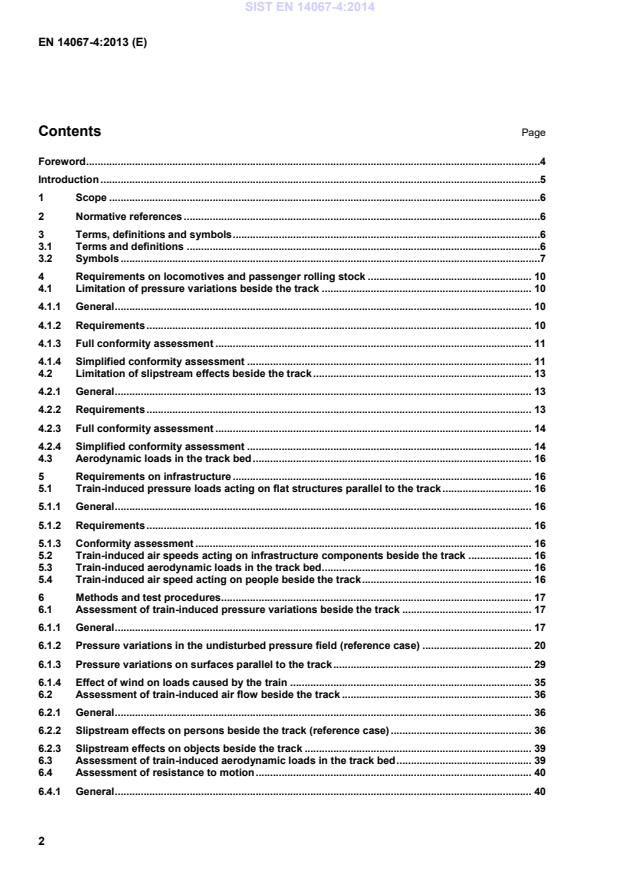
Procedure for full-scale tests regarding train-induced air flow in the track bed . 43 A.1 General . 43 A.2 Track configuration . 43 A.3 Vehicle configuration and test conditions . 43 A.4 Instrumentation and data acquisition . 44 A.5 Data processing . 44 Bibliography . 45
CFD numerical methods of approximating and solving the equations of fluid dynamics 3.1.4 streamline shaped vehicle vehicle with a closed and smooth front which does not cause flow separations in the mean flow field greater than 5 cm from the side of the vehicle 3.1.5 bluff shaped vehicle
vehicle that is not streamlined
CF − coefficient of aerodynamic force
Cp1 − aerodynamic coefficient depending on the distance from track centre Y
Cp2 − aerodynamic coefficient depending on the height above top of rail h
Cp3 − aerodynamic coefficient depending on the distance from track centre Y
C1 N rolling mechanical resistance
C2 vtr N momentum drag due to air flow for traction and auxiliary equipment and the air conditioning systems
C3 vtr2 N aerodynamic drag in the resistance to motion formula
d t s temporal variation
d vtr m/s train speed variation
d x m spatial variation
F N load on an object, maximum value of the force during the passage
g m/s2 acceleration due to gravity
h m height above top of rail
i ‰ gradient of the track
k − factor accounting for the energy stored in rotating masses
≥ 1,0 k1 − shape coefficient of the train
k2 − shape coefficient of the train
k3 − shape coefficient of the train
Ln m length of the train nose distance from front end to where the full cross section of the leading vehicle is achieved m kg train mass normal operational payload according to EN 15663 SIST EN 14067-4:2014
pmax Pa maximum pressure
pmin Pa minimum pressure
p1k Pa characteristic value of distributed load
p2k Pa characteristic value of distributed load
p3k Pa characteristic value of distributed load
r m curve radius
Re − Reynolds number based on reference length of 3,00 m at full scale Remax − maximum Reynolds number
R1 N resistance to motion train contribution R2 N resistance to motion infrastructure contribution S m2 characteristic area
t s time
ui m/s resultant horizontal air speed of the i-th passage after transformation of the time base um,i m/s measured resultant horizontal air speed of the i-th passage
U m/s induced flow speed
U m/s mean value over all measured maxima Ui
Ui m/s maximum resultant horizontal air speed of the i-th passage after averaging and correction to the characteristic train speed
Umax m/s maximum value of U
U2σ m/s upper bound of a 2 1 interval of maximum air speed
U95% m/s maximum resultant horizontal air speed characteristic air speed U95%,max m/s permissible maximum resultant horizontal air speed permissible characteristic air speed vtr m/s train speed
vtr,c m/s full scale train speed
vtr,i m/s train speed during the i-th passage
vtr,max m/s maximum train speed
vtr,ref m/s reference speed
vtr,test m/s nominal test speed
y+ − dimensionless wall distance
Y m lateral distance from track centre
Ymin m minimum lateral distance from track centre
Ymax m maximum lateral distance from track centre
γ m/s2 train acceleration measured during the coasting test
∆Cp,2σ − pressure change coefficient Upper bound of a 2 1 interval of the peak-to-peak pressure change coefficient. The peak-to-peak pressure change coefficient is defined in Formula 2. ∆Cp − pressure change coefficient
∆p Pa peak-to-peak pressure change
p∆ Pa mean value for peak-to-peak pressure change
determined over all measurements ∆pi or by CFD ∆p2σ Pa upper bound of a 2 1 interval of the peak-to-peak pressure change
∆p95% Pa maximum peak-to-peak pressure change characteristic pressure change ∆p95%,max=Pa permissible maximum peak-to-peak pressure change permissible characteristic pressure change ∆pi Pa maximum peak-to-peak pressure value of the i-th passage
∆pm,i Pa maximum peak-to-peak pressure value measured during the i-th passage
∆psim= the head pressure variation from unsteady CFD calculations
simp∆ Pa the head pressure variation from steady CFD calculations
∆t s characteristic time interval passage of train head, time between pressure peaks ε=- relative difference
∑Ri N sum of all the resistances to motion
=Pa·s dynamic viscosity
kg/m3 air density
i kg/m3 air density determined during the i-th passage
0 kg/m3 standard air density 0 = 1,225 kg/m3 SIST EN 14067-4:2014
a) Side view
b) Top view
c) Speed vector diagram Figure 1 – Coordinate system 4 Requirements on locomotives and passenger rolling stock 4.1 Limitation of pressure variations beside the track 4.1.1 General A passing train generates a varying pressure field beside the track which has an effect on objects such as crossing trains, noise barriers, platform installations, etc. To define a clear interface between the subsystems of rolling stock and infrastructure, the train-induced aerodynamic pressure loads beside the track need to be known and limited.
In order to describe and to limit the train-induced aerodynamic pressure loads beside the track one reference case for rolling stock assessment is defined.
4.1.2 Requirements 4.1.2.1 Reference case For standard GA, GB, GC gauge according to EN 15273 in the absence of embankments, cuttings and other significant trackside structures the undisturbed pressure field generated by a passing train at a position of 2,50 m distance from the centre of a straight track with standard track formation profile is referred to as the reference case. The pressure variations occurring are characterized by the upper bound of the 95 % confidence interval for the maximum peak-to-peak pressure. This maximum peak-to-peak pressure change, ∆p95%, refers to the maximum pressure change which occurs during the passage of the train head. 4.1.2.2 Fixed or pre-defined train compositions A fixed or pre-defined train composition, running at the reference speed in the reference case scenario shall not cause the maximum peak-to-peak pressure changes to exceed a value ∆p95%,max as set out in Table 2 SIST EN 14067-4:2014
Permissible pressure change ∆p95%,max at reference speed Reference speed vtr ≤ 160 km/h no requirement 160 km/h < vtr < 250 km/h ∆p95%,max = 800 Pa maximum design speed=250 km/h ≤ vtr ∆p95%,max = 800 Pa 250 km/h=4.1.2.3 Single rolling stock units fitted with a driver’s cab Single rolling stock units fitted with a driver’s cab running as the leading vehicle at the reference speed in the reference case scenario shall not cause the maximum peak-to-peak pressure changes to exceed a value ∆p95%,max as set out in Table 2. The range of heights to be considered are 1,50 m to 3,00 m above the top of rail during the passage of the front end of this unit. For single rolling stock units capable of bidirectional operation as a leading vehicle the requirement applies for each possible running direction. 4.1.2.4 Other passenger rolling stock For passenger rolling stock which is not covered in 4.1.2.2 or 4.1.2.3 there is no requirement. 4.1.3 Full conformity assessment A full conformity assessment of interoperable rolling stock shall be undertaken according to Table 3. Table 3 — Methods applicable for the full conformity assessment of rolling stock Maximum design speed
Methods vtr ≤ 160 km/h No assessment needed 160 km/h < vtr
Assessment by: full-scale tests according to 6.1.2.1; or reduced-scale moving model tests according to 6.1.2.2; or CFD simulations according to 6.1.2.4. 4.1.4 Simplified conformity assessment A simplified conformity assessment may be carried out for rolling stock that are subject to minor design differences in comparison to rolling stock for which a full conformity assessment already exists. With respect to pressure variations beside the track, the only relevant design differences are differences in external geometry and differences in design speed. This simplified conformity assessment shall take one of the following forms in accordance with Table 4: a statement and rationale that the design differences have no impact on the pressure variations beside the track; SIST EN 14067-4:2014
Other differences in external geometry (e.g. in buffers, front couplers, snow ploughs, front or side windows) keeping the basic head shape features.
Documentation of differences and reference to an existing compliant full conformity assessment AND assessment of the relative effect of differences by reduced-scale moving model tests according to 6.1.2.2 or CFD-simulations according to 6.1.2.4, AND
evidence and documentation that
(i) the difference causes changes in p∆ less than ± 10 %, 1,0)()()(<−ApApBp∆∆∆ NOTE B refers to the new train geometry. A refers to the existing compliant train. and (ii) the difference does not exceed 50 % of the margin available on the compliance with 4.1.2. ))((5,0))()((%95max%,95AppApBp∆∆∆∆−⋅<− Increase of design speed less than 10 % for a train with original design speed < 250 km/h, for a train with original design speed ≥ 250 km/h. Documentation of differences and reference to an existing compliant full conformity assessment AND evidence and documentation based on a ∆Cp analysis that the new design under investigation still fulfils the requirements listed in 4.1.2. SIST EN 14067-4:2014
< 250 km/h 0,2 m U95%,max = 20 m/s the maximum design speed 1,4 m U95%,max = 15,5 m/s 200 km/h or the maximum design speed, whichever is lower 250 km/h ≤ vtr,max
0,2 m U95%,max = 22 m/s 300 km/h or, if lower, at maximum design speed 1,4 m U95%,max = 15,5 m/s 200 km/h
4.2.2.4 Other passenger rolling stock Carriages that are operated within trains of different formations are compliant, if similar to existing or proven compliant single rolling stock with respect to: design speed (lower or equal to existing); and bogie external arrangement (position, cavity and bogie envelope); and train envelope (i.e. body width, height) changes above the bogies of less than 10 cm. The similarity and compliance for this approach shall be documented! If this criterion does not apply, the coach running at reference speed in the reference case scenario shall not cause the maximum resultant horizontal air speed to exceed a value U95%,max as set out in Table 5 at heights of 0,20 m and 1,40 m above the top of rail during the passage of the whole train and its wake. It should be tested in two configurations with the rolling stock likely to be used in operation; positioned directly behind an existing or proven compliant locomotive with a rake of carriages of at least 100 m in length behind it, and at the rear of a rake of carriages at least 100 m in length behind a compliant locomotive. If the coach has a dedicated purpose, e.g. restaurant car, which will dictate its position to be always mid-train, it should be tested only in the middle of a rake of carriages at least 100 m long. 4.2.3 Full conformity assessment A full conformity assessment of rolling stock shall be undertaken according to Table 6. Table 6 — Methods applicable for full conformity assessment of rolling stock Maximum design speed
Methods vtr ≤ 160 km/h no assessment needed 160 km/h < vtr assessment by full-scale tests according to 6.2.2.1 or documentation of compliance according to 4.2.2.4
4.2.4 Simplified conformity assessment A simplified conformity assessment may be carried out for rolling stock which are subject to minor design differences in comparison to rolling stock for which a full conformity assessment already exists. For a train composition that has been fully assessed for one direction of running, a simplified conformity assessment may be used for the other direction of running based on the full assessment. SIST EN 14067-4:2014
Documentation of differences and reference to an existing compliant full conformity assessment AND assessment of relative effect of differences by moving model rig test, see 6.2.2.2, AND evidence and documentation that i) the difference does not cause changes in
U95% bigger than ± 10 % and ii) the new design under investigation still fulfils (on the basis of the original value from a compliant full conformity assessment and found relative difference) the requirements listed in 4.2.2. Decrease in design speed
Documentation of differences and reference to an existing compliant full conformity assessment Increase of design speed less than the smaller of 20 km/h or 10 % for a train with original design speed < 300 km/h, for a train with original design speed ≥ 300 km/h. Documentation of differences and reference to an existing compliant full conformity assessment AND evidence and documentation based on linear extrapolation of slipstream velocity U95% at new design speed that the new design under investigation still fulfils the requirements listed in 4.2.2.
NOTE 1 National regulations may exist to cover this point. NOTE 2 EN 50125-3:2003 addresses the environmental conditions for signalling and telecommunication equipment.
NOTE 3 A test method for the measurement of aerodynamic loads in the track bed in connection with the assessment of ballast projection is described in Annex A (informative). 5 Requirements on infrastructure 5.1 Train-induced pressure loads acting on flat structures parallel to the track 5.1.1 General The train-induced pressure loads beside the track are limited by a corresponding requirement on rolling stock (see 4.1). Flat structures parallel to the track (e.g. noise barriers) need to be designed in such a way that these train-induced aerodynamic loads can be sustained during the structure design lifetime. This requires proper provision for the dynamic character of the aerodynamic load and for the dynamic behaviour of the structure. 5.1.2 Requirements The design of flat structures parallel to the track with GA, GB, GC gauge according to EN 15273 shall account for train-induced pressure loads as indicated in EN 1991-2. Dynamic effects need to be accounted for. To include the effect of ambient wind on the train-induced pressure loads, the wind speed component parallel to the track should be added to the train speed. NOTE The predictive formulae stated in 6.1.3.5 of this standard are equivalent to the pressure loads graphically given in EN 1991-2, but allow a wider range of application. 5.1.3 Conformity assessment A standard on fatigue due to dynamic loads on noise barriers from passing trains is in preparation inside CEN TC256 and will be considered for conformity assessment for noise barriers and similar structures (wind barriers, environmental screens) in a future revision of this document. 5.2 Train-induced air speeds acting on infrastructure components beside the track This point is not covered by this standard.
NOTE National regulations may exist to cover this point. 5.3 Train-induced aerodynamic loads in the track bed This point is not covered by this standard.
NOTE 1 National regulations may exist to cover this point. NOTE 2 EN 50125-3:2003 addresses the environmental conditions for signalling and telecommunication equipment. 5.4 Train-induced air speed acting on people beside the track This point is not covered by this standard.
a) Single unit train
b) Double unit train Key 1 wall 2 head of train 3 coupling of train units 4 tail of train p pressure x distance along wall 8 running direction Figure 2 — Examples of instantaneous pressure distributions on a vertical wall caused by the passing of a single and a double unit train SIST EN 14067-4:2014
Figure 3 — Pressure variation linked to head passage of train As the train passes, the static pressure rises to a positive peak and drops rapidly to a negative peak. The most important parameter is the peak-to-peak pressure ∆p. It is related to the nose shape and is generally smaller for a longer streamlined shape than for a bluff sharp-edged shape. The time between the pressure peaks ∆t can be related to the time for the length Ln of the train nose to pass. trnvLt≈∆ (1) A smaller peak-to-peak pressure occurs as the rear of the train passes, but the order of the pressure change is reversed, such that the negative peak precedes the positive peak. Additional smaller peak-to-peak pressure occurs as the couplings of the traction train pass. The peak-to-peak pressure is approximately proportional to the square of the speed of the train. A non-dimensional pressure change coefficient ∆Cp is defined by: ()2trminmax2vppCpρ∆−= (2) The value of ∆Cp for the undisturbed pressure field of a particular train depends on the height above ground and the distance of the measuring point from the train, where ∆Cp decreases with increasing distance. ∆Cp is a fundamental aerodynamic property of a particular train. An example is given in Figure 4. SIST EN 14067-4:2014
Key 1 longer streamlined nose shape 2 bluff sharp-edged nose shape Figure 4 — Typical variation of pressure change coefficient ∆Cp with lateral distance Y Train-induced pressure variations beside the track are of special interest when they act on (i) structures parallel to the track, such as noise barriers or wind barriers, and (ii) on passing trains. To define a clear interface between the subsystems of rolling stock and infrastructure the characteristic pressure variations beside the track are referred to the undisturbed pressure field around the train (i.e. in the absence of other objects). This also allows the train-induced pressure loads to be limited on the basis of corresponding rolling stock requirements. Subclause 6.1.2 presents the methods for the assessment of train-induced pressure variation in the undisturbed pressure field, while subclause 6.1.3 refers to train-induced pressure loads on structures parallel to the track. 6.1.2 Pressure variations in the undisturbed pressure field (reference case) 6.1.2.1 Full-scale tests A test site shall be chosen according to the reference case specification in 4.1.2.1. The vertical distance between the top of rail and the surrounding ground level to a distance of 3 m from the centre of the track to the side where the instrumentation is deployed and ± 10 m in x-direction from the measurement locations shall not exceed 1,00 m. Atypical measurement positions, which provide sheltering against the train-induced pressure field, shall be excluded. Tests shall be carried out on a straight line on open track. The layout of the chosen test site shall be recorded. It shall include the description of location; topography; track cant; track profile; track interval, track formation profile and slopes. For assessment, the rolling stock configuration shall comply with 4.1.2. Correct identification and recording of the passing train type, its speed, length and composition are mandatory (e.g. by video or by recording the passage of axles). The meteorological conditions (air temperature, air pressure, air humidity, wind speed, wind direction) shall be measured and the state of weather recorded. Acquisition of temperature, pressure and humidity data shall comply with ISO 8756. For any rake of pressure sensors the wind speed and direction are determined by a meteorological station. It shall be installed at 2 m above top of rail, about 4 m from the track centre and as close as possible to the rake of pressure sensors, at a maximum distance of 30 m to any rake. SIST EN 14067-4:2014
The pressure sensors used shall be capable of measuring the pressure with a minimum of 150 Hz resolution. It is recommended to use sensors with a measurement range of at least 1 500 Pa. All pressure sensors should be connected to the static pressure opening of Prandtl tubes directed in the negative x-direction, i.e. towards the train. A constant reference pressure (e.g. as stored in an insulated pressure tank) is used. In order to prevent a loss in (dynamic) information, the tubes and pipes between pressure hole and pressure sensor shall not exceed 50 cm. To prevent phase shift, all tubes shall be of equal length. If Prandtl tubes are not used, then the alternative measurement method shall be shown to be equivalent. The uncertainty of the pressure measurement shall be determined and may not exceed ± 2 %. The uncertainty of train speed measurement shall be determined and may not exceed ± 1 %. The pressure signal shall be filtered with a 75 Hz 6 pole Butterworth low pass filter (or another filter with equivalent filter characteristics) and sampled at a minimum of 300 Hz. For each pressure sensor and run, the maximum peak-to-peak pressure value generated during the passage of the train head, p∆,i, shall be computed and then corrected to the reference speed and to standard air density ρ0 = 1,225 kg/m3 using Formula (3): i02ix,w,itr,trim,iρρ∆∆⋅−⋅=vvvpp (3) where vw,x,i is the wind speed component in the x-direction. If a correlation to cross wind is obvious, i.e. the coeffi
...