

EN 1397:2021
(Main)Heat exchangers - Hydronic room fan coil units - Test procedures for establishing the performance
- Abstract
This European Standard applies to hydronic fan coil units (FCU) as factory-made single assemblies which provide the functions of cooling and/or heating but do not include the source of cooling or heating.
The standard covers both air free delivery and air ducted units with a maximum external static pressure due to duct resistance of 120 Pa max.
The standard applies to all types of fan speed control of a fan coil unit (variable speed, multispeed).
This standard deals with the cooling and heating functions of the FCU considered as an emitter for cooling/heating of a room/space. It does not cover any ventilation function of the unit.
If the FCU can also provide fresh air, this function is not considered and the fresh air inlet closed during testing.
This European Standard provides a method for the determination of the thermal performance of fan coil units in standard conditions, for the use with hot or chilled water or water mixtures. The test procedures given in this standard may additionally be used for determining performance at other conditions.
It also provides the method for the determination of the air flow rate supplied by the fan coil unit.
The standard does not cover the rating of heating or cooling from direct expansion coils or heating from electric resistance elements.
The standard does not cover acoustic performance of fan coil units which is dealt with in EN 16583.
It is not the purpose of this standard to specify the tests used for production or field testing.
NOTE For the purpose of remaining clauses, the term “unit” is used to mean “fan coil unit” as defined in 3.1.
- Status
- Published
- Publication Date
- 31-Aug-2021
- Withdrawal Date
- 30-Mar-2022
- Technical Committee
- CEN/TC 110 - Heat exchangers
- Drafting Committee
- CEN/TC 113/WG 14 - Revision of EN 1397
- Current Stage
- 9020 - Submission to 2 Year Review Enquiry - Review Enquiry
- Start Date
- 15-Oct-2026
- Completion Date
- 15-Oct-2026
- Directive
- 2016/2281 - Commission Regulation (EU) 2016/2281 of 30 November 2016 implementing Directive 2009/125/EC of the European Parliament and of the Council establishing a framework for the setting of ecodesign requirements for energy-related products, with regard to ecodesign requirements for air heating products, cooling products, high temperature process chillers and fan coil unitsOJ Ref: 2024/2638, OJ L, OJ L, 2024/2638 OJ Date: 11-Oct-2024

Overview
EN 1397:2021 - Heat exchangers: Hydronic room fan coil units - Test procedures for establishing the performance (CEN) specifies laboratory test methods for determining the thermal and airflow performance of factory-made hydronic fan coil units (FCUs). It applies to water- or water‑mixture‑fed FCUs that provide cooling and/or heating (but do not include the heat source). The standard covers both free‑air and ducted supply units (maximum external static pressure 120 Pa) and all types of fan speed control (variable, multispeed). EN 1397:2021 supersedes EN 1397:2015 and supports EU ecodesign requirements.
Key topics and requirements
The standard defines standardized procedures, measurement criteria and reporting requirements to ensure repeatable performance data:
Scope limits
- Applies to hydronic FCUs (factory-made single assemblies).
- Excludes rating for direct expansion (DX) coils and electric resistance heating elements.
- Excludes ventilation performance (fresh air inlet closed during tests).
- Acoustic testing is outside scope (see EN 16583).
Airflow testing
- Methods for determining air flow rate for ducted and non-ducted units (outlet and inlet measurement methods).
- Pressure settings, test installation and standard rating conditions included.
- Uses EN ISO 5801 principles where applicable for fan testing.
Capacity rating tests
- Procedures for cooling and heating capacity (sensible, latent, total).
- Standardized temperature, electrical and air flow conditions for rating.
- Measurement criteria: dry-bulb, humidity, liquid temperature/pressure, condensate flow, steady-state requirements.
- Uncertainty assessment, test duration and required recorded data.
Operating tests and safety
- Sweat test, condensate disposal test and other operational checks.
- Test report format and manufacturer’s data to be provided.
Annexes
- Drawings of FCU configurations, non-ducted/ducted setups.
- Normative annex for cassette unit partition design.
- Informative Annex ZA relating the standard to Commission Regulation (EU) No 2016/2281 (ecodesign).
Applications and users
EN 1397:2021 is intended for:
- FCU manufacturers - validating declared heating/cooling capacities and airflow data.
- Test laboratories - performing standardized performance testing and producing comparable test reports.
- HVAC designers and specifiers - selecting products with verified thermal performance.
- Regulatory and compliance teams - demonstrating conformance with ecodesign and energy‑related product requirements.
- Procurement and building owners - verifying manufacturer claims during product evaluation.
Related standards and references
- EN 16583 - acoustic performance of fan coil units (separate standard).
- EN ISO 5801:2017 - fans - performance testing using standardized airways (referenced for fan/airflow testing).
- Commission Regulation (EU) No 2016/2281 - ecodesign requirements for fan coil units (informative Annex ZA).
Keywords: EN 1397:2021, hydronic fan coil units, fan coil unit testing, thermal performance, airflow test, capacity rating, CEN, ecodesign.
Relations
- Effective Date
- 08-Sep-2021
- Effective Date
- 08-Sep-2021
- Effective Date
- 28-Jan-2026
- Effective Date
- 28-Jan-2026
Get Certified
Connect with accredited certification bodies for this standard

DNV
DNV is an independent assurance and risk management provider.

Lloyd's Register
Lloyd's Register is a global professional services organisation specialising in engineering and technology.
DNV Energy Systems
Energy and renewable energy certification.
Sponsored listings
Frequently Asked Questions
EN 1397:2021 is a standard published by the European Committee for Standardization (CEN). Its full title is "Heat exchangers - Hydronic room fan coil units - Test procedures for establishing the performance". This standard covers: This European Standard applies to hydronic fan coil units (FCU) as factory-made single assemblies which provide the functions of cooling and/or heating but do not include the source of cooling or heating. The standard covers both air free delivery and air ducted units with a maximum external static pressure due to duct resistance of 120 Pa max. The standard applies to all types of fan speed control of a fan coil unit (variable speed, multispeed). This standard deals with the cooling and heating functions of the FCU considered as an emitter for cooling/heating of a room/space. It does not cover any ventilation function of the unit. If the FCU can also provide fresh air, this function is not considered and the fresh air inlet closed during testing. This European Standard provides a method for the determination of the thermal performance of fan coil units in standard conditions, for the use with hot or chilled water or water mixtures. The test procedures given in this standard may additionally be used for determining performance at other conditions. It also provides the method for the determination of the air flow rate supplied by the fan coil unit. The standard does not cover the rating of heating or cooling from direct expansion coils or heating from electric resistance elements. The standard does not cover acoustic performance of fan coil units which is dealt with in EN 16583. It is not the purpose of this standard to specify the tests used for production or field testing. NOTE For the purpose of remaining clauses, the term “unit” is used to mean “fan coil unit” as defined in 3.1.
This European Standard applies to hydronic fan coil units (FCU) as factory-made single assemblies which provide the functions of cooling and/or heating but do not include the source of cooling or heating. The standard covers both air free delivery and air ducted units with a maximum external static pressure due to duct resistance of 120 Pa max. The standard applies to all types of fan speed control of a fan coil unit (variable speed, multispeed). This standard deals with the cooling and heating functions of the FCU considered as an emitter for cooling/heating of a room/space. It does not cover any ventilation function of the unit. If the FCU can also provide fresh air, this function is not considered and the fresh air inlet closed during testing. This European Standard provides a method for the determination of the thermal performance of fan coil units in standard conditions, for the use with hot or chilled water or water mixtures. The test procedures given in this standard may additionally be used for determining performance at other conditions. It also provides the method for the determination of the air flow rate supplied by the fan coil unit. The standard does not cover the rating of heating or cooling from direct expansion coils or heating from electric resistance elements. The standard does not cover acoustic performance of fan coil units which is dealt with in EN 16583. It is not the purpose of this standard to specify the tests used for production or field testing. NOTE For the purpose of remaining clauses, the term “unit” is used to mean “fan coil unit” as defined in 3.1.
EN 1397:2021 is classified under the following ICS (International Classification for Standards) categories: 27.060.30 - Boilers and heat exchangers. The ICS classification helps identify the subject area and facilitates finding related standards.
EN 1397:2021 has the following relationships with other standards: It is inter standard links to EN 1397:2015/AC:2016, EN 1397:2015, EN ISO 5801:2017, EN ISO 5171:2019. Understanding these relationships helps ensure you are using the most current and applicable version of the standard.
EN 1397:2021 is associated with the following European legislation: EU Directives/Regulations: 2016/2281; Standardization Mandates: M/560. When a standard is cited in the Official Journal of the European Union, products manufactured in conformity with it benefit from a presumption of conformity with the essential requirements of the corresponding EU directive or regulation.
EN 1397:2021 is available in PDF format for immediate download after purchase. The document can be added to your cart and obtained through the secure checkout process. Digital delivery ensures instant access to the complete standard document.
Standards Content (Sample)
SLOVENSKI STANDARD
01-november-2021
Nadomešča:
SIST EN 1397:2015
SIST EN 1397:2015/AC:2016
Prenosniki toplote - Ventilatorski konvektorji voda/zrak - Preskusni postopki za
ugotavljanje lastnosti
Heat exchangers - Hydronic room fan coil units - Test procedures for establishing the
performance
Wärmeübertrager - Wasser-Luft-Ventilatorkonvektoren - Prüfverfahren zur
Leistungsfeststellung
Échangeurs thermiques - Ventilo-convecteurs à eau - Procédures d'essai pour la
détermination des performances
Ta slovenski standard je istoveten z: EN 1397:2021
ICS:
27.060.30 Grelniki vode in prenosniki Boilers and heat exchangers
toplote
2003-01.Slovenski inštitut za standardizacijo. Razmnoževanje celote ali delov tega standarda ni dovoljeno.
EN 1397
EUROPEAN STANDARD
NORME EUROPÉENNE
September 2021
EUROPÄISCHE NORM
ICS 27.060.30 Supersedes EN 1397:2015
English Version
Heat exchangers - Hydronic room fan coil units - Test
procedures for establishing the performance
Échangeurs thermiques - Ventilo-convecteurs à eau - Wärmeübertrager - Wasser-Luft-
Procédures d'essai pour la détermination des Ventilatorkonvektoren - Prüfverfahren zur
performances Leistungsfeststellung
This European Standard was approved by CEN on 23 May 2021.
CEN members are bound to comply with the CEN/CENELEC Internal Regulations which stipulate the conditions for giving this
European Standard the status of a national standard without any alteration. Up-to-date lists and bibliographical references
concerning such national standards may be obtained on application to the CEN-CENELEC Management Centre or to any CEN
member.
This European Standard exists in three official versions (English, French, German). A version in any other language made by
translation under the responsibility of a CEN member into its own language and notified to the CEN-CENELEC Management
Centre has the same status as the official versions.
CEN members are the national standards bodies of Austria, Belgium, Bulgaria, Croatia, Cyprus, Czech Republic, Denmark, Estonia,
Finland, France, Germany, Greece, Hungary, Iceland, Ireland, Italy, Latvia, Lithuania, Luxembourg, Malta, Netherlands, Norway,
Poland, Portugal, Republic of North Macedonia, Romania, Serbia, Slovakia, Slovenia, Spain, Sweden, Switzerland, Turkey and
United Kingdom.
EUROPEAN COMMITTEE FOR STANDARDIZATION
COMITÉ EUROPÉEN DE NORMALISATION
EUROPÄISCHES KOMITEE FÜR NORMUNG
CEN-CENELEC Management Centre: Rue de la Science 23, B-1040 Brussels
© 2021 CEN All rights of exploitation in any form and by any means reserved Ref. No. EN 1397:2021 E
worldwide for CEN national Members.
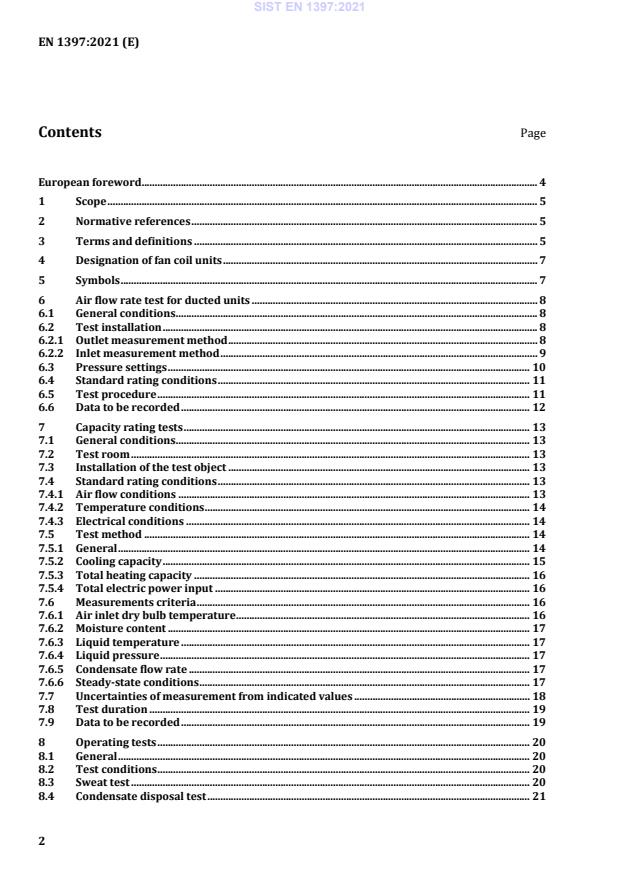
Contents Page
European foreword . 4
1 Scope . 5
2 Normative references . 5
3 Terms and definitions . 5
4 Designation of fan coil units . 7
5 Symbols . 7
6 Air flow rate test for ducted units . 8
6.1 General conditions . 8
6.2 Test installation . 8
6.2.1 Outlet measurement method . 8
6.2.2 Inlet measurement method . 9
6.3 Pressure settings . 10
6.4 Standard rating conditions . 11
6.5 Test procedure . 11
6.6 Data to be recorded . 12
7 Capacity rating tests . 13
7.1 General conditions . 13
7.2 Test room . 13
7.3 Installation of the test object . 13
7.4 Standard rating conditions . 13
7.4.1 Air flow conditions . 13
7.4.2 Temperature conditions . 14
7.4.3 Electrical conditions . 14
7.5 Test method . 14
7.5.1 General . 14
7.5.2 Cooling capacity . 15
7.5.3 Total heating capacity . 16
7.5.4 Total electric power input . 16
7.6 Measurements criteria . 16
7.6.1 Air inlet dry bulb temperature . 16
7.6.2 Moisture content . 17
7.6.3 Liquid temperature . 17
7.6.4 Liquid pressure . 17
7.6.5 Condensate flow rate . 17
7.6.6 Steady-state conditions . 17
7.7 Uncertainties of measurement from indicated values . 18
7.8 Test duration . 19
7.9 Data to be recorded . 19
8 Operating tests . 20
8.1 General . 20
8.2 Test conditions . 20
8.3 Sweat test . 20
8.4 Condensate disposal test . 21
9 Test report . 21
9.1 General information . 21
9.2 Additional information . 21
9.3 Test results . 21
10 Manufacturer's data . 22
Annex A (informative) Drawings of the different types of configurations of fan coil units . 23
A.1 General . 23
A.2 Non ducted units . 23
A.3 Ducted units . 24
Annex B (informative) Air flow rate test for non-ducted units . 26
B.1 General conditions . 26
B.2 Testing equipment . 26
B.3 Test installation . 26
B.4 Standard rating conditions . 26
B.5 Test procedure . 26
B.6 Data to be recorded. 27
Annex C (normative) Design of separation partition for testing of cassette type fan coil
units . 28
C.1 General . 28
C.2 1-way and 2-way cassette type . 28
C.3 4-way cassette type . 29
Annex ZA (informative) Relationship between this European Standard and the ecodesign
requirements of Commission Regulation (EU) No 2016/2281 (OJEU L346/1-50,
20.12.2016) aimed to be covered . 30
European foreword
This document (EN 1397:2021) has been prepared by Technical Committee CEN/TC 113 “Heat pumps
and air conditioning units”, the secretariat of which is held by UNE.
This European Standard shall be given the status of a national standard, either by publication of an
identical text or by endorsement, at the latest by March 2022, and conflicting national standards shall be
withdrawn at the latest by March 2022.
Attention is drawn to the possibility that some of the elements of this document may be the subject of
patent rights. CEN shall not be held responsible for identifying any or all such patent rights.
This document supersedes EN 1397:2015.
This document has been prepared under a Standardization Request given to CEN by the European
Commission and the European Free Trade Association, and supports essential requirements of EU
Directive(s) / Regulation(s).
For relationship with EU Directive(s) / Regulation(s), see informative Annex ZA, which is an integral part
of this document.
This document was prepared in the framework of the Commission Regulation (EU) 2016/2281 of
30 November 2016 implementing Directive 2009/125/EC of the European Parliament and of the Council
establishing a framework for the setting of ecodesign requirements for energy-related products, with
regard to ecodesign requirements for air heating products, cooling products, high temperature process
chillers and fan coil units.
Any feedback and questions on this document should be directed to the users’ national standards body.
A complete listing of these bodies can be found on the CEN website.
According to the CEN-CENELEC Internal Regulations, the national standards organisations of the
following countries are bound to implement this European Standard: Austria, Belgium, Bulgaria, Croatia,
Cyprus, Czech Republic, Denmark, Estonia, Finland, France, Germany, Greece, Hungary, Iceland, Ireland,
Italy, Latvia, Lithuania, Luxembourg, Malta, Netherlands, Norway, Poland, Portugal, Republic of North
Macedonia, Romania, Serbia, Slovakia, Slovenia, Spain, Sweden, Switzerland, Turkey and the United
Kingdom.
1 Scope
This document applies to hydronic fan coil units (FCU) as factory-made single assemblies which provide
the functions of cooling and/or heating but do not include the source of cooling or heating.
This document covers both air free delivery and air ducted units with a maximum external static pressure
due to duct resistance of 120 Pa max.
This document applies to all types of fan speed control of a fan coil unit (variable speed, multispeed).
This document deals with the cooling and heating functions of the FCU considered as an emitter for
cooling/heating of a room/space. It does not cover any ventilation function of the unit.
If the FCU can also provide fresh air, this function is not considered and the fresh air inlet closed during
testing.
This document provides a method for the determination of the thermal performance of fan coil units in
standard conditions, for the use with hot or chilled water or water mixtures. The test procedures given
in this standard may additionally be used for determining performance at other conditions.
It also provides the method for the determination of the air flow rate supplied by the fan coil unit.
This document does not cover the rating of heating or cooling from direct expansion coils or heating from
electric resistance elements.
This document does not cover acoustic performance of fan coil units which is dealt with in EN 16583.
It is not the purpose of this document to specify the tests used for production or field testing.
NOTE For the purpose of remaining clauses, the term “unit” is used to mean “fan coil unit” as defined in 3.1.
2 Normative references
The following documents are referred to in the text in such a way that some or all of their content
constitutes requirements of this document. For dated references, only the edition cited applies. For
undated references, the latest edition of the referenced document (including any amendments) applies.
EN ISO 5801:2017, Fans - Performance testing using standardized airways (ISO 5801:2017)
3 Terms and definitions
For the purposes of this document, the following terms and definitions apply.
ISO and IEC maintain terminological databases for use in standardization at the following addresses:
— IEC Electropedia: available at http://www.electropedia.org/
— ISO Online browsing platform: available at http://www.iso.org/obp
3.1
hydronic fan-coil unit
factory-made single assembly which provides one or more of the functions of forced circulation of air,
heating, cooling, dehumidification and filtering of air, but which does not include the source of heating or
cooling
Note 1 to entry: This device includes at least a liquid-to-air heat exchanger and a fan, and may be designed for
free or ducted intake air and/or for free or ducted delivery of supply air.
3.2
total heating capacity
total heat added to the air by the unit
3.3
total cooling capacity
total heat removed from the air by the unit which is the sum of the sensible and latent cooling capacities
3.4
sensible cooling capacity
heat which is removed from the air by means of a dry-bulb temperature drop
3.5
latent cooling capacity
heat which is removed from the air by condensation of water vapour on the cooling coil
3.6
total electric power input
total electric power absorbed by the unit, including fan(s) and auxiliary devices but excluding any
electrical resistance heater
Note 1 to entry: When a unit is equipped with a drain pump which continuously operates, the drain pump power
input is included in the total electric power input.
3.7
2-pipe fan coil unit
fan coil unit having a single coil, one supply pipe, supplying either cold or hot water to the unit, and one
return pipe
Note 1 to entry: The fan coil unit can include an electrical resistance for heating purpose, but not in operation
during testing.
3.8
4-pipe fan coil unit
fan coil unit having one coil with two independent water circuits for cooling and heating, or two
independent cooling/heating coils
3.9
standard rating condition
mandatory condition that is used for comparison purposes
3.10
application rating condition
optional rating condition which provides additional information on the performance of the unit
3.11
standard fan speed
fan speed setting declared by the manufacturer and used for setting the air flow rate conditions of ducted
units
Note 1 to entry: The fan speed setting can be declared by the manufacturer as a certain wiring, a switch position
or a steering voltage.
3.12
external static pressure
positive pressure difference measured between the air outlet and inlet sections of the unit
3.13
liquid pressure drop
negative pressure difference measured between the outlet and inlet connections of the liquid circuit of
the unit
4 Designation of fan coil units
Fan coil units can be ducted or non-ducted. They can be standing on the floor, hung on the wall, or fitted
into the ceiling or floor, with the inlet and outlet air sections located either on the front, back, bottom or
top of the unit.
Annex A provides a series of drawing schemes associated to designations to show typical existing
configurations.
5 Symbols
For the purposes of this document, the symbols indicated in Table 1 apply.
Table 1 — Symbols
Symbol Description Unit
cpL1 Specific heat capacity of liquid at inlet connection kJ/(kg K)
c Specific heat capacity of liquid at outlet connection kJ/(kg K)
pL2
h Specific enthalpy of liquid at inlet connection (= c × t ) kJ/kg
L1 pL1 L1
h Specific enthalpy of liquid at outlet connection (= c × t ) kJ/kg
L2 pL2 L2
Δh Vaporization heat of water (constant = 2460) kJ/kg
w
−1
n Rotational speed of the fan at air flow test min
−1
n Rotational speed of the fan at capacity test min
P Total electric power input W
elec
P Total electric power input in cooling mode W
elec_C
P Total electric power input in heating mode W
elec_H
P Latent cooling capacity W
lat
P Sensible cooling capacity W
sens
P Total cooling capacity W
C
P Total heating capacity W
H
P Atmospheric pressure kPa
atm
pA External static pressure Pa
q Mass flow rate of air kg/s
mA
q Mass flow rate of liquid g/s
mL
Symbol Description Unit
q Mass flow rate of condensate (air side) g/s
mW
t Liquid inlet temperature °C
L1
t Liquid outlet temperature °C
L2
t Air inlet dry bulb temperature °C
A
t Air inlet dew point temperature °C
Adp
t Air inlet wet bulb temperature °C
Aw
Δp Liquid side pressure drop kPa
L
6 Air flow rate test for ducted units
6.1 General conditions
The test is required to measure the outlet air flow rate of ducted units.
For non-ducted units or ducted units with a declared static pressure lower than 50 Pa at standard fan
speed, the test is optional and is described in the informative Annex B.
For testing, the unit shall include an air filter but no any other accessory for air inlet or diffusion or others.
Dampers for fresh air intake shall be closed.
NOTE 1 No modification such as sealing is made on the unit before testing.
If the unit includes flaps, they shall be adjusted in a fixed position according to the manufacturer
instructions. If this information is not available, their position shall correspond to the maximum
mechanical open position.
NOTE 2 This maximum mechanical open position might differ from the minimum airflow resistance.
6.2 Test installation
6.2.1 Outlet measurement method
The installation is described in Figure 1.
The air flow measurement equipment consists of a test chamber, an air flow measuring device and an
auxiliary fan.
The discharge section of the fan coil unit is connected to the test chamber through a ductwork having an
adjustable resistance. In case of several outlet sections, the ductwork shall contain all of them.
For units that can be ducted at the inlet, the tests are performed without inlet duct(s).
EN ISO 5801:2017, Category “B” installation may be used.
Key
1 object under test (with 0 Pa at the inlet)
2 measured air flow
3 external static pressure
4 ductwork
5 adjustable duct resistance (e.g. damper)
6 test chamber with airflow measuring apparatus
7 fan (may be inside or outside the discharge chamber)
Figure 1 — Schematic of test installation (outlet measurement method)
6.2.2 Inlet measurement method
The installation is described in Figure 2.
The fan coil unit is placed in a chamber. The air flow measuring device is connected to the entrance of
this chamber.
The outlet section of the unit is connected to a ductwork including a damper for adjusting the external
static pressure. In case of several outlet sections, the ductwork shall contain all of them.
EN ISO 5801:2017, Category “B” installation may be used.
Key
1 object under test (with 0 Pa at the inlet) 6 airflow measuring apparatus
2 measured air flow 7 fan
3 external static pressure 8 test chamber
4 ductwork 9 flow straightener
5 adjustable duct resistance (e.g. damper)
Figure 2 — Schematic of test installation (inlet measurement method)
6.3 Pressure settings
For the standard fan speed declared by the manufacturer, the following conditions shall be fulfilled:
— 0 Pa at the inlet of the unit;
— an external static pressure (ESP) of 50 Pa at the outlet of the unit;
— inside the test chamber a static pressure equal to 0 Pa.
For air flow rate measurements at other fan speeds than the standard fan speed, the following apply:
— no change in the position of the adjustable outlet duct resistance;
— 0 Pa at the inlet of the unit;
— inside the test chamber a static pressure equal to 0 Pa, so that the same network curve resistance is
used (see Figure 3).
Key
1 ductwork load curve
2 reference standard speed
3 other speeds
X external static pressure difference (Pa)
Y flow rate
Figure 3 — Setup external static pressure difference of ducted units other speeds
6.4 Standard rating conditions
The air flow rate measurement shall be made in isothermal conditions with dry coil, at an ambient
temperature of 20 °C and at nominal voltage and frequency as specified by the manufacturer, for all fan
speeds declared by the manufacturer.
6.5 Test procedure
The fan coil shall be dry and the liquid circulation pump shall be stopped.
The ESP of 50 Pa shall refer to standard air conditions (1,2 kg/m , 20 °C at atmospheric pressure).
Depending on the atmospheric conditions of the location, the ESP shall be set as stated in Formula (1).
ρ
lab
ESP ESP×
lab std
ρ
std
(1)
=
where
ESP is the external static pressure to be set at the atmospheric and temperature conditions of the
lab
location;
ESP is the external static pressure at standard air conditions and equals 50 Pa;
std
ρ is the air density at the atmospheric and temperature conditions of the location;
lab
ρ is the air density at standard air conditions.
std
The fan motor shall run for at least half an hour before measuring the flow rate.
The air flow rate measurement shall be conducted under steady-state conditions, which are assumed to
be achieved when the rotational speed of the fan motor(s) does not change by more than 1 % but not less
than 10 r/min within 15 min.
All the tests shall be performed within the permissible deviations specified in Table 2.
Table 2 — Permissible deviations from set values
Permissible deviations of the Permissible deviations of
Measured quantity arithmetic mean values from time-individual measured
set values values from set values
Ambient air: dry bulb temperature ±5 K ±5 K
Voltage ±1 % ±2 %
Pressure ±1 Pa ±5 Pa
6.6 Data to be recorded
The data to be recorded for the air flow rate test are given in Table 3. The table identifies the general
information required but is not intended to limit the data to be obtained.
Table 3 — Data to be recorded
Symbol Unit
Atmospheric pressur
...