

EN 13383-1:2002
(Main)Armourstone - Part 1: Specification
- Abstract
This European Standard specifies the properties of aggregates obtained by processing natural, manufactured or recycled materials and mixtures of these materials for use as armourstone.
It provides for the evaluation of conformity of the products to this European Standard.
NOTE 1 The requirements in this European Standard are based upon experience with armourstone types with an established pattern of use. Care should be taken when considering the use of armourstone from sources with no such pattern of use, e.g., recycled armourstone and armourstone arising from certain industrial by-products. Such armourstone, which should comply with all the requirements of this European Standard, could have other characteristics not included in Mandate M 125 that do not apply to the generality of armourstone types with an established pattern of use and when required, provisions valid at the place of use can be used to assess their suitability.
NOTE 2 Finer aggregates than specified in this European Standard are used in hydraulic structures. For such aggregates European Standards for other end uses of aggregates should be applied.
- Status
- Published
- Publication Date
- 07-May-2002
- Withdrawal Date
- 31-May-2004
- Technical Committee
- CEN/TC 154 - Aggregates
- Drafting Committee
- CEN/TC 154/SC 4 - Hydraulic bound and unbound aggregates
- Current Stage
- 9092 - Decision on results of review/2YR ENQ - revise - Review Enquiry
- Start Date
- 06-Oct-2006
- Completion Date
- 06-Oct-2006
- Directive
- 305/2011 - Regulation (eu) No 305/2011 of the European Parliament and of the Council of 9 march 2011 laying down harmonised conditions for the marketing of construction products and repealing council directive 89/106/eecOJ Ref: C, C 259 OJ Date: 08-Aug-2014
89/106/EEC - Construction productsOJ Ref: C, C 139, C 212, C 319 OJ Date: 06-Sep-2002


Overview
EN 13383-1:2002 - Armourstone: Part 1 - Specification (CEN) defines the required properties and conformity assessment for aggregates used as armourstone in hydraulic structures and other civil engineering works. It covers armourstone produced from natural, manufactured or recycled materials and sets the framework for declaring and verifying geometrical, physical, chemical and durability characteristics.
Key topics and technical requirements
- Scope & application
- Properties of coarse aggregates intended as armourstone; guidance on use of recycled or industrial by‑products (use with caution).
- Notes that finer aggregates for hydraulic use are covered by other aggregate standards.
- Geometrical requirements
- Grading types: coarse, light and heavy gradings (standard category designations appear in the standard: CP, LMA/LMB, HMA/HMB and declared gradings).
- Shape controls: length‑to‑thickness ratio, fragment content and particle shape categories.
- Surface characteristics: proportion of pieces with crushed or broken surfaces (rounded vs crushed).
- Physical, chemical and durability requirements
- Tests and limits for mechanical resistance, wear, freeze–thaw and salt crystallization resistance, and relevant chemical criteria (as required for the intended use).
- Sampling, testing and conformity
- Sampling and test procedures are referenced to Part 2 (EN 13383-2) and to established EN test methods (e.g., EN 932 series, EN 1097-1, EN 1367-2, EN 1744, EN 1926).
- Evaluation of conformity, designation, marking and labelling requirements.
- Factory production control & annex guidance
- Annex D (normative) on factory production control; informative annexes give guidance on grading limits, block integrity, resistance to weathering and descriptive properties.
- Regulatory linkage
- Informative Annex ZA links clauses to the EU Construction Products Directive.
Practical applications
- Design and specification of armourstone for:
- Seawalls, breakwaters, revetments, river training works and coastal protection.
- Gabions, riprap layers and other erosion control structures.
- Use cases include new construction, repair works and specification of imported or recycled rock for hydraulic engineering.
Who uses this standard
- Coastal, hydraulic and geotechnical engineers and designers
- Quarry operators, suppliers and manufacturers of armourstone
- Construction contractors and specifiers preparing bills of quantities
- Testing laboratories and conformity assessment bodies
- Regulators and procurement teams requiring standardized product declaration
Related standards
- EN 13383-2 (Armourstone - Part 2: Test methods)
- Relevant EN test methods referenced in the standard (EN 932, EN 933, EN 1097, EN 1367, EN 1744, EN 1926)
- Other aggregate standards for different end uses (e.g., concrete, roads, ballast)
EN 13383-1:2002 is the primary European specification for armourstone product properties and conformity - essential reading for anyone specifying or supplying rock for hydraulic protection works.
Relations
- Effective Date
- 28-Jan-2026
- Effective Date
- 28-Jan-2026
- Effective Date
- 28-Jan-2026
- Effective Date
- 28-Jan-2026
- Effective Date
- 28-Jan-2026
- Effective Date
- 28-Jan-2026
- Effective Date
- 28-Jan-2026
- Effective Date
- 28-Jan-2026
- Effective Date
- 28-Jan-2026
- Effective Date
- 28-Jan-2026
- Referred By
EN 1926:2006 - Natural stone test methods - Determination of uniaxial compressive strength - Effective Date
- 28-Jan-2026
- Effective Date
- 28-Jan-2026
- Effective Date
- 08-Jun-2022
- Effective Date
- 19-Jan-2023
- Effective Date
- 08-Jun-2022
Get Certified
Connect with accredited certification bodies for this standard

DIBt (Deutsches Institut für Bautechnik)
German Institute for Building Technology.
DIN CERTCO
DIN Group product certification.

Aboma Certification B.V.
Specialized in construction, metal, and transport sectors.
Sponsored listings
Frequently Asked Questions
EN 13383-1:2002 is a standard published by the European Committee for Standardization (CEN). Its full title is "Armourstone - Part 1: Specification". This standard covers: This European Standard specifies the properties of aggregates obtained by processing natural, manufactured or recycled materials and mixtures of these materials for use as armourstone. It provides for the evaluation of conformity of the products to this European Standard. NOTE 1 The requirements in this European Standard are based upon experience with armourstone types with an established pattern of use. Care should be taken when considering the use of armourstone from sources with no such pattern of use, e.g., recycled armourstone and armourstone arising from certain industrial by-products. Such armourstone, which should comply with all the requirements of this European Standard, could have other characteristics not included in Mandate M 125 that do not apply to the generality of armourstone types with an established pattern of use and when required, provisions valid at the place of use can be used to assess their suitability. NOTE 2 Finer aggregates than specified in this European Standard are used in hydraulic structures. For such aggregates European Standards for other end uses of aggregates should be applied.
This European Standard specifies the properties of aggregates obtained by processing natural, manufactured or recycled materials and mixtures of these materials for use as armourstone. It provides for the evaluation of conformity of the products to this European Standard. NOTE 1 The requirements in this European Standard are based upon experience with armourstone types with an established pattern of use. Care should be taken when considering the use of armourstone from sources with no such pattern of use, e.g., recycled armourstone and armourstone arising from certain industrial by-products. Such armourstone, which should comply with all the requirements of this European Standard, could have other characteristics not included in Mandate M 125 that do not apply to the generality of armourstone types with an established pattern of use and when required, provisions valid at the place of use can be used to assess their suitability. NOTE 2 Finer aggregates than specified in this European Standard are used in hydraulic structures. For such aggregates European Standards for other end uses of aggregates should be applied.
EN 13383-1:2002 is classified under the following ICS (International Classification for Standards) categories: 91.100.15 - Mineral materials and products. The ICS classification helps identify the subject area and facilitates finding related standards.
EN 13383-1:2002 has the following relationships with other standards: It is inter standard links to EN 1744-1:1998, EN 13383-2:2002, EN 932-3:2022, EN 1097-1:2023, EN 1744-3:2002, EN 933-3:2012, EN 1926:1999, EN 1367-2:2009, EN 932-5:2012, EN 16236:2018, EN 1926:2006, EN 16907-2:2018, EN 13383-1:2002/AC:2004, prEN 13383-1, FprEN 13383-1. Understanding these relationships helps ensure you are using the most current and applicable version of the standard.
EN 13383-1:2002 is associated with the following European legislation: EU Directives/Regulations: 305/2011, 89/106/EEC; Standardization Mandates: M/125. When a standard is cited in the Official Journal of the European Union, products manufactured in conformity with it benefit from a presumption of conformity with the essential requirements of the corresponding EU directive or regulation.
EN 13383-1:2002 is available in PDF format for immediate download after purchase. The document can be added to your cart and obtained through the secure checkout process. Digital delivery ensures instant access to the complete standard document.
Standards Content (Sample)
2003-01.Slovenski inštitut za standardizacijo. Razmnoževanje celote ali delov tega standarda ni dovoljeno.Armourstone - Part 1: SpecificationKamen za obloge pri vodnih zgradbah in drugih gradbenih delih - 1. del: SpecifikacijaEnrochements - Partie 1 : SpécificationsWasserbausteine - Teil 1: Anforderungen91.100.15Mineralni materiali in izdelkiMineral materials and productsICS:SIST EN 13383-1:2002enTa slovenski standard je istoveten z:EN 13383-1:200201-september-2002SIST EN 13383-1:2002SLOVENSKI
STANDARD
EUROPEAN STANDARDNORME EUROPÉENNEEUROPÄISCHE NORMEN 13383-1May 2002ICS 91.100.15English versionArmourstone - Part 1: SpecificationEnrochements - Partie 1: SpécificationsWasserbausteine - Teil 1: AnforderungenThis European Standard was approved by CEN on 25 March 2002.CEN members are bound to comply with the CEN/CENELEC Internal Regulations which stipulate the conditions for giving this EuropeanStandard the status of a national standard without any alteration. Up-to-date lists and bibliographical references concerning such nationalstandards may be obtained on application to the Management Centre or to any CEN member.This European Standard exists in three official versions (English, French, German). A version in any other language made by translationunder the responsibility of a CEN member into its own language and notified to the Management Centre has the same status as the officialversions.CEN members are the national standards bodies of Austria, Belgium, Czech Republic, Denmark, Finland, France, Germany, Greece,Iceland, Ireland, Italy, Luxembourg, Malta, Netherlands, Norway, Portugal, Spain, Sweden, Switzerland and United Kingdom.EUROPEAN COMMITTEE FOR STANDARDIZATIONCOMITÉ EUROPÉEN DE NORMALISATIONEUROPÄISCHES KOMITEE FÜR NORMUNGManagement Centre: rue de Stassart, 36
B-1050 Brussels© 2002 CENAll rights of exploitation in any form and by any means reservedworldwide for CEN national Members.Ref. No. EN 13383-1:2002 E
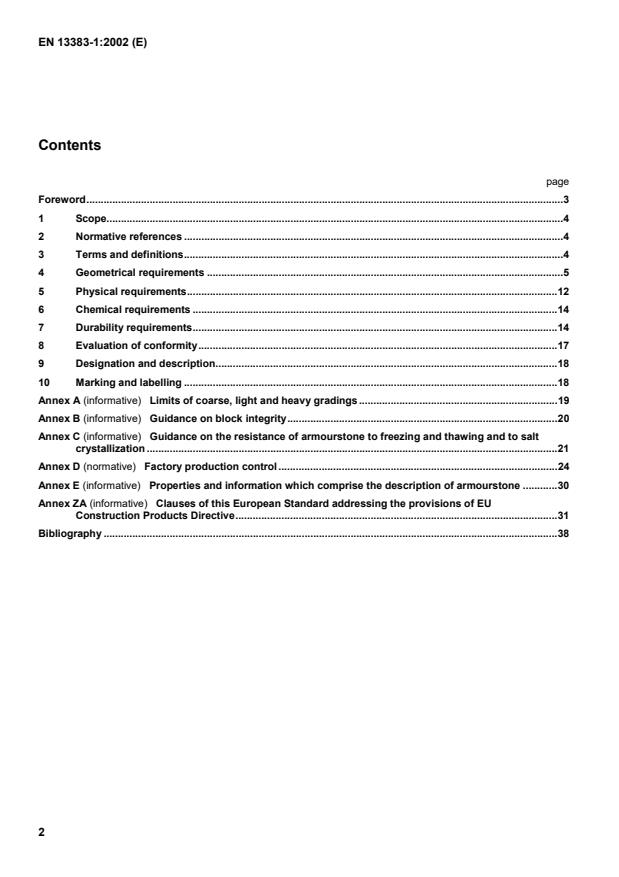
Limits of coarse, light and heavy gradings.19Annex B (informative)
Guidance on block integrity.20Annex C (informative)
Guidance on the resistance of armourstone to freezing and thawing and to saltcrystallization.21Annex D (normative)
Factory production control.24Annex E (informative)
Properties and information which comprise the description of armourstone.30Annex ZA (informative)
Clauses of this European Standard addressing the provisions of EUConstruction Products Directive.31Bibliography.38
construction.prEN 13450Aggregates for railway ballast.According to the CEN/CENELEC Internal Regulations, the national standards organizations of the followingcountries are bound to implement this European Standard: Austria, Belgium, Czech Republic, Denmark, Finland,France, Germany, Greece, Iceland, Ireland, Italy, Luxembourg, Malta, Netherlands, Norway, Portugal, Spain,Sweden, Switzerland and the United Kingdom.
ScopeThis European Standard specifies the properties of aggregates obtained by processing natural, manufactured orrecycled materials and mixtures of these materials for use as armourstone.It provides for the evaluation of conformity of the products to this European Standard.NOTE 1The requirements in this European Standard are based upon experience with armourstone types with an establishedpattern of use. Care should be taken when considering the use of armourstone from sources with no such pattern of use, e.g.,recycled armourstone and armourstone arising from certain industrial by-products. Such armourstone, which should comply withall the requirements of this European Standard, could have other characteristics not included in Mandate M 125 that do notapply to the generality of armourstone types with an established pattern of use and when required, provisions valid at the placeof use can be used to assess their suitability.NOTE 2Finer aggregates than specified in this European Standard are used in hydraulic structures. For such aggregatesEuropean Standards for other end uses of aggregates should be applied.2 Normative referencesThis European Standard incorporates by dated or undated reference, provisions from other publications. Thesenormative references are cited at the appropriate places in the text, and the publications are listed hereafter. Fordated references, subsequent amendments to or revisions of any of these publications apply to this EuropeanStandard only when incorporated in it by amendment or revision. For undated references the latest edition of thepublication referred to applies (including amendments).EN 932-3, Tests for general properties of aggregate — Part 3: Procedure and terminology for simplifiedpetrographic description.EN 932-5, Tests for general properties of aggregate — Part 5: Common equipment and calibration.EN 933-3, Tests for geometrical properties of aggregates — Part 3: Determination of particle shape — Flakiness index.EN 1097-1, Tests for mechanical and physical properties of aggregates — Part 1: Determination of the resistanceto wear (micro-Deval).EN 1367-2, Tests for thermal and weathering properties of aggregates — Part 2: Magnesium sulfate test.EN 1744-1:1998, Tests for chemical properties of aggregates — Part 1: Chemical analysis.prEN 1744-3, Tests for chemical properties of aggregates — Part 3: Preparation of eluates by leachingof aggregates.EN 1926:1999, Methods of test for natural stones — Determination of compressive strength.EN 13383-2:2002, Armourstone — Part 2: Test methods.3 Terms and definitionsFor the purposes of this European Standard, the following terms and definitions apply.3.1armourstonecoarse aggregates used in hydraulic structures and other civil engineering works
80 % by mass.c Fragments.4.2.2 Light gradingsThe mass distribution of light gradings shall be determined in accordance with EN 13383-2:2002, clause 6.The mass distribution of a bulk sample consisting of three samples from a stream of material or six samples from astatic batch shall conform to:
LTDeclaredNo requirementNo requirementNo requirementLTNR4.4 Proportion of crushed or broken surfacesWhen required, the proportion of pieces of armourstone (excluding fragments), with less than 50 % crushed orbroken surfaces (rounded pieces) shall conform to the relevant requirement (or the producer's declaration forcategory RODeclared) specified in Table 7 for the selected category. The sample tested shall be the sample used forthe determination of shape, see 4.3. The sample shall be examined by visual inspection and counting of pieces ofarmourstone.Table 7 — Categories for crushed or broken surfacesPieces of armourstone with less than50 % crushed or broken surfacesPercentage by numberCategoryRO 5Other value declared by the producerRO5
RODeclaredNo requirementRONRNOTE 1
Broken surfaces are understood to include surfaces arising fromdiscontinuities in the rock formation such as bedding planes and joints.NOTE 2
Category RO5 should only be applied to armourstone for use in structuresin which rounded pieces of armourstone could lead to instability.
CSDeclaredNo requirementNo requirementCSNRNOTEBlock integrity is also of particular importance. Armourstone should be free from significant discontinuities such ascracks, veins, stylolite seams, laminations, foliation planes, cleavage planes, unit contacts or other such flaws which could leadto breakage during loading, unloading or placing.
Guidance on block integrity is given in annex B.5.4 Resistance to wearWhen required, the resistance to wear of armourstone (excluding fragments), determined in accordance withEN 1097-1:1996, clause 7, shall conform to the relevant requirement (or the producer's declaration for categoryMDEDeclared) specified in Table 10 for the selected category.Table 10 — Categories for resistance to wear requirementsmicro-Deval coefficientCategoryMDE102030Other value declared by the producerMDE10MDE20MDE30
MDEDeclaredNo requirementMDENRNOTE
These requirements apply to top layers of armourstone which are known to besubject to attrition by sediment.
Suggested use of categories is as follows:Category MDE10: Very highly abrasive environment, e.g. frequently stormy seas with shinglestructure interaction, fluvial torrents, dynamic armour design concept.Category MDE20: Highly abrasive environment, e.g. occasionally stormy seas with shingle orsandy foreshore;Category MDE30: Moderately abrasive environment, e.g. occasional significant wave orcurrent action of suspended sediment load.The test portion shall be prepared in accordance with EN 1097-1:1996, clause 6.
Where suitable aggregaterepresentative of the armourstone is not available, the test portion shall be prepared in accordance withEN 1097-1:1996, clause 6, with the following variations specified in 5.4.1, 5.4.2 and 5.4.3.
However, some recycled materials couldhave other chemical characteristics not included in Mandate M 125 that do not apply to the generality of armourstone with anestablished pattern of use and when required, provisions valid at the place of use can be used to assess its suitability.Sampling shall be carried out as specified in EN 13383-2:2002, clause 4.6.2 ImpuritiesArmourstone shall not contain any foreign matter in a quantity that will cause damage to the structure or theenvironment in which it is used (see Table D.2).6.3 Water soluble constituentsWhen a determination of water soluble constituents is required, an eluate shall be prepared as specified inprEN 1744-3.7 Durability requirements7.1 GeneralThe necessity for testing for all properties in this clause is limited according to the particular application at end use ororigin of the armourstone.
When required, the tests specified in clause 7 shall be carried out to determine appropriatedurability properties.NOTE 1When the value of a property is required but not defined by specified limits the value should be declared by theproducer as an XXDeclared category, e.g. in Table 14 a value of a percentage loss of mass of 30 corresponds to MS30 (Declared value).NOTE 2When a property is not required, a “No requirement” category may be used.
0,5 % and maximum one pieceshows > 20 % loss of mass or cracksDSBOther values declared by the producer
DSDeclaredNo requirementDSNRFor categories DSA and DSB of Table 11, if one of the 20 pieces shows either cracks or more than 20 % loss ofmass, another 20 pieces of steel slag shall be tested. None of these additional pieces shall show either cracks ormore than 20 % loss of mass.7.3 Water absorption as a screening test for resistance to freezing and thawing and to salt crystallizationWhen required, the water absorption of armourstone (excluding fragments) shall be determined in accordance withEN 13383-2:2002, clause 8.If the water absorption is not greater than the value selected as category WA0,5 specified in Table 12, thearmourstone shall be assumed to be resistant to freezing and thawing and to salt crystallization. 10 Pieces ofarmourstone shall be tested.
0,5WA0,57.4 Resistance to freezing and thawingWhen required, the resistance to freezing and thawing of armourstone (excluding fragments) shall be determined inaccordance with EN 13383-2:2002, clause 9. The resistance to freezing and thawing shall conform to the relevantrequirements (or the producer's declaration for category FTDeclared) specified in Table 13 for the selected category.10 Pieces of armourstone shall be tested initially.If one of the tested pieces shows more than 0,5 % loss of mass or formation of open cracks, another 10 pieces ofarmourstone shall be tested.NOTE 1The pieces tested in conformity with clause 7.2 and showing maximum 0,5 % water absorption are excluded fromfurther testing.NOTE 2Guidance on how to specify the resistance of armourstone to freezing and thawing is given in annex C.Table 13 — Categories for resistance to freezing and thawingFreezing and thawingLoss of mass or formation of open cracksCategoryFTMaximum of one of the initially tested piecesand none of the additionally tested piecesshows more than 0,5 % loss of mass orformation of open cracks.FTAOther value declared by the producer
FTDeclaredNo requirementFTNR7.5 Resistance to salt crystallizationWhen required, the resistance to salt crystallization of armourstone (excluding fragments) shall be determined inaccordance with EN 1367-2:1998, clause 8. The resistance to salt crystallization shall conform to the relevantrequirement (or the producer's declaration for category MSDeclared) specified in Table 14 for the selected category.Where suitable aggregate representative of the armourstone is not available, the test portion shall be obtained bycrushing, using a laboratory jaw crusher, at least six separate pieces of armourstone for which the masses do notdiffer by more than 25 %.
MSDeclaredNo requirementMSNRNOTEGuidance on how to specify the resistance of armourstone to salt crystallization is given in annex C.7.6 SonnenbrandWhen required, the presence of signs of Sonnenbrand in armourstone (excluding fragments) from volcanic rocksources like some basalts, shall be determined in accordance with EN 13383–2:2002, clause 10. The presence ofsigns of Sonnenbrand shall conform to the relevant requirement (or the producer's declaration for categorySBDeclared) specified in Table 15 for the selected category.20 Pieces of armourstone shall be tested initially. If one piece shows signs of Sonnenbrand, another 20 pieces ofarmourstone shall be tested.Table 15 — Categories for signs of SonnenbrandSigns of SonnenbrandCategorySBMaximum of one piece of the initially tested pieces and noneof the additionaly tested pieces shows signs of SonnenbrandSBAOther value declared by the producer
SBDeclaredNo requirementSBNR8 Evaluation of conformity8.1 GeneralThe producer shall undertake initial type tests (see 8.2) and factory production control (see annex D) to ensure thatthe product conforms to this European Standard and to declared values as appropriate.8.2 Initial type testsInitial type tests relevant to the intended end use shall be carried out to check compliance with specifiedrequirements in the following circumstances:a) a new source of armourstone is to be used;b) there is a major change in the nature of the raw materials or in the processing conditions which may affect theproperties of the armourstone.The results of the initial tests shall be documented as the starting point of the factory production control for thatmaterial. This shall particularly include the identification of any components likely to emit radiation above normal
:Extreme lower limitNLL
:Nominal lower limit, aNUL
:Nominal upper limit, bEUL
:Extreme upper limitNOTE
See Tables 1, 2 and 4 for values of grading requirements.Figure A.1 -
...