

EN 16728:2026
(Main)LPG equipment and accessories - Transportable refillable LPG cylinders other than traditional welded and brazed steel cylinders - Periodic inspection
- Abstract
This document specifies procedures for periodic inspection and testing, for transportable refillable LPG cylinders with a water capacity from 0,5 l up to and including 150 l.
This document is applicable to the following:
- welded steel LPG cylinders manufactured to an alternative design and construction, according to EN 14140 or equivalent standard;
- welded aluminium LPG cylinders, according to EN 13110 or equivalent standard;
- composite LPG cylinders, according to EN 14427 or equivalent standard;
- over-moulded LPG cylinders designed and manufactured according to EN 1442 or EN 14140;
see Annexes E and F.
This document can also be applied to stainless steel LPG cylinders designed according to national codes, see Clause A.3. This document can also be applied to composite LPG cylinders designed according to EN 12245, ISO 11119-3 and ISO 11119-4.
This document does not apply to cylinders permanently installed in vehicles.
- Status
- Published
- Publication Date
- 21-Apr-2026
- Technical Committee
- CEN/TC 286 - Liquefied petroleum gas equipment and accessories
- Current Stage
- 6060 - Definitive text made available (DAV) - Publishing
- Start Date
- 22-Apr-2026
- Due Date
- 03-Sep-2026
- Completion Date
- 22-Apr-2026

Overview
EN 16728:2026 is a European Standard published by CEN that specifies procedures for the periodic inspection and testing of transportable refillable LPG (liquefied petroleum gas) cylinders with a water capacity from 0.5 liters up to and including 150 liters. Unlike traditional welded and brazed steel cylinders, this standard covers modern cylinder types, including those of alternative welded steel design, welded aluminum, composite construction, over-moulded, and some stainless steel cylinders designed under national codes.
The standard aims to ensure the ongoing safety and integrity of LPG cylinders that are re-used and refilled over their service life. It excludes cylinders that are permanently installed in vehicles.
Key Topics
EN 16728:2026 addresses several critical areas concerning the periodic inspection of LPG cylinders:
Cylinder Types Covered
- Welded steel LPG cylinders of alternative design (to EN 14140 or equivalent)
- Welded aluminum LPG cylinders (to EN 13110 or equivalent)
- Composite LPG cylinders (to EN 14427, EN 12245, ISO 11119-3, ISO 11119-4, or equivalent)
- Over-moulded LPG cylinders (to EN 1442 or EN 14140)
- Stainless steel cylinders as per national codes
Exclusions:
- Cylinders permanently installed in vehicles
Inspection Procedures:
- External and internal visual inspections
- Proof pressure testing (hydraulic or pneumatic as appropriate)
- Inspection of valve and thread condition
- Checking for corrosion, mechanical damage, markings, and attachments
Rejection and Disposition:
- Criteria for scrapping, repair, or re-testing of cylinders that do not pass inspection, ensuring unserviceable cylinders are rendered safe and cannot be reused
Final Operations:
- Marking, purging, weighing (tare mass), and coating requirements post-inspection
Documentation and Records:
- Requirements for maintaining inspection records and calibration data
Applications
EN 16728:2026 is highly relevant for organizations involved in the handling, inspection, reconditioning, and distribution of LPG cylinders across Europe and globally. Typical users include:
LPG Cylinder Inspection Facilities:
Ensures that facilities follow harmonized safety and inspection protocols, improving operational safety and regulatory compliance.Manufacturers and Distributors:
Provides guidelines for ongoing product integrity and supports compliance in international markets.Gas Utilities and Suppliers:
Helps maintain a safer cylinder fleet by mandating inspection intervals, detailed test methods, and proper record keeping.Authorities and Regulatory Bodies:
Offers a common basis for regulations and safety checks, and supports enforcement with clear criteria and referenced procedures.
The practical value of EN 16728:2026 lies in its comprehensive approach to cylinder inspection, contributing to the safety of LPG consumers, reducing environmental hazards associated with faulty cylinders, and enhancing the reliability of the LPG supply chain.
Related Standards
Several other international and European standards are referenced in EN 16728:2026, complementing its inspection processes:
- EN 14140: Alternative design and construction for welded steel LPG cylinders
- EN 13110: Welded aluminum LPG cylinders
- EN 14427: Composite LPG cylinders
- EN 14894: Cylinder and drum marking
- EN 14912: Inspection and maintenance of LPG cylinder valves
- EN 12816: Disposal of LPG cylinders
- EN ISO 14245 / EN ISO 15995: LPG cylinder valves - specifications and testing
- ISO 2859-1: Sampling procedures for inspection by attributes
Using EN 16728:2026 in conjunction with these related standards ensures a robust, standardized process for periodic inspection, maximizing cylinder safety and compliance throughout the LPG industry.
Keywords: EN 16728:2026, LPG cylinders, periodic inspection, CEN, composite cylinders, welded steel cylinders, aluminum LPG cylinders, LPG safety, gas cylinder inspection, European Standards, transportable refillable cylinders.
Relations
- Effective Date
- 29-Apr-2026
- Effective Date
- 05-Jun-2024
- Effective Date
- 06-May-2026
- Effective Date
- 06-May-2026
- Effective Date
- 06-May-2026
- Effective Date
- 06-May-2026
- Effective Date
- 06-May-2026
- Effective Date
- 06-May-2026
- Effective Date
- 06-May-2026
- Refers
EN 12816:2010 - LPG equipment and accessories - Transportable refillable LPG cylinders - Disposal - Effective Date
- 06-May-2026
- Refers
EN 10028-7:2016 - Flat products made of steels for pressure purposes - Part 7: Stainless steels - Effective Date
- 06-May-2026
- Effective Date
- 06-May-2026
- Effective Date
- 06-May-2026
- Effective Date
- 06-May-2026
- Effective Date
- 06-May-2026
Get Certified
Connect with accredited certification bodies for this standard

Institut za varilstvo d.o.o. (Welding Institute)
Slovenia's leading welding institute since 1952. ISO 3834, EN 1090, pressure equipment certification, NDT personnel, welder qualification. Only IIW Au
Sponsored listings
Frequently Asked Questions
EN 16728:2026 is a standard published by the European Committee for Standardization (CEN). Its full title is "LPG equipment and accessories - Transportable refillable LPG cylinders other than traditional welded and brazed steel cylinders - Periodic inspection". This standard covers: This document specifies procedures for periodic inspection and testing, for transportable refillable LPG cylinders with a water capacity from 0,5 l up to and including 150 l. This document is applicable to the following: - welded steel LPG cylinders manufactured to an alternative design and construction, according to EN 14140 or equivalent standard; - welded aluminium LPG cylinders, according to EN 13110 or equivalent standard; - composite LPG cylinders, according to EN 14427 or equivalent standard; - over-moulded LPG cylinders designed and manufactured according to EN 1442 or EN 14140; see Annexes E and F. This document can also be applied to stainless steel LPG cylinders designed according to national codes, see Clause A.3. This document can also be applied to composite LPG cylinders designed according to EN 12245, ISO 11119-3 and ISO 11119-4. This document does not apply to cylinders permanently installed in vehicles.
This document specifies procedures for periodic inspection and testing, for transportable refillable LPG cylinders with a water capacity from 0,5 l up to and including 150 l. This document is applicable to the following: - welded steel LPG cylinders manufactured to an alternative design and construction, according to EN 14140 or equivalent standard; - welded aluminium LPG cylinders, according to EN 13110 or equivalent standard; - composite LPG cylinders, according to EN 14427 or equivalent standard; - over-moulded LPG cylinders designed and manufactured according to EN 1442 or EN 14140; see Annexes E and F. This document can also be applied to stainless steel LPG cylinders designed according to national codes, see Clause A.3. This document can also be applied to composite LPG cylinders designed according to EN 12245, ISO 11119-3 and ISO 11119-4. This document does not apply to cylinders permanently installed in vehicles.
EN 16728:2026 is classified under the following ICS (International Classification for Standards) categories: 23.020.35 - Gas cylinders. The ICS classification helps identify the subject area and facilitates finding related standards.
EN 16728:2026 has the following relationships with other standards: It is inter standard links to EN 16728:2016+A2:2020/AC:2024, EN 16728:2016+A2:2020, EN 14912:2022, EN ISO 15995:2021, ISO 2859-1:1999/Amd 1:2011, ISO 2859-1:1999, EN 837-1:1996, ISO 2859-1:1999/Cor 1:2001, EN 14427:2022, EN 12816:2010, EN 10028-7:2016, EN ISO 4628-3:2024, EN 14894:2021, EN 14140:2014, EN ISO 14245:2021. Understanding these relationships helps ensure you are using the most current and applicable version of the standard.
EN 16728:2026 is associated with the following European legislation: EU Directives/Regulations: 2008/68/EC; Standardization Mandates: M/TDG. When a standard is cited in the Official Journal of the European Union, products manufactured in conformity with it benefit from a presumption of conformity with the essential requirements of the corresponding EU directive or regulation.
EN 16728:2026 is available in PDF format for immediate download after purchase. The document can be added to your cart and obtained through the secure checkout process. Digital delivery ensures instant access to the complete standard document.
Standards Content (Sample)
SLOVENSKI STANDARD
01-junij-2026
Nadomešča:
SIST EN 16728:2016+A2:2020
SIST EN 16728:2016+A2:2020/AC:2024
Oprema in pribor za utekočinjeni naftni plin (UNP) - Premične, ponovno polnljive
jeklenke za UNP iz jekla, ki niso varjene in trdo spajkane - Periodična kontrola
LPG equipment and accessories - Transportable refillable LPG cylinders other than
traditional welded and brazed steel cylinders - Periodic inspection
Flüssiggas-Geräte und Ausrüstungsteile - Ortsbewegliche, wiederbefüllbare Flaschen für
Flüssiggas (LPG), ausgenommen geschweißte und hartgelötete Stahlflaschen -
Wiederkehrende Inspektion
Équipements pour GPL et leurs accessoires - Bouteilles transportables et rechargeables
pour GPL autres que celles en acier soudé et brasé - Contrôle périodique
Ta slovenski standard je istoveten z: EN 16728:2026
ICS:
23.020.35 Plinske jeklenke Gas cylinders
2003-01.Slovenski inštitut za standardizacijo. Razmnoževanje celote ali delov tega standarda ni dovoljeno.
EN 16728
EUROPEAN STANDARD
NORME EUROPÉENNE
April 2026
EUROPÄISCHE NORM
ICS 23.020.35 Supersedes EN 16728:2016+A2:2020
English Version
LPG equipment and accessories - Transportable refillable
LPG cylinders other than traditional welded and brazed
steel cylinders - Periodic inspection
Équipements pour GPL et leurs accessoires - Bouteilles Flüssiggas-Geräte und Ausrüstungsteile -
transportables et rechargeables pour GPL autres que Ortsbewegliche, wiederbefüllbare Flaschen für
celles en acier soudé et brasé - Contrôle périodique Flüssiggas (LPG), ausgenommen geschweißte und
hartgelötete Stahlflaschen - Wiederkehrende
Inspektion
This European Standard was approved by CEN on 6 March 2026.
CEN members are bound to comply with the CEN/CENELEC Internal Regulations which stipulate the conditions for giving this
European Standard the status of a national standard without any alteration. Up-to-date lists and bibliographical references
concerning such national standards may be obtained on application to the CEN-CENELEC Management Centre or to any CEN
member.
This European Standard exists in three official versions (English, French, German). A version in any other language made by
translation under the responsibility of a CEN member into its own language and notified to the CEN-CENELEC Management
Centre has the same status as the official versions.
CEN members are the national standards bodies of Austria, Belgium, Bulgaria, Croatia, Cyprus, Czech Republic, Denmark, Estonia,
Finland, France, Germany, Greece, Hungary, Iceland, Ireland, Italy, Latvia, Lithuania, Luxembourg, Malta, Netherlands, Norway,
Poland, Portugal, Republic of North Macedonia, Romania, Serbia, Slovakia, Slovenia, Spain, Sweden, Switzerland, Türkiye and
United Kingdom.
EUROPEAN COMMITTEE FOR STANDARDIZATION
COMITÉ EUROPÉEN DE NORMALISATION
EUROPÄISCHES KOMITEE FÜR NORMUNG
CEN-CENELEC Management Centre: Rue de la Science 23, B-1040 Brussels
© 2026 CEN All rights of exploitation in any form and by any means reserved Ref. No. EN 16728:2026 E
worldwide for CEN national Members.
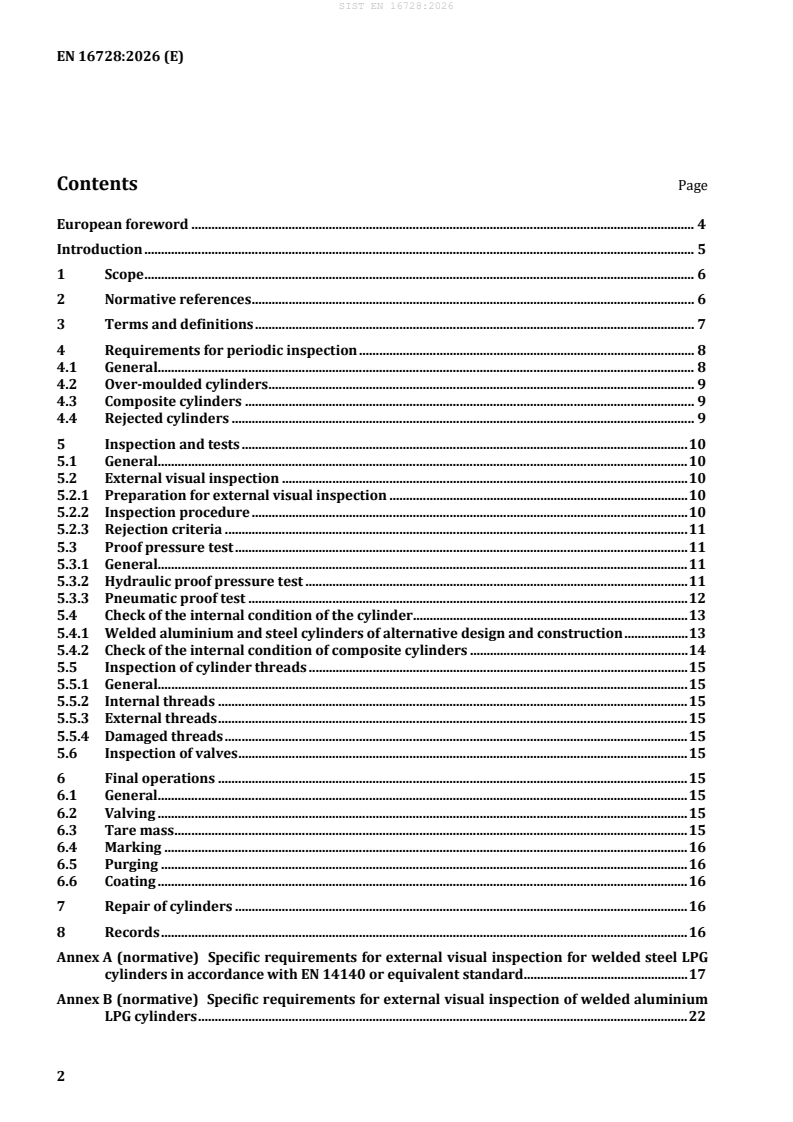
Contents Page
European foreword . 4
Introduction . 5
1 Scope . 6
2 Normative references . 6
3 Terms and definitions . 7
4 Requirements for periodic inspection . 8
4.1 General. 8
4.2 Over-moulded cylinders . 9
4.3 Composite cylinders . 9
4.4 Rejected cylinders . 9
5 Inspection and tests . 10
5.1 General. 10
5.2 External visual inspection . 10
5.2.1 Preparation for external visual inspection . 10
5.2.2 Inspection procedure . 10
5.2.3 Rejection criteria . 11
5.3 Proof pressure test . 11
5.3.1 General. 11
5.3.2 Hydraulic proof pressure test . 11
5.3.3 Pneumatic proof test . 12
5.4 Check of the internal condition of the cylinder . 13
5.4.1 Welded aluminium and steel cylinders of alternative design and construction . 13
5.4.2 Check of the internal condition of composite cylinders . 14
5.5 Inspection of cylinder threads . 15
5.5.1 General. 15
5.5.2 Internal threads . 15
5.5.3 External threads . 15
5.5.4 Damaged threads . 15
5.6 Inspection of valves . 15
6 Final operations . 15
6.1 General. 15
6.2 Valving . 15
6.3 Tare mass . 15
6.4 Marking . 16
6.5 Purging . 16
6.6 Coating . 16
7 Repair of cylinders . 16
8 Records . 16
Annex A (normative) Specific requirements for external visual inspection for welded steel LPG
cylinders in accordance with EN 14140 or equivalent standard . 17
Annex B (normative) Specific requirements for external visual inspection of welded aluminium
LPG cylinders . 22
Annex C (normative) Specific requirements for visual inspection of composite LPG cylinders . 25
Annex D (informative) Guidance on conditions for 10-year periodic inspection interval of
composite cylinders . 38
Annex E (normative) Specific periodic inspection procedure for over-moulded cylinders (OMC)
............................................................................................................................................................................. 40
Annex F (informative) Example of an over-moulded cylinder . 47
Bibliography . 49
European foreword
This document (EN 16728:2026) has been prepared by Technical Committee CEN/TC 286 “Liquefied
petroleum gas equipment and accessories”, the secretariat of which is held by NSAI.
This European Standard shall be given the status of a national standard, either by publication of an
identical text or by endorsement, at the latest by October 2026, and conflicting national standards shall
be withdrawn at the latest by October 2026.
Attention is drawn to the possibility that some of the elements of this document may be the subject of
patent rights. CEN shall not be held responsible for identifying any or all such patent rights.
This document supersedes EN 16728:2016+A2:2020.
This document has been prepared under a standardization request addressed to CEN by the European
Commission. The Standing Committee of the EFTA States subsequently approves these requests for its
Member States.
Any feedback and questions on this document should be directed to the users’ national standards body.
A complete listing of these bodies can be found on the CEN website.
According to the CEN-CENELEC Internal Regulations, the national standards organisations of the
following countries are bound to implement this European Standard: Austria, Belgium, Bulgaria, Croatia,
Cyprus, Czech Republic, Denmark, Estonia, Finland, France, Germany, Greece, Hungary, Iceland, Ireland,
Italy, Latvia, Lithuania, Luxembourg, Malta, Netherlands, Norway, Poland, Portugal, Republic of North
Macedonia, Romania, Serbia, Slovakia, Slovenia, Spain, Sweden, Switzerland, Türkiye and the United
Kingdom.
Introduction
This document deals with the periodic inspection requirements for transportable refillable LPG cylinders
that are not covered by EN 1440.
The primary objective of the periodic inspection of transportable refillable liquefied petroleum gas (LPG)
cylinders is that, on the completion of the tests, the cylinders can be re-introduced into service for a
further period of time.
The new designs of LPG cylinders have led to the development of alternative methods of inspection.
This document has been prepared to reflect the current methodology for periodic inspection of LPG
cylinders, and is based on extensive operating experience.
This document calls for the use of substances and procedures that can be injurious to health if adequate
precautions are not taken. It refers only to technical suitability and does not absolve the user from legal
obligations relating to health and safety at any stage.
Protection of the environment is a key political issue in Europe and elsewhere, for CEN/TC 286 this is
covered in CEN/TS 16765 [6], and this document should be read in conjunction with that.
It has been assumed in the drafting of this document that the execution of its provisions is entrusted to
appropriately qualified and experienced people.
Where judgements are called for, it has been assumed that they are made by competent persons who
have been specifically trained for the tasks.
This European Standard has been submitted for reference into the RID [1] and the technical annexes of
the ADR [2].
NOTE These regulations take precedence over any clause of this standard. It is emphasized that the RID [1] and
ADR [2] are being revised regularly at intervals of two years which can lead to temporary non- compliances with
the clauses of this standard.
1 Scope
This document specifies procedures for periodic inspection and testing, for transportable refillable LPG
cylinders with a water capacity from 0,5 l up to and including 150 l.
This document is applicable to the following:
— welded steel LPG cylinders manufactured to an alternative design and construction, according to
EN 14140 or equivalent standard;
— welded aluminium LPG cylinders, according to EN 13110 or equivalent standard;
— composite LPG cylinders, according to EN 14427 or equivalent standard;
— over-moulded LPG cylinders designed and manufactured according to EN 1442 or EN 14140 (see
Annexes E and F).
This document can also be applied to stainless steel LPG cylinders designed according to national codes,
see Clause A.3. This document can also be applied to composite LPG cylinders designed according to
EN 12245, ISO 11119-3 and ISO 11119-4.
This document does not apply to cylinders permanently installed in vehicles.
2 Normative references
The following documents are referred to in the text in such a way that some or all of their content
constitutes requirements of this document. For dated references, only the edition cited applies. For
undated references, the latest edition of the referenced document (including any amendments) applies.
EN 837-1:1996, Pressure gauges — Part 1: Bourdon tube pressure gauges — Dimensions, metrology,
requirements and testing
EN 837-3:1996, Pressure gauges — Part 3: Diaphragm and capsule pressure gauges — Dimensions,
metrology, requirements and testing
EN 1442:2017, LPG equipment and accessories — Transportable refillable welded steel cylinders for LPG —
Design and construction
EN 10028-7, Flat products made of steels for pressure purposes — Part 7: Stainless steels
EN 12816, LPG equipment and accessories — Transportable refillable LPG cylinders — Disposal
EN 14140:2014, LPG equipment and accessories — Transportable refillable welded steel cylinders for LPG
— Alternative design and construction
EN 14427:2022, LPG equipment and accessories — Transportable refillable composite cylinders for LPG —
Design and construction
EN 14894, LPG equipment and accessories — Cylinder and drum marking
EN 14912, LPG equipment and accessories — Inspection and maintenance of LPG cylinder valves at time of
periodic inspection of cylinders
As impacted by EN 837-1:1996/AC:1998
As impacted by EN 14140:2014/AC:2015
EN ISO 4628-3:2024, Paints and varnishes — Evaluation of quantity and size of defects, and of intensity of
uniform changes in appearance — Part 3: Assessment of degree of rusting (ISO 4628-3:2024)
EN ISO 14245, Gas cylinders — Specifications and testing of LPG cylinder valves — Self-closing (ISO 14245)
EN ISO 15995, Gas cylinders — Specifications and testing of LPG cylinder valves — Manually operated
(ISO 15995)
ISO 2859-1:1999, Sampling procedures for inspection by attributes — Part 1: Sampling schemes indexed
by acceptance quality limit (AQL) for lot-by-lot inspection
3 Terms and definitions
For the purposes of this document, the following terms and definitions apply.
ISO and IEC maintain terminology databases for use in standardization at the following addresses:
— ISO Online browsing platform: available at https://www.iso.org/obp/
— IEC Electropedia: available at https://www.electropedia.org/
3.1
competent authority
authority or authorities or any other body or bodies designated as such in each State and in each specific
case in accordance with domestic law
3.2
competent person
person who by combination of appropriate qualification, training, experience, and resources, is able to
make objective judgements on the subject
3.3
inspection body
independent inspection and testing body approved by the competent authority
3.4
liquefied petroleum gas
LPG
low-pressure liquefied gas composed of one or more light hydrocarbons, which are assigned to UN Nos.
1011, 1075, 1965, 1969 or 1978 only and which consists mainly of propane, propene, butane, butane
isomers, butene with traces of other hydrocarbon gases
3.5
minor repair
operations that include cleaning and replacement of components accessible without any dismantling of
the valve (e.g. outlet seal, excess flow device) and that do not affect the integrity of the pressure receptacle
EXAMPLE outlet seal, excess flow device.
As impacted by ISO 2859-1:1999/Cor 1:2001 and ISO 2859-1:1999/Amd 1:2011
3.6
over-moulded cylinder
OMC
pressure receptacle, intended for the carriage of LPG of a water capacity not exceeding 13 l, made of a
coated steel inner cylinder with an over-moulded protective case made from cellular plastic, which is
non-removable and bonded to the outer surface of the steel cylinder wall
3.7
periodic inspection
activity carried out at defined intervals, including but not limited to examining, measuring, testing,
gauging the characteristics of a pressure vessel and comparing these with specified requirements
3.8
protective casing
layer of protective material which gives mechanical protection which, either cannot be removed without
destroying it or is only removable with special tools or is bonded to the cylinder wall
Note 1 to entry: This definition can be applied to cylinders with over-moulded layers or with separate casings.
3.9
reconditioning
major repairs to cylinders, which can include hot work, welding or de-denting carried out by specialists
away from potential sources of flammable air/gas mixture
3.10
tare mass
sum of the mass of the empty cylinder, the mass of the valve including a dip tube where fitted, and the
mass of all other parts that are permanently attached to the cylinder when it is being filled
EXAMPLE Fixed valve guard.
3.11
sub-group of OMC
part of a basic population, owned by one single owner
Note 1 to entry: A basic population corresponds to a production of cylinders from only one over-moulding
manufacturer using new inner cylinders manufactured by only one manufacturer within one calendar year, based
on the same design type, the same materials and production processes
Note 2 to entry: A basic population is split into sub-groups, one per owner. If the whole basic population is owned
by one owner, the sub-group equals the basic population.
4 Requirements for periodic inspection
4.1 General
The interval between periodic inspections shall be dependent on the content of a written scheme.
Periodic inspections/tests shall be carried out by a competent person under the control of an inspection
body based on a written scheme and in accordance with the procedures specified in Table 1.
NOTE 1 A written scheme describes work procedures, criteria, responsibilities and other minimum
requirements.
NOTE 2 With the agreement of the competent authority an alternative to the proof pressure test of cylinders is
acoustic emission testing, ultrasonic examination or a combination of both.
NOTE 3 Tests can be performed in any order as determined by the written scheme.
4.2 Over-moulded cylinders
Table 1 and Annex E provide specific additional inspection requirements for over-moulded cylinders.
4.3 Composite cylinders
Annex D provides guidance for the determination of periodic inspection interval for composite cylinders.
4.4 Rejected cylinders
Rejected cylinders shall be segregated and be either reconditioned, re-tested or rendered unserviceable.
The decision to render a cylinder unserviceable may be taken at any stage during the periodic inspection
procedure. With agreement by the owner, a cylinder shall be rendered unserviceable in accordance with
EN 12816 such that it cannot be re-issued into service as a pressure vessel.
NOTE In some countries, rendered unserviceable means scrapping.
Table 1 — Requirements for periodic inspection
Cylinders types Procedures
Welded steel cylinders in — External visual inspection as described in 5.2 and Annex A;
conformance with EN 14140, or
— Proof pressure test (hydraulic proof pressure test or, with
equivalent standard.
the agreement of the competent authority, a pneumatic proof
test and leak test) as described in 5.3;
Welded steel cylinders in
— Internal condition checks as described in 5.4.1 and Annex A;
conformance with EN 14140, or
— Inspection of threads as described in 5.5;
equivalent standard
— Inspection of valves as described in 5.6.
— External visual inspection as described in 5.2 and Annex B;
— Proof pressure tests (hydraulic proof pressure test or, with
the agreement of the competent authority, a pneumatic proof
test and leak test) as described in 5.3;
Welded aluminium cylinders
— Internal condition checks as described in 5.4.1;
— Inspection of threads as described in 5.5;
— Inspection of valves as described in 5.6.
— External visual inspection as described in 5.2 and Annex C;
— Proof pressure test (hydraulic proof pressure test or, with
the agreement of the competent authority, a pneumatic proof
test and leak test) as described in 5.3;
Composite cylinders
— Internal condition checks as described in 5.4.2;
— Inspection of threads as described in 5.5;
— Inspection of valves as described in 5.6.
— External visual inspection as described in E.2.2;
— Burst Tests as described in E.2.3;
Over-moulded cylinders — Internal condition checks as described in 5.4;
— Inspection of threads as described in 5.5;
— Inspection of valves as described in 5.6.
5 Inspection and tests
5.1 General
Relevant cylinder data shall be identified before any inspections or tests are carried out. Cylinders which
cannot be safely emptied of gas shall be set aside for special handling. Cylinders with inoperative or
blocked valves shall be set aside for safe valve removal.
Before preparing for inspection, manufacturer's guidelines shall be taken into account to avoid any
damage to the cylinders.
Any chemical solutions and/or cleaning methods used shall be selected to ensure that they do not
adversely affect the cylinder material.
5.2 External visual inspection
5.2.1 Preparation for external visual inspection
a) If necessary, the cylinder shall be cleaned and have all loose coatings or labels, corrosive products,
tar, oil or other foreign matter removed from its external surface;
b) Care shall be taken to avoid damaging the cylinder;
c) When cylinders are treated by a process that might remove cylinder material, the inspection body
shall decide whether a thickness test is required, e.g. ultrasonic thickness check.
NOTE Cleaning methods include wire brushing, shot blasting (in accordance with EN ISO 8501-1 [7] and the
EN ISO 8504 series [8]), water jet cleaning, chemical cleaning or other suitable methods, that do not adversely affect
any part of the cylinders.
5.2.2 Inspection procedure
5.2.2.1 Welded steel and welded aluminium LPG cylinders
Cylinders shall be inspected for
a) dents, cuts, gouges, bulges, cracks, laminations or punctures, while applying the criteria for rejection
in Annex A and Annex B, as appropriate;
b) corrosion while applying the criteria for rejection in A.2 and Table B.2 as appropriate, giving special
attention to areas where water can be trapped;
EXAMPLE At the base of the cylinders;
— the junction between the cylindrical shell and the foot-ring;
— the junction between the cylindrical shell and the valve guard or shroud;
— the cylindrical shell and the valve guard or shroud; and
— hidden corrosion, e.g. under handles, applying the criteria for rejection given in Annex A and Annex B as
appropriate.
c) other defects (e.g. depressed bung or fire damage), while applying the criteria for rejection given in
Annex A and Annex B as appropriate;
d) integrity of all permanent attachments including protective casing where relevant; and
e) integrity of all mandatory permanent markings.
5.2.2.2 Composite cylinders
Cylinders shall be inspected for:
a) cuts, gouges, bulges, cracks or de-laminations, while applying the criteria for acceptance/rejection in
Annex C;
b) other defects, e.g. depressed bung or fire damage, while applying the criteria for acceptance/rejection
in Annex C;
c) integrity of all permanent attachments including protective casing; and
d) integrity of the mandatory permanent marking.
5.2.3 Rejection criteria
Details of defects and rejection limits are described in:
— Annex A for specific requirements for welded steel LPG cylinders manufactured in accordance with
EN 14140 or equivalent standard;
— Annex B for specific requirements for welded aluminium LPG cylinders; and
— Annex C for specific requirements for composite LPG cylinders.
5.3 Proof pressure test
5.3.1 General
The test shall consist of one of the proof pressure tests, as described in 5.3.2 and 5.3.3. The pneumatic
proof test shall only be implemented where such an operation does not entail any danger.
NOTE See also the ADR [2], chapter 6.2.1.6.1.
Pressure gauges that are used to read the cylinder test pressure shall be in accordance with
EN 837-1:1996 and EN 837-3:1996, accuracy class 1,6 or better. They shall be calibrated or checked for
accuracy against a master gauge, at regular intervals and not less frequently than once every six months.
The master gauge shall be calibrated in accordance with national requirements. All joints within the
system shall be leak tight. The test equipment shall not restrict the expansion of the cylinder.
Alternative methods of pressure measurement (e.g. by transducer) may be used if they achieve equivalent
accuracy.
5.3.2 Hydraulic proof pressure test
5.3.2.1 General
A liquid, compatible with the material of construction of the cylinder, shall be used as the test medium.
5.3.2.2 Preparation of cylinders
a) Cylinders shall be depressurized in a safe and controlled manner before proceeding.
b) The external surface of the cylinder shall be in such condition that any leak can be detected. If the
cleaning method involves the wetting of the outside surface or if the outside surface is wet due to
outdoor storage conditions, the outside surface shall be completely dried before commencing the test
procedure.
5.3.2.3 Test equipment
The design and installation of the equipment and the cylinders connected to it shall ensure that no air is
trapped in the system.
A device shall be fitted to the test equipment to ensure that no cylinder is subjected to pressure in excess
of its test pressure by more than the tolerance given in 5.3.2.4.
5.3.2.4 Procedure
a) Where appropriate, cylinders shall be positioned so that the welds are visible during the test.
b) The test pressure shall be at least the test pressure marked on the cylinder.
c) The pressure shall be gradually increased in the cylinder until the test pressure is reached.
d) The test pressure shall not be exceeded by more than 20 % or 6 bar, whichever is the least. More
than one cylinder can be tested at a time provided they all have a test pressure within the tolerance
specified. If the cylinder is tested at a higher pressure than that marked, the owner of the cylinder
shall calculate the maximum pressure not to be exceeded to ensure that the general membrane stress
in the cylinder wall does not exceed 95 % of the guaranteed minimum yield strength of the material
used in the finished cylinder.
e) The test pressure shall be held for the time necessary to inspect the cylinder and examine it for any
leak and/or other defects, but no less than 15 s.
f) If there is leakage in the pressure system, it shall be corrected and the cylinders re-tested.
g) Cylinders that do not leak or show any permanent visible distortion after the pressure has been
released shall be deemed to have passed this test. Cylinders, showing visible defects, shall be
examined by a competent person.
h) Cylinders that fail this test shall be rejected.
i) The inside of each cylinder shall be thoroughly dried by a suitable method immediately after the
pressure test, such that there is no trace of residual water.
j) Records of both passed and failed cylinders shall be in accordance with Clause 8.
5.3.3 Pneumatic proof test
5.3.3.1 Preparation of cylinders
a) Where it is necessary to depressurize a cylinder, this shall be carried out in a safe and controlled
manner before proceeding.
b) Repainting before the pneumatic test shall be limited to a primer coat. The finishing coat shall be
applied after the test in order not to mask potential leaks.
5.3.3.2 Procedure
a) Cylinders shall be tested in a safe enclosure to protect against rupture under pneumatic pressure.
Adequate safety procedures and measures, e.g. hearing protection, shall be adopted to protect
personnel in charge of the test.
b) The pressure of the test for a RID [1]/ADR [2] cylinder shall be at least the test pressure marked on
the cylinder.
c) Where a separate pressure relief valve is fitted, an adequate margin of safety shall be maintained
between the pneumatic proof test pressure and the pressure setting of the pressure relief valve.
Where necessary, the pressure relief valve shall be removed and the port plugged for testing.
d) After the cylinder has been placed in a safe enclosure, it shall be charged with the pneumatic test
medium (e.g. air, nitrogen) to the test pressure and held at that pressure for at least 5 s. The gas to
be used for testing shall be non-flammable to avoid any internal explosion risk. The cylinder shall
then be isolated from the pressure source.
e) The test pressure shall be held for the time necessary to inspect the cylinder and examine it for any
leak and/or other defects, but not less than 5 s.
f) If there is leakage in the pressure system, it shall be corrected and the cylinders re-tested.
g) Cylinders that do not leak or show any permanent visible distortion after the pressure has been
released shall be deemed to have passed this test. All other cylinders shall be set aside and examined
by a competent person.
NOTE It is important to take care to avoid corrosion if full water immersion is used.
h) Cylinders that fail this test shall be rejected.
i) Records of both passed and failed cylinders shall be in accordance with Clause 8.
5.4 Check of the internal condition of the cylinder
5.4.1 Welded aluminium and steel cylinders of alternative design and construction
5.4.1.1 General
The check shall consist of one of the following tests, see 5.4.1.2 and 5.4.1.3.
5.4.1.2 Internal visual inspection
5.4.1.2.1 Preparation of cylinders
a) Cylinders shall be depressurized in a safe and controlled manner before proceeding.
b) Valves shall be removed from cylinders.
c) Where necessary, residual liquid and possible foreign matter shall be removed from the inside of the
cylinder.
5.4.1.2.2 Procedure
a) Cylinders shall be inspected internally for any sign of corrosion or other defects that can affect their
integrity, using a safe inspection lighting system with appropriate internal illumination, e.g. an
endoscope.
b) Cylinders showing signs of internal corrosion, except those having only a film layer of surface rust,
shall be removed for further detailed evaluation in accordance with Table A.2.
c) If cleaning is required, care shall be taken to avoid damaging the cylinder walls. Cylinders shall be re-
inspected after cleaning.
5.4.1.3 Check of the minimum wall thickness
The wall thickness shall be measured, e.g. by ultrasonic method, according to the procedure agreed with
the competent authority, in a sufficient number of places, in order to guarantee the minimum wall
thickness of the entire cylinder. The measurements shall be compared to the required calculated
minimum wall thickness. If one of the measurements is lower than the required calculated minimum wall
thickness, the cylinder shall be rejected.
The required calculated minimum wall thickness shall be provided by the owner of the cylinder.
5.4.2 Check of the internal condition of composite cylinders
5.4.2.1 General
An internal visual inspection shall be performed on cylinders to detect internal defects or the presence
of foreign matter. For translucent/transparent composite cylinders, the internal visual inspection can be
made from outside without depressurizing the cylinder or removing the valve, provided that the internal
defects, as defined by the manufacturer, can be identified from the outside.
5.4.2.2 Preparation of cylinders
a) Cylinders shall be depressurized in a safe and controlled manner before proceeding.
b) Care shall be taken when clamping composite cylinders in order to avoid damage.
5.4.2.3 Procedure
a) Cylinders shall be inspected internally for any sign of corrosion or other defects that could affect their
integrity, using a safe inspection lighting system with appropriate internal illumination, e.g. an
endoscope.
b) Cylinders showing signs of internal corrosion, e.g. general corrosion, local corrosion, chain pitting or
line corrosion, crevice corrosion except those having only superficial surface rust, shall be removed
for further detailed evaluation.
c) Cylinders showing signs of internal defects, e.g. cracks, damaged liner or chemical attack, shall be
scrapped.
d) If cleaning is required, care shall be taken to avoid damaging the cylinder walls. Cylinders shall be re-
inspected after cleaning.
5.5 Inspection of cylinder threads
5.5.1 General
When the valve and any other fitting is removed during periodic inspection, the cylinder threads shall be
inspected in accordance with 5.5.2, 5.5.3 and 5.5.4.
5.5.2 Internal threads
The internal threads of the cylinder shall be visually inspected and cleaned of any foreign matter. The
leak-tightness of the valve onto the cylinder shall be checked after valving.
NOTE The leak-tightness test can be performed at the test station or at the filling station.
5.5.3 External threads
External neck threads, which are required for operational reasons, shall be examined for integrity and
for thread damage.
5.5.4 Damaged threads
Where necessary and where the design permits, damaged threads shall be repaired by a competent
person or the cylinder shall be rendered unserviceable in accordance with EN 12816.
5.6 Inspection of valves
Valves shall be inspected, repaired, refurbished or scrapped in accordance with EN 14912.
NOTE Regarding inspection of valves, see also standards in RID [1]/ADR [2].
6 Final operations
6.1 General
After hydraulic testing, effective precautions shall be taken to prevent internal corrosion and/or
contamination.
6.2 Valving
If the valve is removed for inspection or refurbishment, a new, inspected or refurbished valve, suitable
for the intended use, shall be fitted to the cylinder using a sealing material/system, applying a torque that
ensures a seal between the valve and cylinder.
The torque applied shall be consistent with both the cylinder and valve manufacturer’s
recommendations. The torque applied shall be checked at regular intervals using an appropriate and
calibrated torque wrench. Records of such measurements shall be maintained according to Clause 8.
New valves shall be in conformance with EN ISO 14245 or EN ISO 15995.
The leak-tightness of the valve or any other fitting onto the cylinder shall be checked after valving.
NOTE This leak tightness test can be performed at the test station or at the filling plant.
6.3 Tare mass
The tare mass or indication of tare mass of the cylinder shall be re-established if any modification or re-
valving has been made that affects the tare mass of the cylinder.
The scale used to confirm or determine the tare mass shall be calibrated.
Weight control scales shall be checked at least at the beginning of every shift to ensure that the tare mass
accuracy is met.
The set of weights used to check the scale shall be calibrated.
NOTE Information on calibration can be found in national regulations.
Records of such measurements shall be maintained according to Clause 8.
If the new tare indication is different from the old tare indication, steps shall be taken to ensure that the
former tare is unreadable.
6.4 Marking
After successful completion of the periodic inspection, each cylinder shall be legibly and durably marked
in accordance with EN 14894.
NOTE For over-moulded cylinders, see Annex E.
6.5 Purging
Air shall be removed from the cylinder, e.g. by displacement with LPG.
NOTE This can be performed at the test station or at the filling station.
6.6 Coating
For EN 14140 designed cylinders, any repainting, excluding respray, shall meet the requirements for the
resistance to external corrosion of EN 14140.
7 Repair of cylinders
Reconditioning and minor repairs of cylinders shall only be carried out with the agreement of the cylinder
manufacturer and according to a written scheme approved by an inspection body. The repairs shall only
be carried out by a competent person. All identification marks of the repaired cylinders shall be
maintained, e.g. by transferring or otherwise.
8 Records
The organization operating the periodic inspection station shall maintain records of the quality system,
inspection reports, test data, calibration data and reports concerning the qualifications or approvals of
the competent persons.
Inspection reports and test data for cylinders both passed and failed shall be held and maintained by the
organization operating the periodic inspection station for at least the retest period plus an additional 2
years.
NOTE An inspection report or test data can cover one or more cylinders.
Annex A
(normative)
Specific requirements for external visual inspection for welded steel LPG
cylinders in accordance with EN 14140 or equivalent standard
A.1 General
Where applicable, the protective casing shall be removed prior to inspection.
The owner of the cylinder, or their authorized representative, shall provide a written scheme to the
periodic inspection station, which contains acceptance/rejection criteria for the physical and material
defects and heat damage to the cylinder. If a written scheme is not provided then, the periodic inspection
shall not be carried out.
The procedure for establishing the acceptance/rejection criteria is described in A.2.
These criteria shall be at least those established by the manufacturer, taking into account the design
conditions of the cylinder, e.g. wall thickness, material, protective casing.
The procedure and the records of the test results shall be witnessed and assessed by a competent
authority.
The descriptions of defects for carbon steel cylinders are shown in Table A.1, Table A.2 and Table A.3. The
descriptions of defects for stainless steel cylinders are shown in Table A.4, Table A.5 and Table A.6.
A.2 Procedure for establishing rejection criteria carbon steel cylinders
The rejection criteria for the defects described in Table A.1, Table A.2 and Table A.3 shall be established
in accordance with the following procedure for each design of cylinder as defined in EN 14140:
— for each defect, four cylinders with the same defect shall be tested. The size of this defect shall be
recorded. If the defects of the cylinders are different sizes, the size of the smaller defect shall be
recorded;
— two cylinders shall be submitted to the burst test as described in EN 14140 and two cylinders shall
be submitted to the fatigue test as described in EN 14140;
— if the cylinders pass the tests, the defect shall be deemed acceptable. The rejection limit may then be
defined by the size of that defect;
— when all rejection criteria have been established for a design of cylinder as defined in EN 14140, and
Table A.1, Table A.2 and Table A.3 have been completed by the owner/manufacturer of the cylinder.
Table A.1 — Carbon steel cylinders - Physical defects in the cylinder wall
Defects Description Rejection limit
Bulge Visible swelling of the cylinder. All
a
Dent A depression in the cylinder that has See A.2
neither penetrated nor removed metal,
and its width at any point is greater than
2 % of the external cylinder diameter.
Cut or gouge A sharp impression where metal has See A.2
been removed or redistributed.
Intersecting cut or gouge The point of intersection of two or more All
cuts or gouges.
Dent containing cut or A depression in the cylinder within When the size of the dent or
gouge which there is a cut or gouge. cut or gouge exceeds the
dimensions for rejection as
an individual defect.
Crack A split or rift in the cylinder shell. All
Lamination Layering of the material within the All
cylinder wall appearing as a
discontinuity, crack, lap or bulge at the
surface.
a
Appearance, e.g. sharp dent, and location, e.g. on shoulder of the cylinder, also play a part in the evaluation
of dent severity.
Table A.2 — Carbon steel cylinders - Corrosion on the cylinder wall
Defects Description Rejection
limit
Isolat
...