

EN 1643:2022
(Main)Safety and control devices for burners and appliances burning gaseous and/or liquid fuels - Valve proving systems for automatic shut-off valves
- Abstract
EN 13611:2019, Clause 1 is replaced by following:
This document specifies the safety, design, construction and performance requirements, and testing for valve-proving systems, hereafter referred to as “VPS”, intended for use with gas burners and gas-burning appliances burning one or more gaseous fuels.
This document applies to all types of VPS used for the automatic detection of leakage in a gas burner section having at least two automatic shut-off valves, and which give a signal if the leakage of one of the valves, the piping in-between the valves or of the VPS itself and its components exceeds the detection limit.
This document applies to VPS for gases with a maximum inlet pressure up to and including 500 kPa.
This document does not apply to VPSs for use in explosive atmospheres.
This document is applicable to AC and DC supplied VPS (for VPS supplied by stand-alone battery system, battery systems for mobile applications, or VPS which are intended to be connected to DC supply networks, see Annex I).
- Status
- Published
- Publication Date
- 15-Nov-2022
- Technical Committee
- CEN/TC 58 - Safety and control devices for burners and appliances burning gaseous or liquid fuels
- Drafting Committee
- CEN/TC 58/WG 12 - Electronics
- Current Stage
- 6060 - Definitive text made available (DAV) - Publishing
- Start Date
- 16-Nov-2022
- Due Date
- 11-Aug-2022
- Completion Date
- 16-Nov-2022



Overview
EN 1643:2022 (CEN) specifies safety, design, construction, performance and testing requirements for valve proving systems (VPS) used with gas burners and gas-burning appliances. The standard applies to VPS units that automatically detect leakage in a gas-burner section containing at least two automatic shut-off valves, signaling when leakage of a valve, the piping between valves, or the VPS itself exceeds the detection limit. EN 1643:2022 covers VPS for gases with a maximum inlet pressure up to and including 500 kPa, is applicable to both AC and DC supplied VPS (with further DC specifics in Annex I), and excludes use in explosive atmospheres. This edition aligns with EN 13611:2019 and supersedes EN 1643:2014.
Key Topics
- Scope & definitions for valve-proving systems (VPS) in burner sections.
- Design and construction requirements for mechanical, material and gas connections.
- Performance requirements including leak-tightness, rated flow and durability testing.
- Electrical requirements and EMC: protection, immunity, surge and transient testing to ensure reliable operation in real-world supply conditions.
- Functional safety & diagnostics: guidance on protection against internal faults, reset functions and data exchange.
- Testing methods and measurement uncertainty, with annexes providing volumetric and pressure-loss leak test methods.
- Safety integrity and performance level guidance: Annexes provide methods for determining SIL (Safety Integrity Level) and PL (Performance Level), with clarification that SIL claims cannot be made solely by compliance with this standard.
- Annexes for special cases: Annex I (DC-supplied devices), Annex AA (application guidance), and normative annexes on seals, materials and pressure accessories.
Applications
EN 1643:2022 is intended for manufacturers, designers, test laboratories, system integrators, and regulatory bodies involved in:
- Designing and certifying valve proving systems for commercial and industrial gas burners and appliances.
- Verifying leak detection and automatic shut-off function in multi-valve burner sections.
- Integrating VPS into safety systems where reliable detection of valve or piping leakage is required.
- Developing AC-, DC- or battery-supplied VPS products and ensuring compliance with European national standards and directives.
Related Standards
Key normative references and companion standards:
- EN 13611:2019 - General requirements for safety and control devices
- EN 161:2022 - Automatic shut-off valves for gas appliances
- EN 60730-1 / EN 60730-2-5 - Automatic electrical controls
- EN 60947-5-1, EN 61810-1 - Controlgear and relay requirements
- Additional normative annexes in EN 1643:2022 provide test methods and material specifications.
EN 1643:2022 is essential for ensuring VPS product safety, regulatory compliance and reliable leak detection in gas-burning systems.
Relations
- Effective Date
- 23-Nov-2022
- Effective Date
- 09-Feb-2026
- Effective Date
- 09-Feb-2026
- Effective Date
- 09-Feb-2026
- Effective Date
- 09-Feb-2026
- Effective Date
- 09-Feb-2026
- Effective Date
- 09-Feb-2026
- Effective Date
- 09-Feb-2026
- Effective Date
- 09-Feb-2026
- Refers
EN 61810-1:2015 - Electromechanical elementary relays - Part 1: General and safety requirements - Effective Date
- 09-Feb-2026
- Effective Date
- 28-Jan-2026
- Effective Date
- 28-Jan-2026
- Effective Date
- 28-Jan-2026
- Effective Date
- 28-Jan-2026
- Effective Date
- 28-Jan-2026
Get Certified
Connect with accredited certification bodies for this standard

Institut za varilstvo d.o.o. (Welding Institute)
Slovenia's leading welding institute since 1952. ISO 3834, EN 1090, pressure equipment certification, NDT personnel, welder qualification. Only IIW Au
Sponsored listings
Frequently Asked Questions
EN 1643:2022 is a standard published by the European Committee for Standardization (CEN). Its full title is "Safety and control devices for burners and appliances burning gaseous and/or liquid fuels - Valve proving systems for automatic shut-off valves". This standard covers: EN 13611:2019, Clause 1 is replaced by following: This document specifies the safety, design, construction and performance requirements, and testing for valve-proving systems, hereafter referred to as “VPS”, intended for use with gas burners and gas-burning appliances burning one or more gaseous fuels. This document applies to all types of VPS used for the automatic detection of leakage in a gas burner section having at least two automatic shut-off valves, and which give a signal if the leakage of one of the valves, the piping in-between the valves or of the VPS itself and its components exceeds the detection limit. This document applies to VPS for gases with a maximum inlet pressure up to and including 500 kPa. This document does not apply to VPSs for use in explosive atmospheres. This document is applicable to AC and DC supplied VPS (for VPS supplied by stand-alone battery system, battery systems for mobile applications, or VPS which are intended to be connected to DC supply networks, see Annex I).
EN 13611:2019, Clause 1 is replaced by following: This document specifies the safety, design, construction and performance requirements, and testing for valve-proving systems, hereafter referred to as “VPS”, intended for use with gas burners and gas-burning appliances burning one or more gaseous fuels. This document applies to all types of VPS used for the automatic detection of leakage in a gas burner section having at least two automatic shut-off valves, and which give a signal if the leakage of one of the valves, the piping in-between the valves or of the VPS itself and its components exceeds the detection limit. This document applies to VPS for gases with a maximum inlet pressure up to and including 500 kPa. This document does not apply to VPSs for use in explosive atmospheres. This document is applicable to AC and DC supplied VPS (for VPS supplied by stand-alone battery system, battery systems for mobile applications, or VPS which are intended to be connected to DC supply networks, see Annex I).
EN 1643:2022 is classified under the following ICS (International Classification for Standards) categories: 23.060.40 - Pressure regulators. The ICS classification helps identify the subject area and facilitates finding related standards.
EN 1643:2022 has the following relationships with other standards: It is inter standard links to EN 1643:2014, EN 60730-2-5:2015/A2:2021, EN 60730-1:2016, EN 60730-2-5:2015/A1:2019, EN 61810-1:2015/A1:2020, EN 60947-5-1:2017, EN 60730-2-5:2015, EN 60730-1:2016/A2:2022, EN 60730-1:2016/A1:2019, EN 61810-1:2015, EN 161:2022, EN 13611:2019, EN 1854:2022, EN 126:2012, EN 298:2022. Understanding these relationships helps ensure you are using the most current and applicable version of the standard.
EN 1643:2022 is associated with the following European legislation: EU Directives/Regulations: 2014/68/EU, 2016/426; Standardization Mandates: M/071, M/BC/CEN/89/6. When a standard is cited in the Official Journal of the European Union, products manufactured in conformity with it benefit from a presumption of conformity with the essential requirements of the corresponding EU directive or regulation.
EN 1643:2022 is available in PDF format for immediate download after purchase. The document can be added to your cart and obtained through the secure checkout process. Digital delivery ensures instant access to the complete standard document.
Standards Content (Sample)
SLOVENSKI STANDARD
01-februar-2023
Nadomešča:
SIST EN 1643:2014
Varnostne in nadzorne naprave za gorilnike in aparate na plin in/ali tekoča goriva -
Sistemi za preskušanje avtomatskih zapornih ventilov
Safety and control devices for burners and appliances burning gaseous and/or liquid
fuels - Valve proving systems for automatic shut-off valves
Sicherheits-, Regel- und Steuereinrichtungen für Brenner und Brennstoffgeräte für
gasförmige und/oder flüssige Brennstoffe - Ventilüberwachungssysteme für
automatische Absperrventile
Dispositifs de commande et de sécurité pour brûleurs à gaz et appareils à gaz -
Systèmes de contrôle d'étanchéité pour robinets automatiques de sectionnement
Ta slovenski standard je istoveten z: EN 1643:2022
ICS:
23.060.40 Tlačni regulatorji Pressure regulators
27.060.01 Gorilniki in grelniki vode na Burners and boilers in
splošno general
2003-01.Slovenski inštitut za standardizacijo. Razmnoževanje celote ali delov tega standarda ni dovoljeno.
EN 1643
EUROPEAN STANDARD
NORME EUROPÉENNE
November 2022
EUROPÄISCHE NORM
ICS 23.060.40 Supersedes EN 1643:2014
English Version
Safety and control devices for burners and appliances
burning gaseous and/or liquid fuels - Valve proving
systems for automatic shut-off valves
Dispositifs de commande et de sécurité pour brûleurs à Sicherheits-, Regel- und Steuereinrichtungen für
gaz et appareils à gaz - Systèmes de contrôle Brenner und Brennstoffgeräte für gasförmige
d'étanchéité pour robinets automatiques de und/oder flüssige Brennstoffe -
sectionnement Ventilüberwachungssysteme für automatische
Absperrventile
This European Standard was approved by CEN on 2 October 2022.
CEN members are bound to comply with the CEN/CENELEC Internal Regulations which stipulate the conditions for giving this
European Standard the status of a national standard without any alteration. Up-to-date lists and bibliographical references
concerning such national standards may be obtained on application to the CEN-CENELEC Management Centre or to any CEN
member.
This European Standard exists in three official versions (English, French, German). A version in any other language made by
translation under the responsibility of a CEN member into its own language and notified to the CEN-CENELEC Management
Centre has the same status as the official versions.
CEN members are the national standards bodies of Austria, Belgium, Bulgaria, Croatia, Cyprus, Czech Republic, Denmark, Estonia,
Finland, France, Germany, Greece, Hungary, Iceland, Ireland, Italy, Latvia, Lithuania, Luxembourg, Malta, Netherlands, Norway,
Poland, Portugal, Republic of North Macedonia, Romania, Serbia, Slovakia, Slovenia, Spain, Sweden, Switzerland, Türkiye and
United Kingdom.
EUROPEAN COMMITTEE FOR STANDARDIZATION
COMITÉ EUROPÉEN DE NORMALISATION
EUROPÄISCHES KOMITEE FÜR NORMUNG
CEN-CENELEC Management Centre: Rue de la Science 23, B-1040 Brussels
© 2022 CEN All rights of exploitation in any form and by any means reserved Ref. No. EN 1643:2022 E
worldwide for CEN national Members.
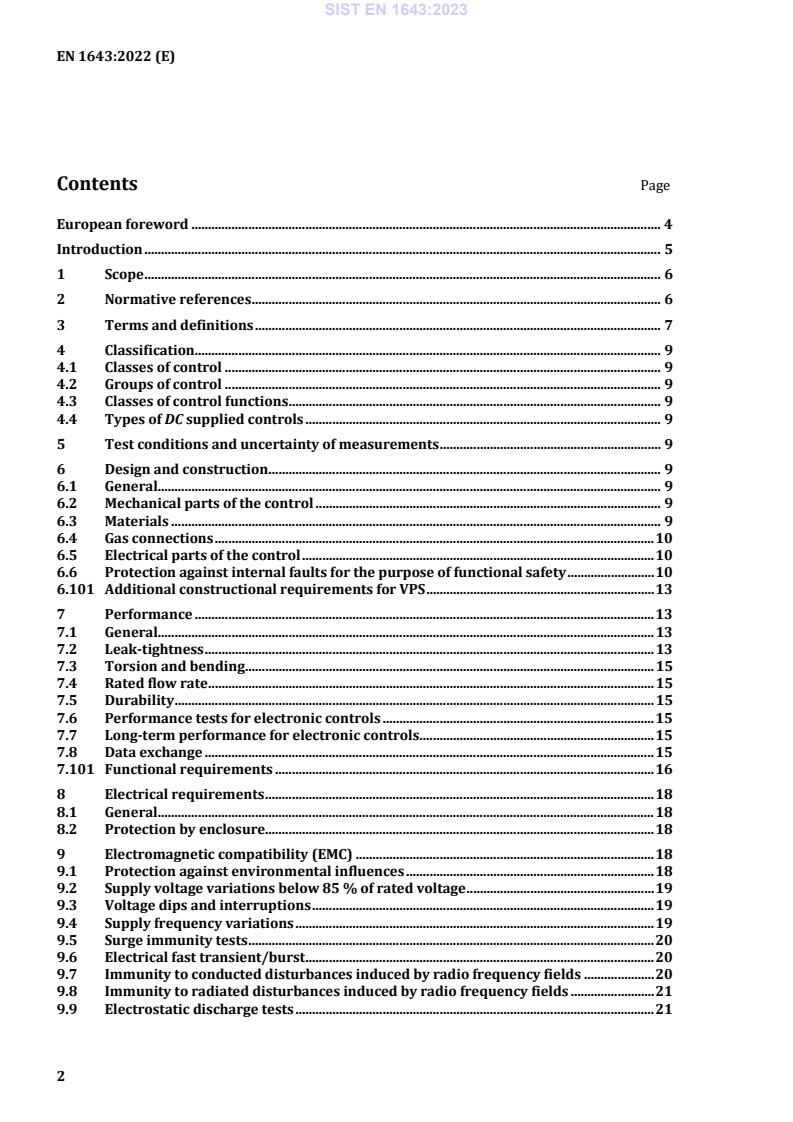
Contents Page
European foreword . 4
Introduction . 5
1 Scope . 6
2 Normative references . 6
3 Terms and definitions . 7
4 Classification. 9
4.1 Classes of control . 9
4.2 Groups of control . 9
4.3 Classes of control functions . 9
4.4 Types of DC supplied controls . 9
5 Test conditions and uncertainty of measurements . 9
6 Design and construction . 9
6.1 General. 9
6.2 Mechanical parts of the control . 9
6.3 Materials . 9
6.4 Gas connections . 10
6.5 Electrical parts of the control . 10
6.6 Protection against internal faults for the purpose of functional safety . 10
6.101 Additional constructional requirements for VPS . 13
7 Performance . 13
7.1 General. 13
7.2 Leak-tightness . 13
7.3 Torsion and bending . 15
7.4 Rated flow rate . 15
7.5 Durability . 15
7.6 Performance tests for electronic controls . 15
7.7 Long-term performance for electronic controls . 15
7.8 Data exchange . 15
7.101 Functional requirements . 16
8 Electrical requirements . 18
8.1 General. 18
8.2 Protection by enclosure. 18
9 Electromagnetic compatibility (EMC) . 18
9.1 Protection against environmental influences . 18
9.2 Supply voltage variations below 85 % of rated voltage . 19
9.3 Voltage dips and interruptions . 19
9.4 Supply frequency variations . 19
9.5 Surge immunity tests . 20
9.6 Electrical fast transient/burst . 20
9.7 Immunity to conducted disturbances induced by radio frequency fields . 20
9.8 Immunity to radiated disturbances induced by radio frequency fields . 21
9.9 Electrostatic discharge tests . 21
9.10 Power frequency magnetic field immunity tests . 21
9.11 Harmonics and interharmonics including mains signalling at AC power port, low
frequency immunity tests . 21
10 Marking, instructions . 22
10.1 Marking . 22
10.2 Instructions . 22
10.3 Warning notice . 22
Annex A (informative) Abbreviations and Symbols . 23
Annex B (informative) Leak-tightness tests for gas controls − volumetric method . 24
Annex C (informative) Leak-tightness tests for gas controls − pressure loss method . 25
Annex D (normative) Calculation of pressure loss into leakage rate . 26
Annex E (normative) Electrical/electronic component fault modes . 27
Annex F (normative) Additional requirements for safety accessories and pressure
accessories as defined in EU Directive 2014/68/EU . 29
Annex G (normative) Materials for pressurized parts . 30
Annex H (normative) Additional materials for pressurized parts . 31
Annex I (normative) Requirements for controls used in DC supplied burners and appliances
burning gaseous or liquid fuels . 32
I.1 Introduction . 32
Annex J (normative) Method for the determination of a Safety Integrity Level (SIL) . 34
Annex K (normative) Method for the determination of a Performance Level (PL) . 35
Annex L (informative) Relationship between Safety Integrity Level (SIL) and Performance
Level (PL) . 36
Annex M (normative) Reset functions . 37
Annex N (informative) Guidance document on Environmental Aspects . 38
Annex O (normative) Seals of elastomer, cork and synthetic fibre mixtures . 39
Annex AA (informative) Application Guidance . 40
AA.1 General . 40
AA.2 Use of a VPS . 40
Annex ZA (informative) Relationship between this document and the essential
requirements of Directive 2009/142/EC aimed to be covered . 41
Annex ZB (informative) Relationship between this European Standard and the essential
requirements of Regulation (EU) 2016/426 aimed to be covered . 42
Annex ZC (informative) Relationship between this document and the essential requirements
of Directive 2014/68/EU aimed to be covered . 43
Bibliography . 44
European foreword
This document (EN 1643:2022) has been prepared by Technical Committee CEN/TC 58 “Safety and
control devices for burners and appliances burning gaseous or liquid fuels”, the secretariat of which is
held by BSI.
This European Standard shall be given the status of a national standard, either by publication of an iden-
tical text or by endorsement, at the latest by May 2023, and conflicting national standards shall be with-
drawn at the latest by November 2025.
Attention is drawn to the possibility that some of the elements of this document may be the subject of
patent rights. CEN shall not be held responsible for identifying any or all such patent rights.
This document supersedes EN 1643:2014.
The following significant changes compared to the previous edition have been incorporated in this
document:
a) alignment with EN 13611:2019;
b) modification of the contents of Annex A: “Gas connections in common use in the various countries”
replaced by “Abbreviations and Symbols”.
Any feedback and questions on this document should be directed to the users’ national standards body.
A complete listing of these bodies can be found on the CEN website.
According to the CEN-CENELEC Internal Regulations, the national standards organisations of the
following countries are bound to implement this European Standard: Austria, Belgium, Bulgaria, Croatia,
Cyprus, Czech Republic, Denmark, Estonia, Finland, France, Germany, Greece, Hungary, Iceland, Ireland,
Italy, Latvia, Lithuania, Luxembourg, Malta, Netherlands, Norway, Poland, Portugal, Republic of North
Macedonia, Romania, Serbia, Slovakia, Slovenia, Spain, Sweden, Switzerland, Türkiye and the United
Kingdom.
Introduction
This document is intended to be used in conjunction with EN 13611:2019.
This document refers to clauses of EN 13611:2019 or adapts clauses by stating “with the following
modification”, “with the following addition”, “is replaced by the following” or “is not applicable” in the
corresponding clause.
This document adds clauses or subclauses to the structure of EN 13611:2019 which are particular to this
document. Subclauses which are additional to those in EN 13611:2019 are numbered starting from 101.
Additional Annexes are designated as Annex AA, Annex BB, Annex CC, etc. It should be noted that these
clauses, subclauses and Annexes are not indicated as an addition.
If by reference to EN 13611:2019 the term “control” is given, this term should be read as valve-proving
system.
EN 1643 compliance for valve-proving systems cannot be claimed based upon SIL classification according
to EN 61508.
SIL classification cannot be claimed based upon compliance with this standard only. A supplementary
method for SIL determination is specified in EN 13611:2019, Annex J.
1 Scope
EN 13611:2019, Clause 1 is replaced by following:
This document specifies the safety, design, construction and performance requirements, and testing for
valve-proving systems, hereafter referred to as “VPS”, intended for use with gas burners and gas-burning
appliances burning one or more gaseous fuels.
This document applies to all types of VPS used for the automatic detection of leakage in a gas burner
section having at least two automatic shut-off valves, and which give a signal if the leakage of one of the
valves, the piping in-between the valves or of the VPS itself and its components exceeds the detection
limit.
This document applies to VPS for gases with a maximum inlet pressure up to and including 500 kPa.
This document does not apply to VPSs for use in explosive atmospheres.
This document is applicable to AC and DC supplied VPS (for VPS supplied by stand-alone battery system,
battery systems for mobile applications, or VPS which are intended to be connected to DC supply
networks, see Annex I).
2 Normative references
EN 13611:2019, Clause 2 applies with the following additions:
The following documents are referred to in the text in such a way that some or all of their content
constitutes requirements of this document. For dated references, only the edition cited applies. For
undated references, the latest edition of the referenced document (including any amendments) applies.
EN 161:2022, Automatic shut-off valves for gas burners and gas appliances
EN 1854:— , Pressure sensing devices for gas burners and gas burning appliances
EN 13611:2019 , Safety and control devices for burners and appliances burning gaseous and/or liquid fuels
— General requirements
EN 60730-1:2016 , Automatic electrical controls — Part 1: General requirements (IEC 60730-1:2013,
modified)
EN 60730-2-5:2015 , Automatic electrical controls — Part 2-5: Particular requirements for automatic
electrical burner control systems (IEC 60730-2-5:2013)
EN 60947-5-1:2017 , Low-voltage switchgear and controlgear — Part 5-1: Control circuit devices and
switching elements — Electromechanical control circuit devices (IEC 60947-5-1:2016, modified)
Under preparation. Stage at the time of publication: FprEN 1854:2022.
As impacted by EN 13611:2019/AC:2021.
As impacted by EN 60730-1:2016/A1:2019 and EN 60730-1:2016/A2:2022.
As impacted by EN 60730-2-5:2015/A1:2019 and EN 60730-2-5:2015/A2:2021.
As impacted by EN 60947-5-1:2017/AC:2020-05.
EN 61810-1:2015 , Electromechanical elementary relays — Part 1: General and safety requirements
(IEC 61810-1:2015)
3 Terms and definitions
For the purposes of this document, the terms and definitions given in EN 13611:2019 apply with the
following modifications.
ISO and IEC maintain terminology databases for use in standardization at the following addresses:
• ISO Online browsing platform: available at https://www.iso.org/obp
• IEC Electropedia: available at https://www.electropedia.org/
3.23
safety shutdown
EN 13611:2019, 3.23 is replaced by 3.108.
3.101
valve proving system
VPS
system to check the effective closure of automatic shut-off valves by detecting leakage, that often consists
of a programming unit, a measuring device, valves and other functional assemblies
3.102
VPS programming unit
unit which follows a predetermined sequence of valve proving actions
3.103
detecting device
device for direct or inferential detection of leakage
Note 1 to entry: Leakage is detected by measuring flow or pressure.
3.104
VPS operational time
time taken by the VPS to perform its entire cycle of operation
3.105
detection limit
maximum amount of leakage that can occur before the VPS is required to give a signal
Note 1 to entry: See Figure 1.
3.106
detection setting
actual leakage rate at which the VPS gives a signal
Note 1 to entry: See Figure 1.
As impacted by EN 61810-1:2015/AC:2017-07, EN 61810-1:2015/AC:2018-04 and EN 61810-1:2015/A1:2020.
Key
X
burner heat input, gas flow, expressed in m /h
Y
detected leakage rate, expressed in dm /h
1 detection limit, see 3.105
2 detection setting, see 3.106
Figure 1 — Illustration of detection limit and detection setting
3.107
leakage testing time
time in which the VPS monitors a gas valve for leakage
3.108
safety shutdown
process which is effected immediately following the detection of a leakage exceeding the detection limit,
or detection of an internal fault, disabling energization of the ignition and of the automatic shut-off valves
3.109
volatile lock-out
safety shutdown condition of the VPS where a restart can only be accomplished by either a manual reset
of the VPS, or an interruption of the main power and its subsequent restoration
[SOURCE: EN 298:2022, 3.121.2]
3.110
non-volatile lock-out
safety shutdown condition of the VPS, where a restart can only be accomplished by a manual reset of the
VPS and by no other means
[SOURCE: EN 298:2022, 3.121.1]
3.111
automatic shut-off valves
valve which opens when energized and closes automatically when de-energized
Note 1 to entry: For further information refer to EN 161.
[SOURCE: EN 161:2022, 3.101]
4 Classification
4.1 Classes of control
EN 13611:2019, 4.1 is not applicable.
4.2 Groups of control
Shall be according to EN 13611:2019, 4.2.
4.3 Classes of control functions
Shall be according to EN 13611:2019, 4.3 with the following addition:
The VPS for automatic shut-off valves is a Class C control function.
4.4 Types of DC supplied controls
Shall be according to EN 13611:2019, 4.4.
5 Test conditions and uncertainty of measurements
Shall be according to EN 13611:2019, Clause 5.
6 Design and construction
6.1 General
Shall be according to EN 13611:2019, 6.1 with the following addition:
The VPS shall be designed such that changes in critical circuit component values (such as those affecting
timing or sequence) within the worst case tolerances of the components specification, including the long-
term stability, shall result in the VPS continuing to function in accordance with this document.
Compliance shall be checked by worst-case analysis.
The construction of any additional functions included in the VPS for which no provisions exist in this
document shall be such that they do not degrade its safe and correct operation.
Where components are used to complete the VPS, these components shall comply with the relevant
standard. Valves (e.g. for pressurizing and relieving the test section) integrated into the VPS functional
sequence shall comply with EN 161:2022, Class A, if not otherwise specified by a relevant appliance
standard. Pressure-sensing devices shall comply with EN 1854:— for combustible gases.
6.2 Mechanical parts of the control
Shall be according to EN 13611:2019, 6.2.
6.3 Materials
Shall be according to EN 13611:2019, 6.3.
6.4 Gas connections
Shall be according to EN 13611:2019, 6.4.
6.5 Electrical parts of the control
6.5.1 General
Shall be according to EN 13611:2019, 6.5.1.
6.5.2 Switching elements
6.5.2.1 Requirements
Shall be according to EN 13611:2019, 6.5.2.1 with the following addition:
The suitability of measures to maintain the capability to interrupt the energization of the shut-off valve
terminals by means of at least one switching element or a non-replaceable overcurrent protection device
has been interrupted shall be verified by 6.5.2.2.
6.5.2.2 Tests of protecting measures against failure of switching elements
Shall be according to EN 13611:2019, 6.5.2.2 with the following modifications:
For the purpose of this clause, the terms “safety related output terminals” or “output terminals” are
replaced by “shut-off valve terminals”.
Delete in the brackets of the first paragraph the words “contacts of”.
Add the following NOTE:
NOTE A switching element means semiconductors as well as electro-mechanic switching elements.
nd
Add to the end of the 2 paragraph the following text:
If the valve circuit of the automatic burner control system is always supplied by an integrated power
supply, the test shall be applied with this integrated power supply under worst-case conditions for the
highest short circuit current.
6.5.3 Electrical components
Shall be according to EN 13611:2019, 6.5.3.
6.6 Protection against internal faults for the purpose of functional safety
6.6.1 Design and construction requirements
Shall be according to EN 13611:2019, 6.6.1.
6.6.2 Class A
EN 13611:2019, 6.6.2 is not applicable.
6.6.3 Class B
EN 13611:2019, 6.6.3 is not applicable.
6.6.4 Class C
6.6.4.1 Design and construction requirements
Shall be according to EN 13611:2019, 6.6.4.1 with the following modification:
Replace the third paragraph by the following:
At least the following states are defined as unsafe states:
a) if during burner shutdown, the gas flow through a valve or by-passing valve is higher than the
detection limit value of that valve except for the function of the VPS;
b) if a test for leakage is outside the limits defined in 3.105 or 3.106 (see 6.101.2);
c) overriding the VPS sequence control of the safety shut-off valves by the automatic burner control
system, except for the normal function of the VPS;
d) preventing the VPS from going to a defined fault response.
VPS or safety-related (hardware) parts of the VPS that are not powered during the stand-by and the
running state of the appliance shall execute all relevant internal tests during powering-up of the VPS.
Once the VPS is operational, the required internal test to detect the first faults leading to one of the unsafe
states as given in a) to d) shall be executed every 3 s.
For this type of VPS, the second fault shall only be considered to occur when a start-up sequence has been
performed between the first and the second fault.
VPS that are powered during stand-by or running state of the appliance shall comply with the following:
— the reaction time to detect the first faults leading to one of the unsafe states as given in a) to d) is ≤ 3 s;
— the reaction time to detect second independent fault is ≤ 24 h.
The VPS shall be fail-safe. VPS which meet the requirements of this clause and EN 13611:2019, 6.6.1.1
are considered to be inherently fail-safe.
The circuitry and the construction of the VPS shall be such that they meet the requirements of 7.101 and
shall be appraised according to the requirements of 6.6.4.2, 6.6.4.3 and 6.6.4.4, and under the test
conditions and criteria of 6.6.5.
Components shall be dimensioned on the basis of the worst-case conditions which can arise in the VPS,
as stated within the design documentation.
6.6.4.2 First fault
EN 13611:2019, 6.6.4.2 is replaced by the following:
Any first fault (see Annex E) in any one component or any one fault together with any other fault arising
from that first fault shall result in either:
a) the VPS becoming inoperative with all valve terminals de-energized;
b) the VPS proceeding to safety shutdown within 3 s, followed by a non-volatile or volatile lock-out. The
lock-out may be executed by the VPS, or by another safety related control within the appliance
preventing the burner start up. During subsequent reset action, the VPS shall not operate any valves
or the pressurizing pump belonging to the valve. Subsequent reset from the lock-out condition under
the same fault condition results in the VPS returning to the volatile or non-volatile lock-out condition;
continue with fault assessment during lock-out or safety shutdown according to 6.6.4.4.3;
c) the VPS continuing to operate, the fault being identified during the next start-up sequence, the result
being a) or b);
d) the VPS remaining operational in accordance with all other requirements of this document
(see 7.101).
For VPS designed for use on non-permanent operating appliances list item c) is applicable, whereas list
item c) is not applicable for VPS designed for use on permanent operating appliances.
6.6.4.3 Second fault
Shall be according to EN 13611:2019, 6.6.4.3 with the following addition:
For VPS designed for use on non-permanent operating appliances EN 13611:2019, 6.6.4.3 a) is applicable,
whereas EN 13611:2019, 6.6.4.3 b) is applicable for VPS designed for use on permanent operating
appliances.
NOTE While conducting this test, the fault can be applied at any time. It is not necessary to wait 24 h before
applying the fault. If the fault was applied before 24 h and unacceptable results were obtained, the fault is applied
24 h after the first fault.
6.6.4.4 Faults during lock-out or safety shutdown
6.6.4.4.1 General
Shall be according to EN 13611:2019, 6.6.4.4.1.
6.6.4.4.2 First fault introduced during lock-out or safety shutdown
EN 13611:2019, 6.6.4.4.2 is replaced by the following:
During assessment, the first fault shall not be considered to occur within 24 h after lock-out or safety
shutdown is reached without an internal fault.
Any first fault (together with any other fault arising from that fault) in any one component (see Annex E),
induced while the VPS is in the safety shutdown or lock-out position, shall result in either:
a) the VPS remaining in safety shutdown or lock-out, with the shut-off valves remaining de-energized;
b) the VPS becoming inoperative with the shut-off valves remaining de-energized;
c) the VPS coming into operation again resulting in a) or b) as mentioned in this clause under the
condition that the shut-off valve terminals are energized not longer than the 3 s. If the cause of the
original safety shutdown or lock-out condition is no longer present and the VPS resumes operation,
it shall operate in accordance with the safety related functional requirements of this document and
the second fault assessment shall be carried out in accordance with 6.6.4.3.
NOTE While conducting this test, the fault can be applied at any time during the lock-out or safety shutdown
condition. It is not necessary to wait 24 h before applying the fault. If the fault was applied before 24 h and
unacceptable results were obtained, the fault is applied 24 h after reaching lock-out or safety shutdown.
6.6.4.4.3 Second fault introduced during lock-out or safety shutdown
Shall be according to EN 13611:2019, 6.6.4.4.3 with the following modifications:
Replace the last paragraph by the following:
NOTE While conducting this test, the fault can be applied at any time during the lock-out or safety shut-down
condition. It is not necessary to wait 24 h before applying the fault. If the fault was a
...