

CEN/TR 18058:2024
(Main)Continuous handling equipment and systems - Safety requirements for equipment for mechanical handling of unit loads - Interpretations relating to EN 619:2022
- Abstract
This document is a collection of interpretations related to the EN 619:2022.
Interpretations aim to improve the understanding of the clause(s) they are referring to and by that facilitating common understanding between manufacturers, installers, notified bodies, inspection bodies and national authorities.
Interpretations do not have the same status as the European standards to which they are related.
However, the application of interpretations give to the interested parties confidence that the relevant European standard has not been wrongly applied. This document is not applicable to the machinery or machinery components manufactured before the date of its publication.
- Status
- Published
- Publication Date
- 30-Apr-2024
- Technical Committee
- CEN/TC 148 - Continuous handling equipment and systems - Safety
- Current Stage
- 6060 - Definitive text made available (DAV) - Publishing
- Start Date
- 01-May-2024
- Due Date
- 13-Jan-2025
- Completion Date
- 01-May-2024

Overview
CEN/TR 18058:2024 - "Continuous handling equipment and systems - Safety requirements for equipment for mechanical handling of unit loads - Interpretations relating to EN 619:2022" is a CEN Technical Report issued May 2024 by CEN/TC 148. It is a collection of official interpretations of EN 619:2022 intended to improve the consistent understanding and application of safety requirements for conveyors and continuous handling equipment. Interpretations clarify clauses for manufacturers, installers, notified bodies, inspection bodies and national authorities. They do not replace EN 619:2022 but help confirm correct application. This document is not applicable to machinery manufactured before its publication.
Key Topics
This Technical Report addresses practical clarifications and examples for common conveyor safety issues, including:
- Area concept and access control - clarification of working, traffic and restricted areas and consequences if the area concept is not adopted.
- Crushing, shearing and draw-in points - interpretation of clearances (e.g., 120 mm–500 mm examples), nip/draw-in hazards and applicable guarding approaches.
- Preventing access at load entry/exit points - guidance for roller conveyors, carrying chain conveyors and twin-belt conveyors to prevent unintended access.
- Safety distances for overhead conveyors - examples and interpretation of lateral minimum distances (e.g., 0.5 m up to 2.5 m height) and accounting for swinging loads.
- Component distinctions and standards selection - e.g., difference between belt (rubber/metal band) and strap (textile webbing), and pointers to appropriate test standards.
- Mechanical guards, nip guards and transfer device access - guidance on guarding vertical/horizontal transfer devices, transfer cars, and pusher arrangements.
- EMC and strength of ropes/chains/belts - reference to electrical compatibility and mechanical strength considerations for lifting and conveying components.
Applications
CEN/TR 18058:2024 is practical for:
- Manufacturers and designers of conveyors and unit-load handling systems seeking consistent interpretation of EN 619:2022 clauses during design and testing.
- Installers and integrators verifying that guarding, distances and area concepts comply with common interpretations.
- Notified and inspection bodies performing conformity assessment and type-examination where consistent clause interpretation is required.
- Health & safety managers and national authorities using the interpretations to support risk assessments and regulatory decisions.
Practical benefits include reduced ambiguity in compliance checks, improved safety risk assessments, and more consistent application of EN 619:2022 across Europe.
Related Standards
- EN 619:2022 (primary standard)
- EN ISO 283:2015 and ISO 433:2017 (examples given in interpretations for conveyor belts)
- ISO 13854 (referenced where EN 619 does not cover specific hazards)
Keywords: CEN/TR 18058:2024, EN 619:2022, continuous handling equipment, conveyor safety, interpretations, unit loads, guarding, safety distances.
Frequently Asked Questions
CEN/TR 18058:2024 is a technical report published by the European Committee for Standardization (CEN). Its full title is "Continuous handling equipment and systems - Safety requirements for equipment for mechanical handling of unit loads - Interpretations relating to EN 619:2022". This standard covers: This document is a collection of interpretations related to the EN 619:2022. Interpretations aim to improve the understanding of the clause(s) they are referring to and by that facilitating common understanding between manufacturers, installers, notified bodies, inspection bodies and national authorities. Interpretations do not have the same status as the European standards to which they are related. However, the application of interpretations give to the interested parties confidence that the relevant European standard has not been wrongly applied. This document is not applicable to the machinery or machinery components manufactured before the date of its publication.
This document is a collection of interpretations related to the EN 619:2022. Interpretations aim to improve the understanding of the clause(s) they are referring to and by that facilitating common understanding between manufacturers, installers, notified bodies, inspection bodies and national authorities. Interpretations do not have the same status as the European standards to which they are related. However, the application of interpretations give to the interested parties confidence that the relevant European standard has not been wrongly applied. This document is not applicable to the machinery or machinery components manufactured before the date of its publication.
CEN/TR 18058:2024 is classified under the following ICS (International Classification for Standards) categories: 53.040.10 - Conveyors. The ICS classification helps identify the subject area and facilitates finding related standards.
CEN/TR 18058:2024 is available in PDF format for immediate download after purchase. The document can be added to your cart and obtained through the secure checkout process. Digital delivery ensures instant access to the complete standard document.
Standards Content (Sample)
SLOVENSKI STANDARD
01-september-2024
Naprave in sistemi za kontinuirni transport - Varnostne zahteve za opremo za
kontinuirni transport kosovnih tovorov - Razlage v zvezi z EN 619:2022
Continuous handling equipment and systems - Safety requirements for equipment for
mechanical handling of unit loads - Interpretations relating to EN 619:2022
Stetigförderer und Systeme — Sicherheitsanforderungen an mechanische
Fördereinrichtungen für Stückgut – Teil 1 : Auslegungen zur EN 619:2022
Equipements et systèmes de manutention continue - Prescriptions de sécurité pour les
équipements de manutention mécanique de charges isolées - Partie 1 : Interprétations
relatives à l'EN 619:2022
Ta slovenski standard je istoveten z: CEN/TR 18058:2024
ICS:
53.040.10 Transporterji Conveyors
2003-01.Slovenski inštitut za standardizacijo. Razmnoževanje celote ali delov tega standarda ni dovoljeno.
CEN/TR 18058
TECHNICAL REPORT
RAPPORT TECHNIQUE
May 2024
TECHNISCHER REPORT
ICS 53.040.10
English Version
Continuous handling equipment and systems - Safety
requirements for equipment for mechanical handling of
unit loads - Interpretations relating to EN 619:2022
Équipements et systèmes de manutention continue - Stetigförderer und Systeme -
Prescriptions de sécurité et de CEM pour les Sicherheitsanforderungen an mechanische
équipements de manutention mécanique des charges Fördereinrichtungen für Stückgut - Teil 1 :
isolées - Interprétations relatives à l'EN 619:2022 Auslegungen zur EN 619:2022
This Technical Report was approved by CEN on 15 April 2024. It has been drawn up by the Technical Committee CEN/TC 148.
CEN members are the national standards bodies of Austria, Belgium, Bulgaria, Croatia, Cyprus, Czech Republic, Denmark, Estonia,
Finland, France, Germany, Greece, Hungary, Iceland, Ireland, Italy, Latvia, Lithuania, Luxembourg, Malta, Netherlands, Norway,
Poland, Portugal, Republic of North Macedonia, Romania, Serbia, Slovakia, Slovenia, Spain, Sweden, Switzerland, Türkiye and
United Kingdom.
EUROPEAN COMMITTEE FOR STANDARDIZATION
COMITÉ EUROPÉEN DE NORMALISATION
EUROPÄISCHES KOMITEE FÜR NORMUNG
CEN-CENELEC Management Centre: Rue de la Science 23, B-1040 Brussels
© 2024 CEN All rights of exploitation in any form and by any means reserved Ref. No. CEN/TR 18058:2024 E
worldwide for CEN national Members.
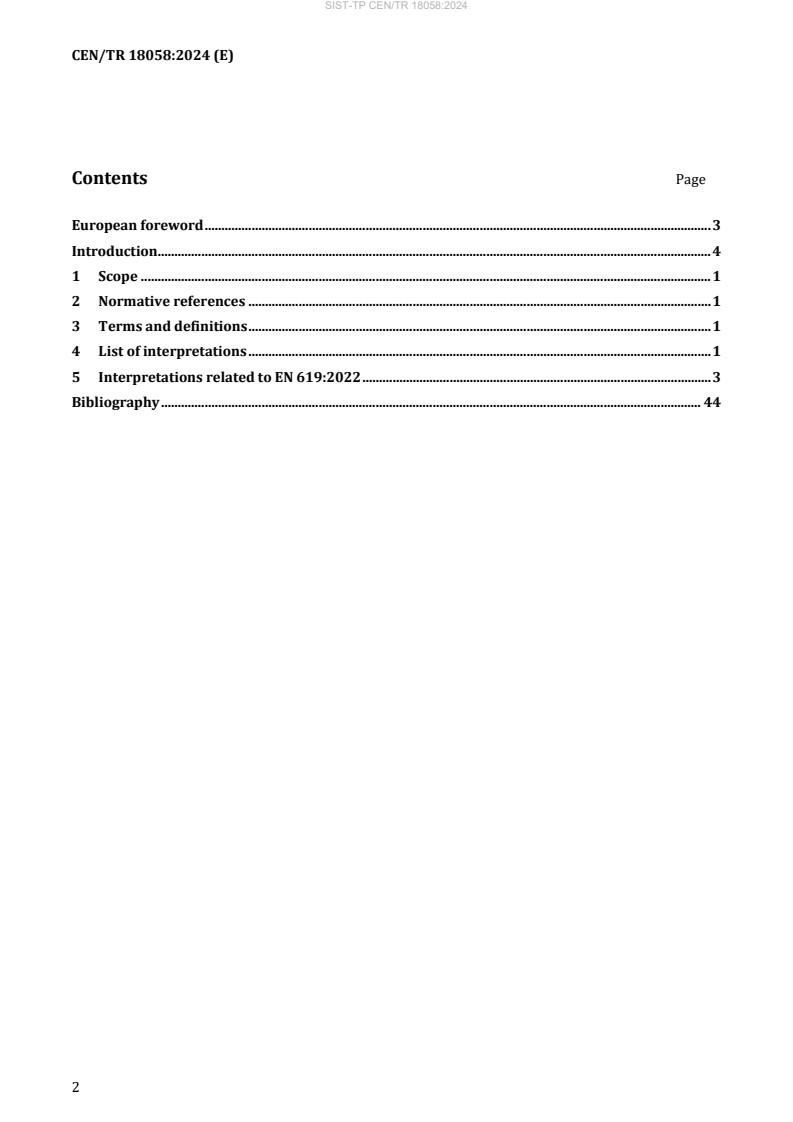
Contents Page
European foreword . 3
Introduction. 4
1 Scope . 1
2 Normative references . 1
3 Terms and definitions . 1
4 List of interpretations . 1
5 Interpretations related to EN 619:2022 . 3
Bibliography . 44
European foreword
This document (CEN/TR 18058:2024) has been prepared by Technical Committee CEN/TC 148
“Continuous handling equipment and systems - Safety”, the secretariat of which is held by AFNOR.
Attention is drawn to the possibility that some of the elements of this document may be the subject of
patent rights. CEN shall not be held responsible for identifying any or all such patent rights.
This document is a collection of interpretations related to the EN 619:2022.
Any feedback and questions on this document should be directed to the users’ national standards body.
A complete listing of these bodies can be found on the CEN website.
Introduction
Standards reflect the consensus of the best European expertise and are prepared with highest care.
Product standards cannot be formulated in such a way that they describe all possible technical solutions
and therefore exclude all uncertainties regarding the understanding of the required provisions. On the
other hand, technology is in a permanent evolution, the progress of which cannot be incorporated into
standards quickly enough.
Interpretations are a practical way to give:
a) answers to questions regarding the understanding of clauses in standards;
b) feedback to the CEN-Committee responsible for a standard about the practical experiences resulting
from the use of the standard;
c) guidance to further development and improvement of standards.
1 Scope
This document is a collection of interpretations related to the EN 619:2022.
Interpretations aim to improve the understanding of the clause(s) they are referring to and by that
facilitating common understanding between manufacturers, installers, notified bodies, inspection bodies
and national authorities.
Interpretations do not have the same status as the European standards to which they are related.
However, the application of interpretations give to the interested parties confidence that the relevant
European standard has not been wrongly applied. This document is not applicable to the machinery or
machinery components manufactured before the date of its publication.
2 Normative references
There are no normative references in this document.
3 Terms and definitions
No terms and definitions are given in this document.
4 List of interpretations
Interpretation - Date of
Related clause Keywords
No. validity
1 3.4 2023-03-28 Straps and belts
2 4.1.1 2023-06-15 Area concept
3 4.2.1.1.4 2023-03-28 Clearance shearing/ crushing points
Preventing access to danger areas across
4 4.2.8, 7) 2023-03-28 the load entry/exit points or stopping the
dangerous movement
Preventing access across the load
nd
5 4.2.9 2 section 2023-03-28
entry/exit points to restricted areas
Crushing and shearing points between
6 4.20.2.1 2023-03-28
roller conveyors and conveyed unit loads
7 4.20.8.2 2023-03-28 Safety distances for overhead conveyors
Strength of ropes, chains and belts for
8 4.2.4.2 /4.20.8.4.2 2023-06-15
lifting purposes
Transfer cars with short distance picking
9 4.20.9.3.3 2023-03-28
places
10 4.20.11.1 2023-03-28 Access to vertical transfer device
Vertical transfer device where riding on the
11 4.20.11.10 2023-03-28
lifting carriage is intended
Preventing access from the restricted area
12 4.20.11.3 2023-06-15 to the danger area of a vertical transfer
device
Preventing access from the working place
13 4.20.11.2/ Pic. D.12 2023-03-28 and traffic area to the danger area of
vertical transfer devices
14 4.20.12 2023-03-28 Horizontal transfer devices
Interpretation - Date of
Related clause Keywords
No. validity
15 Annex C / Fig. C.36 2023-06-15 Pusher, top-view
16 4.2.1.1.3/ 4.2.1.1.4 2023-03-29 Sensitive protective devices/distances
17 4.2.1.1.6 2023-03-29 Belt cover
18 4.2.8/3.1 2023-03-29 Interface area concept
19 4.2.8, 6) 2023-03-29 Mechanical guards
20 4.2.1.1.4 2023-03-29 Shearing and crushing
21 4.2.1.1.4 2023-06-15 Shearing and crushing
22 5.6 2023-03-29 EMC
23 4.2.1.1.6 2023-03-29 Draw-in points
Shearing/crushing between load and a
24 4.2.1.1.4 2023-06-15 fixed adjacent object
Crushing and shearing points between
25 4.20.2.1 2023-06-15
roller conveyors and conveyed unit loads
26 4.2.1.1.6 2023-06-15 Drawing-in points
27 4.2.1.2 2023-06-15 Safety related function for maximum speed
28 4.2.1.1.6 2023-09-12 Nip guards chain-drives
29 4.2.8 2023-09-12 Preventing access to danger areas
30 4.2.8 2023-09-12 Preventing access to danger areas
31 4.2.8 2023-09-12 Access; load entry/exit
carrying chain conveyors; net; preventing
32 4.2.8 2023-09-12
access
Impact hazard, moved goods, limited speed,
33 4.2.1.2 Table 1 2023-09-12
limited weight
5 Interpretations related to EN 619:2022
INTERPRETATION
No.: 1
CEN
RELATED TO
Page 1 of 1
Standard: Edition: Clause(s): Valid from:
3.4
EN 619 2022
Date of modification:
Key-word(s):
Replacing interpretation No.:
Straps and belt
QUESTION
What is the difference between straps and belt?
Is there a normative reference?
INTERPRETATION
The section is pointing out the hazard zone of the carrying element independent of the specific
technology used. The non-exhaustive list should provide examples for commonly used materials
in the industry.
The main difference between strap and a belt is:
- a belt (band of rubber or metallic) is on its driven side, flat
- a strap (flat woven textile webbing) can have on its driven side teeth
It is up to the manufacturer to evaluate the applicable standard for their equipment / component.
Examples of bibliographic references may include:
• EN ISO 283:2015 Textile conveyor belts – Full thickness tensile strength, elongation at break
and elongation at the reference load – Test method (ISO 283:2015)
• ISO 433:2017 Conveyor belts – Marking (ISO 433:2017, IDT)
Date of approval by CEN/TC 148/WG 2 members: 2023-03-28
INTERPRETATION
No.: 2
CEN
RELATED TO
Page 1 of 1
Standard: Edition: Clause(s): Valid from:
4.1.1
EN 619 2022
Date of modification:
Key-word(s):
Replacing interpretation No.:
Area Concept
QUESTION
If area concept isn´t used, what is the consequence?
INTERPRETATION
No Area Concept would mean from you have only danger area and working place, no exceptions are
allowed for traffic and restricted area via the standard. You are supposed to make a risk assessment
and try to make exceptions from danger area and working place for every detail, means a lot of work
and in relation to the standard, the solution needs to be proven.
Using some of the types of areas defined in EN 619:2022 or using the area concept globally, are not
compulsory.
Other standards give examples, placement of emergency stops, fire protection, escape paths and are
using some kind of concept to define the sufficient method of protection for a certain situation.
See for example the former edition EN 619:2002 + A1:2010, it was already defining requirements
based on an area concept.
Extracts from EN 619:2002 + A1:2010
3.1 working area
3.2 traffic area
3.3 transport area
…
5.1 Measures for protection against mechanical hazards
5.1.1 Measures for protection against crushing and shearing hazards
5.1.1.1 General
In the working and traffic area danger zones between powered and fixed components of horizontal
or points, feed points, diverting points, horizontal and vertical transfer devices and gates shall be
safeguarded. This shall be achieved e.g. by providing a continuous maximum gap of 5 mm between
moving and fixed components (see Figure D.1).
Alternatively, the danger zones shall be safeguarded e.g. by fences (wire mesh in accordance with EN
294), interlocking doors or gates or trip devices (photo electric devices, pressure sensitive mats). If the
load creates a danger zone, its most unfavourable position shall be taken into account.
Date of approval by CEN/TC 148/WG 2 members: 2023-06-152
INTERPRETATION
No.: 3
CEN
RELATED TO
Page 1 of 1
Standard: Edition: Clause(s): Valid from:
4.2.1.1.4
EN 619 2022
Date of modification:
Key-word(s):
Replacing interpretation No.:
Clearance shearing/ crushing points
QUESTION
For clearances a from 120 mm to below 500 mm between conveyed unit loads and fixed adjacent
objects or guards crushing and shearing points are intended to be prevented, …
Is this Key “a” in figure C.19 and C.20?
INTERPRETATION
Since in figures C.19 and C.20 key “a” is related to the clearance between moving load and fixed
nd
part of the installation (guard, any fixed adjacent object), subclause 4.2.1.1.4 (2 paragraph)
defines the applicable requirement when this value “a” varies from 120 mm to below 500 mm.
Currently in figure C.19 key a shows the clearance between the outside of the fence and the side
channel of the conveyor. This has been noted by the working group and will be fixed for the
ongoing revision. The key shall indicate the clearance between the moving load and fixed guard as
depicted in C.20.
ISO 13854 give some requirements for hazards which are not covered in EN 619
Date of approval by CEN/TC 148/WG 2 members: 2023-03-28
INTERPRETATION
No.: 4
CEN
RELATED TO
Page 1 of 1
Standard: Edition: Clause(s): Valid from:
4.2.8, 7)
EN 619 2022
Date of modification:
Key-word(s):
Replacing interpretation No.:
Preventing access to danger areas across the load entry/exit
points or stopping the dangerous movement
QUESTION
7) the access over and between gravity roller conveyors is considered to be prevented, if each of
the following requirements are met over the length “a” of at least 2,0 m (independent from the
height of the conveyor) (see Figure D.10):
b) the frame width “a” of the conveyor shall not exceed 40 mm or the possibility of walking on the
frame of the conveyor is minimized by the design of its surface, e.g. by profiles according 4.2.10
(see Figure D.1);
Is “a” in 7) and 7b) the same? If not, it is not so good to have the same letter for different values.
INTERPRETATION
In 4.2.8 indent 7), the value “a” refers to the length of the separating plate (see Figure D9 [top view]
and not as mentioned by error Figure D10 [front view] that has no key “a”).
In 4.2.8 indent 7) item b) the value “a” refers to the width of the frame (see Figure D1).
The mentioned issue will be raised in CEN/TC 148 /WG2 and will be taken into consideration for
future changes.
Date of approval by CEN/TC 148/WG 2 members: 2023-03-28
INTERPRETATION
No.: 5
CEN
RELATED TO
Page 1 of 1
Standard: Edition: Clause(s): Valid from:
nd
4.2.9 2 section
EN 619 2022
Date of modification:
Key-word(s):
Replacing interpretation No.:
Preventing access across the load entry/exit points to restricted
areas
QUESTION
In addition, access to restricted areas over roller conveyors, carrying chain conveyors and twin
belt conveyors is considered to be prevented if the requirements of 4.2.8, a), b), c), d), and 7) b)
and one of the following requirements are met:
Why is there “In addition” instead of “alternative” or “or”? This can be read that it must be used additively.
INTERPRETATION
nd
The standard in 4.2.9 in its 2 section, defines dedicated requirements for roller conveyors,
carrying chain conveyors and twin belt conveyors. These requirements are partially based on
those already defined in 4.2.8.
WG2 intended to provide an alternative access not an additional requirement. WG2 will take the
comment into consideration to improve the wording in the future.
Date of approval by CEN/TC 148/WG 2 members: 2023-03-28
INTERPRETATION
No.: 6
CEN
RELATED TO
Page 1 of 1
Standard: Edition: Clause(s): Valid from:
4.20.2.1
EN 619 2022
Date of modification:
Key-word(s):
Replacing interpretation No.:
Crushing and shearing points between roller conveyors and
conveyed unit loads
QUESTION
At workplaces, crushing and shearing points on roller conveyors . must be secured. In traffic and
maintenance areas the safeguarding can be omitted.
Why could the safeguarding be omitted in the maintenance area?
INTERPRETATION
“Safeguarding can be omitted” only refers to requirements raised in chapter 4.20.2.1.
The standard does not specify a maintenance area because it may appear in different ways
dependent on the system elements or conveyor types. (e.g. a parking position on a self-propelled
overhead conveyor or a temporary maintenance area for a pallet chain conveyor line.)
Note: The next part on the answer assumes the question is referring to restricted areas as defined
instead of the mentioned maintenance area.
The introduced area concept distinguishes between working place (see 3.1.1), traffic area (see
3.1.2) and restricted area (see 3.1.3). Whilst the restricted area may only be infrequently accessed
by qualified personnel the workplace is frequently accessed by operators working along the
installation. The access to restricted areas may be designed according to chapter 4.1.2, 4.2.8 or
4.2.9.
Additional requirements for specific conveyor types are outlined in subsequent chapters.
Date of approval by CEN/TC 148/WG 2 members: 2023-03-28
INTERPRETATION
No.: 7
CEN
RELATED TO
Page 1 of 1
Standard: Edition: Clause(s): Valid from:
4.20.8.2
EN 619 2022
Date of modification:
Key-word(s):
Replacing interpretation No.:
Safety distances for overhead conveyors
QUESTION
The overhead conveyors shall be stopped so as to leave a distance “a” in the direction of travel
between two mobile units and/or their loads of at least 0,5 m up to a height “b” of 2,5 m above the
standing surface of persons (see Figure C.3). Swinging of the mobile units shall be taken into
account.
— “a” = 0,5 m, above parts of structures or machines and above other traffic and transport means
which move under overhead conveyors where persons can be injured by crushing hazards (see
Figure C.4).
Why does the text say for distance a at least 0,5 m and the mirror line say “a” = 0,5 m?
INTERPRETATION
The current wording of standard clearly defines, in both requirements in 4.20.8.2, a value for the
distance of at least 0.5m:
4.20.8.2 Safety distances for overhead conveyors
A lateral minimum distance “a” of 0,5 m up to a height b of 2,5 m above the standing surface of persons
shall be maintained between the conveyors, their loads and fixed objects in the surroundings (see
Figure C.2). Where the lateral distance to fixed objects e.g. columns of the building is less than 0,5 m
additional measures shall be fitted, e.g. sloping plates or protective devices.
The overhead conveyors shall be stopped so as to leave a distance “a” in the direction of travel
between two mobile units and/or their loads of at least 0,5 m up to a height “b” of 2,5 m above the
standing surface of persons (see Figure C.3). Swinging of the mobile units shall be taken into account.
The following vertical safety distances under overhead conveyors, including the suspended conveyed
materials, down to the floor or up to fixed objects shall be maintained at least:
— “c” = 0,5 m between the floor and mobile units (see Figure C.3);
— “a” = 0,5 m, above parts of structures or machines and above other traffic and transport means
which move under overhead conveyors where persons can be injured by crushing hazards (see Figure
C.4).
In both cases, the minimum safety distance of 500mm (consideration body part: body) shall be
maintained to avoid crushing of body parts (EN ISO 13854:2019 - 4.2. Values).
Adjacent objects are described in 4.2.1.1.4.
Date of approval by CEN/TC 148/WG 2 members: 2023-03-28
INTERPRETATION
No.: 8
CEN
RELATED TO
Page 1 of 1
Standard: Edition: Clause(s): Valid from:
4.2.4.2/ 4.20.8.4.2
EN 619 2022
Date of modification:
Key-word(s):
Replacing interpretation No.:
Strength of ropes, chains and belts for lifting purposes
QUESTION
Both chapter has the same text. What is the difference?
This section can be interpreted as requiring 8 times the breaking force for each rope, in which case
it would not be the same as section 4.2.4.2.
Definitions of safety gear, safety brake, safety brake, transmission elements are missing.
Figures C.27/ C.28 are not clearly comprehensible
The value was set down from 10, why?
Insert example calculation, many people do not know how to calculate the redundancy.
4.2.4.2
5000 kg load on belts, 4 belts
5000/4 = 1250 kg load per belt
1250 kg *5 = 6250 kg = 1 x 5 times the safety of one pair of belts
1250 * 2.5 = 3125 kg = 1 * 2.5 times safety with belts
4.20.8.4.2
Each suspension point with 2 independent belts/wire ropes/chains, breaking force for ropes 8
times the maximum static force OR
Independent safety gear and overspeed governor according to EN 81-20
INTERPRETATION
Chapter 4.2.4.2 states general requirements for lifting elements on all type of machines covered
by EN619. Chapter 4.20.8.4.2 emphasizes the requirements for overhead conveyors where the risk
is generally more prominent.
Figures C.27 and C.28 are simplified drive concepts common in vertical transfer devices in
intralogistics. The pictures are required to be non-brand or manufacturer related and therefore
are intentionally abstract.
The changes in EN 619:2022 to the safety factor of carrying elements stem from a harmonization
with requirements stated in EN 528:2021+A1:2022.
The reduction of the safety factor of the carrying element from 10 to 8 has been agreed on since
the connection element from the carrying element to the rope termination (see
EN528:2021+A1:2022 Chapter 4.4.5.2.7) was always required to withstand 80% of the tensile
strength of the carrying element.
With the change the requirement is intended to be the same between anchor points and tensile
strength of the carrying element.
Calculation examples are not provided by CEN TC 148 at the current revision but will be taken as
a note for future publications.
Date of approval by CEN/TC 148/WG 2 members: 2023-06-15
INTERPRETATION
No.: 9
CEN
RELATED TO
Page 1 of 1
Standard: Edition: Clause(s): Valid from:
4.20.9.3.3
EN 619 2022
Date of modification:
Key-word(s):
Replacing interpretation No.:
Transfer cars with short distance picking places
QUESTION
What if the pallet is not completely filled? Then you still enter the danger zone.
INTERPRETATION
This standard based on the state of the Art and on the consensus reached by the experts which
aims to address the common hazards for the product group on a general base. If additional hazards
are present in the specific application / situations the manufacturer needs to address these
additional hazards.
The measures proposed in chapter 4.20.9.3.3 considered the situation. Access into the dangerous
area is only permitted when all hazardous movement has stopped aligning with chapter 4.2.1.1.2.
The standard does not offer the presumption of completeness as stated in chapter 4.1.
4.1 General
“Machinery shall comply with the safety requirements and/or protective/risk reduction measures of
this clause. In addition, the machine shall be designed according the principles of EN ISO
12100:2010 for relevant but not significant hazards which are not dealt with by this document.”
Date of approval by CEN/TC 148/WG 2 members: 2023-03-28
INTERPRETATION
No.: 10
CEN
RELATED TO
Page 1 of 1
Standard: Edition: Clause(s): Valid from:
4.20.11.1
EN 619 2022
Date of modification:
Key-word(s):
Replacing interpretation No.:
Access to vertical transfer device
QUESTION
Interlocked accesses at intermediate levels are not necessary, if all the following requirements are
fulfilled…
What is the definition of intermediate levels?
INTERPRETATION
An intermediate level refers to every level between the highest and lowest level of the vertical
transfer device providing inbound/outbound for loads and additional maintenance point. This
typically refers to all levels, except the floor level, with a pick and drop location but may include
additional points based on the manufacturers guidance for maintenance.
The standard provides clarifications about floor level (see example in Figure D.12) and the upper
level (see example in Figure D.13).
Date of approval by CEN/TC 148/WG 2 members: 2023-03-28
INTERPRETATION
No.: 11
CEN
RELATED TO
Page 1 of 1
Standard: Edition: Clause(s): Valid from:
4.20.11.10
EN 619 2022
Date of modification:
Key-word(s):
Replacing interpretation No.:
Vertical transfer device where riding on the lifting carriage is
intended
QUESTION
nd
The first mirror point could be deleted, the list starts at the 2 point.
INTERPRETATION
The intention of CEN/TC 148/WG2 is to remove the first indent mark (-) this will most likely only
be possible with a revision of the standard. In the meantime, the text should be read as if the first
indent mark would not exist.
Date of approval by CEN/TC 148/WG 2 members: 2023-03-28
INTERPRETATION
No.: 12
CEN
RELATED TO
Page 1 of 1
Standard: Edition: Clause(s): Valid from:
4.20.11.3
EN 619 2022
Date of modification:
Key-word(s):
Replacing interpretation No.:
Preventing access from the restricted area to the danger area
of a vertical transfer device
QUESTION
Access from restricted area to danger area shall be safeguarded according either to 4.2.8 or 4.2.9
(see Figure D.13).
Why can you choose? A lifting carriage is a danger area, why is it allowed to safe it as a restricted
area?
INTERPRETATION
Chapter 4.20.11.2 provides requirements for the transitions from traffic area to the danger area of
vertical transfer devices. Chapter 4.20.11.3 provides requirements for the transition from
restricted areas to the danger area of vertical transfer devices.
Why can we choose between safeguarding according to chapter 4.2.8 or 4.2.9?
We are coming from restricted area; here trained operators are aware of potential dangers.
Untrained personnel present in the traffic areas are required to transition protected intersections
designed according to chapter 4.2.8 or 4.2.9 twice. A single malicious transition of these interfaces
is already considered to be malicious intent.
What is the reason?
Chapter 4.20.11 provides measures for vertical lifts on ground floor or mezzanines. Additional
measures include a door in a visible area to safely enter the machine. Therefore, a misuse to
circumvent safety provisions across the conveyor are non-incentivised
Date of approval by CEN/TC 148/WG 2 members: 2023-06-15
INTERPRETATION
No.: 13
CEN
RELATED TO
Page 1 of 1
Standard: Edition: Clause(s): Valid from:
4.20.11.2 / Fig. D.12
EN 619 2022
Date of modification:
Key-word(s):
Replacing interpretation No.:
Preventing access from the working place and traffic area to the
danger area of vertical transfer devices
QUESTION
Picture D.12 is shown with AOPD, if conveyor is more than 1 m high, you don´t need it
Name figure D.12- Example of vertical transfer device
INTERPRETATION
The standard in 4.20.11.2 “Preventing access from the working place and traffic area to the danger
area of vertical transfer devices” defines the following requirement “Access from the working
place and traffic area to the danger area shall be safeguarded according to 4.2.8 (see Figure D.12).”
The standard in 4.2.8 lists possible additional requirements like:
The one described into indent 1) “sensitive protective devices according to 4.2.1.1.3 are provided;
the activation of the protective device shall stop the dangerous movement.”
The one described into indent 4) “conveying height is 1,0 m high or more (see Figure D.17);
conveyors and any other installation (e.g. guards) are designed to prevent people climbing to the
aperture. The next crossover passageway shall be at least 2,0 m away from the aperture for
conveyors designed to prevent walking on as described in the second paragraph of 4.2.9. For other
conveyors the distance shall be at least 5,0 m;”
Therefore, Figure D.12 aims to provide clarification for a specific configuration of this subclause
of the installation where the conveyor heigh is lower than 1 m and the preventing measure is an
electro-sensitive protective equipment (ESPE) that stops the movement when actuated.
Date of approval by CEN/TC 148/WG 2 members: 2023-03-28
CEN/TR 18058:20
...