

EN 4700-002:2025
(Main)Aerospace series - Steel and heat-resisting alloys for wrought products - Technical specification - Part 002: Bars and sections
- Abstract
This document specifies the requirements for the ordering, manufacture, testing, inspection and delivery of steel and heat-resisting alloy bars and sections. It is presupposed to be applied when referred to and in conjunction with the EN material standard unless otherwise specified on the drawing, order or inspection schedule.
- Status
- Published
- Publication Date
- 09-Dec-2025
- Technical Committee
- ASD-STAN - Aerospace
- Drafting Committee
- ASD-STAN/D 4/S 3 - Steels & Heat Resisting Alloys
- Current Stage
- 6060 - Definitive text made available (DAV) - Publishing
- Start Date
- 10-Dec-2025
- Completion Date
- 10-Dec-2025

Overview
EN 4700-002:2025 - "Aerospace series - Steel and heat‑resisting alloys for wrought products - Technical specification - Part 002: Bars and sections" (CEN) defines requirements for the ordering, manufacture, testing, inspection and delivery of steel and heat‑resisting alloy bars and sections used in aerospace applications. The standard is intended to be applied when referenced and in conjunction with the applicable EN material standard. Approved by CEN (8 September 2025), it supersedes EN 4700-002:2021.
Key Topics
- Scope and ordering: Specifies information that must appear on orders - quantities, delivery dates, material standard number, delivery condition and metallurgical code, dimensions/tolerances, product designation, packing and special test requirements.
- Manufacture and manufacturing schedule: Products shall be made according to the relevant EN material standard and a manufacturing schedule prepared per EN 2078.
- Qualification: Qualification when invoked normally requires a qualification phase on the first three batches from at least two casts.
- Release testing and inspection:
- Release testing is the manufacturer’s responsibility; the purchaser may witness or perform tests.
- Test samples must be representative of the product; specific release criteria are defined in the material standard and in Table 1/Table 2 of EN 4700-002.
- Retests and rejection: Defines retest options (reject, 100% retest, or re‑heat treatment where applicable) and rejection criteria. Limits on the number of reheat cycles are referenced.
- Traceability and documentation: Requires traceability of batches and an inspection/test report. A product safety data sheet must be available to satisfy health and safety laws.
- Special tests and capability clause: Purchaser‑specified special tests can be added; statistical capability evidence may waive repeated testing when invoked, without reducing manufacturer obligations.
- Non‑destructive and mechanical test references: The standard references EN/ISO and ASTM test methods (tensile, hardness, ultrasonic, penetrant, macro/microetch, Charpy, etc.) as normative or referenced documents.
Applications / Who Uses It
- Aerospace OEMs and tiered suppliers specifying wrought steel bars and profiles for airframe, engine, and structural components.
- Quality, procurement and inspection engineers responsible for incoming material specification, lot release and supplier qualification.
- Manufacturers of steel bars/sections and heat‑resisting alloys preparing manufacturing schedules, release testing and traceability documentation.
Related Standards
Relevant referenced documents include EN 2078 (manufacturing/inspection schedules), EN 4259 (terminology), EN 2002 series (test methods), EN 4050 (ultrasonic inspection), EN ISO standards for tensile/Charpy/hardness, and select ASTM/AMS methods noted in the text.
Keywords: EN 4700-002:2025, aerospace series, steel bars and sections, heat-resisting alloys, technical specification, CEN, ordering, testing, inspection, traceability.
Relations
- Effective Date
- 30-Aug-2023
- Effective Date
- 19-Aug-2026
- Effective Date
- 27-May-2026
- Effective Date
- 08-Apr-2026
- Effective Date
- 28-Jan-2026
- Effective Date
- 28-Jan-2026
- Effective Date
- 28-Jan-2026
- Refers
EN ISO 643:2024 - Steels - Micrographic determination of the apparent grain size (ISO 643:2024) - Effective Date
- 28-Jan-2026
- Effective Date
- 28-Jan-2026
- Effective Date
- 28-Jan-2026
- Effective Date
- 28-Jan-2026
- Effective Date
- 28-Jan-2026
- Effective Date
- 28-Jan-2026
- Effective Date
- 28-Jan-2026
- Effective Date
- 28-Jan-2026
Get Certified
Connect with accredited certification bodies for this standard

BUREAU VERITAS Certification Germany
Bureau Veritas certification in Germany.

Element Materials Technology
Materials testing and product certification.

AQMS Ltd.
AQMS provides ISO certification to SMEs across the UK.
Sponsored listings
Frequently Asked Questions
EN 4700-002:2025 is a standard published by the European Committee for Standardization (CEN). Its full title is "Aerospace series - Steel and heat-resisting alloys for wrought products - Technical specification - Part 002: Bars and sections". This standard covers: This document specifies the requirements for the ordering, manufacture, testing, inspection and delivery of steel and heat-resisting alloy bars and sections. It is presupposed to be applied when referred to and in conjunction with the EN material standard unless otherwise specified on the drawing, order or inspection schedule.
This document specifies the requirements for the ordering, manufacture, testing, inspection and delivery of steel and heat-resisting alloy bars and sections. It is presupposed to be applied when referred to and in conjunction with the EN material standard unless otherwise specified on the drawing, order or inspection schedule.
EN 4700-002:2025 is classified under the following ICS (International Classification for Standards) categories: 49.025.10 - Steels. The ICS classification helps identify the subject area and facilitates finding related standards.
EN 4700-002:2025 has the following relationships with other standards: It is inter standard links to EN 4700-002:2021, EN ISO 6892-2:2026, ISO 4967:2013, EN 2002-002:2026, EN ISO 6508-1:2023, EN ISO 15549:2019, EN 2002-001:2026, EN ISO 643:2024, EN 2078:2001, EN 3987:2009, EN ISO 6892-2:2018, EN 2950:2008, EN 10079:2007, EN ISO 642:2024, EN ISO 3887:2023. Understanding these relationships helps ensure you are using the most current and applicable version of the standard.
EN 4700-002:2025 is available in PDF format for immediate download after purchase. The document can be added to your cart and obtained through the secure checkout process. Digital delivery ensures instant access to the complete standard document.
Standards Content (Sample)
SLOVENSKI STANDARD
01-februar-2026
Aeronavtika - Jeklo in zlitine, odporne proti vročini - Gneteni izdelki - Tehnična
specifikacija - 002. del: Palice in profili
Aerospace series - Steel and heat-resisting alloys - Wrought products - Technical
specification - Part 002: Bars and sections
Luft- und Raumfahrt - Stahl und Hochwarmfesten Legierungen - Umgeformte
Erzeugnisse - Technische Lieferbedingungen - Teil 002: Stangen und Profile
Série aérospatiale - Aciers et alliages résistant à chaud - Produits corroyés -
Spécification technique - Partie 002 : Barres et profilés
Ta slovenski standard je istoveten z: EN 4700-002:2025
ICS:
49.025.10 Jekla Steels
77.140.60 Jeklene palice in drogovi Steel bars and rods
2003-01.Slovenski inštitut za standardizacijo. Razmnoževanje celote ali delov tega standarda ni dovoljeno.
EN 4700-002
EUROPEAN STANDARD
NORME EUROPÉENNE
December 2025
EUROPÄISCHE NORM
ICS 49.025.10 Supersedes EN 4700-002:2021
English Version
Aerospace series - Steel and heat-resisting alloys for
wrought products - Technical specification - Part 002: Bars
and sections
Série aérospatiale - Acier et alliages résistant à chaud Luft- und Raumfahrt - Stahl und Hochwarmfesten
pour les produits corroyés - Spécification technique - Legierungen - Umgeformte Erzeugnisse - Technische
Partie 002 : Barres et profilés Lieferbedingungen - Teil 002: Stangen und Profile
This European Standard was approved by CEN on 8 September 2025.
CEN members are bound to comply with the CEN/CENELEC Internal Regulations which stipulate the conditions for giving this
European Standard the status of a national standard without any alteration. Up-to-date lists and bibliographical references
concerning such national standards may be obtained on application to the CEN-CENELEC Management Centre or to any CEN
member.
This European Standard exists in three official versions (English, French, German). A version in any other language made by
translation under the responsibility of a CEN member into its own language and notified to the CEN-CENELEC Management
Centre has the same status as the official versions.
CEN members are the national standards bodies of Austria, Belgium, Bulgaria, Croatia, Cyprus, Czech Republic, Denmark, Estonia,
Finland, France, Germany, Greece, Hungary, Iceland, Ireland, Italy, Latvia, Lithuania, Luxembourg, Malta, Netherlands, Norway,
Poland, Portugal, Republic of North Macedonia, Romania, Serbia, Slovakia, Slovenia, Spain, Sweden, Switzerland, Türkiye and
United Kingdom.
EUROPEAN COMMITTEE FOR STANDARDIZATION
COMITÉ EUROPÉEN DE NORMALISATION
EUROPÄISCHES KOMITEE FÜR NORMUNG
CEN-CENELEC Management Centre: Rue de la Science 23, B-1040 Brussels
© 2025 CEN All rights of exploitation in any form and by any means reserved Ref. No. EN 4700-002:2025 E
worldwide for CEN national Members.
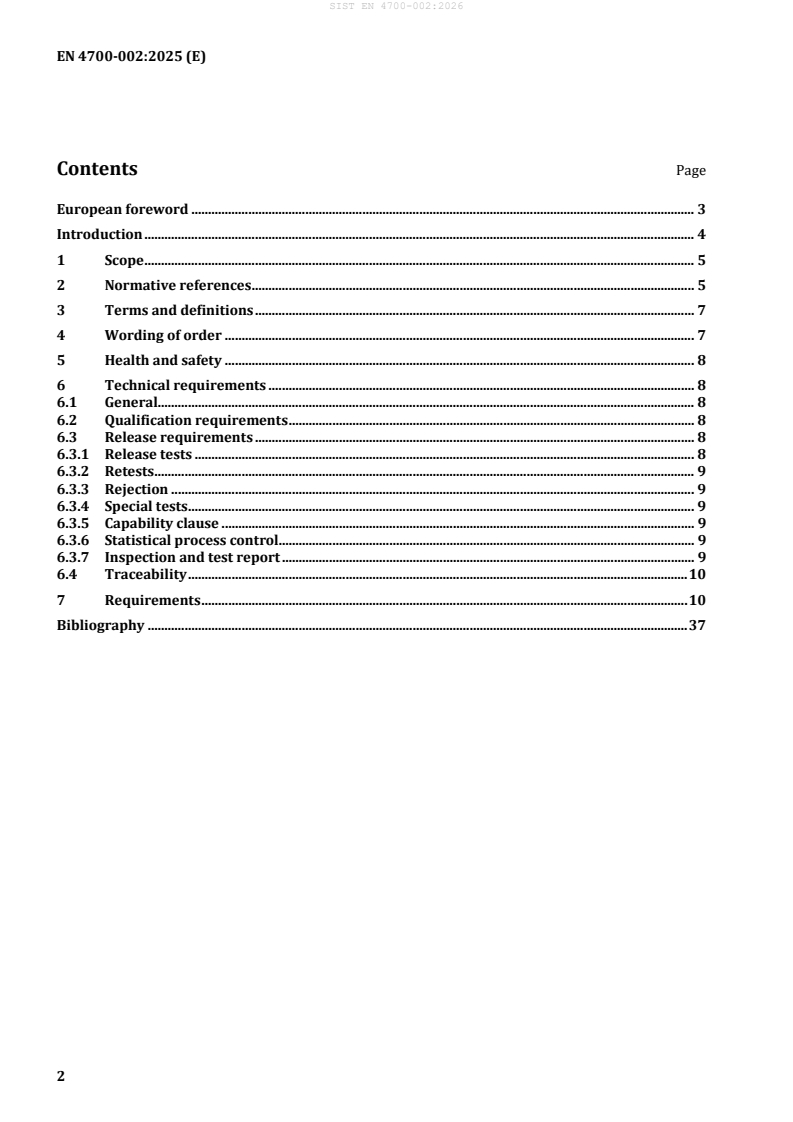
Contents Page
European foreword . 3
Introduction . 4
1 Scope . 5
2 Normative references . 5
3 Terms and definitions . 7
4 Wording of order . 7
5 Health and safety . 8
6 Technical requirements . 8
6.1 General. 8
6.2 Qualification requirements . 8
6.3 Release requirements . 8
6.3.1 Release tests . 8
6.3.2 Retests . 9
6.3.3 Rejection . 9
6.3.4 Special tests . 9
6.3.5 Capability clause . 9
6.3.6 Statistical process control. 9
6.3.7 Inspection and test report . 9
6.4 Traceability . 10
7 Requirements . 10
Bibliography . 37
European foreword
This document (EN 4700-002:2025) has been prepared by ASD-STAN.
After enquiries and votes carried out in accordance with the rules of this Association, this document has
received the approval of the National Associations and the Official Services of the member countries of
ASD-STAN, prior to its presentation to CEN.
This document shall be given the status of a national standard, either by publication of an identical text
or by endorsement, at the latest by June 2026, and conflicting national standards shall be withdrawn at
the latest by June 2026.
Attention is drawn to the possibility that some of the elements of this document may be the subject of
patent rights. CEN shall not be held responsible for identifying any or all such patent rights.
This document supersedes EN 4700-002:2021.
EN 4700-002:2021:
update of Clause 2 “Normative references”;
Table 1: addition of a note in line 17 and addition of ASTM E340 and ASTM E381 for steels in
line 51.
According to the CEN-CENELEC Internal Regulations, the national standards organizations of the
following countries are bound to implement this document: Austria, Belgium, Bulgaria, Croatia, Cyprus,
Czech Republic, Denmark, Estonia, Finland, France, Germany, Greece, Hungary, Iceland, Ireland, Italy,
Latvia, Lithuania, Luxembourg, Malta, Netherlands, Norway, Poland, Portugal, Republic of North
Macedonia, Romania, Serbia, Slovakia, Slovenia, Spain, Sweden, Switzerland, Türkiye and the
United Kingdom.
Introduction
This document is part of the series of EN metallic material standards for aerospace applications.
The general organization of this series is described in EN 4258.
1 Scope
This document specifies the requirements for the ordering, manufacture, testing, inspection and
delivery of steel and heat-resisting alloy bars and sections. It is presupposed to be applied when
referred to and in conjunction with the EN material standard unless otherwise specified on the drawing,
order or inspection schedule.
2 Normative references
The following documents are referred to in the text in such a way that some or all of their content
constitutes requirements of this document. For dated references, only the edition cited applies. For
undated references, the latest edition of the referenced document (including any amendments) applies.
EN 2002-001, Aerospace series — Metallic materials — Test methods — Part 001: Tensile testing at
ambient temperature
EN 2002-002, Aerospace series — Metallic materials — Test methods — Part 002: Tensile testing at
elevated temperature
EN 2002-005, Aerospace series — Test methods for metallic materials — Part 005: Uninterrupted creep
and stress-rupture testing
EN 2002-16, Aerospace series — Metallic materials — Test methods — Part 16: Non-destructive
testing — Penetrant testing
EN 2032-001, Aerospace series — Metallic materials — Part 001: Conventional designation
EN 2032-2, Aerospace series — Metallic materials — Part 2: Coding of metallurgical condition in
delivery condition
EN 2078, Aerospace series — Metallic materials — Manufacturing schedule, inspection schedule,
inspection and test report — Definition, general principles, preparation and approval
EN 2950, Aerospace series — Test method — Wrought heat resisting alloys semi-finished products and
parts — Conditions for macrographic and micrographic examination — Atlas of structures and defects
EN 3874, Aerospace series — Test methods for metallic materials — Constant amplitude force-controlled
low cycle fatigue testing
EN 3987, Aerospace series — Test methods for metallic materials — Constant amplitude force-controlled
high cycle fatigue testing
EN 3988, Aerospace series — Test methods for metallic materials — Constant amplitude strain-
controlled low cycle fatigue testing
EN 4050-1, Aerospace series — Test method for metallic materials — Ultrasonic inspection of bars, plates,
forging stock and forgings — Part 1: General requirements
EN 4050-4, Aerospace series — Test method for metallic materials — Ultrasonic inspection of bars, plates,
forging stock and forgings — Part 4: Acceptance criteria
Published as ASD-STAN prEN at the date of publication of this document, available at:
https://www.asd-stan.org/.
EN 4259:2022, Aerospace series — Metallic materials — Definition of general terms
EN 10027-1, Designation systems for steels — Part 1: Steel names
EN 10079, Definition of steel products
TR 2410, Aerospace series — Metallic materials — Relationship between dimensional standards and
material standards
EN ISO 148-1, Metallic materials — Charpy pendulum impact test — Part 1: Test method (ISO 148-1)
EN ISO 642, Steel — Hardenability test by end quenching (Jominy test) (ISO 642)
EN ISO 643, Steels — Micrographic determination of the apparent grain size (ISO 643)
EN ISO 3651-1, Determination of resistance to intergranular corrosion of stainless steels — Part 1:
Austenitic and ferritic-austenitic (duplex) stainless steels — Corrosion test in nitric acid medium by
measurement of loss in mass (Huey test) (ISO 3651-1)
EN ISO 3651-2, Determination of resistance to intergranular corrosion of stainless steels — Part 2:
Ferritic, austenitic and ferritic-austenitic (duplex) stainless steels — Corrosion test in media containing
sulfuric acid (ISO 3651-2)
EN ISO 3887, Steels — Determination of the depth of decarburization (ISO 3887)
EN ISO 6506-1, Metallic materials — Brinell hardness test — Part 1: Test method (ISO 6506-1)
EN ISO 6507-1, Metallic materials — Vickers hardness test — Part 1: Test method (ISO 6507-1)
EN ISO 6508-1, Metallic materials — Rockwell hardness test — Part 1: Test method (ISO 6508-1)
EN ISO 6892-1, Metallic materials — Tensile testing — Part 1: Method of test at room temperature
(ISO 6892-1)
EN ISO 6892-2, Metallic materials — Tensile testing — Part 2: Method of test at elevated temperature
(ISO 6892-2)
EN ISO 15549, Non-destructive testing — Eddy current testing — General principles (ISO 15549)
ISO 4967, Steel — Determination of content of non-metallic inclusions — Micrographic method using
standard diagrams
AMS 2315, Determination of delta ferrite content
AMS 2750, Pyrometry
ASTM A604, Standard practice for macroetch testing of consumable electrode remelted steel bars and
billets
ASTM E45, Standard test methods for determining the inclusion content of steel
Published as ASD-STAN TR, available at: https://www.asd-stan.org/.
Published by Society of Automotive Engineers (SAE), available at: https://www.sae.org/.
Published by American Society for Testing and Materials (ASTM International), available at:
https://www.astm.org/.
ASTM E340, Standard practice for macroetching metals and alloys
ASTM E381, Standard method of macroetch testing steel bars, billets, blooms and forgings
ASTM E399, Standard test method for linear-elastic plane-strain fracture toughness of metallic materials
ASTM E407, Standard practice for microetching metals and alloys
ASTM E1444, Standard practice for magnetic particle testing for aerospace
3 Terms and definitions
For the purposes of this document, the terms and definitions given in EN 4259:2022 and the following
apply. For definitions specific to steel, EN 10079 applies.
ISO and IEC maintain terminology databases for use in standardization at the following addresses:
— ISO Online browsing platform: available at https://www.iso.org/obp
— IEC Electropedia: available at https://www.electropedia.org/
3.1
batch
quantity of bars and sections consisting of the same nominal dimensions or having the same heat
treatment condition
Note 1 to entry: For the general case, see EN 4259:2022.
Note 2 to entry: For heat treatment using a continuous furnace, a continuous run of less than or equal to eight
hours (or: ≤ 8 h) may be considered as the same heat treatment charge.
[SOURCE: EN 4259:2022, Table 1, No. 4, modified – Addition of Note 1 to entry]
4 Wording of order
The order shall clearly indicate:
a) quantities to be supplied;
b) dates of delivery;
c) material standard number;
d) delivery condition and metallurgical code of products;
e) dimensions and tolerances or reference to an appropriate dimensional standard;
f) product designation, when required;
g) forwarding address;
h) nature and type of packing, if required;
i) surface protection, if appropriate;
j) definition and frequency of any special tests and their retest procedures, if required.
5 Health and safety
The products in the delivery condition shall fulfil the current health and safety laws of the area of the
country where they are to be delivered.
A product safety data sheet shall be available.
6 Technical requirements
6.1 General
The product shall be manufactured in accordance with the requirements of the relevant material
standard and the applicable requirements of this specification. A manufacturing schedule shall be
established and applied in accordance with EN 2078.
Product shall satisfy the requirements of the material standard and/or order and shall be free from
irregularities prejudicial to the subsequent manufacture or use of this product.
Notwithstanding previous acceptance complying with this document, any product that is found at a
later stage to contain such defects shall be rejected.
Unless otherwise specified, the requirements in Table 1 and Table 2 shall apply in conjunction with
those of the relevant material standard. Table 1 relates to lines 1 to 29 (inclusive) of the material
standard and Table 2 relates to lines 30 onwards in which the sub-line format is also used. Lines 2 to 98
may also be opened in line 100 if the material standard details specific qualification requirements. If a
specific line number is not shown in Table 1 and Table 2, the requirement is stated in the material
standard and/or order.
6.2 Qualification requirements
Qualification requirements when invoked by the material standard and/or order are detailed in Table 1
and Table 2. Unless otherwise agreed between the manufacturer and purchaser the qualification phase
shall be run on the first three batches, coming from at least two casts.
6.3 Release requirements
6.3.1 Release tests
Release testing shall be the responsibility of the manufacturer.
The purchaser reserves the right to perform any of the inspections and/or tests required by the
material standard and/or order.
The test samples shall be representative of the product.
When required by the order, the manufacturer shall inform the purchaser of the planned dates for
extraction of samples and release testing in order that these operations may be witnessed.
Table 1 and Table 2 detail the requirements for each line of the material standard. Unless otherwise
specifically requested by the purchaser, a particular inspection and/or test for release shall be carried
out if corresponding acceptance criteria and/or values are stated in the applicable material standard
but see also in subclause 6.3.5.
6.3.2 Retests
If any requirement is not met, retests shall be carried out under the following conditions unless
otherwise stated in the material standard or order. Products shall be:
— rejected;
— 100 % retested and the conforming products accepted; or
— partially or fully re-heat treated if heat treatment can rectify the cause of the failure and retested.
For condition of use material, the number of reheat treatments shall not exceed the number
specified in Table 1 (line 7). The reheat treatment shall be stated on the release test certificate.
6.3.3 Rejection
Any failure to meet the requirements of the material standard shall be cause for rejection.
6.3.4 Special tests
Special tests may be required by the purchaser. In such cases, the nature of the test, method, frequency
and technical requirements shall be specified on the order or inspection schedule and shall be mutually
agreed by the manufacturer and the purchaser.
6.3.5 Capability clause
Where the capability clause is invoked and where sufficient statistical evidence exists, the test need not
be carried out (unless specifically requested by the purchaser).
However, this in no way reduces the obligations of the manufacturer to fulfil the requirements.
If subsequent testing indicates that the product does not comply with the requirements, the batch shall
be rejected.
If sufficient statistical evidence does not exist, the test shall be carried out at a frequency agreed
between the manufacturer and the purchaser.
6.3.6 Statistical process control
Reduction in the extent of release testing, other than that specified in subclause 6.3.5 above, may be
negotiated with the purchaser on the basis of appropriate statistical process control and/or
statistical data.
6.3.7 Inspection and test report
The manufacturer shall furnish, with each delivery, a report conforming to the requirements of EN 2078
stating the following:
a) manufacturer's name and address and, if appropriate, identification of the plant;
b) order number;
c) material standard number;
d) method of melting;
e) delivery condition and metallurgical code of the product;
f) quantity and dimensions;
g) manufacturing and inspection schedule reference;
h) cast and batch number;
i) all heat treatment, including re-heat treatment and, where appropriate, straightening and stress
relieving parameters, applied to the batch;
j) test samples heat treatment;
k) results of the tests and any retests if required by the purchaser.
6.4 Traceability
Each product shall be traceable to the cast, production batch and/or heat treatment batch at all stages
of manufacture, testing and delivery.
7 Requirements
Requirements are given in Table 1 and Table 2.
Table 1 — Technical requirements for lines 1 to 29, where appropriate
Material standard line
Requirements Frequency of testing
reference
Qualification Release
No. Title
1 Material designation EN 2032-001 and EN 10027-1 if applicable — —
2 Chemical composition The chemical composition of the alloy shall comply with requirements of the material a) 1 per cast in a) 1 per cast in
standard. the case of air the case of
melted or air melted
The test samples used for chemical analysis shall be representative of the melt.
vacuum or vacuum
The method of analysis shall be at the option of the manufacturer, but in cases of dispute, the
induction induction
reference method set out in the relevant EN or ISO standard shall be used. If no EN or ISO
melted melted
standard exists, a fundamental and agreed method of chemical analysis calibrated against
product product
accepted reference standards shall be used.
b) 2 per VAR or b) 1 per VAR
In the case of remelted material, samples shall be taken from positions and at frequencies as
ESR ingot ingot
described on the right side of this table.
representing
An analysis shall be made of each sample and certificates of analysis shall be supplied to the
top and
purchaser. The elements to be determined shall be as required by the material specification or
bottom
as agreed between the manufacturer and the purchaser.
positions
Elements not quoted in the material standard shall not be intentionally added to the alloy
without the agreement of the purchaser, except for the purpose of finishing the heat (e.g.
addition of deoxidant); reasonable precautions shall be taken to prevent their inclusion during
manufacture. The purchaser, in agreement with the manufacturer, may set a limit to the
amount of one or more such elements and may require the amount of such elements to be
stated in the certificate of analysis.
The specified ranges of chemical composition are based on cast analyses. Any subsequent
analytical checks shall take into consideration the heterogeneity normal to the alloy.
Additionally for remelted products, the samples shall be representative for the remelted ingot,
taking into account any macro segregation.
Material standard line
Requirements Frequency of testing
reference
Qualification Release
No. Title
3 Method of melting 1 General — —
The alloy shall be made by the process required by the material standard, unless otherwise
agreed between the manufacturer and purchaser. If the specification permits alternative
processes, the manufacturer shall decide which of them shall be used unless the purchaser
states a particular preference on his order. In all instances, the process by which the alloy was
made shall be indicated on the release note.
When materials standards require “air melted”, chemical composition, cleanliness, internal
imperfection… requirements may impose to add refining operation process such as AOD, VOD
or equivalent process.
In this case, the same process used for material qualification should be used for material
delivery.
2 Consumable electrode remelted material
The manufacturer shall ensure that there is no contamination by foreign materials that may
affect the properties and the homogeneity of the final product.
The manufacturer shall establish a procedure for melting and remelting meeting the
requirements as described above.
4.1 Form Bars and sections — —
4.2 Method of production Mechanical hot working: — —
The manufacturer shall establish a procedure for mechanical hot working.
This procedure shall specify:
— the homogenization thermal cycle;
— the thermo-mechanical working processes;
— the manufacturing schedule for each process: the temperatures and durations of pre-
heating; the temperature range for each working process; the dimensions of the products
at each step and conditions for heat treatment between operations.
Material standard line
Requirements Frequency of testing
reference
Qualification Release
No. Title
Mechanical cold working (if any):
The manufacturer shall establish a procedure for the mechanical cold working.
This procedure shall specify:
— the mechanical working processes;
— the manufacturing schedule for each process; the dimensions of the products at each step
and heat treatment conditions between operations.
Final conversion:
Straightening and stress relieving operations shall be indicated in the manufacturing schedule
and shall not cause any imperfections prejudicial to the intended use.
Surface finishing:
Unless otherwise specified, products shall be supplied in the condition specified in the
material standard.
4.3 Limit dimension(s) Minimum and/or maximum size of the product expressed as nominal thickness, a, or nominal — —
thicknesses for multi-legged/flanged sections, or as a nominal diameter, D, of round bar or as
equivalent diameter D
e
5 Technical specification Reference to this document EN 4700-002. In cases of conflict, the requirements of the material — —
standard shall take precedence over those of this document.
6.1 Delivery condition Product shall be supplied in the delivery condition specified in this line in the material — —
standard and/or as stated on the order.
Material standard line
Requirements Frequency of testing
reference
Qualification Release
No. Title
Marking:
The method of marking used shall not cause corrosion, crack initiation, contamination or
unacceptable deformation. The marking shall remain permanently visible after handling and
contact with protective products.
Unless otherwise specified, the nature and colour of marking ink and type of marking
characters shall be left to the discretion of the manufacturer. The marking inks shall be
removable with cleaning products which do not leave a residue which could affect further
processing. The cleaning products shall not give rise to corrosion.
All bars shall be marked legibly in a position chosen by the manufacturer as indicated in the
following tables unless otherwise agreed between the manufacturer and the purchaser:
Products
a b
Continuous marking or end marking
— material grade;
— heat number;
— batch number;
— delivery condition;
— manufacturer/identification.
a Ink or similar product shall be used.
b Hard stamping on one end of the bar.
Material standard line
Requirements Frequency
...