

EN 3639:2025
(Main)Aerospace series - Heat-resisting alloy X6NiCrTiMoV26-15 (1.4980) - Softened and cold worked - Wires for forged fasteners - D ≤ 15 mm - 900 MPa ≤ Rm ≤ 1 100 MPa
- Abstract
This document specifies the requirements relating to:
Heat-resisting alloy X6NiCrTiMoV26-15 (1.4980)
Softened and cold worked
Wires for forged fasteners
D ≤ 15 mm
900 MPa ≤ Rm ≤ 1 100 MPa
for aerospace applications.
W.nr: 1.4980.
ASD-STAN designation: FE-PA2601.
- Status
- Published
- Publication Date
- 02-Dec-2025
- Technical Committee
- ASD-STAN - Aerospace
- Drafting Committee
- ASD-STAN/D 4/S 3 - Steels & Heat Resisting Alloys
- Current Stage
- 6060 - Definitive text made available (DAV) - Publishing
- Start Date
- 03-Dec-2025
- Completion Date
- 03-Dec-2025
Overview
EN 3639:2025 is a CEN aerospace-series standard that specifies requirements for wires made from the heat‑resisting alloy X6NiCrTiMoV26‑15 (W.nr 1.4980) intended for forged fasteners. The standard covers wires with a diameter D ≤ 15 mm delivered in a softened and cold‑worked condition and targeting a tensile strength (Rm) between 900 MPa and 1 100 MPa. Prepared by ASD‑STAN, EN 3639:2025 supersedes EN 3639:2021 and is designated in ASD‑STAN as FE‑PA2601.
Key topics and technical requirements
- Material and designation: Heat‑resisting alloy X6NiCrTiMoV26‑15 (1.4980), chemical composition limits given in the standard.
- Form and size: Wires for forged fasteners, maximum diameter D ≤ 15 mm.
- Mechanical properties: Specified tensile strength range (900–1 100 MPa), proof stress and minimum ductility values (e.g., elongation and reduction of area) and hardness ranges are defined in the requirements table.
- Delivery condition and heat treatment:
- Delivered softened and cold worked (delivery condition code U).
- Typical softening: 900 °C / t = 1 h / air‑cool (or faster).
- Cold work: 15 % ≤ cold worked ≤ 25 % at temperatures ≤ 870 °C.
- Reference (qualification) heat treatment: solution treatment and precipitation treatment (e.g., +980 °C / 1 h / oil‑quench; +720 °C / 16 h / air‑cool).
- Manufacturing and melting: Air melted or vacuum induction melted; consumable electrode remelted (vacuum or slag) options are addressed.
- Testing and inspection: Requirements reference EN 4700‑004 for wire technical specification, visual testing, sampling, mechanical tests and grain size criteria. A product qualification programme is agreed between manufacturer and purchaser.
Applications and users
- Primary use: Production of forged fasteners for aerospace applications where high temperature strength and corrosion resistance are required.
- Who uses this standard:
- Aerospace fastener manufacturers and forgers
- Materials and metallurgical engineers specifying high‑temperature alloys
- Quality and procurement teams in OEMs and Tier‑1 suppliers
- Testing laboratories and certification bodies validating wire batches and mechanical properties
- Practical value: Ensures consistent chemistry, mechanical performance, heat treatment and production practices so forged aerospace fasteners meet safety, repeatability and traceability requirements.
Related standards
- EN 4700‑004 - Aerospace series: Wire technical specification (referenced normative document)
- EN 4258 - Organization of aerospace metallic material standards
- EN 4500‑003 - Rules for drafting heat‑resisting alloy standards
Keywords: EN 3639:2025, X6NiCrTiMoV26‑15, W.nr 1.4980, aerospace standard, wires for forged fasteners, heat‑resisting alloy, softened and cold worked, tensile strength 900–1100 MPa.
Relations
- Effective Date
- 30-Aug-2023
- Effective Date
- 28-Jan-2026
- Effective Date
- 28-Jan-2026
- Effective Date
- 28-Jan-2026
Get Certified
Connect with accredited certification bodies for this standard

BUREAU VERITAS Certification Germany
Bureau Veritas certification in Germany.

Element Materials Technology
Materials testing and product certification.

AQMS Ltd.
AQMS provides ISO certification to SMEs across the UK.
Sponsored listings
Frequently Asked Questions
EN 3639:2025 is a standard published by the European Committee for Standardization (CEN). Its full title is "Aerospace series - Heat-resisting alloy X6NiCrTiMoV26-15 (1.4980) - Softened and cold worked - Wires for forged fasteners - D ≤ 15 mm - 900 MPa ≤ Rm ≤ 1 100 MPa". This standard covers: This document specifies the requirements relating to: Heat-resisting alloy X6NiCrTiMoV26-15 (1.4980) Softened and cold worked Wires for forged fasteners D ≤ 15 mm 900 MPa ≤ Rm ≤ 1 100 MPa for aerospace applications. W.nr: 1.4980. ASD-STAN designation: FE-PA2601.
This document specifies the requirements relating to: Heat-resisting alloy X6NiCrTiMoV26-15 (1.4980) Softened and cold worked Wires for forged fasteners D ≤ 15 mm 900 MPa ≤ Rm ≤ 1 100 MPa for aerospace applications. W.nr: 1.4980. ASD-STAN designation: FE-PA2601.
EN 3639:2025 is classified under the following ICS (International Classification for Standards) categories: 49.025.05 - Ferrous alloys in general. The ICS classification helps identify the subject area and facilitates finding related standards.
EN 3639:2025 has the following relationships with other standards: It is inter standard links to EN 3639:2021, EN 3043:2025, EN 4845:2022, EN 3014:2025. Understanding these relationships helps ensure you are using the most current and applicable version of the standard.
EN 3639:2025 is available in PDF format for immediate download after purchase. The document can be added to your cart and obtained through the secure checkout process. Digital delivery ensures instant access to the complete standard document.
Standards Content (Sample)
SLOVENSKI STANDARD
01-februar-2026
Aeronavtika - Toplotno odporna zlitina X6NiCrTiMoV26-15 (1.4980) - Popuščana in
hladno obdelana - Žice za kovane vezne elemente - D ≤ 15 mm - 900 MPa ≤ Rm ≤
1100 MPa
Aerospace series - Heat-resisting alloy X6NiCrTiMoV26-15 (1.4980) - Softened and cold
worked - Wires for forged fasteners - D ≤ 15 mm - 900 MPa ≤ Rm ≤ 1 100 MPa
Luft- und Raumfahrt - Hochwarmfeste Legierung X6NiCrTiMoV26-15 (1.4980) -
Weichgegluht und kaltverfestigt - Drähte zum Stauchen fur Verbindungselemente - D ≤
15 mm - 900 MPa ≤ Rm ≤ 1 100 MPa
Série aérospatiale - Alliage résistant à chaud X6NiCrTiMoV26-15 (1.4980) - Adouci et
écroui - Fils pour éléments de fixation forgés - D ≤ 15 mm - 900 MPa ≤ Rm ≤ 1 100 MPa
Ta slovenski standard je istoveten z: EN 3639:2025
ICS:
49.025.05 Železove zlitine na splošno Ferrous alloys in general
2003-01.Slovenski inštitut za standardizacijo. Razmnoževanje celote ali delov tega standarda ni dovoljeno.
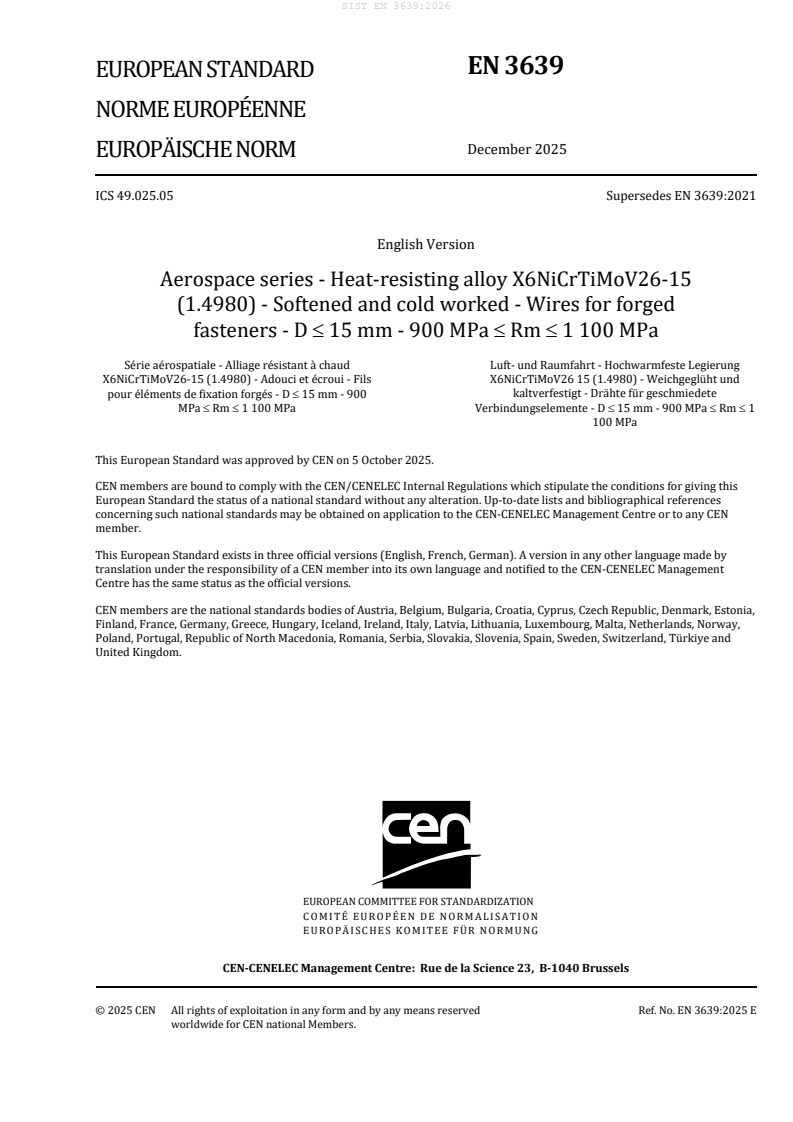
EN 3639
EUROPEAN STANDARD
NORME EUROPÉENNE
December 2025
EUROPÄISCHE NORM
ICS 49.025.05 Supersedes EN 3639:2021
English Version
Aerospace series - Heat-resisting alloy X6NiCrTiMoV26-15
(1.4980) - Softened and cold worked - Wires for forged
fasteners - D 15 mm - 900 MPa Rm 1 100 MPa
Série aérospatiale - Alliage résistant à chaud Luft- und Raumfahrt - Hochwarmfeste Legierung
X6NiCrTiMoV26-15 (1.4980) - Adouci et écroui - Fils X6NiCrTiMoV26 15 (1.4980) - Weichgeglüht und
kaltverfestigt - Drähte für geschmiedete
pour éléments de fixation forgés - D 15 mm - 900
Verbindungselemente - D 15 mm - 900 MPa Rm 1
MPa Rm 1 100 MPa
100 MPa
This European Standard was approved by CEN on 5 October 2025.
CEN members are bound to comply with the CEN/CENELEC Internal Regulations which stipulate the conditions for giving this
European Standard the status of a national standard without any alteration. Up-to-date lists and bibliographical references
concerning such national standards may be obtained on application to the CEN-CENELEC Management Centre or to any CEN
member.
This European Standard exists in three official versions (English, French, German). A version in any other language made by
translation under the responsibility of a CEN member into its own language and notified to the CEN-CENELEC Management
Centre has the same status as the official versions.
CEN members are the national standards bodies of Austria, Belgium, Bulgaria, Croatia, Cyprus, Czech Republic, Denmark, Estonia,
Finland, France, Germany, Greece, Hungary, Iceland, Ireland, Italy, Latvia, Lithuania, Luxembourg, Malta, Netherlands, Norway,
Poland, Portugal, Republic of North Macedonia, Romania, Serbia, Slovakia, Slovenia, Spain, Sweden, Switzerland, Türkiye and
United Kingdom.
EUROPEAN COMMITTEE FOR STANDARDIZATION
COMITÉ EUROPÉEN DE NORMALISATION
EUROPÄISCHES KOMITEE FÜR NORMUNG
CEN-CENELEC Management Centre: Rue de la Science 23, B-1040 Brussels
© 2025 CEN All rights of exploitation in any form and by any means reserved Ref. No. EN 3639:2025 E
worldwide for CEN national Members.
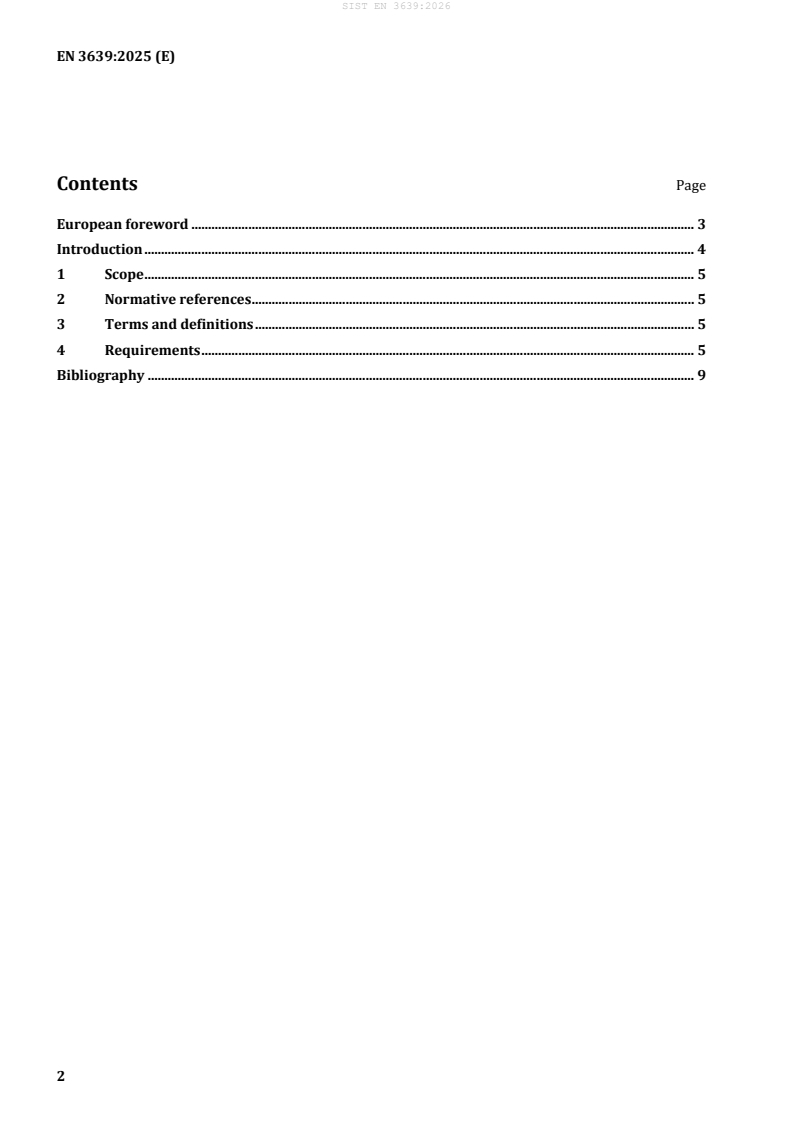
Contents Page
European foreword . 3
Introduction . 4
1 Scope . 5
2 Normative references . 5
3 Terms and definitions . 5
4 Requirements . 5
Bibliography . 9
European foreword
This document (EN 3639:2025) has been prepared by ASD-STAN.
After enquiries and votes carried out in accordance with the rules of this Association, this document has
received the approval of the National Associations and the Official Services of the member countries of
ASD-STAN, prior to its presentation to CEN.
This document shall be given the status of a national standard, either by publication of an identical text
or by endorsement, at the latest by June 2026, and conflicting national standards shall be withdrawn at
the latest by June 2026.
Attention is drawn to the possibility that some of the elements of this document may be the subject of
patent rights. CEN shall not be held responsible for identifying any or all such patent rights.
This document supersedes EN 3639:2021.
EN 3639:2
...