

EN ISO 4254-7:2017
(Main)Agricultural machinery - Safety - Part 7: Combine harvesters, forage harvesters, cotton harvesters and sugar cane harversters (ISO 4254-7:2017, Corrected version 2019-03)
- Abstract
ISO 4254-7:2017, when used together with ISO 4254‑1, specifies the safety requirements and their verification for the design and construction of combine harvesters, forage harvesters, cotton harvesters and sugar cane harvesters. It describes methods for the elimination or reduction of hazards arising from the intended use of these machines by one person (the operator) in the course of normal operation and service. In addition, it specifies the type of information on safe working practices to be provided by the manufacturer.
When provisions of ISO 4254-7:2017 are different from those which are stated in ISO 4254‑1, the provisions of ISO 4254-7:2017 take precedence over the provisions of ISO 4254‑1 for machines that have been designed and built according to the provisions of ISO 4254-7:2017.
ISO 4254-7:2017, taken together with ISO 4254‑1, deals with all the significant hazards (as listed in Table A.1), hazardous situations and events relevant to combine harvesters, forage harvesters, cotton harvesters and sugar cane harvesters, when they are used as intended and under the conditions of misuse that are reasonably foreseeable by the manufacturer (see Annex A). It is not applicable to hazards arising from the presence of persons other than the operator, cleaning of the grain tank, and hazards related to vibrations and moving parts for power transmission, except for strength requirements for guards and barriers. In respect of braking and steering, it is applicable only to the ergonomic aspects (e.g. location of brake pedal and steering wheel); no other aspects related to braking and steering are covered. In the case of trailed harvesters, it is applicable only to hazards related to the working process.
Design requirements for roll-over protective structures (if applicable) are not specified in ISO 4254-7:2017.
Performance levels (or categories) for safety-related parts of control systems in accordance with ISO 25119 or ISO 13849 are not given in ISO 4254-7:2017.
NOTE Specific requirements related to road traffic regulations are not taken into account in ISO 4254-7:2017.
ISO 4254-7:2017 is not applicable to machines manufactured before the date of its publication.
- Status
- Published
- Publication Date
- 05-Dec-2017
- Withdrawal Date
- 29-Jun-2018
- Technical Committee
- CEN/TC 144 - Tractors and machinery for agriculture and forestry
- Drafting Committee
- CEN/TC 144/WG 2 - Tractors and self propelled machines
- Current Stage
- 6060 - Definitive text made available (DAV) - Publishing
- Start Date
- 06-Dec-2017
- Completion Date
- 06-Dec-2017
- Directive
- 2006/42/EC - Directive 2006/42/EC of the European Parliament and of the Council of 17 May 2006 on machinery, and amending Directive 95/16/EC (recast)OJ Ref: L, L 75 OJ Date: 13-Mar-2019
Buy Documents


Overview
EN ISO 4254-7:2017 (Corrected version 2019-03) - published by CEN - specifies safety requirements and verification methods for the design and construction of combine harvesters, forage harvesters, cotton harvesters and sugar cane harvesters when used together with ISO 4254‑1. The standard focuses on eliminating or reducing hazards arising from intended use by a single operator during normal operation and service. Where ISO 4254‑7 differs from ISO 4254‑1, its provisions take precedence for machines designed to this part.
Key exclusions: hazards involving people other than the operator, cleaning of the grain tank, vibration and many power‑transmission moving‑part hazards (except strength of guards/barriers), most braking/steering aspects (only ergonomic locations are covered), ROPS design requirements, and safety‑related control system performance levels (ISO 25119 / ISO 13849 are not specified). Road traffic rules and machines manufactured before publication are also outside scope.
Key Topics
The standard addresses practical machine‑safety topics relevant to harvesting equipment, including:
- Operator’s workstation: seat, controls location and identification, steering ergonomics, visibility, warnings, cabins and access.
- Controls & control clearances: start/stop, layout and safe operation.
- Guards and pinching/shearing point protections: folding elements, interchangeable/detachable harvesting devices, header drive and hold‑up.
- Service and maintenance: safe access, supports for raised parts, greasing, electrical/battery safety and operating fluids.
- Grain tank and grain handling systems: tank design and access considerations.
- Noise, fire hazard, hydraulic components and electric equipment: general risk reduction measures.
- Automatic systems: guidance systems and automatic header disengagement controls.
- Annexes include hazard listings and relationship to the EU Machinery Directive (Annex ZA).
Applications
EN ISO 4254-7 is used to:
- Guide manufacturers and designers of harvesting machinery in meeting recognized safety requirements.
- Support risk assessments for combine and forage harvester design and retrofit projects.
- Provide a reference for testing laboratories and conformity assessment bodies when evaluating machine safety against harmonized European requirements.
- Inform safety engineers, purchasers and fleet managers on expected safety features and operator‑focused protections.
Who should use it
- Agricultural machinery manufacturers and OEMs
- Product design and safety engineers
- Certification and conformity assessment bodies
- Maintenance and training teams creating safe work procedures
- Regulators and procurement specialists specifying machine safety requirements
Related standards
- ISO 4254‑1 (general safety requirements) - to be used together with ISO 4254‑7
- References to ISO 25119 and ISO 13849 appear, but EN ISO 4254‑7 does not specify performance levels for safety‑related control systems.
Keywords: ISO 4254-7, EN ISO 4254-7:2017, agricultural machinery safety, combine harvester safety, forage harvester standard, grain tank safety, operator workstation, harvesting equipment standards.
Relations
- Effective Date
- 13-Dec-2017
- Effective Date
- 13-Dec-2017
- Effective Date
- 03-Jun-2026
- Effective Date
- 03-Jun-2026
- Effective Date
- 03-Jun-2026
- Effective Date
- 03-Jun-2026
- Effective Date
- 03-Jun-2026
- Effective Date
- 03-Jun-2026
- Effective Date
- 03-Jun-2026
- Effective Date
- 09-Feb-2026
- Effective Date
- 09-Feb-2026
- Effective Date
- 09-Feb-2026
- Effective Date
- 09-Feb-2026
- Effective Date
- 09-Feb-2026
- Effective Date
- 09-Feb-2026
Buy Documents
Get Certified
Connect with accredited certification bodies for this standard

Control Union Certifications
Global certification for agriculture and sustainability.

ECOCERT
Organic and sustainability certification.

FSC International
Forest Stewardship Council certification.
Sponsored listings
Frequently Asked Questions
EN ISO 4254-7:2017 is a standard published by the European Committee for Standardization (CEN). Its full title is "Agricultural machinery - Safety - Part 7: Combine harvesters, forage harvesters, cotton harvesters and sugar cane harversters (ISO 4254-7:2017, Corrected version 2019-03)". This standard covers: ISO 4254-7:2017, when used together with ISO 4254‑1, specifies the safety requirements and their verification for the design and construction of combine harvesters, forage harvesters, cotton harvesters and sugar cane harvesters. It describes methods for the elimination or reduction of hazards arising from the intended use of these machines by one person (the operator) in the course of normal operation and service. In addition, it specifies the type of information on safe working practices to be provided by the manufacturer. When provisions of ISO 4254-7:2017 are different from those which are stated in ISO 4254‑1, the provisions of ISO 4254-7:2017 take precedence over the provisions of ISO 4254‑1 for machines that have been designed and built according to the provisions of ISO 4254-7:2017. ISO 4254-7:2017, taken together with ISO 4254‑1, deals with all the significant hazards (as listed in Table A.1), hazardous situations and events relevant to combine harvesters, forage harvesters, cotton harvesters and sugar cane harvesters, when they are used as intended and under the conditions of misuse that are reasonably foreseeable by the manufacturer (see Annex A). It is not applicable to hazards arising from the presence of persons other than the operator, cleaning of the grain tank, and hazards related to vibrations and moving parts for power transmission, except for strength requirements for guards and barriers. In respect of braking and steering, it is applicable only to the ergonomic aspects (e.g. location of brake pedal and steering wheel); no other aspects related to braking and steering are covered. In the case of trailed harvesters, it is applicable only to hazards related to the working process. Design requirements for roll-over protective structures (if applicable) are not specified in ISO 4254-7:2017. Performance levels (or categories) for safety-related parts of control systems in accordance with ISO 25119 or ISO 13849 are not given in ISO 4254-7:2017. NOTE Specific requirements related to road traffic regulations are not taken into account in ISO 4254-7:2017. ISO 4254-7:2017 is not applicable to machines manufactured before the date of its publication.
ISO 4254-7:2017, when used together with ISO 4254‑1, specifies the safety requirements and their verification for the design and construction of combine harvesters, forage harvesters, cotton harvesters and sugar cane harvesters. It describes methods for the elimination or reduction of hazards arising from the intended use of these machines by one person (the operator) in the course of normal operation and service. In addition, it specifies the type of information on safe working practices to be provided by the manufacturer. When provisions of ISO 4254-7:2017 are different from those which are stated in ISO 4254‑1, the provisions of ISO 4254-7:2017 take precedence over the provisions of ISO 4254‑1 for machines that have been designed and built according to the provisions of ISO 4254-7:2017. ISO 4254-7:2017, taken together with ISO 4254‑1, deals with all the significant hazards (as listed in Table A.1), hazardous situations and events relevant to combine harvesters, forage harvesters, cotton harvesters and sugar cane harvesters, when they are used as intended and under the conditions of misuse that are reasonably foreseeable by the manufacturer (see Annex A). It is not applicable to hazards arising from the presence of persons other than the operator, cleaning of the grain tank, and hazards related to vibrations and moving parts for power transmission, except for strength requirements for guards and barriers. In respect of braking and steering, it is applicable only to the ergonomic aspects (e.g. location of brake pedal and steering wheel); no other aspects related to braking and steering are covered. In the case of trailed harvesters, it is applicable only to hazards related to the working process. Design requirements for roll-over protective structures (if applicable) are not specified in ISO 4254-7:2017. Performance levels (or categories) for safety-related parts of control systems in accordance with ISO 25119 or ISO 13849 are not given in ISO 4254-7:2017. NOTE Specific requirements related to road traffic regulations are not taken into account in ISO 4254-7:2017. ISO 4254-7:2017 is not applicable to machines manufactured before the date of its publication.
EN ISO 4254-7:2017 is classified under the following ICS (International Classification for Standards) categories: 65.060.50 - Harvesting equipment. The ICS classification helps identify the subject area and facilitates finding related standards.
EN ISO 4254-7:2017 has the following relationships with other standards: It is inter standard links to EN ISO 4254-7:2009, EN ISO 4254-7:2009/AC:2010, ISO 3776-1:2006, ISO 5353:1995, ISO 3767-2:2016, ISO 3600:2015, ISO 3767-1:2016, ISO 11684:1995, ISO 5687:1999, ISO 15077:2008, ISO 4254-1:2013, ISO 3776-3:2009, ISO 9533:2010, ISO 10975:2009, ISO 12100:2010. Understanding these relationships helps ensure you are using the most current and applicable version of the standard.
EN ISO 4254-7:2017 is associated with the following European legislation: EU Directives/Regulations: 2006/42/EC, 98/37/EC; Standardization Mandates: M/396, M/BC/CEN/91/1. When a standard is cited in the Official Journal of the European Union, products manufactured in conformity with it benefit from a presumption of conformity with the essential requirements of the corresponding EU directive or regulation.
EN ISO 4254-7:2017 is available in PDF format for immediate download after purchase. The document can be added to your cart and obtained through the secure checkout process. Digital delivery ensures instant access to the complete standard document.
Standards Content (Sample)
SLOVENSKI STANDARD
01-februar-2018
Nadomešča:
SIST EN ISO 4254-7:2010
SIST EN ISO 4254-7:2010/AC:2011
Kmetijski stroji - Varnost - 7. del: Splošni kombajni, kombajni za pripravo krme,
obiranje bombaža in žetev sladkornega trsa (ISO 4254-7:2017, popravljena
različica 2019-03)
Agricultural machinery - Safety - Part 7: Combine harvesters, forage harvesters, cotton
harvesters and sugar cane harversters (ISO 4254-7:2017, Corrected version 2019-03)
Landmaschinen - Sicherheit - Teil 7: Mähdrescher, Feldhäcksler,
Baumwollerntemaschinen und Zuckerrohrerntemaschinen (ISO 4254-7:2017, korrigierte
Fassung 2019-03)
Matériel agricole - Sécurité - Partie 7: Moissonneuses-batteuses, récolteuses-
hacheuses-chargeuses de fourrage, récolteuses de coton et récolteuses de cannes à
sucre (ISO 4254-7:2017, Version corrigée 2019-03)
Ta slovenski standard je istoveten z: EN ISO 4254-7:2017
ICS:
65.060.50 Oprema za spravilo pridelkov Harvesting equipment
2003-01.Slovenski inštitut za standardizacijo. Razmnoževanje celote ali delov tega standarda ni dovoljeno.
EN ISO 4254-7
EUROPEAN STANDARD
NORME EUROPÉENNE
December 2017
EUROPÄISCHE NORM
ICS 65.060.50 Supersedes EN ISO 4254-7:2009
English Version
Agricultural machinery - Safety - Part 7: Combine
harvesters, forage harvesters, cotton harvesters and sugar
cane harversters (ISO 4254-7:2017, Corrected version
2019-03)
Matériel agricole - Sécurité - Partie 7: Moissonneuses- Landmaschinen - Sicherheit - Teil 7: Mähdrescher,
batteuses, récolteuses-hacheuses-chargeuses de Feldhäcksler, Baumwollerntemaschinen und
fourrage, récolteuses de coton et récolteuses de cannes Zuckerrohrerntemaschinen (ISO 4254-7:2017)
à sucre (ISO 4254-7:2017, Version corrigée 2019-03)
This European Standard was approved by CEN on 21 September 2017.
This European Standard was corrected and reissued by the CEN-CENELEC Management Centre on 18 September 2019.
CEN members are bound to comply with the CEN/CENELEC Internal Regulations which stipulate the conditions for giving this
European Standard the status of a national standard without any alteration. Up-to-date lists and bibliographical references
concerning such national standards may be obtained on application to the CEN-CENELEC Management Centre or to any CEN
member.
This European Standard exists in three official versions (English, French, German). A version in any other language made by
translation under the responsibility of a CEN member into its own language and notified to the CEN-CENELEC Management
Centre has the same status as the official versions.
CEN members are the national standards bodies of Austria, Belgium, Bulgaria, Croatia, Cyprus, Czech Republic, Denmark, Estonia,
Finland, France, Germany, Greece, Hungary, Iceland, Ireland, Italy, Latvia, Lithuania, Luxembourg, Malta, Netherlands, Norway,
Poland, Portugal, Republic of North Macedonia, Romania, Serbia, Slovakia, Slovenia, Spain, Sweden, Switzerland, Turkey and
United Kingdom.
EUROPEAN COMMITTEE FOR STANDARDIZATION
COMITÉ EUROPÉEN DE NORMALISATIO N
EUROPÄISCHES KOMITEE FÜR NORMUN G
CEN-CENELEC Management Centre: Rue de la Science 23, B-1040 Brussels
© 2017 CEN All rights of exploitation in any form and by any means reserved Ref. No. EN ISO 4254-7:2017 E
worldwide for CEN national Members.
Contents Page
European foreword . 3
Annex ZA (informative) Relationship between this European Standard and the Essential
Requirements of EU Directive 2006/42/EC amended by Directive 2009/127/EC
aimed to be covered . 4
European foreword
This document (EN ISO 4254-7:2017) has been prepared by Technical Committee ISO/TC 23 “Tractors
and machinery for agriculture and forestry” in collaboration with Technical Committee CEN/TC 144
“Tractors and machinery for agriculture and forestry” the secretariat of which is held by AFNOR.
This European Standard shall be given the status of a national standard, either by publication of an
identical text or by endorsement, at the latest by June 2018 and conflicting national standards shall be
withdrawn at the latest by June 2018.
Attention is drawn to the possibility that some of the elements of this document may be the subject of
patent rights. CEN shall not be held responsible for identifying any or all such patent rights.
This document supersedes EN ISO 4254-7:2009.
This document has been prepared under a mandate given to CEN by the European Commission and the
European Free Trade Association, and supports essential requirements of EU Directive(s).
For relationship with EU Directive, see informative Annex ZA, which is an integral part of this
document.
According to the CEN-CENELEC Internal Regulations, the national standards organizations of the
following countries are bound to implement this European Standard: Austria, Belgium, Bulgaria,
Croatia, Cyprus, Czech Republic, Denmark, Estonia, Finland, Former Yugoslav Republic of Macedonia,
France, Germany, Greece, Hungary, Iceland, Ireland, Italy, Latvia, Lithuania, Luxembourg, Malta,
Netherlands, Norway, Poland, Portugal, Romania, Serbia, Slovakia, Slovenia, Spain, Sweden, Switzerland,
Turkey and the United Kingdom.
Endorsement notice
The text of ISO 4254-7:2017, Corrected version 2019-03 has been approved by CEN as EN ISO 4254-
7:2017 without any modification.
Annex ZA
(informative)
Relationship between this European Standard and the Essential
Requirements of EU Directive 2006/42/EC amended by Directive
2009/127/EC aimed to be covered
This European Standard has been prepared under Commission’s standardization request M/396
mandate to CEN and CENELEC for standardisation in the field of machinery to provide one voluntary
means of conforming to Essential Requirements of the New Approach Directive 2006/42/EC of the
European Parliament and of the Council of 17 May 2006 on machinery, and amending Directive
95/16/EC (recast) amended by Directive 2009/127/EC of the European Parliament and of the Council
of 21 October 2009 amending Directive 2006/42/EC with regard to machinery for pesticide application
(Text with EEA relevance) .
Once this standard is cited in the Official Journal of the European Union under that Directive,
compliance with the normative clauses of this standard confers, within the limits of the scope of this
standard, a presumption of conformity with the corresponding Essential Requirements of that Directive
and associated EFTA regulations.
Table ZA.1 — Correspondence between this European Standard and EU Directive 2006/42/EC
amended by Directive 2009/127/EC
Essential requirements of EU Clause(s)/sub-clause(s) of Remarks/Notes
Directive 2006/42/EC this EN
amended by
Directiv2009/127/EC
Within the limits of the All normative clauses. Compliance with the second
scope, all relevant essential and third indents of Essential
requirements are covered Requirement 1.2.1, with
with the exception of regard to safety integrity level,
essential requirement(s): is not achieved.
— for all machines:
— 1.3.7, first paragraph
— 1.3.8.1
— 1.4, with the exception
of 1.4.1 first indent, all
with regard to moving
parts of power
transmission
— 1.5.11
— 1.6.1, only for cleaning
of the grain tank
— 1.7.3, first paragraph,
first, second and sixth
indent
— 1.7.4.2 j)
— 1.7.4.2 t)
— 1.7.4.2 u), fourth
paragraph, second
sentence.
— additionally for self-
propelled machines:
— 1.1.8, only for
vibration
— 1.5.9
— 1.5.12
— 3.3.3
— 3.4.7, fifth, seventh
and eight paragraph
WARNING 1 — Presumption of conformity stays valid only as long as a reference to this European
Standard is maintained in the list published in the Official Journal of the European Union. Users of this
standard should consult frequently the latest list published in the Official Journal of the European
Union.
WARNING 2 — Other Union legislation may be applicable to the product(s) falling within the scope of
this standard.
INTERNATIONAL ISO
STANDARD 4254-7
Third edition
2017-10
Corrected version
2019-03
Agricultural machinery — Safety —
Part 7:
Combine harvesters, forage
harvesters, cotton harvesters and
sugar cane harvesters
Matériel agricole — Sécurité —
Partie 7: Moissonneuses-batteuses, récolteuses-hacheuses-chargeuses
de fourrage, récolteuses de coton et récolteuses de cannes à sucre
Reference number
ISO 4254-7:2017(E)
©
ISO 2017
ISO 4254-7:2017(E)
© ISO 2017
All rights reserved. Unless otherwise specified, or required in the context of its implementation, no part of this publication may
be reproduced or utilized otherwise in any form or by any means, electronic or mechanical, including photocopying, or posting
on the internet or an intranet, without prior written permission. Permission can be requested from either ISO at the address
below or ISO’s member body in the country of the requester.
ISO copyright office
CP 401 • Ch. de Blandonnet 8
CH-1214 Vernier, Geneva
Phone: +41 22 749 01 11
Fax: +41 22 749 09 47
Email: copyright@iso.org
Website: www.iso.org
Published in Switzerland
ii © ISO 2017 – All rights reserved
ISO 4254-7:2017(E)
Contents Page
Foreword .vi
Introduction .viii
1 Scope . 1
2 Normative references . 1
3 Terms and definitions . 2
4 Safety requirements and/or protective/risk reduction measures for all machines .3
4.1 General . 3
4.2 Controls . 3
4.2.1 Location and identification of controls . 3
4.2.2 Control clearances . 4
4.2.3 Starting and stopping the engine . 4
4.3 Operator’s work station . 4
4.3.1 Operator’s seat . 4
4.3.2 Instructional seat . . 4
4.3.3 Steering wheel . 5
4.3.4 Shearing and pinching points . 5
4.3.5 Boarding means . 6
4.3.6 Handrails and handholds. 6
4.3.7 Platforms . 6
4.3.8 Access to operator’s seat . 7
4.3.9 Automatic header disengagement control . 7
4.3.10 Warnings . 7
4.3.11 Visibility — View to front and rear . 7
4.3.12 Cabins . 8
4.4 Other than operator’s work station . 9
4.5 Folding elements . 9
4.6 Interchangeable and detachable harvesting devices .10
4.7 Automatic guidance systems .10
4.8 Hot surfaces .10
4.9 Service and maintenance .10
4.9.1 Manual operation of individual assemblies .10
4.9.2 Electric — Battery .10
4.9.3 Operating fluids .11
4.9.4 Supports for service and maintenance of raised machine parts .11
4.9.5 Tie-down and jacking points .11
4.9.6 Greasing .11
4.10 Fire hazard .11
4.11 Overhead power lines .12
4.12 Header drive .12
4.13 Header/feeding elements drive reverser .12
4.14 Header hold-up .12
4.15 Noise .12
4.16 Hydraulic components and fittings .13
4.17 Electric equipment .13
5 Additional requirements for combine harvesters .13
5.1 General .13
5.2 Cabin .13
5.3 Cutting mechanism, feed augers, reel.13
5.4 Grain tank and grain handling systems .14
5.4.1 Grain tank design . .14
5.4.2 Access into the grain tank .14
5.4.3 Distribution auger .14
ISO 4254-7:2017(E)
5.4.4 Filling auger .15
5.4.5 Discharge auger .15
5.4.6 Clean grain and returns handling systems .16
5.5 Maize harvesting attachment .16
5.5.1 Maize picker head .16
5.5.2 Mid-mounted choppers.16
5.6 Rear straw chopper, straw spreader and chaff spreader .18
5.6.1 General.18
5.6.2 Straw chopper with discharge chute .19
5.6.3 Straw chopper with driven spreader .20
5.6.4 Chaff spreader .20
5.6.5 Straw spreader .20
5.7 Stone trap .21
5.8 Storage of sickle bars .21
6 Additional requirements for forage harvesters .21
6.1 Operator's work station .21
6.2 Infeed mechanism .21
6.3 Cutterhead drive .22
6.4 Run-down of rotating functional elements in the crop flow system .23
6.5 Knife sharpening device .23
7 Additional requirements for cotton harvesters .23
7.1 Harvest mechanism, feed augers, reel .23
7.1.1 Cotton stripper and cotton picker .23
7.1.2 Cotton picker only .24
7.2 Basket (cotton stripper and cotton picker) .24
7.2.1 Lowering basket .24
7.2.2 Compactor auger .24
7.2.3 Basket safety signs .24
7.2.4 Basket handrail .25
7.3 Operating fluids .25
8 Additional requirements for sugar cane harvesters .25
8.1 General .25
8.2 Clearing of blockages or obstructions .25
8.3 Cabin .25
8.4 Service and maintenance .25
8.5 Base cutting system .25
8.6 Billet loading conveyor system .26
9 Verification of the safety requirements and/or protective/risk reduction measures
(see Table 1) .26
10 Information for use .28
10.1 Operator’s manual.28
10.1.1 General.28
10.1.2 All machines .28
10.1.3 Combine harvesters .29
10.1.4 Forage harvesters .29
10.1.5 Cotton harvesters .29
10.1.6 Sugar cane harvesters .30
10.2 Marking .30
10.2.1 General.30
10.2.2 Instructional signs .30
10.2.3 Safety signs .30
Annex A (informative) List of significant hazards.32
Annex B (normative) Identification of hand controls by colour coding .41
Annex C (normative) Noise measurement .43
iv © ISO 2017 – All rights reserved
ISO 4254-7:2017(E)
Bibliography .45
ISO 4254-7:2017(E)
Foreword
ISO (the International Organization for Standardization) is a worldwide federation of national standards
bodies (ISO member bodies). The work of preparing International Standards is normally carried out
through ISO technical committees. Each member body interested in a subject for which a technical
committee has been established has the right to be represented on that committee. International
organizations, governmental and non-governmental, in liaison with ISO, also take part in the work.
ISO collaborates closely with the International Electrotechnical Commission (IEC) on all matters of
electrotechnical standardization.
The procedures used to develop this document and those intended for its further maintenance are
described in the ISO/IEC Directives, Part 1. In particular the different approval criteria needed for the
different types of ISO documents should be noted. This document was drafted in accordance with the
editorial rules of the ISO/IEC Directives, Part 2 (see www .iso .org/directives).
Attention is drawn to the possibility that some of the elements of this document may be the subject of
patent rights. ISO shall not be held responsible for identifying any or all such patent rights. Details of
any patent rights identified during the development of the document will be in the Introduction and/or
on the ISO list of patent declarations received (see www .iso .org/patents).
Any trade name used in this document is information given for the convenience of users and does not
constitute an endorsement.
For an explanation on the voluntary nature of standards, the meaning of ISO specific terms and
expressions related to conformity assessment, as well as information about ISO's adherence to the
World Trade Organization (WTO) principles in the Technical Barriers to Trade (TBT) see the following
URL: www .iso .org/iso/foreword .html.
This document was prepared by Technical Committee ISO/TC 23, Tractors and machinery for agriculture
and forestry, Subcommittee SC 7, Equipment for harvesting and conservation.
This third edition cancels and replaces the second edition (ISO 4254-7:2008), which has been technically
revised.
The main changes compared to the previous edition are as follows:
— additions to the Scope and of requirements for sugar cane harvesters;
— replacement of the reference to ISO 4254-1:2008 by ISO 4254-1:2013;
— addition of references to ISO 3776-3 and ISO 10975;
— deletion of the references to ISO 12100-1:2003 and ISO 12100-2:2003 and replacement with
ISO 12100:2010;
— list of significant hazards (Clause 4) as new informative Annex A;
— in Clause 4, for all machines, replacement of requirements by reference to ISO 4254-1:2013 for the
following:
— operator's seat and addition of a references to ISO 3776-3;
— handrails and handholds with a modification;
— operator platform;
— other boarding means;
vi © ISO 2017 – All rights reserved
ISO 4254-7:2017(E)
— supports for service and maintenance;
— modification of the requirements for the following:
— visibility — view to front and rear;
— disconnection of the battery;
— greasing;
— boarding means;
— addition of requirements for the following:
— forward and rearward facing work lights;
— cleaning the machine;
— header hold-up;
— instructional seat: deletion of the requirement that anchorage points for a restraint system have to
be provided and addition for a requirement that a restraint system has to be provided in the event
of a rollover;
— replacement of the requirements for automatic guidance systems by a reference to ISO 10975;
— in Clause 5, for combine harvesters:
— clean grain and returns handling systems: addition of information for explanation for better
understanding of the requirements;
— straw choppers: addition of requirement for replacing blades;
— in Clause 6, for forage harvesters:
— modification of the requirements for run-down of rotating functional elements in the crop
flow system.
A list of all parts in the ISO 4254 series can be found on the ISO website.
This corrected version of ISO 4254-7:2017 incorporates the following corrections:
— Figure 2 has been replaced to show the correct dimensions.
ISO 4254-7:2017(E)
Introduction
This document is a type-C standard as stated in ISO 12100.
This document is of relevance, in particular, for the following stakeholder groups representing the
market players with regard to machinery safety:
— machine manufacturers (small, medium and large enterprises);
— health and safety bodies (regulators, accident prevention organizations, market surveillance, etc.).
Others can be affected by the level of machinery safety achieved with the means of the document by the
above-mentioned stakeholder groups:
— machine users/employers (small, medium and large enterprises);
— machine users/employees (e.g. trade unions, organizations for people with special needs);
— service providers, e.g. for maintenance (small, medium and large enterprises);
— consumers (in the case of machinery intended for use by consumers).
The above-mentioned stakeholder groups have been given the possibility to participate at the drafting
process of this document.
The machinery and systems concerned and the extent to which hazards, hazardous situations or
hazardous events are covered are indicated in the Scope of this document.
When requirements of this type-C standard are different from those which are stated in type-A or B
standards, the requirements of this type-C standard take precedence over the requirements of the
other standards for machines that have been designed and built according to the requirements of this
type-C standard.
The machinery concerned and the extent to which hazards, hazardous situations and events are
covered are indicated in the Scope of this document. These hazards are specific to combine harvesters,
forage harvesters, cotton harvesters and sugar cane harvesters.
Significant hazards that are common to all the agricultural machines (self-propelled ride-on, mounted,
semi-mounted and trailed) are dealt with in ISO 4254-1.
viii © ISO 2017 – All rights reserved
INTERNATIONAL STANDARD ISO 4254-7:2017(E)
Agricultural machinery — Safety —
Part 7:
Combine harvesters, forage harvesters, cotton harvesters
and sugar cane harvesters
1 Scope
This document, when used together with ISO 4254-1, specifies the safety requirements and their
verification for the design and construction of combine harvesters, forage harvesters, cotton harvesters
and sugar cane harvesters. It describes methods for the elimination or reduction of hazards arising
from the intended use of these machines by one person (the operator) in the course of normal operation
and service. In addition, it specifies the type of information on safe working practices to be provided by
the manufacturer.
When provisions of this document are different from those which are stated in ISO 4254-1, the
provisions of this document take precedence over the provisions of ISO 4254-1 for machines that have
been designed and built according to the provisions of this document.
This document, taken together with ISO 4254-1, deals with all the significant hazards (as listed in
Table A.1), hazardous situations and events relevant to combine harvesters, forage harvesters, cotton
harvesters and sugar cane harvesters, when they are used as intended and under the conditions of
misuse that are reasonably foreseeable by the manufacturer (see Annex A). It is not applicable to hazards
arising from the presence of persons other than the operator, cleaning of the grain tank, and hazards
related to vibrations and moving parts for power transmission, except for strength requirements for
guards and barriers. In respect of braking and steering, it is applicable only to the ergonomic aspects
(e.g. location of brake pedal and steering wheel); no other aspects related to braking and steering are
covered. In the case of trailed harvesters, it is applicable only to hazards related to the working process.
Design requirements for roll-over protective structures (if applicable) are not specified in this
document.
Performance levels (or categories) for safety-related parts of control systems in accordance with
ISO 25119 or ISO 13849 are not given in this document.
NOTE Specific requirements related to road traffic regulations are not taken into account in this document.
This document is not applicable to machines manufactured before the date of its publication.
2 Normative references
The following documents are referred to in the text in such a way that some or all of their content
constitutes requirements of this document. For dated references, only the edition cited applies. For
undated references, the latest edition of the referenced document (including any amendments) applies.
ISO 3600, Tractors, machinery for agriculture and forestry, powered lawn and garden equipment —
Operator's manuals — Content and format
ISO 3767-1, Tractors, machinery for agriculture and forestry, powered lawn and garden equipment —
Symbols for operator controls and other displays — Part 1: Common symbols
ISO 3767-2, Tractors, machinery for agriculture and forestry, powered lawn and garden equipment —
Symbols for operator controls and other displays — Part 2: Symbols for agricultural tractors and machinery
ISO 4254-7:2017(E)
ISO 3776-1, Tractors and machinery for agriculture — Seat belts — Part 1: Anchorage location requirements
ISO 3776-2, Tractors and machinery for agriculture — Seat belts — Part 2: Anchorage strength
requirements
ISO 3776-3, Tractors and machinery for agriculture — Seat belts — Part 3: Requirements for assemblies
ISO 4254-1:2013, Agricultural machinery — Safety — Part 1: General requirements
ISO 5131:2015, Tractors for agriculture and forestry — Measurement of noise at the operator's position —
Survey method
ISO 5353, Earth-moving machinery, and tractors and machinery for agriculture and forestry — Seat
index point
ISO 5687, Equipment for harvesting — Combine harvesters — Determination and designation of grain tank
capacity and unloading device performance (under revision)
ISO 9533, Earth-moving machinery — Machine-mounted audible travel alarms and forward horns — Test
methods and performance criteria
ISO 10975, Tractors and machinery for agriculture — Auto-guidance systems for operator-controlled
tractors and self-propelled machines — Safety requirements
ISO 11684, Tractors, machinery for agriculture and forestry, powered lawn and garden equipment — Safety
signs and hazard pictorials — General principles
ISO 12100:2010, Safety of machinery — General principles for design — Risk assessment and risk reduction
ISO 15077, Tractors and self-propelled machinery for agriculture — Operator controls — Actuating forces,
displacement, location and method of operation
3 Terms and definitions
For the purposes of this document, the terms and definitions given in ISO 4254-1, ISO 12100 and the
following apply.
3.1
basket
container used to receive, hold, compact and unload harvested cotton crop material
3.2
clean grain and returns handling systems
systems for conveying of clean grain and returns within the machine by augers and/or elevators to the
grain tank or threshing/re-threshing system
3.3
combine harvester
mobile grain-harvesting machine for cutting, stripping or picking up crops, threshing, separating,
cleaning and conveying grain into a grain tank and depositing harvest residue onto the ground
3.4
cotton harvester
mobile cotton seed harvesting machine for cleaning, as required, handling and conveying seed cotton
into a basket (3.1) and depositing harvest residue onto the ground
3.5
forage harvester
mobile agricultural machine used to harvest or gather the crop, cut the crop into short parallel lengths
and deliver the chopped crop into containers or separate vehicles
Note 1 to entry: ISO 8909-1 gives detailed definitions of terms related to forage harvesters.
2 © ISO 2017 – All rights reserved
ISO 4254-7:2017(E)
3.6
guidance system
automatic system to control machine steering during the harvesting operation
3.7
header
portion of the harvester comprising the mechanism for gathering, cutting, stripping or picking up the crop
3.8
instructional seat
integral or separate seat to allow a trainer or trainee to be seated
3.9
operator’s work station
location on the self-propelled machine from which the operator controls the travel and work functions
3.10
sugar cane harvester
mobile agricultural machine used to harvest or gather sugar cane crop, cut the crop and deliver the
chopped crop into containers or separate vehicles
4 Safety requirements and/or protective/risk reduction measures for all
machines
4.1 General
4.1.1 Machinery shall comply with the safety requirements and/or protective/risk reduction measures
of this clause.
4.1.2 In addition, the machine shall be designed according to the principles of ISO 12100 for relevant
but not significant hazards which are not dealt with by this document.
4.1.3 Except where otherwise specified in this document, the machine shall be in accordance with
ISO 4254-1.
4.2 Controls
4.2.1 Location and identification of controls
4.2.1.1 Controls such as steering wheels or steering levers, gear levers, control levers, cranks, pedals
and switches shall be chosen, designed, constructed and arranged according to the following:
a) their locations and method of operation shall be in accordance with ISO 15077;
b) unless otherwise specified in this document, the controls referred to in B.3.1, B.3.2 and B.3.3 shall
be located within hand and foot reach of the operator in the operator’s work station. The locations
for all other controls shall be in accordance with ISO 15077;
c) the controls and their different positions shall be identified [see 10.2.2 a)]. These identities shall be
explained in the operator’s manual [see 10.1.2 a)]. If symbols are used, they shall be in accordance
with ISO 3767-1 and ISO 3767-2. If different colours for identification of controls are used, they shall
be in accordance with the provisions of Anne
...
SLOVENSKI STANDARD
oSIST prEN ISO 4254-7:2015
01-januar-2015
Kmetijski stroji - Varnost - 7. del: Kombajni, kombajni za spravljanje silaže in
bombažni kombajni (ISO/DIS 4254-7:2014)
Agricultural machinery - Safety - Part 7: Combine harvesters, forage harvesters, cotton
harvesters and sugar cane harversters (ISO/DIS 4254-7:2014)
Landmaschinen - Sicherheit - Teil 7: Mähdrescher, Feldhäcksler,
Baumwollerntemaschinen und Zuckerrohrerntemaschinen (ISO/DIS 4254-7:2014)
Matériel agricole - Sécurité - Partie 7: Moissonneuses-batteuses, récolteuses-hacheuses
-chargeuses de fourrage, récolteuses de coton et récolteuses de cannes à sucre
(ISO/DIS 4254-7:2014)
Ta slovenski standard je istoveten z: prEN ISO 4254-7:2014
ICS:
65.060.50 Oprema za spravilo pridelkov Harvesting equipment
oSIST prEN ISO 4254-7:2015 de
2003-01.Slovenski inštitut za standardizacijo. Razmnoževanje celote ali delov tega standarda ni dovoljeno.
oSIST prEN ISO 4254-7:2015
oSIST prEN ISO 4254-7:2015
EUROPÄISCHE NORM
ENTWURF
prEN ISO 4254-7
EUROPEAN STANDARD
NORME EUROPÉENNE
Oktober 2014
ICS 65.060.50 Vorgesehen als Ersatz für EN ISO 4254-7:2009
Deutsche Fassung
Landmaschinen - Sicherheit - Teil 7: Mähdrescher, Feldhäcksler,
Baumwollerntemaschinen und Zuckerrohrerntemaschinen
(ISO/DIS 4254-7:2014)
Agricultural machinery - Safety - Part 7: Combine Matériel agricole - Sécurité - Partie 7: Moissonneuses-
harvesters, forage harvesters, cotton harvesters and sugar batteuses, récolteuses-hacheuses-chargeuses de fourrage,
cane harversters (ISO/DIS 4254-7:2014) récolteuses de coton et récolteuses de cannes à sucre
(ISO/DIS 4254-7:2014)
Dieser Europäische Norm-Entwurf wird den CEN-Mitgliedern zur parallelen Umfrage vorgelegt. Er wurde vom Technischen Komitee
CEN/TC 144 erstellt.
Wenn aus diesem Norm-Entwurf eine Europäische Norm wird, sind die CEN-Mitglieder gehalten, die CEN-Geschäftsordnung zu erfüllen, in
der die Bedingungen festgelegt sind, unter denen dieser Europäischen Norm ohne jede Änderung der Status einer nationalen Norm zu
geben ist.
Dieser Europäische Norm-Entwurf wurde vom CEN in drei offiziellen Fassungen (Deutsch, Englisch, Französisch) erstellt. Eine Fassung in
einer anderen Sprache, die von einem CEN-Mitglied in eigener Verantwortung durch Übersetzung in seine Landessprache gemacht und
dem Management-Zentrum des CEN-CENELEC mitgeteilt worden ist, hat den gleichen Status wie die offiziellen Fassungen.
CEN-Mitglieder sind die nationalen Normungsinstitute von Belgien, Bulgarien, Dänemark, Deutschland, der ehemaligen jugoslawischen
Republik Mazedonien, Estland, Finnland, Frankreich, Griechenland, Irland, Island, Italien, Kroatien, Lettland, Litauen, Luxemburg, Malta,
den Niederlanden, Norwegen, Österreich, Polen, Portugal, Rumänien, Schweden, der Schweiz, der Slowakei, Slowenien, Spanien, der
Tschechischen Republik, der Türkei, Ungarn, dem Vereinigten Königreich und Zypern.
Die Empfänger dieses Norm-Entwurfs werden gebeten, mit ihren Kommentaren jegliche relevante Patentrechte, die sie kennen, mitzuteilen
und unterstützende Dokumentationen zur Verfügung zu stellen.
Warnvermerk : Dieses Schriftstück hat noch nicht den Status einer Europäischen Norm. Es wird zur Prüfung und Stellungnahme
vorgelegt. Es kann sich noch ohne Ankündigung ändern und darf nicht als Europäischen Norm in Bezug genommen werden.
EUROPÄISCHES KOMITEE FÜR NORMUNG
EUROPEAN COMMITTEE FOR STANDARDIZATION
COMITÉ EUROPÉEN DE NORMALISATION
CEN-CENELEC Management-Zentrum: Avenue Marnix 17, B-1000 Brüssel
© 2014 CEN Alle Rechte der Verwertung, gleich in welcher Form und in welchem Ref. Nr. prEN ISO 4254-7:2014:2014 D
Verfahren, sind weltweit den nationalen Mitgliedern von CEN vorbehalten.
oSIST prEN ISO 4254-7:2015
prEN ISO 4254-7:2014 (D)
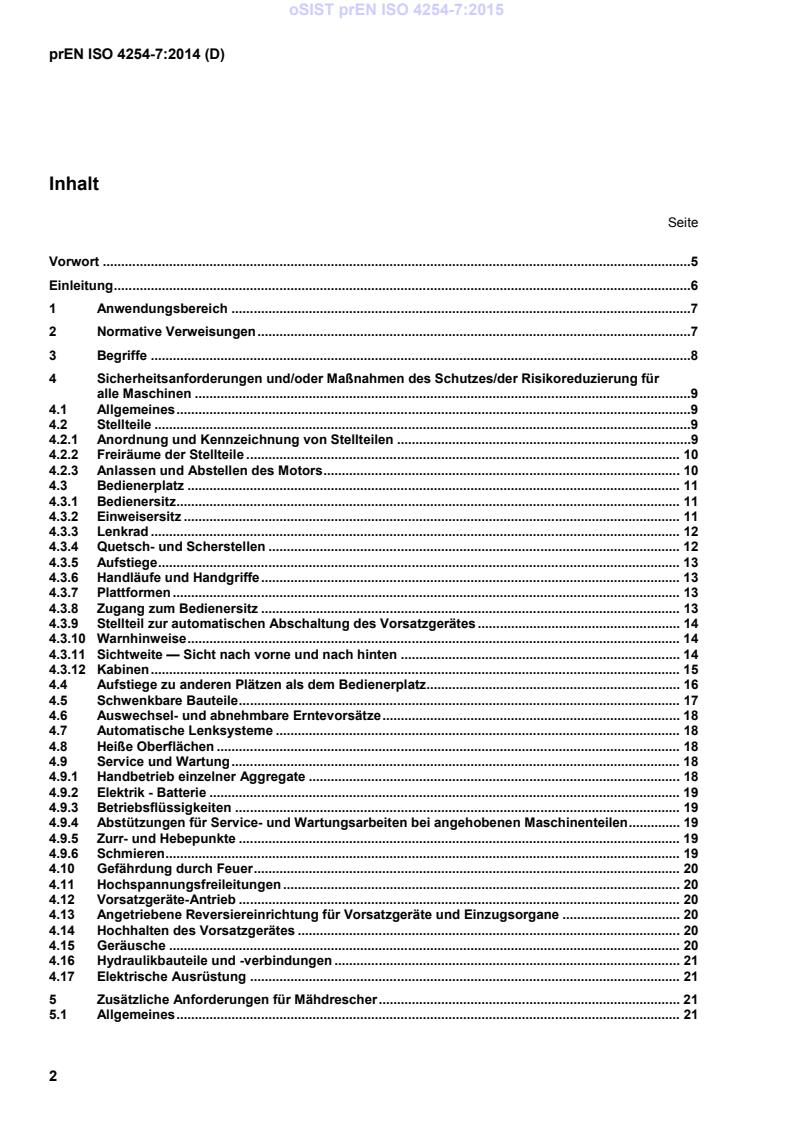
Inhalt
Seite
Vorwort .5
Einleitung .6
1 Anwendungsbereich .7
2 Normative Verweisungen .7
3 Begriffe .8
4 Sicherheitsanforderungen und/oder Maßnahmen des Schutzes/der Risikoreduzierung für
alle Maschinen .9
4.1 Allgemeines .9
4.2 Stellteile .9
4.2.1 Anordnung und Kennzeichnung von Stellteilen .9
4.2.2 Freiräume der Stellteile . 10
4.2.3 Anlassen und Abstellen des Motors . 10
4.3 Bedienerplatz . 11
4.3.1 Bedienersitz . 11
4.3.2 Einweisersitz . 11
4.3.3 Lenkrad . 12
4.3.4 Quetsch- und Scherstellen . 12
4.3.5 Aufstiege . 13
4.3.6 Handläufe und Handgriffe . 13
4.3.7 Plattformen . 13
4.3.8 Zugang zum Bedienersitz . 13
4.3.9 Stellteil zur automatischen Abschaltung des Vorsatzgerätes . 14
4.3.10 Warnhinweise . 14
4.3.11 Sichtweite — Sicht nach vorne und nach hinten . 14
4.3.12 Kabinen . 15
4.4 Aufstiege zu anderen Plätzen als dem Bedienerplatz. 16
4.5 Schwenkbare Bauteile . 17
4.6 Auswechsel- und abnehmbare Erntevorsätze . 18
4.7 Automatische Lenksysteme . 18
4.8 Heiße Oberflächen . 18
4.9 Service und Wartung . 18
4.9.1 Handbetrieb einzelner Aggregate . 18
4.9.2 Elektrik - Batterie . 19
4.9.3 Betriebsflüssigkeiten . 19
4.9.4 Abstützungen für Service- und Wartungsarbeiten bei angehobenen Maschinenteilen . 19
4.9.5 Zurr- und Hebepunkte . 19
4.9.6 Schmieren . 19
4.10 Gefährdung durch Feuer . 20
4.11 Hochspannungsfreileitungen . 20
4.12 Vorsatzgeräte-Antrieb . 20
4.13 Angetriebene Reversiereinrichtung für Vorsatzgeräte und Einzugsorgane . 20
4.14 Hochhalten des Vorsatzgerätes . 20
4.15 Geräusche . 20
4.16 Hydraulikbauteile und -verbindungen . 21
4.17 Elektrische Ausrüstung . 21
5 Zusätzliche Anforderungen für Mähdrescher . 21
5.1 Allgemeines . 21
oSIST prEN ISO 4254-7:2015
prEN ISO 4254-7:2014 (D)
5.2 Kabine . 21
5.3 Mähwerk, Einzugsschnecken, Haspel . 21
5.4 Korntank und Kornförderung . 22
5.4.1 Korntankgestaltung . 22
5.4.2 Zugang in den Korntank . 22
5.4.3 Verteilerschnecke . 22
5.4.4 Befüllschnecke . 23
5.4.5 Austragschnecke . 23
5.4.6 Korn- und Überkehrfördersysteme . 24
5.5 Maiserntevorsatzgerät . 24
5.5.1 Maispflückvorsatz . 24
5.5.2 Maispflückerhäcksler . 24
5.6 Strohhäcksler, Strohverteiler und Spreuverteiler . 26
5.6.1 Allgemeines . 26
5.6.2 Strohhäcksler mit Auswurfschacht . 27
5.6.3 Strohhäcksler mit angetriebenem Verteiler . 28
5.6.4 Spreuverteiler . 29
5.6.5 Strohverteiler . 29
5.7 Steinfangmulde . 29
5.8 Aufbewahrung von Mähmessern . 29
6 Zusätzliche Anforderungen für Feldhäcksler . 29
6.1 Bedienerplatz . 29
6.2 Einzugsorgan . 30
6.3 Häckselorgan — Antrieb . 31
6.4 Nachlauf von rotierenden Funktionselementen im Erntegutflusssystem . 31
6.5 Messerschleifeinrichtung . 32
7 Zusätzliche Anforderungen für Baumwollerntemaschinen . 32
7.1 Ernteorgan, Einzugsschnecken, Haspel . 32
7.1.1 Baumwollrupfer und Baumwollpflücker . 32
7.1.2 Baumwollpflücker . 32
7.2 Korb (Baumwollrupfer und Baumwollpflücker) . 33
7.2.1 Korbabsenkung . 33
7.2.2 Verdichterschnecke . 33
7.2.3 Warnhinweise am Korb . 33
7.2.4 Korbgeländer . 33
7.3 Betriebsflüssigkeiten . 33
8 Zusätzliche Anforderungen für Zuckerrohrerntemaschinen . 34
8.1 Allgemeines . 34
8.2 Beseitigung von Verstopfungen oder Hindernissen . 34
8.3 Kabine . 34
8.4 Erntesammelsystem. 34
8.5 Basisschneidsystem . 34
8.6 Stielförderladesystem . 34
9 Überprüfung der Sicherheitsanforderungen und/oder Maßnahmen des Schutzes/der
Risikoreduzierung (Siehe Tabelle 1.) . 35
10 Informationen zur Benutzung . 37
10.1 Betriebsanleitung . 37
10.1.1 Allgemeines . 37
10.1.2 Alle Maschinen . 38
10.1.3 Mähdrescher . 39
10.1.4 Feldhäcksler . 39
10.1.5 Baumwollerntemaschinen . 39
10.1.6 Zuckerrohrerntemaschinen . 39
10.2 Kennzeichnung . 40
10.2.1 Allgemeines . 40
10.2.2 Instruktionshinweise . 40
10.2.3 Warnhinweise . 40
oSIST prEN ISO 4254-7:2015
prEN ISO 4254-7:2014 (D)
Anhang A (normativ) Kennzeichnung von handbetätigten Stellteilen durch Farbkodierung . 41
A.1 Zweck . 41
A.2 Allgemeines . 41
A.3 Farbkennzeichnung . 41
Anhang B (normativ) Geräuschmessung . 43
B.1 Allgemeines . 43
B.2 Maschinenkonfiguration und Betriebsbedingungen . 43
B.3 Kabine und Zusatzausrüstungen . 44
Anhang C (informativ) Liste der signifikanten Gefährdungen . 45
Literaturhinweise . 58
oSIST prEN ISO 4254-7:2015
prEN ISO 4254-7:2014 (D)
Vorwort
Dieses Dokument (prEN ISO 4254-7:2014) wurde vom Technischen Komitee ISO/TC 23 „Tractors and
machinery for agriculture and forestry“ in Zusammenarbeit mit dem Technischen Komitee CEN/TC 144
„Traktoren und Maschinen für die Land- und Forstwirtschaft“ erarbeitet, dessen Sekretariat vom AFNOR
gehalten wird.
Dieses Dokument ist derzeit zur parallelen Umfrage vorgelegt.
Dieses Dokument wird EN ISO 4254-7:2009 ersetzen.
Dieses Dokument wurde unter einem Mandat erarbeitet, das die Europäische Kommission und die
Europäische Freihandelszone dem CEN erteilt haben, und unterstützt grundlegende Anforderungen der EU-
Richtlinien.
ISO 4254 besteht unter dem allgemeinen Titel Landmaschinen — Sicherheit aus folgenden Teilen:
1)
Part 1: General requirements
Part 5: Power-driven soil working equipment
Part 6: Sprayers and liquid fertilizer distributors
Part 7: Combine harvesters, forage harvesters, cotton harvesters and sugar cane harvesters
Part 8: Solid fertilizer distributors
Part 9: Seed drills
Part 10: Rotary tedders and rakes
Part 11: Pick-up balers
Part 12: Rotary disc and drum mowers and flail mowers
Part 13: Large rotary mowers
2)
Part 14: Bale wrappers
Anerkennungsnotiz
Der Text von ISO/DIS 4254-7:2014 wurde vom CEN als prEN ISO 4254-7:2014 ohne irgendeine Abänderung
genehmigt.
1) Zum Zwecke der allgemeinen Bedeutung wurden die Anforderungen an den Schutz beweglicher Teile für die
Kraftübertragung in zwei separate technische Beschreibungen übertragen und veröffentlicht: ISO/TS 28923:2007 (Öffnen
der Schutzeinrichtung ohne Werkzeug) und ISO/TS 28924:2007 (Öffnen der Schutzeinrichtung mit Werkzeug).
2) In Vorbereitung.
oSIST prEN ISO 4254-7:2015
prEN ISO 4254-7:2014 (D)
Einleitung
Dieses Dokument ist eine Typ-C-Norm wie in ISO 12100 festgelegt.
Dieses Dokument ist insbesondere für die folgenden Anspruchsgruppen von Bedeutung, die Marktteilnehmer
mit Bezug zur Maschinensicherheit vertreten:
Maschinenhersteller (kleine, mittlere und große Unternehmen);
Gesundheits- und Sicherheitsorganisationen (Regulierungsbehörden, Organisationen des Unfallschutzes,
Marktaufsicht, usw.).
Andere können durch den Grad der Maschinensicherheit betroffen sein, der durch die oben genannten
Anspruchsgruppen mit den Mitteln dieses Dokuments erreicht wurde:
Maschinenanwender/Arbeitgeber (kleine, mittlere und große Unternehmen);
Maschinenanwender/Arbeitgeber (z. B. Gewerkschaften, Organisationen für Personen mit besonderen
Bedürfnissen);
Dienstleister, z. B. für Instandhaltung (kleine, mittlere und große Unternehmen);
Verbraucher (wenn die Maschine für die Anwendung durch Verbraucher vorgesehen ist)
Den oben genannten Anspruchsgruppen wurde die Möglichkeit gegeben, sich an der Ausarbeitung dieses
Dokuments zu beteiligen.
Die betroffenen Maschinen und Systeme und das Ausmaß, in dem Gefährdungen, Gefährdungssituationen
oder Gefährdungsereignisse erfasst sind, sind im Anwendungsbereich dieses Dokuments angegeben.
Wenn Bestimmungen dieser Typ-C-Norm von den Bestimmungen in Typ A-oder B-Normen abweichen, haben
die Bestimmungen dieser Typ-C-Norm Vorrang gegenüber den Bestimmungen der anderen Normen für
Maschinen, die nach den Bestimmungen dieser Typ-C-Norm konstruiert und gebaut worden sind.
Die betroffenen Maschinen und die behandelten Gefährdungen, Gefährdungssituationen und
Gefährdungsereignisse sind in dem Anwendungsbereich dieses Teiles von ISO 4254 angegeben. Diese
Gefährdungen sind spezifisch für Mähdrescher, Feldhäcksler, Baumwollerntemaschinen und Zucker-
rohrerntemaschinen.
Signifikante Gefährdungen, die auf alle (selbstfahrenden, angebauten, aufgesattelten und gezogenen)
Landmaschinen gemeinsam zutreffen, werden in ISO 4254-1 behandelt.
oSIST prEN ISO 4254-7:2015
prEN ISO 4254-7:2014 (D)
1 Anwendungsbereich
Dieser Teil von ISO 4254, der zusammen mit ISO 4254-1 anzuwenden ist, enthält sicherheitstechnische
Anforderungen und deren Überprüfung für die Gestaltung und Konstruktion von Mähdreschern,
Feldhäckslern, Bauwollerntemaschinen und Zuckerrohrerntemaschinen. Sie beschreibt Maßnahmen zur
Vermeidung oder Verminderung von Gefährdungen, die sich aus der bestimmungsgemäßen Verwendung
dieser Maschinen durch eine Person (die Bedienungsperson) im Rahmen des normalen Betriebes und der
Wartung ergeben. Zusätzlich legt sie fest, welche Informationen über sicheres Arbeiten vom Hersteller zur
Verfügung zu stellen sind.
Wenn Bestimmungen dieses Teils von ISO 4254 von den in ISO 4254-1 festgelegten Bestimmungen
abweichen, haben die Bestimmungen von diesem Teil von ISO 4254 Vorrang gegenüber den Bestimmungen
von ISO 4254-1 für Maschinen, die nach den Bestimmungen von diesem Teil von ISO 4254 konstruiert und
gebaut sind.
Dieser Teil von ISO 4254 behandelt zusammen mit ISO 4254-1 alle signifikanten Gefährdungen (wie in
Tabelle 1 aufgeführt), Gefährdungssituationen und -ereignisse von Mähdreschern, Feldhäckslern,
Baumwollerntemaschinen und Zuckerrohrerntemaschinen, wenn sie bestimmungsgemäß und unter den vom
Hersteller vorgesehenen Bedingungen verwendet werden (siehe Anhang A). Er gilt nicht für Gefährdungen
durch die Anwesenheit von anderen Personen als der Bedienungsperson, Reinigung des Korntanks und
Gefährdungen in Bezug auf Schwingungen und bewegte Teile der Kraftübertragung, ausgenommen
Festigkeitsanforderungen an Schutzeinrichtungen und Abweisbügel. In Bezug auf Bremsen und Lenkung gilt
sie nur für die ergonomischen Aspekte (z. B. Anordnung von Bremspedal und Lenkrad); weitere Aspekte in
Bezug auf Bremsen und Lenkung sind nicht abgedeckt. Für gezogene Erntemaschinen gilt sie nur für
Gefährdungen im Zusammenhang mit dem Arbeitsverfahren.
ANMERKUNG Besondere Anforderungen in Bezug auf Straßenverkehrsvorschriften werden in diesem Teil von
ISO 4254 nicht berücksichtigt.
Dieser Teil von ISO 4254 gilt nicht für Maschinen, die vor dem Veröffentlichungsdatum hergestellt wurden.
2 Normative Verweisungen
Die folgenden Dokumente, die in diesem Dokument teilweise oder als Ganzes zitiert werden, sind für die
Anwendung dieses Dokuments erforderlich. Bei datierten Verweisungen gilt nur die in Bezug genommene
Ausgabe. Bei undatierten Verweisungen gilt die letzte Ausgabe des in Bezug genommenen Dokuments
(einschließlich aller Änderungen).
ISO 3600, Tractors, machinery for agriculture and forestry, powered lawn and garden equipment —
Operator’s manuals — Content and presentation
ISO 3767-1, Tractors, machinery for agriculture and forestry, powered lawn and garden equipment —
Symbols for operator controls and other displays — Part 1: Common symbols
ISO 3767-2, Tractors, machinery for agriculture and forestry, powered lawn and garden equipment —
Symbols for operator controls and other displays — Part 2: Symbols for agricultural tractors and machinery
ISO 3776-1, Tractors and machinery for agriculture — Seat belts — Part 1: Anchorage location requirements
ISO 3776-2, Tractors and machinery for agriculture — Seat belts — Part 2: Anchorage strength requirements
ISO 3776-3, Tractors and machinery for agriculture — Seat belts — Part 3: Requirements for assemblies
ISO 4253, Agricultural tractors — Operator's seating accommodation — Dimensions
ISO 4254-1:2013, Agricultural machinery — Safety — Part 1: General requirements
oSIST prEN ISO 4254-7:2015
prEN ISO 4254-7:2014 (D)
ISO 5131, Acoustics — Tractors and machinery for agriculture and forestry — Measurement of noise at the
operator’s position — Survey method
ISO 5353, Earth-moving machinery, and tractors and machinery for agriculture and forestry — Seat index
point
ISO 5687, Equipment for harvesting — Combine harvesters — Determination and designation of grain tank
capacity and unloading device performance
ISO 9533, Earth-moving machinery — Machine-mounted forward and reverse audible warning alarm —
Sound test method
ISO 11684, Tractors, machinery for agriculture and forestry, powered lawn and garden equipment — Safety
signs and hazard pictorials — General principles
ISO 12100:2010, Safety of machinery — General principles for design — Risk assessment and risk reduction
ISO 15077, Tractors and self-propelled machinery for agriculture — Operator controls — Actuating forces,
displacement, location and method of operation
3 Begriffe
Für die Anwendung dieses Dokumentes gelten die Begriffe nach ISO 12100 und ISO 4254-1 und die
folgenden Begriffe.
3.1
Einweisersitz
integrierter oder separater Sitz, um dem Ausbilder oder dem Anzulernenden ein Sitzen zu ermöglichen
3.2
Lenksystem
automatisches System zur Steuerung der Lenkung der Maschine während des Erntebetriebs
3.3
Mähdrescher
mobile Getreideerntemaschine zum Abschneiden, Abstreifen oder Aufnehmen von Erntegut, Dreschen,
Trennen, Reinigen und Fördern der Körner in einen Korntank und Ablegen der Ernterückstände auf den
Boden
3.4
Korn- und Überkehrfördersysteme
Systeme zum Fördern von Körnern und Überkehr innerhalb der Maschine durch Schnecken und/oder
Elevatoren zum Korntank oder Dreschwerk/Nachdreschsystem
3.5
Feldhäcksler
mobile Landmaschine zum Ernten oder Aufsammeln des Erntegutes, zum Schneiden des Erntegutes auf
kurze gleichmäßige Länge und zum Fördern des gehäckselten Erntegutes in Container oder separate
Fahrzeuge
Anmerkung 1 zum Begriff: ISO 8909-1 enthält detaillierte Definitionen von Begriffen in Bezug auf Feldhäcksler.
3.6
Baumwollerntemaschine
mobile Erntemaschine für die Feldernte vom Baumwolle zum Reinigen (falls erforderlich), Handhaben und
Fördern von Feld-geernteter Baumwolle in einen Korb und Ablegen der Ernterückstände auf den Boden
oSIST prEN ISO 4254-7:2015
prEN ISO 4254-7:2014 (D)
3.7
Zuckerrohrerntemaschine
mobile Landmaschine zum Ernten oder Aufsammeln von Zuckerrohrerntegut, zum Schneiden des Erntegutes
auf kurze gleichmäßige Länge und zum Fördern des gehäckselten Erntegutes in Container oder separate
Fahrzeuge
3.8
Baumwollernteeinheit
Teil der Baumwollerntemaschine, der aus den Organen zum Aufsammeln und Abstreifen oder Pflücken der
Baumwolle von einer Baumwollpflanze besteht
3.9
Presseinrichtung
Elemente zum Verdichten des Erntegutes in einer mobilen Baumwollerntemaschine
3.10
Korb
Behälter zum Aufnehmen, Bunkern, Verdichten und Überladen von geernteter Baumwolle
3.11
Reinigung
Einrichtung zum Trennen von Beimengungen von der geernteten Baumwolle in einer mobilen
Baumwollerntemaschine
3.12
Vorsatzgerät
Teil eines Mähdreschers/Feldhäckslers oder einer Baumwollerntemaschine, der aus den Organen zum
Aufsammeln, Schneiden, Abstreifen oder Aufnehmen des Erntegutes besteht
3.13
Bedienerplatz
Platz auf der Maschine, der die Fahrerposition einschließt
4 Sicherheitsanforderungen und/oder Maßnahmen des Schutzes/der
Risikoreduzierung für alle Maschinen
4.1 Allgemeines
4.1.1 Die Maschinen müssen mit den Sicherheitsanforderungen und/oder Maßnahmen des Schutzes/der
Risikoreduzierung dieses Abschnittes übereinstimmen.
4.1.2 Zusätzlich muss die Maschine für Gefährdungen, die relevant, aber nicht signifikant sind und die nicht
in diesem Dokument behandelt werden, entsprechend den Regeln von ISO 12100:2010 gestaltet sein.
4.1.3 Falls in diesem Teil von ISO 4254 nichts anderes festgelegt ist, muss die Maschine mit den
Anforderungen von ISO 4254-1 übereinstimmen.
4.2 Stellteile
4.2.1 Anordnung und Kennzeichnung von Stellteilen
4.2.1.1 Stellteile, wie z. B. Lenkräder oder -hebel, Schalthebel, Steuerhebel, Kurbeln, Pedale und Schalter
müssen wie folgt gewählt, gestaltet, gebaut und angeordnet sein:
a) Ihre Anordnungen und Betätigungsart müssen mit ISO 15077 übereinstimmen.
oSIST prEN ISO 4254-7:2015
prEN ISO 4254-7:2014 (D)
b) Falls in diesem Teil von ISO 4254 nichts anderes festgelegt ist, müssen die in A.3.1, A.3.2 und A.3.3
genannten Stellteile innerhalb des Hand- und Fußbereiches der Bedienungsperson am Bedienerplatz
angeordnet sein. Die Anordnungen aller anderen Stellteile müssen mit ISO 15077 übereinstimmen.
c) Die Stellteile und ihre verschiedenen Positionen müssen gekennzeichnet sein [siehe 10.2.2 a)]. Diese
Kennzeichen müssen in der Betriebsanleitung erklärt sein [siehe 10.1.2 a)]. Werden Bildzeichen
verwendet, müssen sie mit ISO 3767-1 und ISO 3767-2 übereinstimmen. Werden zur Kennzeichnung der
Stellteile unterschiedliche Farben verwendet, müssen diese mit den Bestimmungen von Anhang A
übereinstimmen.
4.2.1.2 Zusätzliche Anforderungen für bestimmte Stellteile sind in 4.3.3, 4.3.8, 4.3.9, 4.12, 4.13.3, 5.4.5.2,
6.2.5, 7.1.2.1, 7.2.2.1 und 8.5 enthalten.
4.2.1.3 Stellteile, ausgenommen die Einrichtung zur Anwesenheitskontrolle der Bedienungsperson, falls
vorhanden, müssen so angeordnet sein, dass sie in jeder ihrer Positionen nicht den Zugang zum
Bedienerplatz versperren und dass sie beim Auf- und Absteigen, mit Ausnahme des Lenkrades, nicht als
Handgriffe benutzt werden können (siehe ebenfalls 4.3.8).
4.2.1.4 Im normalen Betrieb müssen die Stellteile für den Fahrantrieb so angeordnet sein, dass sie nur
betätigt werden können, wenn die Bedienungsperson am Bedienerplatz ist. Pedale müssen eine geeignete
Größe, Form und ausreichenden Abstand aufweisen. Die Pedale müssen eine rutschhemmende Oberfläche
haben und leicht zu reinigen sein.
4.2.1.5 Werden Kupplungs-, Brems- und Gaspedal in exakt gleicher Weise verwendet wie in
Personenwagen, müssen sie in gleicher Weise wie in Personenwagen angeordnet sein.
4.2.2 Freiräume der Stellteile
Stellteile mit einer Betätigungskraft ≥ 100 N, gemessen am Griff, müssen einen Mindestfreiraum, a, von
50 mm zwischen ihren Außenkanten und angrenzenden Teilen haben. Stellteile mit einer Betätigungskraft
< 100 N müssen einen Mindestfreiraum, a, von 25 mm haben (siehe Bild 1). Fingertippschalter sind von
diesen Anforderungen ausgenommen, vorausgesetzt, es besteht kein Risiko, angrenzende Stellteile
unbeabsichtigt zu betätigen.
Maße in Millimeter
Legende
a Mindestfreiraum
1 handbetätigtes Stellteil
2 angrenzendes Teil
Bild 1 — Freiräume der Stellteile
4.2.3 Anlassen und Abstellen des Motors
Es gelten die Bestimmungen von ISO 4254-1:2013, 5.1.8.
oSIST prEN ISO 4254-7:2015
prEN ISO 4254-7:2014 (D)
4.3 Bedienerplatz
4.3.1 Bedienersitz
4.3.1.1 Für Bedienersitze gelten die Bestimmungen von ISO 4254-1:2013, 5.1.2.1 und 5.1.2.2.
4.3.1.2 Wenn die Konstruktion der Maschine Schutz im Falle eines Überschlags vorsieht, muss ein
Rückhaltesystem nach ISO 3776-1, ISO 3776-2 und ISO 3776-3 vorhanden sein.
4.3.2 Einweisersitz
Der Einweisersitz, falls vorhanden, muss die folgenden Anforderungen erfüllen:
a) Der Einweisersitz muss wie in Bild 2 dargestellt angeordnet sein. Er muss, vereinbar mit der
Maschinenfunktion und anderen Konstruktionsvorgaben so platziert sein, dass der darauf sitzende
Ausbilder oder Anzulernende eine möglichst geringe Beeinträchtigung für den Betrieb der und die Sicht
auf die Maschine unter den in Abschnitt 1 beschriebenen Benutzungsbedingungen bildet.
b) Der Einweisersitz muss die in Bild 2 dargestellten Mindestabmessungen aufweisen. Der Sitz muss
ebenfalls eine Rückenlehne mit den in Bild 2 dargestellten Mindestabmessungen haben. Ein nicht aus
Glas bestehendes Bauteil an der Rückwand im Kabineninneren kann als Rückenlehne benutzt werden.
c) Für den auf dem Einweisersitz sitzenden Ausbilder oder Anzulernenden muss wenigstens ein in
bequemer Position angeordneter Handgriff oder Handlauf vorhanden sein.
d) Für die Füße des auf dem Einweisersitz sitzenden Ausbilders oder Anzulernenden muss ein geeigneter
Bereich vorhanden sein, der nicht den Bereich der Bedienungsperson beeinträchtigt.
e) Wenn die Konstruktion der Maschine Schutz im Falle eines Überschlags vorsieht, muss ein
Rückhaltesystem nach ISO 3776-1, ISO 3776-2 und ISO 3776-3 vorhanden sein.
f) Der Einweisersitz und der darauf sitzende Ausbilder oder Anzulernende müssen sich innerhalb der
Struktur der geschlossenen Kabine befinden.
g) Die Betriebsanleitung muss einen angemessenen Hinweis zur bestimmungsgemäßen Verwendung des
Einweisersitzes enthalten [siehe 10.1.2 c)].
oSIST prEN ISO 4254-7:2015
prEN ISO 4254-7:2014 (D)
Maße in Millimeter
Legende
1 SIP
2 Vorderansicht
3 Seitenansicht
4 Fußabstützung
5 Freiraum
Bild 2 — Abmessungen des Einweisersitzes
4.3.3 Lenkrad
Die Lenkradmitte muss sich in der Längsachse des Sitzes mit einer maximalen Seitenabweichung von 50 mm
(beidseitig) befinden. Der Freiraum zwischen festen Teilen und dem Lenkrad muss mit 4.3.12.3 überein-
stimmen (siehe Bild 5).
4.3.4 Quetsch- und Scherstellen
4.3.4.1 Am Arbeitsplatz der Bedienungsperson dürfen keine Quetsch- oder Scherstellen vorhanden sein
innerhalb des Hand- oder Fußbereiches der Bedienungsperson oder des Benutzers des Einweisersitzes,
wenn sie in dem vorgesehenen Sitz sitzen.
4.3.4.2 Zwischen dem bewegten Sitz und angrenzenden Teilen muss ein Freiraum von mindestens 25 mm
eingehalten werden.
4.3.4.3 Für Maschinen ohne Kabine ist die Handreichweite durch eine Kugel mit einem Radius von
1 000 mm festgelegt. Der Kugelmittelpunkt liegt auf der Sitzmittellinie 60 mm vor und 580 mm über dem SIP
nach ISO 5353. Der Fußbereich ist durch eine nach unten gerichtete Halbkugel mit einem Radius von
800 mm festgelegt. Der Mittelpunkt dieser Halbkugel liegt auf der Mittellinie des Sitzes an der Vorderkante der
Polsterung, wenn der Sitz in seiner Mittelstellung ist (siehe Bild 3).
4.3.4.4 Bei Maschinen mit Kabine sind der Hand- und Fußbereich durch die oben beschriebenen
Proportionen der Kugel und der Halbkugel festgelegt, die sich innerhalb der Kabine befinden.
oSIST prEN ISO 4254-7:2015
prEN ISO 4254-7:2014 (D)
Maße in Millimeter
Legende
1 SIP
ANMERKUNG Bei Maschinen mit Kabine begrenzt die Kabine den in Bild 3 festgelegten Raum.
Bild 3 — Arm- und Fußreichweite
4.3.5 Aufstiege
Für Aufstiege gelten die Bestimmungen von ISO 4254-1: 2013, 4.7.1.1 und 4.7.1.2 mit folgender Änderung:
Für Aufstiege, die für den Transport schwenkbar sind, sind seitliche Begrenzungen auf der obersten
Oberfläche (Stufe) der beweglichen Leiter nicht erforderlich.
4.3.6 Handläufe und Handgriffe
Für Handläufe und Handgriffe gelten die Bestimmungen von ISO 4254-1:2013, 4.7.1.3, mit der folgenden
Änderung:
Das untere Ende des Handlaufs/Handgriffs darf nicht höher als 1 600 mm über der Bodenoberfläche
angeordnet sein.
4.3.7 Plattformen
Für Bedienerplattformen gelten die Bestimmungen von ISO 4254-1:2013, 4.7.2.
4.3.8 Zugang zum Bedienersitz
Der Zugang zum Bedienersitz muss durch den wechselweisen Auftritt der Füße möglich sein. Hierzu muss im
Bodenbereich eine Mindestbreite von 300 mm vorhanden sein. Einrichtungen, einschließlich Stellteile in jeder
ihrer Positionen müssen so angebracht sein, dass sie nicht den Zugang zum Bedienerplatz versperren.
Ausgenommen sind jedwede Einrichtungen zur Beschränkung des Zugangs der Bedienungsperson zu
Gefährdungen während des Betriebes.
oSIST prEN ISO 4254-7:2015
prEN ISO 4254-7:2014 (D)
4.3.9 Stellteil zur automatischen Abschaltung des Vorsatzgerätes
4.3.9.1 Selbstfahrende Maschinen mit elektrisch betätigter Einschaltung des Vorsatzgerätes müssen mit
einem System ausgerüstet sein, welches das Einschalten des Vorsatzgerätes verhindert, wenn die
Bedienungsperson nicht am Bedienerplatz ist und welches das Vorsatzgerät automatisch abschaltet, wenn
die Bedienungsperson den Bedienerplatz verlässt. Die maximale Zeitverzögerung zum Auslösen der
Abschaltung beträgt 7 s. Nach dem Abschalten muss das Wiedereinschalten des Vorsatzgerätes eine
absichtliche Betätigung eines anderen Stellteiles als dem Stellteil zur automatischen Abschaltung des
Vorsatzgerätes erfordern.
ANMERKUNG Für das Stellteil zur automatischen Abschaltung des Vorsatzgerätes werden Anforderungen an die
Gestaltung entsprechend ISO 13849-1 bei der nächsten Revision von diesem Teil von ISO 4254 ergänzt.
4.3.9.2 Bei selbstfahrenden Maschinen mit mechanischer Einschaltung des Vorsatzgerätes muss der
Schalthebel in eingeschalteter Stellung als Hindernis gegen das Verlassen des Bedienersitzes dienen.
4.3.10 Warnhinweise
Sind akustische oder optische Einrichtungen vorgesehen, um die Bedienungsperson über Fehlfunktionen oder
einen besonderen Betriebszustand der Maschine zu informieren, zum Beispiel:
Korntankerhöhung ausgefahren über 4 m;
Baumwollkorb angehoben;
Auswurfkanal der Zuckerrohrerntemaschine auf über 4 m angehoben;
Lenksysteme aktiviert;
Hangausgleichssystem in maximaler Stellung;
Korntankauslaufrohr ausgeschwenkt;
Messerschleifeinrichtung in Betrieb;
dann müssen die angegebenen Informationen eindeutig und leicht zu verstehen sein. Die Betriebsanleitung
muss genaue Informationen über diese Einrichtungen enthalten [siehe 10.1.2 d)].
4.3.11 Sichtweite — Sicht nach vorne und nach hinten
4.3.11.1 Für die Sicht nach vorne und nach hinten gelten die Bestimmungen von ISO 4254-1:2013, 5.1.7.
4.3.11.2 Die Maschinen müssen mit mindestens zwei Rückspiegeln ausgerüstet sein, einer auf jeder Seite
der Maschine.
4.3.11.3 Die Betriebsanleitung muss Hinweise enthalten, wie die Windschutzscheibe zu reinigen ist und die
die Rückspiegel einzustellen und zu reinigen sind [siehe 10.1.2 e) und 10.1.2 f)].
4.3.11.4 Diese Spiegel müssen einstellbar und gereinigt sein, wobei gleichzeitig ein Dreipunktkontakt
aufrechterhalten werden muss, wenn das Einstellen nicht ferngesteuert erfolgen kann. Die Spiegel müssen so
einstellbar sein, dass sie am Bedienerplatz ein klares Abbild der Gesamthöhe des hinteren Teiles der
Maschine vermitteln.
4.3.11.5 Ist es nicht möglich, von der Bedienersitzposition aus den Bereich unmittelbar hinter der Maschine
einzusehen, muss eine automatisch einschaltende und mit ISO 9533 übereinstimmende akustische Rückfahr-
Warnsignalanlage vorhanden sein.
ANMERKUNG Normen bezüglich des Sichtfelds sind durch ISO/TC 23/SC 3 in Vorbereitung.
oSIST prEN ISO 4254-7:2015
prEN ISO 4254-7:2014 (D)
4.3.11.6 Ist eine Kabine vorhanden, müssen Vorkehrungen getroffen sein zum Einbau von Einrichtungen
zur Säuberung vereister und beschlagener Frontscheiben.
4.3.12 Kabinen
4.3.12.1 Allgemeines
Ist der Bedienerplatz mit einer Kabine ausgerüstet, muss diese die nachfolgenden Anforderungen erfüllen.
4.3.12.2 Türen und Türöffnungen
4.3.12.2.1 Die Türöffnung muss Bild 4 entsprechen, wobei die Winkel zwischen der unteren waagerechten
Begrenzung (Maß ≥ 300 mm) und den seitlichen senkrechten Begrenzungen nicht kleiner als 90° sein dürfen.
Das in Bild 4 dargestellte Maß bezieht sich auf die Türöffnung bei geöffneter Tür. Es muss möglich sein, dass
die Tür in geöffneter Position verbleibt (durch Gasdruckdämpfer, Schwerkraft oder mechanische
Vorrichtungen, usw.).
4.3.12.2.2 Das Öffnen und Schließen der Tür muss vom Boden, von einer Plattform oder von einem Aufstieg
aus möglich sein, wobei ein Dreipunktkontakt aufrechterhalten werden muss.
Maße in Millimeter
Bild 4 — Hauptmaße der Türöffnung
4.3.12.3 Innenraumabmessungen
Die Innenraumabmessungen müssen Bild 5 entsprechen. Die angegebenen Maße gelten für den Sitz in SIP-
Stellung wie in ISO 5353 definiert.
4.3.12.4 Notausgäng
...