

EN 933-3:2012
(Main)Tests for geometrical properties of aggregates - Part 3: Determination of particle shape - Flakiness index
- Abstract
This European Standard describes the reference method, used for type testing and in case of dispute, for determination of the flakiness index of aggregates. For other purposes, in particular production control, other methods may be used, provided that an appropriate working relationship with the reference method has been established.
This European Standard applies to natural, manufactured or recycled aggregates.
The test procedure specified in this part of this European Standard is not applicable to particle sizes less than 4 mm or greater than 100 mm.
- Status
- Published
- Publication Date
- 17-Jan-2012
- Withdrawal Date
- 30-Jul-2012
- Technical Committee
- CEN/TC 154 - Aggregates
- Drafting Committee
- CEN/TC 154/SC 6 - Test methods
- Current Stage
- 9093 - Decision to confirm - Review Enquiry
- Start Date
- 05-Sep-2017
- Completion Date
- 21-Oct-2026


Overview
EN 933-3:2012 - Tests for geometrical properties of aggregates - Part 3: Determination of particle shape - Flakiness index is a CEN reference method for determining the flakiness of aggregate particles. It is the prescribed method for type testing and for resolving disputes; alternative methods may be used for production control provided they have a validated relationship to this reference method. The standard applies to natural, manufactured or recycled aggregates with particle sizes between 4 mm and 100 mm.
Key topics and technical requirements
- Scope & purpose
- Reference method for flakiness index (FI); not applicable to particles <4 mm or >100 mm.
- Used for type testing and dispute resolution; production control may use alternative validated methods.
- Principle
- Two-step sieving: first separate sample into size fractions (di/Di), then sieve each fraction on bar sieves with slot width = Di/2.
- FI = (M2 / M1) × 100, where M1 = total mass of tested size fractions and M2 = total mass passing the bar sieves.
- Apparatus
- Test sieves with square apertures per EN 933-2 (100 mm down to 4 mm).
- Corresponding bar sieves (parallel cylindrical bars) with slot widths specified for each size fraction.
- Balance accurate to ±0.1% of test portion mass.
- Ventilated oven at (110 ± 5) °C for drying to constant mass.
- Sample preparation & procedure
- Reduce laboratory sample per EN 932-2; test portion mass per EN 933-1.
- Dry to constant mass, sieve on test sieves, then on bar sieves; weigh fractions passing slots.
- Reporting
- Mandatory: reference to EN 933-3, sample ID, laboratory ID, test portion mass, overall FI (nearest whole number), sample reception date.
- Optional: source, sampling description, FI by fraction, test date, sampling certificate.
- Precision
- Annex B provides repeatability and reproducibility data from interlaboratory studies and formulas for other sizes/levels.
Applications and users
- Who uses it:
- Aggregate producers and processors (natural, manufactured, recycled)
- Independent testing laboratories and quality control technicians
- Civil engineers, road authorities, contractors specifying materials
- Contract administrators and dispute resolution panels
- Practical uses:
- Acceptance testing and contractual compliance for aggregates
- Assessing particle shape for asphalt and concrete mix design
- Quality control in quarrying, recycling plants and aggregate production
- Supporting performance-related specifications and resolving disputes
Related standards
- EN 933 series (other geometrical tests: Part 1, Part 2, Part 4–11)
- EN 932-1/2/5 (general aggregate tests, sample reduction, equipment)
- EN 1097 (mechanical/physical properties of aggregates)
Keywords: EN 933-3:2012, flakiness index, aggregates, particle shape, bar sieves, sieving method, CEN, aggregate testing, quality control.
Relations
- Effective Date
- 08-Jun-2022
- Effective Date
- 23-Mar-2009
- Effective Date
- 28-Jan-2026
- Effective Date
- 28-Jan-2026
- Effective Date
- 28-Jan-2026
- Referred By
EN 12620:2013 - Aggregates for concrete - Effective Date
- 28-Jan-2026
- Effective Date
- 28-Jan-2026
- Effective Date
- 28-Jan-2026
- Effective Date
- 28-Jan-2026
- Effective Date
- 28-Jan-2026
- Effective Date
- 28-Jan-2026
- Effective Date
- 28-Jan-2026
- Effective Date
- 28-Jan-2026
- Effective Date
- 28-Jan-2026
- Referred By
EN 13139:2002 - Aggregates for mortar - Effective Date
- 28-Jan-2026
Get Certified
Connect with accredited certification bodies for this standard

DIBt (Deutsches Institut für Bautechnik)
German Institute for Building Technology.
DIN CERTCO
DIN Group product certification.

Aboma Certification B.V.
Specialized in construction, metal, and transport sectors.
Sponsored listings
Frequently Asked Questions
EN 933-3:2012 is a standard published by the European Committee for Standardization (CEN). Its full title is "Tests for geometrical properties of aggregates - Part 3: Determination of particle shape - Flakiness index". This standard covers: This European Standard describes the reference method, used for type testing and in case of dispute, for determination of the flakiness index of aggregates. For other purposes, in particular production control, other methods may be used, provided that an appropriate working relationship with the reference method has been established. This European Standard applies to natural, manufactured or recycled aggregates. The test procedure specified in this part of this European Standard is not applicable to particle sizes less than 4 mm or greater than 100 mm.
This European Standard describes the reference method, used for type testing and in case of dispute, for determination of the flakiness index of aggregates. For other purposes, in particular production control, other methods may be used, provided that an appropriate working relationship with the reference method has been established. This European Standard applies to natural, manufactured or recycled aggregates. The test procedure specified in this part of this European Standard is not applicable to particle sizes less than 4 mm or greater than 100 mm.
EN 933-3:2012 is classified under the following ICS (International Classification for Standards) categories: 91.100.15 - Mineral materials and products. The ICS classification helps identify the subject area and facilitates finding related standards.
EN 933-3:2012 has the following relationships with other standards: It is inter standard links to EN 933-3:1997/A1:2003, EN 933-3:1997, EN 932-5:2012, EN 933-2:2020, EN 933-1:2012, EN 12620:2013, EN 933-6:2022, EN 13450:2013, EN 1744-4:2005, EN 13043:2013, EN ISO 11641:2025, EN ISO 105-C08:2010, EN 13242:2013, EN 13383-1:2002, EN 13139:2002. Understanding these relationships helps ensure you are using the most current and applicable version of the standard.
EN 933-3:2012 is associated with the following European legislation: Standardization Mandates: M/125 rev1. When a standard is cited in the Official Journal of the European Union, products manufactured in conformity with it benefit from a presumption of conformity with the essential requirements of the corresponding EU directive or regulation.
EN 933-3:2012 is available in PDF format for immediate download after purchase. The document can be added to your cart and obtained through the secure checkout process. Digital delivery ensures instant access to the complete standard document.
Standards Content (Sample)
2003-01.Slovenski inštitut za standardizacijo. Razmnoževanje celote ali delov tega standarda ni dovoljeno.SORãþDWRVWLPrüfverfahren für geometrische Eigenschaften von Gesteinskörnungen - Teil 3: Bestimmung der Kornform - PlattigkeitskennzahlEssais pour déterminer les caractéristiques géométriques des granulats - Partie 3: Détermination de la forme des granulats - Coefficient d'aplatissementTests for geometrical properties of aggregates - Part 3: Determination of particle shape - Flakiness index91.100.15Mineralni materiali in izdelkiMineral materials and productsICS:Ta slovenski standard je istoveten z:EN 933-3:2012SIST EN 933-3:2012en,fr,de01-maj-2012SIST EN 933-3:2012SLOVENSKI
STANDARDSIST EN 933-3:1999/A1:2004SIST EN 933-3:19991DGRPHãþD
EUROPEAN STANDARD NORME EUROPÉENNE EUROPÄISCHE NORM
EN 933-3
January 2012 ICS 91.100.15 Supersedes EN 933-3:1997English Version
Tests for geometrical properties of aggregates - Part 3: Determination of particle shape - Flakiness index
Essais pour déterminer les caractéristiques géométriques des granulats - Partie 3: Détermination de la forme des granulats - Coefficient d'aplatissement
Prüfverfahren für geometrische Eigenschaften von Gesteinskörnungen - Teil 3: Bestimmung der Kornform - Plattigkeitskennzahl This European Standard was approved by CEN on 29 October 2011.
CEN members are bound to comply with the CEN/CENELEC Internal Regulations which stipulate the conditions for giving this European Standard the status of a national standard without any alteration. Up-to-date lists and bibliographical references concerning such national standards may be obtained on application to the CEN-CENELEC Management Centre or to any CEN member.
This European Standard exists in three official versions (English, French, German). A version in any other language made by translation under the responsibility of a CEN member into its own language and notified to the CEN-CENELEC Management Centre has the same status as the official versions.
CEN members are the national standards bodies of Austria, Belgium, Bulgaria, Croatia, Cyprus, Czech Republic, Denmark, Estonia, Finland, France, Germany, Greece, Hungary, Iceland, Ireland, Italy, Latvia, Lithuania, Luxembourg, Malta, Netherlands, Norway, Poland, Portugal, Romania, Slovakia, Slovenia, Spain, Sweden, Switzerland, Turkey and United Kingdom.
EUROPEAN COMMITTEE FOR STANDARDIZATION
COMITÉ EUROPÉEN DE NORMALISATION EUROPÄISCHES KOMITEE FÜR NORMUNG
Management Centre:
Avenue Marnix 17,
B-1000 Brussels © 2012 CEN All rights of exploitation in any form and by any means reserved worldwide for CEN national Members. Ref. No. EN 933-3:2012: ESIST EN 933-3:2012
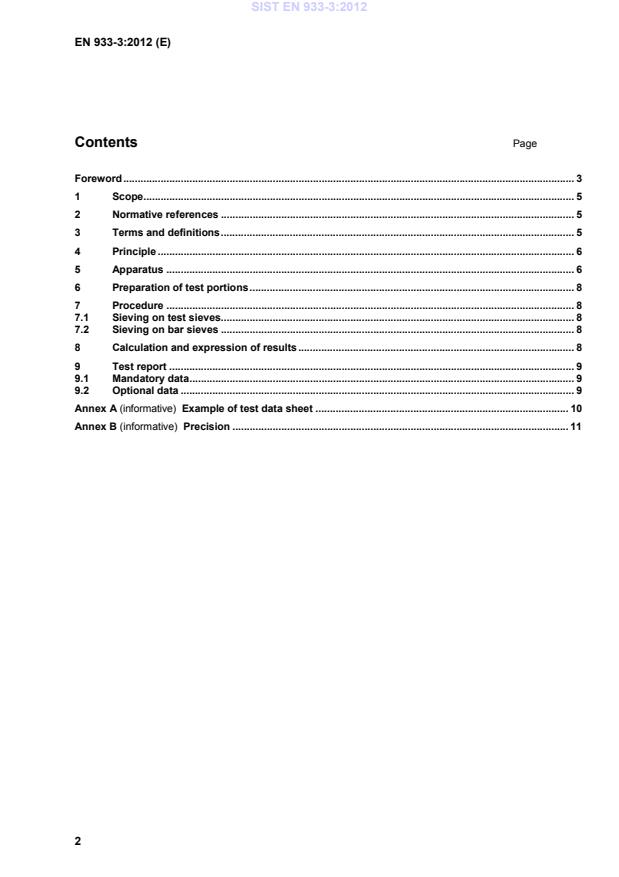
Example of test data sheet . 10Annex B (informative)
Precision . 11
Part 3: Determination of particle shape — Flakiness index; Part 4: Determination of particle shape — Shape index; Part 5: Determination of percentage of crushed and broken surfaces in coarse aggregate particles; Part 6: Assessment of surface characteristics — Flow coefficient of aggregates; Part 7: Determination of shell content — Percentage of shells for coarse aggregates; Part 8: Assessment of fines — Sand equivalent test; SIST EN 933-3:2012
...