

EN 14509:2013
(Main)Self-supporting double skin metal faced insulating panels - Factory made products - Specifications
- Abstract
This European Standard specifies requirements for factory made, self-supporting, double skin metal faced insulating sandwich panels, which are intended for discontinuous laying in the following applications:
a) roofs and roof cladding;
b) external walls and wall cladding;
c) walls (including partitions) and ceilings within the building envelope.
The insulating core materials covered by this European Standard are rigid polyurethane, expanded polystyrene, extruded polystyrene foam, phenolic foam, cellular glass and mineral wool.
NOTE Polyurethane (PUR) includes polyisocyanurate (PIR).
Panels with edge details that utilise different materials from the main insulating core are included in this European Standard.
Panels used in cold store applications are included in this European Standard. Panels, put on the market as a component of a cold storage room, building and/or building envelope kit are covered by ETA-Guideline 021 “Cold storage premises kits”.
This European Standard does not cover the following:
i. sandwich panels with a declared thermal conductivity for the insulating core greater than 0,06 W/m•K at 10 °C;
ii. products consisting of two or more clearly defined layers of different insulating core materials (multi-layered);
iii. panels with perforated facing(s);
iv. curved panels.
- Status
- Published
- Publication Date
- 15-Oct-2013
- Withdrawal Date
- 30-Oct-2014
- Current Stage
- 6060 - Definitive text made available (DAV) - Publishing
- Start Date
- 16-Oct-2013
- Due Date
- 21-May-2014
- Completion Date
- 16-Oct-2013


Overview - EN 14509:2013
EN 14509:2013 specifies requirements for factory-made, self-supporting double skin metal faced insulating sandwich panels intended for discontinuous laying in roofs, external walls (and cladding), internal walls/partitions and ceilings within the building envelope. The standard covers panels with rigid insulating cores such as polyurethane (PUR/PIR), expanded polystyrene (EPS), extruded polystyrene (XPS), phenolic foam, cellular glass and mineral wool. It includes panels used in cold store applications (note: cold store kits are additionally covered by ETA‑Guideline 021).
The standard excludes panels whose core thermal conductivity is greater than 0.06 W/m·K at 10 °C, multi-layer cores, panels with perforated facings and curved panels.
Key technical topics and requirements
- Component material requirements: metal facings, core materials, adhesives and bonding are specified for suitability and durability.
- Mechanical performance: tests and limits for bending, shear, point and repeated loads, and panel resistance under design loads.
- Thermal performance: methods for calculating thermal transmittance (U‑value) of panels and constituent materials.
- Durability and long-term behaviour: creep, ageing, interaction of bending/support forces and service performance.
- Fire characteristics: classification and testing requirements for reaction to fire and related safety.
- Dimensional tolerances: permitted variations for production and installation.
- Weather and permeability: water (driving rain) resistance, air permeability and water vapour transmission tests.
- Acoustic properties: airborne sound insulation (Rw) and sound absorption coefficients.
- Health and safety: specification on dangerous substances.
- Conformity & quality control: requirements for Initial Type Testing (ITT), sampling, Factory Production Control (FPC) and use of family test data.
- Extensive test methods: normative annexes detail tensile, compressive, shear, bending, creep, thermal, permeability and acoustic test procedures.
Practical applications and users
Who uses EN 14509:2013:
- Manufacturers of metal-faced sandwich panels for product design, testing and CE marking.
- Architects and façade/roofing specifiers selecting panel types, U‑values and fire performance.
- Structural and thermal engineers performing load and energy calculations.
- Test laboratories carrying out ITT and FPC testing.
- Building authorities, certifiers and contractors who verify compliance, installation and performance. Practical applications include insulated roofing, exterior cladding systems, internal partitions, cold store walls/ceilings and insulated building envelope components.
Related standards
- ETA‑Guideline 021 - cold storage premises kits (for panels marketed as part of cold storage kits).
- National adoptions of EN 14509 by CEN members (SIST is the Slovenian adoption).
Keywords: EN 14509:2013, self-supporting double skin metal faced insulating panels, sandwich panels, thermal transmittance, fire characteristics, factory production control, initial type testing, PUR/PIR, EPS, XPS, mineral wool.
Relations
- Effective Date
- 23-Oct-2013
- Effective Date
- 23-Oct-2013
- Effective Date
- 29-Jul-2026
- Effective Date
- 24-Jun-2026
- Effective Date
- 04-Feb-2026
- Effective Date
- 28-Jan-2026
- Effective Date
- 28-Jan-2026
- Effective Date
- 28-Jan-2026
- Effective Date
- 28-Jan-2026
- Effective Date
- 28-Jan-2026
- Effective Date
- 28-Jan-2026
- Effective Date
- 28-Jan-2026
- Effective Date
- 28-Jan-2026
- Effective Date
- 28-Jan-2026
- Effective Date
- 28-Jan-2026
Get Certified
Connect with accredited certification bodies for this standard

DIBt (Deutsches Institut für Bautechnik)
German Institute for Building Technology.
DIN CERTCO
DIN Group product certification.

Aboma Certification B.V.
Specialized in construction, metal, and transport sectors.
Sponsored listings
Frequently Asked Questions
EN 14509:2013 is a standard published by the European Committee for Standardization (CEN). Its full title is "Self-supporting double skin metal faced insulating panels - Factory made products - Specifications". This standard covers: This European Standard specifies requirements for factory made, self-supporting, double skin metal faced insulating sandwich panels, which are intended for discontinuous laying in the following applications: a) roofs and roof cladding; b) external walls and wall cladding; c) walls (including partitions) and ceilings within the building envelope. The insulating core materials covered by this European Standard are rigid polyurethane, expanded polystyrene, extruded polystyrene foam, phenolic foam, cellular glass and mineral wool. NOTE Polyurethane (PUR) includes polyisocyanurate (PIR). Panels with edge details that utilise different materials from the main insulating core are included in this European Standard. Panels used in cold store applications are included in this European Standard. Panels, put on the market as a component of a cold storage room, building and/or building envelope kit are covered by ETA-Guideline 021 “Cold storage premises kits”. This European Standard does not cover the following: i. sandwich panels with a declared thermal conductivity for the insulating core greater than 0,06 W/m•K at 10 °C; ii. products consisting of two or more clearly defined layers of different insulating core materials (multi-layered); iii. panels with perforated facing(s); iv. curved panels.
This European Standard specifies requirements for factory made, self-supporting, double skin metal faced insulating sandwich panels, which are intended for discontinuous laying in the following applications: a) roofs and roof cladding; b) external walls and wall cladding; c) walls (including partitions) and ceilings within the building envelope. The insulating core materials covered by this European Standard are rigid polyurethane, expanded polystyrene, extruded polystyrene foam, phenolic foam, cellular glass and mineral wool. NOTE Polyurethane (PUR) includes polyisocyanurate (PIR). Panels with edge details that utilise different materials from the main insulating core are included in this European Standard. Panels used in cold store applications are included in this European Standard. Panels, put on the market as a component of a cold storage room, building and/or building envelope kit are covered by ETA-Guideline 021 “Cold storage premises kits”. This European Standard does not cover the following: i. sandwich panels with a declared thermal conductivity for the insulating core greater than 0,06 W/m•K at 10 °C; ii. products consisting of two or more clearly defined layers of different insulating core materials (multi-layered); iii. panels with perforated facing(s); iv. curved panels.
EN 14509:2013 is classified under the following ICS (International Classification for Standards) categories: 91.100.60 - Thermal and sound insulating materials. The ICS classification helps identify the subject area and facilitates finding related standards.
EN 14509:2013 has the following relationships with other standards: It is inter standard links to EN 14509:2006, EN 14509:2006/AC:2008, EN 15254-5:2026, ISO 12491:1997, EN ISO 11925-2:2026, EN 1365-2:2014, EN 13501-5:2016, EN 1363-1:2020, EN 13381-2:2014, EN ISO 6946:2017, EN 10143:2006, EN 13166:2012+A2:2016, EN 12865:2001, EN 10088-1:2023, EN 480-13:2002. Understanding these relationships helps ensure you are using the most current and applicable version of the standard.
EN 14509:2013 is associated with the following European legislation: EU Directives/Regulations: 305/2011, 89/106/EEC, 89/109/EEC; Standardization Mandates: M/121, M/122. When a standard is cited in the Official Journal of the European Union, products manufactured in conformity with it benefit from a presumption of conformity with the essential requirements of the corresponding EU directive or regulation.
EN 14509:2013 is available in PDF format for immediate download after purchase. The document can be added to your cart and obtained through the secure checkout process. Digital delivery ensures instant access to the complete standard document.
Standards Content (Sample)
2003-01.Slovenski inštitut za standardizacijo. Razmnoževanje celote ali delov tega standarda ni dovoljeno.Selbstragende Sandwich-Elemente mit beidseitigen Metalldeckschichten - Werkmäßig hergestellte Produkte - SpezifikationenPanneaux sandwiches autoportants, isolants, double peau à parements métalliques - Produits manufacturés - SpécificationsSelf-supporting double skin metal faced insulating panels - Factory made products - Specifications91.100.60Thermal and sound insulating materialsICS:Ta slovenski standard je istoveten z:EN 14509:2013SIST EN 14509:2014en,fr,de01-januar-2014SIST EN 14509:2014SLOVENSKI
STANDARDSIST EN 14509:2007/AC:2009SIST EN 14509:20071DGRPHãþD
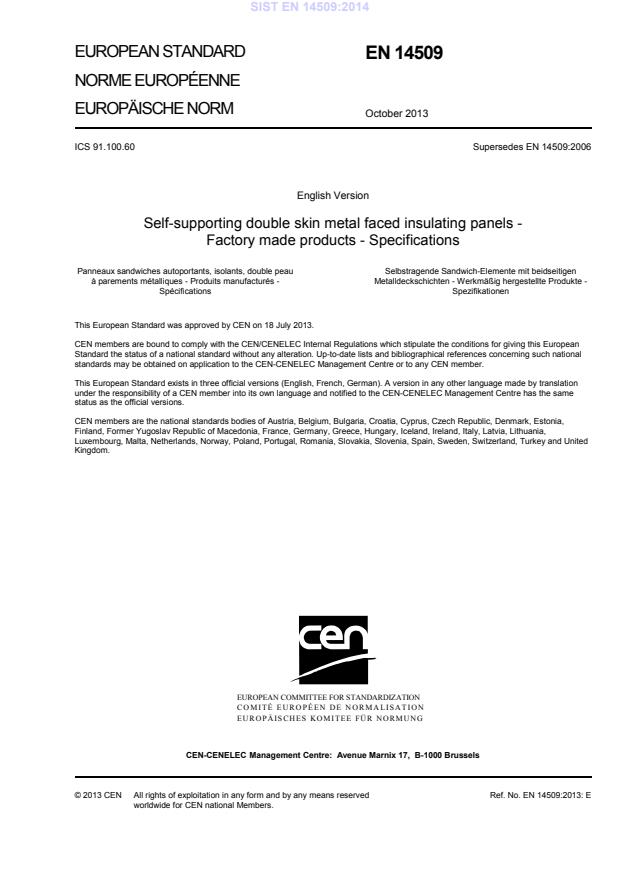
EUROPEAN STANDARD NORME EUROPÉENNE EUROPÄISCHE NORM
EN 14509
October 2013 ICS 91.100.60 Supersedes EN 14509:2006English Version
Self-supporting double skin metal faced insulating panels - Factory made products - Specifications
Panneaux sandwiches autoportants, isolants, double peau à parements métalliques - Produits manufacturés - Spécifications
Selbstragende Sandwich-Elemente mit beidseitigen Metalldeckschichten - Werkmäßig hergestellte Produkte - Spezifikationen This European Standard was approved by CEN on 18 July 2013.
CEN members are bound to comply with the CEN/CENELEC Internal Regulations which stipulate the conditions for giving this European Standard the status of a national standard without any alteration. Up-to-date lists and bibliographical references concerning such national standards may be obtained on application to the CEN-CENELEC Management Centre or to any CEN member.
This European Standard exists in three official versions (English, French, German). A version in any other language made by translation under the responsibility of a CEN member into its own language and notified to the CEN-CENELEC Management Centre has the same status as the official versions.
CEN members are the national standards bodies of Austria, Belgium, Bulgaria, Croatia, Cyprus, Czech Republic, Denmark, Estonia, Finland, Former Yugoslav Republic of Macedonia, France, Germany, Greece, Hungary, Iceland, Ireland, Italy, Latvia, Lithuania, Luxembourg, Malta, Netherlands, Norway, Poland, Portugal, Romania, Slovakia, Slovenia, Spain, Sweden, Switzerland, Turkey and United Kingdom.
EUROPEAN COMMITTEE FOR STANDARDIZATION
COMITÉ EUROPÉEN DE NORMALISATION EUROPÄISCHES KOMITEE FÜR NORMUNG
CEN-CENELEC Management Centre:
Avenue Marnix 17,
B-1000 Brussels © 2013 CEN All rights of exploitation in any form and by any means reserved worldwide for CEN national Members. Ref. No. EN 14509:2013: ESIST EN 14509:2014
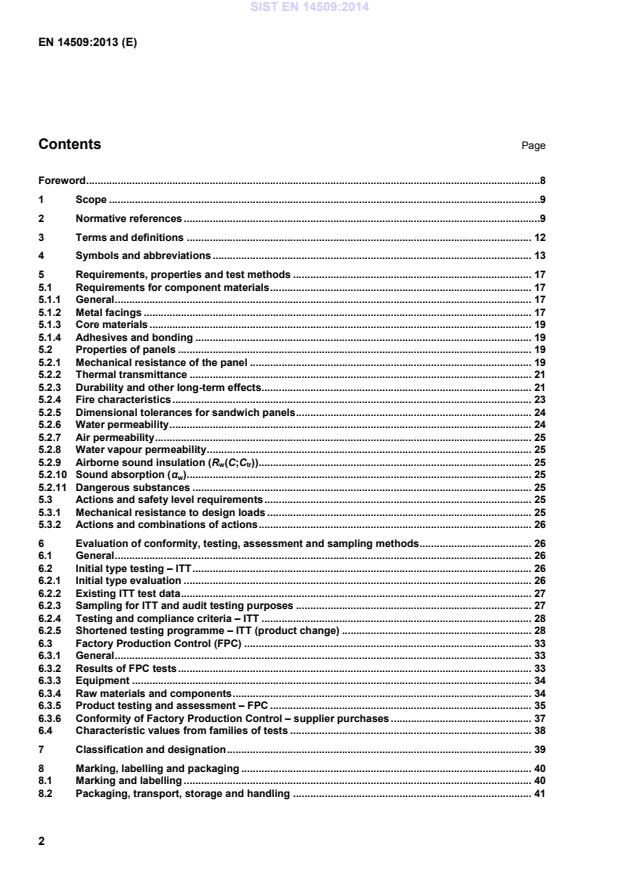
Testing procedures for material properties . 42 A.1 Cross panel tensile test . 42 A.1.1 Principle. 42 A.1.2 Apparatus . 42 A.1.3 Test specimens . 42 A.1.4 Procedure . 43 A.1.5 Calculations and results . 43 A.1.6 Cross panel tensile modulus at elevated temperature . 44 A.2 Compressive strength and modulus of the core material . 45 A.2.1 Principle. 45 A.2.2 Apparatus . 45 A.2.3 Test specimens . 45 A.2.4 Procedure . 45 A.2.5 Calculations and results . 45 A.3 Shear test on the core material . 46 A.3.1 Principle. 46 A.3.2 Apparatus . 46 A.3.3 Test specimens . 47 A.3.4 Procedure . 48 A.3.5 Calculations and results – short-term loading . 48 A.3.6 Test procedures, calculations and results – long term loading . 51 A.4 Test to determine the shear properties of a complete panel . 52 A.4.1 Principle. 52 A.4.2 Apparatus . 52 A.4.3 Test specimens . 53 A.4.4 Procedure . 54 A.4.5 Calculations and results . 54 A.5 Test to determine the bending moment capacity of a simply supported panel . 57 A.5.1 Principle. 57 A.5.2 Apparatus . 57 A.5.3 Test specimens . 60 A.5.4 Procedure . 60 A.5.5 Calculations and results . 61 A.6 Determination of the creep coefficient (3t) . 66 A.6.1 Principle. 66 A.6.2 Apparatus . 66 A.6.3 Test specimens . 66 A.6.4 Procedure . 66 A.6.5 Calculations and results . 67 A.7 Interaction between bending moment and support force . 68 A.7.1 Principle. 68 A.7.2 Apparatus . 69 A.7.3 Test specimens . 70 A.7.4 Procedure . 70 A.7.5 Calculations and results . 70 A.8 Determination of apparent core density and mass of panel . 71 A.8.1 Determination of apparent core density . 71 A.8.2 Determination of mass of a panel . 72 A.9 Test for resistance to point loads and repeated loads . 72 A.9.1 Panels subject to point loads . 72 A.9.2 Panels subject to repeated loads . 73 A.10 Calculation method for the determination of the thermal transmittance of a panel (U) . 75 SIST EN 14509:2014
Durability testing method for sandwich panels . 89 B.1 General . 89 B.2 Test DUR1 . 89 B.2.1 Principle . 89 B.2.2 Apparatus . 89 B.2.3 Test specimens . 89 B.2.4 Procedure . 90 B.2.5 Test results and acceptance criteria – DUR1 . 91 B.3 Test DUR2 . 91 B.3.1 Principle . 91 B.3.2 Apparatus . 91 B.3.3 Test specimens . 92 B.3.4 Procedure . 93 SIST EN 14509:2014
Fire performance tests – additional instructions and direct field of application . 101 C.1 Reaction to fire . 101 C.1.1 Fire test EN 13823 (SBI) – specimens and mounting and fixing . 101 C.1.2 Fire test EN ISO 11925-2 (ignitability test) . 104 C.1.3 Direct field of application of reaction to fire test results . 105 C.2 Fire resistance . 108 C.2.1 General . 108 C.2.2 Fire resistance test EN 1364-1 — Walls . 109 C.2.3 Fire resistance test EN 1365-2 — Roofs . 112 C.2.4 Field of application of fire resistance test results . 113 C.3 Fire tests CEN/TS 1187 - external fire performance for roofs . 114 C.3.1 Classification without further testing (CWFT) . 114 C.3.2 CEN/TS 1187 Method 1 test . 115 C.3.3 CEN/TS 1187 Method 2 test . 115 C.3.4 CEN/TS 1187 Method 3 test . 115 C.3.5 CEN/TS 1187 Method 4 test . 116 C.4 Determination of the amount and thickness of the adhesive layer . 116 C.4.1 General . 116 C.4.2 Measurements on a manufactured panel . 116 C.4.3 Measurements during production . 117 Annex Dwbnormativec
Dimensional tolerances . 119 D.1 General . 119 D.2 Dimensional tolerances . 119 D.2.1 Thickness of panel and joint conformity . 119 D.2.2 Deviation from flatness . 120 D.2.3 Depth of metal profile . 121 D.2.4 Depth of stiffeners on lightly profiled facings . 121 D.2.5 Length . 122 D.2.6 Cover width . 122 D.2.7 Deviation from squareness . 124 SIST EN 14509:2014
Design procedures. 128 E.1 Definitions and symbols . 128 E.1.1 Properties of a sandwich panel . 128 E.1.2 Symbols used in Annex E . 129 E.1.3 Sign convention used in Annex E . 131 E.2 General . 131 E.3 Actions . 132 E.3.1 General . 132 E.3.2 Permanent actions . 132 E.3.3 Variable actions . 132 E.3.4 Actions due to long term effects . 133 E.4 Resistance . 133 E.4.1 General . 133 E.4.2 Residual (rest) bending resistance at an intermediate support . 134 E.4.3 End support reaction capacity . 135 E.5 Combination rules . 136 E.5.1 General . 136 E.5.2 Ultimate limit state . 136 E.5.3 Combination of the effects of actions for the ultimate limit state . 137 E.5.4 Serviceability limit state . 137 E.5.5 Combination of the effects of actions for the serviceability limit states . 138 E.6 Combination coefficients and safety factors . 139 E.6.1 Combination coefficients . 139 E.6.2 Load factors . 139 E.6.3 Material factors . 140 E.7 Calculation of the effects of actions . 141 E.7.1 General . 141 E.7.2 Methods of analysis . 141 E.7.3 Static system, geometry and thickness . 146 E.7.4 Sandwich panels with plane or lightly profiled faces . 146 E.7.5 Sandwich panels with strongly profiled faces . 147 E.7.6 The influence of time on shear deformations of the core . 147 E.8 Panels with special profiles . 148 E.8.1 General . 148 E.8.2 Determination of the effective properties of the faces and the core . 148 E.8.3 Design of panels with special profiles. 148 Annex Fwbinformativec
Significant technical changes between this European Standard and the previous edition . 152 Annex ZAwbinformativec
Clauses of this European Standard addressing the provisions of the EU Construction Products Directive . 156 ZA.1 Scope and relevant characteristics . 156 ZA.2 Procedures for the attestation of conformity of sandwich panels . 158 ZA.2.1 Systems of attestation of conformity . 158 ZA.2.2 Certificate and Declaration of Conformity . 161 ZA.3 CE Marking and labelling . 163 ZA.3.1 General . 163 SIST EN 14509:2014
...