

FprEN 12939
(Main)Thermal performance of building materials and products - Determination of thermal resistance by means of guarded hot plate and heat flow meter methods - Thick products of high and medium thermal resistance
- Abstract
This document specifies procedures to determine the thermal resistance of products whose thicknesses exceed the maximum thickness for guarded hot plate or heat flow meter apparatus. Most of the procedures described in this standard require apparatus that allows tests on specimens up to 100 mm thick .
This document gives guidelines to assess the relevance of the thickness effect, i.e. to establish whether the thermal resistance of a thick product can or cannot be calculated as the sum of the thermal resistances of slices cut from the product, these guidelines complement the indications given in ISO 8302:1991[1] on the guarded hot plate apparatus.
This document describes testing conditions which prevent the onset of convection which could take place in some products under the considered temperature differences and thicknesses.
- Status
- Not Published
- Publication Date
- 03-Mar-2027
- Technical Committee
- CEN/TC 89 - Thermal performance of buildings and building components
- Drafting Committee
- CEN/TC 89/WG 8 - Thermal test methods
- Current Stage
- 4599 - Dispatch of FV draft to CMC - Finalization for Vote
- Start Date
- 27-Aug-2026
- Due Date
- 30-Aug-2026
- Completion Date
- 27-Aug-2026

FprEN 12939 is a CEN draft European Standard for determining the thermal resistance of thick building materials and products with guarded hot plate (GHP) and heat flow meter (HFM) methods. It specifies how to test products that are too thick for the usual apparatus limits, how to judge whether thickness effect matters, and how to report results for insulating materials and products such as mineral wool, wood wool, expanded polystyrene, insulating cork boards, and other cellular plastics.
What does FprEN 12939 specify?
FprEN 12939 specifies procedures for measuring thermal resistance when specimen thickness exceeds the maximum thickness that standard GHP or HFM apparatus can handle. It also gives guidance for deciding whether a thick product can be treated as a stack of slices or whether thickness effect must be taken into account.
| Annex | What it covers |
|---|---|
| Annex A | Instrumentation for the apparatus, including GHP and HFM checks, thickness limits, and flatness tolerances |
| Annex B | Normative conversion utilities and interpolating functions for thick specimens |
| Annex C | Informative advanced procedures for thick specimens that exceed apparatus capabilities |
| Annex D | Items expected to be specified in product standards |
The document is organized into six main clauses: Scope, Normative references, Terms, definitions, symbols and units, Apparatus, Procedures, and Calculations and test report. That structure matters in practice because the standard separates equipment checks, specimen rules, test selection, and reporting.
What are the key requirements of FprEN 12939?
FprEN 12939 is built around one central decision: whether thickness effect is relevant. If it is not, the product can be cut into slices and the thermal resistance of the whole product can be built up from the slices. If it is relevant, the document requires interpolation or extrapolation methods tied to the material family.
Apparatus and specimen limits
Clause 4 requires the measuring apparatus to be a guarded hot plate or heat flow meter conforming with EN 12667. Clause 4.2 points to the maximum specimen thickness in EN 12667:2001, and Annex A adds practical guidance for low-density materials.
Clause 4.3 tightens the minimum specimen thickness and flatness rules for specimens down to a thermal resistance of 0.3 m²K/W. For non-rigid specimens, flatness error must stay small enough that thickness error remains within the stated limit. For rigid specimens, flatness matters because gaps create contact resistance, so the reader has to control specimen face quality, not only thickness.
How to decide whether thickness effect matters
Clause 5.2 introduces the grouping of procedures:
- preliminary checks for thickness effect
- procedures when thickness effect is not relevant
- procedures when thickness effect is relevant
The standard uses the ratio L = T/λt, where T is the transfer factor and λt is the thermal transmissivity of the material. In practice, this ratio tells the user how far the product is from behaving like a simple conductive slab. If 1 - L is small enough, the slice-sum approach is acceptable.
Clause 5.3 says that when 1 - L is at or below 0.02, thickness effect is not relevant for the product considered. For wool-type products, mineral wool, wood wool, expanded polystyrene, and insulating cork boards, the tables in Clause 5 are used to screen the product at the smallest thickness. If the screening indicates a larger effect, the standard calls for multiple measurements and linear regression.
Material-family procedures
Clause 5.3.2 gives a procedure for wool-type products. It requires measuring the smallest thickness, then taking at least three measurements across the thickness range when the quick screening does not settle the issue. The point is to determine whether the product can be represented by a straight-line relationship between thermal resistance and thickness.
Clause 5.3.3 gives the same kind of decision path for other materials, including rigid foam products. It also addresses products with denser surface layers, so the core material is tested when a skin effect is present. In practice, this avoids using surface layers to represent the whole product incorrectly.
What to do when thickness effect is not relevant
Clause 5.4 says to determine the minimum thickness for which 1 - L is at or below 0.01, then cut the product into slices no thinner than that thickness. The thermal resistance of the whole specimen is then the sum of the slice resistances, with correction for material lost during cutting if needed.
This is the routine path for production testing when the product behaves consistently with thickness. It matters because it gives a simple, repeatable way to estimate full-product performance from manageable test pieces.
What to do when thickness effect is relevant
Clause 5.5 switches to material transmissivity or product resistance based on the relevant product standard. If measured data include thicknesses below d, the regression must use the conversion equations in Annex B. If the calculated error is too large, the standard calls for more measurements and appropriate statistics.
For practice, this means the user cannot rely on one universal calculation. The chosen method depends on whether the product family is wool-type, cellular plastic, or insulating cork board, and whether the specimen thickness remains within apparatus capability.
Calculation and reporting
Clause 6 sends the calculation of heat transfer properties back to EN 12667:2001, clause 8, and the test report layout to clause 9 of EN 12667:2001. That matters because FprEN 12939 defines the thick-specimen procedure, while EN 12667 carries the common reporting framework.
What terms does FprEN 12939 define?
- Thermal resistance, R - the property measured for the product, expressed for the specimen in terms of thickness and heat transfer.
- Thermal transmissivity, λt - the thickness-related material quantity used with transfer factor and interpolation formulas.
- Transfer factor, T - the ratio d/R for a specimen, used to connect measured resistance to material behavior.
- Thickness effect - the effect that makes full-product thermal resistance differ from the simple sum of slice resistances.
- Guarded hot plate (GHP) - a steady-state method for measuring heat transfer properties with guarded hot plate apparatus.
- Heat flow meter (HFM) - a steady-state method using a heat flow meter apparatus.
- Density gradient - variation of density through the thickness of a product, important for mineral wool and some foam products.
- Skin product - a cellular plastic product with denser surface layers than its core.
Who uses FprEN 12939?
FprEN 12939 is used by laboratories that measure thermal performance of building materials and products. It is also relevant to manufacturers of insulating products such as mineral wool, wood wool, expanded polystyrene, insulating cork boards, and other cellular plastics, because it tells them how to test thick products and how to interpret thickness-dependent results.
Product standard writers use it to specify specimen preparation, the choice between transmissivity and product resistance, and the test-report items that must be fixed for a given product family. Quality managers, certification bodies, and buyers use it when they need comparable thermal-resistance data from thick insulation products.
What changed in FprEN 12939 from the previous edition?
FprEN 12939 will supersede EN 12939:2000. The document states three significant technical changes:
- revision of the whole document to comply with CEN rules
- revision of Clause 2
- revision of Annex A
Which standards are used with FprEN 12939?
- EN ISO 7345:2018 - supplies the physical quantities and definitions used in the document.
- EN ISO 9288:2022 - supplies radiation vocabulary used for the thermal-radiation terms.
- EN 12667 - provides the common method framework for apparatus, specimen handling, calculations, and reporting for products of high and medium thermal resistance.
- EN 12667:2001 - is the cited edition for apparatus limits, specimen thickness rules, calculation, and report layout.
- ISO 8302:1991 - provides guarded hot plate guidance that the document uses and complements.
- ISO 8301:1991 - provides heat flow meter guidance used in Annex A.
- EN 1946-2 and EN 1946-3 - provide laboratory assessment and performance-check criteria for GHP and HFM equipment.
- CEN/TR 15131:2006 - gives background on interpolating equations for thick specimens.
What does the FprEN 12939 document contain?
The document contains a flowchart for choosing the testing route, tables for the thickness-effect parameter by material family, and formulas for interpolation and extrapolation in low-density insulating materials. Annex A adds apparatus guidance and an edge-heat-loss table for GHP/HFM sizing decisions.
Annex B contains the normative equations used to convert measurements into material parameters and specimen resistance. Annex C adds worked procedures for nearly homogeneous materials, mineral wool with density gradients, cellular plastics, insulating cork boards, and extruded skin products. Annex D lists the items that product standards are expected to specify, such as specimen preparation, calculation choices, and report content.
Relations
- Effective Date
- 18-Jan-2023
Get Certified
Connect with accredited certification bodies for this standard

DIBt (Deutsches Institut für Bautechnik)
German Institute for Building Technology.
DIN CERTCO
DIN Group product certification.

Aboma Certification B.V.
Specialized in construction, metal, and transport sectors.
Sponsored listings
Frequently Asked Questions
FprEN 12939 is a draft published by the European Committee for Standardization (CEN). Its full title is "Thermal performance of building materials and products - Determination of thermal resistance by means of guarded hot plate and heat flow meter methods - Thick products of high and medium thermal resistance". This standard covers: This document specifies procedures to determine the thermal resistance of products whose thicknesses exceed the maximum thickness for guarded hot plate or heat flow meter apparatus. Most of the procedures described in this standard require apparatus that allows tests on specimens up to 100 mm thick . This document gives guidelines to assess the relevance of the thickness effect, i.e. to establish whether the thermal resistance of a thick product can or cannot be calculated as the sum of the thermal resistances of slices cut from the product, these guidelines complement the indications given in ISO 8302:1991[1] on the guarded hot plate apparatus. This document describes testing conditions which prevent the onset of convection which could take place in some products under the considered temperature differences and thicknesses.
This document specifies procedures to determine the thermal resistance of products whose thicknesses exceed the maximum thickness for guarded hot plate or heat flow meter apparatus. Most of the procedures described in this standard require apparatus that allows tests on specimens up to 100 mm thick . This document gives guidelines to assess the relevance of the thickness effect, i.e. to establish whether the thermal resistance of a thick product can or cannot be calculated as the sum of the thermal resistances of slices cut from the product, these guidelines complement the indications given in ISO 8302:1991[1] on the guarded hot plate apparatus. This document describes testing conditions which prevent the onset of convection which could take place in some products under the considered temperature differences and thicknesses.
FprEN 12939 is classified under the following ICS (International Classification for Standards) categories: 91.100.60 - Thermal and sound insulating materials. The ICS classification helps identify the subject area and facilitates finding related standards.
FprEN 12939 has the following relationships with other standards: It is inter standard links to EN 12939:2000. Understanding these relationships helps ensure you are using the most current and applicable version of the standard.
FprEN 12939 is associated with the following European legislation: EU Directives/Regulations: 305/2011. When a standard is cited in the Official Journal of the European Union, products manufactured in conformity with it benefit from a presumption of conformity with the essential requirements of the corresponding EU directive or regulation.
FprEN 12939 is available in PDF format for immediate download after purchase. The document can be added to your cart and obtained through the secure checkout process. Digital delivery ensures instant access to the complete standard document.
Standards Content (Sample)
SLOVENSKI STANDARD
01-december-2025
Toplotne karakteristike gradbenih materialov in proizvodov - Določanje toplotne
upornosti z zaščiteno vročo ploščo in merilniki toplotnih tokov - Debeli proizvodi z
visoko in srednjo toplotno upornostjo
Thermal performance of building materials and products - Determination of thermal
resistance by means of guarded hot plate and heat flow meter methods - Thick products
of high and medium thermal resistance
Wärmetechnisches Verhalten von Baustoffen und Bauprodukten - Bestimmung des
Wärmedurchlasswiderstandes nach dem Verfahren mit dem Plattengerät und dem
Wärmestrommessplatten-Gerät - Dicke Produkte mit hohem und mittlerem
Wärmedurchlasswiderstand
Performance thermique des matériaux et produits pour le bâtiment - Détermination de la
résistance thermique par la méthode de la plaque chaude gardée et la méthode
fluxmétrique - Produits épais de haute et moyenne résistance thermique
Ta slovenski standard je istoveten z: prEN 12939
ICS:
91.100.60 Materiali za toplotno in Thermal and sound insulating
zvočno izolacijo materials
2003-01.Slovenski inštitut za standardizacijo. Razmnoževanje celote ali delov tega standarda ni dovoljeno.
DRAFT
EUROPEAN STANDARD
prEN 12939
NORME EUROPÉENNE
EUROPÄISCHE NORM
October 2025
ICS 91.100.60 Will supersede EN 12939:2000
English Version
Thermal performance of building materials and products -
Determination of thermal resistance by means of guarded
hot plate and heat flow meter methods - Thick products of
high and medium thermal resistance
Performance thermique des matériaux et produits Wärmetechnisches Verhalten von Baustoffen und
pour le bâtiment - Détermination de la résistance Bauprodukten - Bestimmung des
thermique par la méthode de la plaque chaude gardée Wärmedurchlasswiderstandes nach dem Verfahren mit
et la méthode fluxmétrique - Produits épais de haute et dem Plattengerät und dem Wärmestrommessplatten-
moyenne résistance thermique Gerät - Dicke Produkte mit hohem und mittlerem
Wärmedurchlasswiderstand
This draft European Standard is submitted to CEN members for enquiry. It has been drawn up by the Technical Committee
CEN/TC 89.
If this draft becomes a European Standard, CEN members are bound to comply with the CEN/CENELEC Internal Regulations
which stipulate the conditions for giving this European Standard the status of a national standard without any alteration.
This draft European Standard was established by CEN in three official versions (English, French, German). A version in any other
language made by translation under the responsibility of a CEN member into its own language and notified to the CEN-CENELEC
Management Centre has the same status as the official versions.
CEN members are the national standards bodies of Austria, Belgium, Bulgaria, Croatia, Cyprus, Czech Republic, Denmark, Estonia,
Finland, France, Germany, Greece, Hungary, Iceland, Ireland, Italy, Latvia, Lithuania, Luxembourg, Malta, Netherlands, Norway,
Poland, Portugal, Republic of North Macedonia, Romania, Serbia, Slovakia, Slovenia, Spain, Sweden, Switzerland, Türkiye and
United Kingdom.
Recipients of this draft are invited to submit, with their comments, notification of any relevant patent rights of which they are
aware and to provide supporting documentation.
Warning : This document is not a European Standard. It is distributed for review and comments. It is subject to change without
notice and shall not be referred to as a European Standard.
EUROPEAN COMMITTEE FOR STANDARDIZATION
COMITÉ EUROPÉEN DE NORMALISATION
EUROPÄISCHES KOMITEE FÜR NORMUNG
CEN-CENELEC Management Centre: Rue de la Science 23, B-1040 Brussels
© 2025 CEN All rights of exploitation in any form and by any means reserved Ref. No. prEN 12939:2025 E
worldwide for CEN national Members.
prEN 12939 (E)
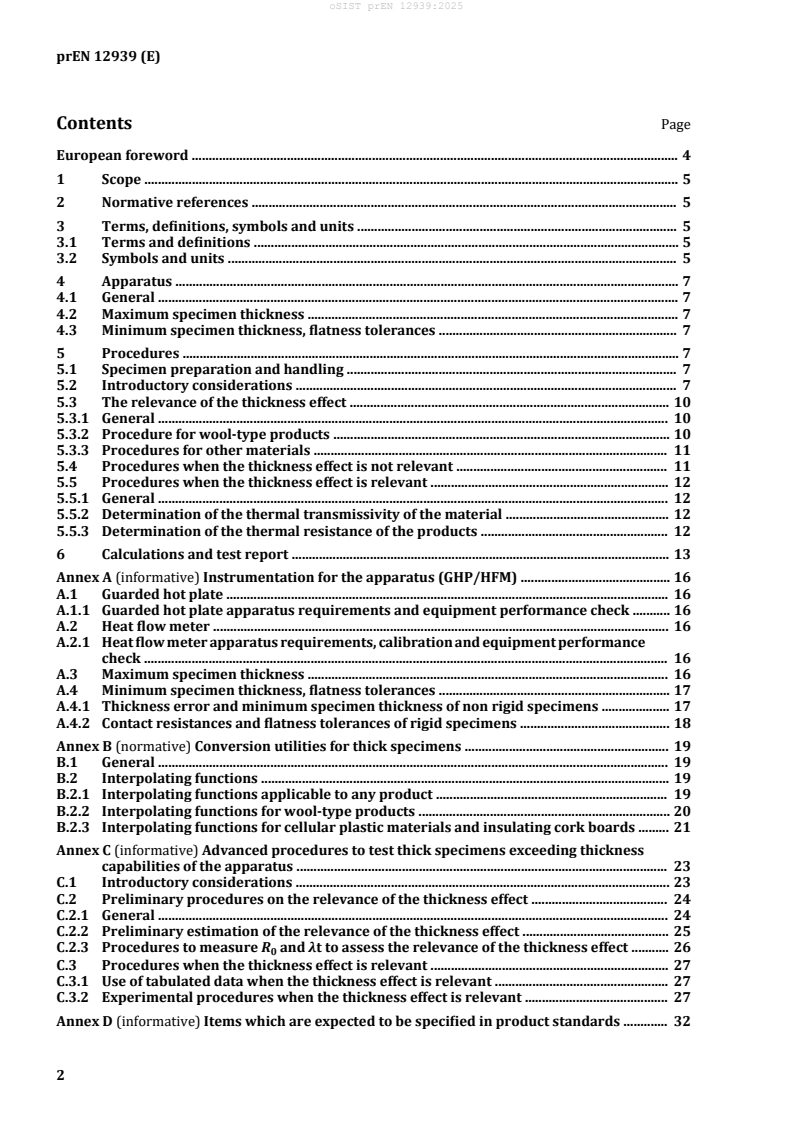
Contents Page
European foreword . 4
1 Scope . 5
2 Normative references . 5
3 Terms, definitions, symbols and units . 5
3.1 Terms and definitions . 5
3.2 Symbols and units . 5
4 Apparatus . 7
4.1 General . 7
4.2 Maximum specimen thickness . 7
4.3 Minimum specimen thickness, flatness tolerances . 7
5 Procedures . 7
5.1 Specimen preparation and handling . 7
5.2 Introductory considerations . 7
5.3 The relevance of the thickness effect . 10
5.3.1 General . 10
5.3.2 Procedure for wool-type products . 10
5.3.3 Procedures for other materials . 11
5.4 Procedures when the thickness effect is not relevant . 11
5.5 Procedures when the thickness effect is relevant . 12
5.5.1 General . 12
5.5.2 Determination of the thermal transmissivity of the material . 12
5.5.3 Determination of the thermal resistance of the products . 12
6 Calculations and test report . 13
Annex A (informative) Instrumentation for the apparatus (GHP/HFM) . 16
A.1 Guarded hot plate . 16
A.1.1 Guarded hot plate apparatus requirements and equipment performance check . 16
A.2 Heat flow meter . 16
A.2.1 Heat flow meter apparatus requirements, calibration and equipment performance
check . 16
A.3 Maximum specimen thickness . 16
A.4 Minimum specimen thickness, flatness tolerances . 17
A.4.1 Thickness error and minimum specimen thickness of non rigid specimens . 17
A.4.2 Contact resistances and flatness tolerances of rigid specimens . 18
Annex B (normative) Conversion utilities for thick specimens . 19
B.1 General . 19
B.2 Interpolating functions . 19
B.2.1 Interpolating functions applicable to any product . 19
B.2.2 Interpolating functions for wool-type products . 20
B.2.3 Interpolating functions for cellular plastic materials and insulating cork boards . 21
Annex C (informative) Advanced procedures to test thick specimens exceeding thickness
capabilities of the apparatus . 23
C.1 Introductory considerations . 23
C.2 Preliminary procedures on the relevance of the thickness effect . 24
C.2.1 General . 24
C.2.2 Preliminary estimation of the relevance of the thickness effect . 25
C.2.3 Procedures to measure R and λt to assess the relevance of the thickness effect . 26
C.3 Procedures when the thickness effect is relevant . 27
C.3.1 Use of tabulated data when the thickness effect is relevant . 27
C.3.2 Experimental procedures when the thickness effect is relevant . 27
Annex D (informative) Items which are expected to be specified in product standards . 32
prEN 12939 (E)
Bibliography . 33
prEN 12939 (E)
European foreword
This document (prEN 12939:2025) has been prepared by Technical Committee CEN/TC 89 "Thermal
performance of buildings and building components", the secretariat of which is held by SIS.
This document is currently submitted to the CEN Enquiry.
This document will supersede EN 12939:2000.
prEN 12939:2025 includes the following significant technical changes with respect to EN 12939:2000:
— revision of all document to be compliant with CEN rules;
— revision of Clause 2;
— revision of Annex A.
prEN 12939 (E)
1 Scope
This document spécifiés procedures to determine the thermal resistance of products whose thicknesses
exceed the maximum thickness for guarded hot plate or heat flow meter apparatus. Most of the
procedures described in this standard require apparatus that allows tests on specimens up to 100 mm
thick .
This document gives guidelines to assess the relevance of the thickness effect, i.e. to establish whether
the thermal resistance of a thick product can or cannot be calculated as the sum of the thermal
resistances of slices cut from the product, these guidelines complement the indications given in ISO
8302:1991[1] on the guarded hot plate apparatus.
This document describes testing conditions which prevent the onset of convection which could take
place in some products under the considered temperature differences and thicknesses.
2 Normative references
The following documents are referred to in the text in such a way that some or all of their content
constitutes requirements of this document. For dated references, only the edition cited applies. For
undated references, the latest edition of the referenced document (including any amendments) applies.
EN ISO 7345:2018, Thermal performance of buildings and building components - Physical quantities and
definitions (ISO 7345:2018)
EN ISO 9288:2022, Thermal insulation - Heat transfer by radiation - Vocabulary (ISO 9288:2022)
EN 12667, Thermal performance of building materials and products - Determination of thermal resistance
by means of guarded hot plate and heat flow meter methods - Products of high and medium thermal
resistance
EN 12667:2001, Thermal performance of building materials and products - Determination of thermal
resistance by means of guarded hot plate and heat flow meter methods - Products of high and medium
thermal resistance
3 Terms, definitions, symbols and units
3.1 Terms and definitions
For the purposes of this document, the terms and définitions given in EN ISO 7345:2018
andEN ISO 9288:2022 apply.
ISO and IEC maintain terminology databases for use in standardization at the following addresses: • ISO
Online browsing platform: available at http://www.iso.org/obp
• IEC Electropedia: available at http://www.electropedia.org/
NOTE EN ISO 9288:2022[2] définés spectral directional extinction, absorption and scattering coéfficiénts and
the spectral directional albedo only, while this standard makes use of total hemispherical coéfficiénts, which can
be obtained by the previous ones by appropriate integrations.
3.2 Symbols and units
Symbol Quantity Unit
A conduction parameter W/(m.K)
B solid conduction parameter
m /kg
prEN 12939 (E)
C radiation parameter
W·m /(kg·K)
-1
E extinction parameter for combined conduction and radiation
m
F complement to unity of the "two flux model" albedo
L thickness effect paramete K
R thermal resistance
m ·K/W
R , R , R extrapolated thermal resistance at zero thickness
m ·K/W
0 01 02
T thermodynamic temperature K
T transfer factor d/R (of a specimen) W/(m.K)
Z emissivity parameter
d thickness m
d mean bead or grain diameter m
b
d thickness beyond which thermal resistance becomes linear m
∞
c spécific heat capacity J/(kg·K)
e edge number ratio
h radiative heat transfer surface coéfficiént
W/(m .K)
r
q density of heat flow rate
W/m
q density of radiative heat flow rate
W/m
r
q total density of heat flow rate
W/m
t
t time s
β' mass extension parameter
m /kg
*
ε emissivity
λ thermal conductivity W/(m·K)
λ thermal conductivity of air W/(m·K)
a
λ thermal conductivity of gas W/(m·K)
g
λ radiativity (of a material) W/(m·K)
r
λ combined gaseous and solid thermal conductivity (of a material) W/(m·K)
cd
λ thermal transmissivity (of a material) Δd/ΔR W/(m·K)
t
θ Celsius temperature °C
ρ density
kg/m
prEN 12939 (E)
ρ density of the solid matrix
kg/m
s
2 4
σ Stefan-Boltzmann constant
W/(m ·K )
n
ω* two-flux model albedo
4 Apparatus
4.1 General
The apparatus used for the measurements shall be a guarded hot plate or heat flow meter conforming
with the requirements of EN 12667.
4.2 Maximum specimen thickness
The maximum specimen thickness should be according to Table A.1 in EN 12667:2001[3]. See also
Annex A of this standard for more information concerning low density specimens.
4.3 Minimum specimen thickness, flatness tolerances
The requirements of A.3.3 of EN 12667:2001 shall be met, extending them for a thermal resistance of
2·
the specimen as low as 0,3 m K/W. The following two testing conditions shall be considered for both
guarded hot plate and heat flow meter apparatus:
a) Tests on non rigid specimens achieving contact with the apparatus and whose thermal resistance is
greater than or equal to 0,3 m ·K/W, e.g. mineral wool boards or elastomeric cellular boards. In this
case the departures from a true plane result in an error in the measurement of specimen thickness. This
error shall be less than 0,5 % (see table A.1 of EN 12667:2001[3] ). For detailed information see Annex
A of this document.
2·
b) Tests on rigid specimens having a thermal resistance greater than or equal to 0,3 m K/W, e.g.
polystyrene or rigid polyurethane boards. In this case the departures from a true plane are the source
of contact resistances; these shall be less than 0,5 % of the specimen thermal resistance (see table A.2
of EN 12667:2001[3] ).
NOTE For testing techniques (use of contact sheets) to be applied when the thermal resistance of the specimen
is less than 0,3 m ·K/W see EN 12664[4].
5 Procedures
5.1 Specimen preparation and handling
Specimen preparation and handling shall be in accordance with EN 12667.
5.2 Introductory considerations
The thermal resistance R of a specimen of low density insulating materials may be written as follows:
d
R = R + (1)
0 λ
t
(where R is the extrapolated thermal resistance at zero thickness) and the transfer factor is définéd
T
as follows:
prEN 12939 (E)
T = λ
t
λ (2)
t
1+ R
d
NOTE 1 For the derivation of Formula (1) and Formula (2) their graphical representation see the document
CEN/TR 15131:2006[5].
The procedures described in this standard can be grouped as follows:
1) preliminary procedures to assess whether the thickness effect is relevant;
2a) procedures applicable when the thickness effect is not relevant;
2b) procedures applicable when the thickness effect is relevant.
The procedures described apply to products having thicknesses exceeding d , with the exception of the
∞
use of Table 3 and Table 4, which also include thicknesses below d . The procedures further assume
∞
that products are sufficiéntly homogeneous, such that no individual value of measured thermal
resistance will deviate by more than 0,7 % from the interpolating straight line. When these conditions
are not satisfiéd or when there is a need to keep the number of measurements to a minimum, Annex C
should be consulted for guidance. A flow-chart showing testing options is given in Figure 1 .
prEN 12939 (E)
Figure 1 — Procedure to test thick specimens
NOTE 2 Due to the different mechanism of the radiation extinction, the procedures of this standard are
differentiated by material families.
The large amount of work required by the experimental procedures to assess the relevance of the
thickness effect suggests they should be reduced to the absolute minimum needed. A thorough
understanding of the influéncé of material parameters and their evaluation allows routines to be
developed that require far less experimental work even though far more sophisticated. For this purpose
prEN 12939 (E)
some theoretical calculations based on just one measured value of the thermal resistance of a specimen
are supplied in Clause C.2 .
NOTE 3 Even though this standard gives procedures to determine product thermal resistance at thicknesses
that exceed guarded hot plate or heat flow meter capabilities, those applicable to materials exhibiting a relevant
thickness effect can equally be applied to materials produced in thicknesses falling within apparatus capabilities,
to allow the interpolation of product thermal resistances from measurements at few product thicknesses only.
All the procedures intended to characterise specimens having a thickness exceeding apparatus
capabilities require a preliminary evaluation of the relevance of the thickness effect, i.e. how far from
unity is the ratio L = T/λ between the transfer factor and thermal transmissivity.
t
NOTE 4 The difference (1 - L) can be of greater interest than L because (1 - L) is zero when the thickness effect
has no relevance.
5.3 The relevance of the thickness effect
5.3.1 General
If (1 - L) = R /R≤ 0,02, the thickness effect is not relevant for the product considered and the procedure
of 5.4 shall be used. Otherwise elementary material-dependent procedures are given in 5.3.2 and 5.3.3
for routine and control purposes.
The range of thicknesses of the products made of one material should be considered: if the largest
product thickness is lower than the maximum allowed specimen thickness for the apparatus to be used
and the relevance of the specimen thickness is to be assessed, the procedure in 3.4.2 of ISO 8302:1991[1]
can be used.
NOTE The simplest assessment of the relevance of the thickness effect is for materials containing air within
their solid matrix, because tables or a graph can be used, see e.g. C.2.2.2 .
5.3.2 Procedure for wool-type products
Measure the transfer factor of the product of the smallest thickness.
a) If, according to the data of Table 1 for mineral wool or Table 2 for wood wool, (1 - L) ≤ 0,01, the
thickness effect may be considered not relevant.
b) If (1 - L) > 0,01 according to Table 1 for mineral wool or Table 2 for wood wool, assess the relevance
of the thickness effect as follows:
As a minimum three measurements shall be made:
- close to the maximum allowed apparatus thickness;
- at the minimum product thickness or at a thickness approximately one third of the maximum allowed
specimen thickness (by slicing a specimen), whichever is smaller;
- at a thickness approximately the mean of the above two.
EXAMPLE A material is produced in thicknesses of 80 mm, 120 mm and 200 mm; the maximum allowed
apparatus thickness is 120 mm. The measurements are taken at 120 mm, 80 mm and 40 mm (by slicing
a thicker product).
Through linear regression compute R and λt; using Formula (2) compute the transfer factor at the
minimum product thickness and from this the ratio L = T/λt. Check whether (1 - L) ≤ 0,02.
When mineral wool products have density gradients in the thickness direction, the data of Table 1 f
shall be applied by introducing the transfer factor measured on a slice having the lowest density found
in an actual inhomogeneous product.
prEN 12939 (E)
For products having density inhomogeneities or density gradients in the thickness direction, that
generate deviations of measured thermal resistance from a straight line exceeding 0,7 %, Annex C may
be consulted for guidance.
5.3.3 Procedures for other materials
Measure the transfer factor of the product of the smallest thickness and if, according to the data of Table
3 for polystyrene or the data of Table 4 for insulating cork boards, (1 - L) ≤ 0,01, assume that the thickness
effect is not relevant.
If (1 - L) > 0,01 according to Table 3 for expanded polystyrene or Table 4 for insulating cork boards, and
in any case for any other material, assess the relevance of the thickness effect as follows:
a) Make three or preferably more thermal resistance measurements, starting from a specimen having
a thickness close to the maximum allowed apparatus thickness and then cutting away slices and
retesting the remaining part of the specimen. Measurements shall be taken:
— close to the maximum allowed apparatus thickness;
— at a thickness preferably between 10 mm and 15 mm or at least at the lowest allowed apparatus
thickness;
— at one or more thicknesses between the above two, one of which approximately twice the one
indicated in the second dash above.
b) If there are at least three measurements among those indicated in a) that can be interpolated by a
straight line within 0,7 %, using linear regression, compute R and λt; through Formula (2) compute the
transfer factor at the minimum product thickness and from this the ratio L = T/λt (otherwise take
measurements at additional thicknesses or C.3.2.3 should be consulted).
c) Check whether (1 - L) ≤ 0,02.
When the extrusion process of a cellular plastic material results in a product with much higher density
at the surfaces of the product looking like a skin, the core material (that it is expected to be quite
homogeneous) shall be tested.
5.4 Procedures when the thickness effect is not relevant
— When the thickness effect is not relevant according to 5.3 , from the above procedure determine
the minimum thickness for which (1 - L) ≤ 0,01.
— Cut the product in slices not thinner than the thickness so définéd.
NOTE When deciding whether an apparatus is suitable to use this procedure, the above thickness can also be
regarded as the minimum value for the maximum allowed specimen thickness of the apparatus to be used.
Cutting, e.g. with a band saw, may remove a layer of material from each slice. If this is the case, the
measured thermal resistance of the cut slice shall be corrected. If not otherwise spécifiéd in a product
standard, the slice thermal resistance is that of the cut slice increased by a percentage equal to that of
the thickness of the removed layer referred to the cut slice thickness.
— Compute the total specimen thermal resistance as the sum of the thermal resistances of the slices,
making appropriate allowance for the material lost during cutting.
Consult product standards for advice on whether it is acceptable to compute the total thermal resistance
of the specimen as the product of the thermal resistance of one slice and the number of equal slices
composing the specimen, or whether each slice shall be tested and the total thermal resistance of the
specimen computed as the sum of the thermal resistances of the slices.
When the thickness effect is not relevant for an inhomogeneous mineral wool product (e.g. having
density gradients in the direction of the thickness) or is not relevant for products made of cellular plastic
prEN 12939 (E)
materials in which the extrusion process produced much higher density at the surfaces of the product
(like a skin), then:
- Cut the product in slices not thinner than the thickness for which (1 - L) = 0,01.
- Measure the thermal resistance of each slice.
- Compute the product thermal resistance by adding the measured thermal resistance of each slice,
making appropriate allowance if some material is lost during cutting, see above.
5.5 Procedures when the thickness effect is relevant
5.5.1 General
If the thickness is relevant, consult the relevant product standard about the possibility of choosing
between the determination of the thermal transmissivity of the material or the thermal resistance of
the product.
Product standards may allow the use of the values of L derived fromTable 1 , Table 2 , Table 3 or Table
4 to compute the thermal transmissivity from the measured transfer factor of a product slice or from
the average transfer factor of all the slices cut from the product.
5.5.2 Determination of the thermal transmissivity of the material
If there is a product such that for its thickness (1 - L) ≤ 0,01 and its thickness is not greater than the
maximum allowed apparatus thickness, take a specimen from this product, test the specimen and take
the thermal transmissivity of the material as equal to the measured transfer factor of the specimen.
If such a product does not exist, consult product standards for advice on whether λt shall be obtained
by linear interpolation of the measurements indicated in 5.3 or whether all the slices cut from the
product shall be tested and the measured data introduced in the linear regression to derive λ .
t
When the linear regression is applied to three measured data, as indicated in 5.3 , the worst case relative
error on the calculated thermal transmissivity is 2 ΔR/(RM - Rm), where ΔR is the maximum absolute
error in measured thermal resistances, while RM and Rm are the largest and smallest measured thermal
resistances respectively (see also 5.5.3 ). If the error on the calculated thermal transmissivity is too large
(e.g. > 1 %), the number of measurements shall be increased and appropriate statistics shall be applied
to evaluate the resulting error.
When some or all of the data have been measured on specimens having thicknesses lower than
d (e.g. for some low density expanded polystyrene products), a linear interpolation is not possible and
∞
the regression shall be applied to the formulae given in Annex B . See Annex C for more guidance in this
situation
5.5.3 Determination of the thermal resistance of the products
The thermal resistance of products exceeding apparatus capabilities shall be computed using Formula
(1) (and the transfer factor using Formula (2)) in 5.2 .
NOTE Product standards can contain requirements on whether R and λ , to derive R, shall be is obtained by
0 t
linear interpolation of the measurements or whether all the slices cut from the product is to be tested and the
measured data introduced in the linear regression to derive R and λ .
0 t
When the linear regression is applied to three measured data, as indicated in 5.3 the worst case error
ΔR in the extrapolated thermal resistance Re at the thickness de is such that
e
ΔR /R = 2 ΔR/(R - R )×[1 - (R + R )/(2 R )]
e e M m M m e
prEN 12939 (E)
where ΔR is the maximum error in measured thermal resistances, while R and R are the largest and
M m
smallest measured thermal resistances respectively. For the relative error
ΔR /R , ΔR/R ≤ ΔR /R ≤ 2 ΔR/(R - R ).
e e M e e M m
The lower limit ΔR/R applies when Re ≈RM, while the upper limit 2 ΔR/(RM - Rm) applies when
M
Re >> R . If the relative error ΔRe/Re is too large (e.g. > 1 %), the number of measurements shall be
M
increased and appropriate statistics shall be applied to evaluate the resulting error.
When some or all the data were measured on specimens having thicknesses lower than d (e.g. for some
∞
low density expanded polystyrene products) a linear interpolation is not possible and the regression
shall be applied to the equations given inAnnex B . See Annex C for more guidance in this situation.
6 Calculations and test report
Calculations of measured heat transfer properties shall be according to clause 8 of EN 12667:2001; the
general layout of the report shall be in accordance to clause 9 of EN 12667:2001.
Table 1 — Thickness effect parameter for mineral wool
Transfer factor Specimen thickness Thickness effect parameter
T D L
mW/(m·K) mm
50 40 0,952 to 0,957
80 0,978 to 0,980
200 0,991 to 0,993
45 40 0,970 to 0,973
80 0,986 to 0,988
200 0,993 to 0,996
40 40 0,983 to 0,987
80 0,991 to 0,994
200 0,996 to 0,998
35 20 0,986 to 0,993
40 0,993 to 0,997
80 0,996 to 0,999
200 0,998 to 1,000
Table 2 — Thickness effect parameter for wood wool
Transfer factor Specimen thickness Thickness effect parameter
T D L
mW/(m·K) mm
65 30 0,906 to 0,921
50 0,945 to 0,955
100 0,972 to 0,977
prEN 12939 (E)
Transfer factor Specimen thickness Thickness effect parameter
T D L
mW/(m·K) mm
55 15 0,885 to 0,925
30 0,953 to 0,969
50 0,973 to 0,983
100 0,986 to 0,992
50 15 0,935 to 0,965
30 0,972 to 0,985
50 0,983 to 0,992
100 0,991 to 0,997
46 15 0,962 to 0,985
30 0,980 to 0,992
50 0,985 to 0,995
100 0,991 to 0,997
Table 3 — Thickness effect parameter for expanded polystyrene
Transfer factor Specimen thickness Thickness effect parameter
T D L
mW/(m·K) mm
43 20 0,805 to 0,815
40 0,905 to 0,910
100 0,965 to 0,970
40 20 0,855 to 0,870
40 0,930 to 0,940
100 0,970 to 0,980
35 20 0,935 to 0,945
40 0,965 to 0,980
100 0,985 to 0,990
32 20 0,970 to 0,985
40 0,985 to 0,995
100 0,995 to 0,999
prEN 12939 (E)
Table 4 — Thickness effect parameter for insulating cork boards
Transfer factor Specimen thickness Thickness effect parameter
T D L
mW/(m·K) mm
47 40 0,890 to 0,909
100 0,959 to 0,962
200 0,977 to 0,981
40 20 0,896 to 0,921
40 0,948 to 0,962
100 0,981 to 0,984
200 0,990 to 0,994
35 20 0,958 to 0,976
40 0,977 to 0,988
100 0,993 to 0,996
200 0,996 to 0,998
33 20 0,979 to 0,992
40 0,985 to 0,995
100 0,995 to 0,997
200 0,996 to 0,998
prEN 12939 (E)
Annex A
(informative)
Instrumentation for the apparatus (GHP/HFM)
A.1 Guarded hot plate
A.1.1 Guarded hot plate apparatus requirements and equipment performance check
Annex B of EN 12667:2001[3] summarises apparatus requirements. According to EN 1946-2[6],
equipment design and error analysis shall be in accordance with 2.1, 2.2 and 2.3 of ISO 8302:1991. The
equipment performance check shall be in accordance with 4.5 of EN 1946-2:1999[7]
A.2 Heat flow meter
A.2.1 Heat flow meter apparatus requirements, calibration and equipment
performance check
Annex C of EN 12667:2001[3] summarises apparatus requirements. According to EN 1946-3[8],
equipment design and error analysis shall be in accordance with 2.1, 2.2 and 2.3 of ISO 8301:1991[9].
The calibration shall be in accordance with 4.5 of EN 1946-3:1999[10] and equipment performance
check shall be in accordance with 4.6 of EN 1946-3:1999[10].
A.3 Maximum specimen thickness
Table A.1 in EN 12667:2001[3] shows, for some apparatus dimensions, the maximum allowed specimen
thickness when some testing conditions are satisfiéd. That information is based on purely conductive
models. For low density materials (e.g. less than 20 kg/m3), where a considerable amount of radiation
heat transfer takes place, it is yet to be established how effectively gradient guards can control lateral
losses, and it is advisable not to exceed the thicknesses allowed from the data of table A.1 in EN
12667:2001[3] unless the calculations of edge heat loss errors include coupled conduction and radiation
heat transfer. The adverse effect of radiation heat transfer on edge heat loss error can be understood
by comparing the two sets of data of Table A.1 of this document: they correspond to the two extremes
of pure conduction in the specimen and pure radiation if the space occupied by the specimen were left
void. The value e = 0 corresponds to the minimum edge heat loss error for pure radiation (as e close to
0,5 corresponds to the minimum edge heat loss error for pure conduction in the specimen).
NOTE The parameter e is définéd as the ratio of the temperature difference between the edge, assumed at
uniform temperature, and the cold side of the specimen to the temperature difference between hot and cold sides
of the specimen.
The information given in this clause is also based on an assumption of isotropic specimens, and it is not
suitable to assess the instrument performance for equipment intended to test highly non-isotropic or
layered specimens.
prEN 12939 (E)
Table A.1 — Errors due to edge heat losses by pure conduction or pure radiation
Specimen thickness
Overall Metering Guard 40 50 60 80 100 120 160 200
Size section section
Pure conduction, e = 0
500 300 100 0.01% 0.08 0.27% 1.35% 3.75% -- -- --
%
500 200 150 0.00% 0.01 0.03% 0.28% 1.10% 2.84% 9.72% --
%
Pure radiation, e = 0
500 300 100 3.3% 5.1% -- -- -- -- -- --
500 200 150 2.5% 3.8% 5.5% -- -- -- -- --
A.4 Minimum specimen thickness, flatness tolerances
A.4.1 Thickness error and minimum specimen thickness of non rigid specimens
When testing non rigid specimens in good contact with the apparatus, the departures from a true plane
can be considered directly an error in the measurement of specimen thickness. This error is the
consequence of departures from a true plane of specimen surfaces resulting from departures from a
true plane of apparatus surfaces.
The worst-case condition resulting from flatnéss tolerances is at the minimum measurable thickness,
dm, when both hot and cold surfaces are either dished or bowing, see Figure A.1. If p is the flatnéss
tolerance expressed as maximum distance of one apparatus surface from a true plane, the average
thickness error for each apparatus surface is p/2. Considering then both apparatus surfaces in contact
with the specimen, the thickness error is p.
According to EN 12667[11], if G is the overall size of the apparatus, i.e. the external side of the guard,
the maximum allowed flatnéss tolerance, p, should not exceed 0,025 % of G i.e. 100 p/G = 0,025, see the
fifth column of table A.1 of EN 12667:2001[3]. Due to the limit on thickness error, 100 p/dm ≤ 0,5. The
minimum specimen thickness, dm, is then limited by flatnéss tolerances and shall be not less than 5 %
of G, see the sixth column of table A.1 of EN 12667:2001[3].
When the minimum specimen thickness of the eighth column of table A.1 of EN 12667:2001[3](related
to the maximum allowed gap width) is larger than that of the sixth column, the actual gap width shall
be checked to ensure that the minimum specimen thickness is not less than 10 g. In the opposite case
only better flatnéss tolerances allow tests at the minimum specimen thickness dependent on the gap
width.
prEN 12939 (E)
Figure A.1 — Non rigid specimen
Key
1 Metering area
2 Flatness tolerance
Figure A.2 — Rigid specimen
A.4.2 Contact resistances and flatness tolerances of rigid specimens
When testing rigid specimens, a thermal resistance due to the air pockets (on both sides of the specimen
as in Figure A.2 in worst case conditions) is created by departures from a plane (contact resistance).
Around room temperature (the thermal conductivity of air is close to 0,025 W/(m·K) ) the maximum
allowed equivalent air layer resulting from the air pockets on both sides of the specimen and inclusive
of the effect of both apparatus and specimen departures from a true plane has been computed and is
given in table A.2 of EN 12667:2001[3].
NOTE Table A.2 of EN 12667:2001[3] shows that the required levels of flatnéss for both the specimen and
apparatus surfaces are stringent and not related to the apparatus size
prEN 12939 (E)
Annex B
(normative)
Conversion utilities for thick specimens
B.1 General
All testing procedures to evaluate the thermal performance of thick specimens require utilities which
are essentially based on interpolating functions containing a number of material parameters and testing
conditions. Interpolating functions and material parameters are not the same for all materials. Common
interpolating functions are presented in B.2.1 , which is followed by separate equations for each material
family.
NOTE A presentation of essential phenomena and applicable limits for the use of interpolating functions is
given in the document CEN/TR 15131:2006[5].
B.2 Interpolating functions
B.2.1 Interpolating functions applicable to any product
The following formulaes, describing heat transfer when testing low density homogeneous insulating
materials, shall be used in this standard as interpolating tools. The use of these formulae also for some
inhomogeneous materials is described in Annex C . A special case on mineral wool with uniform density
gradients is considered in B.2.2.2 .
The thermal resistance, R, of a flat specimen of low density material can be expressed as:
d
R = R′ + (B.1)
0 λ
t
where R ' is not necessarily independent of the thickness d, as it is in Formula (1) ), and
λ = λ +λ
(B.2)
t cd r
where
λ is the thermal transmissivity;
t
λ is the combined gaseous and solid thermal conductivity;
cd
λ is the radiativity.
r
-8 2 4
If T is the mean test thermodynamic temperature, σ = 5,6699×10 W/(m ·K ) the Stefan-Boltzmann
m n
constant, ε the total hemispherical emissivity of the apparatus, β '* a mass extinction parameter, ω* an
albedo, ρ the bulk density of the material and the following expressions are introduced
F = 1 −ω ℎ = 4 σ T (B.3)
* r n m
The radiativity, λr, is expressed as follows:
2ℎ
r
λ =
r (B.4)
β′ ρ/2
*
and the term R ' is expressed as follows:
prEN 12939 (E)
ℎ
r
R′=
(B.5)
ε 1
ρ
λ β′ Z+
t 2
*
2 −ε
Ed λcd
tanℎ F
2 λ
t
Z = 1 applies for all materials except expanded polystyrene or insulating cork boards, see B.2.3 , while
E is a modifiéd extinction parameter, due to coupled conduction and radiation heat transfer,
expressed as:
λ
t
E = β′ ρ F (B.6)
*
λ
cd
The transfer factor, T = d/R, often referred to in technical literature as measured, equivalent or effective
thermal conductivity of a specimen, is expressed as follows if Formula (B.1) is expressed as follows:
T = λ
t
λ (B.7)
t
1+ R′
d
Both Formula (B.5) and the term λ may be written in different forms, depending on the material family.
cd
B.2.2 Interpolating functions for wool-type products
B.2.2.1 One layer of homogeneous wool-type product
For wool-type products the parameter F that appears in Formula (B.6) has values between 0,2 and 0,5;
consequently the majority of the specimens have thicknesses such that tanh(Ed/2) does not differ from
1 by more than 1%. In this situation the thermal resistance R ', expressed by Formula (B.5) , becomes
a thermal resistance R independent of specimen thickness.
ℎ
r
R′=
(B.8)
ε 1
ρ
λ β′ +
t 2
*
2 −ε
λcd
F
λ
t
The term λ , which represents the combined conduction through the gaseous phase (air, of conductivity
cd
λ ) and the solid matrix (of density ρs) of the insulating material, is expressed as:
a
1+B ρ
λ = λ (B.9)
cd a
1+ ρρ B
s
where B is a constant parameter.
By introducing an additional parameter C = 2 hr/β ' , and taking account ofFormula (B.4) and
*
(B.9),Formula (B.2) can be rewritten as follows:
ρ C
λ = A 1+B + (B.10)
t
1+ ρρ B
s ρ
Around room temperature, the thermal conductivity of air, λ can be expressed versus the Celsius
a
temperature, θ, by the following expression:
prEN 12939 (E)
−6
(B.11)
λ = λ 1+0.003052 θ −1.282 10 θ
a a0
where λ replaces the constant 0,0242396. Then Formula (B.1) to Formula (B.5) or Formula (B.8) and
Formula (B.9) shall be used to interpolate experimental results. In these formulae there are three
material parameters that enter in the définition of the thermal transmissivity, namely the parameters
A and B and the mass extinction parameter, β ' . In addition the material bulk density and the mean test
*
temperature shall be known. The définition of the thermal resistance or the transfer factor requires an
additional material parameter, F (or its complement to 1, the albedo ω*), and an additional testing
condition, the emissivity, ε , of the apparatus.
B.2.2.2 One layer of mineral wool with uniform density gradient
There are situations when a wide density change exists in the direction of the specimen thickness. These
changes are not rigorously linear, but the assumption
ρ = ρ 1+k x
(B.12)
for the density in the direction x, parallel to the specimen thicknesses, is accurate enough for the
purposes of this standard (k is a coéfficiént in the first order Formula (B.12) , while ρ is the density for
x = 0). The value x = 0 is in the centre of the specimen, so that the surfaces of a specimen of thickness d
are at the coordinates x = -d/2 and x = +d/2.
When the thickness effect is not relevant, the integration of the Fourier's law between the coordinates
x1 and x2, introducing Formula (B.2) under the above assumptions, leads to the thermal resistance R12
of the layer of thickness (x - x ):
1 2
λ
cd
1+k x
x −x λ 1 λ
1 2 r t
R = − ln (B.13)
2 λ
λ
cd
cd 1+k x
λ k λ
cd t
Formula (B.13) gives the thermal resistance R of the whole specimen when x = -d/2 and x = +d/2.
...