

EN 17543:2021
(Main)Conservation of Cultural Heritage - Finishes of built heritage - Investigation and documentation
- Abstract
This document defines best practice for collecting data and processing findings when investigating finishes on built heritage, with the aim of establishing existing schemes. It applies to decorative and protective finishes on buildings and their interiors, as well as other objects of built heritage.
This document applies to the planning and execution of such investigations with documentation throughout. It can be used as a process reference for stakeholders involved in the investigation of built heritage.
- Status
- Published
- Publication Date
- 10-Aug-2021
- Withdrawal Date
- 27-Feb-2022
- Technical Committee
- CEN/TC 346 - Conservation of cultural property
- Drafting Committee
- WG 17 - Management and monitoring of built heritage
- Current Stage
- 6060 - Definitive text made available (DAV) - Publishing
- Start Date
- 11-Aug-2021
- Due Date
- 20-Mar-2022
- Completion Date
- 11-Aug-2021


Overview
EN 17543:2021 - Conservation of Cultural Heritage: Finishes of built heritage - Investigation and documentation is a CEN European Standard that defines best practice for planning, executing and documenting investigations of decorative and protective finishes on buildings and other built heritage (excluding wall paintings). Published/approved in 2021, the standard provides a structured process to collect, analyse and report data to establish existing finish schemes and support conservation decision‑making.
Key topics and technical requirements
- Scope and exclusions: Applies to finishes on building exteriors, interiors and other built heritage objects; explicitly excludes wall paintings.
- Process framework: Investigation is structured into three main phases - Preparation, Execution, and Reporting - and should be defined before any alteration work.
- Preparation: Creation of a project brief, commissioning arrangements and permissions; alignment with heritage authorities when required.
- Execution (on‑site and laboratory):
- Archival and documentary research to inform field work.
- Initial survey, technical imaging (including raking, UV/IR), and stratigraphic exposures.
- Probing cuts, exposures and systematic sampling in line with conservation sampling methodology.
- Cross‑section preparation and microscopic examination (photomicrographs) to read layered schemes.
- Advanced material analysis where needed (analytical chemistry, pigments, binders) and colour evaluation.
- Preparation of a period chart (time‑referenced table of schemes).
- Reporting: Comprehensive documentation of methods, findings, interpretations, limitations and recommendations. Reports serve as a permanent record for conservation planning.
- Multidisciplinary competence: Investigators may include conservators, conservation scientists, art historians, architects, building archaeologists and traditional craft specialists.
Practical applications
- Establishing decorative sequences and original colour schemes for restoration or presentation.
- Informing conservation treatment decisions, condition assessments and maintenance planning.
- Supporting research into building history, construction phases and alterations.
- Providing robust documentation for tendering, procurement and compliance with heritage regulations.
- Serving as a process reference for conservation projects and stakeholder communications.
Who should use this standard
- Conservation professionals and conservation scientists
- Architectural paint researchers (APR) and building archaeologists
- Museums, heritage agencies and cultural authorities
- Architects, conservators and contractors appointed for restoration works
- Clients commissioning conservation investigations
Related standards
- EN 16085:2012 - Sampling from materials of cultural property
- EN 16853:2017 - Conservation process: decision making, planning and implementation
- EN 17429:2020 - Procurement of conservation services and works
Keywords: EN 17543, conservation of cultural heritage, finishes of built heritage, investigation and documentation, architectural paint research, sampling, cross‑section, period chart, conservation standards, CEN.
Relations
- Effective Date
- 28-Jan-2026
- Refers
EN 17429:2020 - Conservation of cultural heritage - Procurement of conservation services and works - Effective Date
- 28-Jan-2026
- Effective Date
- 28-Jan-2026
Frequently Asked Questions
EN 17543:2021 is a standard published by the European Committee for Standardization (CEN). Its full title is "Conservation of Cultural Heritage - Finishes of built heritage - Investigation and documentation". This standard covers: This document defines best practice for collecting data and processing findings when investigating finishes on built heritage, with the aim of establishing existing schemes. It applies to decorative and protective finishes on buildings and their interiors, as well as other objects of built heritage. This document applies to the planning and execution of such investigations with documentation throughout. It can be used as a process reference for stakeholders involved in the investigation of built heritage.
This document defines best practice for collecting data and processing findings when investigating finishes on built heritage, with the aim of establishing existing schemes. It applies to decorative and protective finishes on buildings and their interiors, as well as other objects of built heritage. This document applies to the planning and execution of such investigations with documentation throughout. It can be used as a process reference for stakeholders involved in the investigation of built heritage.
EN 17543:2021 is classified under the following ICS (International Classification for Standards) categories: 97.195 - Items of art and handicrafts. Cultural property and heritage. The ICS classification helps identify the subject area and facilitates finding related standards.
EN 17543:2021 has the following relationships with other standards: It is inter standard links to EN 16853:2017, EN 17429:2020, EN 16085:2012. Understanding these relationships helps ensure you are using the most current and applicable version of the standard.
EN 17543:2021 is available in PDF format for immediate download after purchase. The document can be added to your cart and obtained through the secure checkout process. Digital delivery ensures instant access to the complete standard document.
Standards Content (Sample)
SLOVENSKI STANDARD
01-oktober-2021
Ohranjanje kulturne dediščine - Zidne obloge gradbene dediščine - Preiskovanje in
dokumentiranje
Conservation of Cultural Heritage - Finishes of built heritage - Investigation and
documentation
Erhaltung des kulturellen Erbes - Oberflächenausführungen des gebauten Erbes -
Untersuchung und Dokumentation
Conservation du patrimoine culturel - Finitions du patrimoine bâti - Investigation et
documentation
Ta slovenski standard je istoveten z: EN 17543:2021
ICS:
97.195 Umetniški in obrtniški izdelki. Items of art and handicrafts.
Kulturne dobrine in kulturna Cultural property and
dediščina heritage
2003-01.Slovenski inštitut za standardizacijo. Razmnoževanje celote ali delov tega standarda ni dovoljeno.
EN 17543
EUROPEAN STANDARD
NORME EUROPÉENNE
August 2021
EUROPÄISCHE NORM
ICS 97.195
English Version
Conservation of Cultural Heritage - Finishes of built
heritage - Investigation and documentation
Conservation du patrimoine culturel - Finitions du Erhaltung des kulturellen Erbes -
patrimoine bâti - Investigation et documentation Oberflächenausführungen des gebauten Erbes -
Untersuchung und Dokumentation
This European Standard was approved by CEN on 28 June 2021.
CEN members are bound to comply with the CEN/CENELEC Internal Regulations which stipulate the conditions for giving this
European Standard the status of a national standard without any alteration. Up-to-date lists and bibliographical references
concerning such national standards may be obtained on application to the CEN-CENELEC Management Centre or to any CEN
member.
This European Standard exists in three official versions (English, French, German). A version in any other language made by
translation under the responsibility of a CEN member into its own language and notified to the CEN-CENELEC Management
Centre has the same status as the official versions.
CEN members are the national standards bodies of Austria, Belgium, Bulgaria, Croatia, Cyprus, Czech Republic, Denmark, Estonia,
Finland, France, Germany, Greece, Hungary, Iceland, Ireland, Italy, Latvia, Lithuania, Luxembourg, Malta, Netherlands, Norway,
Poland, Portugal, Republic of North Macedonia, Romania, Serbia, Slovakia, Slovenia, Spain, Sweden, Switzerland, Turkey and
United Kingdom.
EUROPEAN COMMITTEE FOR STANDARDIZATION
COMITÉ EUROPÉEN DE NORMALISATION
EUROPÄISCHES KOMITEE FÜR NORMUNG
CEN-CENELEC Management Centre: Rue de la Science 23, B-1040 Brussels
© 2021 CEN All rights of exploitation in any form and by any means reserved Ref. No. EN 17543:2021 E
worldwide for CEN national Members.
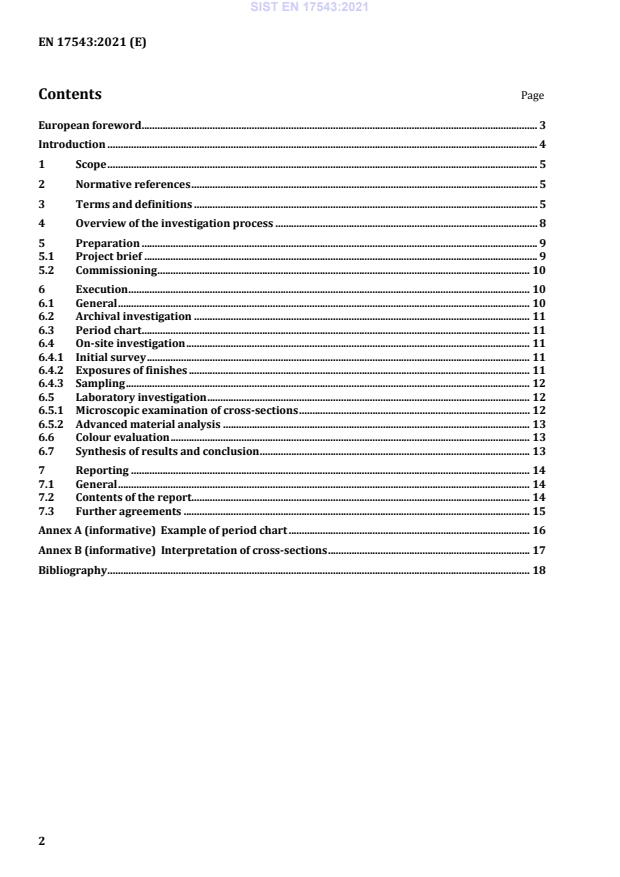
Contents Page
European foreword . 3
Introduction . 4
1 Scope . 5
2 Normative references . 5
3 Terms and definitions . 5
4 Overview of the investigation process . 8
5 Preparation . 9
5.1 Project brief . 9
5.2 Commissioning . 10
6 Execution . 10
6.1 General . 10
6.2 Archival investigation . 11
6.3 Period chart . 11
6.4 On-site investigation . 11
6.4.1 Initial survey . 11
6.4.2 Exposures of finishes . 11
6.4.3 Sampling . 12
6.5 Laboratory investigation . 12
6.5.1 Microscopic examination of cross-sections . 12
6.5.2 Advanced material analysis . 13
6.6 Colour evaluation . 13
6.7 Synthesis of results and conclusion . 13
7 Reporting . 14
7.1 General . 14
7.2 Contents of the report. 14
7.3 Further agreements . 15
Annex A (informative) Example of period chart . 16
Annex B (informative) Interpretation of cross-sections . 17
Bibliography . 18
European foreword
This document (EN 17543:2021) has been prepared by Technical Committee CEN/TC 346 “Conservation
of Cultural Heritage”, the secretariat of which is held by UNI.
This European Standard shall be given the status of a national standard, either by publication of an
identical text or by endorsement, at the latest by February 2022, and conflicting national standards shall
be withdrawn at the latest by February 2022.
Attention is drawn to the possibility that some of the elements of this document may be the subject of
patent rights. CEN shall not be held responsible for identifying any or all such patent rights.
Any feedback and questions on this document should be directed to the users’ national standards body.
A complete listing of these bodies can be found on the CEN website.
According to the CEN-CENELEC Internal Regulations, the national standards organisations of the
following countries are bound to implement this European Standard: Austria, Belgium, Bulgaria, Croatia,
Cyprus, Czech Republic, Denmark, Estonia, Finland, France, Germany, Greece, Hungary, Iceland, Ireland,
Italy, Latvia, Lithuania, Luxembourg, Malta, Netherlands, Norway, Poland, Portugal, Republic of North
Macedonia, Romania, Serbia, Slovakia, Slovenia, Spain, Sweden, Switzerland, Turkey and the United
Kingdom.
Introduction
Throughout its existence, built heritage is subject to continuous change and alteration. The most frequent
changes have been the repeated refurbishment and redecoration of interiors and exterior architectural
surfaces, carried out in response to a wide range of factors: developments in decorative fashions, changes
in the functions of rooms, changes in the wealth of successive occupants and owners, the need to revive
an old and worn painted decoration or simply maintenance. The investigation on built heritage finishes
provides a systematic method of understanding these changes. It offers insights into the appearance of
original and later schemes and may provide dates for the application of specific finishes.
The purpose of the investigation can be to locate, identify, interpret and, if possible, date current and
previous finishes. Such investigations help to deepen our general knowledge of the significance of the
area under investigation, its history and alterations, and also to assess its condition and to plan for future
conservation and presentation, taking account of aesthetic considerations. These investigations should
be looked upon as an integral part of the documentation and investigation process on built heritage.
The aim of each investigation may vary considerably in scope and complexity. While this document offers
a framework, it should be recognized that every finish offers a different challenge to an investigation and
interpretation. The presence of wall paintings will be recorded, although the investigation and
documentation of wall paintings themselves is beyond the scope of this standard.
While the focus of this document is the investigation of finishes in and on buildings, the techniques
described are commonly employed on other heritage objects.
The expertise required to carry out such investigations should be in line with the objectives and
challenges. Multidisciplinary professionals involved in this field are drawn from a wide range of
backgrounds, including conservation, science, art history, architecture, building archaeology, and
painting and decorating crafts.
In some countries, the investigation and documentation of finishes, is known as Architectural Paint
Research (APR).
It is the aim of this document to define common principles and best practice for the investigation on built
heritage finishes.
1 Scope
This document defines best practice when investigating finishes on built heritage, with the aim of
establishing existing schemes by collecting data and processing findings. It applies to finishes that can be
decorative or protective, on buildings and their interiors, as well as other built heritage, but explicitly
excludes the category of wall paintings.
This document applies to the planning and execution of such investigations with documentation
throughout. It can be used as a process reference for stakeholders involved in the investigation of built
heritage.
2 Normative references
The following documents are referred to in the text in such a way that some or all of their content
constitutes requirements of this document. For dated references, only the edition cited applies. For
undated references, the latest edition of the referenced document (including any amendments) applies.
EN 16085:2012, Conservation of Cultural property - Methodology for sampling from materials of cultural
property - General rules
EN 16853:2017, Conservation of cultural heritage - Conservation process - Decision making, planning and
implementation
EN 17429:2020, Conservation of cultural heritage - Procurement of conservation services and works
3 Terms and definitions
For the purposes of this document, the following terms and definitions apply.
ISO and IEC maintain terminological databases for use in standardization at the following addresses:
— ISO Online browsing platform: available at https://www.iso.org/obp
— IEC Electropedia: available at https://www.electropedia.org/
3.1
architectural element
designed part of a building
Note 1 entry: “architectural element” has a wider meaning, but in this standard refers to a elements of a building,
such as skirting, panel, door, column, pillar, etc.
3.2
built heritage
immovable and movable standing structures which have an architectural, cultural or historic value
EXAMPLES: buildings, railings, street furniture, vehicles, industrial artefacts, ships, boats, furniture
3.3
conservation
measures and actions aimed at safeguarding cultural heritage while respecting its significance,
including its accessibility to present and future generations
Note 1 to entry: Conservation includes preventive conservation, remedial conservation and restoration.
Note 2 to entry: The term “preservation” is also used, e.g. in libraries and archives.
Note 3 to entry: All conservation actions are based on documentary and/or material evidence.
[SOURCE: EN 15898:2019, 3.3.1]
3.4
cross-section
sample material cut perpendicularly to the surface of the last layer
3.5
cultural heritage
tangible and intangible entities of significance to present and future generations
[SOURCE: EN 15898:2019, 3.1.1]
3.6
documentation
recorded information created, collected, held and maintained for the purpose of present and future
conservation and for reference
EXAMPLES: drawings, photographs, written reports, scientific data
Note 1 to entry: This term can also refer to the process itself.
Note 2 to entry: Documentation of all stages of conservation is an essential part of the overall process of
conservation planning.
[SOURCE: EN 15898:2019, 3.6.8, modified]
3.7
exposure
removal of overlying layers to reveal a specific finish
Note 1 to entry: See also 3.19 stratigraphic exposure.
Note 2 to entry: This term can also refer to the surface obtained as a result of an exposure.
3.8
finish
treatment or result of a treatment of a surface
EXAMPLES: paint, varnishes, gilding, glazes, stencilling, marbling, wood graining, textiles and/or
wallpapers, plasters, renders, stucco, veneers, leather, tiles, ceramics
Note 1 to entry: A finish can be a planned combination of several layers (primer, undercoat, top coat, glazes and
varnishes) or an uncoated surface left as built.
Note 2 to entry: The term finish is also used to describe the self-finished surface of a building material such as
concrete, render, stone, stucco or wood.
Note 3 to entry: Applied to protect or decorate a surface.
3.9
investigation
obtaining and gathering the information necessary for a conservation decision-making process
Note 1 to entry: This should include both qualitative and quantitative information.
Note 2 to entry: When the objective of the investigation is about conservation purposes, the definition given in
EN 15898:2019 becomes relevant.
[SOURCE: EN 15898:2019, 3.6.3 modified]
3.10
investigator
professional performing an investigation
Note 1 to entry: Professions include, but are not limited to, conservation, science, art history, architecture,
building engineering, building archaeology, and painting and decorating crafts.
3.11
method statement
detailed description of the way a service, work, task or process is to be completed
Note 1 to entry: The costed method statement is the equivalent of a tender offer (EN 17429:2020, 3.2.9).
(SOURCE: EN 17429:2020, 3.2.10, note added)
3.12
period chart
time-referenced table of all schemes
3.13
photomicrograph
graphic reproduction of the image of a cross-section captured through a microscope
3.14
probing cut
oblique incision from surface to substrate
Note 1 to entry: Made to establish the existence of layers.
Note 2 to entry: Known as cratering when circular.
3.15
project brief
description of the objective, background and context for the proposed investigation
3.16
sampling
process of removing material for investigation
[SOURCE: EN 16085:2012, 3.3, modified]
3.17
scheme
set of finishes applied to different architectural elements at a particular period in time
3.18
statement of significance
expression that determines the value of a heritage asset because of its heritage interest; such interest
may be archaeological, architectural, artistic or historic
Note 1 to entry: When it exists, legal protection status of the studied object needs to be taken into account.
3.19
stratigraphic exposure
systematic removal of overlying layers to establish a sequence of finishes/schemes
Note 1 to entry: See also 3.7 exposure.
3.20
substrate
material upon which finishes are applied
3.21
technical imaging
all images that can be obtained using different magnification and under different lighting conditions
(direct light, semi- or raking light) and different wavelengths (from ultraviolet to infrared)
4 Overview of the investigation process
Investigation of finishes on built heritage will expand the understanding of a building’s history and
condition. Results can inform future conservation management and presentation. Documentation of the
findings shall follow the steps of this process and shall be defined and initiated before any alteration
works. The commissioner shall obtain any permissions required by national legislation.
An investigation of finishes may be initiated to:
• obtain a general understanding of the decorative history and use of a building;
• identify a specific scheme;
• establish a scheme sequence;
• inform an exposure or a reconstruction of a specific scheme;
• clarify structural development and alteration;
• assess the significance of an existing finish;
• clarify the type, cause(s) and effect of alteration processes in the existing finishes;
• inform conservation-restoration options.
The investigation and documentation is composed of three main parts, according to Figure 1.
Figure 1 — Flow-chart of the investigation process
5 Preparation
5.1 Project brief
Every investigation of finishes shall begin with an expression of need, which is formalized into a project
brief. The drafting of the project brief will be carried out by the commissioner or their representatives.
When suitable and/or stated by demands in accordance with law, this will be done in dialogue with
cultural heritage authorities.
The development of the project brief shall be in accordance with EN 17429:2020, Clause 5.
For the purpose of this standard, the project brief shall include, but not be limited to:
— an expression of need, scope of research, and anticipated outcomes;
— a statement of significance;
— all documentation relevant to the proposed investigation (including any existing research);
— agreement on archiving, copyright and other intellectual property issues;
— agreement on how exposed or sampled areas will be treated after on-site investigation;
— time frame or provisional schedule.
The scope and aims of the investigation of finishes shall be determined in close collaboration between
commissioners and their advisors. This process shall follow EN 16853:2017, Clause 6.1.
5.2 Commissioning
The commissioning of an investigator to undertake the work is an important part
...