

EN 14399-3:2015
(Main)High-strength structural bolting assemblies for preloading - Part 3: System HR - Hexagon bolt and nut assemblies
- Abstract
This European Standard specifies, together with EN 14399 1 and EN 14399 2, the requirements for assemblies of high-strength structural bolts and nuts of system HR suitable for preloaded joints with large widths across flats, thread sizes M12 to M36 and property classes 8.8/8 or 8.8/10 and 10.9/10.
Bolting assemblies in accordance with this document have been designed to allow preloading of at least 0,7 fub × As ) according to EN 1993 1 8 (Eurocode 3) and to obtain ductility predominantly by plastic elongation of the bolt. For this purpose the components have the following characteristics:
- normal nut height (style 1), see EN ISO 4032;
- thread length of the bolt according to ISO 888.
Bolting assemblies in accordance with this document include washers according to EN 14399 6 or to EN 14399 5 (under the nut only).
NOTE Attention is drawn to the importance of ensuring that bolting assemblies are correctly used if satisfactory results are to be obtained. For recommendations concerning proper application, reference to EN 1090-2 is made.
General requirements and requirements for suitability for preloading are specified in EN 14399 2.
Clamp lengths and grip lengths for the bolting assemblies are specified in the normative Annex A.
- Status
- Published
- Publication Date
- 17-Feb-2015
- Withdrawal Date
- 29-Nov-2016
- Technical Committee
- CEN/TC 185 - Threaded and nonthreaded mechanical fasteners and accessories
- Drafting Committee
- CEN/TC 185/WG 6 - Structural bolting
- Current Stage
- 9093 - Decision to confirm - Review Enquiry
- Start Date
- 16-Apr-2023
- Completion Date
- 21-Oct-2026

Overview
EN 14399-3:2015 defines the requirements for high-strength structural bolting assemblies for preloading - System HR (hexagon bolt and nut assemblies). It applies to preloaded structural joints using hexagon bolts and nuts with thread sizes M12 to M36 and property classes 8.8/8, 8.8/10 and 10.9/10. Assemblies are designed to achieve a minimum preload of 0.7 fub × As (per EN 1993‑1‑8, Eurocode 3) and to obtain ductility primarily by plastic elongation of the bolt.
Key topics and technical requirements
- Scope and system characteristics
- Covers HR system bolt/nut/washer assemblies intended for preloaded joints with large widths across flats.
- Components specified to provide ductility via bolt elongation and to achieve required preload.
- Component dimensions and marking
- Bolt and nut dimensions, thread lengths (per ISO 888) and nut height (normal, style 1 per EN ISO 4032) are defined.
- Marking conventions for bolts, nuts and washers are included to prevent mixing HR and HV systems.
- Preload performance and testing
- Assemblies are specified to allow preloading ≥ 0.7 fub × As and must meet suitability-for-preloading requirements described in EN 14399‑2.
- Functional characteristics such as k‑factor values, maximum bolt force during fitness-for-purpose tests and angles for tightening are specified; the permitted coefficient of variation of the k‑factor (Vk) is tightened (0.06).
- Washers and fit
- Washers are referenced to EN 14399‑6 (plain chamfered) or EN 14399‑5 (plain washers, under the nut only).
- Clamp and grip lengths
- Normative Annex A provides clamp lengths and grip length specifications to ensure correct preload distribution.
Practical applications and who uses this standard
EN 14399‑3:2015 is used where preloaded, high-strength bolted connections are required in steel structures:
- Structural and design engineers specifying bolted connections to Eurocode 3
- Steel fabricators and erection contractors implementing EN 1090‑2 recommendations
- Fastener manufacturers and suppliers producing HR bolting assemblies (bolts, nuts, washers)
- Quality inspectors and procurement teams verifying conformity, marking and suitability for preloading
This standard helps ensure reliable preload, predictable joint behavior and interchangeability of components when used as part of the EN 14399 family.
Related standards
- EN 14399‑1 - General requirements for high‑strength structural bolting assemblies
- EN 14399‑2 - Suitability for preloading (testing procedures)
- EN 14399‑5 / EN 14399‑6 - Washers for preloaded assemblies
- EN 1993‑1‑8 (Eurocode 3) - Design rules for preloaded bolt strength
- EN 1090‑2 - Execution of steel structures (installation and application guidance)
Keywords: EN 14399-3:2015, high-strength structural bolting, System HR, preloaded joints, hexagon bolt and nut assemblies, M12–M36, Eurocode 3, preload, washers, clamp length.
Relations
- Effective Date
- 19-Mar-2011
- Refers
ISO 3508:1976 - Thread run-outs for fasteners with thread in accordance with ISO 261 and ISO 262 - Effective Date
- 25-Aug-2026
- Effective Date
- 25-Aug-2026
- Effective Date
- 25-Aug-2026
- Effective Date
- 09-Feb-2026
- Effective Date
- 28-Jan-2026
- Effective Date
- 28-Jan-2026
- Refers
EN 14399-5:2015 - High-strength structural bolting assemblies for preloading - Part 5: Plain washers - Effective Date
- 28-Jan-2026
- Effective Date
- 28-Jan-2026
- Effective Date
- 28-Jan-2026
- Effective Date
- 28-Jan-2026
- Effective Date
- 28-Jan-2026
- Effective Date
- 28-Jan-2026
- Effective Date
- 28-Jan-2026
- Effective Date
- 28-Jan-2026
Frequently Asked Questions
EN 14399-3:2015 is a standard published by the European Committee for Standardization (CEN). Its full title is "High-strength structural bolting assemblies for preloading - Part 3: System HR - Hexagon bolt and nut assemblies". This standard covers: This European Standard specifies, together with EN 14399 1 and EN 14399 2, the requirements for assemblies of high-strength structural bolts and nuts of system HR suitable for preloaded joints with large widths across flats, thread sizes M12 to M36 and property classes 8.8/8 or 8.8/10 and 10.9/10. Bolting assemblies in accordance with this document have been designed to allow preloading of at least 0,7 fub × As ) according to EN 1993 1 8 (Eurocode 3) and to obtain ductility predominantly by plastic elongation of the bolt. For this purpose the components have the following characteristics: - normal nut height (style 1), see EN ISO 4032; - thread length of the bolt according to ISO 888. Bolting assemblies in accordance with this document include washers according to EN 14399 6 or to EN 14399 5 (under the nut only). NOTE Attention is drawn to the importance of ensuring that bolting assemblies are correctly used if satisfactory results are to be obtained. For recommendations concerning proper application, reference to EN 1090-2 is made. General requirements and requirements for suitability for preloading are specified in EN 14399 2. Clamp lengths and grip lengths for the bolting assemblies are specified in the normative Annex A.
This European Standard specifies, together with EN 14399 1 and EN 14399 2, the requirements for assemblies of high-strength structural bolts and nuts of system HR suitable for preloaded joints with large widths across flats, thread sizes M12 to M36 and property classes 8.8/8 or 8.8/10 and 10.9/10. Bolting assemblies in accordance with this document have been designed to allow preloading of at least 0,7 fub × As ) according to EN 1993 1 8 (Eurocode 3) and to obtain ductility predominantly by plastic elongation of the bolt. For this purpose the components have the following characteristics: - normal nut height (style 1), see EN ISO 4032; - thread length of the bolt according to ISO 888. Bolting assemblies in accordance with this document include washers according to EN 14399 6 or to EN 14399 5 (under the nut only). NOTE Attention is drawn to the importance of ensuring that bolting assemblies are correctly used if satisfactory results are to be obtained. For recommendations concerning proper application, reference to EN 1090-2 is made. General requirements and requirements for suitability for preloading are specified in EN 14399 2. Clamp lengths and grip lengths for the bolting assemblies are specified in the normative Annex A.
EN 14399-3:2015 is classified under the following ICS (International Classification for Standards) categories: 21.060.01 - Fasteners in general; 21.060.10 - Bolts, screws, studs; 21.060.20 - Nuts. The ICS classification helps identify the subject area and facilitates finding related standards.
EN 14399-3:2015 has the following relationships with other standards: It is inter standard links to EN 14399-3:2005, ISO 3508:1976, ISO 261:1998, ISO 965-2:1998, ISO 965-5:1998, EN ISO 4759-1:2000, EN 14399-1:2015, EN 14399-5:2015, EN ISO 6157-2:2004, EN 572-7:2004, EN ISO 10684:2004, EN ISO 898-1:2013, EN 14399-6:2015, EN 923:1998, EN ISO 3269:2019. Understanding these relationships helps ensure you are using the most current and applicable version of the standard.
EN 14399-3:2015 is associated with the following European legislation: EU Directives/Regulations: 305/2011, 89/106/EEC, 97/23/EC. When a standard is cited in the Official Journal of the European Union, products manufactured in conformity with it benefit from a presumption of conformity with the essential requirements of the corresponding EU directive or regulation.
EN 14399-3:2015 is available in PDF format for immediate download after purchase. The document can be added to your cart and obtained through the secure checkout process. Digital delivery ensures instant access to the complete standard document.
Standards Content (Sample)
2003-01.Slovenski inštitut za standardizacijo. Razmnoževanje celote ali delov tega standarda ni dovoljeno.Hochfeste vorspannbare Garnituren für Schraubverbindungen im Metallbau - Teil 3: System HR - Garnituren aus Sechskantschrauben und -mutternBoulonnerie de construction métallique à haute résistance apte à la précontrainte - Partie 3: Système HR - Boulons à tête hexagonale (vis + écrou)High-strength structural bolting assemblies for preloading - Part 3: System HR - Hexagon bolt and nut assemblies21.060.20MaticeNuts21.060.10Sorniki, vijaki, stebelni vijakiBolts, screws, studsICS:Ta slovenski standard je istoveten z:EN 14399-3:2015SIST EN 14399-3:2015en,fr,de01-maj-2015SIST EN 14399-3:2015SLOVENSKI
STANDARDSIST EN 14399-3:20051DGRPHãþD
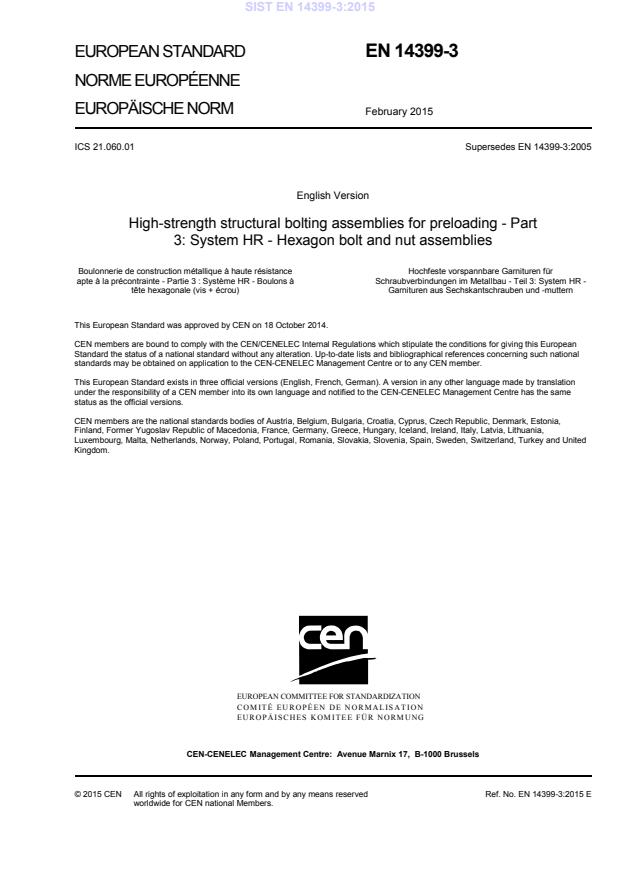
EUROPEAN STANDARD NORME EUROPÉENNE EUROPÄISCHE NORM
EN 14399-3
February 2015 ICS 21.060.01 Supersedes EN 14399-3:2005English Version
High-strength structural bolting assemblies for preloading - Part 3: System HR - Hexagon bolt and nut assemblies
Boulonnerie de construction métallique à haute résistance apte à la précontrainte - Partie 3 : Système HR - Boulons à tête hexagonale (vis + écrou)
Hochfeste vorspannbare Garnituren für Schraubverbindungen im Metallbau - Teil 3: System HR - Garnituren aus Sechskantschrauben und -muttern This European Standard was approved by CEN on 18 October 2014.
CEN members are bound to comply with the CEN/CENELEC Internal Regulations which stipulate the conditions for giving this European Standard the status of a national standard without any alteration. Up-to-date lists and bibliographical references concerning such national standards may be obtained on application to the CEN-CENELEC Management Centre or to any CEN member.
This European Standard exists in three official versions (English, French, German). A version in any other language made by translation under the responsibility of a CEN member into its own language and notified to the CEN-CENELEC Management Centre has the same status as the official versions.
CEN members are the national standards bodies of Austria, Belgium, Bulgaria, Croatia, Cyprus, Czech Republic, Denmark, Estonia, Finland, Former Yugoslav Republic of Macedonia, France, Germany, Greece, Hungary, Iceland, Ireland, Italy, Latvia, Lithuania, Luxembourg, Malta, Netherlands, Norway, Poland, Portugal, Romania, Slovakia, Slovenia, Spain, Sweden, Switzerland, Turkey and United Kingdom.
EUROPEAN COMMITTEE FOR STANDARDIZATION
COMITÉ EUROPÉEN DE NORMALISATION EUROPÄISCHES KOMITEE FÜR NORMUNG
CEN-CENELEC Management Centre:
Avenue Marnix 17,
B-1000 Brussels © 2015 CEN All rights of exploitation in any form and by any means reserved worldwide for CEN national Members. Ref. No. EN 14399-3:2015 ESIST EN 14399-3:2015
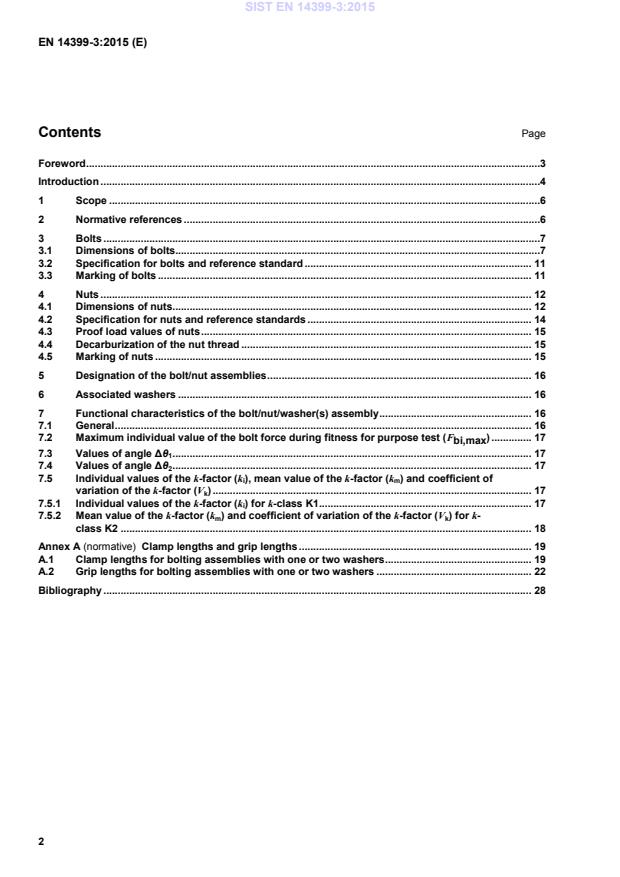
Clamp lengths and grip lengths . 19 A.1 Clamp lengths for bolting assemblies with one or two washers . 19 A.2 Grip lengths for bolting assemblies with one or two washers . 22 Bibliography . 28
EN ISO 898-1, Mechanical properties of fasteners made of carbon steel and alloy steel - Part 1: Bolts, screws and studs with specified property classes - Coarse thread and fine pitch thread (ISO 898-1) EN ISO 898-2, Mechanical properties of fasteners made of carbon steel and alloy steel - Part 2: Nuts with specified property classes - Coarse thread and fine pitch thread (ISO 898-2) EN ISO 3269, Fasteners - Acceptance inspection (ISO 3269) EN ISO 4759-1, Tolerances for fasteners - Part 1: Bolts, screws, studs and nuts - Product grades A, B and C (ISO 4759-1) EN ISO 6157-2, Fasteners - Surface discontinuities - Part 2: Nuts (ISO 6157-2)
1) fub is the nominal tensile strength (Rm) and As the nominal stress area of the bolt. SIST EN 14399-3:2015
Key a incomplete thread u ≤ 2P b 15° to 30° Figure 1 — Dimensions of bolts The difference between lg and ls should not be less than 1,5 P. For coated bolts, the dimensions apply prior to coating. SIST EN 14399-3:2015
40 38,75 41,25 – 7
– 8
45 43,75 46,25 6,25 15
– 8
50 48,75 51,25 11,25 20 – 8 – 8
– 10 55 53,5 56,5 16,25 25 11 21 – 8
– 10 60 58,5 61,5 21,25 30 16 26 12 22 – 10 – 10 65 63,5 66,5 26,25 35 21 31 17 27 10,5 23 – 10 70 68,5 71,5 31,25 40 26 36 22 32 15,5 28 11,5 24 75 73,5 76,5 36,25 45 31 41 27 37 20,5 33 16,5 29 80 78,5 81,5 41,25 50 36 46 32 42 25,5 38 21,5 34 85 83,25 86,75 46,25 55 41 51 37 47 30,5 43 26,5 39 90 88,25 91,75 51,25 60 46 56 42 52 35,5 48 31,5 44 95 93,25 96,75 56,25 65 51 61 47 57 40,5 53 36,5 49 100 98,25 101,75 61,25 70 56 66 52 62 45,5 58 41,5 54 SIST EN 14399-3:2015
66 76 62 72 55,5 68 51,5 64 120 118,25 121,75
76 86 72 82 65,5 78 61,5 74 130 128 132
80 90 76 86 69,5 82 65,5 78 140 138 142
90 100 86 96 79,5 92 75,5 88 150 148 152
100 110 96 106 89,5 102 85,5 98 160 156 164
110 120 106 116 99,5 112 95,5 108
Thread (d) M22 M24 M27 M30 M36 Pb 2,5 3 3 3,5 4 b (ref.) c 50 54 60 66 78 d 56 60 66 72 84 e 69 73 79 85 97 c max. 0,8 0,8 0,8 0,8 0,8 min. 0,4 0,4 0,4 0,4 0,4 da max. 26,4 28,4 32,4 35,4 42,4 ds max. 22,84 24,84 27,84 30,84 37,00 min. 21,16 23,16 26,16 29,16 35,00 dw max. f f f f f min. 33,3 38,0 42,8 46,6 55,9 e min. 39,55 45,20 50,85 55,37 66,44 k nom. 14 15 17 18,7 22,5 max. 14,90 15,90 17,90 19,75 23,55 min. 13,10 14,10 16,10 17,65 21,45 kw min. 9,2 9,9 11,3 12,4 15,0 r min. 1,5 1,5 2,0 2,0 2,0 s max. 36 41 46 50 60 min. 35,0 40,0 45,0 49,0 58,8 l ls and lgg, h ls lg ls lg ls lg ls lg ls lg nom. min. max. min. max. min. max. min. max. min. max. min. max. 50 48,75 51,25 – 10
55 53,5 56,5 – 10
60 58,5 61,5 – 10 – 12 – 12
65 63,5 66,5 – 10 – 12 – 12
70 68,5 71,5 – 10 – 12 – 12 – 14
75 73,5 76,5 12,5 25 – 12 – 12 – 14
80 78,5 81,5 17,5 30 – 12 – 12 – 14
85 83,25 86,75 22,5 35 16 31 – 12 – 14 – 16 90 88,25 91,75 27,5 40 21 36 15 30 – 14 – 16 SIST EN 14399-3:2015
95 110 89 104 80,5 98 66 86 180 176 184
105 120 99 114 90,5 108 76 96 190 186 194
115 130 109 124 100,5 118 86 106 200 196 204
125 140 119 134 110,5 128 96 116 NOTE 1 Preferred lengths are defined in terms of lengths ls,min and lg,max. a Non-preferred sizes. b P is the pitch of thread. c For lengths lnom ≤ 125 mm. d For lengths 125 mm < lnom ≤ 200 mm. e For lengths lnom > 200 mm. f dw,max
=
sactual g lg,max = lnom – b ls,min = lg,max – 5P h When ls,min as calculated by the formula in g is less than 0,5d then the bolts be fully threaded, and in this case lg,max is equal to amax as specified in ISO 3508 for product grade C, i.e. 4P. Fully threaded bolts are shown above the stepped line.
...