

EN 14373:2021+A1:2025
(Main + Amendment)Explosion suppression systems
- Abstract
This document describes the basic requirements for the design and application of explosion suppression systems. This document also specifies test methods for evaluating the effectiveness and the scaling up of explosion suppression systems against defined explosions. This document covers:
- general requirements for explosion suppression system parts;
- evaluating the effectiveness of an explosion suppression system;
- evaluating the scale up of an explosion suppression system to larger than tested volumes;
- development and evaluation of design tools for explosion suppression systems;
- installation, operation and maintenance instructions for an explosion suppression system.
This document is applicable only to explosion suppression systems intended for the protection of closed, or essentially closed, enclosures in which an explosion could result as a consequence of ignition of an explosible mixture, e.g. dust-air, gas(vapour)-air, dust-gas(vapour)-air and mist-air.
This document is not applicable for explosions of materials listed below, or for mixtures containing some of those materials:
- unstable materials that are liable to dissociate;
- explosive materials;
- pyrotechnic materials;
- pyrophoric materials.
- Status
- Published
- Publication Date
- 18-Feb-2025
- Current Stage
- 6060 - Definitive text made available (DAV) - Publishing
- Start Date
- 19-Feb-2025
- Due Date
- 23-May-2025
- Completion Date
- 19-Feb-2025
- Directive
- 2014/34/EU - Directive 2014/34/EU Of The European Parliament And Of The Council of 26 February 2014 on the harmonisation of the laws of the Member States relating to equipment and protective systems intended for use in potentially explosive atmospheres (recast)OJ Ref: 2025/1810, OJ L, OJ L, 2025/1810 OJ Date: 12-Sep-2025


Overview
EN 14373:2021+A1:2025 (CEN) defines the basic requirements and test methods for explosion suppression systems used to protect closed or essentially closed enclosures where ignition of an explosible mixture could cause an explosion. The standard covers system design, component requirements, experimental testing of efficacy, scale‑up to larger volumes, development and validation of design tools, and installation, commissioning, operation and maintenance instructions. It applies to protection against dust‑air, gas(vapour)‑air, dust‑gas(vapour)‑air and mist‑air explosions, but excludes unstable, explosive, pyrotechnic or pyrophoric materials.
Key topics and technical requirements
- Design and general function: Requirements for suppression system architecture, activation and interaction with process equipment.
- Parts and components: Specification of performance expectations for actuators, suppressant storage (e.g., HRD‑suppressor), dispersal mechanisms and environmental considerations.
- Suppressant types: Descriptions of powder and liquid suppressants and their intended use (definitions and properties are provided).
- Experimental testing: Test programs and methods for evaluating suppression effectiveness for non‑metal dust, metal dust, gases, hybrid mixtures and mists; parameters to be measured and reporting requirements.
- Scale‑up and modelling: Procedures and criteria for extrapolating tested performance to larger volumes and for developing/validating explosion suppression calculation models.
- Installation, commissioning and maintenance: Instructions and documentation requirements for safe installation, cable routing, assembly, hand‑over, commissioning reports, maintenance schedules and system marking/packaging.
- Safety & environmental aspects: Consideration of suppressant environmental impact and safety of actuators and components.
Applications and who uses this standard
EN 14373 is intended for professionals involved in explosion protection and process safety, including:
- Plant designers and process engineers specifying protection for spray dryers, silos, conveyors, elevators, elongated enclosures and other closed vessels.
- Manufacturers and integrators of explosion suppression systems and HRD‑suppressors.
- Safety managers, maintenance teams and commissioning engineers implementing protective systems.
- Certification bodies and regulators assessing compliance with European safety directives (see Annex ZA).
Practical benefits: ensures reproducible test methods, supports validated scale‑up of protection concepts, and provides clear guidance for installation, operation and maintenance to reduce explosion risk in industrial settings.
Related standards
Relevant normative references and complementary standards include: EN 1127‑1, EN 14034‑1/2, EN IEC 60079‑0, EN IEC 60079‑14, and other standards on functional safety and explosive atmosphere terminology. These assist in hazard analysis, equipment selection and regulatory compliance.
Relations
- Effective Date
- 11-Dec-2024
- Effective Date
- 11-Dec-2024
- Effective Date
- 09-Feb-2026
- Effective Date
- 09-Feb-2026
- Effective Date
- 09-Feb-2026
- Effective Date
- 09-Feb-2026
- Refers
EN IEC 60079-0:2018/A11:2024 - Explosive atmospheres - Part 0: Equipment - General requirements - Effective Date
- 09-Feb-2026
- Effective Date
- 09-Feb-2026
- Effective Date
- 28-Jan-2026
- Effective Date
- 28-Jan-2026
- Effective Date
- 28-Jan-2026
- Effective Date
- 28-Jan-2026
- Effective Date
- 28-Jan-2026
- Effective Date
- 28-Jan-2026
- Effective Date
- 28-Jan-2026
Get Certified
Connect with accredited certification bodies for this standard

CIS Institut d.o.o.
Personal Protective Equipment (PPE) certification body. Notified Body NB-2890 for EU Regulation 2016/425 PPE.

Kiwa BDA Testing
Building and construction product certification.
Kmetijski inštitut Slovenije
Agricultural Institute of Slovenia. Soil testing, plant health, agricultural product analysis.
Sponsored listings
Frequently Asked Questions
EN 14373:2021+A1:2025 is a standard published by the European Committee for Standardization (CEN). Its full title is "Explosion suppression systems". This standard covers: This document describes the basic requirements for the design and application of explosion suppression systems. This document also specifies test methods for evaluating the effectiveness and the scaling up of explosion suppression systems against defined explosions. This document covers: - general requirements for explosion suppression system parts; - evaluating the effectiveness of an explosion suppression system; - evaluating the scale up of an explosion suppression system to larger than tested volumes; - development and evaluation of design tools for explosion suppression systems; - installation, operation and maintenance instructions for an explosion suppression system. This document is applicable only to explosion suppression systems intended for the protection of closed, or essentially closed, enclosures in which an explosion could result as a consequence of ignition of an explosible mixture, e.g. dust-air, gas(vapour)-air, dust-gas(vapour)-air and mist-air. This document is not applicable for explosions of materials listed below, or for mixtures containing some of those materials: - unstable materials that are liable to dissociate; - explosive materials; - pyrotechnic materials; - pyrophoric materials.
This document describes the basic requirements for the design and application of explosion suppression systems. This document also specifies test methods for evaluating the effectiveness and the scaling up of explosion suppression systems against defined explosions. This document covers: - general requirements for explosion suppression system parts; - evaluating the effectiveness of an explosion suppression system; - evaluating the scale up of an explosion suppression system to larger than tested volumes; - development and evaluation of design tools for explosion suppression systems; - installation, operation and maintenance instructions for an explosion suppression system. This document is applicable only to explosion suppression systems intended for the protection of closed, or essentially closed, enclosures in which an explosion could result as a consequence of ignition of an explosible mixture, e.g. dust-air, gas(vapour)-air, dust-gas(vapour)-air and mist-air. This document is not applicable for explosions of materials listed below, or for mixtures containing some of those materials: - unstable materials that are liable to dissociate; - explosive materials; - pyrotechnic materials; - pyrophoric materials.
EN 14373:2021+A1:2025 is classified under the following ICS (International Classification for Standards) categories: 13.230 - Explosion protection. The ICS classification helps identify the subject area and facilitates finding related standards.
EN 14373:2021+A1:2025 has the following relationships with other standards: It is inter standard links to EN 14373:2021/FprA1, EN 14373:2021, EN 60529:1991, EN IEC 60079-14:2024, EN 60529:1991/A2:2013, EN 60529:1991/A1:2000, EN IEC 60079-0:2018/A11:2024, EN IEC 60079-0:2018, EN 13237:2024, EN 1127-1:2019, EN 15967:2022, EN 14034-2:2006+A1:2011, EN ISO 80079-36:2016, EN 15233:2007, EN 16447:2014. Understanding these relationships helps ensure you are using the most current and applicable version of the standard.
EN 14373:2021+A1:2025 is associated with the following European legislation: EU Directives/Regulations: 2014/34/EU; Standardization Mandates: M/596. When a standard is cited in the Official Journal of the European Union, products manufactured in conformity with it benefit from a presumption of conformity with the essential requirements of the corresponding EU directive or regulation.
EN 14373:2021+A1:2025 is available in PDF format for immediate download after purchase. The document can be added to your cart and obtained through the secure checkout process. Digital delivery ensures instant access to the complete standard document.
Standards Content (Sample)
SLOVENSKI STANDARD
01-maj-2025
Sistemi za dušenje eksplozij
Explosion suppression systems
Explosions-Unterdrückungssysteme
Systèmes de suppression d'explosion
Ta slovenski standard je istoveten z: EN 14373:2021+A1:2025
ICS:
13.230 Varstvo pred eksplozijo Explosion protection
2003-01.Slovenski inštitut za standardizacijo. Razmnoževanje celote ali delov tega standarda ni dovoljeno.
EN 14373:2021+A1
EUROPEAN STANDARD
NORME EUROPÉENNE
February 2025
EUROPÄISCHE NORM
ICS 13.230 Supersedes EN 14373:2021
English Version
Explosion suppression systems
Systèmes de suppression d'explosion Explosions-Unterdrückungssysteme
This European Standard was approved by CEN on 27 September 2021 and includes Amendment 1 approved by CEN on 29
December 2024.
CEN members are bound to comply with the CEN/CENELEC Internal Regulations which stipulate the conditions for giving this
European Standard the status of a national standard without any alteration. Up-to-date lists and bibliographical references
concerning such national standards may be obtained on application to the CEN-CENELEC Management Centre or to any CEN
member.
This European Standard exists in three official versions (English, French, German). A version in any other language made by
translation under the responsibility of a CEN member into its own language and notified to the CEN-CENELEC Management
Centre has the same status as the official versions.
CEN members are the national standards bodies of Austria, Belgium, Bulgaria, Croatia, Cyprus, Czech Republic, Denmark, Estonia,
Finland, France, Germany, Greece, Hungary, Iceland, Ireland, Italy, Latvia, Lithuania, Luxembourg, Malta, Netherlands, Norway,
Poland, Portugal, Republic of North Macedonia, Romania, Serbia, Slovakia, Slovenia, Spain, Sweden, Switzerland, Türkiye and
United Kingdom.
EUROPEAN COMMITTEE FOR STANDARDIZATION
COMITÉ EUROPÉEN DE NORMALISATION
EUROPÄISCHES KOMITEE FÜR NORMUNG
CEN-CENELEC Management Centre: Rue de la Science 23, B-1040 Brussels
© 2025 CEN All rights of exploitation in any form and by any means reserved Ref. No. EN 14373:2021+A1:2025 E
worldwide for CEN national Members.
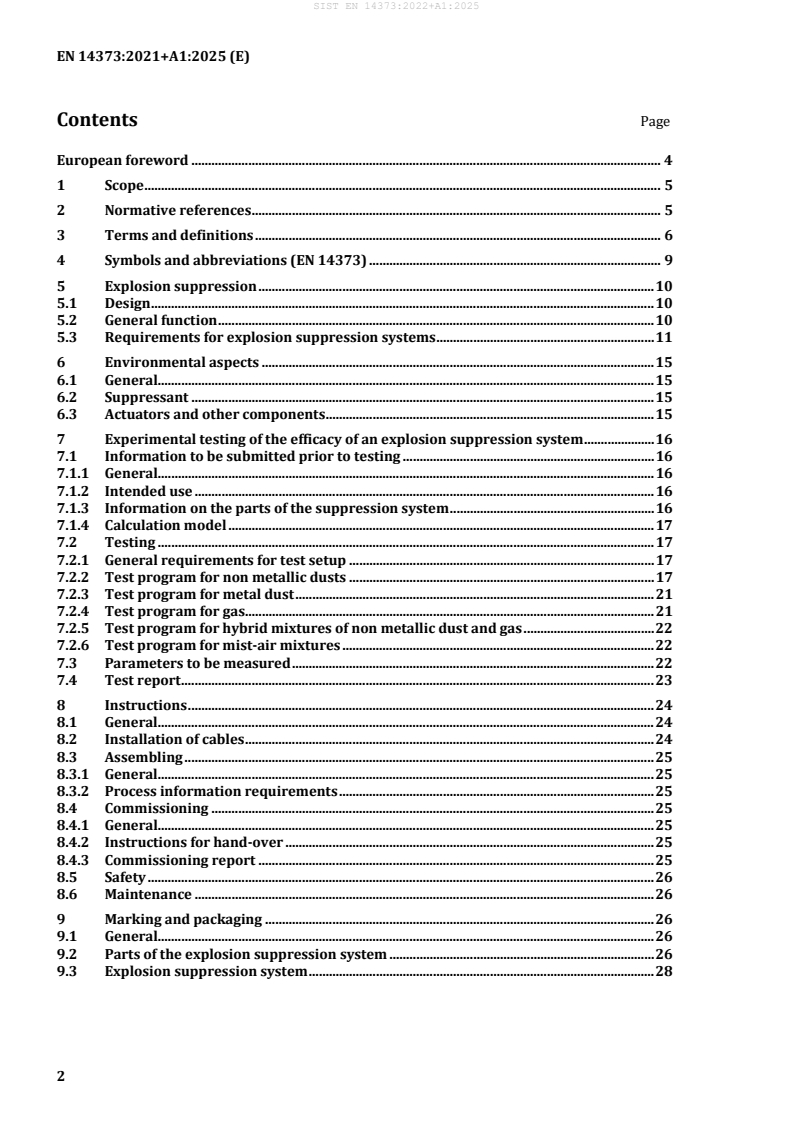
Contents Page
European foreword . 4
1 Scope . 5
2 Normative references . 5
3 Terms and definitions . 6
4 Symbols and abbreviations (EN 14373) . 9
5 Explosion suppression . 10
5.1 Design . 10
5.2 General function . 10
5.3 Requirements for explosion suppression systems . 11
6 Environmental aspects . 15
6.1 General. 15
6.2 Suppressant . 15
6.3 Actuators and other components . 15
7 Experimental testing of the efficacy of an explosion suppression system . 16
7.1 Information to be submitted prior to testing . 16
7.1.1 General. 16
7.1.2 Intended use . 16
7.1.3 Information on the parts of the suppression system . 16
7.1.4 Calculation model . 17
7.2 Testing . 17
7.2.1 General requirements for test setup . 17
7.2.2 Test program for non metallic dusts . 17
7.2.3 Test program for metal dust . 21
7.2.4 Test program for gas . 21
7.2.5 Test program for hybrid mixtures of non metallic dust and gas . 22
7.2.6 Test program for mist-air mixtures . 22
7.3 Parameters to be measured . 22
7.4 Test report . 23
8 Instructions . 24
8.1 General. 24
8.2 Installation of cables . 24
8.3 Assembling . 25
8.3.1 General. 25
8.3.2 Process information requirements . 25
8.4 Commissioning . 25
8.4.1 General. 25
8.4.2 Instructions for hand-over . 25
8.4.3 Commissioning report . 25
8.5 Safety . 26
8.6 Maintenance . 26
9 Marking and packaging . 26
9.1 General. 26
9.2 Parts of the explosion suppression system . 26
9.3 Explosion suppression system . 28
Annex A (informative) Development of an explosion suppression calculation model . 29
A.1 General . 29
A.2 Extinction. 29
A.3 Functional tests for model development . 30
A.4 Model validation . 31
Annex B (informative) Applications. 32
B.1 General . 32
B.2 Hazard definition . 32
B.3 Typical process equipment . 33
B.3.1 Spray dryers . 33
B.3.1.1 Introduction . 33
B.3.1.2 Definition of elements . 33
B.3.1.3 Dust concentration . 34
B.3.1.4 Protection concept . 35
B.3.1.5 Isolation . 35
B.3.1.6 Advanced inerting . 35
B.3.1.7 Flame Duration . 35
B.3.1.8 Interlocking . 35
B.3.2 Clean volumes . 35
B.3.3 Elevators . 35
B.3.4 Elongated enclosures . 36
B.3.5 Pipes . 36
B.3.6 Occupied spaces . 36
Annex C (informative) Extrapolation to larger volumes . 38
Annex D (informative) Significant changes between this European Standard and
EN 14373:2005 . 42
Annex ZA (informative) Relationship between this European Standard and the essential
requirements of EU Directive 2014/34/EU aimed to be covered . 44
Bibliography . 46
European foreword
This document (EN 14373:2021+A1:2025) has been prepared by Technical Committee CEN/TC 305
“Potentially explosive atmospheres - Explosion prevention and protection”, the secretariat of which is
held by DIN.
This European Standard shall be given the status of a national standard, either by publication of an
identical text or by endorsement, at the latest by August 2025, and conflicting national standards shall be
withdrawn at the latest by August 2025.
Attention is drawn to the possibility that some of the elements of this document may be the subject of
patent rights. CEN shall not be held responsible for identifying any or all such patent rights.
This document supersedes !EN 14373:2021".
This document includes Amendment 1 approved by CEN on 29 December 2024.
The start and finish of text introduced or altered by amendment is indicated in the text by tags !".
The significant changes between this document and EN 14373:2005 are given in Annex D.
This document has been prepared under a standardization request addressed to CEN by the European
Commission. The Standing Committee of the EFTA States subsequently approves these requests for its
Member States.
For the relationship with EU Legislation, see informative Annex ZA, which is an integral part of this
document.
Any feedback and questions on this document should be directed to the users’ national standards body.
A complete listing of these bodies can be found on the CEN website.
According to the CEN-CENELEC Internal Regulations, the national standards organisations of the
following countries are bound to implement this European Standard: Austria, Belgium, Bulgaria, Croatia,
Cyprus, Czech Republic, Denmark, Estonia, Finland, France, Germany, Greece, Hungary, Iceland, Ireland,
Italy, Latvia, Lithuania, Luxembourg, Malta, Netherlands, Norway, Poland, Portugal, Republic of North
Macedonia, Romania, Serbia, Slovakia, Slovenia, Spain, Sweden, Switzerland, Türkiye and the United
Kingdom.
1 Scope
This document describes the basic requirements for the design and application of explosion suppression
systems. This document also specifies test methods for evaluating the effectiveness and the scaling up of
explosion suppression systems against defined explosions. This document covers:
— general requirements for explosion suppression system parts;
— evaluating the effectiveness of an explosion suppression system;
— evaluating the scale up of an explosion suppression system to larger than tested volumes;
— development and evaluation of design tools for explosion suppression systems;
— installation, operation and maintenance instructions for an explosion suppression system.
This document is applicable only to explosion suppression systems intended for the protection of closed,
or essentially closed, enclosures in which an explosion could result as a consequence of ignition of an
explosible mixture, e.g. dust-air, gas(vapour)-air, dust-gas(vapour)-air and mist-air.
This document is not applicable for explosions of materials listed below, or for mixtures containing some
of those materials:
— unstable materials that are liable to dissociate;
— explosive materials;
— pyrotechnic materials;
— pyrophoric materials.
2 Normative references
The following documents are referred to in the text in such a way that some or all of their content
constitutes requirements of this document. For dated references, only the edition cited applies. For
undated references, the latest edition of the referenced document (including any amendments) applies.
EN 1127-1:2019, Explosive atmospheres - Explosion prevention and protection - Part 1: Basic concepts and
methodology
!EN 13237:2024, Potentially explosive atmospheres - Terms and definitions for equipment and protective
systems intended for use in potentially explosive atmospheres"
EN 15233:2007, Methodology for functional safety assessment of protective systems for potentially
explosive atmospheres
!EN 15967:2022, Determination of maximum explosion pressure and the maximum rate of pressure rise
of gases and vapours"
EN 14034-1:2004+A1:2011, Determination of explosion characteristics of dust clouds - Part 1:
Determination of the maximum explosion pressure p of dust clouds
max
EN 14034-2:2006+A1:2011, Determination of explosion characteristics of dust clouds - Part 2:
Determination of the maximum rate of explosion pressure rise (d /d )max of dust clouds
p t
!EN IEC 60079-0:2018, Explosive atmospheres - Part 0: Equipment - General requirements (IEC 60079-
0:2017)"
!EN IEC 60079-14:2024, Explosive atmospheres - Part 14: Electrical installation design, selection and
installation of equipment, including initial inspection (IEC 60079-14:2024)"
!EN 60529:1991, Degrees of protection provided by enclosures (IP Code) (IEC 60529:1989)"
!EN ISO 80079-36:2016, Explosive atmospheres - Part 36: Non-electrical equipment for explosive
atmospheres - Basic method and requirements (ISO 80079-36:2016)"
3 Terms and definitions
For the purposes of this document, the terms and definitions given in EN 1127-1:2019 and
!EN 13237:2024" and the following apply.
ISO and IEC maintain terminology databases for use in standardization at the following addresses:
• IEC Electropedia: available at https://www.electropedia.org/
• ISO Online browsing platform: available at https://www.iso.org/obp
3.1
high rate discharge suppressor
HRD-suppressor
vessel with opening mechanism, which upon activation discharges an explosion suppressant at a high
rate
3.2
suppressant
substance contained in the HRD-suppressor which, when dispersed into an enclosure to be protected,
can arrest and mitigate a developing explosion in that enclosure
3.2.1
powder suppressant
powder with recognised flame extinguishing properties such as products based on monoammonium
phosphate, potassium bicarbonate or sodium bicarbonate
3.2.2
liquid suppressant
substance stored as a liquid with recognised flame extinguishing properties such as cold or hot water
3.3
dispersion pressure
p
s
pressure in HRD-suppressor to disperse the suppressant, which is provided by gas, chemical reaction or
the application of heat
As impacted by EN IEC 60079-0:2018/AC:2020-02 and EN IEC 60079-0:2018/A11:2024.
As impacted by EN 60529:1991/A1:2000, EN 60529:1991/A2:2013, EN 60529:1991/AC:2016-12 and
EN 60529:1991/A2:2013/AC:2019-02.
As impacted by EN ISO 80079-36:2016/AC:2019.
3.4
suppressant charge
M
s
mass of the suppressant contained within the suppressor
3.5
explosion detector
device that responds to an explosion (e.g. developing pressure and/or radiation) and provides a signal to
the control and indicating equipment
Note 1 to entry: See 3.10.
3.6
activation pressure
p
a
pressure at which the control and indicating equipment activates the high rate discharge suppressor(s)
3.7
maximum reduced (suppressed) explosion pressure
p
red,max
maximum explosion overpressure generated by an explosion of an explosive atmosphere in an enclosure
at optimum fuel concentration, after effective explosion venting or explosion suppression
3.8
explosion suppression
technique limiting and/or avoiding the destructive effect of an explosion by the deployment of
suppressant
3.9
explosion suppression system
arrangement comprising one or more explosion detectors, control and indicating equipment and one or
more high rate discharge suppressors aiming at achieving explosion suppression
3.10
control and indicating equipment
CIE
safety device, which is an electronic system which controls, records and monitors the status of the
explosion protection system and initiates the explosion protection devices upon detection
Note 1 to entry: The CIE is intended to activate the explosion protection devices and to initiate alarm systems and
process shutdown.
3.11
dispersion nozzle
device fitted on a HRD-suppressor and designed to distribute the suppressant throughout the enclosure
to be protected
3.12
compact enclosure/cubic enclosure
enclosures having a length (height) to diameter ratio of less than 2
3.13
elongated enclosures
enclosures with a length (height) to diameter ratio of 2 to 10
3.14
pipe
construction with a length (height) to diameter ratio greater than 10
3.15
hazard sector
three-dimensional space for which the explosion suppression system is designed to be active
3.16
lowest observable adverse effect level
LOAEL
lowest concentration of the suppressant at which an adverse toxicological or physiological effect has been
observed
3.17
suppression model
mathematical calculation which predicts the course of an explosion, the action of the suppression system
and its interaction with the explosion, in order to enable an accurate design of explosion suppression
systems
3.18
maximum throw
maximum distance from a suppressor at which the concentration of the expelled suppressant is still
sufficiently high to extinguish an explosion flame
3.19
arming
enabling the explosion suppression system for fault free operation
3.20
activation
initiation of the high rate discharge suppressor to discharge
3.21
discharge
opening and consequential emptying of the high rate discharge suppressor
3.22
lock out
mechanical device to prevent discharge of the high rate discharge suppressor
4 Symbols and abbreviations (EN 14373)
CIE control and indicating equipment
C heat capacity at constant pressure
p
HRD high rate discharge
IP ingress protection
K maximum rate of pressure rise to be applied and determined according to
max
EN 14034-2:2006+A1:2011 for a certain dust and dust concentration normalised to a
1 m volume or according to !EN 15967:2022" for a certain gas or vapour and gas
or vapour concentration normalised to a 1 m volume
K minimum rate of pressure rise to be applied and determined according to
min
EN 14034-2:2006+A1:2011 for a certain dust and dust concentration normalised to a
1 m volume or according to !EN 15967:2022" for a certain gas or vapour and gas
or vapour concentration normalised to a 1 m volume
K maximum rate of pressure rise of a dust determined according to
St
EN 14034-2:2006+A1:2011 normalised to a 1 m volume
L/D length-to-diameter ratio
LEL lower explosion limit
LOAEL lowest observable adverse effect level
MIE minimum ignition energy
MIT minimum ignition temperature of a dust cloud
MSDS material safety data sheets
M suppressant charge
s
p activation pressure
a
p maximum explosion overpressure of a dust determined according to
max
EN 14034-2:2006+A1:2011 or gas or vapour determined according to
!EN 15967:2022$
p reduced (suppressed) overpressure
red
p maximum reduced (suppressed) explosion pressure
red,max
p dispersion pressure
s
p pressure transducer
t
S laminar burning velocity
u
TPED Transportable Pressure Equipment Directive
PED Pressure Equipment Directive
V volume
5 Explosion suppression
5.1 Design
Explosion suppression systems shall be designed to extinguish propagating flames and to reduce the
maximum explosion pressure, p to a reduced explosion pressure (p ), following an ignition in the
max, red
protected enclosure. Successful explosion suppression implies that the p will not exceed the strength
red
of the protected equipment. Explosion suppression systems can be applied to flammable gases, mists,
dusts or hybrid mixtures.
See Annex B for examples of applications of explosion suppression systems.
5.2 General function
Explosion suppression is a protective measure for enclosures, where a gas, mist, dust or hybrid mixture
explosion is detected and arrested during incipient stages (see Figure 1).
Key
1 suppressor
2 explosion detector !(2)"
a The explosive atmosphere in an enclosure is ignited. The enclosure is provided with one (or more) explosion
detectors !(2)" and one (or more) suppressors (1).
b The explosion is detected by the explosion detector(s).
c The control and indicating equipment CIE (not shown) has received the signal from the explosion detector(s)
and activated the suppressor(s). The suppressor(s) has (have) started to inject suppressant into the
enclosure.
d The suppressant cloud reaches the explosion flame.
e The flame is extinguished: the explosion is suppressed.
Figure 1 — Stages in explosion suppression of an enclosure
The performance of an explosion suppression system depends on:
— the response time of the system: time until explosion is detected + response time of the various items
+ time required to inject sufficient suppressant into the enclosure;
— the suppressant dispersion: spatial distribution, as a function of time;
— the effectiveness of the suppressant.
Explosion suppression measures shall be designed and installed such that their operational effectiveness
is assured.
The effectiveness of a suppression system is dependent on many factors also related to the application:
— volume and geometry of the component to be protected;
— reactivity of the combustible dust:
• p maximum explosion pressure,
max
• K explosion rate constant,
St
— process conditions: airflow and turbulence;
— detection pressure threshold value;
— type and efficiency of explosion suppressors;
— number, and geometric distribution of suppressors;
— propellant pressure.
5.3 Requirements for explosion suppression systems
An explosion suppression system consists of at least one: explosion detector, HRD suppressor, complete
with suppressant / dispersion nozzle and connected to control and indicating equipment (CIE).
Essential requirements are:
— the overall requirement of the explosion suppression system is to detect an explosion in the incipient
stage and to have a fast response to allow for the dispersion of suppressant and extinguishment of
the flame in order to limit the maximum reduced explosion pressure below the admissible pressure
of the protected equipment - Experimental validation shall be performed as described in Clause 7;
— the system as installed or any of its parts shall not introduce ignition hazards, such as electrostatic
discharge, mechanical friction, electrical sparks, hot surfaces:
• All electrical and non-electrical equipment and components, as parts of explosion suppression
system, intended for use in potentially explosive atmospheres, shall be designed and constructed
in conformity with the required categories for group II equipment to ensure avoidance of any
ignition sources as detailed in EN 1127-1:2019.
• Any electrical equipment as a part of an explosion suppression system installed and located in
hazardous areas shall conform to the requirements of !EN IEC 60079-14:2024" through at
least EN IEC 60079-0:2018 and relevant type(s) of protection.
• Any non-electrical equipment as a part of an explosion suppression system installed and located
in hazardous areas shall conform to the requirements of EN ISO 80079-36:2016 and relevant
type(s) of protection.
— the activation of the suppression system shall not result in dangerous ejected parts;
— the explosion suppression system shall have a defined reliability for safety-functions according to
the intended use (see 5.3 h);
— if discharging the suppressant during maintenance or inspection can result in injury, the explosion
suppression system shall have safe provisions in place to prevent an unintended suppressor
discharge prior to performing such operations;
— the supplier shall provide instructions which ensure safe operation of the explosion suppression
system and the system is always armed when explosible atmospheres are present and is disarmed
and locked out before access to be inside protected equipment is granted (see 8.5);
— the explosion suppression system shall avoid operation of the protected process by provision of a
safe signal interface through the CIE so that operation cannot be started or resumed until the
suppression system is armed and fault free;
— relevant parts of the explosion suppression system directly exposed to the explosion shall be capable
of withstanding the expected maximum explosion pressure.
NOTE 1 Parts of suppression systems like suppressors, valves, pipe systems and hoses which are exposed to
internal pressure under normal operating conditions are expected to comply with, and be handled in accordance
with applicable official standards and instructions, the Pressure Equipment Directive (PED) and the Transportable
Pressure Equipment Directive (TPED).
Other essential requirements are:
a) explosion detector
An explosion detector shall detect the onset of the explosion in time to allow for achieving successful
suppression.
b) CIE
The hardware and software used in the Control and Indication Equipment (CIE) shall ensure
explosion suppression system functionality by undertaking the following:
— process detection signals;
— initiate the suppressors;
— initiate interlocks/alarms;
— enable safe disarming;
— enable an automatic and orderly safe-mode of the protected process upon activation,
fault/trouble condition.
c) emergency power (e.g. battery)
Emergency power shall be specified and facilitated such that full uninterrupted unchanged explosion
protection functionality is ensured for at least 4 h immediately after a mains power failure. For the
selection of appropriate batteries, see IEEE 1184:2006.
NOTE 2 4 hours is assumed to be sufficient time to put the protected installation in a safe condition.
d) explosion suppressors
Explosion suppressors shall inject sufficient suppressant into the protected enclosure in the required
time. Either monitored mechanical blocking or other equally effective monitored provisions (e.g.
removal of propellant agent) to prevent unintended discharge shall be present.
The performance of suppressors depends upon at least:
— volume, shape and outlet diameter of the suppressor;
— filling ratio and pressure inside the suppressor;
— opening time of the suppressor;
— characteristics of the dispersion nozzle and the suppressant.
The selection of materials for the suppressor needs information to avoid chemical reaction and or
corrosion caused by the suppressant.
e) dispersion nozzle
The dispersion nozzle shall spread the suppressant into the protected enclosure to achieve both
required throw and spatial distribution / concentration without affecting the necessary release rate
considerably. Generally, each suppressor is provided with a single nozzle.
The performance of a dispersion nozzle depends upon at least:
— design of the nozzle;
— characteristics of the suppressor and the suppressant.
Depending on the intended use specific dispersion nozzles can be applied, with special performances,
for example to obtain strong directional effects.
f) suppressant
Two categories of suppressants are in general use, separately or in combination:
— powder suppressant;
— liquid suppressant.
The suppressant shall have dispersion characteristics and extinguishing properties allowing for
extinguishing an explosion flame for a given fuel type.
The properties influencing these characteristics include:
— the particle/droplet size distribution;
— chemical and thermal properties.
The suppressants can contain additives to improve their flow properties and their effectiveness. In
case of a liquid suppressant, the suppressant may contain an agent providing frost protection.
Apart from the effectiveness in explosion suppression of the suppressant applied, also the
compatibility of the suppressant with the process shall be considered:
— temperature stability;
— any adverse reaction with the process products;
— toxicity levels of the suppressant;
— possibility of freezing;
— effect of heat;
— plant activities.
Common suppressants are:
— Dry powders which are usually variants of the proprietary dry chemical fire extinguishants that
have been conditioned to have a low median particle size and a high degree of fluidity. Powders
include alkali metal bicarbonates, ammonium phosphates and substituted areas.
— Water and superheated water, having a satisfactory suppressing effect for dust explosions
involving hydrophilic dust.
g) installation, commissioning, service and maintenance
Installation instructions, service and maintenance requirements and intervals shall be specified in
the system documentation (see Clause 8).
The normal ambient temperature application range for this protective system is –20 °C to +40 °C,
unless otherwise specified and marked including process temperature and service temperature.
h) reliability and functional safety
The functional safety of all elements of the suppression system (CIE, suppressors, sensors, etc.) shall
be assessed according to e.g. EN 15233:2007.
The reliability of the system shall be ensured by monitoring of as a minimum the following:
1) wiring circuits for continuity, earth faults and open circuits;
2) mains power supply;
3) emergency power supply;
4) system safety interlock circuitry;
5) system-disabling interlock circuitry;
6) electrically operated actuating devices;
7) detection devices;
8) health monitoring of HRD Suppressors (e.g. pressure).
External influences can modify the reliability of the suppression system including the efficiency and
lifetime of the suppressant caused by e.g. freezing, heat, chemical aggression. Also, the frequency of
maintenance can affect the reliability (see 8.6).
In addition one shall assess the functional safety. As a minimum the following aspects shall be
addressed:
a) design faults in the hardware;
b) adverse environmental conditions, including electromagnetic disturbance;
c) design faults in the software;
d) lifetime of protective system parts.
In case of an identifiable fault such that the safety function of the system cannot be guaranteed to the
agreed level of safety integrity, the suppression system shall provide a fail-safe means to place the
installation into a safe condition.
6 Environmental aspects
6.1 General
Dispositions shall be taken to limit the impact of the explosion suppression devices on the environment.
Materials shall be selected to optimize product durability and lifetime and consideration shall be made
to avoiding the selection of rare or hazardous materials. Consideration shall be made to using recycled or
reused materials, and to the selection of materials which can then be subsequently recycled.
Packaging design shall consider using recycled materials, and materials that need little energy for their
manufacture, and shall minimize waste.
It shall be taken into account that each combustion process can generate toxic decomposition products.
After activation of a suppression system the installation shall be cleaned up properly with due
precautions taken regarding the toxicity of the suppressant. Also the combustible material could have
been affected by the suppressant and by the combustion and can exhibit toxic properties. Waste and
cleaning materials shall be disposed according to the manufacturer instructions and to the enforced law
in respect of environmental protection to limit any risk of water and soil pollution.
6.2 Suppressant
During explosion suppression a large quantity of the suppressant is released into the process. The
manufacturer’s instructions shall address the following items:
— food compatibility;
— toxicity of the suppressant;
— corrosion of equipment.
Depending on the application the toxicity, corrosiveness and food compatibility of the suppressant shall
be considered.
6.3 Actuators and other components
Other components including actuators (after activation) can affect the environment and shall be handled
accordingly.
7 Experimental testing of the efficacy of an explosion suppression system
7.1 Information to be submitted prior to testing
7.1.1 General
Before testing the manufacturer shall describe the intended use and shall provide detailed information
on the suppression system.
As a minimum, the following information shall be provided prior to testing.
7.1.2 Intended use
The manufacturer shall provide limits of applications. The minimum requirements are listed below:
a) explosive atmosphere type including fuel type (K , p , S (for gases only), MIT, MIE);
max max u
b) range of initial conditions (temperature, pressure);
c) range of p ;
red,max
d) volume range and maximum throw distance.
These requirements are interrelated and the limits of application shall therefore be documented
accordingly.
7.1.3 Information on the parts of the suppression system
The manufacturer shall provide detailed information such as revision controlled engineering drawings
of each of the parts of the suppression system:
a) suppressant: name, type, chemical composition, lifetime, density, bulk density, particle size
distribution (powder), material safety data sheets (MSDS) including information regarding storage
conditions to avoid any adverse reaction with other(s) stored substance(s) and/or chemical
aggression;
b) HRD-suppressor: name, type, volume;
— amount of suppressant per suppressor;
— HRD-suppressor opening time and tolerances;
— propellant mechanism (gas generator, static pressure) and type;
— gas generator: parameters describing its performance characteristics and its tolerance;
— nominal dispersion pressure of the suppressor and its tolerances;
— opening mechanism: name, type, size;
c) dispersion nozzle and connectors;
— connection suppressor to nozzle (e.g. pipe, elbow): name, type, size, length;
— nozzle: name, type, size, nozzle cover;
d) detection system: name, type, pressure, flame or other;
— software version;
— operating characteristics;
— trigger conditions;
— response time;
e) control and indication equipment CIE: name, model designation;
— software version;
— response time;
f) permissible operating temperature and permissible ambient temperature of the suppression system
and parts.
7.1.4 Calculation model
If a calculation model is available the manufacturer shall deliver predictions for all experimental
conditions investigated as part of the verification process of the suppression system. The manufacturer
shall indicate the version and issue date of the calculation model.
7.2 Testing
7.2.1 General requirements for test setup
It has to be ensured that the vessel is clean (no remaining suppressant) and dry before each experiment
is performed.
The suppression system shall not be triggered by the dust dispersion system or the ignition system.
The volume of the test vessel shall reflect the intended use described in 7.1.
The generation and the ignition of the explosive atmosphere shall be in accordance
EN 14034-1:2004+A1:2011 and EN 14034-2:2006+A1:2011 for dusts, and !EN 15967:2022" for
gases and vapours.
7.2.2 Test program for non-metallic dusts
7.2.2.1 Tests for single vessel volume protection
7.2.2.1.1 General
To start with testing an evaluation is required to determine the worst case location of the ignition source.
NOTE The worst case ignition source location can depend on the position of the suppressor(s), the suppressant
distribution (nozzle dependant), the position of the detector and the vessel geometry. For cylindrical test vessels
with the suppressor(s) mounted on one end, the worst case ignition location will typically be close to the opposite
end, see Figure 2. It is expected the worst case location will be between 60 % and 90 % of the vessel length from the
suppressor.
Key
L = vessel length
Z = worst case ignition location where 0,6xL < Z < 0,9xL
Figure 2 — Worst case ignition location
Tests shall be performed at the minimum dispersion pressure (nominal pressure minus tolerance at the
minimum working temperature) as specified by the manufacturer.
Three different explosions test conditions are required with the same explosion suppression
configuration:
— Test 1: highest K as specified by the intended use;
St
— Test 2: K = 30 % of K as specified by the intended use but minimum of 50 bar m/s. Preferably
min St
such a test should be done with a dust having a low K value, if necessary in combination with
St
variation of the concentration. Varying the ignition delay time should be avoided.
— Test 3: Intermediate value of K between those used in Test 1 and Test 2, achieved by variation of the
concentration of a dust with a higher K value, but not by varying the ignition delay time.
St
At least one of the tests (Test 2 or 3) has to be at a rich concentration with an equivalent K value as
prescribed for Test 2 and 3.
Each test conducted shall be repeated at least once.
Criterion: the maximum reduced explosion pressure shall not exceed the p , indicated by the
red,max
manufacturer (see 7.1.2). The test results shall not be in disagreement with the essential requirements
(see 5.3).
7.2.2.1.2 Modifying of explosion relevant hardware and parameters
In case of any relevant changes in explosion parameters or parts of the suppression system and settings
of the suppression system (7.1.2 and 7.1.3), at least one series of three additional tests at worst conditions
is required.
Results from explosion suppression tests cannot be transferred among the different suppressant
systems: e.g. solid-, liquid- or vapour-suppressant-system.
7.2.2.2 Extrapolation to other vessel volumes than tested
7.2.2.2.1 General
In order to confirm the application of a suppression system to a range of volumes, additional testing is
required. Tests shall be carried out in different volumes to validate t
...