

EN 13757-3:2025
(Main)Communication systems for meters - Part 3: Application protocols
- Abstract
This document specifies application services for communication systems for meters, sensors, and actuators, used to provide metering services.
This document specifies application protocols, especially the M-Bus application protocol.
This document is intended to be used with the lower layer specifications determined in the relevant parts of the EN 13757 series.
- Status
- Published
- Publication Date
- 01-Apr-2025
- Technical Committee
- CEN/TC 294 - Communication systems for meters and remote reading of meters
- Drafting Committee
- CEN/TC 294/WG 4 - Data exchange for meters on bus-systems and interface
- Current Stage
- 6060 - Definitive text made available (DAV) - Publishing
- Start Date
- 02-Apr-2025
- Due Date
- 06-Mar-2025
- Completion Date
- 02-Apr-2025

Overview
EN 13757-3:2025 - "Communication systems for meters - Part 3: Application protocols" is the CEN European standard that specifies application-layer services and protocols used for metering services (meters, sensors, actuators). The document focuses especially on the M‑Bus application protocol and is designed to be used together with the lower-layer specifications in the EN 13757 series (e.g., wired M‑Bus EN 13757-2 and Wireless M‑Bus EN 13757-4).
Key updates in the 2025 edition include support for sensor and alarm devices, revised device type codes for thermal energy meters, new installation-condition bit definitions, deprecated VIF/VIFE entries, extended message application coding, alternative non-metric units, and revised clock synchronization.
Key topics and technical requirements
- M‑Bus application protocol: structure and behaviour of M‑Bus data records, Data Information Block (DIB), Value Information Block (VIB), VIF/VIFE coding and extensions.
- Data encoding rules: coding of data records, BCD interpretation, and special unit coding (normative annexes).
- Profile and frame formats: standard load profile, compact M‑Bus frame and full-frame CRC/format signatures.
- Device-specific features: sensor-specific information, sub-device types, status bits and manufacturer-specific unstructured data blocks.
- Operational services: application reset/select, clock synchronization, alarm status reporting, application error reporting, baud-rate switching (per EN 13757-2).
- Advanced functions: image transfer (firmware/image transfer phases and commands), transmission of profiles, OBIS-type mapping (M‑Bus to OBIS translation).
- Manufacturer/custom protocols: guidelines for vendor-specific implementations and interoperability considerations.
Applications and users
This standard is essential for stakeholders involved in smart metering and telemetry:
- Meter manufacturers (electricity, gas, water, heat) implementing M‑Bus application layer.
- Sensor and actuator vendors integrating with metering systems.
- Utilities and energy service providers designing metering data collection and interoperability.
- System integrators and building automation teams implementing M‑Bus based communications.
- Test labs and certification bodies verifying conformance to application-layer requirements.
Practical uses include meter-to-collector communication, profile reporting, remote control/enablement functions, alarm/event reporting, remote firmware/image update, and integration with higher-level energy management systems.
Related standards
- EN 13757-1 - Data exchange (series overview)
- EN 13757-2 - Wired M‑Bus (link/physical layer)
- EN 13757-4 - Wireless M‑Bus
- EN 13757-7 - Transport and security services
- CEN/TR 17167 - Examples and supplementary information
Keywords: EN 13757-3:2025, M‑Bus application protocol, communication systems for meters, application protocols, smart metering, sensors, actuators, Wired M‑Bus, Wireless M‑Bus, metering services.
Relations
- Effective Date
- 28-Jan-2023
- Effective Date
- 25-Mar-2026
- Refers
ISO/IEC 60559:2020 - Information technology — Microprocessor Systems — Floating-Point arithmetic - Effective Date
- 25-Mar-2026
- Refers
EN 13757-2:2018+A1:2023 - Communication systems for meters - Part 2: Wired M-Bus communication - Effective Date
- 28-Jan-2026
- Effective Date
- 28-Jan-2026
- Effective Date
- 28-Jan-2026
- Effective Date
- 28-Jan-2026
- Referred By
EN 13757-7:2025 - Communication systems for meters - Part 7: Transport and security services - Effective Date
- 28-Jan-2026
- Effective Date
- 28-Jan-2026
- Referred By
EN 13757-4:2025 - Communication systems for meters - Part 4: Wireless M-Bus communication - Effective Date
- 28-Jan-2026
Get Certified
Connect with accredited certification bodies for this standard

BSI Group
BSI (British Standards Institution) is the business standards company that helps organizations make excellence a habit.

DIBt (Deutsches Institut für Bautechnik)
German Institute for Building Technology.
DIN CERTCO
DIN Group product certification.
Sponsored listings
Frequently Asked Questions
EN 13757-3:2025 is a standard published by the European Committee for Standardization (CEN). Its full title is "Communication systems for meters - Part 3: Application protocols". This standard covers: This document specifies application services for communication systems for meters, sensors, and actuators, used to provide metering services. This document specifies application protocols, especially the M-Bus application protocol. This document is intended to be used with the lower layer specifications determined in the relevant parts of the EN 13757 series.
This document specifies application services for communication systems for meters, sensors, and actuators, used to provide metering services. This document specifies application protocols, especially the M-Bus application protocol. This document is intended to be used with the lower layer specifications determined in the relevant parts of the EN 13757 series.
EN 13757-3:2025 is classified under the following ICS (International Classification for Standards) categories: 33.200 - Telecontrol. Telemetering; 35.100.70 - Application layer; 35.240.99 - IT applications in other fields; 91.140.50 - Electricity supply systems. The ICS classification helps identify the subject area and facilitates finding related standards.
EN 13757-3:2025 has the following relationships with other standards: It is inter standard links to EN 13757-3:2018, ISO/IEC 8859-1:1998, ISO/IEC 60559:2020, EN 13757-2:2018+A1:2023, EN 14516:2006/FprA1, EN 16314:2013, EN 1434-3:2025, EN 13757-7:2025, EN 13757-8:2023, EN 13757-4:2025. Understanding these relationships helps ensure you are using the most current and applicable version of the standard.
EN 13757-3:2025 is associated with the following European legislation: Standardization Mandates: M/441. When a standard is cited in the Official Journal of the European Union, products manufactured in conformity with it benefit from a presumption of conformity with the essential requirements of the corresponding EU directive or regulation.
EN 13757-3:2025 is available in PDF format for immediate download after purchase. The document can be added to your cart and obtained through the secure checkout process. Digital delivery ensures instant access to the complete standard document.
Standards Content (Sample)
SLOVENSKI STANDARD
01-junij-2025
Komunikacijski sistemi za merilnike - 3. del: Aplikacijski protokoli
Communication systems for meters - Part 3: Application protocols
Kommunikationssysteme für Zähler - Teil 3: Anwendungsprotokolle
Systèmes de communication pour compteurs - Partie 3 : Protocoles d'application
Ta slovenski standard je istoveten z: EN 13757-3:2025
ICS:
33.200 Daljinsko krmiljenje, daljinske Telecontrol. Telemetering
meritve (telemetrija)
35.100.70 Uporabniški sloj Application layer
2003-01.Slovenski inštitut za standardizacijo. Razmnoževanje celote ali delov tega standarda ni dovoljeno.
EN 13757-3
EUROPEAN STANDARD
NORME EUROPÉENNE
April 2025
EUROPÄISCHE NORM
ICS 33.200; 35.100.70; 35.240.99; 91.140.50 Supersedes EN 13757-3:2018
English Version
Communication systems for meters - Part 3: Application
protocols
Systèmes de communication pour compteurs - Partie 3 Kommunikationssysteme für Zähler - Teil 3:
: Protocoles d'application Anwendungsprotokolle
This European Standard was approved by CEN on 24 February 2025.
CEN members are bound to comply with the CEN/CENELEC Internal Regulations which stipulate the conditions for giving this
European Standard the status of a national standard without any alteration. Up-to-date lists and bibliographical references
concerning such national standards may be obtained on application to the CEN-CENELEC Management Centre or to any CEN
member.
This European Standard exists in three official versions (English, French, German). A version in any other language made by
translation under the responsibility of a CEN member into its own language and notified to the CEN-CENELEC Management
Centre has the same status as the official versions.
CEN members are the national standards bodies of Austria, Belgium, Bulgaria, Croatia, Cyprus, Czech Republic, Denmark, Estonia,
Finland, France, Germany, Greece, Hungary, Iceland, Ireland, Italy, Latvia, Lithuania, Luxembourg, Malta, Netherlands, Norway,
Poland, Portugal, Republic of North Macedonia, Romania, Serbia, Slovakia, Slovenia, Spain, Sweden, Switzerland, Türkiye and
United Kingdom.
EUROPEAN COMMITTEE FOR STANDARDIZATION
COMITÉ EUROPÉEN DE NORMALISATION
EUROPÄISCHES KOMITEE FÜR NORMUNG
CEN-CENELEC Management Centre: Rue de la Science 23, B-1040 Brussels
© 2025 CEN All rights of exploitation in any form and by any means reserved Ref. No. EN 13757-3:2025 E
worldwide for CEN national Members.
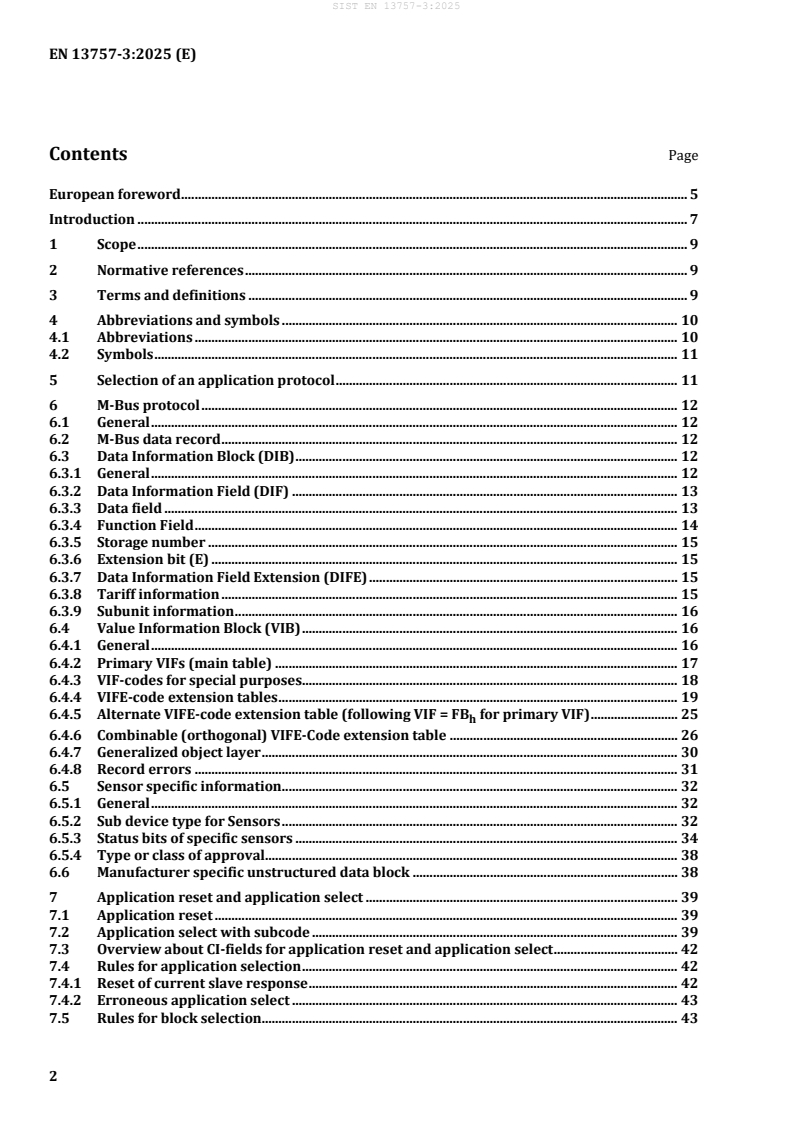
Contents Page
European foreword . 5
Introduction . 7
1 Scope . 9
2 Normative references . 9
3 Terms and definitions . 9
4 Abbreviations and symbols . 10
4.1 Abbreviations . 10
4.2 Symbols . 11
5 Selection of an application protocol . 11
6 M-Bus protocol . 12
6.1 General . 12
6.2 M-Bus data record . 12
6.3 Data Information Block (DIB) . 12
6.3.1 General . 12
6.3.2 Data Information Field (DIF) . 13
6.3.3 Data field . 13
6.3.4 Function Field . 14
6.3.5 Storage number . 15
6.3.6 Extension bit (E) . 15
6.3.7 Data Information Field Extension (DIFE) . 15
6.3.8 Tariff information . 15
6.3.9 Subunit information . 16
6.4 Value Information Block (VIB) . 16
6.4.1 General . 16
6.4.2 Primary VIFs (main table) . 17
6.4.3 VIF-codes for special purposes. 18
6.4.4 VIFE-code extension tables . 19
6.4.5 Alternate VIFE-code extension table (following VIF = FB for primary VIF) . 25
h
6.4.6 Combinable (orthogonal) VIFE-Code extension table . 26
6.4.7 Generalized object layer . 30
6.4.8 Record errors . 31
6.5 Sensor specific information . 32
6.5.1 General . 32
6.5.2 Sub device type for Sensors . 32
6.5.3 Status bits of specific sensors . 34
6.5.4 Type or class of approval . 38
6.6 Manufacturer specific unstructured data block . 38
7 Application reset and application select . 39
7.1 Application reset . 39
7.2 Application select with subcode . 39
7.3 Overview about CI-fields for application reset and application select . 42
7.4 Rules for application selection . 42
7.4.1 Reset of current slave response . 42
7.4.2 Erroneous application select . 43
7.5 Rules for block selection. 43
7.6 Selected application block in M-Bus application protocol . 43
8 Clock synchronization . 43
9 Report of alarm status (slave to master) . 44
10 Report of application error . 44
10.1 General . 44
10.2 Status field . 44
10.3 General application layer errors . 44
11 Switching baud rate for M-Bus link layer according to EN 13757-2 . 46
12 Synchronize action . 46
13 Manufacturer specific protocols . 46
14 Other application protocols . 46
15 Image Transfer . 47
Annex A (normative) Coding of data records . 48
Annex B (normative) Interpretation of hex-codes A –F in BCD-data fields . 56
h h
B.1 General description standard reference . 56
B.2 Definition . 56
Annex C (normative) VIF coding for special units . 57
C.1 Non-metric units . 57
C.2 Plain text units . 57
C.3 Remote enablement/disablement of valve/breaker . 58
Annex D (informative) Alarm protocol . 59
D.1 M-Bus according to EN 13757-2 . 59
D.2 Wireless M-Bus according to EN 13757-4 . 59
Annex E (informative) Special sequences for M-Bus devices . 60
E.1 VIF/VIFE/VIFE = FD 97 1D (error flag) . 60
h h h
E.2 VIF/VIFE/VIFE = FD 9F 1D for passing remote control on a node . 62
h h h
E.3 Clock synchronization . 63
Annex F (normative) Transmission of profiles . 66
F.1 The standard load profile . 66
F.2 The M-Bus compact profile . 67
Annex G (normative) Compact M-Bus frame . 72
G.1 General . 72
G.2 CI-fields of the Full and the Compact M-Bus frame . 72
G.3 Calculation of the Full-Frame-CRC . 74
G.4 Calculation of the Format Signature . 74
G.5 Frame examples . 75
Annex H (normative) Translating M-Bus type record descriptors to OBIS-type record
descriptors . 77
H.1 General . 77
H.2 Translation of predefined data record types . 77
H.3 Online addition of an entry for the M-Bus to OBIS conversion table . 95
Annex I (normative) Image Transfer . 96
I.1 Image Transfer phases . 96
I.2 Commands for Image Transfer . 99
I.3 Overview Image Transfer . 116
Annex J (informative) Example for electrical phase angles . 118
J.1 Phase angle between UL1 and UL2, UL3 . 118
J.2 Phase angle between UL1 and IL1 . 118
Bibliography . 120
European foreword
This document (EN 13757-3:2025) has been prepared by Technical Committee CEN/TC 294
“Communication systems for meters”, the secretariat of which is held by DIN.
This European Standard shall be given the status of a national standard, either by publication of an
identical text or by endorsement, at the latest by October 2025, and conflicting national standards shall
be withdrawn at the latest by October 2025.
This document supersedes EN 13757-3:2018.
— support of sensor devices and alarm devices in new subclause 6.5 and Table 13;
— change of device type codes for thermal energy meters (heat and cooling);
— addition of a new Table 14 - Bit field definition of “Installation conditions”;
— marking of unused VIF/VIFE in Table 10 and Table 12 as deprecated;
— extension of the coding of message application in Table 26;
— addition of alternative non-metric units in Annex C;
— revision of the clock synchronisation protocol in Clause E.3.
EN 13757 is currently composed with the following parts:
— Communication systems for meters — Part 1: Data exchange;
— Communication systems for meters — Part 2: Wired M-Bus communication;
— Communication systems for meters — Part 3: Application protocols;
— Communication systems for meters — Part 4: Wireless M-Bus communication;
— Communication systems for meters — Part 5: Wireless M-Bus relaying;
— Communication systems for meters — Part 7: Transport and security services;
— Communication systems for meters — Part 8: Adaptation Layer;
— CEN/TR 17167, Communication systems for meters — Accompanying TR to EN 13757-2, -3 and -7,
Examples and supplementary information.
This document has been prepared under a standardization request addressed to CEN by the European
Commission. The Standing Committee of the EFTA States subsequently approves these requests for its
Member States.
This document falls under Mandate EU M/441 “Standardisation mandate to CEN, CENELEC and ETSI in
the field of measuring instruments for the development of an open architecture for utility meters
involving communication protocols enabling interoperability” by providing the relevant definitions and
methods for meter data transmission on application layer level. The M/441 Mandate is driving significant
development of standards in smart metering.
Any feedback and questions on this document should be directed to the users’ national standards body.
A complete listing of these bodies can be found on the CEN website.
According to the CEN-CENELEC Internal Regulations, the national standards organisations of the
following countries are bound to implement this European Standard: Austria, Belgium, Bulgaria, Croatia,
Cyprus, Czech Republic, Denmark, Estonia, Finland, France, Germany, Greece, Hungary, Iceland, Ireland,
Italy, Latvia, Lithuania, Luxembourg, Malta, Netherlands, Norway, Poland, Portugal, Republic of North
Macedonia, Romania, Serbia, Slovakia, Slovenia, Spain, Sweden, Switzerland, Türkiye and the United
Kingdom.
Introduction
This document belongs to the EN 13757 series, which covers communication systems for meters.
EN 13757-1 contains generic descriptions and a communication protocol. EN 13757-2 contains a
physical and a link layer for twisted pair based Meter-Bus (M-Bus). EN 13757-4 specifies wireless
communication (often called wireless M-Bus or wM-Bus). EN 13757-5 specifies the wireless network
used for repeating, relaying and routing for the different modes of EN 13757-4. EN 13757-7 specifies
transport mechanism and security methods for data. The Technical Report CEN/TR 17167 contains
informative annexes for EN 13757-2, EN 13757-3 and EN 13757-7.
These upper M-Bus protocol layers can be used with various Physical Layers and with Data Link Layers
and Network Layers, which support the transmission of variable length binary transparent messages.
Frequently, the Physical and Link Layers of EN 13757-2 (twisted pair) and EN 13757-4 (wireless) as well
as EN 13757-5 (wireless with routing function) or the alternatives specified in EN 13757-1 are used.
These upper M-Bus protocol layers have been optimized for minimum battery consumption of meters,
especially for the case of wireless communication, to ensure long battery lifetimes of the meters.
Secondly, it is optimized for minimum message length to minimize the wireless channel occupancy and
hence the collision rate. Thirdly, it is optimized for minimum requirements towards the meter processor
regarding requirements of RAM size, code length and computational power.
An overview of communication systems for meters is given in EN 13757-1, which also contains further
definitions.
This document concentrates on the meter communication. The meter communicates with one (or
occasionally several) fixed or mobile communication partners which again might be part of a private or
public network. These further communication systems might use the same or other application layer
protocols, security, privacy, authentication, and management methods.
To facilitate common communication systems for CEN meters (e.g. gas, water, thermal energy and heat
cost allocators) and for electricity meters, in this document occasionally electricity meters are mentioned.
All these references are for information only and are not standard requirements. The specification of
communication standards for electricity meters (possibly by a reference to CEN standards) remains
solely in the responsibility of CENELEC.
NOTE 1 CEN/TR 17167:2023, Annex C specifies how parts of this document and of EN 13757-2 and EN 13757-4
can be used to implement smart meter functionalities. Similar functionalities could also be implemented using other
physical and link layers.
NOTE 2 For information on installation procedures and their integration in meter management systems, see
CEN/TR 17167:2023, Annex D.
The European Committee for Standardization (CEN) draws attention to the fact that it is claimed that
compliance with this document may involve the use of a patent concerning Image Transfer given in
Annex I and which is claimed to be relevant for the following clause(s) of this document: Clause 15.
CEN takes no position concerning the evidence, validity and scope of this patent right. The holder of this
patent right has ensured CEN that they are willing to negotiate licences under reasonable and non-
discriminatory terms and conditions with applicants throughout the world. In this respect, the statement
of the holder of this patent right is registered with CEN. Information may be obtained from:
ITRON, INC
Shig Furukawa, Associate General Counsel IP, Legal Department
2111 N. Molter Road
Liberty Lake, Washington 99019
USA
Attention is drawn to the possibility that some of the elements of this document may be the subject of
patent rights other than those identified above. CEN shall not be held responsible for identifying any or
all such patent rights.
1 Scope
This document specifies application services for communication systems for meters, sensors, and
actuators, used to provide metering services.
This document specifies application protocols, especially the M-Bus application protocol.
This document is intended to be used with the lower layer specifications determined in the relevant parts
of the EN 13757 series.
2 Normative references
The following documents are referred to in the text in such a way that some or all of their content
constitutes requirements of this document. For dated references, only the edition cited applies. For
undated references, the latest edition of the referenced document (including any amendments) applies.
EN 13757-2, Communication systems for meters — Part 2: Wired M-Bus communication
EN 13757-7:2025, Communication systems for meters — Part 7: Transport and security services
ISO/IEC 8859-1, Information technology — 8-bit single-byte coded graphic character sets — Part 1: Latin
alphabet No. 1
ISO/IEC 60559:2020, Information technology — Microprocessor Systems — Floating-Point arithmetic
3 Terms and definitions
For the purposes of this document, the following terms and definitions apply.
ISO and IEC maintain terminology databases for use in standardization at the following addresses:
— ISO Online browsing platform: available at https://www.iso.org/obp/
— IEC Electropedia: available at https://www.electropedia.org/
3.1
byte
octet of bits
3.2
datagram
unit of data transferred from source to destination
Note 1 to entry: In previous versions of EN 13757-3 datagram was called telegram.
3.3
fragment
datagram of a fragmented message
3.4
final DIFE
additional last DIFE with the value 00h that marks a storage number as a register number
3.5
hex-ASCII
base-16 numbers encoded as ASCII characters (‘0’–‘9’, ‘A’–‘F’)
[SOURCE: ANSI X9 TR-31:2010]
3.6
message
functional set of data transferred from source to destination
Note 1 to entry: A message can consist of one or more datagrams.
3.7
meter
measuring device for water or energy consumption, including sensors or actuators used to provide
metering services
Note 1 to entry: Meter is in general understood as including metrological devices, sensors, and actuators.
Note 2 to entry: Combination of the term meter in combination with “electricity”, “water”, “gas”, “thermal energy”,
“heat/cooling” is to be considered as a metrological device.
3.8
metrological device
measuring device for water or energy consumption, excluding sensors or actuators used to provide
metering services
EXAMPLES electricity meter, water meter, gas meter, thermal energy meter, heat cost allocator
3.9
register number
number of a predefined historical value register (like consumption value) corresponding to an OBIS value
group F value
3.10
sublayer
subdivision of a layer
[SOURCE: ISO/IEC 7498-1:1994, 5.2.1.4]
4 Abbreviations and symbols
4.1 Abbreviations
ACK Acknowledge
AES Advanced Encryption Standard
AFL Authentication and Fragmentation Sublayer
APL Application Layer
ASCII American Standard Code for Information Interchange
BCD Binary Coded Decimal numbers
CI Control Information field
CMD Command
FCB Frame count bit (see EN 13757-2)
FCV Frame count valid bit (see EN 13757-2)
DIB Data Information Block
DIF Data Information Field
DIFE Data Information Field Extensions
DLMS Device Language Message Specification
DRH Data Record Header
E Extension bit
LSB Least Significant Byte
LSBit Least Significant Bit
MDH Manufacturer Data Header
MSB Most Significant Byte
MSBit Most Significant Bit
OBIS Object Identification System (see EN 62056-6-1)
REQ-UD Request User Data (class 1 or 2), (see EN 13757-4)
RSP-UD Respond User Data (see EN 13757-4)
RSSI Received Signal Strength Indicator
SND-NKE Send Link Reset (see EN 13757-4)
SND-UD Send User Data (see EN 13757-4)
SND-UD2 Send User Data 2 (see EN 13757-4)
TPL Transport Layer
VIB Value Information Block
VIF Value Information Field
VIFE Value Information Field Extensions
4.2 Symbols
Hexadecimal numbers are designated by a following “ ”.
h
Binary numbers are designated by a following “ ”.
b
Decimal numbers have no suffix.
5 Selection of an application protocol
This document supports several application protocols. A specific protocol shall be chosen accordingly to
the selected CI-Field specified in EN 13757-7:2025, 5.2. Beside the M-Bus protocol there are specific
protocols specified in the following clauses. Further application protocols applying DLMS/COSEM or M-
Bus based usage of OBIS-type value descriptors are referenced in EN 13757-7:2025, Table 2. Annex H
specifies translation from M-Bus type record descriptors to OBIS-type record descriptors.
The support for the different commands or protocols declared by the CI-field is optional in the meter.
6 M-Bus protocol
6.1 General
The application data, together with information regarding coding, length and the type of data, is
transmitted in data records in arbitrary sequence.
The M-Bus Application Layer data may consist of two segments of data. The first segment holds M-Bus
data records (see 6.2). The second, optional segment, holds manufacturer specific data. (see Table 1).
Table 1 — Structure of an M-Bus APL with manufacturer specific data
APL Variable data blocks MDH Manufacturer specific data
(Records) (optional) (optional)
Variable number 1 byte Variable number
A Manufacturer Data Header (MDH) shall be inserted before the manufacturer specific data. The MDH is
one of the characters 0F or 1F . The MDH 0F shall be omitted if there is no manufacturer specific data
h h h
(see 6.6).
Unencrypted data following encrypted data shall start at a data record boundary, i.e. the first byte of
unencrypted data shall be interpreted as a DIF.
Special data structures are specified in Annex F and in Annex G.
If nothing other declared, then multi byte fields shall be transmitted with least significant byte first (little
endian).
6.2 M-Bus data record
The structure of an M-Bus data record is shown in Table 2. The transmission order of the element is from
left to right.
Table 2 — Data record structure
DIF DIFE VIF VIFE Data
1 byte 0 to 10 (1 byte each) 1 byte 0 to 10 (1 byte each) 0 to N bytes
Data Information Block (DIB) Value Information Block (VIB)
Data Record Header (DRH)
Each data record consists of a Data Record Header (DRH) and the value (data). The DRH consists of a Data
Information Block (DIB) and a Value Information Block (VIB). The DIB specifies the length, type and
coding of the data. The VIB specifies the unit for the data and the multiplier to use.
NOTE An application message can contain either just a single data record but also an arbitrary number of such
data records in arbitrary order, each describing and containing a data element. For examples of such multi record
messages see CEN/TR 17167:2023, Annex A, or for further information on M-Bus see CEN/TR 17167:2023,
Annex C.
6.3 Data Information Block (DIB)
6.3.1 General
The DIB contains at least one byte of Data Information Field (DIF) and can be extended by a maximum of
10 Data Information Field Extensions (DIFE).
6.3.2 Data Information Field (DIF)
The coding of the DIF is shown in Table 3.
Table 3 — Data Information Field (DIF)
Bit 7 6 5 4 3 2 1 0
Extension bit Data field:
LSBit of storage
Function Field
number
(E) Length and coding of data
6.3.3 Data field
The data field shows how length and coding of data shall be interpreted. Table 4 shows the allowed codes
for the data field.
Table 4 — Coding of the data field
Code Length in bit Data type
0 No data
b
8 8 bit integer/binary
b
16 16 bit integer/binary
b
24 24 bit integer/binary
b
32 32 bit integer/binary
b
32 32 bit real
b
48 48 bit integer/binary
b
64 64 bit integer/binary
b
0 Selection for readout
b
8 2 digit BCD
b
16 4 digit BCD
b
24 6 digit BCD
b
32 8 digit BCD
b
N Variable length
b
48 12 digit BCD
b
— Special functions
b
For a detailed description of data types, refer to Annex A (e.g. BCD = type A, Real = type H). The coding as
integer/binary by default implies coding type B (signed integer). The coding may however be overridden
by the settings in VIF/VIFE of the record (e.g. date/time).
Variable length:
A Code of 1101 implies data with variable length. The length is coded in the first byte of the data, after
b
the DRH and is named LVAR. (e.g. LVAR = 02 shows that two bytes of data follows.)
h
If LVAR is used as the variable length of a wireless M-Bus data container (see CEN/TR 17167:2023,
Annex F) it counts the number of bytes inside the container (see Table 5).
Table 5 — LVAR interpretation
Range Data Type Calculation
8-bit text string according to
a
00 –BF
LVAR (0 to 191) characters
h h
ISO/IEC 8859-1
C0 –C9
Positive BCD number (LVAR–C0h)*2 digits, 0 to 18 digits
h h
D0 –D9
Negative BCD number (LVAR–D0h)*2 digits, 0 to 18 digits
h h
E0 –EF
Binary number (LVAR–E0h) bytes, 0 to 15 bytes
h h
F0 –F4
Binary number 4*(LVAR–ECh) bytes, 16, 20, 24, 28, 32 bytes
h h
F5
Binary number 48 bytes
h
F6
Binary number 64 bytes
h
Others LVAR values Reserved
a
If a wireless M-Bus data container is used it counts the number of bytes inside the container (see also Table 12, Footnote f).
All multi byte fields following LVAR (according to Table 5) shall be transmitted with Least Significant
Byte first.
A Code of 1111 implies coding for special functions as specified in Table 6.
b
Table 6 — DIF-coding for special functions
DIF Function
0F
Start of manufacturer specific data structures to end of user data (see 6.6)
h
1F Same meaning as DIF = 0F + more records follow in next datagram (see 6.6)
h h
2F
Idle filler (not to be interpreted), following byte = DIF of next record
h
3F to 6F
Reserved
h h
7F
Global readout request (all storage numbers, units, tariffs, Function Fields)
h
6.3.4 Function Field
The Function Field gives the type of value as specified in Table 7.
Table 7 — Function Field
Code Description
Instantaneous value
b
Maximum value
b
Minimum value
b
Value during error state
b
6.3.5 Storage number
Bit 6 of the DIF serves as the LSBit of the storage number of the data concerned, and the slave can in this
way indicate and transmit various stored or historical values of the metrological device. This bit is the
least significant bit of the storage number and allows therefore the storage numbers 0 and 1 to be coded.
If storage numbers higher than “1” are needed, following (optional) DIFE´s contain the higher bits. The
storage number 0 signals a current value.
Each storage number is associated with a dedicated time point. Each data record with the same storage
number refers the value to this (common) time point given by this storage number. A time/date record
for each storage number can be included somewhere in the message to signal this time point associated
with this storage number. This date or date/time is coded with a data record with a VIF = E110110n .
b
Normally (but not necessarily) higher storage numbers indicate an older time point. A sequential block
of storage numbers can be associated with a sequence of equidistantly spaced time points (profile). Such
a block can be specified by its starting time, the time spacing, the first storage number (of such a block)
and the length of the block. For an example see Annex F.
Some metrological devices require the assignment of historical values (like consumption values) to
register numbers that are represented by OBIS value group F values. In this case the storage number is
used to indicate the register number while the DIB shall be extended by a Final DIFE with the value 00h
in order to mark the storage number as a register number. Register numbers up to 125 can be coded in
this way (see Clause H.2).
6.3.6 Extension bit (E)
Bit 7, the Extension bit of the DIF, indicates when set, that additional data description follows in one or
more Data Field Extension, DIFE, bytes.
6.3.7 Data Information Field Extension (DIFE)
There may be up to 10 successive DIFE bytes. The coding of the DIFE is shown in Table 8. Bit 7 (E) of a
DIFE byte shows whether a further DIFE byte follows. Bit 6 is a part of the numbering of subunits. Bit 5
and 4 is a part of the numbering of the Tariff and bits 3 through 0 are a part of the Storage number. The
full Storage number/Tariff/Subunit number is made up of a concatenation of the information from all of
the DIFE’s for a parameter.
Table 8 — Coding of the Data Information Field Extension (DIFE)
Bit 7 6 5 4 3 2 1 0
Extension Bit
(Device)
Value Tariff Storage number
Subunit
(E)
With the maximum of 10 DIFEs, which are provided, there are 41 bits for the storage number, 20 bits for
the tariff and 10 bits for the subunit of the meter. There is no application conceivable in which this
immense number of bits could all be used.
The use of the Final DIFE is explained in 6.3.5.
6.3.8 Tariff information
For each (unique) value type designation given by the following VIB at each unique time point (given by
the storage number) of each unique function (given by the Function Field), there might exist still various
different data, measured or accumulated under different conditions. Such conditions could be time of day,
various value ranges of the variable (i.e. separate storage of positive accumulated values and negative
accumulated values) itself or of other signals or variables or various averaging durations. Such variables,
which could not be distinguished otherwise, are made different by assigning them different values of the
tariff variable in their data information block.
NOTE This includes but is not necessarily restricted to various tariffs in a monetary sense. It is at the distinction
of the manufacturer to specify for each tariff (except 0) what is different for each tariff number. Again, as with the
storage numbers, all variables with the same tariff information share the same tariff associating condition.
6.3.9 Subunit information
A device (meter) may consist of several functionally/logically independent subunits. Such a device may
either use multiple different primary/secondary addresses or use the subunit information in the DIFE’s
to address independent subunits. The use of multiple addresses is recommended for collections of
physically independent devices. Devices, that share common information, but have different logical
entities, are recommended to use a single address and to differentiate between the different entities using
the subunit information.
6.4 Value Information Block (VIB)
6.4.1 General
A DIB will, with the exception of the special values given in Table 6, be followed by a VIB. The VIB consists
of a Value Information Field (VIF) byte and zero or more (up to 10) Value Information Field Extension
(VIFE) bytes. VIF/VIFE use the same extension mechanism as specified for DIF and DIFE (see 6.3.6 and
6.3.7). The basic coding of the VIF is shown in Table 9.
Table 9 — Coding of the Value Information Field (VIF)
Bit 7 6 5 4 3 2 1 0
Extension Bit
Value Unit and multiplier (value)
(E)
There are five types of coding depending on the VIF:
a) Primary VIF: E000 0000 to E111 1010
b b
The unit and multiplier are taken from Table 10.
b) Plain-text VIF: E111 1100
b
In case of VIF = 7C /FC , the true VIF is represented by the following ASCII string with the length
h h
given in the first byte.
Clause C.2 shows an example for a plain text VIF.
c) Linear VIF-extension: FD and FB
h h
In case of VIF = FD and VIF = FB (see Table 11) the true VIF is given by the next byte (i.e. the first
h h
VIFE) and the coding is taken from Table 12 and Table 15, respectively. This extends the available
VIFs by another 256 codes.
d) Any VIF: 7E /FE
h h
This VIF-Code can be used in direction master to slave for readout selection of all VIFs. See special
function in 6.3.3.
e) Manufacturer specific: 7F /FF
h h
In this case, the remainder of this data record including VIFEs has manufacturer specific coding.
6.4.2 Primary VIFs (main table)
The first section of the main table contains integral values, the second typically averaged values, the third
typically instantaneous values and the fourth block contains parameters (E: extension bit).
Table 10 — Primary VIF-codes
Coding Description Range coding Range
(nnn–3)
E000 0nnn Energy 10 Wh 0,001 Wh to 10 000 Wh
(nnn)
E000 1nnn Energy
10 J 0,001 kJ to 10 000 kJ
a (nnn–6) 3
E001 0nnn 0,001 l to 10 000 l
Volume 10 m
(nnn–3)
E001 1nnn Mass 10 kg 0,001 kg to 10 000 kg
d
E010 00nn On time Duration of meter power up
nn
d
E010 01nn Operating time nn Duration of meter accumulation
(nnn–3)
E010 1nnn Power 0,001 W to 10 000 W
10 W
(nnn)
E011 0nnn Power 10 J/h 0,001 kJ/h to 10 000 kJ/h
(nnn–6) 3
E011 1nnn Volume flow 0,001 l/h to 10 000 l/h
10 m /h
(nnn–7) 3
E100 0nnn Volume flow ext. 0,000 1l/min to 1 000 l/min
10 m /min
Deprecated (formerly Volume flow
(nnn–9) 3
E100 1nnn 10 m /s 0,001 ml/s to 10 000ml/s
ext.)
(nnn–3)
E101 0nnn Deprecated (formerly Mass flow) 10 kg/h 0,001 kg/h to 10 000 kg/h
(nn–3)
E101 10nn Flow temperature 0,001 °C to 1 °C
10 °C
(nn–3)
E101 11nn Return temperature 10 °C 0,001 °C to 1 °C
(nn–3)
E110 00nn Temperature difference 1 mK to 1 000 mK
10 K
(nn–3)
E110 01nn External temperature 0,001 °C to 1 °C
10 °C
(nn–3)
E110 10nn Pressure 10 bar 1 mbar to 1 000 mbar
Date (actual or associated with a
c
Data field = 0010 , type G
E110 1100 YYYY-MM-DD
b
storage number/function)
Date and Time (actual or associated
b c
Data field = 0100 , type F
E110 1101 YYYY-MM-DD hh-mm
b
with a storage number/function)
Time (actual or associated with a
b c
Data field = 0011 , type J
E110 1101 hh:mm:ss
b
storage number/function)
Date and Time (actual or associated
b c
Data field = 0110 , type I
E110 1101 YYYY-MM-DD hh:mm:ss
b
with a storage number/function)
YYYY-MM-DD
Date and Time or duration (actual c
hh:mm:ss,ppppp
b
Data field = 1101 , type M
or associated with a storage
E110 1101
b
Or
number/function)
c
ssssssssss,ppppp
E110 1110 Units for HCA Dimensionless
Coding Description Range coding Range
Reserved for a future third table of
E110 1111
VIF-extensions
d
E111 00nn Averaging duration
nn
d
E111 01nn Actuality duration nn
E111 1000 Fabrication no See CEN/TR 17167:2023, A.8
E111 1001 (Enhanced) identification
For EN 13757-2: data field
0001 (1 byte link layer
b
address, data type C)
E111 1010 Address
For EN 13757-4: data field
0110 (6 byte header-ID) or
b
0111 (full 8 byte header)
b
a
For gas it is the temperature converted volume, unless a VIFE signals volume at metering-conditions or volume at base
conditions.
b
Meaning depends on data field. Other data fields shall be handled as invalid.
c
YYYY – year
MM – month
DD – day
hh – hour
mm – mi
...