

FprEN 889
(Main)Chemicals used for treatment of water intended for human consumption - Iron (II) sulfate
- Abstract
This document is applicable to iron (II) sulfate heptahydrate and iron (II) sulfate monohydrate used for treatment of water intended for human consumption. It describes the characteristics of iron (II) sulfate heptahydrate and monohydrate, specifies the requirements and the corresponding analytical methods and gives information on their use in water treatment. It also specifies the rules relating to safe handling (Annex B) and describes the use of iron (II) sulfate (Annex A).
- Status
- Not Published
- Publication Date
- 09-Dec-2026
- Technical Committee
- CEN/TC 164 - Water supply
- Drafting Committee
- CEN/TC 164/WG 9 - Drinking water treatment
- Current Stage
- 5060 - Closure of Vote - Formal Approval
- Start Date
- 15-Oct-2026
- Due Date
- 12-Jan-2027
- Completion Date
- 15-Oct-2026

FprEN 889 is a CEN draft European Standard for iron (II) sulfate used in the treatment of water intended for human consumption. It specifies the characteristics, purity criteria, analytical methods, labelling, transport, storage and safety rules for iron (II) sulfate heptahydrate and iron (II) sulfate monohydrate, so users can check whether the product matches a water-treatment application.
What does FprEN 889 specify?
FprEN 889 applies to iron (II) sulfate heptahydrate and iron (II) sulfate monohydrate for treating water intended for human consumption. It also gives guidance on use in water treatment and includes separate annexes for general use information and safety rules.
The document is organized into seven clauses, followed by two annexes and a bibliography:
- Clause 1 Scope
- Clause 2 Normative references
- Clause 3 Terms and definitions
- Clause 4 Description
- Clause 5 Purity criteria
- Clause 6 Test methods
- Clause 7 Labelling - Transportation - Storage
| Annex | What it covers |
|---|---|
| Annex A | General information on iron (II) sulfate, including origin, quality and use |
| Annex B | General rules relating to safety, including first aid, spillage and fire |
The introduction also states that conformity with FprEN 889 does not by itself mean the product is accepted for use in any EU or EFTA Member State. National rules remain in force, which matters for buyers and operators who must also check local approval conditions.
What are the key requirements of FprEN 889?
FprEN 889 sets requirements for product identity, purity, testing, labelling, delivery and storage. In practice, it tells a purchaser or plant operator what the material is, how clean it must be, how to verify it, and how to handle it safely.
Product identity and forms
Clause 4 identifies three chemical names: iron (II) sulfate heptahydrate, iron (II) sulfate monohydrate and iron (II) sulfate solution. It also lists common names such as ferrous sulfate and iron vitriol, and describes the usual commercial forms.
This matters because the physical form affects dosing, storage and transport. The document distinguishes damp crystals, free-flowing crystals, dry crystals and solution, so users can order and handle the right form for the process.
Purity and product classification
Clause 5 sets minimum composition requirements for the commercial product. The heptahydrate and monohydrate forms must meet the stated minimum content for the named compound and stay close to the manufacturer's declared values.
Clause 5 also separates the product into grades and types. The grade limits manganese and insoluble matter, while the type limits trace impurities such as arsenic, cadmium, chromium, mercury, nickel, lead, antimony and selenium.
This classification is important for water-treatment work because the impurity level can affect treated water quality. A buyer can use the grade and type to compare suppliers and choose the product that fits raw water quality, dosage and site conditions.
Test methods
Clause 6 points to EN 17215 for both sampling and analyses. The standard does not set out separate in-house test procedures in the body text; instead, it relies on the analytical methods in that referenced standard.
For a laboratory or quality manager, this means the sampling and analysis route is fixed by EN 17215 when checking compliance with FprEN 889.
Delivery, labelling and storage
Clause 7 requires delivery in tankers or containers made of suitable non-corrosive materials. The delivery equipment should not previously have carried another product unless it has been cleaned and prepared, because contamination can affect purity.
Clause 7 also requires labelling to show the product name, trade name, commercial form, grade, type, net mass, supplier or manufacturer, and the statement that the product conforms to EN 889. Transport rules depend on the form: the solution is treated as a dangerous good under the listed transport systems, while the solid forms are not assigned a UN number in the text.
Storage guidance in Clause 7 is practical and specific. Damp crystals should be used quickly, free-flowing crystals need dry storage below 40 °C, monohydrate needs a dry place, and solution should be kept at ambient conditions with sufficient concentration and low pH to limit oxidation and hydrolysis.
Safety
Annex B gives the safety rules to follow in normal and emergency handling. It requires the supplier to provide current safety instructions and the user to read the safety data sheet.
The annex also covers first aid, spillage cleanup and fire response. The product is stated to be non-combustible, which helps warehouse and site safety planning.
What terms does FprEN 889 define?
FprEN 889 uses a small set of terms that matter for ordering, testing and use:
- Iron (II) sulfate heptahydrate - the hydrated solid form with seven water molecules, used where the heptahydrate product is specified.
- Iron (II) sulfate monohydrate - the hydrated solid form with one water molecule, used where the monohydrate product is specified.
- Commercial form - the physical supply form, such as damp crystals, free-flowing crystals, dry crystals or solution.
- Grade - the quality classification based mainly on manganese and insoluble matter limits.
- Type - the impurity classification based on trace elements such as arsenic, cadmium, chromium, mercury, nickel, lead, antimony and selenium.
- Primary coagulant - the use described in Annex A for water treatment, where the product helps form flocs that can be removed.
- eSDS (extended safety data sheet) - the safety document mentioned for labelling and handling information.
- RID, ADR, IMDG and IATA - the transport regimes named for rail, road, sea and air carriage of the solution form.
Who uses FprEN 889?
FprEN 889 is used by drinking water treatment operators, chemical suppliers, plant designers, quality managers and laboratories. It is also relevant to buyers who need to specify a product grade and type.
In practice, suppliers use it to describe the product correctly and label it correctly. Water utilities and treatment plants use it to select a suitable coagulant, check purity, set dosing and plan storage. Testing laboratories use it for sampling and analysis under EN 17215, while transport and logistics teams use it to judge delivery and dangerous goods handling.
What changed in FprEN 889 from the previous edition?
FprEN 889 will supersede EN 889:2023. The stated technical change is an update of the information related to limit values in Table 2 and Annex A.
Which standards are used with FprEN 889?
FprEN 889 refers to EN 17215 for the analytical methods used in sampling and analysis. That reference supplies the test methods needed to check whether the product meets the clause 5 requirements.
The bibliography also cites Directive (EU) 2020/2184 and Regulation (EC) No 1272/2008. In the document, they support the discussion of drinking water quality and classification, labelling and packaging.
What does the FprEN 889 document contain?
FprEN 889 contains product identification data, commercial forms, physical properties and chemical properties for iron (II) sulfate. It also contains purity criteria tables for grades and types, which are the core compliance checks for procurement and quality control.
The document includes a test-method clause that points to EN 17215 for sampling and analysis. It also includes a labelling, transportation and storage clause that combines packaging, marking, storage stability and incompatibility guidance.
Annex A adds practical information on origin, manufacturing process, quality of commercial product and use as a primary coagulant. It also includes tables showing the expected impact of the product on trace metals in treated water, which is useful when checking process suitability and drinking-water targets.
Annex B gives emergency handling guidance for first aid, spillage and fire. That annex is the part to use for site procedures, operator training and safety documentation.
Relations
- Effective Date
- 28-Jan-2026
- Effective Date
- 04-Dec-2024
Get Certified
Connect with accredited certification bodies for this standard

ECOCERT
Organic and sustainability certification.

Eurofins Food Testing Global
Global leader in food, environment, and pharmaceutical product testing.

Intertek Bangladesh
Intertek certification and testing services in Bangladesh.
Sponsored listings
Frequently Asked Questions
FprEN 889 is a draft published by the European Committee for Standardization (CEN). Its full title is "Chemicals used for treatment of water intended for human consumption - Iron (II) sulfate". This standard covers: This document is applicable to iron (II) sulfate heptahydrate and iron (II) sulfate monohydrate used for treatment of water intended for human consumption. It describes the characteristics of iron (II) sulfate heptahydrate and monohydrate, specifies the requirements and the corresponding analytical methods and gives information on their use in water treatment. It also specifies the rules relating to safe handling (Annex B) and describes the use of iron (II) sulfate (Annex A).
This document is applicable to iron (II) sulfate heptahydrate and iron (II) sulfate monohydrate used for treatment of water intended for human consumption. It describes the characteristics of iron (II) sulfate heptahydrate and monohydrate, specifies the requirements and the corresponding analytical methods and gives information on their use in water treatment. It also specifies the rules relating to safe handling (Annex B) and describes the use of iron (II) sulfate (Annex A).
FprEN 889 is classified under the following ICS (International Classification for Standards) categories: 71.100.80 - Chemicals for purification of water. The ICS classification helps identify the subject area and facilitates finding related standards.
FprEN 889 has the following relationships with other standards: It is inter standard links to EN ISO 17871:2020, EN 889:2023. Understanding these relationships helps ensure you are using the most current and applicable version of the standard.
FprEN 889 is available in PDF format for immediate download after purchase. The document can be added to your cart and obtained through the secure checkout process. Digital delivery ensures instant access to the complete standard document.
Standards Content (Sample)
SLOVENSKI STANDARD
oSIST prEN 889:2025
01-oktober-2025
Kemikalije, ki se uporabljajo za pripravo pitne vode - Železov (II) sulfat
Chemicals used for treatment of water intended for human consumption - Iron (II) sulfate
Produkte zur Aufbereitung von Wasser für den menschlichen Gebrauch - Eisen(II)sulfat
Produits chimiques utilisés pour le traitement de l'eau destinée à la consommation
humaine - Sulfate de fer (II)
Ta slovenski standard je istoveten z: prEN 889
ICS:
13.060.20 Pitna voda Drinking water
71.100.80 Kemikalije za čiščenje vode Chemicals for purification of
water
oSIST prEN 889:2025 en,fr,de
2003-01.Slovenski inštitut za standardizacijo. Razmnoževanje celote ali delov tega standarda ni dovoljeno.
oSIST prEN 889:2025
oSIST prEN 889:2025
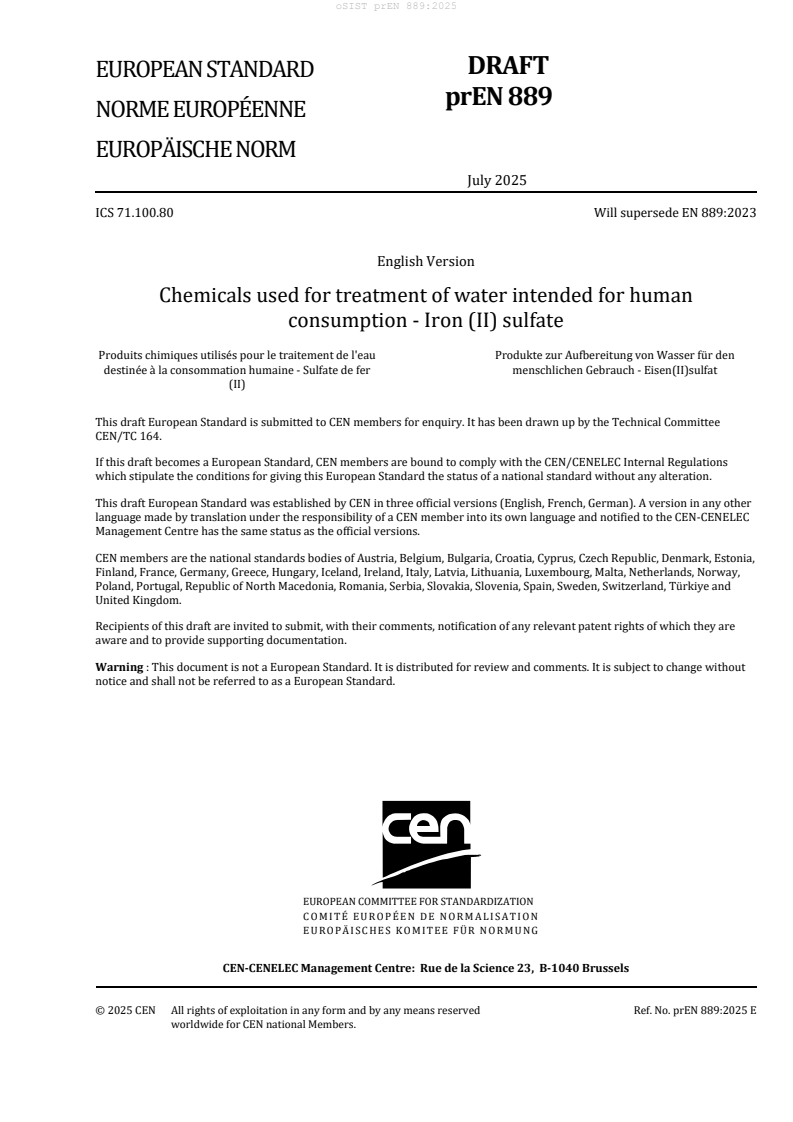
DRAFT
EUROPEAN STANDARD
prEN 889
NORME EUROPÉENNE
EUROPÄISCHE NORM
July 2025
ICS 71.100.80 Will supersede EN 889:2023
English Version
Chemicals used for treatment of water intended for human
consumption - Iron (II) sulfate
Produits chimiques utilisés pour le traitement de l'eau Produkte zur Aufbereitung von Wasser für den
destinée à la consommation humaine - Sulfate de fer menschlichen Gebrauch - Eisen(II)sulfat
(II)
This draft European Standard is submitted to CEN members for enquiry. It has been drawn up by the Technical Committee
CEN/TC 164.
If this draft becomes a European Standard, CEN members are bound to comply with the CEN/CENELEC Internal Regulations
which stipulate the conditions for giving this European Standard the status of a national standard without any alteration.
This draft European Standard was established by CEN in three official versions (English, French, German). A version in any other
language made by translation under the responsibility of a CEN member into its own language and notified to the CEN-CENELEC
Management Centre has the same status as the official versions.
CEN members are the national standards bodies of Austria, Belgium, Bulgaria, Croatia, Cyprus, Czech Republic, Denmark, Estonia,
Finland, France, Germany, Greece, Hungary, Iceland, Ireland, Italy, Latvia, Lithuania, Luxembourg, Malta, Netherlands, Norway,
Poland, Portugal, Republic of North Macedonia, Romania, Serbia, Slovakia, Slovenia, Spain, Sweden, Switzerland, Türkiye and
United Kingdom.
Recipients of this draft are invited to submit, with their comments, notification of any relevant patent rights of which they are
aware and to provide supporting documentation.
Warning : This document is not a European Standard. It is distributed for review and comments. It is subject to change without
notice and shall not be referred to as a European Standard.
EUROPEAN COMMITTEE FOR STANDARDIZATION
COMITÉ EUROPÉEN DE NORMALISATION
EUROPÄISCHES KOMITEE FÜR NORMUNG
CEN-CENELEC Management Centre: Rue de la Science 23, B-1040 Brussels
© 2025 CEN All rights of exploitation in any form and by any means reserved Ref. No. prEN 889:2025 E
worldwide for CEN national Members.
oSIST prEN 889:2025
prEN 889:2025 (E)
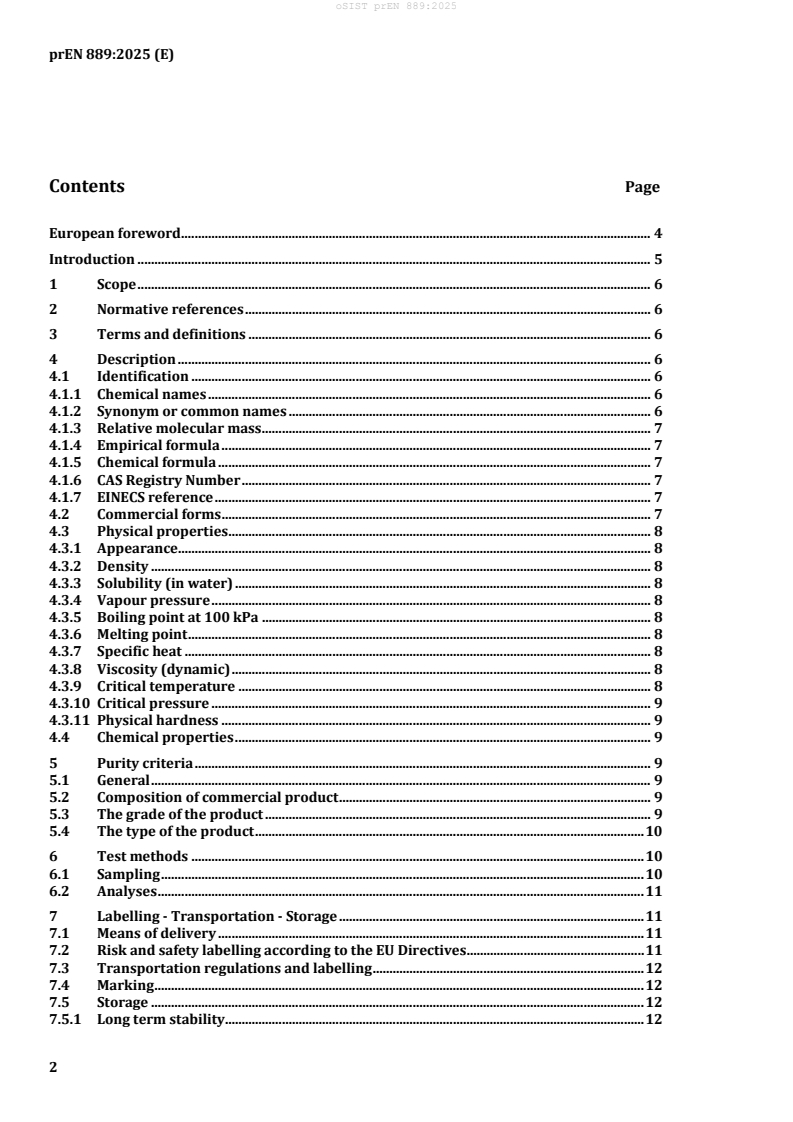
Contents Page
European foreword . 4
Introduction . 5
1 Scope . 6
2 Normative references . 6
3 Terms and definitions . 6
4 Description . 6
4.1 Identification . 6
4.1.1 Chemical names . 6
4.1.2 Synonym or common names . 6
4.1.3 Relative molecular mass . 7
4.1.4 Empirical formula . 7
4.1.5 Chemical formula . 7
4.1.6 CAS Registry Number . 7
4.1.7 EINECS reference . 7
4.2 Commercial forms . 7
4.3 Physical properties . 8
4.3.1 Appearance . 8
4.3.2 Density . 8
4.3.3 Solubility (in water) . 8
4.3.4 Vapour pressure . 8
4.3.5 Boiling point at 100 kPa . 8
4.3.6 Melting point . 8
4.3.7 Specific heat . 8
4.3.8 Viscosity (dynamic) . 8
4.3.9 Critical temperature . 8
4.3.10 Critical pressure . 9
4.3.11 Physical hardness . 9
4.4 Chemical properties . 9
5 Purity criteria . 9
5.1 General . 9
5.2 Composition of commercial product . 9
5.3 The grade of the product . 9
5.4 The type of the product . 10
6 Test methods . 10
6.1 Sampling . 10
6.2 Analyses . 11
7 Labelling - Transportation - Storage . 11
7.1 Means of delivery . 11
7.2 Risk and safety labelling according to the EU Directives . 11
7.3 Transportation regulations and labelling . 12
7.4 Marking . 12
7.5 Storage . 12
7.5.1 Long term stability . 12
oSIST prEN 889:2025
prEN 889:2025 (E)
7.5.2 Storage incompatibilities . 13
Annex A (informative) General information on iron (II) sulfate . 14
A.1 Origin . 14
A.1.1 Raw materials . 14
A.1.2 Manufacturing process . 14
A.2 Quality of commercial product . 14
A.3 Use . 16
A.3.1 Function . 16
A.3.2 Form in which it is used. 16
A.3.3 Treatment dose . 16
A.3.4 Means of application . 16
A.3.5 Secondary effects . 16
A.3.6 Removal of excess product . 17
Annex B (normative) General rules relating to safety . 18
B.1 General rules relating to safety . 18
B.2 Emergency procedures . 18
B.2.1 First aid . 18
B.2.2 Spillage . 18
B.2.3 Fire . 18
Bibliography . 19
oSIST prEN 889:2025
prEN 889:2025 (E)
European foreword
This document (prEN 889:2025) has been prepared by Technical Committee CEN/TC 164 “Water
supply”, the secretariat of which is held by AFNOR.
This document is currently submitted to the CEN Enquiry.
This document will supersede EN 889:2023.
prEN 889:2025 includes the following significant technical changes with respect to EN 889:2023:
— update of the information related to limit values in Table 2 and Annex A.
oSIST prEN 889:2025
prEN 889:2025 (E)
Introduction
In respect of potential adverse effects on the quality of water intended for human consumption, caused
by the product covered by this document:
a) this document provides no information as to whether the product may be used without restriction
in any of the Member States of the EU or EFTA;
b) it should be noted that, while awaiting the adoption of verifiable European criteria, existing
national regulations concerning the use and/or the characteristics of this product remain in force.
NOTE Conformity with this document does not confer or imply acceptance or approval of the product in any
of the Member States of the EU or EFTA. The use of the product covered by this document is subject to regulation
or control by National Authorities.
oSIST prEN 889:2025
prEN 889:2025 (E)
1 Scope
This document is applicable to iron (II) sulfate heptahydrate and iron (II) sulfate monohydrate used for
treatment of water intended for human consumption. It describes the characteristics of iron (II) sulfate
heptahydrate and monohydrate, specifies the requirements and the corresponding analytical methods
and gives information on their use in water treatment. It also determines the rules relating to safe
handling (Annex B) and use of iron (II) sulfate (Annex A).
2 Normative references
The following documents are referred to in the text in such a way that some or all of their content
constitutes requirements of this document. For dated references, only the edition cited applies. For
undated references, the latest edition of the referenced document (including any amendments) applies.
EN 17215, Chemicals used for treatment of water intended for human consumption — Iron-based
coagulants — Analytical methods
3 Terms and definitions
No terms and definitions are listed in this document.
ISO and IEC maintain terminology databases for use in standardization at the following addresses:
— ISO Online browsing platform: available at https://www.iso.org/obp
— IEC Electropedia: available at https://www.electropedia.org/
4 Description
4.1 Identification
4.1.1 Chemical names
a) Iron (II) sulfate heptahydrate
b) Iron (II) sulfate monohydrate
c) Iron (II) sulfate solution
4.1.2 Synonym or common names
a) Ferrous sulfate, iron vitriol, copperas, green salt
b) Ferrous sulfate, monohydrate
c) Ferrous sulfate, solution
oSIST prEN 889:2025
prEN 889:2025 (E)
4.1.3 Relative molecular mass
a) 278,02 g/mol
b) 169,96 g/mol
c) 151,94 g/mol
4.1.4 Empirical formula
a) FeSO ·7H O
4 2
b) FeSO ·H O
4 2
c)
...