

EN 1993-1-2:2024
(Main)Eurocode 3 - Design of steel structures - Part 1-2: Structural fire design
- Abstract
1.1 Scope of prEN 1993-1-2
(1) This document provides rules for the design of steel structures for the accidental situation of fire exposure. This Part of EN 1993 only identifies differences from, or supplements to, normal temperature design.
(2) This document applies to steel structures required to fulfil a loadbearing function.
(3) This document does not include rules for separating function.
(4) This document gives principles and application rules for the design of structures for specified requirements in respect of the aforementioned function and the levels of performance.
(5) This document applies to structures, or parts of structures, that are within the scope of EN 1993 1 1 and are designed accordingly.
(6) This document is intended to be used in conjunction with EN 1991-1-2, EN 1993-1-1, EN 1993 1-3, EN 1993-1-4, EN 1993-1-5, EN 1993-1-6, EN 1993-1-7, EN 1993-1-8, EN 1993-1-11, EN 1993-1-13 or EN 1993-1-14.
1.2 Assumptions
(1) Unless specifically stated, EN 1990, EN 1991(all parts) and EN 1993-1-1 apply.
(2) The design methods given in prEN 1993-1-2 are applicable if
- the execution quality is as specified in EN 1090-2 and/or EN 1090-4, and
- the construction materials and products used are as specified in prEN 1993-1-1:2020, Table 5.1 and Table 5.2 and in prEN 1993-1-3:2022, Table 5.1 and Table 5.2, or in the relevant material and product specifications.
(3) In addition to the general assumptions of EN 1990 the following assumptions apply:
- the choice of the relevant design fire scenario is made by appropriate qualified and experienced personnel, or is given by the relevant national regulation;
- any fire protection measure taken into account in the design will be adequately maintained.
- Status
- Published
- Publication Date
- 19-Mar-2024
- Technical Committee
- CEN/TC 250 - Structural Eurocodes
- Drafting Committee
- CEN/TC 250/SC 3 - Eurocode 3: Design of steel structures
- Current Stage
- 9093 - Decision to confirm - Review Enquiry
- Start Date
- 01-Oct-2026
- Completion Date
- 14-Oct-2026


Overview
EN 1993-1-2:2024 - Eurocode 3: Structural fire design provides the rules for designing steel structures for accidental fire exposure. This Part of Eurocode 3 identifies the differences from, or supplements to, normal-temperature design and applies to steel elements required to fulfil a loadbearing function. It does not cover separating functions (e.g., fire compartmentation). The standard is intended to be used together with other Eurocodes (notably EN 1991-1-2 for fire actions and EN 1993-1-1 for normal-temperature steel design) and with execution/product standards such as EN 1090-2/4.
Key topics and technical requirements
- Scope & assumptions: Applies to steel members within the scope of EN 1993‑1‑1. Design fire scenarios must be chosen by qualified personnel or follow national regulation; fire protection measures accounted for in design must be maintained.
- Design approaches: Provides simplified design methods (tabulated data, classification of cross-sections) and advanced design methods (coupled thermal and mechanical analyses). Verification can be at member, part-of-structure, or global structural levels.
- Thermal and mechanical behaviour: Defines thermal properties, temperature development, and elevated-temperature mechanical properties for structural steels, including strain-hardening (Annex A) and stainless steels (Annex C).
- Tabulated data & calculation aids: Includes tabulated design values, critical temperatures, and rules for class 4 cross-sections and effective widths.
- Special topics & annexes:
- Heat transfer to external steelwork and models for columns/beams (Annex B).
- Joints and temperature of joints in fire; bolted/welded joint behaviour; welded steel tubular joints (Annex D).
- Beams with large web openings (new Annex E).
- Material and product constraints: Nominal fire procedures apply up to steel grade S700; physically based thermal actions applicable up to S500. Execution quality per EN 1090 required.
Practical applications and users
Who uses EN 1993-1-2:2024:
- Structural and fire engineers designing steel frames, columns, beams and connections for required fire-resistance periods.
- Design offices preparing building permits and compliance documentation in CEN member countries.
- Fabricators and contractors ensuring execution quality (EN 1090) and maintenance of passive fire protection.
- Regulatory authorities and code officials applying National Annex choices (NDPs) and approving fire design strategies.
Typical uses:
- Determining required fire protection or section sizes to achieve a specified fire-resistance rating.
- Performing simplified checks for common members or advanced numerical thermal-mechanical analyses for complex structures.
- Designing stainless steel or high-strength steel members exposed to fire, and assessing joint temperatures.
Related standards
- EN 1990 (Basis of design)
- EN 1991-1-2 (Actions - structural fire design)
- EN 1993-1-1 and other EN 1993 parts (material/product rules)
- EN 1090-2 / EN 1090-4 (execution and fabrication quality)
Keywords: EN 1993-1-2:2024, Eurocode 3, structural fire design, steel structures, fire resistance, thermal analysis, simplified design methods, EN 1991-1-2, EN 1090.
Relations
- Effective Date
- 08-Apr-2024
- Effective Date
- 08-Apr-2024
- Effective Date
- 19-Jan-2023
- Effective Date
- 25-Mar-2026
- Effective Date
- 25-Mar-2026
- Refers
EN 1991-3:2026 - Eurocode 1 - Actions on structures - Part 3: Actions induced by cranes and machines - Effective Date
- 25-Mar-2026
- Effective Date
- 25-Mar-2026
- Effective Date
- 25-Mar-2026
- Effective Date
- 25-Mar-2026
- Effective Date
- 28-Jan-2026
- Effective Date
- 28-Jan-2026
- Effective Date
- 28-Jan-2026
- Effective Date
- 28-Jan-2026
- Effective Date
- 28-Jan-2026
- Effective Date
- 28-Jan-2026
Get Certified
Connect with accredited certification bodies for this standard

DIBt (Deutsches Institut für Bautechnik)
German Institute for Building Technology.
DIN CERTCO
DIN Group product certification.

Kiwa BDA Testing
Building and construction product certification.
Sponsored listings
Frequently Asked Questions
EN 1993-1-2:2024 is a standard published by the European Committee for Standardization (CEN). Its full title is "Eurocode 3 - Design of steel structures - Part 1-2: Structural fire design". This standard covers: 1.1 Scope of prEN 1993-1-2 (1) This document provides rules for the design of steel structures for the accidental situation of fire exposure. This Part of EN 1993 only identifies differences from, or supplements to, normal temperature design. (2) This document applies to steel structures required to fulfil a loadbearing function. (3) This document does not include rules for separating function. (4) This document gives principles and application rules for the design of structures for specified requirements in respect of the aforementioned function and the levels of performance. (5) This document applies to structures, or parts of structures, that are within the scope of EN 1993 1 1 and are designed accordingly. (6) This document is intended to be used in conjunction with EN 1991-1-2, EN 1993-1-1, EN 1993 1-3, EN 1993-1-4, EN 1993-1-5, EN 1993-1-6, EN 1993-1-7, EN 1993-1-8, EN 1993-1-11, EN 1993-1-13 or EN 1993-1-14. 1.2 Assumptions (1) Unless specifically stated, EN 1990, EN 1991(all parts) and EN 1993-1-1 apply. (2) The design methods given in prEN 1993-1-2 are applicable if - the execution quality is as specified in EN 1090-2 and/or EN 1090-4, and - the construction materials and products used are as specified in prEN 1993-1-1:2020, Table 5.1 and Table 5.2 and in prEN 1993-1-3:2022, Table 5.1 and Table 5.2, or in the relevant material and product specifications. (3) In addition to the general assumptions of EN 1990 the following assumptions apply: - the choice of the relevant design fire scenario is made by appropriate qualified and experienced personnel, or is given by the relevant national regulation; - any fire protection measure taken into account in the design will be adequately maintained.
1.1 Scope of prEN 1993-1-2 (1) This document provides rules for the design of steel structures for the accidental situation of fire exposure. This Part of EN 1993 only identifies differences from, or supplements to, normal temperature design. (2) This document applies to steel structures required to fulfil a loadbearing function. (3) This document does not include rules for separating function. (4) This document gives principles and application rules for the design of structures for specified requirements in respect of the aforementioned function and the levels of performance. (5) This document applies to structures, or parts of structures, that are within the scope of EN 1993 1 1 and are designed accordingly. (6) This document is intended to be used in conjunction with EN 1991-1-2, EN 1993-1-1, EN 1993 1-3, EN 1993-1-4, EN 1993-1-5, EN 1993-1-6, EN 1993-1-7, EN 1993-1-8, EN 1993-1-11, EN 1993-1-13 or EN 1993-1-14. 1.2 Assumptions (1) Unless specifically stated, EN 1990, EN 1991(all parts) and EN 1993-1-1 apply. (2) The design methods given in prEN 1993-1-2 are applicable if - the execution quality is as specified in EN 1090-2 and/or EN 1090-4, and - the construction materials and products used are as specified in prEN 1993-1-1:2020, Table 5.1 and Table 5.2 and in prEN 1993-1-3:2022, Table 5.1 and Table 5.2, or in the relevant material and product specifications. (3) In addition to the general assumptions of EN 1990 the following assumptions apply: - the choice of the relevant design fire scenario is made by appropriate qualified and experienced personnel, or is given by the relevant national regulation; - any fire protection measure taken into account in the design will be adequately maintained.
EN 1993-1-2:2024 is classified under the following ICS (International Classification for Standards) categories: 13.220.50 - Fire-resistance of building materials and elements; 91.010.30 - Technical aspects; 91.080.13 - Steel structures. The ICS classification helps identify the subject area and facilitates finding related standards.
EN 1993-1-2:2024 has the following relationships with other standards: It is inter standard links to EN 1993-1-2:2005/AC:2005, EN 1993-1-2:2005/AC:2009, EN 1993-1-2:2005, EN 1991-1-6:2026, EN 1991-1-8:2026, EN 1991-3:2026, EN 1991-1-4:2026, EN 1991-4:2026, EN 1993-1-11:2026, EN 1991-1-6:2005, EN 1991-3:2006, EN 1991-1-4:2005/A1:2010, EN 1090-2:2018+A1:2024, EN 1993-1-3:2024, EN 1991-1-7:2025. Understanding these relationships helps ensure you are using the most current and applicable version of the standard.
EN 1993-1-2:2024 is associated with the following European legislation: EU Directives/Regulations: 305/2011; Standardization Mandates: M/515. When a standard is cited in the Official Journal of the European Union, products manufactured in conformity with it benefit from a presumption of conformity with the essential requirements of the corresponding EU directive or regulation.
EN 1993-1-2:2024 is available in PDF format for immediate download after purchase. The document can be added to your cart and obtained through the secure checkout process. Digital delivery ensures instant access to the complete standard document.
Standards Content (Sample)
SLOVENSKI STANDARD
SIST EN 1993-1-2:2024
01-julij-2024
Nadomešča:
SIST EN 1993-1-2:2005
SIST EN 1993-1-2:2005/AC:2009
Evrokod 3 - Projektiranje jeklenih konstrukcij - 1-2. del: Požarnoodporno
projektiranje
Eurocode 3 - Design of steel structures - Part 1-2: Structural fire design
Eurocode 3 - Bemessung und Konstruktion von Stahlbauten - Teil 1-2:
Tragwerksbemessung für den Brandfall
Eurocode 3 - Calcul des structures en acier - Partie 1-2 : Calcul du comportement au feu
Ta slovenski standard je istoveten z: EN 1993-1-2:2024
ICS:
13.220.50 Požarna odpornost Fire-resistance of building
gradbenih materialov in materials and elements
elementov
91.010.30 Tehnični vidiki Technical aspects
91.080.13 Jeklene konstrukcije Steel structures
SIST EN 1993-1-2:2024 en,fr,de
2003-01.Slovenski inštitut za standardizacijo. Razmnoževanje celote ali delov tega standarda ni dovoljeno.
SIST EN 1993-1-2:2024
SIST EN 1993-1-2:2024
EN 1993-1-2
EUROPEAN STANDARD
NORME EUROPÉENNE
March 2024
EUROPÄISCHE NORM
ICS 13.220.50; 91.010.30; 91.080.13 Supersedes EN 1993-1-2:2005
English Version
Eurocode 3 - Design of steel structures - Part 1-2:
Structural fire design
Eurocode 3 - Calcul des structures en acier - Partie 1-2 : Eurocode 3 - Bemessung und Konstruktion von
Calcul du comportement au feu Stahlbauten - Teil 1-2: Tragwerksbemessung für den
Brandfall
This European Standard was approved by CEN on 1 January 2024.
CEN members are bound to comply with the CEN/CENELEC Internal Regulations which stipulate the conditions for giving this
European Standard the status of a national standard without any alteration. Up-to-date lists and bibliographical references
concerning such national standards may be obtained on application to the CEN-CENELEC Management Centre or to any CEN
member.
This European Standard exists in three official versions (English, French, German). A version in any other language made by
translation under the responsibility of a CEN member into its own language and notified to the CEN-CENELEC Management
Centre has the same status as the official versions.
CEN members are the national standards bodies of Austria, Belgium, Bulgaria, Croatia, Cyprus, Czech Republic, Denmark, Estonia,
Finland, France, Germany, Greece, Hungary, Iceland, Ireland, Italy, Latvia, Lithuania, Luxembourg, Malta, Netherlands, Norway,
Poland, Portugal, Republic of North Macedonia, Romania, Serbia, Slovakia, Slovenia, Spain, Sweden, Switzerland, Türkiye and
United Kingdom.
EUROPEAN COMMITTEE FOR STANDARDIZATION
COMITÉ EUROPÉEN DE NORMALISATION
EUROPÄISCHES KOMITEE FÜR NORMUNG
CEN-CENELEC Management Centre: Rue de la Science 23, B-1040 Brussels
© 2024 CEN All rights of exploitation in any form and by any means reserved Ref. No. EN 1993-1-2:2024 E
worldwide for CEN national Members.
SIST EN 1993-1-2:2024
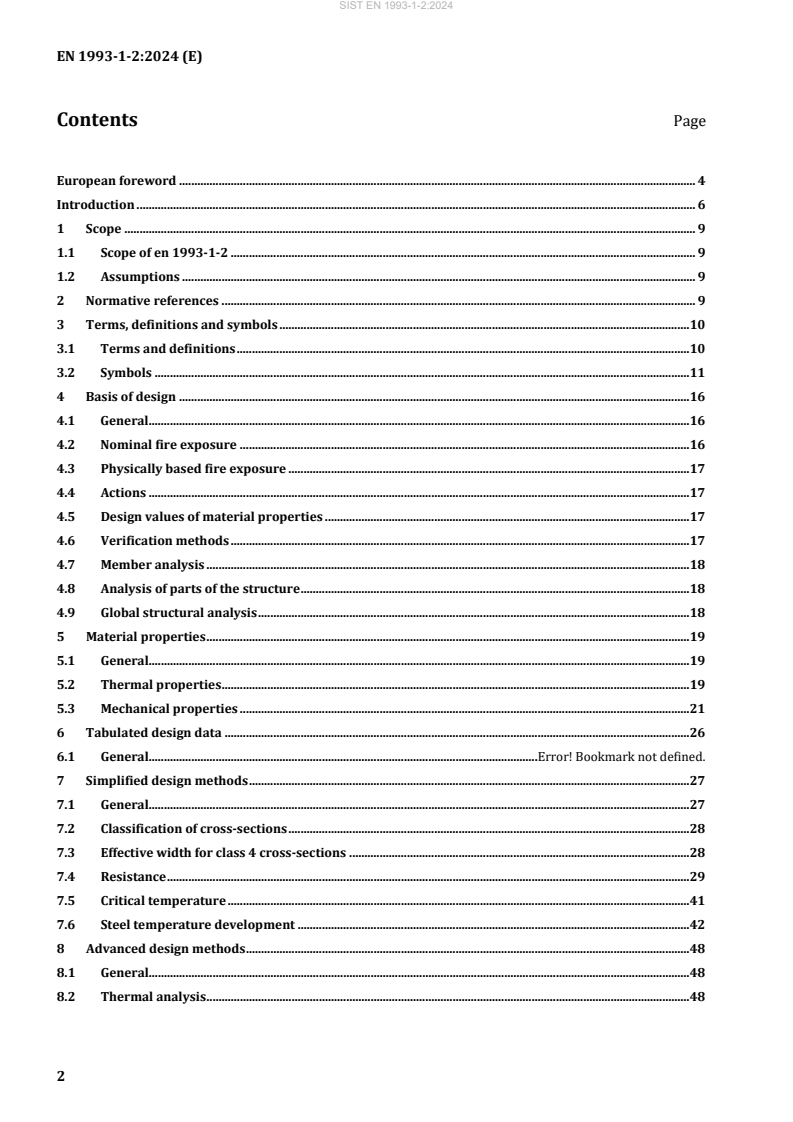
Contents Page
European foreword . 4
Introduction . 6
1 Scope . 9
1.1 Scope of en 1993-1-2 . 9
1.2 Assumptions . 9
2 Normative references . 9
3 Terms, definitions and symbols . 10
3.1 Terms and definitions . 10
3.2 Symbols . 11
4 Basis of design . 16
4.1 General. 16
4.2 Nominal fire exposure . 16
4.3 Physically based fire exposure . 17
4.4 Actions . 17
4.5 Design values of material properties . 17
4.6 Verification methods . 17
4.7 Member analysis . 18
4.8 Analysis of parts of the structure . 18
4.9 Global structural analysis . 18
5 Material properties . 19
5.1 General. 19
5.2 Thermal properties . 19
5.3 Mechanical properties . 21
6 Tabulated design data . 26
6.1 General. Error! Bookmark not defined.
7 Simplified design methods . 27
7.1 General. 27
7.2 Classification of cross-sections . 28
7.3 Effective width for class 4 cross-sections . 28
7.4 Resistance . 29
7.5 Critical temperature . 41
7.6 Steel temperature development . 42
8 Advanced design methods . 48
8.1 General. 48
8.2 Thermal analysis . 48
SIST EN 1993-1-2:2024
8.3 Mechanical analysis . 48
8.4 Validation of advanced design methods . 49
Annex A (normative) Strain-hardening of steel at elevated temperatures . 50
A.1 Use of this annex . 50
A.2 Scope and field of application . 50
A.3 Stress-strain relationships at elevated temperatures for structural steel . 50
Annex B (normative) Heat transfer to external steelwork . 52
B.1 Use of this annex . 52
B.2 Scope and field of application . 52
B.3 General . 52
B.4 Column not engulfed in flame . 56
B.5 Beam not engulfed in flame . 61
B.6 Column engulfed in flame. 65
B.7 Beam fully or partially engulfed in flame . 68
Annex C (normative) Stainless steels . 72
C.1 Use of this annex . 72
C.2 Scope and field of application . 72
C.3 Thermal properties . 72
C.4 Mechanical properties of stainless steel . 73
C.5 Simple calculation models . 78
Annex D (normative) Joints . 87
D.1 Use of this annex . 87
D.2 Scope and field of application . 87
D.3 Bolted joints . 87
D.4 Design resistance of welds . 89
D.5 Temperature of joints in fire . 90
D.6 Welded steel tubular joints . 90
Annex E (normative) Beams with large web openings . 92
E.1 Use of this annex . 92
E.2 Scope and field of application . 92
E.3 Thermal response . 92
E.4 Mechanical response . 96
Bibliography . 97
SIST EN 1993-1-2:2024
European foreword
This document (EN 1993-1-2:2024) has been prepared by Technical Committee CEN/TC 250 “Structural
Eurocodes”, the secretariat of which is held by BSI. CEN/TC 250 is responsible for all Structural
Eurocodes and has been assigned responsibility for structural and geotechnical design matters by CEN.
This European Standard shall be given the status of a national standard, either by publication of an
identical text or by endorsement, at the latest by September 2027, and conflicting national standards shall
be withdrawn at the latest by March 2028.
Attention is drawn to the possibility that some of the elements of this document may be the subject of
patent rights. CEN shall not be held responsible for identifying any or all such patent rights.
This document supersedes EN 1993-1-2:2005 and its corrigenda.
The first generation of EN Eurocodes was published between 2002 and 2007. This document forms part
of the second generation of the Eurocodes, which have been prepared under Mandate M/515 issued to
CEN by the European Commission and the European Free Trade Association.
The Eurocodes have been drafted to be used in conjunction with relevant execution, material, product
and test standards, and to identify requirements for execution, materials, products and testing that are
relied upon by the Eurocodes.
The Eurocodes recognize the responsibility of each Member State and have safeguarded their right to
determine values related to regulatory safety matters at national level through the use of National
Annexes.
The main changes compared to the previous edition are listed below:
• reduction in number of National Choices (NDPs): NDPs have reduced from 5 to 4;
• enhanced ease of use;
• new structure harmonized with fire parts of other Eurocodes;
• high strength steels: Nominal fires are applicable to steel grades up to and including S700. Physically
based thermal actions are applicable to steel grades up to and including S500;
• emissivity coefficient for hot-dip galvanized steel;
• existing buckling curve for LTB has been improved to take in to account the beneficial effect of non-
uniform bending diagrams;
• Annex C for stainless steel member has been changed with a completely new content;
• Annex D has changed the calculation of the temperature of joints in fire;
• Annex D now includes welded steel tubular joints;
• former Annex E for Class 4 cross-sections was withdrawn. New design rules for class 4 cross-sections
were included in EN 1993-1-2;
• new Annex E for beams with large web openings.
SIST EN 1993-1-2:2024
Any feedback and questions on this document should be directed to the users’ national standards body.
A complete listing of these bodies can be found on the CEN website.
According to the CEN-CENELEC Internal Regulations, the national standards organisations of the
following countries are bound to implement this European Standard: Austria, Belgium, Bulgaria, Croatia,
Cyprus, Czech Republic, Denmark, Estonia, Finland, France, Germany, Greece, Hungary, Iceland, Ireland,
Italy, Latvia, Lithuania, Luxembourg, Malta, Netherlands, Norway, Poland, Portugal, Republic of North
Macedonia, Romania, Serbia, Slovakia, Slovenia, Spain, Sweden, Switzerland, Türkiye and the United
Kingdom.
SIST EN 1993-1-2:2024
Introduction
0.1 Introduction to the Eurocodes
The Structural Eurocodes comprise the following standards generally consisting of a number of parts:
— EN 1990 Eurocode: Basis of structural and geotechnical design
— EN 1991 Eurocode 1: Actions on structures
— EN 1992 Eurocode 2: Design of concrete structures
— EN 1993 Eurocode 3: Design of steel structures
— EN 1994 Eurocode 4: Design of composite steel and concrete structures
— EN 1995 Eurocode 5: Design of timber structures
— EN 1996 Eurocode 6: Design of masonry structures
— EN 1997 Eurocode 7: Geotechnical design
— EN 1998 Eurocode 8: Design of structures for earthquake resistance
— EN 1999 Eurocode 9: Design of aluminium structures
— New parts are under development, e.g. Eurocode for design of structural glass
0.2 Introduction to EN 1993 (all parts)
EN 1993 (all parts) applies to the design of buildings and civil engineering works in steel. It complies with
the principles and requirements for the safety and serviceability of structures, the basis of their design
and verification that are given in EN 1990 – Basis of structural and geotechnical design.
EN 1993 (all parts) is concerned only with requirements for resistance, serviceability, durability and fire
resistance of steel structures. Other requirements, e.g. concerning thermal or sound insulation, are not
covered.
EN 1993 is subdivided in various parts:
EN 1993-1, Design of Steel Structures — Part 1: General rules and rules for buildings;
EN 1993-2, Design of Steel Structures — Part 2: Bridges;
EN 1993-3, Design of Steel Structures — Part 3: Towers, masts and chimneys;
EN 1993-4, Design of Steel Structures — Part 4: Silos and tanks;
EN 1993-5, Design of Steel Structures — Part 5: Piling;
EN 1993-6, Design of Steel Structures — Part 6: Crane supporting structures;
EN 1993-7, Design of steel structures — Part 7: Sandwich panels.
EN 1993-1 in itself does not exist as a physical document, but comprises the following 14 separate parts,
the basic part being EN 1993-1-1:
EN 1993-1-1, Design of Steel Structures — Part 1-1: General rules and rules for buildings;
EN 1993-1-2, Design of Steel Structures — Part 1-2: Structural fire design;
EN 1993-1-3, Design of Steel Structures — Part 1-3: Cold-formed members and sheeting;
SIST EN 1993-1-2:2024
NOTE Cold formed hollow sections supplied according to EN 10219 are covered in EN 1993-1-1.
EN 1993-1-4, Design of Steel Structures — Part 1-4: Stainless steel structures;
EN 1993-1-5, Design of Steel Structures — Part 1-5: Plated structural elements;
EN 1993-1-6, Design of Steel Structures — Part 1-6: Strength and stability of shell structures;
EN 1993-1-7, Design of Steel Structures — Part 1-7: Plate assemblies with elements under transverse loads;
EN 1993-1-8, Design of Steel Structures — Part 1-8: Joints;
EN 1993-1-9, Design of Steel Structures — Part 1-9: Fatigue;
EN 1993-1-10, Design of Steel Structures — Part 1-10: Material toughness and through-thickness
properties;
EN 1993-1-11, Design of Steel Structures — Part 1-11: Tension components;
EN 1993-1-12, Design of Steel Structures — Part 1-12: Additional rules for steel grades up to S960;
EN 1993-1-13, Design of Steel Structures — Part 1-13: Beams with large web openings;
EN 1993-1-14, Design of Steel Structures — Part 1-14: Design assisted by finite element analysis.
All subsequent parts EN 1993-1-2 to EN 1993-1-14 treat general topics that are independent from the
structural type like structural fire design, cold-formed members and sheeting, stainless steels, plated
structural elements, etc.
All subsequent parts numbered EN 1993-2 to EN 1993-7 treat topics relevant for a specific structural
type like steel bridges, towers, masts and chimneys, silos and tanks, piling, crane supporting structures,
etc. EN 1993-2 to EN 1993-7 refer to the generic rules in EN 1993-1 and supplement, modify or supersede
them, where relevant.
0.3 Introduction to EN 1993-1-2
EN 1993-1-2 describes the principles, requirements and rules for the structural design of steel buildings
exposed to fire. The focus in EN 1993-1-2 is on design methods and design rules for individual members
(beams, columns, beam-columns), joints and skeletal structures (frames) regarding resistance and
stability under fire conditions.
0.4 Verbal forms used in the Eurocodes
The verb “shall” expresses a requirement strictly to be followed and from which no deviation is permitted
in order to comply with the Eurocodes.
The verb “should” expresses a highly recommended choice or course of action. Subject to national
regulation and/or any relevant contractual provisions, alternative approaches could be used/adopted
where technically justified.
The verb “may” expresses a course of action permissible within the limits of the Eurocodes.
The verb “can” expresses possibility and capability; it is used for statements of fact and clarification of
concepts.
0.5 National Annex for EN 1993-1-2
National choice is allowed in this standard where explicitly stated within notes. National choice includes
the selection of values for Nationally Determined Parameters (NDPs).
The national standard implementing EN 1993-1-2 can have a National Annex containing all national
choices to be used for the design of buildings and civil engineering works to be constructed in the relevant
country.
When no national choice is given, the default choice given in this standard is to be used.
SIST EN 1993-1-2:2024
When no national choice is made and no default is given in this standard, the choice can be specified by a
relevant authority or, where not specified, agreed for a specific project by appropriate parties.
National choice is allowed in EN 1993-1-2 through notes to the following clauses:
4.5 (1) 4.7 (2) 7.5 (2) – 2 choices
National choice is allowed in EN 1993-1-2 on the application of the following informative annexes:
None
The National Annex can contain, directly or by reference, non-contradictory complementary information
for ease of implementation, provided it does not alter any provisions of the Eurocodes.
SIST EN 1993-1-2:2024
1 Scope
1.1 Scope of EN 1993-1-2
(1) This document provides rules for the design of steel structures for the accidental situation of fire
exposure. This Part of EN 1993 only identifies differences from, or supplements to, normal temperature
design.
(2) This document applies to steel structures required to fulfil a loadbearing function.
(3) This document does not include rules for separating function.
(4) This document gives principles and application rules for the design of structures for specified
requirements in respect of the aforementioned loadbearing function and the levels of performance.
(5) This document applies to structures, or parts of structures, that are within the scope of EN 1993-1-1
and are designed accordingly.
(6) This document is intended to be used in conjunction with EN 1991-1-2, EN 1993-1-1, EN 1993-1-3,
EN 1993-1-4, EN 1993-1-5, EN 1993-1-6, EN 1993-1-7, EN 1993-1-8, EN 1993-1-11, EN 1993-1-13 or
EN 1993-1-14.
(7) In this document, carbon steel is meant when the term steel is used. Only in Annex C stainless steel is
addressed.
1.2 Assumptions
(1) Unless specifically stated, EN 1990, EN 1991(all parts) and EN 1993-1-1 apply.
(2) The design methods given in this document are applicable if
— the execution quality is as specified in EN 1090-2 and/or EN 1090-4, and
— the construction materials and products used are as specified in EN 1993-1-1:2022, Table 5.1 and
Table 5.2 and in EN 1993-1-3:2024, Table 5.1 and Table 5.2, or in the relevant material and product
specifications.
(3) In addition to the general assumptions of EN 1990 the following assumptions apply:
— the choice of the relevant design fire scenario is made by appropriate qualified and experienced
personnel, or is given by the relevant national regulation;
— any fire protection measure taken into account in the design will be adequately maintained.
2 Normative references
The following documents are referred to in the text in such a way that some or all of their content
constitutes requirements of this document. For dated references, only the edition cited applies. For
undated references, the latest edition of the referenced document (including any amendments) applies.
NOTE See the Bibliography for a list of other documents cited that are not normative references, including
those referenced as recommendations (i.e. through ‘should’ clauses) and permissions (i.e. through ‘may’ clauses).
EN 1090-2, Execution of steel structures and aluminium structures - Part 2: Technical requirements for steel
structures
EN 1090-4, Execution of steel structures and aluminium structures - Part 4: Technical requirements for cold-
formed structural steel elements and cold-formed structures for roof, ceiling, floor and wall applications
EN 1990:2023, Eurocode - Basis of structural and geotechnical design
SIST EN 1993-1-2:2024
EN 1991 (all parts), Eurocode 1 - Actions on structures
EN 1991-1-2:2024, Eurocode 1: Actions on structures - Part 1-2: General actions - Actions on structures
exposed to fire
EN 1993-1-1:2022, Eurocode 3 - Design of steel structures - Part 1-1: General rules and rules for buildings
EN 1993-1-3:2024, Eurocode 3 - Design of steel structures - Part 1-3: General rules - Supplementary rules
for cold-formed members and sheeting
EN 1993-1-4, Eurocode 3 - Design of steel structures - Part 1-4: General rules - Supplementary rules for
stainless steels
EN 1993-1-5:2024, Eurocode 3 - Design of steel structures - Part 1-5: Plated structural elements
EN 1993-1-6, Eurocode 3 - Design of steel structures - Part 1-6: Strength and Stability of Shell Structures
EN 1993-1-7, Eurocode 3 - Design of steel structures - Part 1-7: Plated structures subject to out of plane
loading
EN 1993-1-8:2024, Eurocode 3: Design of steel structures - Part 1-8: Design of joints
EN 1993-1-11, Eurocode 3 - Design of steel structures - Part 1-11: Design of structures with tension
components
EN 1993-1-13:2024, Eurocode 3 — Design of steel structures - Part 1-13: Beams with large web openings
EN 1993-1-14, Eurocode 3 — Design of steel structures - Part 1-14: Design assisted by finite element
analysis
3 Terms, definitions and symbols
3.1 Terms and definitions
For the purposes of this document, the terms and definitions given in EN 1990, EN 1991-1-2 and the
following apply.
3.1.1
box value of section factor
ratio between the exposed surface area of a notional bounding box to the section and the volume of steel
3.1.2
critical temperature of structural steel element
temperature for a given load level, at which failure is expected to occur in a structural steel element
assuming a uniform temperature distribution
3.1.3
effective yield strength
stress level for a given temperature, at which the stress-strain relationship of steel is truncated to provide
a yield plateau
SIST EN 1993-1-2:2024
3.1.4
fire protection material
any material or combination of materials applied to a structural member for the purpose of increasing its
fire resistance
3.1.5
part of structure
isolated part of a structure with appropriate support and boundary conditions
3.1.6
section factor
ratio between the exposed surface area and the volume of steel for a steel member, or ratio between the
internal surface area of the exposed encasement and the volume of steel for an enclosed member
3.2 Symbols
For the purposes of this document, the following symbols apply.
3.2.1 Latin upper case letters
A an elemental area of the cross-section with a temperature θ ;
i a,i
A surface area exposed to fire of a member per unit length;
m
A / V section factor of unprotected steel members;
m
A appropriate area of fire protection material per unit length of the member;
p
A / V section factor for steel members insulated by fire protection material;
p
C protection coefficient of member face i;
i
Ea modulus of elasticity of steel for normal temperature design;
E slope of the linear elastic range for steel at elevated temperature θ ;
a,θ a
E design effect of actions at normal temperature, determined in accordance with
d
EN 1991-1-1;
E design effect of actions for the fire situation, determined in accordance with
d,fi
EN 1991-1-2, including the effects of thermal expansions and deformations;
E
p0,2,θ tangent modulus at f ;
p0,2,θ
F design bearing resistance per bolt according to EN 1993-1-8;
b,Rd
F design bearing resistance per bolt in the fire situation at time t;
b,Rd,fi,t
F design shear resistance per bolt per shear plane calculated assuming that the
v,Rd
shear plane passes through the threads of the bolt according to EN 1993-1-8;
F design shear resistance per bolt per shear plane in the fire situation at time t;
v,Rd,fi,t
F design resistance per unit length of a fillet weld according to EN 1993-1-8;
w,Rd
F design resistance per unit length of a fillet weld in the fire situation at time t;
w,Rd,fi,t
If radiative heat flux from an opening;
I radiative heat flux from a flame;
z
I radiative heat flux from a flame to a column face i;
z,i
L system length of a column in the relevant storey;
SIST EN 1993-1-2:2024
L length along axis between the opening and the relevant point;
i
M number of openings on side m;
M design buckling resistance moment in the fire situation at time t;
b,Rd,fi,t
M plastic moment resistance of the gross cross-section M for normal
c,Rd pl,Rd
temperature design; the elastic moment resistance of the gross cross-section
M for normal temperature design;
el,Rd
M elastic critical moment for lateral torsional buckling based on the gross cross-sectional
cr
properties, taking into account loading conditions, actual moment distribution and lateral
restraints;
M design moment resistance in the fire situation at time t;
Rd,fi,t
M design moment resistance of the cross-section for a uniform temperature θ ;
Rd,fi,θ a
N number of openings on side n;
N design buckling resistance in the fire situation at time t of a compression member;
b,Rd,fi,t
N elastic critical axial force for the relevant buckling mode based on the gross
cr
cross-sectional properties, using the buckling length under fire conditions;
N design resistance in the fire situation at time t of a tension member with a
Rd,fi,t
non-uniform temperature distribution across the cross-section;
N design resistance of a tension member with a uniform temperature θ ;
Rd,fi,θ a
N design tension resistance of the cross-section for normal temperature design, according to
t,Rd
EN 1993-1-1;
R design resistance in the fire situation at time t;
d,fi,t
R value of R for time t = 0 ;
d,fi,0 d,fi,t
T temperature of fire;
f
T temperature of the steel member;
m
T flame temperature at the opening;
o
T flame temperature at the flame tip;
x
flame temperature;
Tz
T flame temperature [K] from Annex B of EN 1991-1-2:2024, level with the bottom of
z,1
a beam;
T flame temperature from Annex B of EN 1991-1-2:2024, level with the top of
z,2
a beam;
V volume of a member per unit length;
V design value of the resistance to shear force for normal temperature design, according to
c,Rd
EN 1993-1-1;
V design shear resistance in the fire situation at time t;
Rd,fi,t
Xk characteristic value of a strength or deformation property (generally fk or Ek) for normal
temperature design to EN 1993-1-1).
SIST EN 1993-1-2:2024
3.2.2 Latin lower case letters
a absorptivity of flames;
z
c specific heat of steel;
a
c specific heat of the fire protection material;
p
d effective cross-sectional dimension;
d cross-sectional dimension of member face i;
i
d thickness of fire protection material;
p
d thickness of the fire protection material. (d = 0 for unprotected members.);
f f
f modification factor for χ ;
LT,fi
f proportional limit for steel at elevated temperature θ ;
p,θ a
f ultimate strength at elevated temperature, allowing for strain-hardening;
u,θ
f yield strength at 20 °C;
y
f effective yield strength of steel at elevated temperature θ ;
y,θ a
f nominal yield strength f for the elemental area A taken as positive on the
y,i y i
compression side of the plastic neutral axis and negative on the tension side;
h equivalent height of the opening;
eq
design value of the net heat flux per unit area;
h
net,d
hz height of the top of the flame above the bottom of the beam;
i column face indicator (1), (2), (3) or (4);
k reduction factor determined for the appropriate bolt temperature;
b, θ
k correction factor for moment distribution;
c
k reduction factor for the slope of the linear elastic range at the
E,θ
steel temperature θ reached at time t ;
a
k reduction factor for the slope of the linear elastic range at the maximum steel
E,θ,com
temperature in the compression flange θ reached at time t ;
a,com
k reduction factor for the 0,2 % proof strength at the steel
p0,2,θ
temperature θ reached at time t ;
a
k correction factor for the shadow effect;
sh
k reduction factor for the ultimate strength at the steel temperature θ reached
u,θ a
at time t ;
k relative value of a strength or deformation property of steel at elevated
θ
temperature θ ;
a
k strength reduction factor for welds at elevated temperature;
w,θ
k reduction factor for the yield strength at the steel
y,θ
temperature θ reached at time t ;
a
k reduction factor for the yield strength of steel at the maximum temperature in
y,θ,com
the compression flange θ reached at time t ;
a,com
k reduction factor for the yield strength of steel at temperature θ ;
y,θ,i i
SIST EN 1993-1-2:2024
k reduction factor for the yield strength of steel at the maximum steel
y,θ,max
temperature θ reached at time t ;
a,max
k reduction factor for the yield strength of steel at the steel temperature θ ;
y,θ,web web
k interaction factor for buckling about y-y-axis;
y
k interaction factor for buckling about z-z axis;
z
k interaction factor for lateral torsional buckling;
LT
l length at 20 °C ; a distance from an opening, measured along the flame axis;
l buckling length of a column for the fire design situation;
fi
s horizontal distance from the centreline of a column to a wall of a fire compartment;
t time in fire exposure;
w width of an opening;
i
z distance from the plastic neutral axis to the centroid of the elemental area A .
i i
3.2.3 Greek upper case letters
Δt time interval;
Δl temperature induced expansion;
Δθ increase of the steel uniform temperature distribution in a cross-section
a,t
during the time interval Δt ;
Δθ increase of the ambient gas temperature during the time interval Δt .
g,t
3.2.4 Greek lower case letters
imperfection factor for flexural buckling;
α
α convective heat transfer coefficient;
c
α imperfection factor for lateral-torsional buckling;
LT
β equivalent uniform moment factors;
M
γ partial factor for resistance of cross-sections at normal temperature;
M0
γ partial factor at normal temperature;
M2
γ partial factor for the relevant material property, for the fire situation;
M,fi
ε material parameter depending on f , at normal temperature;
y
ε emissivity of a flame; the emissivity of an opening;
f
εfi material parameter depending on fy, for the fire situation;
ε surface emissivity of the member;
m
ε emissivity of a flame;
z
ε total emissivity of the flames on side m;
z,m
ε total emissivity of the flames on side n;
z,n
ε strain at the steel temperature θ ;
θ a
η reduction factor applied to E in order to obtain E ;
fi d d,fi
θ temperature;
SIST EN 1993-1-2:2024
θ steel temperature;
a
θ critical temperature of steel;
a,cr
θ ambient gas temperature at time t ;
g,t
θ average temperature in the web of the section;
web
θ temperature in elemental area A ;
a,i i
κ adaptation factor for non-uniform temperature across the cross-section;
κ adaptation factor for non-uniform temperature along the beam;
λ thermal conductivity;
λ i flame thickness for an opening i ;
relative slenderness for flexural buckling;
λ
relative slenderness for flexural buckling at the steel temperature θ ;
a
λ
θ
relative slenderness for lateral torsional buckling;
λ
LT
relative slenderness for lateral torsional buckling at the maximum
λ
LT,θ,com
temperature in the compression flange θ ;
a,com
relative slenderness for plate buckling of plane elements at the steel temperature θ ;
a
λ
p,θ
λ thermal conductivity of the fire protection system;
p
λ effective thermal conductivity of the fire protection material;
f
μ degree of utilization at time t = 0;
σ Stefan Boltzmann constant;
σ stress at the steel temperature θ ;
θ a
ρ density of steel;
a
ρ density of the fire protection material;
p
ϕ overall configuration factor of the member for radiative heat transfer from
f
the opening;
ϕ configuration factor of member face i for an opening;
f,i
ϕ overall configuration factor of the member for radiative heat transfer from the flame;
z
ϕ configuration factor of member face i for a flame;
z,i
ϕ overall configuration factor of the column for heat from flames on side m;
z,m
ϕ overall configuration factor of the column for heat from flames on side n:
z,n
χ reduction factor for flexural buckling in the fire design situation;
fi
χ reduction factor for lateral-torsional buckling in the fire design situation;
LT,fi
χ modified reduction factor for lateral-torsional buckling;
LT,fi,mod
χ minimum value of χ and χ ;
min,fi y,fi z,fi
χ reduction factor for flexural buckling about the y-axis in the fire design
y,fi
situation;
SIST EN 1993-1-2:2024
χ reduction factor for flexural buckling about the z-axis in the fire design
z,fi
situation.
4 Basis of design
4.1 General
(1) The structural fire design shall be in accordance with the general rules given in EN 1990 and EN 1991
(all parts) and the specific design provisions for steel structures given in EN 1993-1-1, EN 1993-1-3,
EN 1993-1-4, EN 1993-1-5, EN 1993-1-6, EN 1993-1-7, EN 1993-1-8, EN 1993-1-11, EN 1993-1-13 or
EN 1993-1-14.
(2) Steel structures designed according to this document shall be executed according to EN 1090-2
and/or EN 1090-4 with construction materials and products used as specified in the relevant parts of
EN 1993, or in the relevant material and product specifications.
(3) Where mechanical resistance in the case of fire is required, steel structures shall be designed and
constructed in such a way that they maintain their loadbearing function during the relevant fire exposure.
(4) Deformation criteria shall be applied where the means of fire protection require consideration of the
deformation of the loadbearing structure.
(5) Consideration of the deformation of the loadbearing structure may be omitted when the efficiency of
the means of protection has been evaluated according to 5.2.3.
(6) Deformation criteria shall be applied where the design criteria for separating elements require taking
into account of the deformation of the loadbearing structure.
(7) Consideration of the deformation of the loadbearing structure may be omitted when the separating
elements fulfil requirements of a nominal fire exposure.
(8) Steel structures designed in accordance with EN 1993-1-1 should be considered to have sufficient
minimum robustness for the accidental fire design case. Where additional requirements are necessary
the procedures of EN 1991-1-7:— , Annex A, apply.
4.2 Nominal fire exposure
(1) For standard fire exposure, elements shall comply with the following function defined in EN 1991-1-2
during the required time of fire exposure:
— loadbearing function: loadbearing capacity (R);
— separating function: integrity (E) and, when requested, insulation (I);
— separating and loadbearing functions: R, E and, when requested, I.
NOTE 1 The loadbearing function is assumed to be satisfied when loadbearing capacity is maintained.
NOTE 2 The separating function is assumed to be satisfied when integrity and, when requested, insulation are
maintained.
NOTE 3 Integrity is assumed to be maintained when a separating element of building construction, exposed to
fire on one side, prevents the passage through it of flames and hot gases and the occurrence of flames on the
unexposed side.
Under preparation. Stage at the time of publication: prEN 1993-1-7:2023.
SIST EN 1993-1-2:2024
NOTE 4 Insulation is assumed to be maintained when the average temperature rise over the whole of the
unexposed surface is limited to 140 K, and the maximum temperature rise at any point of that surface does not
exceed 180 K.
(2) With the hydrocarbon fire exposure curve the same loadbearing capacity (R) applies, however the
reference to this specific curve shall be identified by the letters “HC”.
4.3 Physically based fire exposure
(1) The loadbearing function shall be maintained during the complete duration of the fire, including the
cooling phase or during a required period of time according to 4.4 (4) of EN 1991-1-2:2024.
4.4 Actions
(1) Thermal and mechanical actions shall be ta
...