

EN 9116:2025
(Main)Aerospace series - Notice of change (NOC)
- Abstract
1 Scope
1.1 General
The aviation, space, and defence industries rely on the development and manufacture of complex products comprised of multiple systems, subsystems, and components each designed by individual designers (design activities) at various levels within the supply chain. Each design or manufacturing activity controls various aspects of the configuration and specifications related to the product. When a change to design or process is requested or required, the change is typically required to be evaluated against the impacts to the entire system.
Proposed changes to design data/information that the design activity identifies to be minor and have no effect on the product requirements or specifications, have the potential to be implemented and approved, where authorized to do so, but requires notification. Changes that affect customer mandated requirements or specifications shall be approved prior to implementation. In many cases, the design activity is not conducted by the DAH or design authority. The design activity may be several layers below the design approval. Irrespective of where the design activity is conducted in the supply chain, notification is required. The typical change notification flow is presented in Figure 1.
[Figure 1]
Submitting NOC data either electronically or conventionally on paper is subject to the terms and conditions of the customer’s contract. This also includes, where applicable, data access under the regulations of export control.
The process of exchanging, coordinating, and approving NOC data varies with the multiple relationships and agreements among all organizations concerned. An objective of this document is to provide the definition of a data set that can be integrated into any form of communication (e.g. electronic data interchange, submission of conventional paper forms). A sample form can be found in the Supply Chain Management Handbook (SCMH).
If all or part of this document is contractually invoked, design organizations and design holders (i.e. the organization responsible for the product end item design) that have responsibility for change management of products used on other higher-level designs shall use the information and processes defined in this document for submitting change notifications.
1.2 Application
This document defines the common NOC requirements for aviation, space, and defence organizations. The requirements that a design organization are to use when submitting a NOC to the customer for either change authorization or notification are included herein. A NOC informs the customer of physical or functional (e.g. design, material, software, maintenance) changes or any associated process changes to an established baseline configuration.
Retention of the NOC establishes a means of configuration control and captures the evolution of the part. This requirement is of utmost importance in commercial/civil aviation products where changes to type certificated products are mandated by regulations; however, these same concepts are also required in defence and space applications per contractual requirements.
Where there are changes to items which the organization does not have design input or is not permitted to make any changes to the design [e.g. build to print, Technical Standard Order (TSO) articles] then change requests are to be formally submitted to the customer and approved via the customer’s change request process.
[...]
- Status
- Published
- Publication Date
- 06-May-2025
- Technical Committee
- ASD-STAN - Aerospace
- Drafting Committee
- ASD-STAN/D 6/S 1 - EAQG European Aerospace Quality Group
- Current Stage
- 6060 - Definitive text made available (DAV) - Publishing
- Start Date
- 07-May-2025
- Completion Date
- 07-May-2025

Overview
EN 9116:2025 - Aerospace series - Notice of Change (NOC) - is a CEN/IAQG standard that defines common requirements, data sets, and processes for submitting supplier change notifications across the aviation, space and defence supply chain. Published in 2025 and superseding EN 9116:2015, the standard formalizes how design and manufacturing organizations notify Design Approval Holders (DAH) and customers of physical, functional, software or process changes to a baseline configuration. EN 9116:2025 is intended for contractual invocation or use alongside EN 9100-series quality management standards.
Key topics and requirements
- Scope and application: Applies to design/manufacturing changes that impact an approved baseline configuration; excludes unmodified commercial off‑the‑shelf (COTS) items.
- Notice of Change (NOC) data set: Defines a common data definition that supports both electronic data interchange and conventional paper submissions (see Annex C and sample form in Annex D / SCMH).
- Change types and approval rules: Differentiates changes that require prior approval, those requiring customer acceptance before implementation, concurrent-notification changes, and non-configuration changes.
- Change impact analysis (CIA): Requires assessment of fit, form, function and downstream/system impacts; Annex B presents a logic tree for CIA.
- Design Approval Holder (DAH) responsibilities: Specifies requirements for performing change impact assessments, approval prerequisites, and maintaining documented information and retention of NOC records for configuration control.
- Supply chain and contractual considerations: Submitting NOC data (electronic or paper) is subject to customer contract terms and export control/regulatory access requirements.
- Quality & governance: Aligns with EN 9100-series and ISO 9000 vocabulary; mandates organizational processes to manage change notifications and approvals.
Practical applications & users
Who uses EN 9116:2025:
- Design organizations and suppliers at all tiers preparing and submitting change notifications.
- Design Approval Holders (DAH) and design authorities responsible for change authorization and system-level impact assessment.
- Quality, configuration management and engineering teams implementing change control, retention of NOC records and change impact analysis.
- Procurement and program managers ensuring contractually required change notification flows and export control compliance.
Practical benefits:
- Improves configuration control, traceability and safety through standardized NOC content.
- Reduces variability and cost across the supply chain by harmonizing change submission expectations.
- Facilitates regulatory compliance for type‑certificated and contractually governed aerospace products.
Related standards
- EN 9100 (Quality management for aviation, space and defence)
- EN 9102 (First article inspection)
- ISO 9000 (Quality management fundamentals)
- SAE EIA649 (Configuration Management Standard)
Relations
- Effective Date
- 02-Mar-2022
- Effective Date
- 09-Feb-2026
- Effective Date
- 28-Jan-2026
- Effective Date
- 28-Jan-2026
Get Certified
Connect with accredited certification bodies for this standard

BSI Group
BSI (British Standards Institution) is the business standards company that helps organizations make excellence a habit.

Bureau Veritas
Bureau Veritas is a world leader in laboratory testing, inspection and certification services.

DNV
DNV is an independent assurance and risk management provider.
Sponsored listings
Frequently Asked Questions
EN 9116:2025 is a standard published by the European Committee for Standardization (CEN). Its full title is "Aerospace series - Notice of change (NOC)". This standard covers: 1 Scope 1.1 General The aviation, space, and defence industries rely on the development and manufacture of complex products comprised of multiple systems, subsystems, and components each designed by individual designers (design activities) at various levels within the supply chain. Each design or manufacturing activity controls various aspects of the configuration and specifications related to the product. When a change to design or process is requested or required, the change is typically required to be evaluated against the impacts to the entire system. Proposed changes to design data/information that the design activity identifies to be minor and have no effect on the product requirements or specifications, have the potential to be implemented and approved, where authorized to do so, but requires notification. Changes that affect customer mandated requirements or specifications shall be approved prior to implementation. In many cases, the design activity is not conducted by the DAH or design authority. The design activity may be several layers below the design approval. Irrespective of where the design activity is conducted in the supply chain, notification is required. The typical change notification flow is presented in Figure 1. [Figure 1] Submitting NOC data either electronically or conventionally on paper is subject to the terms and conditions of the customer’s contract. This also includes, where applicable, data access under the regulations of export control. The process of exchanging, coordinating, and approving NOC data varies with the multiple relationships and agreements among all organizations concerned. An objective of this document is to provide the definition of a data set that can be integrated into any form of communication (e.g. electronic data interchange, submission of conventional paper forms). A sample form can be found in the Supply Chain Management Handbook (SCMH). If all or part of this document is contractually invoked, design organizations and design holders (i.e. the organization responsible for the product end item design) that have responsibility for change management of products used on other higher-level designs shall use the information and processes defined in this document for submitting change notifications. 1.2 Application This document defines the common NOC requirements for aviation, space, and defence organizations. The requirements that a design organization are to use when submitting a NOC to the customer for either change authorization or notification are included herein. A NOC informs the customer of physical or functional (e.g. design, material, software, maintenance) changes or any associated process changes to an established baseline configuration. Retention of the NOC establishes a means of configuration control and captures the evolution of the part. This requirement is of utmost importance in commercial/civil aviation products where changes to type certificated products are mandated by regulations; however, these same concepts are also required in defence and space applications per contractual requirements. Where there are changes to items which the organization does not have design input or is not permitted to make any changes to the design [e.g. build to print, Technical Standard Order (TSO) articles] then change requests are to be formally submitted to the customer and approved via the customer’s change request process. [...]
1 Scope 1.1 General The aviation, space, and defence industries rely on the development and manufacture of complex products comprised of multiple systems, subsystems, and components each designed by individual designers (design activities) at various levels within the supply chain. Each design or manufacturing activity controls various aspects of the configuration and specifications related to the product. When a change to design or process is requested or required, the change is typically required to be evaluated against the impacts to the entire system. Proposed changes to design data/information that the design activity identifies to be minor and have no effect on the product requirements or specifications, have the potential to be implemented and approved, where authorized to do so, but requires notification. Changes that affect customer mandated requirements or specifications shall be approved prior to implementation. In many cases, the design activity is not conducted by the DAH or design authority. The design activity may be several layers below the design approval. Irrespective of where the design activity is conducted in the supply chain, notification is required. The typical change notification flow is presented in Figure 1. [Figure 1] Submitting NOC data either electronically or conventionally on paper is subject to the terms and conditions of the customer’s contract. This also includes, where applicable, data access under the regulations of export control. The process of exchanging, coordinating, and approving NOC data varies with the multiple relationships and agreements among all organizations concerned. An objective of this document is to provide the definition of a data set that can be integrated into any form of communication (e.g. electronic data interchange, submission of conventional paper forms). A sample form can be found in the Supply Chain Management Handbook (SCMH). If all or part of this document is contractually invoked, design organizations and design holders (i.e. the organization responsible for the product end item design) that have responsibility for change management of products used on other higher-level designs shall use the information and processes defined in this document for submitting change notifications. 1.2 Application This document defines the common NOC requirements for aviation, space, and defence organizations. The requirements that a design organization are to use when submitting a NOC to the customer for either change authorization or notification are included herein. A NOC informs the customer of physical or functional (e.g. design, material, software, maintenance) changes or any associated process changes to an established baseline configuration. Retention of the NOC establishes a means of configuration control and captures the evolution of the part. This requirement is of utmost importance in commercial/civil aviation products where changes to type certificated products are mandated by regulations; however, these same concepts are also required in defence and space applications per contractual requirements. Where there are changes to items which the organization does not have design input or is not permitted to make any changes to the design [e.g. build to print, Technical Standard Order (TSO) articles] then change requests are to be formally submitted to the customer and approved via the customer’s change request process. [...]
EN 9116:2025 is classified under the following ICS (International Classification for Standards) categories: 03.100.50 - Production. Production management; 03.120.10 - Quality management and quality assurance; 49.020 - Aircraft and space vehicles in general. The ICS classification helps identify the subject area and facilitates finding related standards.
EN 9116:2025 has the following relationships with other standards: It is inter standard links to EN 9116:2015, ISO 9000:2015, EN 9100:2018, EN 9102:2024. Understanding these relationships helps ensure you are using the most current and applicable version of the standard.
EN 9116:2025 is available in PDF format for immediate download after purchase. The document can be added to your cart and obtained through the secure checkout process. Digital delivery ensures instant access to the complete standard document.
Standards Content (Sample)
SLOVENSKI STANDARD
01-julij-2025
Aeronavtika - Sporočilo dobavitelja o spremembi
Aerospace Series - Supplier Notice of Change (NOC)
Luft- und Raumfahrt - Anforderungen an eine Änderungsmitteilung
Série aérospatiale - Avis de modification (NOC) du fournisseur
Ta slovenski standard je istoveten z: EN 9116:2025
ICS:
03.100.50 Proizvodnja. Vodenje Production. Production
proizvodnje management
03.120.10 Vodenje in zagotavljanje Quality management and
kakovosti quality assurance
49.020 Letala in vesoljska vozila na Aircraft and space vehicles in
splošno general
2003-01.Slovenski inštitut za standardizacijo. Razmnoževanje celote ali delov tega standarda ni dovoljeno.
EN 9116
EUROPEAN STANDARD
NORME EUROPÉENNE
May 2025
EUROPÄISCHE NORM
ICS 03.100.50; 03.120.10; 49.020 Supersedes EN 9116:2015
English Version
Aerospace series - Notice of change (NOC)
Série aérospatiale - Avis de modification (NOC) Luft- und Raumfahrt - Anforderungen an eine
Änderungsmitteilung
This European Standard was approved by CEN on 25 November 2024.
CEN members are bound to comply with the CEN/CENELEC Internal Regulations which stipulate the conditions for giving this
European Standard the status of a national standard without any alteration. Up-to-date lists and bibliographical references
concerning such national standards may be obtained on application to the CEN-CENELEC Management Centre or to any CEN
member.
This European Standard exists in three official versions (English, French, German). A version in any other language made by
translation under the responsibility of a CEN member into its own language and notified to the CEN-CENELEC Management
Centre has the same status as the official versions.
CEN members are the national standards bodies of Austria, Belgium, Bulgaria, Croatia, Cyprus, Czech Republic, Denmark, Estonia,
Finland, France, Germany, Greece, Hungary, Iceland, Ireland, Italy, Latvia, Lithuania, Luxembourg, Malta, Netherlands, Norway,
Poland, Portugal, Republic of North Macedonia, Romania, Serbia, Slovakia, Slovenia, Spain, Sweden, Switzerland, Türkiye and
United Kingdom.
EUROPEAN COMMITTEE FOR STANDARDIZATION
COMITÉ EUROPÉEN DE NORMALISATION
EUROPÄISCHES KOMITEE FÜR NORMUNG
CEN-CENELEC Management Centre: Rue de la Science 23, B-1040 Brussels
© 2025 CEN All rights of exploitation in any form and by any means reserved Ref. No. EN 9116:2025 E
worldwide for CEN national Members.
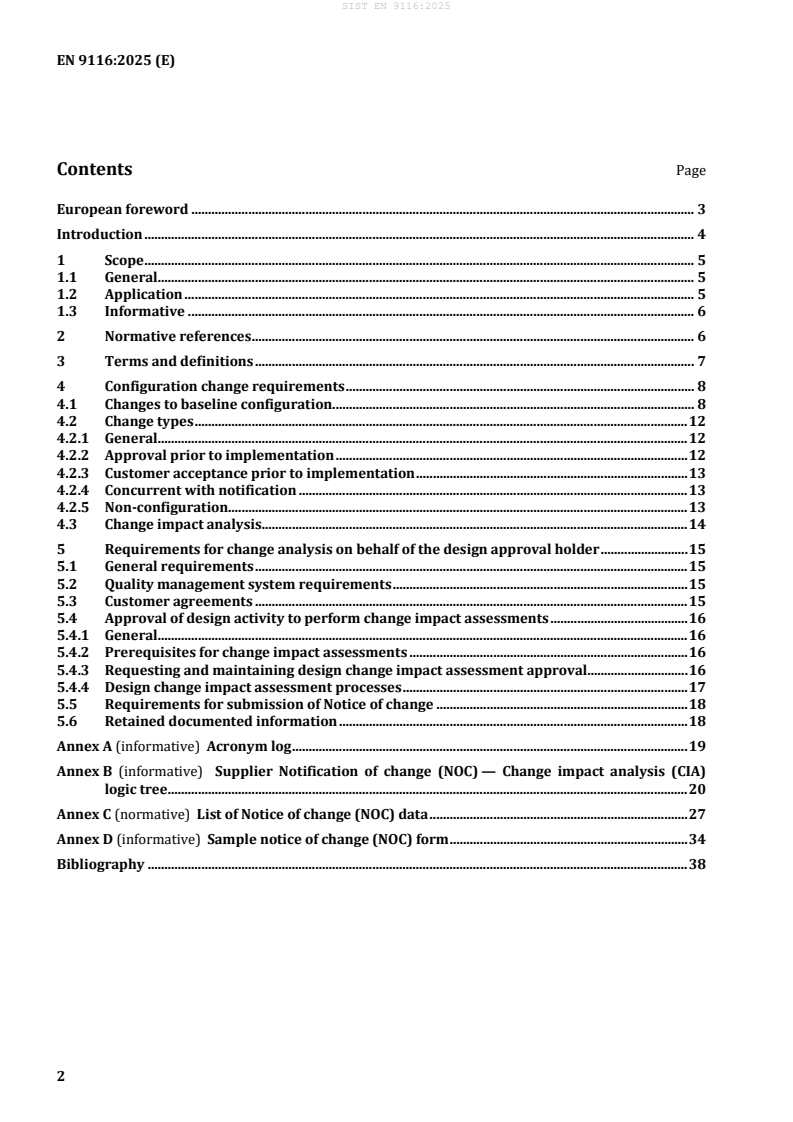
Contents Page
European foreword . 3
Introduction . 4
1 Scope . 5
1.1 General. 5
1.2 Application . 5
1.3 Informative . 6
2 Normative references . 6
3 Terms and definitions . 7
4 Configuration change requirements . 8
4.1 Changes to baseline configuration. 8
4.2 Change types . 12
4.2.1 General. 12
4.2.2 Approval prior to implementation . 12
4.2.3 Customer acceptance prior to implementation . 13
4.2.4 Concurrent with notification . 13
4.2.5 Non-configuration. 13
4.3 Change impact analysis . 14
5 Requirements for change analysis on behalf of the design approval holder . 15
5.1 General requirements . 15
5.2 Quality management system requirements . 15
5.3 Customer agreements . 15
5.4 Approval of design activity to perform change impact assessments . 16
5.4.1 General. 16
5.4.2 Prerequisites for change impact assessments . 16
5.4.3 Requesting and maintaining design change impact assessment approval . 16
5.4.4 Design change impact assessment processes . 17
5.5 Requirements for submission of Notice of change . 18
5.6 Retained documented information . 18
Annex A (informative) Acronym log . 19
Annex B (informative) Supplier Notification of change (NOC) — Change impact analysis (CIA)
logic tree . 20
Annex C (normative) List of Notice of change (NOC) data . 27
Annex D (informative) Sample notice of change (NOC) form . 34
Bibliography . 38
European foreword
This document (EN 9116:2025) has been prepared by ASD-STAN.
After enquiries and votes carried out in accordance with the rules of this Association, this document has
received the approval of the National Associations and the Official Services of the member countries of
ASD-STAN, prior to its presentation to CEN.
This document shall be given the status of a national standard, either by publication of an identical text
or by endorsement, at the latest by November 2025, and conflicting national standards shall be
withdrawn at the latest by November 2025.
Attention is drawn to the possibility that some of the elements of this document may be the subject of
patent rights. CEN shall not be held responsible for identifying any or all such patent rights.
This document supersedes EN 9116:2015.
— editorially revised.
According to the CEN-CENELEC Internal Regulations, the national standards organizations of the
following countries are bound to implement this document: Austria, Belgium, Bulgaria, Croatia, Cyprus,
Czech Republic, Denmark, Estonia, Finland, France, Germany, Greece, Hungary, Iceland, Ireland, Italy,
Latvia, Lithuania, Luxembourg, Malta, Netherlands, Norway, Poland, Portugal, Republic of North
Macedonia, Romania, Serbia, Slovakia, Slovenia, Spain, Sweden, Switzerland, Türkiye and the
United Kingdom.
Introduction
This document was created to define the process requirements and data expectations for the
submission of proposed changes in design and manufacturing information that requires approval of the
Design Approval Holder (DAH), when the DAH is different from the entity providing the design
information requiring approval. This document provides for the organizational requirements,
definitions, and data submission, including suggested data descriptions and format (paper or electronic
submission).
This revision to the document provides updated information and improves the writing clarity to
facilitate uniform submittal of change notifications and/or approval when contractually invoked at any
level, including sub-tier organizations, or as guidance within the aviation, space, and defence industries.
To ensure customer satisfaction, aviation, space, and defence industry organizations provide and
continually improve safe and reliable products and services that meet or exceed customer and
applicable statutory and regulatory authority requirements. The globalization of the industry and the
resulting diversity of regional and national requirements and expectations have complicated this
objective. Organizations have the challenge of purchasing products and services from external
providers throughout the world and at all levels within the supply chain. External providers have the
challenge of delivering products and services to multiple customers with varying quality expectations
and requirements.
Industry established the International Aerospace Quality Group (IAQG), with representatives from
aviation, space and defence companies in the Americas, Asia/Pacific, and Europe, to implement
initiatives that make significant improvement in quality and reductions in cost throughout the value
stream. This document has been prepared by the IAQG.
This document identifies requirements for design change management and/or manufacturing process
change to a previously approved product design (baseline configuration) of the product. This includes
requirements for Notice of change (NOC) data definition and documentation for the aviation, space, and
defence industries. The establishment of common requirements for use at all levels of the supply-chain
is intended to improve quality, safety, and decrease costs by the elimination or reduction of
organization-unique requirements and the resultant variation inherent in these multiple expectations.
This document can be invoked as a stand-alone requirement or used in conjunction with EN 9100-
series standards (i.e. EN 9100, EN 9110, EN 9120).
See Annex A for a list of acronyms applicable to this document.
1 Scope
1.1 General
The aviation, space, and defence industries rely on the development and manufacture of complex
products comprised of multiple systems, subsystems, and components each designed by individual
designers (design activities) at various levels within the supply chain. Each design or manufacturing
activity controls various aspects of the configuration and specifications related to the product. When a
change to design or process is requested or required, the change is typically required to be evaluated
against the impacts to the entire system.
Proposed changes to design data/information that the design activity identifies to be minor and have no
effect on the product requirements or specifications, have the potential to be implemented and
approved, where authorized to do so, but require notification. Changes that affect customer mandated
requirements or specifications are approved prior to implementation. In many cases, the design activity
is not conducted by the DAH or design authority. The design activity might be several layers below the
design approval. Irrespective of where the design activity is conducted in the supply chain, notification
is required. The typical change notification flow is presented in Figure 1.
Figure 1 — Requirements for change notification flow
Submitting NOC data either electronically or conventionally on paper is subject to the terms and
conditions of the customer’s contract. This also includes, where applicable, data access under the
regulations of export control.
The process of exchanging, coordinating, and approving NOC data varies with the multiple relationships
and agreements among all organizations concerned. An objective of this document is to provide the
definition of a data set that can be integrated into any form of communication (e.g. electronic data
interchange, submission of conventional paper forms). A sample form can be found in the Supply Chain
Management Handbook (SCMH).
If all or part of this document is contractually invoked, design organizations and design holders (i.e. the
organization responsible for the product end item design) that have responsibility for change
management of products used on other higher-level designs will use the information and processes
defined in this document for submitting change notifications.
1.2 Application
This document defines the common NOC requirements for aviation, space, and defence organizations.
The requirements that a design organization uses when submitting a NOC to the customer for either
change authorization or notification are included herein. A NOC informs the customer of physical or
functional (e.g. design, material, software, maintenance) changes or any associated process changes to
an established baseline configuration.
Retention of the NOC establishes a means of configuration control and captures the evolution of the
part. This requirement is of utmost importance in commercial/civil aviation products where changes to
type certificated products are mandated by regulations; however, these same concepts are also
required in defence and space applications per contractual requirements.
Where there are changes to items which the organization does not have design input or is not permitted
to make any changes to the design [e.g. build to print, Technical Standard Order (TSO) articles] then
change requests are formally submitted to the customer and approved via the customer’s change
request process.
This document is not applicable to commercial parts [off-the-shelf items not specifically designed for
aviation, space, or defence products; aka Commercial off-the-Shelf (COTS)] for which changes in
product definition is not affected or known. COTS items that are modified or altered are subject to the
requirements herein. When this document is applied to an organization that distributes a product, then
this document is also a requirement to the organization from which the product is procured by the
distribution organization.
1.3 Informative
In this document, the following terms are used:
— “shall” indicates a requirement;
— “should” indicates a recommendation;
— “may” indicates a permission; and
— “can” indicates a possibility or capability.
Words “example” or “e.g.” indicate suggestions given for guidance. Information marked “NOTE” is for
guidance in understanding or clarifying the associated requirement.
2 Normative references
The following documents are referred to in the text in such a way that some or all of their content
constitutes requirements of this document. For dated references, only the edition cited applies. For
undated references, the latest edition of the referenced document (including any amendments) applies.
EN 9100:2018, Quality management systems — Requirements for aviation, space and defence
organizations
EN 9102, Aerospace series — Quality systems — First article inspection requirements
ISO 9000:2015, Quality management systems — Fundamentals and vocabulary
SAE EIA649, Configuration Management Standard
As developed under the auspice of the IAQG and published by various standards bodies [e.g., AeroSpace and
Defence Industries Association of Europe – Standardization (ASD-STAN), SAE International, European Committee
for Standardization (CEN), Japanese Standards Association (JSA)/Society of Japanese Aerospace Companies
(SJAC), Brazilian Association for Technical Norms (ABNT)].
Published by Society of Automotive Engineers (SAE), available at: https://www.sae.org/.
3 Terms and definitions
For the purposes of this document, the terms and definitions given in ISO 9000:2015, the IAQG
Dictionary and the following apply.
ISO and IEC maintain terminological databases for use in standardization at the following addresses:
— ISO Online browsing platform: available at https://www.iso.org/obp
— IEC Electropedia: available at https://www.electropedia.org/
3.1
baseline configuration
functional, allocated and product baseline definitions that are established by agreeing to the definition
of the attributes for a product at a point in time; identifies a known configuration to which changes are
addressed
Note 1 to entry: This definition is sometimes determined jointly by the customer and the design activity and might
require consultation with the DAH and/or design authority, if different than the customer.
3.2
change evaluator
person(s) authorized on behalf of the DAH to assess the potential impact of the change(s), evaluates
changes for the potential impact on the fit, form, or functionality of the part, system, or assembly and
failure to meet the customer requirements
Note 1 to entry: The change evaluator could also be the customer or the producer of the end item.
3.3
critical item
item (e.g., function, part, software, characteristic, process) having significant effect on the provision and
use of the products and services; including safety, performance, form, fit, function, producibility, service
life, etc.; that requires specific actions to ensure they are adequately managed
EXAMPLE Examples of critical items include safety critical items, fracture critical items, mission critical items,
and key characteristics.
3.4
design activity
organization(s) that transform(s) customer supplied information and/or design specifications into
product attributes to establish the configuration of the product
3.5
design approval holder
DAH
organization with formal approval for the design, validation, and service support of a product
Note 1 to entry: In civil aviation, this is the organization responsible for the design of product or for changes
thereto that is the holder of a design approval granted by a regulatory authority [i.e. Type Certificate (TC);
Supplemental Type Certificate (STC); Parts Manufacturer Approval (PMA); Technical Standard Order (TSO);
European Part Approval (EPA); or equivalent].
Located on the IAQG website: https://iaqg.org/tools/dictionary/.
3.6
end item
item that is ultimately delivered to the end user
EXAMPLE Aircraft, vehicle, propulsion system.
3.7
key characteristic
attribute or feature whose variation has a significant effect on product fit, form, function, performance,
service life, or producibility that requires specific actions for the purpose of controlling variation
Note 1 to entry: Refer to 3.3.
3.8
product
aviation, space, and defence vehicle, engine, propeller, airframe part, or equipment (within that vehicle)
to be used in operating or controlling a vehicle in flight
EXAMPLE Product examples include a vehicle, engine, equipment, component, deliverable software, or parts
and materials thereof.
Note 1 to entry: See “end item” (3.6).
Note 2 to entry: Product might include software that is embedded or field loadable in the end item.
[SOURCE: ISO 9000:2015]
3.9
source control drawing
SCD
engineering description, qualification requirements, and acceptance criteria for items procurable from a
specialized segment of industry, that provides the performance, installation, interchangeability, or other
characteristics required for critical applications
Note 1 to entry: A SCD also provides visibility of approved sources and the vendor's item identification that is
qualified and approved for use in the critical application(s).
[SOURCE: adapted from ANSI/ASME Y14.24]
3.10
special process
process where the resulting output cannot be verified by subsequent monitoring or measurement and
as a consequence, deficiencies become apparent only after the product is in use or has been delivered
4 Configuration change requirements
4.1 Changes to baseline configuration
A baseline configuration is an agreed configuration definition from which compliance was shown
(e.g. certification baseline). Baseline configuration is captured by design data and is typically retained
by the design activity. The baseline configuration shall clearly define the design characteristics and
performance requirements of the product, including acceptance conditions of the products to the lowest
level of detail necessary to produce the product and ensure compliance with all applicable
requirements of the customer.
All changes to previously customer accepted baseline configurations shall be evaluated and approved.
Any changes in the configuration shall be submitted to the customer and DAH, if different from the
customer. Figure 2 depicts the process when customer delegated change evaluation is not obtained, and
Figure 3 is for organizations with customer delegated change evaluation approval.
The product baseline configuration from which changes will be evaluated may include the following
elements according to its status/revision/version:
a) SCD;
b) product specifications and drawings, including electronic data sets and supersession;
c) Bill of Materials (BOM), including definition of spare or substitute parts which may be used in
repair, but have different definition than those of baseline configuration parts;
d) process specifications in accordance with contractual requirements;
e) manufacturing methods, as shown on engineering drawings or supporting process specifications;
f) product usage/function/systems application, which may include:
o effect of product failure on system application;
o identification of key components, processes, and/or characteristics, as applicable.
NOTE 1 Design activity does not meet criteria of Clause 5.
NOTE 2 Design activity is not authorized to analyse changes on behalf of customer.
Figure 2 — Flow chart for Notice of change (NOC) submittal
NOTE 1 Design activity meets criteria of Clause 5.
NOTE 2 Design activity is authorized to analyse changes on behalf of customer.
Figure 3 — Flow chart for Notice of change (NOC) submittal
4.2 Change types
4.2.1 General
Change types are controlled by the customer contract terms and conditions, and/or DAH. The following
apply, unless modified or changed by the customer and/or DAH.
4.2.2 Approval prior to implementation
Changes in design or design information that shall require prior acceptance from the customer, unless
otherwise stated in the contract:
a) any change that affects product airworthiness or safety;
b) any change to product function;
c) any change affecting a SCD or top-level drawing;
d) any change to product performance tolerances specified by customer or product definition;
e) weight, balance, or moment of inertia change outside of specification requirements;
f) change affecting interchangeability, compatibility, maintainability, or repairability at customer
serviceable level;
g) electromagnetic characteristics or signature change;
h) change in product technical data, including Qualification Test Plan (QTP) or Acceptance Test Plan
(ATP); see 4.2.2q;
i) any change in installed software/firmware that changes the software identity or functionality;
j) change affecting environmental interactions (e.g. use of hazardous/prohibited materials);
k) change affecting traceability of a required traceable item;
l) any change to a ‘frozen’ design or process;
m) change to customer identified ‘critical items’ or ‘key characteristics’;
n) change that negatively impacts contractual prices, schedules, or deliveries to the customer;
o) change that positively or negatively impact Failure Modes and Effects Analysis (FMEA) or Failure
Review and Corrective Action System (FRACAS) information originally approved;
p) any change of electronic or specific component;
q) any change to tooling or gages used for product acceptance.
4.2.3 Customer acceptance prior to implementation
Depending on product definition or customer requirements, these types of changes to design, product
manufacturing, or product maintenance information might also require prior acceptance from the
customer. The customer agreement shall determine prior acceptance requirements:
a) change to the BOM;
b) any change of a special process (type or actual process);
c) change in special process sources;
d) change in sources of supply of sub-components, including obsolescence;
e) change in manufacturing methods, including changes to specified tolerances;
f) change in location of manufacture for the end item;
g) change to manuals or instructional material which has been provided to the customer;
h) revision to a repair/modification drawing that changes the baseline configuration, which had been
previously approved by the DAH/design activity;
i) any change driving the need for a First Article Inspection (FAI) or partial FAI (as defined in EN 9102).
4.2.4 Concurrent with notification
Changes other than those described in 4.2.2, and potentially 4.2.3, may be implemented and delivered prior
to customer acceptance, if the authority to proceed is granted in accordance with Clause 5 requirements.
Any change to design information that does not require prior customer acceptance is considered eligible for
implementation and requires a NOC form to be created. Submittal of the NOC form to the customer
concurrently for any change is necessary, when required by the customer and/or DAH.
If authority for change implementation is not granted from the customer, then changes other than those
defined in 4.2.2, and potentially 4.2.3, may be implemented at the risk of the design and manufacturing
activities, but shall not be delivered to the customer pending acceptance.
4.2.5 Non-configuration
Changes to design information that are clerical in nature or are to correct errors in previously approved
design information, and do not affect items listed in 4.2.2, 4.2.3, and 4.2.4, do not have to be reported or
documented via the NOC process defined in this document. However, these types of changes shall be
recorded and documented within the design activity’s configuration management system and records
retained per 5.6. In addition, the customer and/or DAH may negotiate with the design activity a
schedule for notification of non-configuration changes for information purposes.
Non-configuration changes may include:
a) drawing corrections; bringing documented information in line with manufacturing practices;
b) drawing corrections; elimination of clerical/typing/drafting drawing errors;
c) alteration of non-functional features, if no formal qualification testing is required, providing that
any change does not increase the envelope or weight of the unit or affect unit performance;
d) addition of dash number to catalogue component drawings; does not affect existing configurations;
e) supplier order office name and address changes/additions for industry standard catalogue
components and detail parts;
f) revision of notes to incorporate latest revision of industry standards and supplier company
specifications where there is no impact on configuration or product characteristics or change to
contractual requirements;
g) addition, selection, or amendment of data/information on drawings not delivered to the customer where
there is no impact on configuration or product characteristics or change to contractual requirements;
h) changes to the format of drawings not delivered to the customer [e.g. transfer from paper to
Computer-Aided Design (CAD) format];
i) corrections to component part markings that do not affect traceability;
j) update of the method of component part marking, but not the contents;
k) changes that do not require update to design technical data delivered to the customer.
4.3 Change impact analysis
In order to assist in proper evaluation of changes, there is an industry-developed tool for the evaluation
of change and configuration change effects. This tool is available at https://scmh.iaqg.org/design-
develop/#1613168639802-160461ef-d42c and is intended to assist the design activity in the
evaluation of the category of change per 4.2 with respect to the impact on:
a) airworthiness (safety);
b) form;
c) fit;
d) function;
e) mass properties;
f) environment;
g) reliability;
h) drawing, engineering data (e.g. three-dimensional models), or specification changes;
i) traceability;
j) in-service effects;
k) producibility or inspectability;
l) test;
m) contractual price.
The description of the associated questions and supporting Change Impact Analysis (CIA) is provided in
Annex B; for the most current information, consult the IAQG website. The requirements as to what
constitutes a change are subject to customer purchase and contract agreements in effect at the time of
the product change request.
NOTE The DAH or customer reserves the right to use an alternative tool or not to use the tool, based on its
applicability to their products.
5 Requirements for change analysis on behalf of the design approval holder
5.1 General requirements
The design activity shall submit a CIA and a NOC to the customer, prior to implementing any change
described in 4.2.2, 4.2.3, and 4.2.4. However, the design activity shall meet the criteria requirements of
5.2 and 5.3 in order to be authorized to analyse changes described in 4.2.4 on behalf of the customer
(see Figure 3).
5.2 Quality management system requirements
The design activity shall have a quality management system that contains the following, at a minimum:
a) a design control system that complies with the applicable requirements detailed in EN 9100:2018,
subclause 8.3;
b) a configuration management system that complies with the requirements of SAE EIA649 or
EN 9100:2018, subclause 8.1.2;
c) control of sub-tier supplier changes in accordance with EN 9100:2018, subclause 8.4;
d) control of nonconforming product in accordance with EN 9100:2018, subclause 8.7;
e) a corrective action process in accordance with the EN 9100:2018, subclause 10.2;
f) control of documented information in accordance with EN 9100:2018, subclause 7.5.3 and
customer requirements.
5.3 Customer agreements
5.3.1 In order to be eligible for submitting design information changes or change requests
concurrently, the organization/design activity shall have the following agreements with the customer
and/or DAH, at a minimum:
a) baseline definition of each product (see subclause 4.1);
b) a process for authorization of personnel with the competency to verify design analysis
determinations in terms of change effects;
c) customer review/acceptance cycle and frequency of submittal of NOCs;
d) a documented approval, including any limitations, from the customer allowing use of the
authorization provisions of this document (see subclause 5.4).
5.3.2 The organization/design activity shall be subject to approval and reviews by the customer or
DAH for assurance that the requirements of subclause 5.2 are satisfied and for verification of change
classifications. This includes access to and review of design data, procedures, and documented
information of the design activity by the customer and/or DAH. The method of review and approval is
at the discretion of the customer and/or design authority.
5.4 Approval of design activity to perform change impact assessments
5.4.1 General
The approval to perform design change impact assessments, on behalf of the customer and/or DAH, is
intended for organizations that design the product. The customer and/or DAH has the responsibility to
ensure design changes to its products comply with applicable customer and regulatory requirements.
This requires that the customer and/or DAH maintain the appropriate level of definition, approval, and
oversight of the design change impact assessments performed by the organization/design activity.
The customer and/or DAH shall have the authority for definition and interpretation of all requirements
associated with these design change impact assessments.
5.4.2 Prerequisites for change impact assessments
Organization/design activity shall meet the following prerequisites before requesting any level of
design change impact assessments approvals:
a) have a quality management system that complies with the requirements delineated within
subclause 5.2;
b) have sufficient design competency for the products for which they are requesting design change
impact assessment approval. The design is typically acknowledged by the customer and/or DAH
through a contractual requirement for design to customer requirements, statement of work, or
other specifications and supporting engineering definition;
c) have existing engineering competencies of sufficient breadth and capability, as recognized by the
customer and/or DAH, to implement and support the design change impact assessment system;
d) have documented processes to support the design change impact assessment system in accordance
with 5.4.3;
e) documented processes for the submittal of change impact assessment shall be submitted to the
customer and/or DAH for approval, prior to implementation.
NOTE The documented processes of the organization/design activity is intended to be initially submitted for
review/approval by the DAH with the authorization request letter defined within 5.4.2.
5.4.3 Requesting and maintaining design change impact assessment approval
a) Organization/design activities that meet the prerequisites of subclause 5.2 and subclause 5.3, shall
request design change impact assessment approval by submitting an authorization request to the
customer and/or DAH to define the scope of the proposed design change impact assessment.
b) The authorization request shall identify the type of product being supplied on which the
organization/design activity has design capability and requests design change impact assessment
approval.
c) The authorization request shall identify the applicable organization/design activity design change
impact assessment documented information in accordance with the requirements of this
document.
d) The authorization request is reviewed by the customer and/or DAH to determine if it is within the
scope for design change impact assessment approval. If the scope is acceptable, the customer/DAH
notifies the organization/design activity in writing authorizing the organization/design activities’
design change impact assessment approval, at which point the organization/design activity may
begin performing design change impact assessments on behalf of the customer and/or DAH, and
within requirements of this document. A record of the approval of the organization/design
activities’ design change impact assessment approval request and customer and/or DAH’s
authorization shall be retained by the organization/design activity.
e) The organization/design activity shall submit a new design change impact assessment approval
request for changes in scope (e.g. providing a new type of product, additional approval for existing
product).
f) Deviations from the requirements of this document may be requested by the organization/design
activity through correspondence with the customer and/or DAH. Deviations shall be approved by
the customer and/or DAH, prior to implementation. Records of any approved deviations shall be
retained by the organization/design activity.
5.4.4 Design change impact assessment processes
5.4.4.1 The organization/design activity shall maintain documented processes that clearly define the
requirements of the overall design change impact assessment system, including the following:
a) design change impact assessment system description;
b) design change impact assessment system scope of approval identified in 5.4.2.a;
c) design change impact assessment system organizational responsibilities and reporting
relationships;
d) design change impact assessment system forms;
e) design change impact assessment system personnel listing and any limits on their authority to
conduct design change impact assessment on behalf of the customer and/or DAH;
f) design change impact assessment system personnel competencies, including education, experience,
product and process knowledge, training, and recurrent training requirements;
g) design change impact assessment system retained documented information.
5.4.4.2 The organization/design activities design change impact assessment processes shall clearly
define how design change impact assessment authority is flowed down to sub-tier supplier/design
activities and the requirements of this document are flowed down.
5.4.4.3 The organization/design activity documented information shall include a listing of any sub-tier
organization/design activity that have been delegated design change impact assessment authority and
their design change impact assessment processes, if applicable.
5.5 Requirements for submission of Notice of change
5.5.1 Information related to the NOC (e.g. content, format, size) shall be in accordance with the
information defined in Annex C, “List of Notice of change (NOC) data”. Information may be in either in
electronic or paper form. Mandatory items (in bold; marked with an *) shall be recorded and
transmitted to every customer. Optional information (without marking) shall appear when requested
by the customer but may also be formatted based on the originator's needs.
For any data field recorded and transmitted, whether mandatory or optional, not applicable (N/A) shall be
entered as a minimum requirement prior to final approval/signature, if there is no data to be entered.
Different customers may require different optional data fields tailored to meet contractual
requirements. It is therefore recommended that the Information Technology (IT) system (electronic
data storage) is capable of processing all sets of information (i.e. mandatory, optional). The system
should recognize data fields not effectively used as being inactive and be capable of adding new
requirements or changing existing requirements.
5.5.2 The persons responsible for entering and approving/acknowledging NOC data shall process the
activities in accordance with the terms and conditions of the customer contract.
5.5.3 Attached files shall be in a protected format (e.g. pdf, tif, jpg). Formats that can be easily changed
(e.g. doc, xls, ppt) should be avoided, as much as possible, but may be used if necessary. In such cases,
appropriate precautions should be taken to prevent inadvertent changes to the document.
5.5.4 When the NOC is not required in electronic format and/or when it is required as a printout, it shall
be in a linear format similar to the example shown in Annex D, “Sample Notice of change (NOC) form”.
However, the size and order of the fields may be changed to suit the individual application provided that:
a) the box numbers and contents allocation specified in this document are maintained;
b) all mandatory data fields are printed out on the paper form;
c) the form is not changed to the extent that would make it unrecognizable;
d) it is in line with contractual/regulatory requirements.
5.5.5 Forms may be pre-printed, computer generated, or accessed via a net-based system
(intranet/internet); providing in all cases, the printing of lines and characters are clear and legible. The
information entered on the forms shall be machine/computer printed or handwritten as long as the
document remains legible.
The use of abbreviations should be kept at a minimum.
5.5.6 When required, continuation/additional sheets and attachments shall include the same NOC
reference number as the original document.
The information in the data fields shall be in English or the language specified by the customer, DAH,
and/or authority.
5.6 Retained documented information
Change information, including NOC data and approvals or acknowledgements shall be retained in
accordance with the customer’s design data requirements.
Typically, design information is required to be retained for 25 years or the service life of the product
plus 7 years, whichever is longer. Data should be maintained in either paper or electronic format.
Annex A
(informative)
Acronym log
ABNT Brazilian Association for Technical Norms / Associação Brasileira de Normas
Técnicas
ANSI American National Standards Institute
ASD-STAN AeroSpace and Defence Industries Association of Europe — Standardization
ATP Acceptance Test Plan
BOM Bill of Materials
CAD Computer-Aided Design
CEN European Committee for Standardization / Comité Européen de Normalisation
CIA Change Impact Analysis
COTS Commercial off-the-Shell
CPU Central Processing Unit
DAH Design Approval Holder
EASA European Union Aviation Safety Agency
EIA Electronic Industries Alliance
EPA European Part Approval
FAI First Article Inspection
FMEA Failure Mode and Effects Analysis
FRACAS Failure Review and Corrective Action System
IAQG International Aerospace Quality Group
ISO International Organization for Standardization
IT Information Technology
JSA Japanese Standards Association
N/A Not Applicable
NOC Notice of Change
PMA Parts Manufacturer Approval
QTP Qualification Test Plan
RF Radio Frequency
SCD Source Control Drawing
SCMH Supply Chain Management Handbook
SJAC Society of Japanese Aerospace Companies
STC Supplemental Type Certificate
TSO Technical Standard Order
...