

EN 16809-1:2019
(Main)Thermal insulation products of buildings - In-situ formed products from loose-fill expanded polystyrene (EPS) beads and bonded expanded polystyrene beads - Part 1: Specification for the bonded and loose-fill products before installation
- Abstract
This document specifies the requirements for products of loose-filled expanded polystyrene (EPS) beads and bonded expanded polystyrene beads for in-situ installation in masonry cavity walls and frame constructions.
This document is a specification for the insulation products before installation. It describes the product characteristics and includes procedures for testing, marking and labelling.
This document does not specify the required level of a given property to be achieved by a product to demonstrate fitness for purpose in a particular application. The levels required for a given application are to be found in regulations or non-conflicting standards.
NOTE To avoid water penetration in masonry walls special tests adjusted to local climate might be needed.
This document does not cover factory made expanded polystyrene (EPS) insulation products or factory made or in-situ products intended to be used for the insulation of building equipment and industrial installations.
Products with a declared thermal resistance lower than 0,25 m2·K/W or a declared thermal conductivity greater than 0,060 W/(m·K) at 10 °C are not covered by this document.
This document does not cover products intended for airborne sound insulation and for acoustic absorption applications.
- Status
- Published
- Publication Date
- 26-Nov-2019
- Withdrawal Date
- 30-Aug-2021
- Technical Committee
- CEN/TC 88 - Thermal insulating materials and products
- Drafting Committee
- CEN/TC 88/WG 15 - In situ formed insulation products
- Current Stage
- 9093 - Decision to confirm - Review Enquiry
- Start Date
- 20-Aug-2025
- Completion Date
- 07-Oct-2026



EN 16809-1:2019 - Overview
EN 16809-1:2019 (CEN) specifies requirements for in‑situ formed thermal insulation products made from loose‑fill and bonded expanded polystyrene (EPS) beads before installation. It covers product characteristics, test procedures, marking and labelling for EPS beads intended for filling masonry cavity walls and frame constructions. This part is the product specification (Part 2 of EN 16809 covers installed products). The standard does not set application‑specific performance levels - those are determined by regulations or complementary standards.
Key topics and technical requirements
- Scope and exclusions
- Applies to loose‑fill and bonded EPS beads for masonry cavities and frame constructions.
- Excludes factory‑made EPS boards, products for building equipment/industrial installations, airborne/acoustic products, and products with declared R < 0.25 m2·K/W or λ > 0.060 W/(m·K) at 10 °C.
- Thermal properties
- Thermal resistance (R) and thermal conductivity (λ) measured per EN 12667 / EN 12939.
- Declared values must represent at least 90 % of production with 90 % confidence (90/90). λ rounded upwards to 0.001 W/(m·K); R rounded down to 0.05 m2·K/W increments.
- Physical properties
- Density of a sale unit (EN 1602) must meet manufacturer’s declared minimum.
- Bead size measured per EN 933‑1 (typical bead sizes ~1–10 mm depending on injection method).
- Settlement (loose fill) measured per Annex G; bonded beads have no settlement.
- Reaction to fire
- Classification per EN 13501‑1 using relevant reaction‑to‑fire tests and mounting rules (EN 15715 and Annex D).
- Durability and ageing
- Declared thermal properties and reaction‑to‑fire performance are considered durable; settlement covers long‑term loose‑fill behaviour.
- Quality & conformity
- Procedures for product type determination, factory production control (FPC), marking, labelling and Declaration of Performance (DoP) are specified.
Applications and who uses this standard
- Target users:
- EPS manufacturers, product developers and quality managers
- Testing laboratories and certification bodies
- Architects, specifiers and building contractors specifying cavity and frame insulation
- Regulators and conformity assessment bodies
- Practical use:
- Establish product datasheets and DoP for marketed EPS bead products
- Define test programmes for thermal performance, density, settlement, and fire reaction
- Ensure labelling and FPC meet European market requirements before on‑site installation
Related standards
- EN 12667, EN 12939 (thermal tests)
- EN 1602, EN 1609, EN 12086 (density, water absorption, vapour)
- EN 13501‑1, EN 13823, EN ISO 1182, EN ISO 11925‑2 (reaction to fire)
- EN 13172 (conformity), EN 15715 (mounting for fire tests)
EN 16809‑1:2019 is essential when marketing, testing or specifying in‑situ EPS bead insulation - it defines how product performance must be measured and declared prior to installation.
Relations
- Effective Date
- 09-Feb-2026
- Effective Date
- 04-Feb-2026
- Effective Date
- 28-Jan-2026
- Effective Date
- 28-Jan-2026
- Refers
EN ISO 1182:2020 - Reaction to fire tests for products - Non-combustibility test (ISO 1182:2020) - Effective Date
- 28-Jan-2026
- Effective Date
- 28-Jan-2026
- Effective Date
- 28-Jan-2026
- Effective Date
- 28-Jan-2026
- Effective Date
- 28-Jan-2026
- Effective Date
- 28-Jan-2026
- Effective Date
- 28-Jan-2026
- Effective Date
- 28-Jan-2026
- Effective Date
- 28-Jan-2026
- Effective Date
- 28-Jan-2026
- Effective Date
- 28-Jan-2026
Get Certified
Connect with accredited certification bodies for this standard

DIBt (Deutsches Institut für Bautechnik)
German Institute for Building Technology.
DIN CERTCO
DIN Group product certification.

Aboma Certification B.V.
Specialized in construction, metal, and transport sectors.
Sponsored listings
Frequently Asked Questions
EN 16809-1:2019 is a standard published by the European Committee for Standardization (CEN). Its full title is "Thermal insulation products of buildings - In-situ formed products from loose-fill expanded polystyrene (EPS) beads and bonded expanded polystyrene beads - Part 1: Specification for the bonded and loose-fill products before installation". This standard covers: This document specifies the requirements for products of loose-filled expanded polystyrene (EPS) beads and bonded expanded polystyrene beads for in-situ installation in masonry cavity walls and frame constructions. This document is a specification for the insulation products before installation. It describes the product characteristics and includes procedures for testing, marking and labelling. This document does not specify the required level of a given property to be achieved by a product to demonstrate fitness for purpose in a particular application. The levels required for a given application are to be found in regulations or non-conflicting standards. NOTE To avoid water penetration in masonry walls special tests adjusted to local climate might be needed. This document does not cover factory made expanded polystyrene (EPS) insulation products or factory made or in-situ products intended to be used for the insulation of building equipment and industrial installations. Products with a declared thermal resistance lower than 0,25 m2·K/W or a declared thermal conductivity greater than 0,060 W/(m·K) at 10 °C are not covered by this document. This document does not cover products intended for airborne sound insulation and for acoustic absorption applications.
This document specifies the requirements for products of loose-filled expanded polystyrene (EPS) beads and bonded expanded polystyrene beads for in-situ installation in masonry cavity walls and frame constructions. This document is a specification for the insulation products before installation. It describes the product characteristics and includes procedures for testing, marking and labelling. This document does not specify the required level of a given property to be achieved by a product to demonstrate fitness for purpose in a particular application. The levels required for a given application are to be found in regulations or non-conflicting standards. NOTE To avoid water penetration in masonry walls special tests adjusted to local climate might be needed. This document does not cover factory made expanded polystyrene (EPS) insulation products or factory made or in-situ products intended to be used for the insulation of building equipment and industrial installations. Products with a declared thermal resistance lower than 0,25 m2·K/W or a declared thermal conductivity greater than 0,060 W/(m·K) at 10 °C are not covered by this document. This document does not cover products intended for airborne sound insulation and for acoustic absorption applications.
EN 16809-1:2019 is classified under the following ICS (International Classification for Standards) categories: 91.100.60 - Thermal and sound insulating materials. The ICS classification helps identify the subject area and facilitates finding related standards.
EN 16809-1:2019 has the following relationships with other standards: It is inter standard links to ISO 16269-6:2014, EN ISO 11925-2:2026, EN 13820:2003, EN ISO 29470:2020, EN ISO 1182:2020, EN 13501-1:2018, EN 12086:2013, EN ISO 29767:2019, EN 13172:2024, EN 15715:2009, EN 12667:2001, EN 13823:2020+A1:2022, EN 12939:2000, EN 933-1:2012, EN ISO 11925-2:2020. Understanding these relationships helps ensure you are using the most current and applicable version of the standard.
EN 16809-1:2019 is associated with the following European legislation: EU Directives/Regulations: 305/2011; Standardization Mandates: M/103. When a standard is cited in the Official Journal of the European Union, products manufactured in conformity with it benefit from a presumption of conformity with the essential requirements of the corresponding EU directive or regulation.
EN 16809-1:2019 is available in PDF format for immediate download after purchase. The document can be added to your cart and obtained through the secure checkout process. Digital delivery ensures instant access to the complete standard document.
Standards Content (Sample)
SLOVENSKI STANDARD
01-januar-2020
Toplotnoizolacijski proizvodi za stavbe - Proizvodi, izdelani na mestu vgradnje iz
nevezanih in vezanih kroglic iz ekspandiranega polistirena (EPS) - 1. del:
Specifikacija za nevezane in vezane proizvode pred vgradnjo
Thermal insulation products of buildings - In-situ formed products from loose-fill
expanded polystyrene (EPS) beads and bonded expanded polystyrene beads - Part 1:
Specification for the bonded and loose-fill products before installation
Wärmedämmstoffe für Gebäude - An der Verwendungsstelle hergestellte Produkte aus
losen expandierten Polystyrolkugeln (EPS) und gebundenen expandierten
Polystyrolkugeln - Teil 1: Spezifikation für gebundene und lose Schütt- und
Einblasdämmstoffe vor dem Einbau
Produits isolants thermiques destinés aux bâtiments - Produits formés sur place à partir
de billes en polystyrène expansé (PSE) en vrac et de billes en polystyrène expansé liées
- Partie 1 : Spécification des produits avec et sans liant avant mise en œuvre
Ta slovenski standard je istoveten z: EN 16809-1:2019
ICS:
91.100.60 Materiali za toplotno in Thermal and sound insulating
zvočno izolacijo materials
2003-01.Slovenski inštitut za standardizacijo. Razmnoževanje celote ali delov tega standarda ni dovoljeno.
EN 16809-1
EUROPEAN STANDARD
NORME EUROPÉENNE
November 2019
EUROPÄISCHE NORM
ICS 91.100.60
English Version
Thermal insulation products of buildings - In-situ formed
products from loose-fill expanded polystyrene (EPS) beads
and bonded expanded polystyrene beads - Part 1:
Specification for the bonded and loose-fill products before
installation
Produits isolants thermiques destinés aux bâtiments - Wärmedämmstoffe für Gebäude - An der
Produits formés sur place à partir de billes en Verwendungsstelle hergestellte Produkte aus losen
polystyrène expansé (PSE) en vrac et de billes en expandierten Polystyrolkugeln (EPS) und gebundenen
polystyrène expansé liées - Partie 1 : Spécification des expandierten Polystyrolkugeln - Teil 1: Spezifikation
produits avec et sans liant avant mise en œuvre für gebundene und lose Schütt- und
Einblasdämmstoffe vor dem Einbau
This European Standard was approved by CEN on 23 September 2019.
CEN members are bound to comply with the CEN/CENELEC Internal Regulations which stipulate the conditions for giving this
European Standard the status of a national standard without any alteration. Up-to-date lists and bibliographical references
concerning such national standards may be obtained on application to the CEN-CENELEC Management Centre or to any CEN
member.
This European Standard exists in three official versions (English, French, German). A version in any other language made by
translation under the responsibility of a CEN member into its own language and notified to the CEN-CENELEC Management
Centre has the same status as the official versions.
CEN members are the national standards bodies of Austria, Belgium, Bulgaria, Croatia, Cyprus, Czech Republic, Denmark, Estonia,
Finland, France, Germany, Greece, Hungary, Iceland, Ireland, Italy, Latvia, Lithuania, Luxembourg, Malta, Netherlands, Norway,
Poland, Portugal, Republic of North Macedonia, Romania, Serbia, Slovakia, Slovenia, Spain, Sweden, Switzerland, Turkey and
United Kingdom.
EUROPEAN COMMITTEE FOR STANDARDIZATION
COMITÉ EUROPÉEN DE NORMALISATION
EUROPÄISCHES KOMITEE FÜR NORMUNG
CEN-CENELEC Management Centre: Rue de la Science 23, B-1040 Brussels
© 2019 CEN All rights of exploitation in any form and by any means reserved Ref. No. EN 16809-1:2019 E
worldwide for CEN national Members.
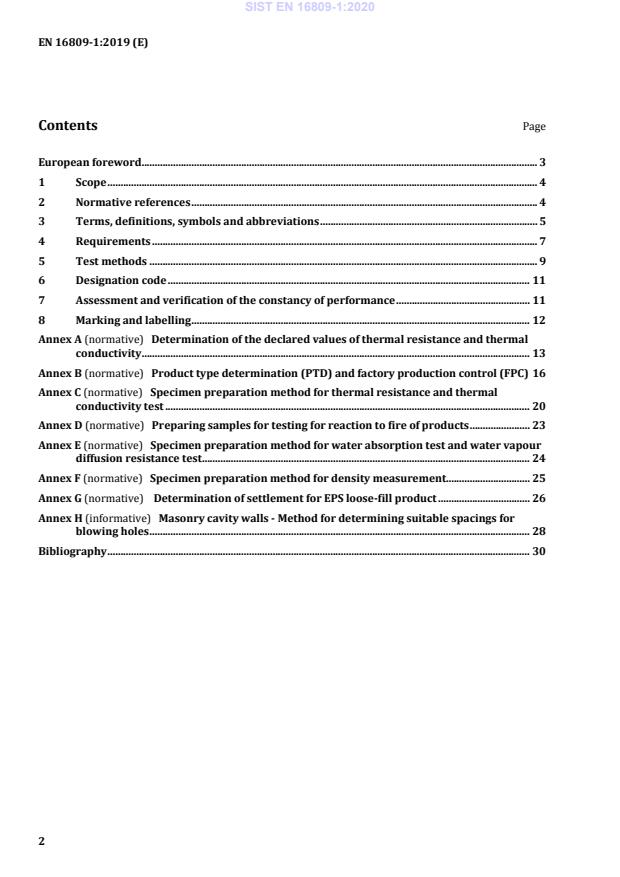
Contents Page
European foreword . 3
1 Scope . 4
2 Normative references . 4
3 Terms, definitions, symbols and abbreviations . 5
4 Requirements . 7
5 Test methods . 9
6 Designation code . 11
7 Assessment and verification of the constancy of performance . 11
8 Marking and labelling . 12
Annex A (normative) Determination of the declared values of thermal resistance and thermal
conductivity . 13
Annex B (normative) Product type determination (PTD) and factory production control (FPC) 16
Annex C (normative) Specimen preparation method for thermal resistance and thermal
conductivity test . 20
Annex D (normative) Preparing samples for testing for reaction to fire of products . 23
Annex E (normative) Specimen preparation method for water absorption test and water vapour
diffusion resistance test . 24
Annex F (normative) Specimen preparation method for density measurement. 25
Annex G (normative) Determination of settlement for EPS loose-fill product . 26
Annex H (informative) Masonry cavity walls - Method for determining suitable spacings for
blowing holes . 28
Bibliography . 30
European foreword
This document (EN 16809-1:2019) has been prepared by Technical Committee CEN/TC 88 “Thermal insulating
materials and products”, the secretariat of which is held by DIN.
This European Standard shall be given the status of a national standard, either by publication of an identical
text or by endorsement, at the latest by May 2020, and conflicting national standards shall be withdrawn at the
latest by August 2021.
Attention is drawn to the possibility that some of the elements of this document may be the subject of patent
rights. CEN shall not be held responsible for identifying any or all such patent rights.
EN 16809-1, Thermal insulation products for buildings — In situ formed products from loose-fill expanded
polystyrene (EPS) beads and bonded expanded polystyrene beads, consists of two parts which form a package.
The first part (this document), covers the products, which are placed on the market. The second part covers the
specification for the installed products. Both parts need to be used for the application of the insulation product
in the end-use applications covered by EN 16809-2.
The reduction in energy used and emissions produced during the installed life of insulation products exceeds
by far the energy used and emissions made during the production and disposal processes.
According to the CEN-CENELEC Internal Regulations, the national standards organisations of the following
countries are bound to implement this European Standard: Austria, Belgium, Bulgaria, Croatia, Cyprus, Czech
Republic, Denmark, Estonia, Finland, France, Germany, Greece, Hungary, Iceland, Ireland, Italy, Latvia,
Lithuania, Luxembourg, Malta, Netherlands, Norway, Poland, Portugal, Republic of North Macedonia, Romania,
Serbia, Slovakia, Slovenia, Spain, Sweden, Switzerland, Turkey and the United Kingdom.
1 Scope
This document specifies the requirements for products of loose-filled expanded polystyrene (EPS) beads and
bonded expanded polystyrene beads for in situ installation in masonry cavity walls and frame constructions.
This document is a specification for the insulation products before installation. It describes the product
characteristics and includes procedures for testing, marking and labelling.
This document does not specify the required level of a given property to be achieved by a product to
demonstrate fitness for purpose in a particular application. The levels required for a given application are to be
found in regulations or non-conflicting standards.
NOTE To avoid water penetration in masonry walls special tests adjusted to local climate could be needed.
This document does not cover factory made expanded polystyrene (EPS) insulation products and factory made
or in situ products intended to be used for the insulation of building equipment and industrial installations.
Products with a declared thermal resistance lower than 0,25 m ·K/W or a declared thermal conductivity
greater than 0,060 W/(m·K) at 10 °C are not covered by this document.
This document does not cover products intended for airborne sound insulation and for acoustic absorption
applications.
2 Normative references
The following documents are referred to in the text in such a way that some or all of their content constitutes
requirements of this document. For dated references, only the edition cited applies. For undated references, the
latest edition of the referenced document (including any amendments) applies.
EN 933-1, Tests for geometrical properties of aggregates – Part 1: Determination of particle size distribution –
Sieving method
EN 1602, Thermal insulating products for building applications —– Determination of the apparent density
EN 1609, Thermal insulating products for building applications — Determination of short term water absorption
by partial immersion
EN 12086, Thermal insulating products for building applications – Determination of water vapour transmission
properties
EN 12667, Thermal performance of building materials and products — Determination of thermal resistance by
means of guarded hot plate and heat flow meter methods — Products of high and medium thermal resistance
EN 12939, Thermal performance of building materials and products —– Determination of thermal resistance by
means of guarded hot plate and heat flow meter methods — Thick products of high and medium thermal
resistance
EN 13172, Thermal insulation products — Evaluation of conformity
EN 13501-1, Fire classification of construction products and building elements — Part 1: Classification using data
from reaction to fire tests
EN 13820, Thermal insulating materials for building applications — Determination of organic content
EN 13823, Reaction to fire tests for building products — Building products excluding floorings exposed to the
thermal attack by a single burning item
EN 15715, Thermal insulation products — Instructions for mounting and fixing for reaction to fire testing —
Factory made products
EN ISO 1182, Reaction to fire tests for products — Non-combustibility test (ISO 1182)
EN ISO 11925-2, Reaction to fire tests — Ignitability of products subjected to direct impingement of flame — Part
2: Single-flame source test (ISO 11925-2)
ISO 16269-6:2014, Statistical interpretation of data — Part 6: determination of statistical tolerance intervals
3 Terms, definitions, symbols and abbreviations
3.1 Terms and definitions
For the purposes of this document, the following terms and definitions apply.
ISO and IEC maintain terminological databases for use in standardization at the following addresses:
— IEC Electropedia: available at http://www.electropedia.org/
— ISO Online browsing platform: available at https://www.iso.org/obp
3.1.1
expanded polystyrene beads
insulation material consisting of beads manufactured from expandable polystyrene or one of its copolymers
with an air filled closed cellular structure
Note 1 to entry: Beads can be made from non-infrared absorbing or infrared absorbing raw material.
3.1.2
blowing hole
hole, cut or formed, in a masonry cavity wall or frame construction, through which the EPS beads are blown
3.1.3
frame construction
walls with wood or metal studs, sloping roof with insulation between rafters, the larger surfaces covered by
facings
3.1.4
settlement
decrease of installed insulation height in cavities and frame constructions with time, expressed as a percentage
of the initial installed height
3.2 Symbols and abbreviations
Symbols used in this document:
λ is the 90 % fractile with a confidence level of 90 % for the thermal conductivity W/(m·K)
90/90
λ is the declared thermal conductivity W/(m·K)
D
λ is one test result of thermal conductivity W/(m·K)
i
λ is the mean thermal conductivity W/(m·K)
mean
ρ is the declared density 3
D kg/m
A is the area of the test specimen m
d is the thickness of the test specimen mm
D is the diameter of the beads mm
n is the number of test results –
Ρ is the 90 % fractile with a confidence level of 90 % for the thermal resistance 2
90/90 m ·K/W
R is the declared thermal resistance 2
D m ·K/W
R is one test result of thermal resistance 2
i m ·K/W
s is the estimate of the standard deviation of the thermal conductivity W/(m·K)
λ
s is the estimate of the standard deviation of the thermal resistance 2
R m ·K/W
s is the estimate of the standard deviation of the density 3
ρ kg/m
W is the short-term water absorption 2
p kg/m
Q is the nominal weight of the quantity delivered kg
nom
MU is the symbol for the declared value for water vapour diffusion resistance
factor
S is the symbol for the declared class for settlement
WS is the symbol of the declared level for short-term water absorption
Abbreviations used in this document:
EPS Expanded PolyStyrene
AVCP Assessment and Verification of Constancy of Performance (previously named Attestation of
Conformity)
DoP Declaration of Performance
FPC Factory Production Control
PTD Product Type Determination (previously named ITT for Initial Type Test)
RtF Reaction to Fire
ThIB Thermal Insulation for Buildings
4 Requirements
4.1 General
Product properties shall be assessed in accordance with Clause 5. To comply with this standard, products shall
meet the requirements of 4.2, and the requirements of 4.3 as appropriate.
One test result on a product property is the average of the measured values on the number of test specimens
given in Table 1.
4.2 For all applications
4.2.1 Thermal conductivity − Thermal resistance
Thermal resistance and thermal conductivity shall be based upon measurements carried out in accordance with
EN 12667 or EN 12939 for thick products
The thermal values shall be determined in accordance with Annex A and declared by the manufacturer,
according to the following:
— the reference mean temperature shall be 10 °C;
— the measured values shall be expressed with three significant figures;
— the thermal resistance, R , shall always be declared. The thermal conductivity, λ , shall be declared where
D D
possible;
— the thermal resistance, R , and the thermal conductivity, λ , shall be given as limit values representing at
D D
least 90 % of the production determined with a confidence level of 90 %;
— the value of thermal conductivity λ shall be rounded upwards to the nearest 0,001 W/(m·K) and
90/90
declared in levels with steps of 0,001 W/(m·K);
— the declared thermal resistance, R , shall be calculated from the insulation thickness and the
D
corresponding thermal conductivity, λ (see Note below);
90/90
— The value of thermal resistance, R , shall be rounded downward to the nearest 0,05 m ·K/W and declared
D
in levels with steps of 0,05 m ·K/W.
NOTE The declaration of the installed thermal resistance for blown EPS beads is described in EN 16809-2.
4.2.2 Density of the sale unit
The density of the material in one sale unit, measured according to EN 1602, shall not be lower than the
minimum density declared by the manufacturer.
4.2.3 Expanded bead size
The bead size is measured according to EN 933-1.
NOTE 1 The bead size normally is between 1 and 10 mm.
NOTE 2 In masonry cavity wall insulation and frame insulation, the bead size depends on what is suitable for the way
the beads are injected into the cavity.
4.2.4 Settlement
For bonded beads no settlement occurs.
For loose beads measuring the settlement shall be performed according to Annex G. The settlement, S, shall be
declared in steps of 1 %.
NOTE Test methods to determine the settlements in masonry walls and frame constructions are currently under
investigation and, therefore, when a test method is available, this document will be amended.
4.2.5 Reaction to fire of the product as placed on the market
Reaction to fire classification of the product, as placed on the market, shall be determined according to test
methods given in Table B.2, in connection with EN 13501-1, the basic mounting and fixing rules given in
EN 15715 and Annex D of this document.
Detailed information about the test conditions on tests on bonded or loose-fill products and the field of
application of the classification as stated in the reaction to fire classification report shall be given in the
manufacturer's literature.
4.2.6 Durability characteristics
4.2.6.1 General
The appropriate durability characteristics have been considered and are covered in 4.2.6.2 and 4.2.6.3.
4.2.6.2 Durability of reaction to fire of the product as placed on the market against ageing/degradation
The reaction to fire performance of EPS beads as declared by 4.2.5 “Reaction to fire of the product as placed on
the market” does not change with time.
4.2.6.3 Durability of thermal resistance and thermal conductivity against ageing/degradation
The thermal conductivity of products of EPS beads as declared by 4.2.1 “Thermal conductivity – thermal
resistance” does not change with time. For loose fill EPS beads products it is also covered by the settlement.
4.3 For specific applications
4.3.1 General
If there is no requirement for a property described in 4.3, for a product in use, then the property need not be
determined and declared by the manufacturer.
4.3.2 Adhesive
When adhesive is used to produce bonded EPS beads, the product shall fulfil the declared performance of the
product.
The amount of adhesive to be used shall be declared by the manufacturer.
4.3.3 Water absorption
Short-term water absorption by partial immersion, W , shall be determined in accordance with EN 1609,
p
method A, with specimen preparation in accordance with Annex E. No test result of the water absorption W ,
p
shall exceed 1,0 kg/m .
4.3.4 Water vapour diffusion resistance
Water vapour transmission properties shall be determined in accordance with EN 12086 and declared as the
water vapour diffusion resistance factor μ for homogeneous products. Specimen preparation for loose fill EPS
beads products shall be performed according to Annex E.
All test results of µ shall be within the range declared by the manufacturer.
Alternatively, values cited in EN ISO 10456:2007, Table 3, may be used.
4.3.5 Reaction to fire of the product in standardized assemblies simulating end-use applications
Reaction to fire classification of products in standardized assemblies simulating end-use applications shall be
determined in accordance with EN 13501-1 and the mounting and fixing rules given in EN 15715.
This classification offers the opportunity to give a complementary and optional declaration on reaction to fire
for standard test configurations of assemblies which include the insulation product.
The number of the selected test configuration of assembly (EN 15715:2009, Table 5) which is used in the test
shall be quoted with the Euroclass.
Detailed information about the test conditions and the field of application of the classification as stated in the
reaction to fire classification report shall be given in the manufacturer's literature.
4.3.6 Release of dangerous substances
National regulations on dangerous substances may require verification and declaration on release, and
sometimes content, when construction products covered by this document are placed on those markets.
In the absence of European harmonized test methods, verification and declaration on release/content should
be done taking into account national provisions in the place of use.
NOTE An informative database covering European and national provisions on dangerous substances is available at
the Construction website on EUROPA accessed through: http://ec.europa.eu/growth/tools-databases/cp-ds
5 Test methods
5.1 Sampling
Test specimens shall be taken from the same sample with a total amount of not less than 0,15 m and sufficient
to cover the needed tests.
5.2 Conditioning
No special conditioning of the test specimens is needed, unless otherwise specified in the test standard or in
Annex C of this document.
In case of dispute, the test specimens shall be stored at (23 ± 2) °C and (50 ± 5) % relative humidity for at least
fourteen days prior to testing.
5.3 Testing
5.3.1 General
Table 1 gives the dimensions of the test specimens, the minimum number of measurements required to get one
test result and any specific conditions which are necessary.
Table 1 — Test methods, test specimens and conditions
Dimensions in millimetres
Clause Title Test method Test specimen Specific
conditions
Dimensions Number to
get one test
(mm)
result
Thermal resistance minimum 1 Measuring area:
4.2.1 EN 12667
and thermal 300 × 300 × 50 minimum
or
conductivity (100 × 100)
EN 12939
Sample
preparation: see
Annex C
Density - 1 Sample
4.2.2 EN 1602
preparation: see
Annex F
Bead size 1 ≤ D ≤ 10 1 -
4.2.3 EN 933-1
Settlement See Annex G -
4.2.4
Reaction to fire of See EN 13501-1 and EN 15715 Sample
4.2.5
the product as preparation: see
placed on the Annex D
market
Water absorption 200 × 200 4 Method A
4.3.3 EN 1609
Height ≥ 50
Sample
preparation: see
Annex E
5 Set B
Water vapour See
4.3.4 EN 12086
diffusion resistance EN 12086:2013,
Sample
Clause 6.1
preparation: see
Annex E
Reaction to fire of See EN 13501-1 and EN 15715 -
4.3.5
the product in
standardized
assemblies
simulating end-use
applications
Release of - - -
4.3.6 a
dangerous
substances
a
Not yet available.
5.3.2 Thermal resistance and thermal conductivity
Thermal conductivity shall be determined in accordance with EN 12667 and EN 12939 for thick products under
the following conditions:
— at a mean temperature of (10 ± 0,3) °C;
— after conditioning in accordance with 5.2;
— the test specimen shall be prepared according to Annex C of this document.
Thermal resistance and thermal conductivity may also be measured at mean temperatures other than 10 °C, if
the correlation of the relationship between temperature and thermal properties is documented.
Thermal resistance and thermal conductivity shall be determined directly at the measured thickness. In the
event that this is not possible, they shall be determined by measurements on other thicknesses of the product
providing that:
— the product is of similar chemical and physical characteristics and is produced on the same production
unit;
— it can be demonstrated in accordance with EN 12667 and EN 12939 for thick products that the thermal
conductivity does not vary more than 2 % over the range of thicknesses where the calculation is applied.
5.3.3 Reaction to fire
Test shall be carried out in accordance with EN 13501-1.
Rules for mounting and fixing when testing are given in Annex D and EN 15715.
6 Designation code
The manufacturer shall give a designation code for the product. The following shall be included except when
there is no requirement for a property described in 4.3:
— In situ formed EPS beads EPS
— This document number EN 16809-1
— Settlement class (only for loose-fill beads products) Si
— Water absorption WS
— Water vapour diffusion resistance factor MUi
where “i” shall be used to indicate the relevant class or level.
The designation code for a loose-fill expanded polystyrene product is illustrated by the following example:
EXAMPLE EPS EN 16809-1 – S1 – WS – MU1
7 Assessment and verification of the constancy of performance
7.1 General
The manufacturer or his authorized representative shall be responsible for the conformity of his product with
the requirements of this document. The verification of the constancy of performance shall be carried out in
accordance with EN 13172 and shall be based on product type determination (PTD) and factory production
control (FPC) by the manufacturer, including product assessment and tests on samples taken at the factory.
The compliance of the product with the requirements of this document and with the stated values (including
levels and classes) shall be demonstrated by:
— Product type determination (PTD);
— Factory production control by the manufacturer, including product assessment.
If a manufacturer decides to group his products, it shall be done in accordance with EN 13172.
7.2 Product type determination
All characteristics defined in 4.2 and those in 4.3 if declared shall be subject to product type determination
(PTD), in accordance
...