

EN 16095:2012
(Main)Conservation of cultural property - Condition recording for movable cultural heritage
- Abstract
This European Standard sets out the purpose and context of condition recording for movable cultural heritage and provides a framework for a condition report. It specifies the status of a condition report and its essential contents.
This European Standard applies to all kinds of movable cultural heritage, whether individual objects or whole collections. It can also be used for immovable features in buildings or monuments.
- Status
- Published
- Publication Date
- 31-Jul-2012
- Withdrawal Date
- 27-Feb-2013
- Technical Committee
- CEN/TC 346 - Conservation of cultural property
- Drafting Committee
- CEN/TC 346/WG 11 - Conservation process
- Current Stage
- 9093 - Decision to confirm - Review Enquiry
- Start Date
- 22-May-2024
- Completion Date
- 07-Oct-2026

Overview
EN 16095:2012 - published by CEN - defines the purpose, context and essential contents of a condition report for movable cultural heritage. It provides a framework for recording the state of individual objects or whole collections (and can be applied to immovable features in buildings), focusing on what information should be captured rather than how the report should be formatted. The Standard is intended to support conservation decision‑making, monitoring change over time and creating archival documentation with potential contractual or legal value.
Key topics and requirements
- Scope and purpose: Records condition following inspection to inform care, handling, transport, display, treatment, emergency response and long‑term management.
- Status of reports: Condition reports are archival documents; signed reports can be used for contractual or evidential purposes.
- Recommended contents:
- Reporting information: inspector(s), qualifications, dates, tools/methods, purpose/context, client, working conditions, data reliability.
- Object identification: inventory number, title, creator/attribution, acquisition/ownership and protection status, brief significance statement.
- Object description: materials, structure, dimensions, technique, components, photographic/visual record (annotated and using standardized reference units).
- Object environment: record of location and environmental conditions and any observed effects on the object.
- Condition description: observed/measured condition, conservation history, nature and extent of deterioration, mapped damage, option for free‑text observations and scoring system explanations.
- Diagnosis and conclusions: causes of change, recommendations for care, further investigations or treatments.
- Practical guidance: includes recommended personnel, working conditions, and practices for carrying out assessments. Visual documentation must be durable and annotated for future retrieval.
- Format neutrality: the Standard sets core content only - reports may be paper or digital and various formats are acceptable.
Applications and who uses it
EN 16095:2012 is used by:
- Conservators and conservation scientists preparing condition assessments and treatment plans
- Museum registrars, collection managers and archivists documenting acquisitions, loans and collections
- Exhibition and loans staff for pre/post‑loan reporting and transit risk assessment
- Insurance and legal professionals when condition documentation is required for contracts or claims
- Emergency response teams documenting damage after incidents
- Researchers and heritage planners monitoring change and prioritizing interventions
Typical uses include pre‑transport/loan checks, pre‑/post‑exhibition records, baseline documentation before treatment, post‑emergency assessments, and building an archival history of objects.
Related standards
- EN 15946 - referenced for condition reporting for objects in transit (packing/transport context)
- EN 15898 - source for definitions used in condition reporting and surveys
Keywords: EN 16095:2012, condition recording, condition report, movable cultural heritage, conservation documentation, collection management, CEN.
Relations
- Effective Date
- 28-Jan-2026
- Effective Date
- 25-Mar-2026
- Effective Date
- 28-Jan-2026
- Effective Date
- 28-Jan-2026
- Effective Date
- 28-Jan-2026
- Effective Date
- 28-Jan-2026
- Effective Date
- 28-Jan-2026
- Effective Date
- 28-Jan-2026
- Referred By
EN 17429:2020 - Conservation of cultural heritage - Procurement of conservation services and works - Effective Date
- 28-Jan-2026
Frequently Asked Questions
EN 16095:2012 is a standard published by the European Committee for Standardization (CEN). Its full title is "Conservation of cultural property - Condition recording for movable cultural heritage". This standard covers: This European Standard sets out the purpose and context of condition recording for movable cultural heritage and provides a framework for a condition report. It specifies the status of a condition report and its essential contents. This European Standard applies to all kinds of movable cultural heritage, whether individual objects or whole collections. It can also be used for immovable features in buildings or monuments.
This European Standard sets out the purpose and context of condition recording for movable cultural heritage and provides a framework for a condition report. It specifies the status of a condition report and its essential contents. This European Standard applies to all kinds of movable cultural heritage, whether individual objects or whole collections. It can also be used for immovable features in buildings or monuments.
EN 16095:2012 is classified under the following ICS (International Classification for Standards) categories: 97.195 - Items of art and handicrafts. Cultural property and heritage. The ICS classification helps identify the subject area and facilitates finding related standards.
EN 16095:2012 has the following relationships with other standards: It is inter standard links to EN 15946:2011, EN 16853:2026, EN 17820:2023, EN 15759-1:2011, EN 16085:2012, EN 17488:2021, EN 15759-2:2018, EN 16853:2017, EN 17429:2020. Understanding these relationships helps ensure you are using the most current and applicable version of the standard.
EN 16095:2012 is available in PDF format for immediate download after purchase. The document can be added to your cart and obtained through the secure checkout process. Digital delivery ensures instant access to the complete standard document.
Standards Content (Sample)
2003-01.Slovenski inštitut za standardizacijo. Razmnoževanje celote ali delov tega standarda ni dovoljeno.Erhaltung des kulturellen Erbes - Zustandsaufnahme an beweglichem KulturerbeConservation des biens culturels - Constater l'état du patrimoine culturel mobilierConservation of cultural property - Condition recording for movable cultural heritage97.195Umetniški in obrtniški izdelkiItems of art and handicraftsICS:Ta slovenski standard je istoveten z:EN 16095:2012SIST EN 16095:2012en,de01-oktober-2012SIST EN 16095:2012SLOVENSKI
STANDARD
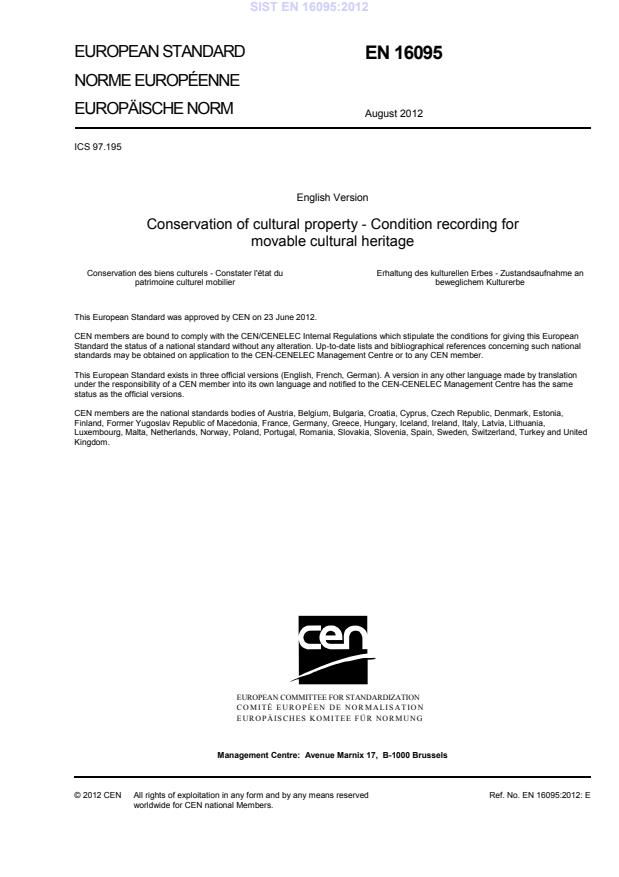
EUROPEAN STANDARD NORME EUROPÉENNE EUROPÄISCHE NORM
EN 16095
August 2012 ICS 97.195 English Version
Conservation of cultural property - Condition recording for movable cultural heritage
Conservation des biens culturels - Constater l'état du patrimoine culturel mobilier
Erhaltung des kulturellen Erbes - Zustandsaufnahme an beweglichem Kulturerbe This European Standard was approved by CEN on 23 June 2012.
CEN members are bound to comply with the CEN/CENELEC Internal Regulations which stipulate the conditions for giving this European Standard the status of a national standard without any alteration. Up-to-date lists and bibliographical references concerning such national standards may be obtained on application to the CEN-CENELEC Management Centre or to any CEN member.
This European Standard exists in three official versions (English, French, German). A version in any other language made by translation under the responsibility of a CEN member into its own language and notified to the CEN-CENELEC Management Centre has the same status as the official versions.
CEN members are the national standards bodies of Austria, Belgium, Bulgaria, Croatia, Cyprus, Czech Republic, Denmark, Estonia, Finland, Former Yugoslav Republic of Macedonia, France, Germany, Greece, Hungary, Iceland, Ireland, Italy, Latvia, Lithuania, Luxembourg, Malta, Netherlands, Norway, Poland, Portugal, Romania, Slovakia, Slovenia, Spain, Sweden, Switzerland, Turkey and United Kingdom.
EUROPEAN COMMITTEE FOR STANDARDIZATION
COMITÉ EUROPÉEN DE NORMALISATION EUROPÄISCHES KOMITEE FÜR NORMUNG
Management Centre:
Avenue Marnix 17,
B-1000 Brussels © 2012 CEN All rights of exploitation in any form and by any means reserved worldwide for CEN national Members. Ref. No. EN 16095:2012: ESIST EN 16095:2012
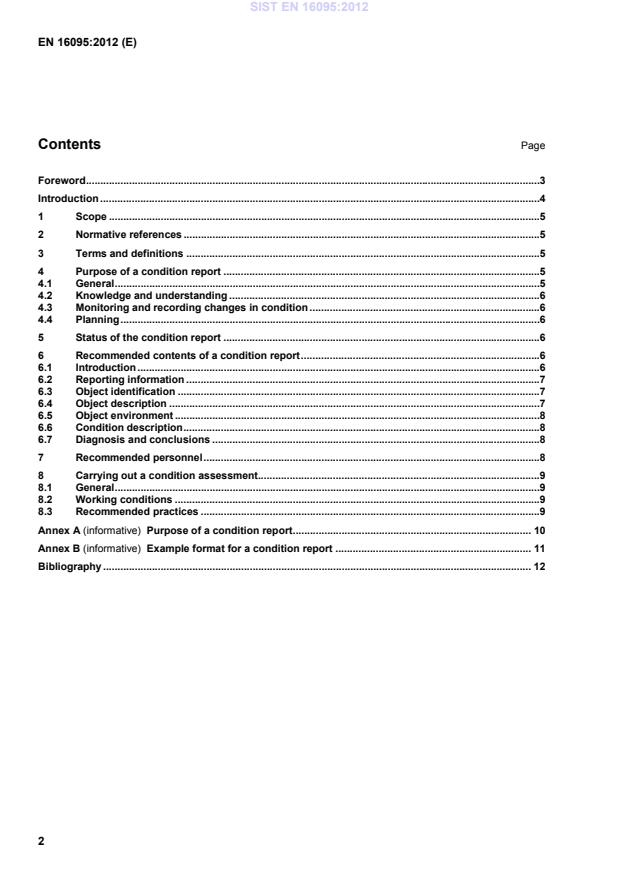
Purpose of a condition report . 10Annex B (informative)
Example format for a condition report . 11Bibliography . 12 SIST EN 16095:2012
Packing principles for transport 3 Terms and definitions For the purposes of this document, the following terms and definitions apply. 3.1 condition report record of condition for a specific purpose, dated and authored Note 1 to entry: A condition report normally results from a condition survey. [SOURCE: EN 15898:2011] 3.2 condition survey inspection to assess condition [SOURCE: EN 15898:2011] 3.3 diagnosis process of identifying the present condition of an object and determining the nature and causes of any change, as well as the conclusions drawn Note 1 to entry: Diagnosis is based on observation, investigation, historical analysis, etc. [SOURCE: EN 15898:2011] 4 Purpose of a condition report 4.1 General The purpose of making a condition report is to record the condition of cultural heritage following an inspection and assessment. The contents of a condition report can provide not only technical data but also knowledge and understanding about an object or collection, information produced by monitoring its change over time and information that will assist with future planning. Changes in the condition of cultural heritage may diminish its significance and reduce its potential benefits to present and future generations. SIST EN 16095:2012
...