


FprEN 18215
(Main)Innovation management professionals - Competence requirements
General Information
- Abstract
This document defines the requirements related to the professional activity of individuals active in the innovation management field at different levels of complexity for all types of organizations, regardless of type, sector, maturity-level or size.
The competence requirements contained in this document are specified based on the identified tasks and activities in terms of knowledge, skills, autonomy and responsibility. The different professional profiles align to the European Qualifications Framework (EQF) to facilitate harmonization to the evaluation and validation of learning outcomes. This document can be used in relation to conformity assessment processes.
- Status
- Not Published
- Publication Date
- 16-Dec-2026
- Technical Committee
- CEN/TC 389 - Innovation Management
- Drafting Committee
- WG 7 - Innovation Management Professionals
- Current Stage
- 4599 - Dispatch of FV draft to CMC - Finalization for Vote
- Start Date
- 03-Jul-2026
- Due Date
- 24-Sep-2025
- Completion Date
- 03-Jul-2026

Overview
FprEN 18215: Innovation management professionals - Competence requirements is a European draft standard developed by CEN/TC 389. It defines competence requirements for individuals engaged in innovation management, regardless of organizational type, sector, size, or maturity-level. This standard specifies key professional profiles, their main tasks, and activities in terms of knowledge, skills, autonomy, and responsibility. The alignment with the European Qualifications Framework (EQF) supports harmonization in evaluating and validating innovation management competence and learning outcomes.
The document guides the evaluation, professional development, recruitment, and certification of innovation management professionals. It applies to various organizational contexts and is suitable for professionals, organizations, accreditation bodies, and training providers.
Key Topics
- Competence Requirements: Clearly describes what knowledge and skills innovation management professionals need, as well as the expected levels of autonomy and responsibility.
- Professional Profiles:
- Chief Innovation Officer (strategic leadership)
- Innovation Manager (strategic-operational management)
- Innovation Specialist (tactical-managerial role)
- Innovation Technician (operational support)
- Innovation Assistant (operational support under supervision)
- Tasks and Activities: Consistently defined across profiles, with complexity and accountability scaling with seniority. Key tasks include:
- Managing relationships within and outside the organization
- Collecting and managing innovation-related data and knowledge
- Creating and implementing innovation strategies
- Selecting and assessing innovation initiatives
- Applying Innovation Management Principles (IMPs)
- Supporting, implementing, and integrating Innovation Management Systems (IMS)
- Communication, training, and advisory on innovation management
- Integration with EQF: Professional profiles and competence requirements are mapped to the EQF levels, ensuring transparency and mutual recognition of qualifications across Europe.
- Evaluation and Validation: Provides a framework for the objective assessment of knowledge, skills, and learning outcomes for conformity assessment and certification.
- Ethics and Professional Conduct: Includes guidance on ethical principles, professional integrity, and codes of conduct, ensuring responsible innovation management practice.
Applications
FprEN 18215 supports multiple practical applications:
- Professional Development: Helps innovation management professionals identify required competencies and plan career advancement.
- Recruitment and HR: Aids organizations in defining job descriptions, selecting candidates, and designing innovation teams aligned with best practices.
- Training and Certification: Serves as a reference for developing training programs, certification schemes, and professional qualifications in innovation management.
- Conformity Assessment: Enables transparent and harmonized assessment of individuals' competencies for accreditation and validation.
- Organizational Excellence: Supports organizations aiming to establish or optimize their innovation management systems (IMS), improve innovation outcomes, and foster an innovative culture.
- Cross-sectoral Relevance: Applicable to both private and public sectors, including research, product development, and management of complex innovation projects.
Related Standards
FprEN 18215 complements and is compatible with other key standards and frameworks:
- ISO 56000 Family: Provides terminology, principles, and core concepts for innovation management systems.
- European Qualifications Framework (EQF): Harmonizes competence and qualification levels across Europe.
- Other Management System Standards: Aligns with sector-specific standards such as ISO 9001 (Quality) or ISO 14001 (Environmental Management), promoting integrated system approaches.
- CEN Guide 14:2010: Offers methodological guidelines for developing European professional standards.
By detailing competence requirements for innovation management professionals, FprEN 18215 delivers a robust foundation for talent development, professionalization, and innovation capability across organizations and sectors.
Get Certified
Connect with accredited certification bodies for this standard

BSI Group
BSI (British Standards Institution) is the business standards company that helps organizations make excellence a habit.

Bureau Veritas
Bureau Veritas is a world leader in laboratory testing, inspection and certification services.

DNV
DNV is an independent assurance and risk management provider.
Sponsored listings
Frequently Asked Questions
FprEN 18215 is a draft published by the European Committee for Standardization (CEN). Its full title is "Innovation management professionals - Competence requirements". This standard covers: This document defines the requirements related to the professional activity of individuals active in the innovation management field at different levels of complexity for all types of organizations, regardless of type, sector, maturity-level or size. The competence requirements contained in this document are specified based on the identified tasks and activities in terms of knowledge, skills, autonomy and responsibility. The different professional profiles align to the European Qualifications Framework (EQF) to facilitate harmonization to the evaluation and validation of learning outcomes. This document can be used in relation to conformity assessment processes.
This document defines the requirements related to the professional activity of individuals active in the innovation management field at different levels of complexity for all types of organizations, regardless of type, sector, maturity-level or size. The competence requirements contained in this document are specified based on the identified tasks and activities in terms of knowledge, skills, autonomy and responsibility. The different professional profiles align to the European Qualifications Framework (EQF) to facilitate harmonization to the evaluation and validation of learning outcomes. This document can be used in relation to conformity assessment processes.
FprEN 18215 is classified under the following ICS (International Classification for Standards) categories: 03.100.30 - Management of human resources; 03.100.40 - Research and development. The ICS classification helps identify the subject area and facilitates finding related standards.
FprEN 18215 is available in PDF format for immediate download after purchase. The document can be added to your cart and obtained through the secure checkout process. Digital delivery ensures instant access to the complete standard document.
Standards Content (Sample)
SLOVENSKI STANDARD
01-december-2025
Strokovnjaki za upravljanje inovacij - Zahteve za usposobljenost
Innovation management professionals - Competence requirements
Fachleute für Innovationsmanagement - Anforderungen an Wissen, Fähigkeiten,
Autonomie und Verantwortlichkeit
Professionnels du management de l'innovation - Exigences en matière de compétences
Ta slovenski standard je istoveten z: prEN 18215
ICS:
03.100.30 Vodenje ljudi Management of human
resources
03.100.40 Raziskave in razvoj Research and development
2003-01.Slovenski inštitut za standardizacijo. Razmnoževanje celote ali delov tega standarda ni dovoljeno.
DRAFT
EUROPEAN STANDARD
prEN 18215
NORME EUROPÉENNE
EUROPÄISCHE NORM
October 2025
ICS 03.100.40
English Version
Innovation management professionals - Competence
requirements
Professionnels du management de l'innovation - Fachleute für Innovationsmanagement -
Exigences en matière de compétences Anforderungen an Wissen, Fähigkeiten, Autonomie und
Verantwortlichkeit
This draft European Standard is submitted to CEN members for enquiry. It has been drawn up by the Technical Committee
CEN/TC 389.
If this draft becomes a European Standard, CEN members are bound to comply with the CEN/CENELEC Internal Regulations
which stipulate the conditions for giving this European Standard the status of a national standard without any alteration.
This draft European Standard was established by CEN in three official versions (English, French, German). A version in any other
language made by translation under the responsibility of a CEN member into its own language and notified to the CEN-CENELEC
Management Centre has the same status as the official versions.
CEN members are the national standards bodies of Austria, Belgium, Bulgaria, Croatia, Cyprus, Czech Republic, Denmark, Estonia,
Finland, France, Germany, Greece, Hungary, Iceland, Ireland, Italy, Latvia, Lithuania, Luxembourg, Malta, Netherlands, Norway,
Poland, Portugal, Republic of North Macedonia, Romania, Serbia, Slovakia, Slovenia, Spain, Sweden, Switzerland, Türkiye and
United Kingdom.
Recipients of this draft are invited to submit, with their comments, notification of any relevant patent rights of which they are
aware and to provide supporting documentation.
Warning : This document is not a European Standard. It is distributed for review and comments. It is subject to change without
notice and shall not be referred to as a European Standard.
EUROPEAN COMMITTEE FOR STANDARDIZATION
COMITÉ EUROPÉEN DE NORMALISATION
EUROPÄISCHES KOMITEE FÜR NORMUNG
CEN-CENELEC Management Centre: Rue de la Science 23, B-1040 Brussels
© 2025 CEN All rights of exploitation in any form and by any means reserved Ref. No. prEN 18215:2025 E
worldwide for CEN national Members.
prEN 18215:2025 (E)
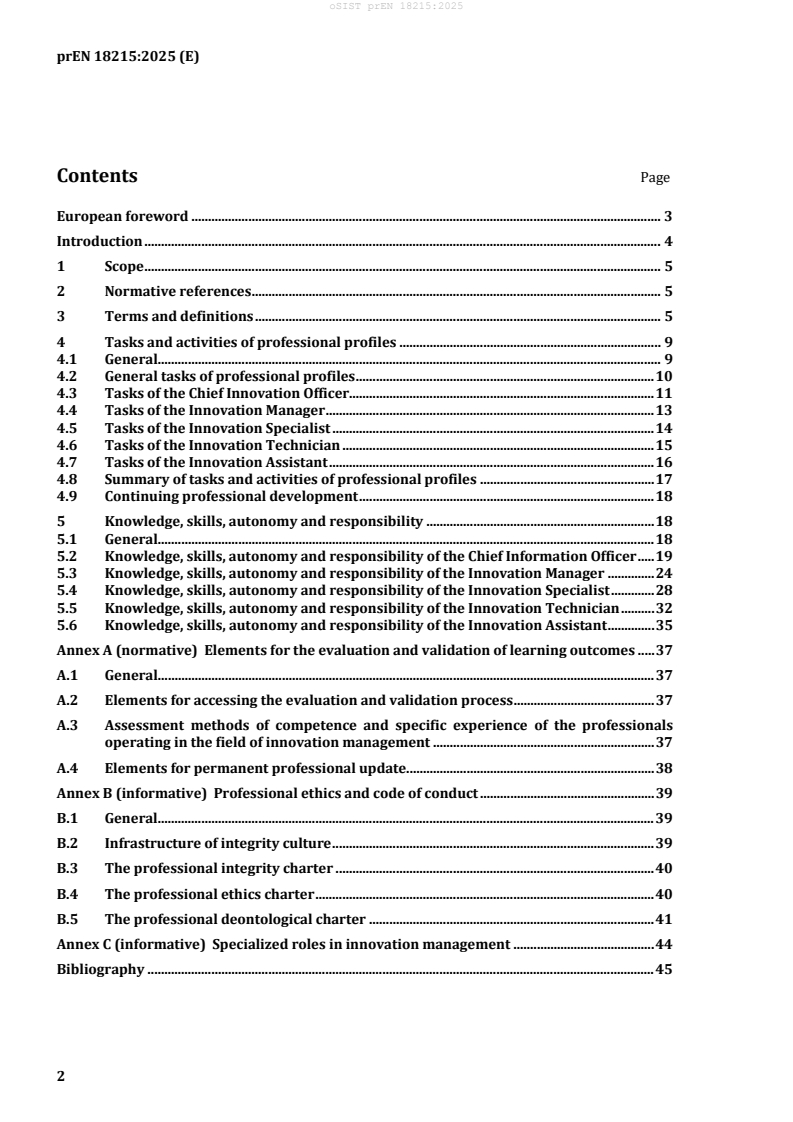
Contents Page
European foreword . 3
Introduction . 4
1 Scope . 5
2 Normative references . 5
3 Terms and definitions . 5
4 Tasks and activities of professional profiles . 9
4.1 General. 9
4.2 General tasks of professional profiles . 10
4.3 Tasks of the Chief Innovation Officer. 11
4.4 Tasks of the Innovation Manager . 13
4.5 Tasks of the Innovation Specialist . 14
4.6 Tasks of the Innovation Technician . 15
4.7 Tasks of the Innovation Assistant . 16
4.8 Summary of tasks and activities of professional profiles . 17
4.9 Continuing professional development . 18
5 Knowledge, skills, autonomy and responsibility . 18
5.1 General. 18
5.2 Knowledge, skills, autonomy and responsibility of the Chief Information Officer . 19
5.3 Knowledge, skills, autonomy and responsibility of the Innovation Manager . 24
5.4 Knowledge, skills, autonomy and responsibility of the Innovation Specialist . 28
5.5 Knowledge, skills, autonomy and responsibility of the Innovation Technician . 32
5.6 Knowledge, skills, autonomy and responsibility of the Innovation Assistant . 35
Annex A (normative) Elements for the evaluation and validation of learning outcomes . 37
A.1 General. 37
A.2 Elements for accessing the evaluation and validation process . 37
A.3 Assessment methods of competence and specific experience of the professionals
operating in the field of innovation management . 37
A.4 Elements for permanent professional update. 38
Annex B (informative) Professional ethics and code of conduct . 39
B.1 General. 39
B.2 Infrastructure of integrity culture . 39
B.3 The professional integrity charter . 40
B.4 The professional ethics charter . 40
B.5 The professional deontological charter . 41
Annex C (informative) Specialized roles in innovation management . 44
Bibliography . 45
prEN 18215:2025 (E)
European foreword
This document (prEN 18215:2025) has been prepared by Technical Committee CEN/TC 389 “Innovation
Management”, the secretariat of which is held by UNE.
This document is currently submitted to the CEN Enquiry.
prEN 18215:2025 (E)
Introduction
Defining the requirements for professional profiles in the field of innovation management is crucial for
identifying the core knowledge, skills, and competencies that define these roles.
This document applies to professional profiles in this domain, irrespective of working methods or types
of employment relationships. The tasks and activities associated with these roles are described based on
the actual functions carried out by professionals across diverse work environments.
The profiles outlined in this document are not intended to be exhaustive but serve as a flexible framework
applicable to various organizational contexts within the innovation management sector.
The document is primarily targeted at professionals seeking career development guidance, organizations
designing their internal innovation management structures and recruitment strategies, and entities
involved in training, accreditation, or certification services.
From a methodological perspective, the following key aspects were established:
— Basic terms and definitions (Clause 3): The terms and definitions adopted are primarily derived from
the European Qualifications Framework (EQF) and relevant EU terminology.
— Tasks and activities identification (Clause 4): To describe the requirements related to knowledge,
skills, autonomy, and responsibility for the specific professional profile, it is essential to first identify
the tasks and specific activities associated with the profession.
— Professional requirements (Clause 5): The requirements for the professional profile are defined in
terms of knowledge, skills, autonomy, and responsibility. Where applicable, expected personal
capabilities are also specified. The level of autonomy and responsibility associated with the
professional activities is indicated, using the EQF descriptors as a reference.
— Elements for the evaluation and validation of learning outcomes (Annex A – normative): This annex
provides useful elements for the objective evaluation and validation of learning outcomes for
professional profiles operating in the field of innovation management, with reference to the
competence elements defined in Clause 5.
— Ethical and deontological aspects (Annex B - informative): This annex includes guidance on
applicable ethical and deontological principles, alongside a general framework for fostering a culture
of professional integrity. This framework is particularly relevant for protecting consumers, users, and
other stakeholders.
— Specialized roles in Innovation Management (Annex C – informative): This annex presents a set of
specialized roles reflecting emerging practices in innovation management, which may complement
the general professional profiles defined in this document.
— Bibliography: A comprehensive list of applicable European references and other relevant documents
is provided to support the accurate understanding and application of this document.
Where relevant, the guidelines specified in the CEN Guide 14:2010 are also followed.
prEN 18215:2025 (E)
1 Scope
This document defines the requirements related to the professional activity of individuals active in the
innovation management field at different levels of complexity for all types of organizations, regardless of
type, sector, maturity-level or size.
The competence requirements contained in this document are specified based on the identified tasks and
activities in terms of knowledge, skills, autonomy and responsibility. The different professional profiles
align to the European Qualifications Framework (EQF) to facilitate harmonization to the evaluation and
validation of learning outcomes. This document can be used in relation to conformity assessment
processes.
2 Normative references
There are no normative references in this document.
3 Terms and definitions
For the purposes of this document, the following terms and definitions apply.
ISO and IEC maintain terminology databases for use in standardization at the following addresses:
— ISO Online browsing platform: available at https://www.iso.org/obp/
— IEC Electropedia: available at https://www.electropedia.org/
3.1
innovation
new or changed entity, realizing or redistributing value
Note 1 to entry: Novelty and value are relative to, and determined by, the perception of the organization and
relevant interested parties.
Note 2 to entry: An innovation can be a product, service, process, model, method, etc.
Note 3 to entry: Innovation is an outcome. The word “innovation” sometimes refers to activities or processes
resulting in, or aiming for, innovation. When “innovation” is used in this sense, it should always be used with some
form of qualifier, e.g. “innovation activities”.
Note 4 to entry: For the purpose of statistical measurement, refer to the Oslo Manual by OECD/Eurostat [XX].
[SOURCE: ISO 56000:2025, 3.1.1]
3.2
Chief Innovation Officer
professional working in the field of innovation management at a political strategic level with a leading
role
Note 1 to entry: The professional in question is associated with an EQF level of autonomy and responsibility equal
to 8 (see 5.2).
3.3
Innovation Manager
professional working in the field of innovation management at a political-strategic level
prEN 18215:2025 (E)
Note 1 to entry: The professional in question is associated with an EQF level of autonomy and responsibility equal
to 7 (see 5.3).
3.4
Innovation Specialist
professional working in the field of innovation management at a tactical-managerial level
Note 1 to entry: The professional in question is associated with an EQF level of autonomy and responsibility equal
to 6 (see 5.4).
3.5
Innovation Technician
professional working in the field of innovation management at an operational level
Note 1 to entry: The professional in question is associated with an EQF level of autonomy and responsibility equal
to 5 (see 5.5).
3.6
Innovation Assistant
professional working in the field of innovation management at an operational level, under supervision
Note 1 to entry: The professional in question is associated with an EQF level of autonomy and responsibility equal
to 4 (see 5.6).
3.7
innovation management
management with regard to innovation
Note 1 to entry: Innovation management can include establishing an innovation policy, innovation vision,
innovation strategy, and innovation objectives, and organizational structures and innovation processes to achieve
those objectives through planning, support, operations, performance evaluation and improvement.
[SOURCE: ISO 56000:2025, 3.1.2.1]
3.8
innovation management system
management system with regard to innovation
Note 1 to entry: An innovation management system can be part of a general or integrated management system of
an organization.
[SOURCE: ISO 56000:2025, 3.1.3.3]
3.9
innovation ecosystem
system of interdependent persons or organizations collectively or collaboratively developing or enabling
innovation
Note 1 to entry: Ecosystem participants can include private and public organizations.
Note 2 to entry: The scope of an innovation ecosystem can be defined in terms of a platform, set of technologies,
knowledge area, set of skills, sector, community or geographic area.
Note 3 to entry: An innovation ecosystem can range from being an arbitrary group of participants to an
orchestrated, multi-party community based on collaborative innovation partnerships.
prEN 18215:2025 (E)
[SOURCE: ISO 56000:2025, 3.1.3.4]
3.10
innovation activity
activity with regard to innovation
Note 1 to entry: Innovation activities can be planned or unplanned and are normally conducted in the context of
uncertainty.
Note 2 to entry: Innovation activities are directly or indirectly aiming for innovation. Not all innovation activities
result in innovation.
[SOURCE: ISO 56000:2025, 3.1.4]
3.11
culture
shared pattern of beliefs, values and behaviours of an organization or community over time
[SOURCE: ISO 56000:2025, 3.2.3]
3.12
uncertainty
state of deficiency of information, understanding, or knowledge
Note 1 to entry: Uncertainty can be related to the consequences or likelihood of an event, or the characteristics of
an entity.
Note 2 to entry: Uncertainties can be managed by systematically addressing assumptions regarding the
consequences, likelihood or characteristics of events and entities, to gain information, understanding and
knowledge.
[SOURCE: ISO 56000:2025, 3.2.12]
3.13
risk
effect of uncertainty (3.12)
Note 1 to entry: An effect is a deviation from the expected — positive or negative.
Note 2 to entry: Uncertainty is the state, even partial, of deficiency of information related to, understanding or
knowledge of, an event, its consequence, or likelihood.
Note 3 to entry: Risk is often characterized by reference to potential events and consequences, or a combination of
these.
Note 4 to entry: Risk is often expressed in terms of a combination of the consequences of an event (including
changes in circumstances) and the associated likelihood of occurrence.
[SOURCE: ISO 56000:2025, 3.2.13]
3.14
antifragile
ability to gain from stressors, uncertainty (3.12) and risk (3.13)
Note 1 to entry: Stressors can be shocks, failures, disruptions, emergencies, crises, etc.
prEN 18215:2025 (E)
Note 2 to entry: An antifragile entity can thrive and/or evolve from unexpected stressors, take advantage of
uncertainty and positively assume risk.
[SOURCE: ISO 56000:2025, 3.2.14]
3.15
value
gains from satisfying needs and expectations, in relation to the resources used
EXAMPLE Revenues, savings, productivity, sustainability, satisfaction, empowerment, engagement,
experience, trust.
Note 1 to entry: Value is relative to, and determined by the perception of, the organization and interested parties.
Note 2 to entry: Value can be financial or non-financial.
Note 3 to entry: Value can be created, realized, acquired, redistributed, shared, lost or destroyed.
Note 4 to entry: The value of an entity is generally determined in terms of the amount of other entities for which it
can be exchanged.
Note 5 to entry: The word “value” sometimes refers to a (numerical) unit of data, e.g. the output from measurement,
and “values” sometimes refers to principles or standards of behaviour, e.g. included in the concept of culture (3.11).
When “value” is used in these senses, it should always be used with some form of qualifier, e.g. “numerical value” or
the meaning should be obvious from the context.
[SOURCE: ISO 56000:2025, 3.7.7]
3.16
knowledge
result of the assimilation of information through learning
Note 1 to entry: Knowledge can be acquired through, for example, research, experience, education and user
feedback.
Note 2 to entry: Knowledge includes information, facts, principles, theories and practices that is related to a field
of work or study.
Note 3 to entry: Knowledge can be individual or collective. Collective knowledge is gained from people
collaborating and releasing their tacit and subconscious knowledge.
[SOURCE: ISO 56000:2025, 3.4.1]
3.17
skill
ability to perform a task or activity
prEN 18215:2025 (E)
Note 1 to entry: Skills can be acquired through education, training, experience or other means.
[SOURCE: ISO 56000:2025, 3.4.4]
3.18
competence
competency
ability to apply knowledge (3.16) and skills (3.17) to achieve intended results
[SOURCE: ISO 56000:2025, 3.4.2]
3.19
autonomy and responsibility
ability of the individual to apply knowledge (3.16) and skills (3.17) autonomously and with responsibility
[SOURCE: EQF, Annex I, definition h), modified - the term “learner” has been replaced by the term
“individual”]
3.20
formal learning
learning process deriving from training activities, intentional and structured, carried out by
entities/institutions of education and training recognized by a competent authority
Note 1 to entry: Formal learning can involve the issues of certificate with legal value.
3.21
informal learning
learning process deriving from work experiences, from family life and also from leisure time
Note 1 to entry: Informal learning is not a deliberately structured activity and sometimes learning is not
intentional.
3.22
non-formal learning
learning process resulting from training activities, intentional and structured, implemented in any field
other than formal
Note 1 to entry: Such a training does not issue a certificate with legal value.
4 Tasks and activities of professional profiles
4.1 General
This document defines five distinct professional levels, the related tasks and specific activities of which
are described in the following subclauses:
— Chief Innovation Officer: 4.3,
— Innovation Manager: 4.4,
— Innovation Specialist: 4.5,
— Innovation Technician: 4.6,
— Innovation Assistant: 4.7.
prEN 18215:2025 (E)
The tasks and specific activities attributed to each level reflect the intention to identify the different
organizational levels at which these professionals are expected to operate, in accordance with the
corresponding definitions (see 3.2, 3.3, 3.4, 3.5, and 3.6). These levels are identified as:
— political-strategic,
— tactical-managerial, and
— operational.
This approach is consistent with both the characterization of the EQF descriptors (see 5.2 to 5.6), as well
as with the HS-based approach used in management systems.
Annex C provides examples of specialized roles that may be assumed in addition to the general
professional profiles, depending on the organizational context.
The formulation of the tasks presented in the following clauses is based on the following methodological
considerations:
— some tasks are common to all professional levels, but are performed with different degrees of
autonomy and responsibility, in accordance with the respective EQF level;
— other tasks are exclusive to higher professional levels, as they require advanced competence and the
capacity to act with strategic and organizational impact;
— professionals at a higher EQF level perform additional and distinctive tasks;
— the performance of such additional and distinctive tasks requires the acquisition and application of
additional or advanced knowledge and skills (see 5.1).
In light of these considerations, subclause 4.2 defines the general tasks, which are subsequently detailed
through the specific activities corresponding to each professional level in 4.3 to 4.7.
4.2 General tasks of professional profiles
The following set of general tasks outlines the key activities carried out by professionals involved in the
field of innovation management.
These tasks follow a logical sequence and cover the key activity areas of innovation management, from
building relationships and gathering information to defining strategy, managing initiatives, and, where
applicable, integrating innovation into organizational systems.
Each task is performed with a corresponding degree of knowledge, skills, and autonomy and
responsibility appropriate to each profile, according to the related EQF level also.
The tasks are defined as follows, together with brief descriptions which are intended to support
understanding and implementation:
• T1 – Manage relationships with relevant people and functions within and outside the
organization in the innovation field of the organization
Initiating and maintaining relationships within the organization and with the external innovation
ecosystem to enable information flow, cooperation, and alignment.
• T2 – Gather, structure, interpret, and manage data, information and knowledge within the
innovation field of the organization
Developing a robust knowledge base to support strategic and operational innovation decisions.
prEN 18215:2025 (E)
• T3 – Establish and implement the innovation strategy and related objectives
Formulating strategic directions and innovation goals based on contextual analysis and
organizational ambition.
• T4 – Take decisions about innovation initiatives and assess their impact
Selecting, prioritizing and committing to specific innovation actions, in line with strategic intent.
• T5 – Undertake innovation paths according to the ISO Standard 5600X family (where
appropriate).
Undertaking innovation paths with reference to the ISO 5600X standards, which provide guidance
for structured and coherent approaches to innovation.
• T6 – Apply Innovation Management Principles (IMPs) within the organization's management
system
Integrate Innovation Management Principles (IMPs) into the organization and its processes to
support and align innovation activities with strategic objectives.
• T7 – Adopt an HS-Based (Harmonized Structure) approach to manage the organization's
innovation initiatives
Structuring innovation processes using a consistent and integrated management framework.
• T8 – Make a strategic decision to have an IMS (where applicable)
Formally committing to the establishment of an Innovation Management System to structure and
manage innovation processes within the organization
• T9 – Implement, maintain, and improve the IMS (where applicable)
Implementing, managing, and continuously improving the Innovation Management System to ensure
its effectiveness and alignment with organizational goals.
• T10 – Integrate the IMS with other management systems (where applicable)
Creating synergies by aligning the IMS with other existing management systems, such as those for
quality or environment.
• T11 – Communicate information, train, and advise on Innovation Management
Fostering innovation capabilities and culture through targeted internal communication, training, and
advisory support on Innovation Management.
4.3 Tasks of the Chief Innovation Officer
The tasks and specific activities of the Chief Innovation Officer are defined as follows:
• T1 – Manage relationships with relevant people and functions within and outside the
organization in the innovation field of the organization
prEN 18215:2025 (E)
Provide strategic leadership in managing key relationships within the organization's innovation field,
ensuring alignment with its innovation strategy and fostering active engagement with external
stakeholders within the innovation ecosystem.
• T2 – Gather, structure, interpret, and manage data, information and knowledge within the
innovation field of organization
Oversee the strategic governance of data and knowledge, ensuring alignment with strategic foresight
and decision-making within the innovation field of the organization.
• T3 – Establish and implement the innovation strategy and related objectives
Lead the formulation and implementation of the innovation strategy, aligning it with the
organization’s long-term goals and vision. Ensure that innovation objectives are clearly defined,
communicated, and integrated into organizational planning and decision-making processes.
• T4 - Take decisions about innovation initiatives and assessing their impact
Provide visionary guidance and thought leadership at the highest organizational level, shaping
policies and frameworks for innovation initiatives, making high-level strategic decisions, and
evaluating their impact on the organization and its ecosystem.
• T5 – Undertake innovation paths according to the ISO Standard 5600X family (where
appropriate)
Provide strategic direction and influence policies to shape and enhance innovation paths in
alignment with the ISO 5600X standards at both organizational and industry levels.
• T6 – Apply Innovation Management Principles (IMPs) within the organization's management
system
Provide strategic leadership in embedding Innovation Management Principles (IMPs) across the
organization, ensuring their integration into organization’s governance, business strategy, and
decision-making processes, while generating value and fostering a culture of innovation at all levels.
• T7 – Adopt an HS-Based (Harmonized Structure) approach to manage organization's
innovation initiatives
Provide strategic direction and influence policies to advance the adoption of an HS-based approach
at both organizational and industry levels in innovation initiatives.
• T8 – Make a strategic decision to have an IMS (where applicable)
Provide strategic leadership in the decision-making process regarding the adoption of an IMS,
ensuring alignment with organization’s objectives, and long-term sustainability.
• T9 – Implement, maintain, and improve the IMS (where applicable)
Provide strategic leadership in the implementation, maintenance, and continuous improvement of
an IMS, ensuring alignment with organization governance, regulatory frameworks, and principles of
sustainability, social responsibility, and integrity.
• T10 – Integrate the IMS with other management systems (where applicable)
prEN 18215:2025 (E)
Provide strategic oversight and governance for the integration of the IMS with other management
systems, ensuring alignment with organization’s policies, regulatory requirements, and global best
practices.
• T11 – Communicate information, train, and advise on Innovation Management
Provide strategic leadership in the communication of information and training on innovation
management, while acting as a key advisor to top management in shaping innovation strategies and
initiatives.
4.4 Tasks of the Innovation Manager
The tasks and specific activities of the Innovation Manager are defined as follows:
• T1 – Manage relationships with relevant people and functions within and outside the
organization in the innovation field of the organization
Manage key relationships within the organization's innovation field, ensuring alignment with its
innovation strategy and fostering active engagement with external stakeholders within the
innovation ecosystem.
• T2 – Gather, structure, interpret, and manage data, information and knowledge within the
innovation field of organization
Lead the gathering, structuring, interpretation, and continuous management of innovation-related
data and knowledge within the innovation field of the organization, ensuring they support decision-
making and strategic foresight.
• T3 – Establish and implement the innovation strategy and related objectives
Assume a leadership role in developing and implementing the innovation strategy by defining
actionable objectives. Ensure these objectives align with the organization’s operational goals, and
coordinate innovation initiatives across the organization and track progress towards achieving
strategic outcomes.
• T4 – Take decisions about innovation initiatives and assessing their impact
Provide leadership within the organization, including at top management levels, in making strategic
decisions regarding innovation initiatives, and assessing their impact on the organization’s
performance and alignment with long-term goals.
• T5 – Undertake innovation paths according to the ISO Standard 5600X family (where
appropriate)
Assume a leadership role within the organization and act as an advisor to top management in making
strategic decisions for innovation paths, in line with ISO 5600X standards, to drive organizational
innovation maturity.
• T6 – Apply Innovation Management Principles (IMPs) within the organization's management
system
Lead and advise top management on the application of Innovation Management Principles (IMPs) to
generate value and foster a culture of innovation within the organization’s management system,
ensuring alignment with strategic goals.
prEN 18215:2025 (E)
• T7 – Adopt an HS-Based (Harmonized Structure) approach to manage organization's
innovation initiatives
Lead and advise top management in adopting a Harmonized Structure (HS)-based approach to
manage and optimize the organization's innovation initiatives, ensuring consistency and integration
across processes.
• T8 – Make a strategic decision to have an IMS (where applicable)
Advise top management on the strategic decision to adopt an Innovation Management System (IMS),
ensuring alignment with the organization’s objectives, innovation goals, and long-term
sustainability.
• T9 – Implement, maintain, and improve the IMS (where applicable)
Assume a leadership role within the organization and act as an advisor to top management to
implement, maintain, and improve an IMS, according to principles of sustainability, social
responsibility, and integrity.
• T10 – Integrate the IMS with other management systems (where applicable)
Assume a leadership role within the organization and act as an advisor to top management to guide
the integration of the IMS with other relevant management systems, ensuring alignment with
organizational policies, regulatory requirements, and other industry best practices.
• T11 – Communicate information, train, and advise on Innovation Management
Assume a leadership role to support key people and functions within the organization, including top
management, by providing information, training, and advisory in the field of innovation management
of the organization.
4.5 Tasks of the Innovation Specialist
The tasks and specific activities of the Innovation Specialist are defined as follows:
• T1 – Manage relationships with relevant people and functions within and outside the
organization in the innovation field of the organization
Manage relationships with relevant people and functions within the organization, including top
management, in its specific innovation field, as well as with external stakeholders.
• T2 – Gather, structure, interpret, and manage data, information and knowledge within the
innovation field of organization
Gather, structure, interpret, manage innovation-related data and knowledge and ensure continuous
updating within the organization’s innovation field.
• T3 – Establish and implement the innovation strategy and related objectives
Support the implementation of the innovation strategy by contributing to the definition of specific
objectives, supporting the development of action plans, and executing innovation-related tasks
within the defined scope of responsibility.
• T4 – Take decisions about innovation initiatives and assessing their impact
prEN 18215:2025 (E)
Assume a proactive role within the organization, including collaboration with top management, in
supporting decision-making processes and assessing the impact of innovation initiatives.
• T5 – Undertake innovation paths according to the ISO Standard 5600X family (where
appropriate)
Assume a proactive role within the organization, including interactions with top management, in
undertaking innovation paths according to the ISO 5600X standards.
• T6 – Apply Innovation Management Principles (IMPs) within the organization's management
system
Assume a proactive role within the organization, including top management, to facilitate the
application of Innovation Management Principles (IMPs) with the purpose of generating value and
promoting a culture of innovation, within the organization's management system.
• T7 – Adopt an HS-Based (Harmonized Structure) approach to manage organization's
innovation initiatives
Assume a proactive role within the organization, including interactions with top management, in
facilitating the adoption of an HS-based approach in (its) innovation initiatives.
• T8 – Make a strategic decision to have an IMS (where applicable)
Assume a proactive role in supporting top management in making the strategic decision to adopt an
IMS, ensuring consistency with the organization’s objectives and long-term sustainability.
• T9 – Implement, maintain, and improve the IMS (where applicable)
Take a proactive role within the organization, including interactions with top management, to
implement, maintain, and improve an IMS, according to principles of sustainability, social
responsibility, and integrity.
• T10 – Integrate the IMS with other management systems (where applicable)
Assume a proactive role within the organization, including interactions with top management, in
facilitating the integration of the IMS with other management systems.
• T11 – Communicate information, train, and advise on Innovation Management
Support relevant people and functions within the organization by providing information and training
on innovation management.
4.6 Tasks of the Innovation Technician
The tasks and specific activities of the Innovation Technician are defined as follows:
• T1 – Manage relationships with relevant people and functions within and outside the
organization in the innovation field of the organization
Support the management of relationships within the organization in the specific innovation field,
facilitating communication and collaboration across departments. Assist in fostering engagement
with external stakeholders within the innovation ecosystem.
prEN 18215:2025 (E)
• T2 – Gather, structure, interpret, and manage data, information and knowledge within the
innovation field of organization
Support in gathering, structuring, and interpreting innovation-related data and information. Support
the management of knowledge within the organization, ensuring the data collected is organized and
accessible to relevant teams.
• T4 – Take decisions about innovation initiatives and assessing their impact
Support in evaluating the impact of innovation initiatives. Provide support for decision-making by
analysing relevant data, helping assess the outcomes of innovation activities in alignment with
organizational objectives.
• T5 – Undertake innovation paths according to the ISO Standard 5600X family (where
appropriate)
Support the implementation of innovation paths in alignment with the ISO 5600X standards. Assist
in the operational execution of innovation initiatives, ensuring they are conducted in accordance
with established best practices and standards.
• T7 –- Adopt an HS-Based (Harmonized Structure) approach to manage organization's
innovation initiatives
Support the adoption of an HS-Based (Harmonized Structure) approach within the organization’s
innovation initiatives. Assist in ensuring the consistency and integration of innovation processes
across the organization.
• T9 – Implement, maintain, and improve the IMS (where applicable)
Support in the implementation, maintenance, and improvement of the Innovation Management
System (IMS). Ensure that the system aligns with organizational needs and helps monitor innovation
performance, contributing to ongoing improvements in the system.
• T10 – Integrate the IMS with other management systems (where applicable)
Support the integration of the IMS with other management systems, ensuring that innovation
processes are aligned with the organization’s overall management structure and regulatory
requirements.
4.7 Tasks of the Innovation Assistant
The tasks and specific activities of the Innovation Assistant are defined as follows:
• T1 – Manage relationships with relevant people and functions within and outside the
organization in the innovation field of the organization
Assist in establishing and maintaining relationships within the organization in its specific innovation
field, supporting communication and collaboration activities under supervision, and contributing to
the circulation of information between relevant functions.
• T2 – Gather, structure, interpret, and manage data, information and knowledge within the
innovation field of organization
prEN 18215:2025 (E)
Assist in collecting, organizing, and updating data and information related to innovation activities
under supervision, ensuring that records are clear, accessible, and available to support team
activities.
• T5 – Undertake innovation paths according to the ISO Standard 5600X family (where
appropriate)
Assist in collecting and organizing information to support the adoption of innovation paths in
accordance with the ISO 5600X standards under supervision, contributing to the documentation and
basic tracking of related activities.
• T7 – Adopt an HS-Based (Harmonized Structure) approach to manage organization's
innovation initiatives
Assist in collecting and organizing information to support the adoption of an HS-based approach in
the innovation initiatives of the organization, under supervision, contributing to consistency in
documentation and basic reporting.
• T9 – Implement, maintain, and improve the IMS (where applicable)
Assist in collecting, organizing, and updating information to support the implementation,
maintenance, and improvement of the Innovation Management System (IMS) under supervision,
contributing to documentation and administrative follow-up.
• T10 – Integrate the IMS with other management systems (where applicable)
Assist in collecting and organizing information to support the integration of the IMS with other
management systems under supervision, contributing to the alignment of basic procedures and
documentation.
4.8 Summary of tasks and activities of professional profiles
The following Table 1 illustrates and summarizes, in matrix form, the correlation between the general
tasks and specific activities according to the level of professional covered by this document.
Table 1 — Summary of tasks and activities of professional profiles
Chief
Innovation Innovation Innovation Innovation
Innovation
General tasks Manager - Specialist - Technician Assistant –
Officer -
EQF 7 EQF 6 - EQF 5 EQF 4
EQF 8
T1 – Manage relationships with relevant people
and functions within and outside the organization See 4.3 See 4.4 See 4.5 See 4.6 See 4.7
in the innovation field of the organization
T2 – Gather, structure, interpret, and manage
data, information and knowledge within the See 4.3 See 4.4 See 4.5 See 4.6 See 4.7
innovation field of the organization
T3 – Establish and implement the innovation
See 4.3 See 4.4 See 4.5 - -
strategy and related objectives
T4 – Take decisions about innovation initiatives
See 4.3 See 4.4 See 4.5 See 4.6 -
and assess their impact
T5 – Undertake innovation paths according to the
See 4.3 See 4.4 See 4.5 - See 4.7
ISO Standard 5600X family (where appropriate)
prEN 18215:2025 (E)
Chief
Innovation Innovation Innovation Innovation
Innovation
General tasks Manager - Specialist - Technician Assistant –
Officer -
EQF 7 EQF 6 - EQF 5 EQF 4
EQF 8
T6 – Apply Innovation Management Principles
(IMPs) within the organization's management See 4.3 See 4.4 See 4.5 See 4.6 -
system
T7 – Adopt an HS-Based (Harmonized Structure)
approach to manage the organization's innovation See 4.3 See 4.4 See 4.5 See 4.6 See 4.7
initiatives
T8 – Make a strategic decision to have an IMS
See 4.3 See 4.4 See 4.5 - -
(where applicable)
T9 – Implement, maintain, and improve the IMS
See 4.3 See 4.4 See 4.5 See 4.6 See 4.7
(where applicable)
T10 – Integrate the IMS with other management
See 4.3 See 4.4 See 4.5 See 4.6 See 4.7
systems (where applicable)
T11 – Communicate information, train, and advise
See 4.3 See 4.4 See 4.5 - -
on Innovation Management
4.9 Continuing professional development
At the time of publication of this document, the maintenance, updating, and development of the
competences required for the professional profiles described herein are not subject to a specific or
mandatory training program.
Nevertheless, professionals are expected to engag
...