

EN 16161:2012
(Main)Water quality - Guidance on the use of in vivo absorption techniques for the estimation of chlorophyll-a concentration in marine and fresh water samples
- Abstract
This European Standard provides guidance in the use of in vivo absorption techniques to quantify
chlorophyll-a concentration in marine and fresh waters.
This European Standard is comprised of the following:
- definition of the equipment requirement;
- a priori data and mathematical tools;
- recommendations for verification of measurement system performance and consideration of factors that can influence measurements;
- listing of the procedures to be implemented.
- Status
- Published
- Publication Date
- 03-Jul-2012
- Technical Committee
- CEN/TC 230 - Water analysis
- Drafting Committee
- CEN/TC 230/WG 2 - Biological methods
- Current Stage
- 9093 - Decision to confirm - Review Enquiry
- Start Date
- 09-Feb-2022
- Completion Date
- 21-Oct-2026



Overview
EN 16161:2012 - "Water quality: Guidance on the use of in vivo absorption techniques for the estimation of chlorophyll‑a concentration in marine and fresh water samples" (CEN) provides practical guidance for using in vivo photometric (IVP) absorption methods to quantify chlorophyll‑a. The standard covers equipment requirements, a priori data and mathematical tools, verification of measurement system performance, factors influencing measurements, and step‑by‑step procedures for calibration, blank and sample measurement.
Key topics and technical requirements
- Measurement principle: IVP uses the characteristic chlorophyll‑a absorption feature near ~675 nm and a priori spectral knowledge to estimate concentration non‑destructively.
- Instrument requirements:
- Spectral range: 600–750 nm
- Spectral resolution: better than 10 nm
- Data capture intervals: 5 nm or smaller
- System must hold a unit chlorophyll‑a response spectrum (datum a*(λ)) and a clean water reference spectrum Iw(λ).
- Calibration & blanks:
- Record a reference spectrum using water free of chlorophyll (e.g., 0.1 µm filtered drinking water or representative filtered site water).
- Check blank stability (repeat measurements on reference water) and flush measurement cell to avoid residual fouling.
- Consider temperature and salinity differences between reference and sample spectra for low‑level accuracy (~1 µg/l).
- Data processing:
- Use a mathematical routine/curve‑fitting algorithm to determine the concentration C of unit chlorophyll spectra in the sample.
- Include uncertainty assessment and repeatability checks (see quality assurance).
- Factors influencing results: package effect, breakdown pigments, accessory pigments (chlorophyll‑b, phycocyanin), dissolved colour - detailed in annexes.
- Validation: Annexes detail methods to determine a*chl_sys, paired sample comparisons with extractive/HPLC methods, and spectrometric validation examples.
Practical applications and users
EN 16161:2012 is designed for:
- Environmental monitoring agencies and water quality laboratories conducting eutrophication and primary productivity surveys
- Coastal and inland water researchers needing rapid, non‑destructive chlorophyll‑a assessments
- Field teams performing high‑throughput surveys where results are needed within minutes
- Instrument manufacturers and instrument validation teams implementing IVP systems
- Programs that combine IVP with ISO 10260 extraction methods, HPLC pigment analysis, or fluorescence to identify inconsistencies and improve monitoring efficiency
Benefits include fast turnaround (measurements can be achieved in about one minute), no chemical extraction, and suitability for both field and laboratory use.
Related standards
- ISO 10260 (chlorophyll extraction methods) - complementary laboratory technique
- ENV 13005 (Guide to the expression of uncertainty in measurement) - referenced for uncertainty assessment
Keywords: EN 16161:2012, chlorophyll-a, in vivo absorption, IVP, water quality, spectrophotometer, eutrophication monitoring, chlorophyll measurement.
Relations
- Effective Date
- 28-Jan-2026
Get Certified
Connect with accredited certification bodies for this standard

CIS Institut d.o.o.
Personal Protective Equipment (PPE) certification body. Notified Body NB-2890 for EU Regulation 2016/425 PPE.

Kiwa BDA Testing
Building and construction product certification.
Kmetijski inštitut Slovenije
Agricultural Institute of Slovenia. Soil testing, plant health, agricultural product analysis.
Sponsored listings
Frequently Asked Questions
EN 16161:2012 is a standard published by the European Committee for Standardization (CEN). Its full title is "Water quality - Guidance on the use of in vivo absorption techniques for the estimation of chlorophyll-a concentration in marine and fresh water samples". This standard covers: This European Standard provides guidance in the use of in vivo absorption techniques to quantify chlorophyll-a concentration in marine and fresh waters. This European Standard is comprised of the following: - definition of the equipment requirement; - a priori data and mathematical tools; - recommendations for verification of measurement system performance and consideration of factors that can influence measurements; - listing of the procedures to be implemented.
This European Standard provides guidance in the use of in vivo absorption techniques to quantify chlorophyll-a concentration in marine and fresh waters. This European Standard is comprised of the following: - definition of the equipment requirement; - a priori data and mathematical tools; - recommendations for verification of measurement system performance and consideration of factors that can influence measurements; - listing of the procedures to be implemented.
EN 16161:2012 is classified under the following ICS (International Classification for Standards) categories: 13.060.70 - Examination of biological properties of water. The ICS classification helps identify the subject area and facilitates finding related standards.
EN 16161:2012 has the following relationships with other standards: It is inter standard links to ENV 13005:1999. Understanding these relationships helps ensure you are using the most current and applicable version of the standard.
EN 16161:2012 is available in PDF format for immediate download after purchase. The document can be added to your cart and obtained through the secure checkout process. Digital delivery ensures instant access to the complete standard document.
Standards Content (Sample)
2003-01.Slovenski inštitut za standardizacijo. Razmnoževanje celote ali delov tega standarda ni dovoljeno.Kakovost vode - Navodilo za uporabo absorpcijskih tehnik in vivo za oceno koncentracije klorofila a v morskih in celinskih vodahWasserbeschaffenheit - Anleitung für die Anwendung der in-vivo-Absorption zur Abschätzung des Chlorophyllgehaltes in Meer- und SüßwasserQualité de l'eau - Lignes directrices sur l'utilisation de techniques d'absorption in vivo pour l'estimation de la concentration de chlorophylle a dans des échantillons d'eau de mer et d'eau douceWater quality - Guidance on the use of in vivo absorption techniques for the estimation of chlorophyll-a concentration in marine and fresh water samples13.060.70Preiskava bioloških lastnosti vodeExamination of biological properties of water13.060.10Voda iz naravnih virovWater of natural resourcesICS:Ta slovenski standard je istoveten z:EN 16161:2012SIST EN 16161:2013en,fr,de01-januar-2013SIST EN 16161:2013SLOVENSKI
STANDARD
EUROPEAN STANDARD NORME EUROPÉENNE EUROPÄISCHE NORM
EN 16161
July 2012 ICS 13.060.70 English Version
Water quality - Guidance on the use of in vivo absorption techniques for the estimation of chlorophyll-a concentration in marine and fresh water samples
Qualité de l'eau - Lignes directrices sur l'utilisation des techniques d'absorption in vivo pour l'estimation de la concentration de chlorophylle-a dans les eaux douces et eaux marines
Wasserbeschaffenheit - Anleitung für die Anwendung der in-vivo-Absorption zur Abschätzung der Chlorophyll a-Konzentration in Meer- und Süßwasser This European Standard was approved by CEN on 17 May 2012.
CEN members are bound to comply with the CEN/CENELEC Internal Regulations which stipulate the conditions for giving this European Standard the status of a national standard without any alteration. Up-to-date lists and bibliographical references concerning such national standards may be obtained on application to the CEN-CENELEC Management Centre or to any CEN member.
This European Standard exists in three official versions (English, French, German). A version in any other language made by translation under the responsibility of a CEN member into its own language and notified to the CEN-CENELEC Management Centre has the same status as the official versions.
CEN members are the national standards bodies of Austria, Belgium, Bulgaria, Croatia, Cyprus, Czech Republic, Denmark, Estonia, Finland, Former Yugoslav Republic of Macedonia, France, Germany, Greece, Hungary, Iceland, Ireland, Italy, Latvia, Lithuania, Luxembourg, Malta, Netherlands, Norway, Poland, Portugal, Romania, Slovakia, Slovenia, Spain, Sweden, Switzerland, Turkey and United Kingdom.
EUROPEAN COMMITTEE FOR STANDARDIZATION
COMITÉ EUROPÉEN DE NORMALISATION EUROPÄISCHES KOMITEE FÜR NORMUNG
Management Centre:
Avenue Marnix 17,
B-1000 Brussels © 2012 CEN All rights of exploitation in any form and by any means reserved worldwide for CEN national Members. Ref. No. EN 16161:2012: ESIST EN 16161:2013
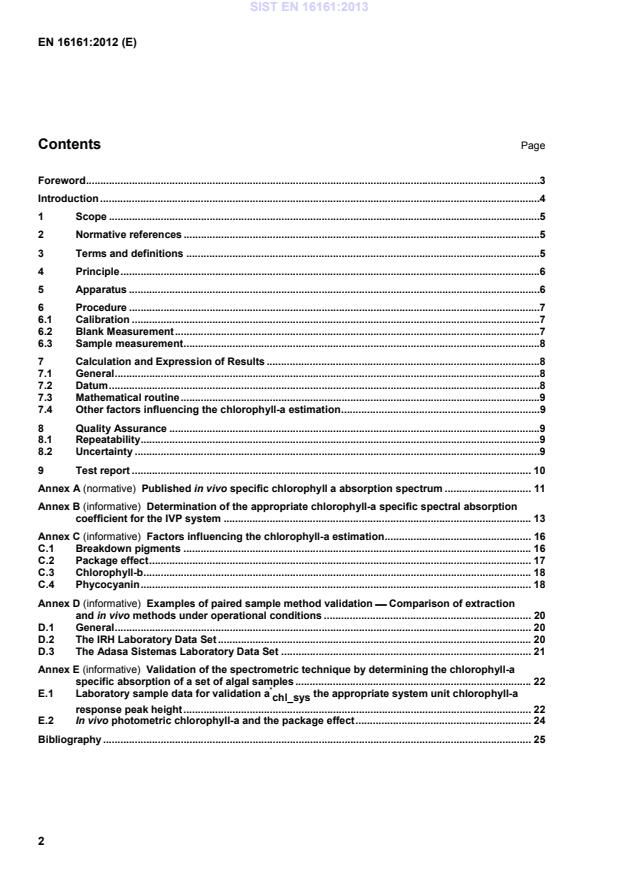
Published in vivo specific chlorophyll a absorption spectrum . 11Annex B (informative)
Determination of the appropriate chlorophyll-a specific spectral absorption coefficient for the IVP system . 13Annex C (informative)
Factors influencing the chlorophyll-a estimation . 16C.1Breakdown pigments . 16C.2Package effect . 17C.3Chlorophyll-b . 18C.4Phycocyanin . 18Annex D (informative)
Examples of paired sample method validation Comparison of extraction and in vivo methods under operational conditions . 20D.1General . 20D.2The IRH Laboratory Data Set . 20D.3The Adasa Sistemas Laboratory Data Set . 21Annex E (informative)
Validation of the spectrometric technique by determining the chlorophyll-a specific absorption of a set of algal samples . 22E.1Laboratory sample data for validation a*chl_sys the appropriate system unit chlorophyll-a response peak height . 22E.2In vivo photometric chlorophyll-a and the package effect . 24Bibliography . 25 SIST EN 16161:2013
chlorophyll-a concentration in marine and fresh waters. This European Standard is comprised of the following: definition of the equipment requirement; a priori data and mathematical tools; recommendations for verification of measurement system performance and consideration of factors that can influence measurements; listing of the procedures to be implemented. 2 Normative references The following documents, in whole or in part, are normatively referenced in this document and are indispensable for its application. For dated references, only the edition cited applies. For undated references, the latest edition of the referenced document (including any amendments) applies. ENV 13005, Guide to the expression of uncertainty in measurement 3 Terms and definitions For the purposes of this document, the following terms and definitions apply. 3.1 absorption coefficient
a
natural logarithm of the ratio between the light intensity entering and corresponding intensity emerging directly through a sample of water divided by the sample path length (in metres) in cases where the scattering of light is negligible Note 1 to entry: The unit is m-1.
Note 2 to entry: A spectrophotometer often gives the Log10 of the ratio in place of the natural logarithm. 3.2 extinction
c
sum of losses of directly transmitted light by absorption and scattering
Note 1 to entry: The unit is m-1.
Note 2 to entry: The extinction c is related to absorption a and scattering b, by bac+=. 3.3 extractive photometric
EP method of chlorophyll concentration estimation involving extraction and absorption measurement SIST EN 16161:2013
IVP method of assessing chlorophyll-a concentration through the use of in vivo spectral photometry 3.5 package effect flattening of a spectral absorption feature arising from excessive absorbing molecule concentration within cells 3.6 resolution width at half height of the instrument response function 3.7 scattering coefficient b
natural logarithm of the ratio between the light intensity entering and corresponding intensity emerging directly through a sample of water divided by the sample path length (in metres) in cases where the absorption of light is negligible Note 1 to entry: The unit is m-1.
3.8 spectrum set of data of a sample taken over a defined wavelength range and by a defined resolution
3.9 wavelength range range from minimum to maximum wavelength over which a spectrum is described 4 Principle The in vivo photometric absorption technique (IVP) is based on: a) the additive nature of absorption of individual constituents within a suspension; b) the use of a priori knowledge about the absorption features of chlorophyll-a in the wavelength area of approximately 675 nm; c) the absence of other components interfering with spectral features of chlorophyll-a in this region; d) the use of a measurement cell (a cuvette or other sample receptacle) of sufficient length and spectrophotometer of sufficient performance to enable the absorption feature of chlorophyll-a to be identified at the concentration levels required; e) the availability of a suitable algorithm to identify and quantify the distinctive chlorophyll-a absorption feature within a spectral absorption measurement. 5 Apparatus 5.1 Spectrophotometer, or equivalent, with the capability to determine the absorption spectrum of an in situ sample of water. The spectral measuring instrument shall be capable of measuring the absorption of the sample in a range between 600 nm and 750 nm with a resolution better than 10 nm. The data capture is carried out in measuring intervals of 5 nm or smaller. SIST EN 16161:2013
6 Procedure 6.1 Calibration The reference spectrum should be recorded with a sample of water which is free of constituents with absorption effects likely to mimic or interfere with chlorophyll-a absorption spectral features in the 650 nm to 710 nm region. This measurement should be stored as a system reference spectral signal of the water Iw(). The temperature of the reference water sample should not differ more than around 10 °C from that of the samples to avoid affecting chlorophyll estimation results at the 1 µg/l level. If the same measurement cell is used for successive samples, the measuring chamber should be flushed to remove influences of previous measurements before the next measurement (see 6.3). This is particularly necessary in cases where a flow-through measurement cell is utilised. Persistent positive residual chlorophyll-a measurements on clean water samples indicate window fouling by chlorophyllous material. Either the measurement cell should be cleaned or the effects of the persistent fouling should be zeroed out by taking a new clean water reference spectrum.
Water free of chlorophyll-a can be generated by filtering drinking water through a pore size of 0,1 µm. For the measurement of samples with high content of dissolved salts or colour (especially high content of humic substances), a representative water sample can be filtered for use as reference. When a measurement cell is emptied there is often a residue. In practice, the number of flushes recommended should be sufficient to bring verification of zero measurements to within two standard deviations of zero. If a significant positive residue persists, this might indicate window fouling and either a new reference clean water sample should be taken or the measurement cell should be cleaned. EXAMPLE A sample of clean water free of chlorophyll inserted after a measurement of a sample with 100 µg/l of chlorophyll-a may record a residual chlorophyll-a concentration of 2 µg/l, or a 2 % residual. Two flushes should reduce this to 2 % of 2 % or 0,04 % and three flushes to 0,008 %.
The effect of temperature difference on the system algorithm can be checked by repeating measurements on one sample using different reference water or sample water temperatures. Such effects arise because of small changes in the absorption of pure water with temperature. These changes are well described in the literature [15] and can influence the curvature of an absorption spectrum near 675 nm. The influence of the temperature and the salinity differences between the spectrum of the sample and reference spectrum shall be considered if concentrations around or below 1 µg/l need to be determined accurately. These changes are well described in the literature [15] and can influence the shape of an absorption spectrum near 675 nm. 6.2 Blank Measurement For any instrument system, the standard deviation of the determination of C in a series of measurements on a clean water sample should be determined by statistical methods. This will indicate the contribution of instrument and algorithm fitting noise to the determination of minimum detectable chlorophyll concentration. For each new reference water, a second measurement of that water used as a sample to determine estimated chlorophyll C should be made. This estimate should not exceed ± two standard deviations of zero for the SIST EN 16161:2013
is the signal observed through the sample; wI
the signal observed through clean water, free of chlorophyll; d
is the optical path length of the light through the sample, in metres (m). 7.2 Datum The datum describes the unit response spectrum for chlorophyll-a absorption ()λchla in the region around 675 nm for the spectrophotometer in use. See Annex B for suggested methods of determining this and Annex D for examples. A multiple of the datum of chlorophyll-a should be recorded according to Formula (2): ()()010chlλλλ−+=aaa (2) where ()λchla is the unit response spectrum for chlorophyll-a absorption effective over a range of wavelengths from approximately 600 nm to 710 nm.
The mathematic routine used shall be capable of determining the quantity C of unit chlorophyll-a spectra present in the sample spectrum. For example, a minimisation routine capable of finding the best fit between a sample absorption spectrum ()λsa and the model spectrum ()()λλλchl010acaa×+−+, by varying C until sample and model spectra have minimum differences over the range 650 nm to 710 nm (see Annex E). 7.4 Other factors influencing the chlorophyll-a estimation The following differences that may arise should be assessed:
a) breakdown pigments with similar spectral features; b) the package effect; c) the presence of other pigments whose absorption features extend to some extent into the 675 nm region; principally phycocyanin and chlorophyll-b. The effects that these factors can have on a measurement are described in Annex C. NOTE This method yields an estimate based on the chlorophyll-a-like absorption feature at 675 nm as it appears in vivo. This is not necessarily the same as the chlorophyll-a absorption effect produced by the chlorophyll-a molecules alone when extracted from the in vivo cells. While this in vivo estimate is a good measure of the effective solar harvesting capability of the chlorophyll-a within the cell at the time of measurement, the differences that may arise when compared with extracted chlorophyll-a estimates should be clearly understood.
8 Quality Assurance 8.1 Repeatability The absorption characteristics may change if the samples remain in the measuring chamber for a longer time (e.g., with multiple measurements, by sedimentation, agglomeration or buoyancy of algae cells). Therefore, the measuring cell should be equipped with a stirrer; or else the measuring chamber shall be filled again after each single measurement. 8.2 Uncertainty The measurements should be accompanied by a statement of uncertainty, prepared by taking full account of natural factors which may influence or interfere with the estimation. Uncertainty estimation requires clear identification of:
a) the measurand, and
b) the uncertainty sources in accordance with ENV 13005.
Once the uncertainty sources are identified, they should be quantified and combined into a total uncertainty.
NOTE 1 Further useful guides to the estimation of uncertainty can be found in the bibliography, [13] and [14]. The measurand here is the chlorophyll-a estimate. Tracing backwards, the main sources of uncertainty are: 1) the uncertainty of the performance of the mathematical algorithm in determining the concentration C of chlorophyll-a, i.e. in determining the amplitude of the system unit chlorophyll-a response present in the measured absorption spectrum; 2) the uncertainty in determining the system unit chlorophyll-a response from the a priori unit chlorophyll-a response (Annex A) which is used in 1 above; SIST EN 16161:2013
An entire assessment of uncertainty of the determination of the chlorophyll a concentration of a water sample also requires the inclusion of the uncertainties derived from sampling, storage and sampling handling, etc. NOTE 4 Taylor and Kuyatt, NIST 1994 [16] describe the combination by the root sum of squares of individual uncertainties as the ‘combined standard uncertainty’. A measure of uncertainty that defines an interval about the measurement result in which the value of the measurand is confidently believed to lie is termed the ‘expanded uncertainty’ and is obtain
...