


EN 14130:2003
(Main)Foodstuffs - Determination of vitamin C by HPLC
Foodstuffs - Determination of vitamin C by HPLC
This European Standard specifies an HPLC-method for the determination of vitamin C in foodstuffs. Vitamin C is the sum of L(+) ascorbic acid and dehydro L(+) ascorbic acid.
Lebensmittel - Bestimmung von Vitamin C mit HPLC
Diese Europäische Norm legt ein Verfahren zur Bestimmung von Vitamin C in Lebensmitteln mit Hochleistungs-Flüssigchromatographie (HPLC) fest.
Vitamin C ist die Summe von L(+)-Ascorbinsäure und L(+)-Dehydroascorbinsäure
Produits alimentaires - Dosage de la vitamine C par CLHP
Živila – Določevanje vitamina C s HPLC
General Information
- Status
- Withdrawn
- Publication Date
- 03-Jun-2003
- Withdrawal Date
- 04-Aug-2010
- Technical Committee
- CEN/TC 275 - Food analysis - Horizontal methods
- Drafting Committee
- CEN/TC 275/WG 9 - Vitamins and Carotenoids
- Current Stage
- 9960 - Withdrawal effective - Withdrawal
- Start Date
- 05-Aug-2010
- Completion Date
- 05-Aug-2010

Get Certified
Connect with accredited certification bodies for this standard

BSI Group
BSI (British Standards Institution) is the business standards company that helps organizations make excellence a habit.

Bureau Veritas
Bureau Veritas is a world leader in laboratory testing, inspection and certification services.

DNV
DNV is an independent assurance and risk management provider.
Sponsored listings
Frequently Asked Questions
EN 14130:2003 is a standard published by the European Committee for Standardization (CEN). Its full title is "Foodstuffs - Determination of vitamin C by HPLC". This standard covers: This European Standard specifies an HPLC-method for the determination of vitamin C in foodstuffs. Vitamin C is the sum of L(+) ascorbic acid and dehydro L(+) ascorbic acid.
This European Standard specifies an HPLC-method for the determination of vitamin C in foodstuffs. Vitamin C is the sum of L(+) ascorbic acid and dehydro L(+) ascorbic acid.
EN 14130:2003 is classified under the following ICS (International Classification for Standards) categories: 67.050 - General methods of tests and analysis for food products. The ICS classification helps identify the subject area and facilitates finding related standards.
EN 14130:2003 is available in PDF format for immediate download after purchase. The document can be added to your cart and obtained through the secure checkout process. Digital delivery ensures instant access to the complete standard document.
Standards Content (Sample)
2003-01.Slovenski inštitut za standardizacijo. Razmnoževanje celote ali delov tega standarda ni dovoljeno.Lebensmittel - Bestimmung von Vitamin C mit HPLCProduits alimentaires - Dosage de la vitamine C par CLHPFoodstuffs - Determination of vitamin C by HPLC67.050Splošne preskusne in analizne metode za živilske proizvodeGeneral methods of tests and analysis for food productsICS:Ta slovenski standard je istoveten z:EN 14130:2003SIST EN 14130:2003en01-november-2003SIST EN 14130:2003SLOVENSKI
STANDARD
EUROPEAN STANDARDNORME EUROPÉENNEEUROPÄISCHE NORMEN 14130June 2003ICS 67.050English versionFoodstuffs - Determination of vitamin C by HPLCProduits alimentaires - Dosage de la vitamine C par CLHPLebensmittel - Bestimmung von Vitamin C mit HPLCThis European Standard was approved by CEN on 21 April 2003.CEN members are bound to comply with the CEN/CENELEC Internal Regulations which stipulate the conditions for giving this EuropeanStandard the status of a national standard without any alteration. Up-to-date lists and bibliographical references concerning such nationalstandards may be obtained on application to the Management Centre or to any CEN member.This European Standard exists in three official versions (English, French, German). A version in any other language made by translationunder the responsibility of a CEN member into its own language and notified to the Management Centre has the same status as the officialversions.CEN members are the national standards bodies of Austria, Belgium, Czech Republic, Denmark, Finland, France, Germany, Greece,Hungary, Iceland, Ireland, Italy, Luxembourg, Malta, Netherlands, Norway, Portugal, Slovakia, Spain, Sweden, Switzerland and UnitedKingdom.EUROPEAN COMMITTEE FOR STANDARDIZATIONCOMITÉ EUROPÉEN DE NORMALISATIONEUROPÄISCHES KOMITEE FÜR NORMUNGManagement Centre: rue de Stassart, 36
B-1050 Brussels© 2003 CENAll rights of exploitation in any form and by any means reservedworldwide for CEN national Members.Ref. No. EN 14130:2003 ESIST EN 14130:2003
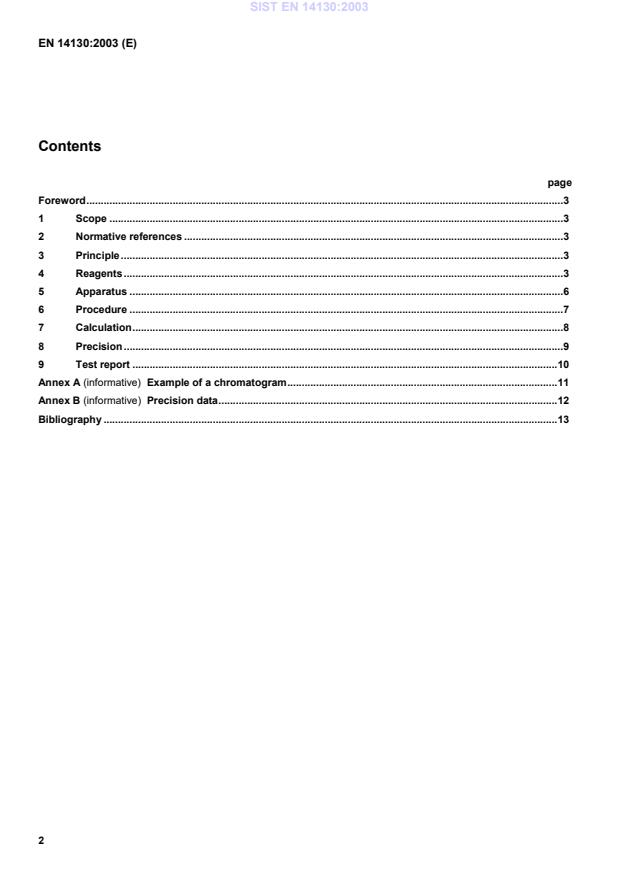
Example of a chromatogram.11Annex B (informative)
Precision data.12Bibliography.13SIST EN 14130:2003
98,0 %4.2.3 Potassium dihydrogen phosphate, w(KH2PO4)
99,0 %4.2.4 L-Cysteine or another suitable reducing agent, w(C3H7NO2S)
99,0 %4.2.5 N-cetyl-N,N,N--trimethylammonium bromide, w(C19H42BrN)
99,0 %4.2.6 Methanol (HPLC grade), w(CH3OH)
99,0 %4.2.7 Metaphosphoric acid solution, mass concentration ((HPO3)n) = 200 g/lDissolve 200 g of metaphosphoric acid (4.2.1) in a 1 l volumetric flask with water to the mark. This solution is stablefor one month if stored at + 4 °C.4.2.8 Metaphosphoric acid solution, ((HPO3)n) = 20 g/lPipet 50 ml of the metaphosphoric solution (4.2.7) into a 500 ml volumetric flask. Dilute to the mark with water.Prepare fresh each day of the analysis.4.2.9 Trisodium phosphate solution, (Na3PO4 ·12H2O) = 200 g/lDissolve 200 g of trisodium phosphate (4.2.2) in a 1 l volumetric flask with water. Dilute to the mark with water.4.2.10 L-Cysteine solution, (C3H7NO2S) = 40 g/lDissolve 20 g of cysteine (4.2.4) in a 500 ml volumetric flask with water. Dilute to the mark with water. Preparefresh each day of analysis.4.2.11 HPLC mobile phase:Dissolve 13,6 g of potassium dihydrogen phosphate (4.2.3) in 900 ml of water in a beaker. Filter through a 0,45 µmfilter (solution A). Dissolve 1,82 g of N-cetyl-N,N,N-trimethylammonium bromide (4.2.5) in 100 ml of methanol(4.2.6) in a beaker. Mix and filter through a 0,45 µm filter (solution B). Mix the 900 ml of solution A with the 100 mlof solution B. Degas the solution before use, if necessary.4.2.12 Starch solution (optional), (soluble starch) = 1 g/100 ml4.2.13 Iodine solution (optional), c(I2) = 0,05 mol/l4.2.14 Diluted sulfuric acid
c (H2SO4) = 0,1 mol/l4.3 Standard substances4.3.1 Ascorbic acid, L(+) Ascorbic acid, w(C6H8O6)
99,7 %(R)-5-[(S)-1,2-Dihydroxyethyl]-3,4-dihydroxy-5-H-furan-2-on4.3.2 Erythorbic (Isoascorbic) acid, D (-) Ascorbic acid, w(C6H8O6)
99,0 %(R)-5-[(R)-1,2-Dihydroxyethyl]-3,4-dihydroxy-5-H-furan-2-onSIST EN 14130:2003
1 mg/mlDissolve an accurately weighed amount of ascorbic acid (4.3.1), e.g. approximately 100 mg to the nearest 0,1 mgin a defined volume, e.g. 100 ml, of the metaphosphoric acid solution (4.2.8). Prepare fresh each day of analysis.The stability of the stock solution can be enhanced by addition of L-Cysteine.4.4.2 Erythorbic acid stock solution, (C6H8O6)
1 mg/mlDissolve an accurately weighed amount of the erythorbic acid (4.3.2), e.g. approximately 100 mg to the nearest0,1 mg in a defined volume, e.g. 100 ml, of the metaphosphoric acid solution (4.2.8). Prepare fresh each day ofanalysis.4.4.3 Purity test (optional)Weigh accurately approximately 150 mg of the ascorbic acid standard substance in a conical flask and dissolve byadding 10 ml of diluted sulfuric acid (4.2.14) and 80 ml of carbon dioxide free water. After addition of starch orstarch solution (4.2.12), titrate with iodine solution (4.2.13) until permanent coloration. 1 ml of iodine solutioncorresponds to 8,81 mg ascorbic acid.Calculate the purity of the standard substance, wst, in percent according to equation (1).m,Vw100×818×=1st(1)whereV1is the volume of the iodine solution used, in millilitre;mis the sample mass, in milligramm;8,81is the conversion factor;100is the conversion factor to get the result in percent.4.5 Calibration solutions4.5.1 Ascorbic acid calibration solutions, (C6H8O6) = 5 g/ml to 50 g/mlPipette 0,5 ml to 5 ml of the ascorbic acid stock solution (4.4.1) into 100 ml volumetric flask and dilute withmetaphosphoric acid (4.2.8) to the mark. Prepare fresh each day of analysis.4.5.2 Erythorbic acid calibration solution, (optional), (C6H8O6)
10 µg/mlPipet 1 ml of the erythorbic acid stock solution (4.4.2) into a 100 ml volumetric flask and dilute to the mark withmetaphosphoric acid solution (4.2.8). The standard solution should have a concentration of 5 µg/ml to 20 µg/ml oferythorbic acid. Prepare fresh each
...
Questions, Comments and Discussion
Ask us and Technical Secretary will try to provide an answer. You can facilitate discussion about the standard in here.
Loading comments...