

EN ISO 17117-1:2025
(Main)Health informatics - Terminological resources - Part 1: Characteristics (ISO 17117-1:2025)
- Abstract
This document defines universal and specialized characteristics of health terminological resources that make them fit for the purposes required of various applications. It covers only terminological resources that are primarily designed to be used for clinical concept representation or to those parts of other terminological resources designed to be used for clinical concept representation.
This document helps users to assess whether a terminology has the characteristics or provides the functions that will support their specified requirements. In order to do that, this document focuses on defining characteristics and functions of terminological resources in healthcare that can be used to identify different types of terminological resources for categorization purposes.
NOTE 1 Categorization of healthcare terminological systems according to the name of the system might not be helpful and has caused confusion in the past.
The following aspects are not covered in this document:
— evaluations of terminological resources;
— health service requirements for terminological resources and evaluation criteria based on the characteristics and functions;
— the nature and quality of mappings between different terminologies;
NOTE 2 It is unlikely that a single terminology will meet all the terminology requirements of a healthcare organization: some terminology providers produce mappings to administrative or classification systems such as the International Classification of Diseases (ICD). The presence of such maps would be a consideration in the evaluation of the terminology.
— the nature and quality of mappings between different versions of the same terminology;
NOTE 3 To support data migration and historical retrieval, terminology providers can provide maps between versions of their terminology. The presence of such maps would be a consideration in the evaluation of the terminology.
— terminology server requirements and techniques and tools for terminology developers;
— characteristics for computational biology terminology.
- Status
- Published
- Publication Date
- 02-Dec-2025
- Technical Committee
- CEN/TC 251 - Medical informatics
- Drafting Committee
- CEN/TC 251/WG 1 - Information models
- Current Stage
- 6060 - Definitive text made available (DAV) - Publishing
- Start Date
- 03-Dec-2025
- Completion Date
- 03-Dec-2025


Overview
EN ISO 17117-1:2025 - Health informatics - Terminological resources - Part 1: Characteristics defines the essential characteristics and functions of health terminological resources intended for clinical concept representation. The standard helps users determine whether a terminology provides the properties and capabilities needed for specific healthcare applications (clinical documentation, interoperability, analytics), and establishes a framework to categorize terminological resources based on those characteristics.
Key topics
- Scope and purpose
- Defines universal and specialized characteristics for terminologies used in clinical concept representation.
- Focuses on characteristics and functions rather than conducting evaluations or prescribing evaluation criteria.
- Clarifies that categorization by system name can be misleading.
- Characteristics (Clause 4)
- Identifiers: term and concept identifiers, context-free and persistent identifiers, and version identifiers.
- Concept orientation: how terms map to clinical concepts and support unambiguous identification.
- Extensibility: mechanisms to specify more detailed concepts or broaden coverage.
- Data aggregation & classification: mutual exclusiveness, exhaustiveness and categorial structures for statistical uses.
- Formal concept representation: compositionality, hierarchical and associative relations, semantic consistency.
- Maintenance: editorial metadata, obsoletion marking, responsiveness and version control.
- Functions (Clause 5)
- How characteristics support data capture, display/presentation, data aggregation, reasoning, and maintenance-related functions (e.g., concept permanence and version management).
Practical applications
EN ISO 17117-1 is practical for organizations and professionals who need to select, integrate, or manage clinical terminologies:
- EHR vendors and health IT implementers - to choose terminologies that enable clinical data capture and semantic interoperability.
- Terminology managers and clinical informaticians - to design or maintain concept models with appropriate identifiers, versioning, and compositional structures.
- Health information governance and policy teams - to categorize terminological resources and inform procurement or national strategy decisions.
- Researchers and data analysts - to understand how terminology characteristics influence data aggregation, reporting and automated reasoning.
Note: Part 1 focuses on what characteristics exist and which functions they enable. Evaluation criteria, mapping quality assessments, terminology server requirements, and computational biology terminologies are out of scope and are intended for other parts or future work.
Related standards & keywords
- Related: ISO 17117 series (replacement of ISO/TS 17117:2002); ISO/TC 215 health informatics outputs.
- SEO keywords: health informatics, terminological resources, clinical concept representation, semantic interoperability, terminology characteristics, concept identifiers, compositionality, terminology maintenance, EHR interoperability.
Relations
- Effective Date
- 06-Dec-2023
- Consolidated By
ISO 17117-1:2025 - Health informatics — Terminological resources — Part 1: Characteristics - Effective Date
- 12-Feb-2026
Get Certified
Connect with accredited certification bodies for this standard

BSI Group
BSI (British Standards Institution) is the business standards company that helps organizations make excellence a habit.

NYCE
Mexican standards and certification body.
Sponsored listings
Frequently Asked Questions
EN ISO 17117-1:2025 is a standard published by the European Committee for Standardization (CEN). Its full title is "Health informatics - Terminological resources - Part 1: Characteristics (ISO 17117-1:2025)". This standard covers: This document defines universal and specialized characteristics of health terminological resources that make them fit for the purposes required of various applications. It covers only terminological resources that are primarily designed to be used for clinical concept representation or to those parts of other terminological resources designed to be used for clinical concept representation. This document helps users to assess whether a terminology has the characteristics or provides the functions that will support their specified requirements. In order to do that, this document focuses on defining characteristics and functions of terminological resources in healthcare that can be used to identify different types of terminological resources for categorization purposes. NOTE 1 Categorization of healthcare terminological systems according to the name of the system might not be helpful and has caused confusion in the past. The following aspects are not covered in this document: — evaluations of terminological resources; — health service requirements for terminological resources and evaluation criteria based on the characteristics and functions; — the nature and quality of mappings between different terminologies; NOTE 2 It is unlikely that a single terminology will meet all the terminology requirements of a healthcare organization: some terminology providers produce mappings to administrative or classification systems such as the International Classification of Diseases (ICD). The presence of such maps would be a consideration in the evaluation of the terminology. — the nature and quality of mappings between different versions of the same terminology; NOTE 3 To support data migration and historical retrieval, terminology providers can provide maps between versions of their terminology. The presence of such maps would be a consideration in the evaluation of the terminology. — terminology server requirements and techniques and tools for terminology developers; — characteristics for computational biology terminology.
This document defines universal and specialized characteristics of health terminological resources that make them fit for the purposes required of various applications. It covers only terminological resources that are primarily designed to be used for clinical concept representation or to those parts of other terminological resources designed to be used for clinical concept representation. This document helps users to assess whether a terminology has the characteristics or provides the functions that will support their specified requirements. In order to do that, this document focuses on defining characteristics and functions of terminological resources in healthcare that can be used to identify different types of terminological resources for categorization purposes. NOTE 1 Categorization of healthcare terminological systems according to the name of the system might not be helpful and has caused confusion in the past. The following aspects are not covered in this document: — evaluations of terminological resources; — health service requirements for terminological resources and evaluation criteria based on the characteristics and functions; — the nature and quality of mappings between different terminologies; NOTE 2 It is unlikely that a single terminology will meet all the terminology requirements of a healthcare organization: some terminology providers produce mappings to administrative or classification systems such as the International Classification of Diseases (ICD). The presence of such maps would be a consideration in the evaluation of the terminology. — the nature and quality of mappings between different versions of the same terminology; NOTE 3 To support data migration and historical retrieval, terminology providers can provide maps between versions of their terminology. The presence of such maps would be a consideration in the evaluation of the terminology. — terminology server requirements and techniques and tools for terminology developers; — characteristics for computational biology terminology.
EN ISO 17117-1:2025 is classified under the following ICS (International Classification for Standards) categories: 01.020 - Terminology (principles and coordination); 35.240.80 - IT applications in health care technology. The ICS classification helps identify the subject area and facilitates finding related standards.
EN ISO 17117-1:2025 has the following relationships with other standards: It is inter standard links to EN ISO 17117-1:2023, ISO 17117-1:2025. Understanding these relationships helps ensure you are using the most current and applicable version of the standard.
EN ISO 17117-1:2025 is available in PDF format for immediate download after purchase. The document can be added to your cart and obtained through the secure checkout process. Digital delivery ensures instant access to the complete standard document.
Standards Content (Sample)
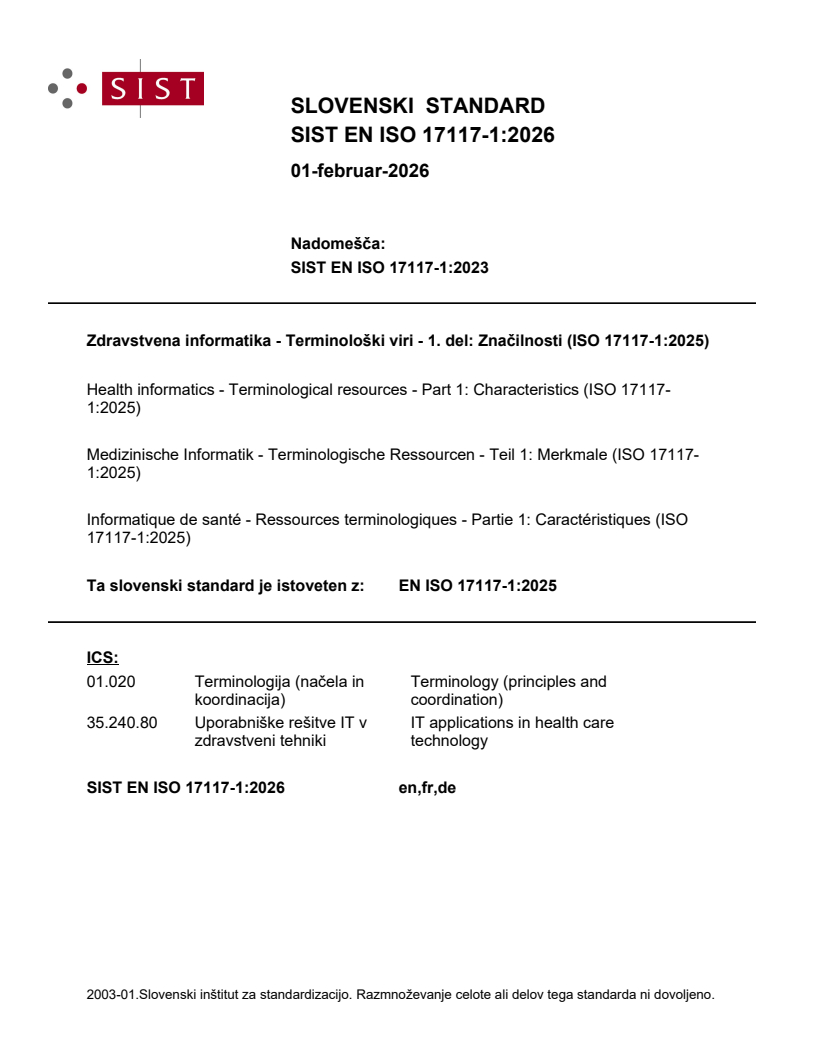
SLOVENSKI STANDARD
01-februar-2026
Nadomešča:
SIST EN ISO 17117-1:2023
Zdravstvena informatika - Terminološki viri - 1. del: Značilnosti (ISO 17117-1:2025)
Health informatics - Terminological resources - Part 1: Characteristics (ISO 17117-
1:2025)
Medizinische Informatik - Terminologische Ressourcen - Teil 1: Merkmale (ISO 17117-
1:2025)
Informatique de santé - Ressources terminologiques - Partie 1: Caractéristiques (ISO
17117-1:2025)
Ta slovenski standard je istoveten z: EN ISO 17117-1:2025
ICS:
01.020 Terminologija (načela in Terminology (principles and
koordinacija) coordination)
35.240.80 Uporabniške rešitve IT v IT applications in health care
zdravstveni tehniki technology
2003-01.Slovenski inštitut za standardizacijo. Razmnoževanje celote ali delov tega standarda ni dovoljeno.
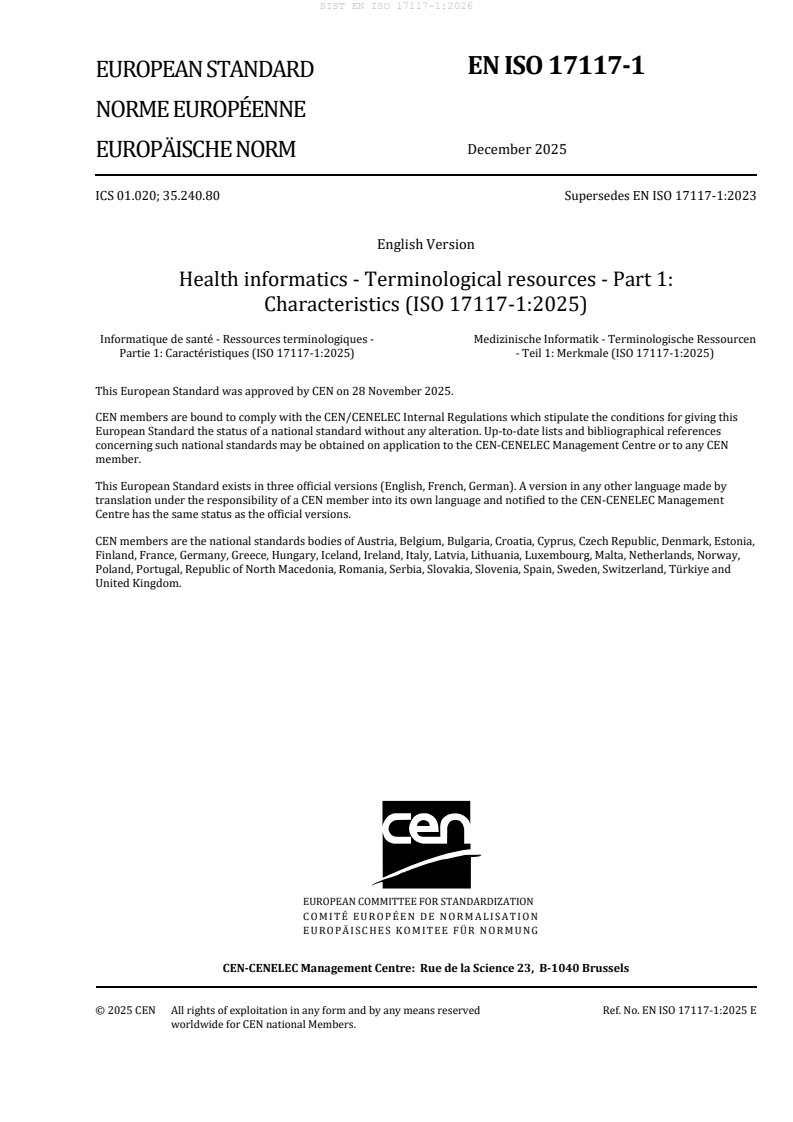
EN ISO 17117-1
EUROPEAN STANDARD
NORME EUROPÉENNE
December 2025
EUROPÄISCHE NORM
ICS 01.020; 35.240.80 Supersedes EN ISO 17117-1:2023
English Version
Health informatics - Terminological resources - Part 1:
Characteristics (ISO 17117-1:2025)
Informatique de santé - Ressources terminologiques - Medizinische Informatik - Terminologische Ressourcen
Partie 1: Caractéristiques (ISO 17117-1:2025) - Teil 1: Merkmale (ISO 17117-1:2025)
This European Standard was approved by CEN on 28 November 2025.
CEN members are bound to comply with the CEN/CENELEC Internal Regulations which stipulate the conditions for giving this
European Standard the status of a national standard without any alteration. Up-to-date lists and bibliographical references
concerning such national standards may be obtained on application to the CEN-CENELEC Management Centre or to any CEN
member.
This European Standard exists in three official versions (English, French, German). A version in any other language made by
translation under the responsibility of a CEN member into its own language and notified to the CEN-CENELEC Management
Centre has the same status as the official versions.
CEN members are the national standards bodies of Austria, Belgium, Bulgaria, Croatia, Cyprus, Czech Republic, Denmark, Estonia,
Finland, France, Germany, Greece, Hungary, Iceland, Ireland, Italy, Latvia, Lithuania, Luxembourg, Malta, Netherlands, Norway,
Poland, Portugal, Republic of North Macedonia, Romania, Serbia, Slovakia, Slovenia, Spain, Sweden, Switzerland, Türkiye and
United Kingdom.
EUROPEAN COMMITTEE FOR STANDARDIZATION
COMITÉ EUROPÉEN DE NORMALISATION
EUROPÄISCHES KOMITEE FÜR NORMUNG
CEN-CENELEC Management Centre: Rue de la Science 23, B-1040 Brussels
© 2025 CEN All rights of exploitation in any form and by any means reserved Ref. No. EN ISO 17117-1:2025 E
worldwide for CEN national Members.
Contents Page
European foreword . 3
European foreword
This document (EN ISO 17117-1:2025) has been prepared by Technical Committee ISO/TC 215 "Health
informatics" in collaboration with Technical Committee CEN/TC 251 “Health informatics” the
secretariat of which is held by NEN.
This European Standard shall be given the status of a national standard, either by publication of an
identical text or by endorsement, at the latest by June 2026, and conflicting national standards shall be
withdrawn at the latest by June 2026.
Attention is drawn to the possibility that some of the elements of this document may be the subject of
patent rights. CEN shall not be held responsible for identifying any or all such patent rights.
This document supersedes EN ISO 17117-1:2023.
Any feedback and questions on this document should be directed to the users’ national standards
body/national committee. A complete listing of these bodies can be found on the CEN website.
According to the CEN-CENELEC Internal Regulations, the national standards organizations of the
following countries are bound to implement this European Standard: Austria, Belgium, Bulgaria,
Croatia, Cyprus, Czech Republic, Denmark, Estonia, Finland, France, Germany, Greece, Hungary, Iceland,
Ireland, Italy, Latvia, Lithuania, Luxembourg, Malta, Netherlands, Norway, Poland, Portugal, Republic of
North Macedonia, Romania, Serbia, Slovakia, Slovenia, Spain, Sweden, Switzerland, Türkiye and the
United Kingdom.
Endorsement notice
The text of ISO 17117-1:2025 has been approved by CEN as EN ISO 17117-1:2025 without any
modification.
International
Standard
ISO 17117-1
Second edition
Health informatics —
2025-11
Terminological resources —
Part 1:
Characteristics
Informatique de santé — Ressources terminologiques —
Partie 1: Caractéristiques
Reference number
ISO 17117-1:2025(en) © ISO 2025
ISO 17117-1:2025(en)
© ISO 2025
All rights reserved. Unless otherwise specified, or required in the context of its implementation, no part of this publication may
be reproduced or utilized otherwise in any form or by any means, electronic or mechanical, including photocopying, or posting on
the internet or an intranet, without prior written permission. Permission can be requested from either ISO at the address below
or ISO’s member body in the country of the requester.
ISO copyright office
CP 401 • Ch. de Blandonnet 8
CH-1214 Vernier, Geneva
Phone: +41 22 749 01 11
Email: copyright@iso.org
Website: www.iso.org
Published in Switzerland
ii
ISO 17117-1:2025(en)
Contents Page
Foreword .v
Introduction .vi
1 Scope . 1
2 Normative references . 1
3 Terms and definitions . 1
3.1 General terms .2
3.2 Relations between concepts .4
3.3 Formal concept representation .5
3.4 Terminological resources (in health domain).6
4 Characteristics of terminological resources in the health domain . 8
4.1 Basics .8
4.2 Pre-coordinated characteristics aiming at identification of a specific concept/term .9
4.2.1 Term identifier .9
4.2.2 Concept identifier .9
4.2.3 Concept orientation .9
4.3 Characteristics related to extensibility for concept representations .10
4.3.1 Characteristics to specify more detailed concepts .10
4.3.2 Characteristics to broaden coverage of concepts .11
4.4 Characteristics related to data aggregation or classification system.11
4.4.1 General .11
4.4.2 Mutual exclusiveness .11
4.4.3 Exhaustiveness . 12
4.5 Characteristics related to formal concept representation and semantic interoperability . 12
4.5.1 Compositionality . 12
4.5.2 Hierarchical relation . 12
4.5.3 Associative relation . 13
4.5.4 Categorial structure . 13
4.5.5 Semantic consistency .14
4.6 Characteristics related to maintenance of terminological resources .14
4.6.1 Context-free identifiers .14
4.6.2 Persistence of identifiers .14
4.6.3 Version identifier . . 15
4.6.4 Editorial information . 15
4.6.5 Obsolete marking . 15
4.6.6 Responsiveness . . 15
5 Functions invoked by a certain set of characteristics .15
5.1 Basics . 15
5.2 Data capture . 15
5.2.1 General . 15
5.2.2 Extensibility for concept representation .16
5.2.3 Providing semantically consistent formal concept representation . .16
5.3 Display/presentation/identification .17
5.3.1 General .17
5.3.2 Accessing concepts using terminology structure .17
5.4 Data aggregation for statistical analysis .18
5.5 Reasoning .18
5.5.1 General .18
5.5.2 Reasoning of internal consistency .18
5.6 Maintenance-related functions.19
5.6.1 Concept permanence .19
5.6.2 Version control . 20
Annex A (informative) Relations between characteristics, functions, requirements and
evaluation criteria of terminological resources .21
iii
ISO 17117-1:2025(en)
Annex B (informative) Relations among terminological resources .22
Bibliography .23
iv
ISO 17117-1:2025(en)
Foreword
ISO (the International Organization for Standardization) is a worldwide federation of national standards
bodies (ISO member bodies). The work of preparing International Standards is normally carried out through
ISO technical committees. Each member body interested in a subject for which a technical committee
has been established has the right to be represented on that committee. International organizations,
governmental and non-governmental, in liaison with ISO, also take part in the work. ISO collaborates closely
with the International Electrotechnical Commission (IEC) on all matters of electrotechnical standardization.
The procedures used to develop this document and those intended for its further maintenance are described
in the ISO/IEC Directives, Part 1. In particular, the different approval criteria needed for the different types
of ISO documents should be noted. This document was drafted in accordance with the editorial rules of the
ISO/IEC Directives, Part 2 (see www.iso.org/directives).
ISO draws attention to the possibility that the implementation of this document may involve the use of (a)
patent(s). ISO takes no position concerning the evidence, validity or applicability of any claimed patent
rights in respect thereof. As of the date of publication of this document, ISO had not received notice of (a)
patent(s) which may be required to implement this document. However, implementers are cautioned that
this may not represent the latest information, which may be obtained from the patent database available at
www.iso.org/patents. ISO shall not be held responsible for identifying any or all such patent rights.
Any trade name used in this document is information given for the convenience of users and does not
constitute an endorsement.
For an explanation of the voluntary nature of standards, the meaning of ISO specific terms and expressions
related to conformity assessment, as well as information about ISO’s adherence to the World Trade
Organization (WTO) principles in the Technical Barriers to Trade (TBT), see www.iso.org/iso/foreword.html.
This document was prepared by Technical Committee ISO/TC 215, Health informatics, in collaboration with
the European Committee for Standardization (CEN) Technical Committee CEN/TC 251, Health informatics,
in accordance with the Agreement on technical cooperation between ISO and CEN (Vienna Agreement).
This second edition cancels and replaces the first edition (ISO 17117-1:2018), which has been technically
revised.
The main changes are as follows:
— The document has been updated to reflect the state of medical and technical practices at a time, and
incorporating relevant new normative references.
A list of all parts in the ISO 17117 series can be found on the ISO website.
Any feedback or questions on this document should be directed to the user’s national standards body. A
complete listing of these bodies can be found at www.iso.org/members.html.
v
ISO 17117-1:2025(en)
Introduction
Health terminology is complex and multifaceted. It has been estimated that up to 45 million different terms
are needed to adequately describe health-related concepts such as conditions of patients and populations,
actions in healthcare, and related concepts, such as medicines, biomedical molecules, genes, organisms,
technical methods and social concepts (see ISO 17115). Many formal and less formal terminological
resources exist to represent this complexity. These can be called terminological systems, coding systems,
formal concept representation systems, classification systems, and others. Specific features of different
terminological resources make them more or less useful for particular purposes and technological
environments.
The need for formal terminological resources to support health information management has been widely
[13][14][15]
recognized. Such resources are required for precise data collection, accurate interpretation of
[14]
data and interoperability among information systems that exchange such data. National governments,
healthcare organizations and others are currently concerned with the question of which of the available
terminological resources will meet their requirements, i.e. they wish to ‘assign value’ to specific
terminological resources to decide which are suitable for their purposes and healthcare contexts.
1)
A set of criteria to support such evaluations was originally published in ISO/TS 17117:2002 . The main
purpose was to enable users to assess whether a terminological resource has the characteristics that will
support their specified requirements, since the characteristics of a terminological resource influence
its utility and appropriateness in applications. There has been much progress in the study and use of
[16][17]
terminological resources since that time and some experience of formal evaluations.
As the first part of the entire revision work, this document identifies the characteristics of terminological
resources in healthcare (Clause 4) and functions or roles invoked by those characteristics (Clause 5).
This document also provides a framework to identify different types of terminological resources using a
combination of those characteristics and functions, which is essential for the development of criteria for
the categorization of terminological resources in healthcare. Requirements for, and evaluation criteria of,
terminological resources in healthcare, addressed in other parts of ISO 17117, are tightly related to the
characteristics of terminological resources and functions that they can provide.
The target groups for this document are:
a) organizations wishing to select terminological systems for use in healthcare information systems;
b) developers of terminological systems;
c) developers of terminology standards;
d) those undertaking independent evaluations or academic reviews of terminological resources;
e) terminology Registration Authorities.
1) Withdrawn.
vi
International Standard ISO 17117-1:2025(en)
Health informatics — Terminological resources —
Part 1:
Characteristics
1 Scope
This document defines universal and specialized characteristics of health terminological resources that
make them fit for the purposes required of various applications. It covers only terminological resources that
are primarily designed to be used for clinical concept representation or to those parts of other terminological
resources designed to be used for clinical concept representation.
This document helps users to assess whether a terminology has the characteristics or provides the functions
that will support their specified requirements. In order to do that, this document focuses on defining
characteristics and functions of terminological resources in healthcare that can be used to identify different
types of terminological resources for categorization purposes.
NOTE 1 Categorization of healthcare terminological systems according to the name of the system might not be
helpful and has caused confusion in the past.
The following aspects are not covered in this document:
— evaluations of terminological resources;
— health service requirements for terminological resources and evaluation criteria based on the
characteristics and functions;
— the nature and quality of mappings between different terminologies;
NOTE 2 It is unlikely that a single terminology will meet all the terminology requirements of a healthcare
organization: some terminology providers produce mappings to administrative or classification systems such
as the International Classification of Diseases (ICD). The presence of such maps would be a consideration in the
evaluation of the terminology.
— the nature and quality of mappings between different versions of the same terminology;
NOTE 3 To support data migration and historical retrieval, terminology providers can provide maps between
versions of their terminology. The presence of such maps would be a consideration in the evaluation of the
terminology.
— terminology server requirements and techniques and tools for terminology developers;
— characteristics for computational biology terminology.
2 Normative references
There are no normative references in this document.
3 Terms and definitions
For the purposes of this document, the following terms and definitions apply.
ISO 17117-1:2025(en)
ISO and IEC maintain terminology databases for use in standardization at the following addresses:
— ISO Online browsing platform: available at https:// www .iso .org/ obp
— IEC Electropedia: available at https:// www .electropedia .org/
3.1 General terms
3.1.1
concept
unit of knowledge created by a unique combination of characteristics (3.1.3)
Note 1 to entry: Informally, the term ‘concept’ is often used when what is meant is ‘concept representation’. However,
this leads to confusion when precise meanings are required. Concepts arise out of human individuals and social
conceptualizations of the world around them. Concept representations are artefacts constructed of symbols.
Note 2 to entry: Concept representations are not necessarily bound to particular languages. However, they are
influenced by the social or cultural context of use often leading to different categorizations.
[SOURCE: ISO 1087:2019, 3.2.7, modified — The notes to entry were changed.]
3.1.2
term
linguistic representation of a concept (3.1.1) in a specific subject field (3.1.15)
3.1.3
characteristic
abstraction of a property
EXAMPLE ‘Being a disease of the nervous system’ is a characteristic of the concept ‘Functional parkinsonism’.
Note 1 to entry: Characteristics are used for describing concepts (3.1.1).
[SOURCE: ISO 1087:2019, 3.2.1, modified — The example was changed.]
3.1.4
term identifier
sequence of letters, numbers or symbols, capable of uniquely identifying a term (3.1.2) within the
terminological resource (3.4.1)
Note 1 to entry: Term identifier shall be unique within the terminological resource.
3.1.5
concept identifier
canonical expression (3.3.5), or sequence of letters, numbers or symbols, capable of uniquely identifying a
concept (3.1.1) within the terminological resource (3.4.1)
Note 1 to entry: Concept identifier shall be unique within the terminological resource, so terms shall not be used as
concept identifiers in case polysemy exists.
3.1.6
code
identifier expressed by a series of letters, numbers, or symbols
Note 1 to entry: A code is a concept identifier (3.1.5) when used in a coding system (3.4.4).
3.1.7
terminological resource identifier
unique permanent identifier of a terminological resource (3.4.1) for use in information interchange
Note 1 to entry: This is equivalent to Health Coding Scheme Designator in EN 1068:2005 for registration of coding
systems.
Note 2 to entry: Globally unique schemes such as OIDs, UUIDs, and URIs may be used for this purpose.
ISO 17117-1:2025(en)
3.1.8
terminological resource version identifier
version identifier
identifier assigned to a version under which a terminological resource (3.4.1) is published or updated
3.1.9
coding scheme
collection of rules that map the elements in one set, the ‘coded set’, onto the elements in a second set, ‘the
code set’
Note 1 to entry: The two sets are not part of the coding scheme.
3.1.10
composite characteristic
representation of a characteristic (3.1.3)
EXAMPLE has Cause Bacteria; Location = LeftUpperLobeOfLung.
Note 1 to entry: Typically expressed by a semantic link (3.2.5) and a characterizing concept (3.1.11).
3.1.11
characterizing concept
concept (3.1.1) that is referenced by a semantic link (3.2.5) in a composite characteristic (3.1.10)
EXAMPLE ‘Bacterium’ in the construct ‘Disease that has Cause Bacterium’; ‘Yellow’ in the construct ‘Skin Lesion
that has Colour Yellow’.
3.1.12
characterizing generic concept
characterizing category
value domain
formal category whose specialization by a domain constraint (3.1.14) is allowed to be used as characterizing
concept (3.1.11) in a particular context
EXAMPLE 1 = {bacterium, virus, parasite}, in the context of ‘infection that has Cause
INFECTIOUS_ORGANISM’.
EXAMPLE 2 has Cause Bacteria; Location = LeftUpperLobeOfLung.
Note 1 to entry: The context includes a superordinate concept and a semantic link (3.2.5).
3.1.13
sanctioned characteristic
formal representation of a type of characteristics (3.1.3)
EXAMPLE 1 performed Using ; hasLocation .
EXAMPLE 2 ‘Cause Of Inflammation can Be set {bacteria, virus, parasite, autoimmune, chemical, physical}’, where
‘can Be’ is the semantic link, and ‘set {bacteria, virus, parasite, autoimmune, chemical, physical}’ is the characterizing
generic concept.
Note 1 to entry: A sanctioned characteristic is typically made up of a combination of a semantic link (3.2.5) and a
characterizing generic concept (3.1.12), and can be used in domain constraints (3.1.14).
3.1.14
domain constraint
sanction rule prescribing the set of sanctioned characteristics (3.1.13) that are valid to specialize a concept
(3.1.1) in a particular subject field (3.1.15)
EXAMPLE ‘Infection possibly has Location Skeletal Structure’ describes that an infection in a certain context can
be located in a structure that is a kind of skeletal structure.
ISO 17117-1:2025(en)
Note 1 to entry: The rule describes the set of potential characteristics (3.1.3) by combining the semantic link (3.2.5) and
the characterizing generic concept (3.1.12) it links to, possibly by enumeration of the concepts in the characterizing
generic concept.
Note 2 to entry: Different levels of sanctioning are possible (e.g. conceivable, sensible, normal, usually In The Context
Of, necessary).
[SOURCE: ISO 17115:2020, 3.1.5]
3.1.15
subject field
domain
field of special knowledge
Note 1 to entry: The borderlines of a subject field are defined from a purpose-related point of view.
[SOURCE: ISO 17115:2020, 3.1.7]
3.2 Relations between concepts
3.2.1
generic relation
generalization-specialization relation
genus-species relation
relation between two concepts (3.1.1) where the intension of one of the concepts includes that of the other
concept and at least one additional delimiting characteristic (3.1.3)
Note 1 to entry: A generic relation exists between the concepts ‘word’ and ‘pronoun’, ‘vehicle’ and ‘car’, ‘person’ and
‘child’.
Note 2 to entry: This relation is equivalent to ‘parent-child’ or ‘is-a’ relation. The child concept has the same intension
as the parent concept and at least one additional delimiting characteristic. Also the same in X ‘is-a’ Y.
Note 3 to entry: The use of the term ‘relation’ from an English perspective means that this is describing the concept
(i.e. this concept is a generic relation of another concept) not the relationship. However, the ‘generic relation’ here
means the relationship itself, not a concept.
[SOURCE: ISO 17115:2020, 3.2.1]
3.2.2
partitive relation
whole-part relation
relation between two concepts (3.1.1) where one of the concepts constitutes the whole and the other concept
a part of that whole
Note 1 to entry: A partitive relation exists between the concepts ‘week’ and ‘day’, ‘molecule’ and ‘atom’.
Note 2 to entry: This relation is different from generic relation (3.2.1). For example, a day is part of a week, but is not a
specialization of a week, i.e. it is not a type of week.
[SOURCE: ISO 17115:2020, 3.2.2]
3.2.3
hierarchical relation
relation between two concepts (3.1.1) which may be either a generic relation (3.2.1) or a partitive relation (3.2.2)
EXAMPLE Relations such as ‘stomach’ ↔ ‘organ’ and ‘stomach’ ↔ ‘body’ are hierarchical relations, but the former
is a generic relation and the latter is a partitive relation.
Note 1 to entry: Partitive relations have several sub-types, such as ‘constitutional part of’, ‘regional part of’, ‘grouped
by’, and so on, which are also hierarchical types of relations.
ISO 17117-1:2025(en)
Note 2 to entry: A characteristic (3.1.3) which is explicitly identified in the terminological resource (3.4.1) may be used
to determine a hierarchy, and it includes declaration of directionality. There may be more than one such characteristic
in which case the terminological resource can be said to have ‘poly-hierarchy’. The characteristic shall have a value in
the two concepts at either end of the relation which can be compared to determine the hierarchy.
[SOURCE: ISO 1087:2019, 3.2.12, modified — The admitted term “hierarchical concept relation” was
removed; “relation between two concepts which may be either” was added in the definition; the example
and the notes were added.]
3.2.4
associative relation
associative concept relation
pragmatic relation
non-hierarchical concept (3.1.1) relation
EXAMPLE The relation between disease ‘X’ and virus ‘Y’ is not a hierarchical relation (3.2.3) but an associative one.
The relation exists under a certain theme of interest (e.g. ‘a disease and its causative agent”) and explicitly recognized
by virtue of experience.
[SOURCE: ISO 1087:2019, 3.2.23, modified— The example was changed.]
3.2.5
semantic link
formal representation of a directed associative relation (3.2.4) or partitive relation (3.2.2) between two
concepts (3.1.1)
EXAMPLE hasCause (with inverse isCauseOf).
Note 1 to entry: This includes all relations except the generic relation (3.2.1)
Note 2 to entry: A semantic link always has an inverse, i.e. another semantic link with the opposite direction.
[SOURCE: ISO 17115:2020, 3.2.5]
3.3 Formal concept representation
3.3.1
axiomatic concept representation
atomic concept representation
concept representation that is not composed of other simpler concept representations within a formal
(concept representation) system (3.4.7)
EXAMPLE ‘Liver’, ‘Incision act’, ‘Pain’.
Note 1 to entry: In many cases, axiomatic concept representations will correspond to what philosophers call ‘natural
kinds’. Such an entity cannot be meaningfully decomposed. These should form the basis of all concept representations.
Note 2 to entry: A coding system (3.4.4) may include axiomatic concept representations as well as compositional concept
representations (3.3.2) required for different use cases.
3.3.2
compositional concept representation
composite concept representation
intensional definition of a concept (3.1.1) using as delimiting characteristics one or more composite
characteristics (3.1.10)
Note 1 to entry: Each characterizing concept (3.1.11) in a composite characteristic may be axiomatic concept
representation (3.3.1) or another compositional concept representation.
Note 2 to entry: This allows inference of subsumption within a formal (concept representation) system (3.4.7). It is often
expressed in a formalism, such as description logic.
Note 3 to entry: Compositional concept representation can be further divided into pre-coordinated concept
representation (3.3.3) and post-coordinated concept representation (3.3.4).
ISO 17117-1:2025(en)
3.3.3
pre-coordinated concept representation
compositional concept representation (3.3.2) predefined within a formal (concept representation) system
(3.4.7), with an equivalent single unique concept identifier (3.1.5)
EXAMPLE In SNOMED CT, ‘cancer of colon’ is predefined and has a single unique identifier, which means to the
SNOMED CT that it represents a ‘single’ concept. However, ‘colon’ is a synonym for ‘colon structure’ and ‘cancer’ is a
synonym for ‘malignant neoplastic disease in SNOMED CT. Therefore, ‘colon cancer’ is non-atomic as it can be broken
down into compositional concept representation (e.g. ‘cancer of colon’ = ‘malignant neoplastic disease’ < Finding_Site:
‘colon structure’>.).
3.3.4
post-coordinated concept representation
compositional concept representation (3.3.2), which is not pre-coordinated and therefore is represented using
more than one concept (3.1.1) from one or many compositional systems (3.4.5), combined using mechanisms
within or outside the compositional systems
EXAMPLE 1 Problem.Main = Fracture, Problem.Location = Femur (within a template for a problem description).
EXAMPLE 2 Some common terminological resources (3.4.1), such as IETF BCP-47 for language tags, explicitly construct
post-coordinated concept representations from disparate coding systems for language, script, region, and so on.
Note 1 to entry: Combining concepts from disparate terminologies can cause problems with either overlapping or
conflicting concepts, or both, because there might be various ways to form compositional concept representations
for the same concept. Typically, the mechanisms for making compositional concept representations across disparate
terminological resources are specified in an information model (e.g. as templates for a certain type of concept).
3.3.5
canonical expression
concept name
term (3.1.2) which uniquely designates a concept (3.1.1) within a terminology (3.4.2)
EXAMPLE 1 Machine readable: >(with compositional
characteristics sorted alphabetically after semantic link) instead of
EXAMPLE 2 General language: Inflammation that has cause bacteria and has location lung (with compositional
characteristics sorted alphabetically after semantic link) instead of pulmonary infection that has cause bacteria.
Note 1 to entry: It is unique within the system and unambiguous.
3.3.6
categorial structure
minimal set of domain constraints (3.1.14) for representing terminologies (3.4.2) in a subject field (3.1.15)
[SOURCE: ISO 17115:2020, 3.1.1, modified — The admitted term “reference terminology model” was
removed.]
3.4 Terminological resources (in health domain)
3.4.1
terminological resource
controlled set of terms (3.1.2) in health domain
Note 1 to entry: Usually designed and controlled for use with computers for a specific purpose in the health domain,
such as data entry, aggregation, retrieval and analysis. Accordingly, it has usability characteristics in health domain as
described in Clause 4.
Note 2 to entry: It has a generic relation (3.2.1) to the terms terminology (3.4.2), classification system (3.4.3), coding
system (3.4.4), compositional system (3.4.5), nomenclature (3.4.6), and formal (concept representation) system (3.4.7).
ISO 17117-1:2025(en)
3.4.2
terminology
terminological system
concept representation system
structured human and machine-readable representation of health concepts (3.1.1) and relationships
Note 1 to entry: Every terminology shall be organized by either hierarchical relations (3.2.3) or associative relations
(3.2.4), or both. Typically, most terminologies are organized by hierarchical relations.
Note 2 to entry: Every terminology shall have term representations of health concepts for human-readability.
Note 3 to entry: It is used directly or indirectly to describe health concepts such as health conditions and healthcare
activities, and to allow their subsequent retrieval for analysis.
3.4.3
classification system
statistical classification
classification
terminological resource (3.4.1) which has characteristics of mutual exclusiveness and exhaustiveness to
aggregate data to a pre-prescribed level of specialization for a specific purpose
Note 1 to entry: Both of the two additional characteristics are indispensable to provide data aggregation function
(5.4), and accordingly, to suit the use case for statistical analysis and data aggregation.
Note 2 to entry: It usually includes hierarchical relations (3.2.3) as well as definitions and rules for use but might not,
as in the example simple classification system of gender: Male, Female.
Note 3 to entry: It does not necessarily consist of a pre-defined exhaustive set of mutually exclusive categories.
Classification systems are allowed to have explicit rules to enable mutual exclusiveness.
Note 4 to entry: All classification systems are suited to statistical use as they group things and have concepts to
represent other and unspecified.
3.4.4
coding system
combination of a set of concepts (coded concepts) (3.1.1), a set of code (3.1.6) values, and at least one coding
scheme (3.1.9) mapping code values to coded concepts
Note 1 to entry: Coded concepts are typically represented by terms (3.1.2) but can have other representation. Code
values are typically numeric or alphanumeric.
Note 2 to entry: Coding systems without organization by either hierarchical relations (3.2.3) or associative relations
(3.2.4), or both, such as ISO 3166-1 for country codes, are not terminologies.
3.4.5
compositional system
compositional terminology
terminology (3.4.2) that supports the creation of compositional concept representation (3.3.2)
Note 1 to entry: The definition implies that compositional system has an ability of post-coordination. It does not
preclude that a compositional system also includes axiomatic and pre-coordinated concepts.
Note 2 to entry: Pre-defined concepts in a compositional system are not necessarily represented as compositional
concept representation, since pre-defined concepts may include axiomatic concept representations (3.3.1).
3.4.6
nomenclature
compositional system (3.4.5) structured systematically according to pre-established naming rules
EXAMPLE 1 Naming rules for a family of molecules such as ‘—ane’, ‘—ene’, ‘halo—‘, ‘hydroxyl—‘ in prefix or suffix
is an example of pre-established naming rules in the compositional concept creation.
EXAMPLE 2 In SNOMED CT, ‘fully specified names’ use a number of pre-established naming rules.
ISO 17117-1:2025(en)
3.4.7
formal (concept representation) system
compositional system (3.4.5) with a set of machine-processable definitions in a subject field (3.1.15)
Note 1 to entry: Each definition of a pre-defined concept shall be an axiomatic concept representation (3.3.1), a
compositional concept representation (3.3.2) or a formal extensional definition.
4 Characteristics of terminological resources in the health domain
4.1 Basics
Clause 4 and Clause 5 support categorization according to the characteristics and functions of the
terminological resources rather than the name.
The characteristics of a terminological resource influence its utility and appropriateness in clinical
applications. Terminological resources should be evaluated within the context of their stated scope and
purpose and are intended to complement and utilize those notions already identified by other national and
international standards bodies.
This document explicitly refers only to terminological resources that are primarily designed to be used for
health concept representation or to the aspect of a terminological resource designed to be used for health
concept representation. This document will also provide terminological resource developers and users with
the basic characteristics and functions invoked by those characteristics that should be taken into account
on the occasion of assessing whether a terminological resource meets their requirements. These tenets do
not attempt to specify all the richness that can be incorporated
...