

EN 13763-27:2025
(Main)Explosives for civil uses - Detonators and detonating cord relays - Part 27: Test methods for electronic initiation systems
- Abstract
This document specifies test methods for electronic initiation systems.
The test methods for electronic initiation systems refer to complete electronic initiation systems but also to electronic detonators, wireless electronic detonators and to firing units, programming units, testing units and control units that are part of an electronic initiation system.
Other parts of the EN 13763 series contain test methods applicable to electronic detonators, too.
This document does not apply to electric, non-electric, plain and semi-finished detonators, surface connectors, detonating cord relays, coupling accessories, leading wires and shock tubes.
- Status
- Published
- Publication Date
- 30-Sep-2025
- Technical Committee
- CEN/TC 321 - Explosives for civil uses
- Drafting Committee
- CEN/TC 321/WG 4 - Detonators and relays
- Current Stage
- 6060 - Definitive text made available (DAV) - Publishing
- Start Date
- 01-Oct-2025
- Due Date
- 29-Aug-2022
- Completion Date
- 01-Oct-2025

Overview
EN 13763-27:2025 - "Explosives for civil uses - Detonators and detonating cord relays - Part 27: Test methods for electronic initiation systems" is a CEN European Standard that specifies test methods for complete electronic initiation systems and their electronic components. The scope covers electronic detonators (including wireless types), firing units, programming/test/control units and other items that form part of an electronic initiation system. It explicitly excludes electric, non‑electric, plain and semi‑finished detonators, surface connectors, detonating cord relays, coupling accessories, leading wires and shock tubes. EN 13763-27:2025 supersedes CEN/TS 13763-27:2003 and is part of the wider EN 13763 series.
Key topics and technical requirements
The standard defines structured test methods and reporting requirements for critical technical aspects, including:
- HAZOP completeness verification - procedures to verify hazard and operability analysis coverage for systems.
- Uniqueness of fire command - tests ensuring a single intended firing command cannot be confused or duplicated.
- Latency and delay accuracy - measurement of system latency and precision of programmed delays.
- Data integrity checks - verification of error detection for transmitted information within initiation networks.
- Electromagnetic compatibility (EMC) - extensive EMC testing including:
- high‑level and low‑level conducted and radiated disturbances,
- surge testing,
- electrical fast transients and bursts,
- voltage dips and short interruptions,
- electrostatic discharge (ESD),
- radio‑frequency emissions.
- Environmental and mechanical resilience for electronic detonators - tests for overvoltage, dynamic pressure, slow and rapid temperature changes, discharge of firing capacitors, fuse head current, and checks for unintended initiation due to stored electrical energy.
- Test apparatus, sample preparation, procedures, result expression and test report templates required for consistent, auditable testing.
Applications
EN 13763-27:2025 is intended to ensure safety, reliability and interoperability of electronic initiation systems used in civil explosive applications such as mining, quarrying, construction blasting and controlled demolition. The standard supports:
- Product development and type testing by manufacturers of electronic detonators and initiation equipment.
- Type approval and conformity assessment by notified bodies and accredited test laboratories.
- Procurement specifications and acceptance testing by contractors and site operators.
- Risk assessment and safety management for blasting operations.
Who should use this standard
- Manufacturers and designers of electronic initiation systems
- Test laboratories and EMC facilities
- Certification bodies and regulators
- Blasting engineers, safety managers and procurement teams
Related standards
- Other parts of the EN 13763 series (test methods applicable to electronic detonators)
- Relevant EMC and product safety standards referenced within EN 13763-27 for harmonized testing
Keywords: EN 13763-27:2025, electronic initiation systems, test methods, electronic detonators, EMC testing, latency, delay accuracy, CEN standard, blasting safety.
Relations
- Effective Date
- 24-Mar-2020
- Effective Date
- 09-Feb-2026
- Effective Date
- 09-Feb-2026
- Effective Date
- 09-Feb-2026
- Effective Date
- 09-Feb-2026
- Effective Date
- 09-Feb-2026
- Effective Date
- 09-Feb-2026
- Effective Date
- 09-Feb-2026
- Effective Date
- 09-Feb-2026
- Effective Date
- 09-Feb-2026
- Effective Date
- 09-Feb-2026
- Effective Date
- 09-Feb-2026
- Effective Date
- 09-Feb-2026
- Effective Date
- 09-Feb-2026
- Effective Date
- 09-Feb-2026
Get Certified
Connect with accredited certification bodies for this standard

ECOCERT
Organic and sustainability certification.

Eurofins Food Testing Global
Global leader in food, environment, and pharmaceutical product testing.

Intertek Bangladesh
Intertek certification and testing services in Bangladesh.
Sponsored listings
Frequently Asked Questions
EN 13763-27:2025 is a standard published by the European Committee for Standardization (CEN). Its full title is "Explosives for civil uses - Detonators and detonating cord relays - Part 27: Test methods for electronic initiation systems". This standard covers: This document specifies test methods for electronic initiation systems. The test methods for electronic initiation systems refer to complete electronic initiation systems but also to electronic detonators, wireless electronic detonators and to firing units, programming units, testing units and control units that are part of an electronic initiation system. Other parts of the EN 13763 series contain test methods applicable to electronic detonators, too. This document does not apply to electric, non-electric, plain and semi-finished detonators, surface connectors, detonating cord relays, coupling accessories, leading wires and shock tubes.
This document specifies test methods for electronic initiation systems. The test methods for electronic initiation systems refer to complete electronic initiation systems but also to electronic detonators, wireless electronic detonators and to firing units, programming units, testing units and control units that are part of an electronic initiation system. Other parts of the EN 13763 series contain test methods applicable to electronic detonators, too. This document does not apply to electric, non-electric, plain and semi-finished detonators, surface connectors, detonating cord relays, coupling accessories, leading wires and shock tubes.
EN 13763-27:2025 is classified under the following ICS (International Classification for Standards) categories: 71.100.30 - Explosives. Pyrotechnics and fireworks. The ICS classification helps identify the subject area and facilitates finding related standards.
EN 13763-27:2025 has the following relationships with other standards: It is inter standard links to CEN/TS 13763-27:2003, EN 55011:2016/A1:2017, EN 61000-4-4:2012, EN IEC 61000-4-11:2020, EN IEC 61000-4-6:2023, EN IEC 61000-4-3:2020, EN 55011:2016/A11:2020, EN 60068-2-64:2008/A1:2019, EN 60068-2-27:2009, EN 60068-2-31:2008, EN 61000-4-2:2009, EN 60529:1991/A2:2013, EN 60529:1991, EN 60068-2-47:2005, EN 61000-4-5:2014/A1:2017. Understanding these relationships helps ensure you are using the most current and applicable version of the standard.
EN 13763-27:2025 is associated with the following European legislation: EU Directives/Regulations: 2014/28/EU; Standardization Mandates: M/562. When a standard is cited in the Official Journal of the European Union, products manufactured in conformity with it benefit from a presumption of conformity with the essential requirements of the corresponding EU directive or regulation.
EN 13763-27:2025 is available in PDF format for immediate download after purchase. The document can be added to your cart and obtained through the secure checkout process. Digital delivery ensures instant access to the complete standard document.
Standards Content (Sample)
SLOVENSKI STANDARD
01-december-2025
Eksplozivi za civilno uporabo - Detonatorji in zakasnilniki - 27. del: Preskusne
metode za elektronske sisteme za aktiviranje
Explosives for civil uses - Detonators and detonating cord relays - Part 27: Test methods
for electronic initiation systems
Explosivstoffe für zivile Zwecke - Zünder und Sprengschnurverzögerer - Teil 27:
Prüfverfahren für elektronische Zündsysteme
Explosifs à usage civil - Détonateurs et relais pour cordeau détonant - Partie 27 :
Méthodes d’essai pour systèmes d’amorçage électroniques
Ta slovenski standard je istoveten z: EN 13763-27:2025
ICS:
71.100.30 Eksplozivi. Pirotehnika in Explosives. Pyrotechnics and
ognjemeti fireworks
2003-01.Slovenski inštitut za standardizacijo. Razmnoževanje celote ali delov tega standarda ni dovoljeno.
EN 13763-27
EUROPEAN STANDARD
NORME EUROPÉENNE
October 2025
EUROPÄISCHE NORM
ICS 71.100.30 Supersedes CEN/TS 13763-27:2003
English Version
Explosives for civil uses - Detonators and detonating cord
relays - Part 27: Test methods for electronic initiation
systems
Explosifs à usage civil - Détonateurs et relais pour Explosivstoffe für zivile Zwecke - Zünder und
cordeau détonant - Partie 27 : Méthodes d'essai pour Sprengschnurverzögerer - Teil 27: Prüfverfahren für
systèmes d'amorçage électroniques elektronische Zündsysteme
This European Standard was approved by CEN on 29 September 2025.
CEN members are bound to comply with the CEN/CENELEC Internal Regulations which stipulate the conditions for giving this
European Standard the status of a national standard without any alteration. Up-to-date lists and bibliographical references
concerning such national standards may be obtained on application to the CEN-CENELEC Management Centre or to any CEN
member.
This European Standard exists in three official versions (English, French, German). A version in any other language made by
translation under the responsibility of a CEN member into its own language and notified to the CEN-CENELEC Management
Centre has the same status as the official versions.
CEN members are the national standards bodies of Austria, Belgium, Bulgaria, Croatia, Cyprus, Czech Republic, Denmark, Estonia,
Finland, France, Germany, Greece, Hungary, Iceland, Ireland, Italy, Latvia, Lithuania, Luxembourg, Malta, Netherlands, Norway,
Poland, Portugal, Republic of North Macedonia, Romania, Serbia, Slovakia, Slovenia, Spain, Sweden, Switzerland, Türkiye and
United Kingdom.
EUROPEAN COMMITTEE FOR STANDARDIZATION
COMITÉ EUROPÉEN DE NORMALISATION
EUROPÄISCHES KOMITEE FÜR NORMUNG
CEN-CENELEC Management Centre: Rue de la Science 23, B-1040 Brussels
© 2025 CEN All rights of exploitation in any form and by any means reserved Ref. No. EN 13763-27:2025 E
worldwide for CEN national Members.
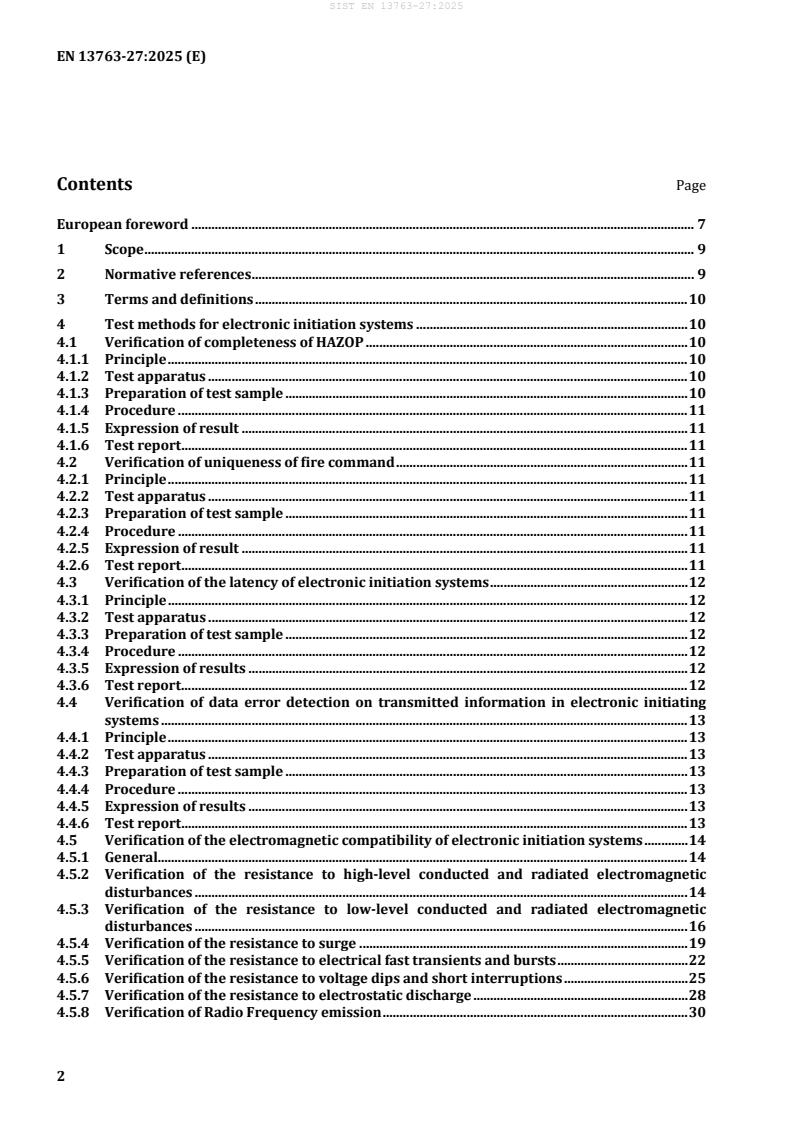
Contents Page
European foreword . 7
1 Scope . 9
2 Normative references . 9
3 Terms and definitions . 10
4 Test methods for electronic initiation systems . 10
4.1 Verification of completeness of HAZOP . 10
4.1.1 Principle . 10
4.1.2 Test apparatus . 10
4.1.3 Preparation of test sample . 10
4.1.4 Procedure . 11
4.1.5 Expression of result . 11
4.1.6 Test report . 11
4.2 Verification of uniqueness of fire command . 11
4.2.1 Principle . 11
4.2.2 Test apparatus . 11
4.2.3 Preparation of test sample . 11
4.2.4 Procedure . 11
4.2.5 Expression of result . 11
4.2.6 Test report . 11
4.3 Verification of the latency of electronic initiation systems . 12
4.3.1 Principle . 12
4.3.2 Test apparatus . 12
4.3.3 Preparation of test sample . 12
4.3.4 Procedure . 12
4.3.5 Expression of results . 12
4.3.6 Test report . 12
4.4 Verification of data error detection on transmitted information in electronic initiating
systems . 13
4.4.1 Principle . 13
4.4.2 Test apparatus . 13
4.4.3 Preparation of test sample . 13
4.4.4 Procedure . 13
4.4.5 Expression of results . 13
4.4.6 Test report . 13
4.5 Verification of the electromagnetic compatibility of electronic initiation systems . 14
4.5.1 General. 14
4.5.2 Verification of the resistance to high-level conducted and radiated electromagnetic
disturbances . 14
4.5.3 Verification of the resistance to low-level conducted and radiated electromagnetic
disturbances . 16
4.5.4 Verification of the resistance to surge . 19
4.5.5 Verification of the resistance to electrical fast transients and bursts . 22
4.5.6 Verification of the resistance to voltage dips and short interruptions . 25
4.5.7 Verification of the resistance to electrostatic discharge . 28
4.5.8 Verification of Radio Frequency emission . 30
4.6 Verification of delay accuracy of electronic initiation systems . 32
4.6.1 Principle . 32
4.6.2 Test apparatus . 32
4.6.3 Preparation of test sample . 33
4.6.4 Procedure . 35
4.6.5 Expression of result . 36
4.6.6 Test report . 36
5 Test methods for electronic detonators . 37
5.1 Verification of the resistance to overvoltage of electronic detonators with leading wires
............................................................................................................................................................................. 37
5.1.1 Principle . 37
5.1.2 Test apparatus . 37
5.1.3 Preparation of test sample . 37
5.1.4 Procedure . 38
5.1.5 Expression of results . 39
5.1.6 Test report . 39
5.2 Verification of resistance to dynamic pressure of electronic detonators . 40
5.2.1 Principle . 40
5.2.2 Test apparatus . 40
5.2.3 Preparation of test sample . 40
5.2.4 Procedure . 41
5.2.5 Expression of results . 43
5.2.6 Test report . 43
5.3 Verification of resistance to slow temperature changes of electronic detonators . 43
5.3.1 Principle . 43
5.3.2 Test apparatus . 44
5.3.3 Preparation of test sample . 44
5.3.4 Procedure . 44
5.3.5 Expression of result . 44
5.3.6 Test report . 44
5.4 Verification of resistance to rapid temperature change of electronic detonators . 45
5.4.1 Principle . 45
5.4.2 Test apparatus . 45
5.4.3 Preparation of test sample . 45
5.4.4 Procedure . 45
5.4.5 Expression of result . 45
5.4.6 Test report . 45
5.5 Verification of safety against unintended initiation due to electric energy storage in the
detonator . 46
5.5.1 Principle . 46
5.5.2 Test apparatus . 46
5.5.3 Preparation of test sample . 46
5.5.4 Procedure . 46
5.5.5 Expression of results . 46
5.5.6 Test report . 46
5.6 Verification of defined ways of firing electronic detonators . 47
5.6.1 Principle . 47
5.6.2 Test apparatus . 47
5.6.3 Preparation of test sample . 47
5.6.4 Procedure . 47
5.6.5 Expression of results . 47
5.6.6 Test report . 47
5.7 Verification of discharge of firing capacitors of electronic detonators . 47
5.7.1 Principle . 47
5.7.2 Test apparatus . 47
5.7.3 Preparation of test sample . 48
5.7.4 Procedure . 48
5.7.5 Expression of results . 48
5.7.6 Test report . 48
5.8 Verification of fuse head current of electronic detonators . 49
5.8.1 Principle . 49
5.8.2 Test apparatus . 49
5.8.3 Preparation of test sample . 49
5.8.4 Procedure . 49
5.8.5 Expression of result . 49
5.8.6 Test report . 49
5.9 Verification of autonomous operation of electronic detonators . 50
5.9.1 Principle . 50
5.9.2 Test apparatus . 50
5.9.3 Preparation of test sample . 50
5.9.4 Procedure . 50
5.9.5 Expression of results . 51
5.9.6 Test report . 51
6 Test methods for firing units, programming units, testing units and control units of
electronic initiation systems . 51
6.1 Verification of the maximum output current and the maximum transient output energy
pulse of programming units and testing units . 51
6.1.1 Principle . 51
6.1.2 Test apparatus . 51
6.1.3 Preparation of test sample . 52
6.1.4 Procedure . 52
6.1.5 Expression of test result . 53
6.1.6 Test report . 53
6.2 Verification of the insulation resistance of firing units, programming units and testing
units . 53
6.2.1 Principle . 53
6.2.2 Test apparatus . 54
6.2.3 Preparation of test sample . 54
6.2.4 Procedure . 54
6.2.5 Expression of results . 54
6.2.6 Test report . 54
6.3 Verification of the resistance to climatic and mechanical stress of firing units,
programming units, testing units and control units . 54
6.3.1 Preparation of test sample . 54
6.3.2 Verification of the resistance to high temperature . 55
6.3.3 Verification of the resistance to rapid temperature changes . 56
6.3.4 Verification of the resistance to damp heat – first cycle . 57
6.3.5 Verification of the resistance to low temperatures . 59
6.3.6 Verification of the resistance to damp heat – remaining five cycles . 60
6.3.7 Verification of the resistance to shock of units . 61
6.3.8 Verification of the resistance to vibration of units . 62
6.3.9 Verification of the resistance to dropping of units . 64
6.3.10 Verification of the resistance to damp heat – steady-state . 65
6.3.11 Verification of the resistance against ingress of objects or liquids . 66
6.4 Verification of system response in case of faults leading to inadvertent initiation or
misfires of electronic detonators . 68
6.4.1 Principle . 68
6.4.2 Test apparatus . 68
6.4.3 Preparation of test sample . 68
6.4.4 Procedure . 68
6.4.5 Expression of result . 69
6.4.6 Test result. 69
6.5 Verification of fault tolerance of units of electronic initiation systems . 69
6.5.1 Fault tolerance against unintended detonation of electronic detonators . 69
6.5.2 Fault tolerance against unintended detonation of electric detonators . 70
6.6 Verification of incapability of programming and testing units to submit a command to fire
electronic detonators . 71
6.6.1 Principle . 71
6.6.2 Test apparatus . 71
6.6.3 Preparation of test sample . 71
6.6.4 Procedure . 71
6.6.5 Expression of results . 71
6.6.6 Test report . 72
6.7 Verification of maximum duration of the firing window . 72
6.7.1 Principle . 72
6.7.2 Test apparatus . 72
6.7.3 Preparation of test sample . 72
6.7.4 Procedure . 72
6.7.5 Expression of results . 72
6.7.6 Test report . 73
6.8 Verification of user confirmation to fire . 73
6.8.1 Principle . 73
6.8.2 Test apparatus . 73
6.8.3 Preparation of test sample . 73
6.8.4 Procedure . 73
6.8.5 Expression of test result . 73
6.8.6 Test report . 73
6.9 Verification of information about blast parameters provided by the units of electronic
initiating systems . 74
6.9.1 Principle . 74
6.9.2 Test apparatus . 74
6.9.3 Preparation of test sample . 74
6.9.4 Procedure . 74
6.9.5 Expression of test result . 74
6.9.6 Test report . 74
6.10 Verification of remote firing systems entering safe state . 75
6.10.1 Principle . 75
6.10.2 Test apparatus . 75
6.10.3 Preparation of test sample . 75
6.10.4 Procedure . 75
6.10.5 Expression of test result . 75
6.10.6 Test report . 75
6.11 Verification of access protection of updates for units of electronic initiation systems . 76
6.11.1 Principle . 76
6.11.2 Test apparatus . 76
6.11.3 Preparation of test sample . 76
6.11.4 Procedure . 76
6.11.5 Expression of results . 76
6.11.6 Test report . 76
Annex A (normative) Function test for electronic detonators . 77
A.1 Principle . 77
A.2 Test apparatus . 77
A.3 Preparation of test sample . 77
A.4 Procedure . 77
A.5 Expression of result . 78
Annex ZA (informative) Relationship between this European Standard and the essential
requirements of Directive 2014/28/EU relating to the making available on the market and
supervision of explosives for civil uses aimed to be covered . 79
Bibliography . 81
European foreword
This document (EN 13763-27:2025) has been prepared by Technical Committee CEN/TC 321
“Explosives for civil uses”, the secretariat of which is held by UNE.
This European Standard shall be given the status of a national standard, either by publication of an
identical text or by endorsement, at the latest by April 2026, and conflicting national standards shall be
withdrawn at the latest by April 2026.
Attention is drawn to the possibility that some of the elements of this document may be the subject of
patent rights. CEN shall not be held responsible for identifying any or all such patent rights.
This document supersedes CEN/TS 13763-27:2003.
CEN/TS 13763-27:2003:
a) the document title has been changed from “Detonators and relays — Part 27: Definitions, methods
and requirements for electronic initiation systems” to “Detonators and detonating cord relays — Part
27: Test methods for electronic initiation systems”;
b) the document has been comprehensively revised to make the former technical specification fit the
requirements of a European standard;
c) the Introduction has been removed;
d) the Scope has been entirely revised to clarify the content of the document as well as the covered and
not covered explosives;
e) the normative references have been updated;
f) the former terminology entries 3.1 to 3.17 have been removed;
g) the former Clauses 4 “Procedure”, 5 “Test report” and 6 “Requirements” have been removed;
h) the new Clauses 4 “Test methods for electronic initiation systems”, 5 “Test methods for electronic
detonators” and 6 “Test methods for units of electronic initiation systems” have been added;
i) the new Clause 4 contains the revised specifications of the former Subclauses 4.5.1 “Evaluation of
functionality”, 4.5.2 “Evaluation of fault tolerance”, 4.5.3 “Evaluation of design”, 4.5.6.3 “Test method
for the determination of delay accuracy of electronic detonators” and 4.5.6.4 “Test method for the
determination of electromagnetic compatibility of electronic detonators”;
j) the new Clause 5 contains new test methods on the verification of the resistance to overvoltage and
the verification of the resistance to dynamic pressure of electronic detonators as well as the revised
specifications of the former Subclauses 4.5.6.1 “Slow temperature change test” and 4.5.6.2 “Rapid
temperature change test”;
k) the new Clause 6 contains new test methods on the verification of the maximum output current and
the maximum transient output energy pulse, the verification of the insulation resistance and the
verification of the resistance against climatic and mechanical stress;
l) the former Annex C “Proposals for the detonator fuse head replaced (dummy detonators)” has been
removed;
m) the former Annex D “Determination of resistance to dynamic pressure” has been removed;
n) the Annex ZA has been added;
o) the Bibliography has been updated and now also lists EN ISO/IEC 17025:2017.
This document has been prepared under a standardization request addressed to CEN by the European
Commission. The Standing Committee of the EFTA States subsequently approves these requests for its
Member States.
For the relationship with EU Legislation, see informative Annex ZA, which is an integral part of this
document.
A list of all parts in the EN 13763 series, published under the general title Explosives for civil uses —
Detonators and detonating cord relays, can be found on the CEN website.
Any feedback and questions on this document should be directed to the users’ national standards body.
A complete listing of these bodies can be found on the CEN website.
According to the CEN-CENELEC Internal Regulations, the national standards organisations of the
following countries are bound to implement this European Standard: Austria, Belgium, Bulgaria, Croatia,
Cyprus, Czech Republic, Denmark, Estonia, Finland, France, Germany, Greece, Hungary, Iceland, Ireland,
Italy, Latvia, Lithuania, Luxembourg, Malta, Netherlands, Norway, Poland, Portugal, Republic of North
Macedonia, Romania, Serbia, Slovakia, Slovenia, Spain, Sweden, Switzerland, Türkiye and the United
Kingdom.
1 Scope
This document specifies test methods for electronic initiation systems.
The test methods for electronic initiation systems refer to complete electronic initiation systems but also
to electronic detonators, wireless electronic detonators and to firing units, programming units, testing
units and control units that are part of an electronic initiation system.
Other parts of the EN 13763 series contain test methods applicable to electronic detonators, too.
This document does not apply to electric, non-electric, plain and semi-finished detonators, surface
connectors, detonating cord relays, coupling accessories, leading wires and shock tubes.
2 Normative references
The following documents are referred to in the text in such a way that some or all of their content
constitutes requirements of this document. For dated references, only the edition cited applies. For
undated references, the latest edition of the referenced document (including any amendments) applies.
EN 13857-1:2025, Explosives for civil uses — Part 1: Vocabulary
EN 13763-1:2025, Explosives for civil uses — Detonators and detonating cord relays — Part 1:
Requirements
1)
EN 55011:2016, Industrial, scientific and medical equipment — Radio-frequency disturbance
characteristics — Limits and methods of measurement
EN 60068-2-14:2009, Environmental testing — Part 2-14: Tests — Test N: Change of temperature
(IEC 60068-2-14:2009)
EN 60068-2-27:2009, Environmental testing — Part 2-27: Tests — Test Ea and guidance: Shock
(IEC 60068-2-27:2008)
EN 60068-2-30:2005, Environmental testing — Part 2-30: Tests — Test Db: Damp heat, cyclic (12 h + 12 h
cycle) (IEC 60068-2-30:2005)
EN 60068-2-31:2008, Environmental testing — Part 2-31: Tests — Test Ec: Rough handling shocks,
primarily for equipment-type specimens (IEC 60068-2-31:2008)
EN 60068-2-47:2005, Environmental testing — Part 2-47: Tests — Mounting of specimens for vibration,
impact and similar dynamic tests (IEC 60068-2-47:2005)
2)
EN 60068-2-64:2008, Environmental testing — Part 2-64: Tests — Test Fh: Vibration, broadband random
and guidance (EN 60068-2-64:2008)
EN 60068-2-78:2013, Environmental testing — Part 2-78: Tests — Test Cab: Damp heat, steady state
(IEC 60068-2-78:2012)
1)
As impacted by EN 55011:2016/A1:2017, EN 55011:2016/A2:2021 and EN 55011:2016/A11:2020.
2)
As impacted EN 60068-2-64:2008/A1:2019.
3)
EN 60529:1991, Degrees of protection provided by enclosures (IP Code) (IEC 60529:1989)
EN 61000-4-2:2009, Electromagnetic compatibility (EMC) — Part 4-2: Testing and measurement
techniques — Electrostatic discharge immunity test (IEC 61000-4-2:2008)
EN 61000-4-4:2012, Electromagnetic compatibility (EMC) — Part 4-4: Testing and measurement
techniques — Electrical fast transient/burst immunity test (IEC 61000-4-4:2012)
4)
EN 61000-4-5:2014, Electromagnetic compatibility (EMC) — Part 4-5: Testing and measurement
techniques — Surge immunity test (IEC 61000-4-5:2014)
EN IEC 61000-4-3:2020, Electromagnetic compatibility (EMC) — Part 4-3 : Testing and measurement
techniques — Radiated, radio-frequency, electromagnetic field immunity test (IEC 61000-4-3:2020)
EN IEC 61000-4-6:2023, Electromagnetic compatibility (EMC) — Part 4-6: Testing and measurement
techniques — Immunity to conducted disturbances, induced by radio-frequen
...